America and Ancient Rome: The Secret Connection That Explains the USA Today
Published: July 7, 2025 | Category: History | Blog: Tastes & Wonders of Italy URL: https://tastewondersitaly.altervista.org/america-ancient-rome-connection/
—
The connection between America and Ancient Rome is one of the most consequential…
Recently, a peculiar online trend has revealed a curious habit: a vast number of men, for no apparent reason, find themselves thinking often about the Roman Empire. This viral wave, however lighthearted, touches upon a profound and fundamental truth: it is impossible to understand America—its birth, its institutions, its deepest fears—without looking to its greatest and most complex source of inspiration: Ancient Rome.
But the connection between America and Rome is far deeper than a simple meme or vague architectural similarities. It is an intellectual, philosophical, and economic bond, rooted in the very heart of the American experiment. The Founding Fathers were not mere admirers; they were meticulous, almost obsessive, students of Roman history. They didn’t want to simply copy Rome, but to distill the essence of its republican liberty and, at all costs, avoid the seeds of its catastrophic fall.
In this definitive guide, we will move beyond the usual parallels. We will analyze not only which institutions the Americans borrowed from Rome, but why they did so, what economic lessons they learned from its collapse, and why the distinction between the virtuous Roman Republic and the decadent Roman Empire is the key to deciphering the soul of the United States, then and now.
—
Why Were America’s Founders So Obsessed with Ancient Rome?
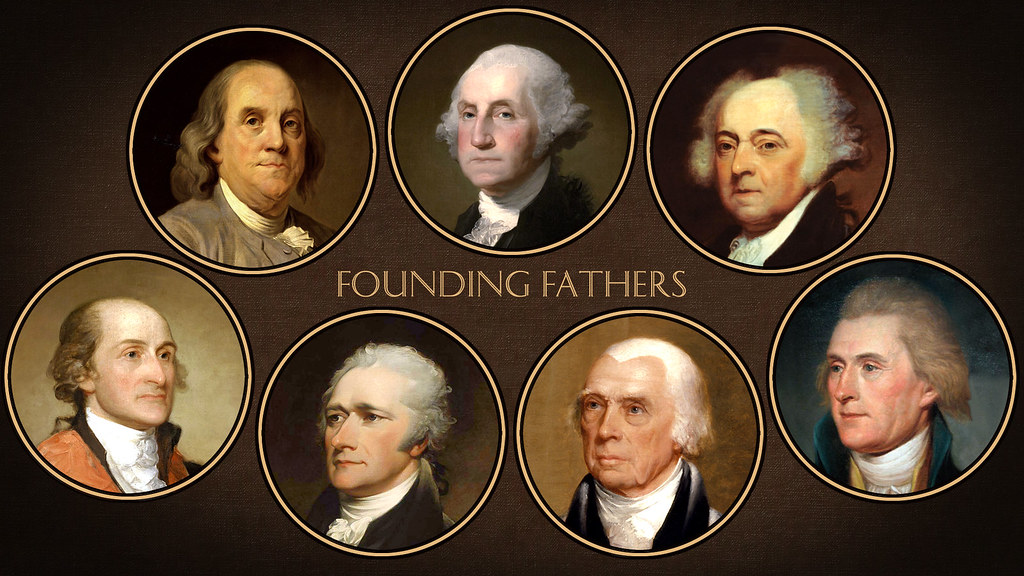
The intellectual elite of the 18th century, from which figures like Thomas Jefferson, John Adams, James Madison, and George Washington emerged, was steeped in a profoundly classical education. Reading Latin was not a luxury; it was a prerequisite. Works we now consider academic—the speeches of Cicero, the histories of Livy and Tacitus, the biographies of Plutarch—were their handbooks on politics, ethics, and strategy.
For these men, engaged in an unprecedented undertaking (founding a large republic based on liberty in a world dominated by monarchies), history was not a pastime. It was a laboratory. And the history of Rome represented the grandest, most enduring, and ultimately, most tragic experiment in self-government ever attempted.
They saw in the Roman Republic a mirror: a people who had overthrown a king (Tarquin the Proud in 509 B.C.), established a government based on law with divided powers and term limits, and risen to unparalleled greatness. But they also saw its terrifying decline: the corruption, the civil wars, the rise of strongmen like Julius Caesar, and the final transformation into an Empire under Augustus, where the form of the Republic survived, but its substance of freedom was dead. To study Rome was, for them, a matter of political survival.
—
American Institutions Directly Inspired by Rome
When the delegates gathered in Philadelphia in 1787 to draft the Constitution, the shadow of Rome loomed over every debate. The institutional similarities are striking, but it is the underlying logic that reveals the true depth of the connection.
- The Senate: The name itself is a direct inheritance. The Roman Senatus was originally a council of elders (senex, old man) that represented the continuity and wisdom of the state. The American Senate was conceived with a similar purpose: an upper chamber, more deliberative and insulated from the momentary passions of the populace, to balance the more “popular” and directly elected House of Representatives.
- The Presidency and the Figure of the Consul: The Founders feared executive power concentrated in a single man, mindful of how Julius Caesar had used his position to dismantle the Republic. The Roman solution had been two Consuls, with equal powers and a mutual veto, serving for only one year. The Americans adapted this model: they created a single President but surrounded him with strict limits: the fixed term (originally with no numerical limit, but Washington set the two-term precedent), the veto power of Congress, and the possibility of impeachment—an echo of the charges that could be brought against Roman magistrates at the end of their term.
- Checks and Balances: The idea that power must check power is perhaps the greatest lesson the Founders drew from the Greek historian Polybius and his analysis of the mixed Roman constitution. Polybius argued that Rome’s strength lay in the balance between the monarchical element (the Consuls), the aristocratic element (the Senate), and the democratic element (the popular Assemblies). The U.S. Constitution replicated this structure with the division between the Presidency, the Senate/Courts, and the House of Representatives, creating a system of institutional antagonism designed to prevent the rise of tyrannical power.
- The Veto: The U.S. President’s veto power derives directly from the veto (“I forbid”) of the Tribunes of the Plebs in Rome, who could block the decisions of magistrates or the Senate to protect the rights of common citizens.
—
The Philosophy Behind the Law: How Did Cicero Influence the U.S. Constitution?
Moving beyond institutional structures takes us to the philosophical heart of the Roman connection. And here, one figure towers above all others: Marcus Tullius Cicero. A statesman, lawyer, and philosopher, Cicero was the most strenuous defender of the Roman Republic in its final phase. To the Founding Fathers, he was a hero and a martyr for liberty. John Adams claimed that “all the ages of the world have not produced a greater statesman and philosopher.”
Cicero’s influence is palpable in the concept of Natural Law (Lex Naturalis). According to Cicero, there exists a universal and eternal law, derived from reason and God, that is superior to any man-made law. This natural law endows all human beings with inherent rights that no government can legitimately violate.
When Thomas Jefferson wrote in the Declaration of Independence that all men “are endowed by their Creator with certain unalienable Rights,” he was not merely using fine rhetoric. He was directly channeling two thousand years of philosophical thought that ran from Aristotle and the Stoics through Cicero and, later, to John Locke. The idea that rights do not come from the government, but precede government itself, is a Ciceronian pillar.
Furthermore, Cicero argued that one of the fundamental duties of the state was the protection of private property. This was not a selfish view but a necessary condition for individual liberty. This emphasis on property as a bulwark against the tyranny of the state was a core principle for the Founders and was enshrined in the Constitution.
To delve deeper into Cicero’s thought, one can consult his foundational works like De re publica (On the Republic), which outlines his vision of the ideal constitution.
—
The Economic Blind Spot: The Financial Lessons America Learned from Rome
While most analyses stop at politics, the most urgent lesson the Founders learned from Rome was economic. As pragmatic historians and economists, they carefully studied the causes of the Republic’s financial collapse, seeing in it a terrible warning for their own future.
- Currency Debasement and Inflation: The Founders knew that the Roman Empire had financed its perpetual wars and sprawling bureaucracy by debasing its currency. The denarius, once of nearly pure silver, was progressively diluted with base metals, causing runaway inflation that destroyed savings, impoverished the middle class, and destabilized the entire society. This fear of inflation and “easy money” is one reason the U.S. Constitution grants Congress the power to “coin Money” and regulate its value, in an attempt to create stability.
- Public Debt and Oppressive Taxation: Roman military expansionism and soaring expenses led to an unsustainable debt and a predatory tax system, especially in the provinces. This not only choked the economy but also created deep resentment against the central government. Figures like Alexander Hamilton were obsessed with managing the American public debt responsibly, viewing it as a necessary but dangerous tool, capable of destroying the nation if left unchecked.
- Panem et Circenses (Bread and Circuses): Perhaps the most famous lesson. The Founders read in the writings of Juvenal and Tacitus how the Roman political class placated and controlled an impoverished and restless urban population through free grain distributions and grandiose public spectacles. They saw this “welfare state” not as an act of charity, but as a cynical transaction: the citizens’ liberty was exchanged for dependence on the government. Their emphasis on self-reliance, hard work, and individual responsibility was a direct reaction to the fear of creating a dependent citizenry that would vote for anyone promising more benefits, at the expense of liberty and the fiscal health of the state.
This often-overlooked economic analysis is crucial. The “virtue” so exalted by the Founders was not only moral but also fiscal: a republic of independent and productive citizens was seen as the only bulwark against the economic tyranny that had helped bring Rome to its knees.
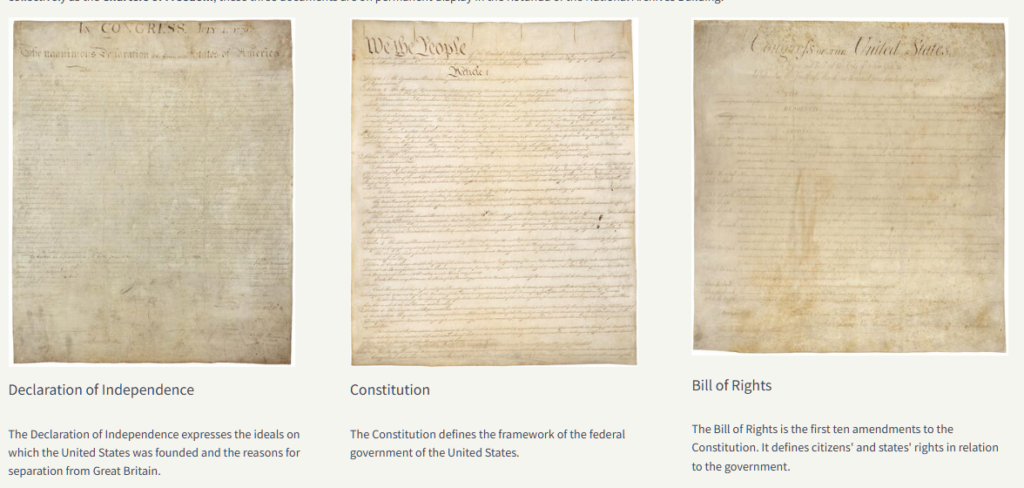
https://visit.archives.gov/whats-on/explore-exhibits/charters-freedom
Republican Virtue vs. Imperial Decadence: The Founders’ True Choice
Here we arrive at the most subtle and important point, one often flattened in modern discussions. The Founding Fathers did not admire the “Roman Empire.” They feared it. Their muse was the Roman Republic of earlier centuries, an entity that, in their idealized vision, was founded on virtue, duty, austerity, and sacrifice for the common good.
Their gallery of heroes proves this:
- Lucius Quinctius Cincinnatus: The quintessential republican hero. In 458 B.C., Cincinnatus was appointed dictator to save Rome from an invasion. After achieving a stunning victory in just 16 days, instead of clinging to absolute power, he disbanded his army, resigned the dictatorship, and returned to his humble plow.
- Marcus Porcius Cato (the Younger): The great-grandson of the more famous Cato the Censor, he was the unyielding opponent of Julius Caesar. His story, immortalized in the play Cato, a Tragedy by Joseph Addison, was required reading for the revolutionaries. Cato, defeated, took his own life rather than live under Caesar’s tyranny, becoming the ultimate symbol of sacrifice for republican liberty.
Was George Washington Truly the “American Cincinnatus”?
Yes, and this was not just a nickname. It was the recognition of his most revolutionary act. After winning the Revolutionary War, Washington was the most powerful man on the continent. Many, in the army and without, would have gladly made him king. Instead, in a gesture that stunned Europe, he disbanded the Continental Army and resigned his commission as commander-in-chief, returning power to Congress. And, after two terms as President, he voluntarily retired to his estate at Mount Vernon. Washington was consciously embodying the ideal of Cincinnatus, proving that power was a duty to be served, not a privilege to be owned. This act founded the American tradition of the peaceful transfer of power.
On the other side were the anti-heroes, the living warnings:
- Julius Caesar: The brilliant populist general who used his popularity and his army to cross the Rubicon, defy the Senate, and make himself dictator for life, ending the Republic.
- Augustus: The first emperor, who maintained the republican institutions (Senate, consulate) as an empty facade while concentrating all effective power in his own hands. For the Founders, Augustus was the emblem of the subtle tyrant who kills liberty while preserving its appearance.
The question that obsessed the Founders was: would America follow the path of Cincinnatus or the path of Caesar?
—
The Names of the Battle: Publius and Brutus in the Constitutional Debate
The Roman influence was so pervasive that it became a weapon in the greatest political debate in American history: the ratification of the Constitution. The authors of the 85 essays supporting the Constitution, known as The Federalist Papers, chose a collective pseudonym: Publius. This was not a random name. Publius Valerius Publicola was one of the four founders of the Roman Republic after the expulsion of the kings. The name was a message: we are the true heirs of the republican tradition.
In response, the opponents of the Constitution (the Anti-Federalists), who feared the new central government would become too powerful, chose equally evocative pseudonyms. The most famous was Brutus. Lucius Junius Brutus had been the leader of the revolt against the kings in 509 B.C. A descendant of his, Marcus Junius Brutus, was one of the assassins of Julius Caesar. To choose “Brutus” was to position oneself as the defender of liberty against a potential tyranny, just like their Roman namesakes.
The entire debate was steeped in Roman analogies, with both sides using the history of Rome to argue that their vision would save America, while the opposing one would condemn it to repeat Rome’s tragic fall.
—
Conclusion: Is the United States Doomed to Fall Like the Roman Empire?
The connection between America and Rome is not a historical relic. It is a perennial warning. The Founding Fathers not only borrowed Rome’s institutions, but they also internalized its fear of decline. They were acutely aware that republics are not eternal.
The question of whether the United States will follow Rome’s trajectory is more relevant than ever. The parallels are unsettling and familiar:
- An astronomical public debt.
- Political polarization reminiscent of the struggles between Optimates and Populares in the late Republic.
- A global military footprint with enormous costs.
- Heated debates over the role of the welfare state and citizen dependency.
- The temptation to follow charismatic leaders who promise to “fix things” by bypassing institutional norms.
The legacy of Rome, therefore, is not just a success story to be emulated, but above all, a cautionary manual on how great nations can decay. The answer to whether America will avoid Rome’s fate lies, perhaps, in the same lesson the Founders drew more than two centuries ago: the survival of a republic depends, ultimately, not just on its laws, but on the character, responsibility, and virtue of its citizens.
To think about Ancient Rome, after all, is not just a pastime. It is a way of asking questions about our present, and our future.
—
Written by Mirco Vitellozzi, a structural engineer from Le Marche who writes about Italy from the inside. More essays at Tastes & Wonders of Italy, and short films on YouTube.