Infiorate di Spello 2026: An Italian Insider’s Guide to Umbria’s Corpus Christi Flower Festival
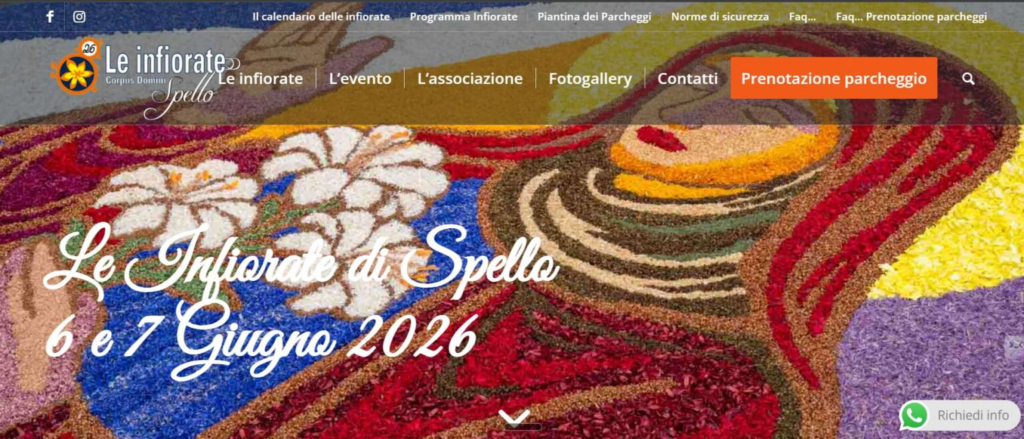
Image from https://www.infioratespello.it/fotogallery/infiorate-2023/
Published: May 2, 2026 | Category: Travel | Blog: Tastes & Wonders of Italy URL: https://tastewondersitaly.altervista.org/infiorate-di-spello/
—
On the first Saturday night of June, the medieval streets of Spello — a pink-stoned Umbrian hill town wedged between Assisi and Foligno — close to traffic, fill with tarpaulin tunnels, and by dawn are completely transformed. Almost a thousand townspeople work from dusk until nine on Sunday morning, sifting fennel and rose petals by the handful along a route that stretches roughly one mile through the centro storico. This is the Infiorate di Spello 2026, Umbria‘s Corpus Christi flower festival, and for a few hours every June the town becomes one of the most serious feats of collective folk art in Europe. In 2026, the key dates are Saturday, June 6 and Sunday, June 7, and this guide is written for the American traveler who wants to understand what is actually happening — and why the event is worth building a trip around.
—
What is happening: Le Infiorate di Spello 2026
The word infiorata literally means “decked with flowers.” What Spello does with the idea, though, is considerably more ambitious than the term suggests. Along the processional route that the bishop of Spello will follow on Sunday morning carrying the Blessed Sacrament, townspeople lay down roughly sixty-plus floral carpets and figurative works — sources from the organizing association put the number at close to seventy pieces in recent editions, covering an estimated 1,500 square meters of cobblestone. The works divide into two main categories: tappeti (carpets, typically 12 to 15 meters long, with a minimum of 15 square meters of surface) and quadri (figurative “paintings,” ranging from 25 to 90 square meters). The carpets tend toward geometric and ornamental patterns; the quadri are where the visual drama happens, with reproductions of Madonnas, angels, scenes from the Old and New Testament, and sometimes interpretations of Caravaggio or Umbrian Renaissance masters — all rendered in petals, seeds, and dried plant material.
Dates, duration, editions
The festival is timed to the Catholic feast of Corpus Christi, which in 2026 falls on Sunday, June 7. The Infiorate di Spello program therefore runs across both Saturday, June 6 (setup, drawing, and the all-night creation phase known as the Notte dei Fiori) and Sunday, June 7 (the completed carpets open to the public at 9:00 a.m., with the solemn procession typically beginning around 10:30 a.m.). The organizing body is the Associazione Le Infiorate di Spello, based at Piazza della Repubblica in the heart of town; they manage the competition, the judging categories, and the year-round Museo delle Infiorate. The event is a single annual edition and has been held continuously in its modern form for decades, though as we will see, the documented roots reach back nearly two centuries.
—
The backstory: why this tradition matters
The Infiorate di Spello has an unusual pedigree because unlike many Italian folk traditions, which float vaguely in “centuries past,” this one has a paper trail. The first formal documentation comes from the municipal archive of Spello on October 19, 1831, when the gonfaloniere Francesco Nicoletti issued an order to all citizens whose houses faced the main processional street: keep your frontage clean, remove rubbish, and spread flowers and greenery along the route. That is the birth certificate of the Infiorate as civic practice. Before 1831, flowers were scattered loosely in front of religious processions — a custom spread widely in Catholic Europe — but in Spello, from that fall afternoon onward, the practice began to formalize into something closer to an organized craft.
Through the nineteenth century, techniques evolved: borders of ginestra (broom) and finocchio selvatico (wild fennel) appeared, then wreaths of cornflowers, daisies, and rose petals framing the path. By the early twentieth century, local families began composing figurative scenes rather than simply carpeting the street, and by the postwar decades the competition had become a true community-wide enterprise, with each gruppo fielding expert artists, teenagers on border work, and families taking shifts through the night.
The Italian insider angle
Here is what most English-language guides to the Infiorate miss. To the American visitor, the event can read as spectacle — a pretty Catholic festival with exceptionally ambitious decorations. To the people of Spello, it is closer to what an Italian calls an impresa collettiva, a collective undertaking in which the social fabric of the town is rewoven each year. If you stay the Saturday night, you will see seventy-year-old men arguing with their grandchildren over the exact shade of yellow for an angel’s robe, families breaking at 3:00 a.m. for coffee under the tarpaulin tunnels, teenage girls crouched silently over borders they have practiced on paper for six months. The Umbrian journalist Lorella Befani once described the vigil as “una notte particolarmente sofferta” — a particularly difficult night — and the phrase captures the tone more honestly than any glossy writeup. It is artistic labor, performed in public, that produces a masterpiece designed to be destroyed within hours. That ephemerality is the point.
—
What you’ll actually see: the works and the flowers
A first-time visitor walking the route on Sunday morning is usually unprepared for the scale. The carpets unfurl around corners; the quadri sometimes fill entire piazzas. Up close, a floral panel resolves into hundreds of thousands of individual petal fragments — no glue, no chemical fixatives, no synthetic dyes. Petals are placed directly on the stone and held in place by careful layering alone. The effect on the eye is strange and wonderful: at three meters, a Madonna painted in the manner of Perugino; at thirty centimeters, a field of torn rose petals shimmering in the June sun.
The flowers themselves
Spello’s infioratori (flower artists) are strict about materials. The rule is that every element must be plant-based and natural: fresh or dried petals, leaves, seeds, bark, and aromatic herbs, with no wood, no glitter, no artificial color. Any drying is done in sunlight, not in ovens. The common species you will see include ginestra (broom) for deep yellows, finocchio selvatico for greens and structural outlines, roses for rich reds and pinks, cornflowers for blues, daisies for whites, and fennel fronds to suggest leaves and vegetation. Coffee grounds, sawdust from untreated wood, and spices are sometimes used for browns and earth tones. Petals wet with early-morning dew are used for shading and for depth, the way an oil painter might use a darker glaze.
The judging and the categories
The works are judged across several categories, including large figurative quadri by master groups, decorative tappeti by intermediate teams, and youth compositions (typically under-14 and under-18 sections). Criteria combine technical precision, fidelity to religious iconography, chromatic harmony, and inventiveness. Awards are modest in monetary terms but carry significant prestige inside the town — children born in Spello grow up knowing whose gruppo won which year, the way children elsewhere remember football scores.
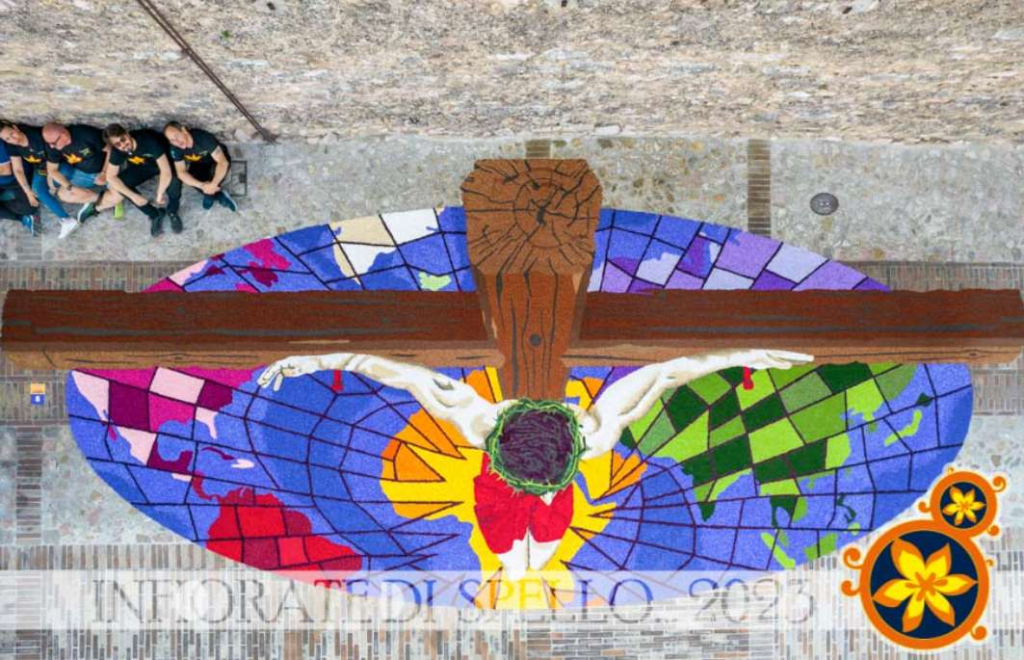
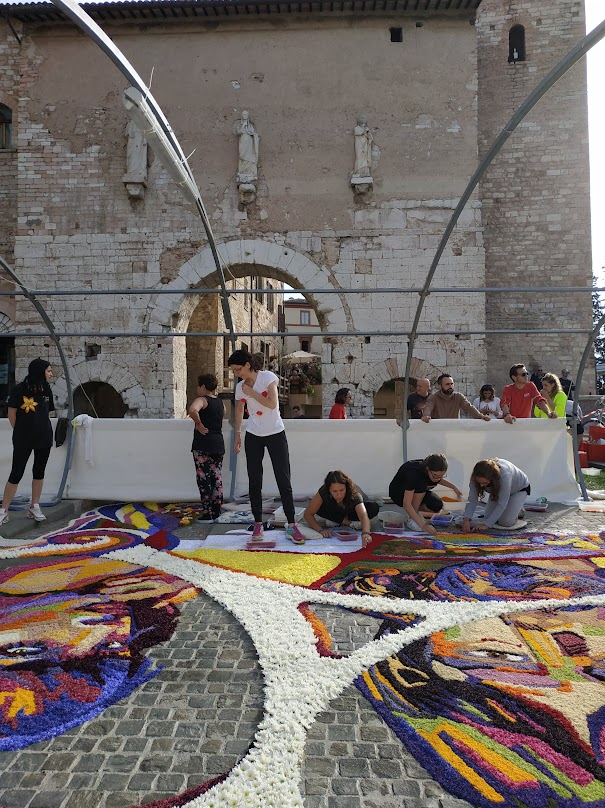
Image from https://www.infioratespello.it/fotogallery/infiorate-2023/
La Notte dei Fiori: the all-night vigil
If you are serious about understanding the Infiorate, the night is where the event actually lives. The afternoon of Saturday, June 6, 2026, Spello begins to seal itself off. Streets close to traffic; crews install long tarpaulin tunnels along the route as rain and wind protection; portable lighting is strung overhead. By evening, the groups carry out their scale drawings — sometimes on rolled paper taped to the pavement, sometimes as freehand chalk outlines, sometimes using cardboard or metal stencils cut during the winter months. Then, throughout the night, the petals go down.
The Notte dei Fiori is open to the public. You are not permitted to walk on the works, of course, but you can move along the route and watch the creation in progress. A good visitor strategy is to walk it once around 10:00 p.m., when compositions are beginning to take shape, and again around 4:00 or 5:00 a.m., when the figurative quadri are nearing completion and the light begins to come up behind the Apennines. Bring a warm layer — June nights in Umbria can drop into the low fifties Fahrenheit — and good shoes. The atmosphere is informal; families offer coffee to visitors; artists explain their work if you ask politely in Italian or English. If you speak a little Italian, this is the night to use it.
—
Corpus Domini morning: the procession
By 9:00 a.m. on Sunday, June 7, 2026, the works are complete. For a little over an hour, the town opens the route for ordinary foot traffic and photography — and this is when you should plan to see the finished carpets in daylight. Around 10:30 a.m., the solemn Corpus Domini procession begins, with the bishop of Spello carrying the monstrance containing the consecrated host, accompanied by clergy, confraternities, the civic authorities of the town, and a great many locals in their best clothes. The procession walks directly over the floral carpets. This is not vandalism — it is the point. The Infiorate is an offering made to be consumed by the passage of the Eucharist. The ephemeral is its theology.
By early Sunday afternoon, the carpets are gone. By Monday morning, the streets are swept. And by the following Saturday, the infioratori have already begun sketching for the next year.
—
Beyond the carpets: the rest of Spello
An American visitor flying six hours and driving ninety minutes south from Rome should not build a trip around a single twenty-four-hour event, however extraordinary. Spello itself rewards at least two days.
Pinturicchio and the Baglioni Chapel
The town’s artistic jewel, and the single best reason to visit any time of year, is the Cappella Baglioni inside the Church of Santa Maria Maggiore. Commissioned by Troilo Baglioni and frescoed by Pinturicchio between the late summer of 1500 and the spring of 1501, the chapel contains three large scenes — the Annunciation, the Adoration of the Shepherds, and the Dispute in the Temple — painted at a moment when Pinturicchio was at the height of his powers. The Annunciation includes a small self-portrait of the artist, hung as a trompe-l’œil panel within the fresco itself. The floor of the chapel is laid with original Deruta maiolica tiles. Admission is €3; opening hours are generally 9:45 a.m. to 12:30 p.m. and 2:30 p.m. to 5:00 p.m., closed Mondays. I would argue, without hedging, that these frescoes belong on any serious Italian art itinerary.
https://www.infioratespello.it
The Museo delle Infiorate
For visitors who come outside the festival weekend — and for those who want context before or after seeing the event live — the Museo delle Infiorate is housed in the Sala delle Volte off Piazza della Repubblica. The collection includes a permanent walkable reproduction of an infiorata design, photographic panels tracing the event’s evolution since 1831, original tools and stencils from historic editions, and documentation of award-winning works. The museum opens on weekends (typically Friday through Sunday) and on public holidays. Entry is generally free; times are best confirmed via the association’s phone line listed below.
Corsi di cucina floreale
An interesting secondary offering is the corsi di cucina floreale — floral cooking classes led by chef Riccardo Foglietti at the Centro Costantino Imperatore. A 2026 session is scheduled for Saturday, June 20, 10:00 a.m. to 1:00 p.m. The program covers the culinary use of edible flowers (violets, nasturtiums, elderflower, borage, rose) and ends with a tasting. Cost: €45. For Americans interested in Italian foraging traditions, it is good value.
—
Planning your visit to Spello
Getting there
Spello sits on the Rome–Ancona rail line, which is the simplest way to arrive. From Rome Termini, trains to Foligno take about ninety minutes; from Foligno, a regional connection reaches Spello in seven to ten minutes. From Florence, it is a three-hour ride via Perugia. If you are driving, Spello lies on the SS75, eight kilometers south of Assisi. Note that the centro storico is closed to non-resident vehicles and is on a steep incline — park in the lots at Porta Consolare or Via Centrale Umbra and walk up.
Tickets and prices
Viewing the Infiorate is free. There is no admission, no reserved seating, no required registration. The Associazione Le Infiorate di Spello does offer advance parking reservations during the festival weekend through the clappit.com platform, and this is worth doing in 2026 given the pressure on the town’s few available lots. The Cappella Baglioni admission is €3. Museum access is typically free. The cucina floreale course is €45.
Best times to go
If you can only visit once, come Saturday evening and stay overnight. Walking the route during the Notte dei Fiori is the most memorable part of the experience, and the Sunday morning viewing is most beautiful between 9:00 and 10:15 a.m. — before the procession, before the crowds peak, and in clean early light. For the rest of the year, Spello is loveliest in April (wisteria blooming on the pink façades), early May (the Fioritura di Castelluccio just starting nearby), and October (Umbrian harvest, truffles, olive oil). August is hot and crowded; January and February are quiet and damp but can be magical.
Where to stay nearby
Staying inside Spello is ideal for the festival weekend, but small boutique B&Bs book up by Christmas for early June. If Spello is full, consider Foligno (eight minutes by train, lower prices), Bevagna (twenty minutes by car, beautifully medieval), or Assisi (fifteen minutes by car, more inventory but pricier during Corpus Domini). I personally prefer Bevagna — quieter evenings, excellent restaurants, and an easy drive over.
What else to pair
A five-to-seven-day Umbria itinerary around the Infiorate weekend might include Assisi (the Giotto cycle at San Francesco), Perugia (the National Gallery of Umbria), Bevagna (Roman mosaics and the Gaite reenactment), Montefalco (Sagrantino wine and the Benozzo Gozzoli cycle), and the Piano Grande of Castelluccio for wildflowers. Adding Orvieto on the way back to Rome is smart — the cathedral’s Signorelli chapel pairs thematically with the Pinturicchio you have just seen.
—
FAQ — Common questions about the Infiorate di Spello
1. What is the Infiorate di Spello? The Infiorate di Spello is an annual religious and artistic festival held each year on the feast of Corpus Christi in the Umbrian hill town of Spello, Italy. Residents create roughly sixty to seventy elaborate floral carpets and figurative “paintings” along the streets of the historic center, using only natural petals, leaves, and plant materials. The works are completed overnight and destroyed the next morning when the bishop’s procession walks over them.
2. When is the best time to visit for the 2026 edition? Arrive Saturday, June 6, 2026, by late afternoon, walk the Notte dei Fiori starting around 10:00 p.m., and be back on the route Sunday morning, June 7, between 9:00 and 10:15 a.m. to see the completed works in daylight before the 10:30 a.m. procession. A one-night stay in Spello or nearby Bevagna makes the experience practical.
3. Do I need to book tickets or reserve a spot? No. Viewing the Infiorate is free and requires no reservation. The Associazione Le Infiorate di Spello does offer pre-paid parking reservations through clappit.com for the festival weekend, which is strongly recommended given limited parking availability near the centro storico.
4. How much should I budget for the weekend? Outside of lodging, the festival itself costs nothing. Budget €3 for the Cappella Baglioni, €45 if you take the cucina floreale cooking class on June 20, €15–25 for parking, and €40–80 per person per meal in a good Umbrian trattoria. Hotel rates in Spello and Assisi rise substantially on this weekend, so reserve months in advance.
5. How much time should I plan for the visit? Minimum useful time is twenty-four hours: Saturday afternoon to Sunday lunch. To see Spello properly — including the Baglioni Chapel, the Roman gates, the Pinacoteca, and the Museo delle Infiorate — allow two full days. As part of a wider Umbria trip, plan five to seven days in the region.
6. What other Umbrian flower festivals or events pair well with this one? Several Umbrian towns hold infiorate on the same Corpus Christi weekend, though Spello is the largest and most artistically ambitious. In the surrounding days, consider the Fioritura di Castelluccio (the wildflower bloom of the Piano Grande, usually late May through early July), the Bevagna Mercato delle Gaite in late June, and the Assisi Calendimaggio in early May. Umbria in June is arguably at its peak.
7. What is the one thing most foreign visitors get wrong about the Infiorate? They treat the carpets as decorations to be preserved. They are not — they are offerings, and they are meant to be destroyed by the procession. Photographing them before Sunday morning is encouraged, but asking whether the carpets are “saved” or “protected” afterward misses the entire spiritual logic of the event. The meaning lives in the ephemerality, not despite it.
—
The takeaway
The Infiorate di Spello 2026 is one of those rare European events where you can still watch a whole town do something difficult together, in public, without a ticket booth dictating the experience. It is old, it is free, it is deeply Catholic without being inaccessible, and it rewards the traveler willing to stay up past midnight to see how it is made. If you are planning your Italian June around one single extraordinary day, this is a defensible choice. Come on Saturday, June 6. Walk the route slowly. Accept the coffee offered at 3:00 a.m. Be back in position by 9:00 Sunday morning.
If you want more dispatches like this — written by an Italian who knows these towns from the inside — explore more on Tastes & Wonders of Italy or subscribe to our YouTube channel for video coverage from around the country.
—
Written by Mirco Vitellozzi, a structural engineer from Le Marche who writes about Italy from the inside. More essays at Tastes & Wonders of Italy, and short films on YouTube.