Venice Biennale 2026: Tickets and Hours, by an Italian Who’s Been There
As an Italian engineer who has walked the Giardini in every season, I can tell you that the most disorienting moment of any visit to the Venice Biennale isn’t the first national pavilion you step into. It’s the silence that hangs between two cypress trees in late afternoon, when the heat of July softens just enough for the gravel paths to release the smell of pine resin and the world’s largest contemporary art exhibition seems, for ten minutes, almost private.
That contradiction — a global cultural event scaled to the body of a single visitor — is what makes the Biennale di Venezia worth crossing an ocean for. If you’ve already decided to visit and you’re now sorting through Venice Biennale 2026 tickets and hours, this article gives you what the official site doesn’t: the practical logic of how to buy, when to go, where to start, and how to plan a day that doesn’t end in exhaustion or regret.
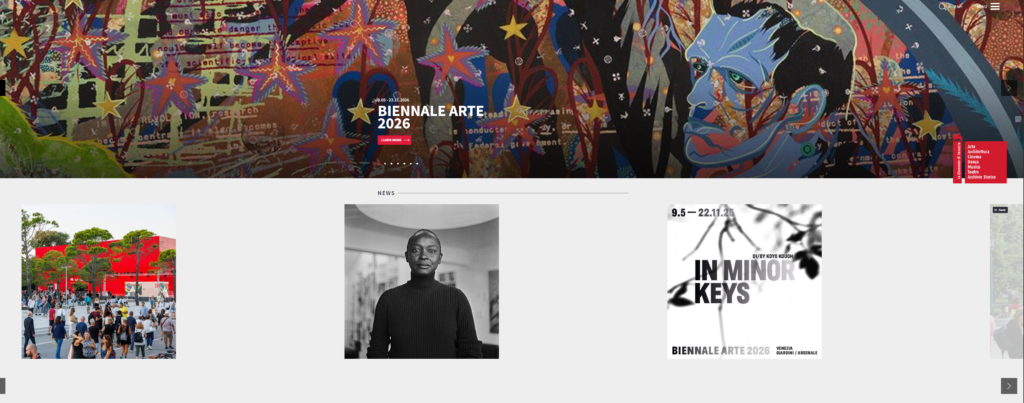
The 61st International Art Exhibition, titled In Minor Keys and curated by the late Koyo Kouoh, opens on 9 May 2026 and closes on 22 November 2026. Below you’ll find current ticket types and prices, opening hours by season, the difference between the Giardini and the Arsenale venues, and the kind of advice you only get from someone who has done the visit wrong at least twice before doing it right.
A note on links: some of the booking links in this article are affiliate links. If you book through them, I earn a small commission at no additional cost to you. Biennale admission itself is not one of them — those tickets are sold only by La Biennale, as explained below.
What the Venice Biennale Actually Is (and Why 2026 Is Art)
The word biennale, in Italian, simply means “biennial.” What La Biennale di Venezia institutionalized in 1895 was the radical idea that contemporary art could be exhibited every two years at the highest international level, in a permanent infrastructure of pavilions built by participating nations on Venetian soil. Today the institution runs two main exhibitions in alternating years: the Biennale Arte, dedicated to contemporary visual art, and the Biennale Architettura, dedicated to architecture and urban thought. The 2025 edition was Architecture, curated by Carlo Ratti. The 2026 edition is Art — the 61st International Art Exhibition, titled In Minor Keys.
The 2026 curator, Koyo Kouoh, was the Swiss-Cameroonian art historian and director of Zeitz MOCAA in Cape Town. Her appointment, announced in December 2024, made her the first Black woman to lead the Venice Art Biennale. Kouoh died before the exhibition opened, and the curatorial program she conceived has been carried forward by a team of five collaborators she personally selected. The theme, In Minor Keys, frames contemporary art as a register of small undercurrents — the moods, gestures, and shifts of daily life that conventional historical narration tends to ignore.
What makes the Biennale Arte 2026 different from any other art event on earth is its architecture of pavilions: nearly a hundred countries exhibit not in standardized booths but in their own permanent buildings, each a national declaration of cultural identity rendered in steel, glass, brick, and intention. The La Biennale di Venezia official website is the only authoritative source for daily updates on national participations, collateral events, and changes to the schedule.
Venice Biennale 2026 Dates and Opening Hours
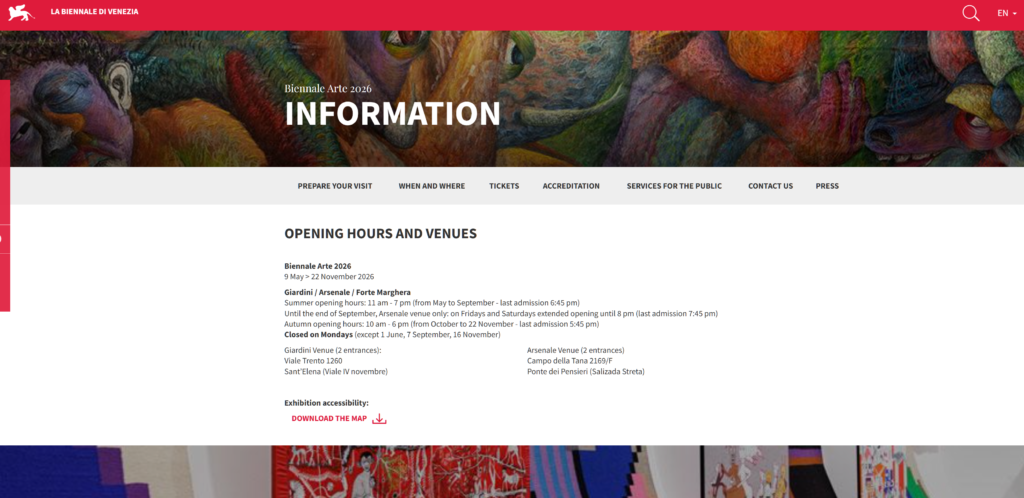
The Biennale Arte 2026 runs from 9 May to 22 November 2026. That’s six and a half months of continuous exhibition, divided by the official calendar into two seasons with different opening hours.
From 9 May to 27 September, summer hours apply: both the Giardini and the Arsenale open at 11 am and close at 7 pm, with last admission at 6:45 pm. The Arsenale venue extends to 8 pm on Fridays and Saturdays until 26 September, with last admission at 7:45 pm — a window worth knowing if you want to see the Arsenale in evening light, when the brick warehouses turn copper-pink against the lagoon.
From 29 September to the closing day on 22 November, autumn hours take over: both venues open at 10 am and close at 6 pm, with last admission at 5:45 pm.
The exhibition is closed on Mondays, with four exceptions when Monday opening is granted: 11 May, 1 June, 7 September, and 16 November 2026. If your Venice trip falls on one of those dates, take advantage — Mondays are the least crowded day of the entire run.
| Period | Venues | Hours | Last admission |
|---|---|---|---|
| 9 May – 27 September | Giardini & Arsenale | 11 am – 7 pm | 6:45 pm |
| 9 May – 26 September (Fri-Sat) | Arsenale only | 11 am – 8 pm | 7:45 pm |
| 29 September – 22 November | Giardini & Arsenale | 10 am – 6 pm | 5:45 pm |
| Every Monday | Both | Closed | — |
| Exception Mondays (11 May, 1 Jun, 7 Sep, 16 Nov) | Both | Standard hours | Standard |
How to Buy Venice Biennale 2026 Tickets
All Venice Biennale 2026 tickets must be purchased online. The walk-up ticket offices at the Giardini and the Arsenale still operate, but the official Biennale Arte 2026 ticket page is the canonical source and the only place where you can confirm same-day availability for guided tours, group rates, and accessibility passes. A €0.50 presale fee applies to every ticket.
The standard one-access ticket costs €30 at full price, €20 reduced (over 65, Venice residents with a valid ID), and €16 for students and anyone under 26. It allows one entry to the Giardini and one entry to the Arsenale, on the same day or on two different non-consecutive days. That detail matters: if you want to split the visit across two Venice trips during the season, the one-access ticket permits it.
Beyond the standard ticket, the platform sells a three-day ticket at €40, valid for three consecutive days; a weekly ticket at €50, valid for seven consecutive days; and a full-season accreditation at €80 with unlimited access for the entire six-and-a-half-month run. The Venice residents’ accreditation is reduced to €50 and the students/under-26 accreditation to €45. The group rate, available for parties of ten to twenty-five participants, drops the adult price to €20 per person.
Two combination tickets are worth knowing. The Art + DMT formula at €40 pairs the exhibition ticket with one Dance, Music, or Theatre performance during the season. Children up to six years old enter for free; from age seven they pay the student rate. Visitors with a certified disability access the reduced €20 ticket, and one accompanying adult enters free.
Buy directly through the official platform unless you have a specific reason to pay more. Third-party resellers exist, and the only legitimate reason to use them is fast-track admission on peak weekends — which I’ll address next.
Should You Buy Skip-the-Line Tickets?
Honest answer: most of the time, no. An official online ticket already lets you bypass the cashier — you walk past the ticket office and proceed straight to the security check. The visible queues at the Giardini and Arsenale entrances in July and August are security queues, not ticket queues, and no commercial product clears those.
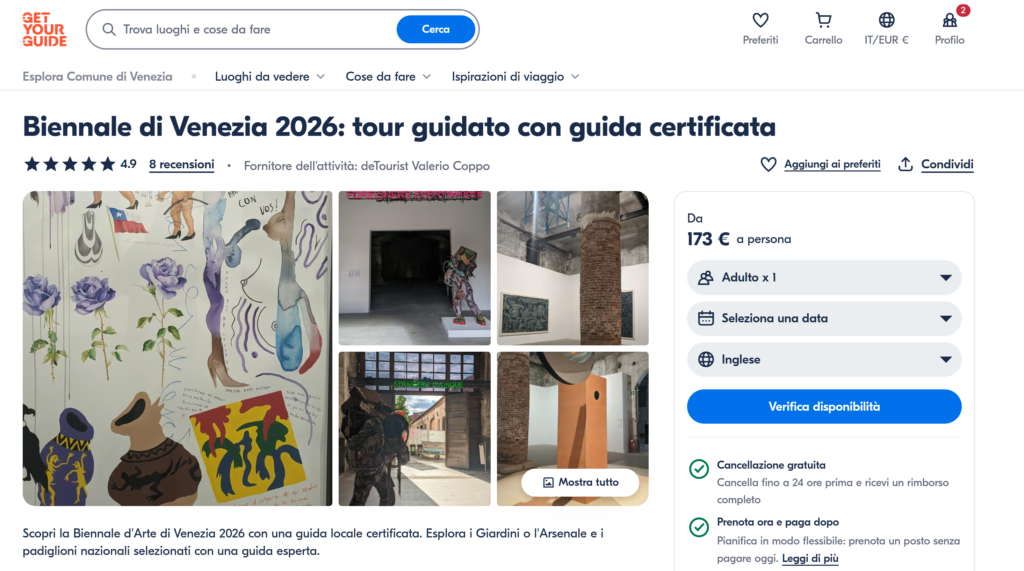
There is also a point worth stating plainly, because almost no English-language guide does: the major experience platforms do not sell Biennale admission. Search GetYourGuide, Viator or any comparable reseller and you will find Venetian museums, palaces and boat tours in abundance, but not a single Biennale Arte 2026 entry ticket. The exhibition sells only through its own channel, with a fifty-cent presale fee. Anything advertised elsewhere as a Biennale ticket is either a private guiding service that still requires you to hold your own admission, or a listing left over from a previous edition.
So the answer is simple. Buy the €30 one-access ticket from La Biennale, choose a weekday, and spend the money you would have wasted on a markup somewhere it actually improves the trip.
Giardini or Arsenale? Where to Start Your Visit
Both venues are essential to seeing the Biennale Arte 2026 as a complete exhibition, and your ticket grants admission to both. They sit about a ten-minute walk apart along the lagoon shore in the Castello sestiere — close enough to combine in a single day if you’re disciplined, far enough that the order of the visit matters. The average visiting time at each venue is three hours.
Start at the Giardini if this is your first Biennale. The historic site, opened to international pavilions in 1907, holds the Central Pavilion and twenty-nine national pavilions designed across the twentieth century by architects like Carlo Scarpa, Gerrit Rietveld, Alvar Aalto, James Stirling, and Sverre Fehn. The Central Pavilion houses the curator’s thematic exhibition — the canonical entry point into the year’s argument. Walking through it first gives you the conceptual frame you need before encountering the national pavilions’ interpretations of In Minor Keys.
Move to the Arsenale in the afternoon. The former shipbuilding complex of the Venetian Republic — the largest pre-industrial production facility in Europe — has hosted Biennale exhibitions since 1980. It runs as a single processional sequence along the Corderie, the seven-hundred-foot-long rope factory that frames the second half of the curatorial program along with the participations of countries that don’t own a permanent pavilion. The scale shifts everything: where the Giardini reads as a botanical archive of national architectures, the Arsenale reads as one continuous industrial cathedral. Save it for the second half of the day — the air conditioning is less consistent and the walking distances are longer, and arriving with fresh legs is not optional.
If you’d rather not navigate the curatorial logic alone, private art historians in Venice do offer Biennale walkthroughs, but they are arranged directly and they assume you already hold your ticket. Budget two hours per venue with a guide, and be clear when booking whether admission is included — in almost every case it is not.
Practical Tips from a Local
Three pieces of advice you won’t find on the official site.
First, time your visit by weekday. Tuesday through Thursday are the least crowded days, particularly in May and late September. Weekends in July and August are saturated. If you can choose your dates, plan your Biennale day for a Wednesday or Thursday and aim for a 10:30 am arrival at the Giardini gate on Viale Trento, before the group tours start clogging the Central Pavilion.
Second, the walk from Venezia Santa Lucia station to the Giardini takes about forty-five minutes and crosses the spine of the city — a useful first morning if you’re staying near the Rialto. With luggage, take the ACTV vaporetto line 1 or 5.1 directly to the Giardini stop. Skip the water taxis for this leg: within the city they cost more than the exhibition ticket and they don’t drop you closer to the entrance gate.
The arrival from Marco Polo is a different calculation, and this is where travellers get it wrong in the opposite direction. The shared water taxi from the airport costs about the same as a taxi ride from any American airport to a city centre and delivers you to a landing stage rather than a bus terminal on the mainland. If there are four or more of you, or you are arriving after a transatlantic flight with a Giardini slot booked the following morning, the private boat transfer is priced per group rather than per person and stops being an extravagance somewhere around the third passenger.
Third, lunch in Castello between venues is the single most overlooked decision of the visit. Avoid the restaurants facing the lagoon on Riva degli Schiavoni: they charge €25 for a glass of mediocre wine because they can. Walk two streets inland, where bacari like Al Portego or El Refolo serve cicchetti and an ombra of Raboso for under fifteen euros, and the bread comes from a bakery that has been open since 1957.
Booking Notes: The Rest of the Venice Day
Three hours at the Giardini and three at the Arsenale is a full day, and most visitors sensibly split the Biennale across two. That leaves an afternoon to fill, and what you choose determines whether Venice feels like a queue or a city.
For the second half-day. The Doge’s Palace with the New Prisons and St. Mark’s Basilica is the pairing I would take. The New Prisons section is the part most itineraries omit and the part that explains the Republic better than any painting in the Sala del Maggior Consiglio — you cross the Bridge of Sighs from the side the condemned crossed it, not the side the postcards show.
For anyone who found the pavilions too loud. The Jewish Ghetto walk with synagogue visits covers the oldest ghetto in Europe, established in 1516, and the interiors are not otherwise accessible without a guide. Two hours, in Cannaregio, and the quietest serious thing you can do in Venice in August.
What I would skip. The cheap half-day Murano, Burano and Torcello boat excursion. It exists in every catalogue at a very low price and there is a reason: the glass factory stop is a sales floor, Burano gets forty minutes, and you spend most of the afternoon on a boat with a hundred other people. If the lagoon islands matter to you, take the public vaporetto line 12 from Fondamente Nove and go at your own pace for the price of a transit ticket.
Conclusion
Venice Biennale 2026 tickets and hours are structured around a six-and-a-half-month exhibition that rewards planning. The official one-access ticket at €30 covers both venues on different days; the full-season accreditation at €80 makes sense only if you’re staying in Venice for a week or more, or if you intend to return for the autumn season. Buy through La Biennale’s official channel for standard admission, and consider a Tiqets fast-track only for peak summer weekends.
Book your Venice Biennale 2026 tickets through the official channel before mid-June if you plan to visit in high season — the August accreditation queues at the Infopoints are real, and group rates need at least seven days of advance booking. The exhibition closes on 22 November 2026. Don’t leave the trip to the last weekend.
Written by Mirco Vitellozzi, a structural engineer from Le Marche who writes about Italy from the inside. More essays at Tastes & Wonders of Italy, and short films on YouTube.