Arena di Verona Opera Festival 2026: Tickets, Schedule, and the Insider’s Guide to Italy’s Greatest Open-Air Opera
https://tasteandwondersofitaly.com/ – https://www.youtube.com/@TasteWondersofItaly
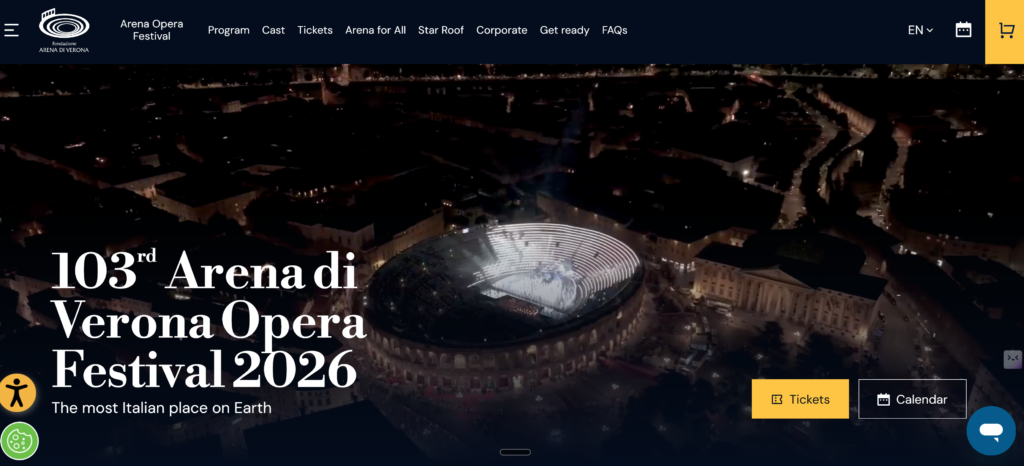
There is a moment, around half past nine on a July evening in Piazza Bra, when the last orange light slips off the sun-warmed limestone of the Arena and the swallows go quiet over the rooftops. Inside the amphitheatre, twenty thousand strangers begin to dig small wax candles out of paper sleeves. One by one they light them, until the ancient bowl of the Arena glows from within like a vast Roman lantern. Then, in the hush before the first note, you understand why generations of Italians have travelled to Verona for this single experience, and why no concert hall in the world can ever quite reproduce it.
I grew up an hour’s drive from this place. I have walked into the Arena as a student with a five-euro ticket on the stone steps, and I have sat in a velvet poltronissima with a glass of Valpolicella balanced on my knee. What follows is the guide I wish every first-time visitor had before booking the most extraordinary opera night of their life.
Why the Arena di Verona Is Unlike Any Other Opera House in the World
To understand why the Arena di Verona Opera Festival is treated as the summit of summer opera in Europe, you have to forget what an opera house usually looks like. There is no gilded foyer, no chandelier, no plush red curtain. There is a Roman amphitheatre built in the first century after Christ, an oval of pink and white Veronese marble open to the sky, and a stage so vast that an entire pyramid can be raised on it.
A 2,000-Year-Old Roman Amphitheatre That Still Sings
The Arena was completed around 30 AD, when Verona was a thriving Roman colony. It is older than the Colosseum’s most famous gladiatorial games and considerably better preserved than most of its contemporaries. The acoustics, often described as miraculous, are in fact the product of geometry: the elliptical stone walls reflect sound with a clarity that modern engineers still study. A whispered phrase from the stage can reach the highest stone step without a microphone, and on the great choral nights of Aida or Nabucco, the sound seems to rise out of the stones themselves.
The Tradition of the Candlelit Opening
The candles handed to ticket-holders are not a marketing gimmick. The ritual dates back to 10 August 1913, when the Arena opened as an opera venue with a commemorative performance of Aida for the centenary of Verdi’s birth. The audience that night brought candles to honour the composer, and the gesture has survived more than a hundred summer seasons. The moment when twenty thousand small flames bloom across the stone tiers, just before the conductor lifts the baton, is for many Italians the single most moving image of a lifetime of opera-going.
The 2026 Season at a Glance
Festival Dates and Anniversary Highlights
The 2026 Arena di Verona Opera Festival runs from mid-June to early September, with performances clustered most heavily across July and August. As is tradition, the season opens with the iconic staging of Aida and closes with a gala evening that mixes the most beloved arias of the year. Each performance begins at 21:00 in the early summer and at 20:45 from mid-August onwards, when the days grow shorter and the stage lights need only the dusk for a cue.
The 2026 Programme — Operas and Special Events
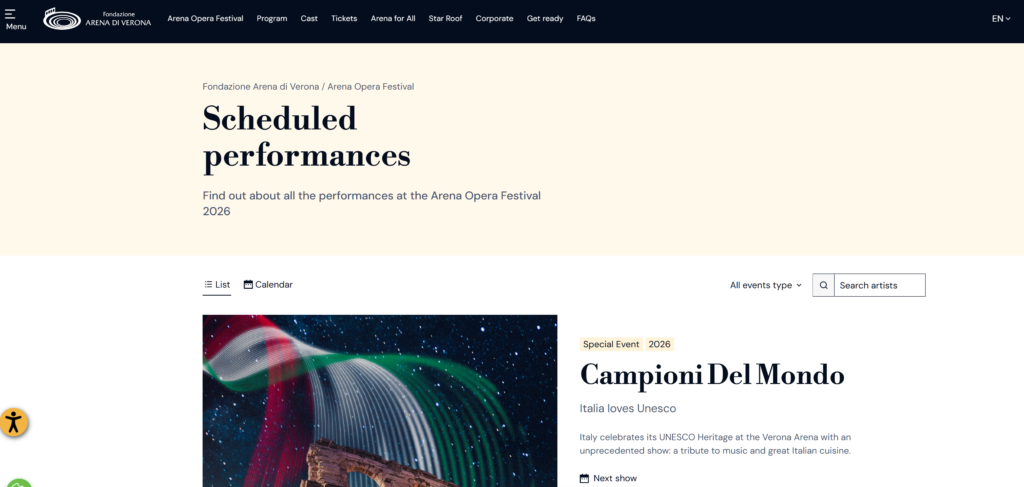
The 2026 programme draws from the heart of the Italian repertoire: Verdi’s Aida in the historic 1913 staging, Nabucco, La Traviata, Puccini’s Tosca and Turandot, and Bizet’s Carmen, alongside symphonic galas and ballet evenings. The full schedule of titles, dates and casts is published on the official Arena di Verona 2026 events page, which is updated as casting is confirmed and additional dates are announced.
A practical word of advice: do not book your flights and hotel before checking the precise date of the title you want to see. The Arena rotates its operas through the week, and some titles only run on six or seven specific evenings across the entire summer.
How to Buy Tickets for the Arena di Verona 2026
Official Box Office vs. Authorized Resellers
There are essentially three legitimate ways to buy a seat for an Arena performance. The first, and the only one I recommend for premium seating, is the official Arena di Verona tickets website, where the entire seating map is released directly by the Fondazione Arena. The second is the physical box office in Via Dietro Anfiteatro, useful for last-minute purchases. The third is a small number of authorised international resellers, including major travel platforms, which add a service fee but offer English-language customer support and the convenience of a single booking flow alongside your hotel and tours.
Avoid unauthorised secondary marketplaces. Tickets there are frequently overpriced and occasionally invalid, and the Arena’s policy is unforgiving on resold inventory.
When Tickets Go on Sale (And When to Book)
Sales typically open in two waves. Subscription packages and priority access for opening-night Aida are released first, usually in late autumn of the preceding year. Single tickets for the full season follow in winter, generally from December onwards.
For the most prestigious nights, the season opener and the two or three Saturdays in early August, the best numbered seats begin to disappear by March. If you are travelling in July and August 2026 and want a guaranteed seat in the stalls, you should be booking now, not in May or June. The gradinata (stone steps) is more forgiving and rarely sells out except on opening night, but even there the central sections fill quickly.
Mobile Tickets, Print-at-Home, and Will-Call Collection
The Arena has moved almost entirely to digital tickets. After purchase you will receive a PDF with a QR code, which can either be printed or shown directly from a smartphone at the entrance gate. Make sure your phone is charged before the performance: there is no cloakroom inside the Arena, but there is also no help if your battery dies in front of the turnstile.
Insider Tip from a Local If you are travelling with a group of four or more, book a row together in the central poltronissime rather than a “best available” block. The Arena’s seat-allocation algorithm tends to scatter groups across odd corners of the stalls, and once a row is broken it cannot be reassembled at the gate.
For an English-speaking visitor who values one-click booking and a single confirmation email alongside hotels and day tours, the convenience of an authorised reseller often outweighs the small service fee. \[GetYourGuide affiliate placeholder — Arena di Verona skip-the-line tickets\]
Understanding the Seating: From Gradinata to Poltronissima Gold
Stone Steps (Gradinata) — The Authentic Experience
The gradinata is the unreserved seating directly on the original Roman stone steps. There are no individual seats: you sit where you find space, on a strip of cool limestone that has worn smooth over two thousand years. The view is panoramic, the acoustics are spectacular, and the experience is exactly the one the ancient Veronese would have known. Bring a cushion. Or rent one at the entrance for a few euros. After three hours of Tosca on bare stone, you will understand why.
Numbered Seats in the Stalls (Poltrone and Poltronissime)
Below the stone tiers, in the floor of the Arena, lie the numbered seats. From the back forward, they are graded as poltrone numerate, poltronissime, and at the front, the poltronissime gold and platinum. These are folding seats arranged in long rows facing the stage, with progressively better sightlines and proximity to the orchestra as you move forward.
Which Section Should You Actually Choose?
For a first-time visitor with no acoustic preference and a budget around 100 to 200 euros, the unreserved gradinata is, in my honest opinion, the most authentic option. For a visitor who values a guaranteed seat, a printed name on a ticket, and a clear unobstructed view, a central poltronissima in the first twenty rows is the most reliable investment. The gold and platinum categories add little to the acoustics and a great deal to the price; pay for them only if you specifically want to see the singers’ faces.
| Section | Indicative 2026 Price | Experience |
|---|---|---|
| Gradinata unnumbered (stone steps) | from €27 to €50 | Authentic, panoramic, bring a cushion |
| Gradinata numerata (numbered stone) | €70 to €110 | Reserved spot on the historic steps |
| Poltrona numerata (rear stalls) | €110 to €170 | Folding seat, full view, good acoustics |
| Poltronissima (central stalls) | €180 to €260 | The classic premium opera experience |
| Poltronissima Gold / Platinum | €260 to €390+ | Front rows, close to orchestra and stage |
Prices vary noticeably by title and date. Aida on opening night carries a premium of twenty to thirty percent over a midweek Carmen in late August.
The Stars of the 2026 Festival
The Arena does not import a roster of opera celebrities the way Salzburg or the Met might. Instead, it cultivates a deep bench of Italian and international singers who return year after year, joined by a handful of marquee names whose presence is announced months in advance. The 2026 season continues this tradition: a mix of established stars in their signature roles and rising voices in their first major Arena debut. Conductors of the calibre of Riccardo Frizza, Daniel Oren and Marco Armiliato typically lead the most prestigious evenings.
The full and up-to-date roster of artists, conductors and creative teams for each production is published on the Arena di Verona artists page. Casts are sometimes adjusted in the weeks leading up to a performance, so it is worth checking the page again a few days before your evening.
What to Expect on the Night: A First-Timer’s Practical Guide
Dress Code — What Italians Actually Wear
There is no formal dress code at the Arena, and you should ignore any blog that tells you otherwise. Italians dress with care but not with ceremony for an Arena evening. A linen jacket and trousers for men, a summer dress for women, comfortable closed shoes for the stone steps, a light shawl for the cooler air that descends after midnight. Avoid shorts, flip-flops and large backpacks: they are tolerated but make you look like a passing tourist rather than a guest.
Doors, Seating, and the Famous Candle Ritual
The gates open ninety minutes before the performance. For the gradinata, arriving early matters: the best stone is in the central sections, facing the stage directly, and it is taken within the first twenty minutes. Numbered-seat ticket holders can arrive more comfortably, around half an hour before curtain. The candles are handed out by ushers as you enter; you light them in unison, just as the house lights begin to fall. No one tells you to applaud or be silent. The crowd self-regulates, with the unspoken etiquette of an audience that has done this for a century.
Cushions, Blankets, and the Stone-Step Problem
If you are sitting on the gradinata, the question is not whether you will be uncomfortable, but how prepared you are to be uncomfortable. Cushions are available for hire at the entrance for around six euros, or you can bring a small folding seat-pad of your own. A light blanket or shawl is useful after midnight: the marble holds heat all day, but the air over Piazza Bra cools quickly once the sun is fully down.
Food, Drinks, and the Long Intervals
There is one main interval, usually between the second and third act, lasting around thirty minutes. Light snacks, water, and prosecco are sold inside, but the queues are long and the offering is modest. Italians treat the interval as an extension of the evening and rarely eat a real meal before. The traditional pattern is a light aperitivo in the early evening, the opera, and then a proper dinner at 23:45 or midnight at one of the many restaurants that stay open late around Piazza Bra specifically for the Arena audience.
English Surtitles and How to Follow the Story
Surtitles are displayed on screens flanking the stage, in Italian and English. They are clear from every seat in the Arena, though slightly easier to read from the central numbered sections than from the far edges of the gradinata. You do not need a word of Italian to follow the plot, and most operas in the Arena repertoire have stories simple enough to be summarised in a paragraph: a tenor, a soprano, a love triangle, and at least one death in the final scene.
“Ogni sera all’Arena, Verona dimentica di essere una città e ricorda di essere un teatro.” Every evening at the Arena, Verona forgets she is a city and remembers she is a theatre.
When It Rains in Verona: The Postponement Policy
The Arena has no roof. If a thunderstorm makes performance impossible, the show is postponed, usually by one or two hours within the same evening, or, if the weather does not clear, to a substitute date later in the season. Ticket holders are entitled to a refund or to use their ticket on the rescheduled night. The decision is taken on the evening itself, often only twenty or thirty minutes before curtain, and announced inside the Arena and on the official channels. Insurance, where available through your reseller, is worth considering for a single-night visit booked months in advance.
Combining the Opera with a Wider Verona Experience
Where to Eat Before the Performance (Late, Italian-Style)
The best dinner around Piazza Bra is the one you eat after the opera, not before. Most serious Veronese restaurants reserve their late tables for the Arena audience, and a midnight bowl of bigoli con l’anatra at Osteria Ponte Pietra, or a plate of risotto all’Amarone in a small trattoria off Via Mazzini, will close the evening far better than an early dinner ever could. Before the show, a glass of Soave and a few cicchetti at a wine bar in Via Sottoriva will do nicely.
Hotels Within Walking Distance of Piazza Bra
For an opera evening, the right hotel is one you can walk back to at one in the morning in evening shoes. The historic centre around Piazza Bra and Piazza Erbe is compact and entirely walkable, and the best four- and five-star options are within ten minutes of the Arena gates. Verona is also one of the safest mid-sized cities in northern Italy; the walk home after a performance is unremarkable, even alone.
Day Trips: Lake Garda, Valpolicella, Soave
Two or three nights in Verona deserve at least one daytime excursion. The eastern shore of Lake Garda is twenty-five minutes by train. The Valpolicella wine region, source of Amarone, lies directly north of the city and is best explored on a half-day private tour with a tasting at one of the historic cellars. The medieval village of Soave, with its perfectly preserved hilltop walls, is forty minutes east. A combined Verona walking tour and Valpolicella wine experience is one of the most rewarding ways to spend the day before your evening at the Arena. \[GetYourGuide affiliate placeholder — Verona \+ Valpolicella day tour\]
Frequently Asked Questions About Arena di Verona 2026
Is the Arena di Verona worth it?
For any traveller with an interest in music, architecture, or Italian cultural history, yes, unreservedly. The combination of a Roman amphitheatre, world-class staging and the candlelit ritual produces an evening that has no real equivalent in Europe. Even visitors who consider themselves indifferent to opera tend to leave converted.
How early should I book tickets for 2026?
For premium numbered seats on opening night or a Saturday in August, book by March 2026\. For unreserved gradinata on a midweek performance, you can wait until a few weeks before, though the best stone fills up fast.
Are children allowed at the opera?
Children aged four and above are admitted, with a ticket. The Arena is, however, a long evening, often ending past midnight, and the heat and noise can be challenging for younger children. Operas with strong narrative arcs, such as Aida or Carmen, tend to work better with attentive children aged ten and above.
Can I bring my own cushion?
Yes. Small cushions and folding seat-pads are welcome on the gradinata. Large camping chairs, hard cases and bulky bags are not permitted through security.
What happens if it rains?
The performance is postponed within the same evening if possible, and rescheduled to a later date if not. Tickets are valid for the new date or fully refundable. The decision is made by the Arena’s management and announced on the night.
Is the Arena accessible for guests with reduced mobility?
Yes, with advance booking. Designated wheelchair spaces and dedicated entrances are available, and the Arena’s accessibility office can be contacted directly through the official ticket office to arrange assistance.
How long does an opera at the Arena last?
Most productions run between three and three and a half hours, including one interval. Aida in the historic staging runs closer to four hours. Plan for the performance to end between midnight and 00:30.
Do I need to know Italian to enjoy it?
Not at all. English surtitles are displayed clearly. The music, the staging and the spectacle communicate the story far more powerfully than the libretto, and most visitors leave with a deeper appreciation of Italian opera than they had on arrival.
\[GetYourGuide affiliate placeholder — Verona experiences and skip-the-line bundles\]
A Final Word from a Verona-Loving Engineer
I have walked out of the Arena di Verona more times than I can count, always at the same hour: the city silent, Piazza Bra emptying slowly under the lampposts, the last echo of an aria still in my ears. There is a small ritual I keep. I stop at a particular bench, the one closest to the western gate, and I look back at the amphitheatre for thirty seconds before walking on to dinner. After two thousand years and a hundred opera seasons, it deserves at least that much from anyone who has been lucky enough to spend an evening inside.
If you come to Verona in the summer of 2026, plan carefully, book early, sit on the stone steps at least once in your life, and let the city show you what it has been quietly preparing since the days of the Caesars. You will not forget it.
https://tasteandwondersofitaly.com/ – https://www.youtube.com/@TasteWondersofItaly