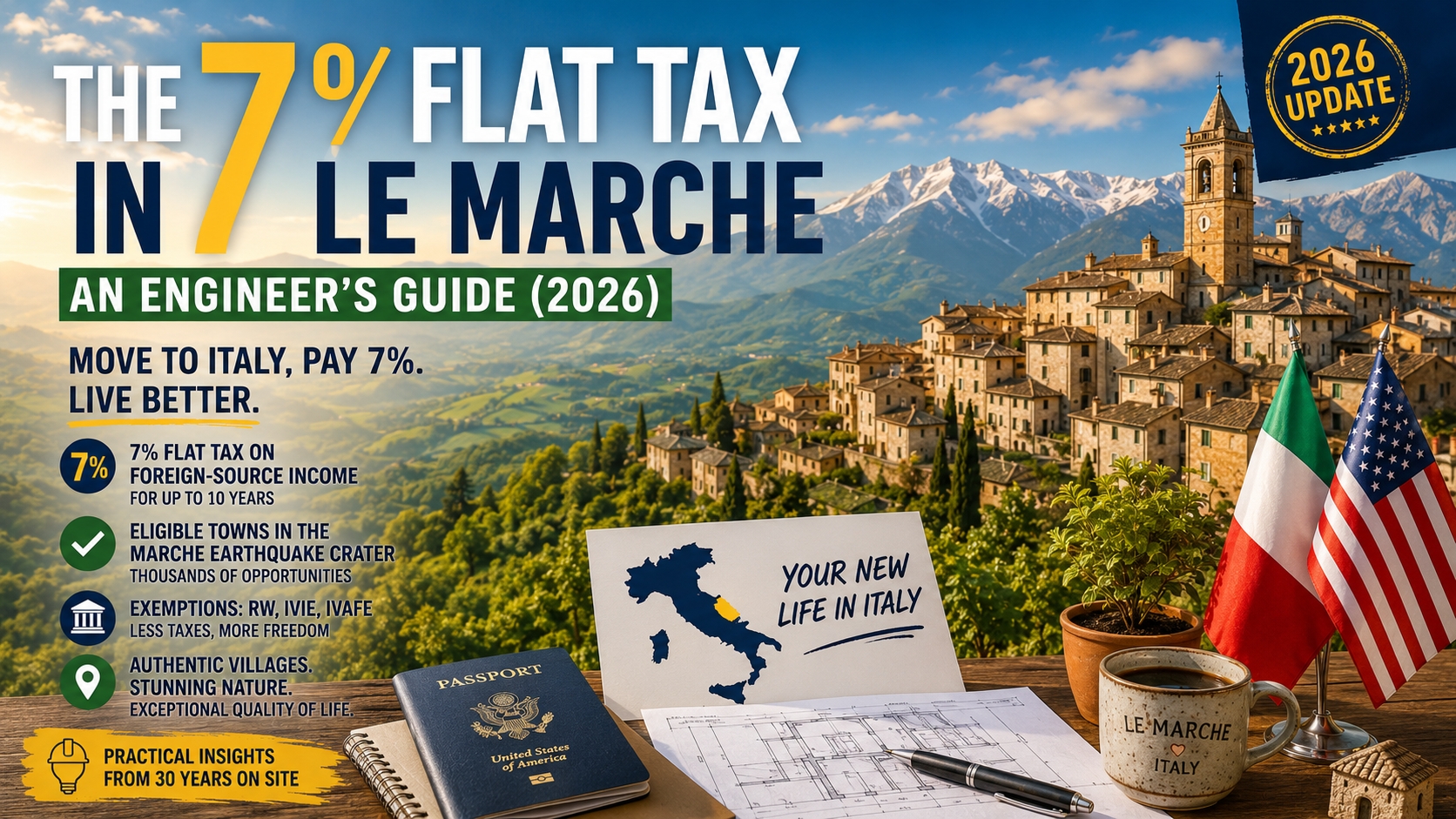
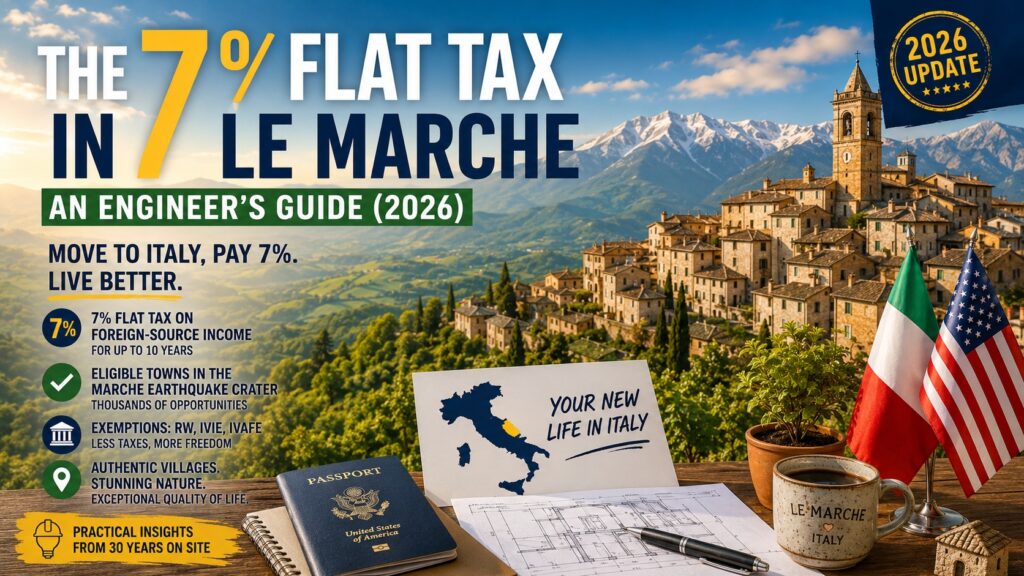
The 7% Flat Tax in Le Marche: An Engineer’s Guide (2026)
Most Americans who have heard of Italy’s 7% flat tax for foreign retirees picture Puglia: whitewashed masserie, Ostuni’s sugar-cube skyline, an olive grove within walking distance of the sea. Almost nobody pictures the Sibillini Mountains, where I have spent thirty years assessing buildings for a living. Yet a retiree who moves into a stone house in San Ginesio or Sarnano, in the heart of the Marche earthquake crater, can access exactly the same 7% substitute tax as someone settling into a converted trullo near Lecce — and has been able to for years, under different, less publicized terms. This guide explains how that works, what changed in the law in April 2026, and why the towns you’d assume are excluded are almost never the ones that actually are.
What the 7% flat tax is, and why it reaches into Le Marche
Italy’s regime dei pensionati esteri, introduced by art. 24-ter of the TUIR (Italy’s consolidated income tax code) in 2019, lets a foreign pensioner who relocates to a qualifying Italian municipality pay a flat 7% substitute tax on all foreign-source income — not just the pension itself, but foreign dividends, interest, rental income, and capital gains too — for up to ten years. The regime was written with two target zones in mind: small municipalities across eight southern regions, and, separately, the municipalities inside the 2016–2017 central Italian earthquake crater across Abruzzo, Lazio, Marche, and Umbria, plus the towns hit by the 2009 L’Aquila quake. A retiree does not need to choose the south to get the 7% rate. A hill town in the Marche crater qualifies on its own terms, under its own population ceiling, entirely independent of Puglia or Sicily.
How the regime actually works
- Rate: 7% substitute tax, replacing ordinary progressive IRPEF, on income of foreign origin.
- Duration: up to ten tax years from the year the option becomes effective (the regime was extended from an original six years by the 2019 Decreto Crescita).
- Income covered: any category of foreign-source income, once the taxpayer holds a foreign-paid pension — investment income, foreign rents, and foreign capital gains can ride along with it.
- Eligibility: the applicant must hold a pension paid by a foreign entity, must not have been an Italian tax resident in the five years before opting in, and must be moving from a country with an information-exchange agreement with Italy — the United States qualifies.
- Side benefits: for the life of the option, the taxpayer is generally exempt from the quadro RW foreign-asset monitoring form and from IVIE and IVAFE, the property and financial-asset wealth taxes that would otherwise apply to holdings abroad.
None of this is available on request. The taxpayer must register residency in a qualifying municipality, obtain an Italian tax code, wait roughly six months after registering with the anagrafe (the municipal residency registry), and then exercise the option in the first tax return that follows.
Which Marche municipalities actually qualify
Here is where a lot of English-language guidance on this topic, including some of what circulates among American retirees planning a move, is working from an outdated rulebook. When the regime was first extended to the earthquake crater, the eligible municipalities were capped at 3,000 residents — a genuinely restrictive threshold that would have excluded plenty of the Marche’s best-known hill towns. That ceiling is gone. A 2022 reform (the converted Decreto Sostegni-ter) raised the crater threshold to 20,000 residents, matching the cap already in place for the eight southern regions. Then, in April 2026, a further law aimed mainly at the south raised that southern threshold again, to 30,000 residents; Italy’s own tax authority, the Agenzia delle Entrate, states in its public guidance that the higher ceiling extends to the earthquake-crater municipalities as well, though I’ll note as an engineer would: this particular extension was still being described as “pending clarification” by some international tax practitioners in the weeks right after the law took effect, so it’s worth a direct check before you rely on it.
What this means in practice is simpler than the legal back-and-forth suggests. San Ginesio, with roughly 3,100 residents, and Sarnano, with roughly 3,100 as well, both sit comfortably under even the older, uncontested 20,000-resident ceiling — nowhere near a borderline case. The same goes for Arquata del Tronto, Amandola, Visso, Ussita, and effectively every hill town in the Sibillini crater that an American retiree would plausibly be considering. The population trap that circulated for years — some towns qualifying, others just missing the cut — belonged to the pre-2022 version of the law. Under the version in force today, the practical question isn’t whether your town of choice clears the ceiling. It’s whether it appears on the official list at all, which depends on which decree annexed it to the crater in the first place. That list is maintained by the government’s Special Commissioner for Reconstruction, and it is the one document worth checking directly before you commit to a comune, since annex lists get amended and a name you assume is included may have been added or left out for reasons that have nothing to do with population.
The counterpoint an engineer has to raise
Here is the layer that no tax advisor is positioned to give you, and that I am, after thirty years of assessing buildings across this same territory. A house in a crater municipality is, by definition, a house in a zone where the ground moved in 2016. Some of these buildings have been fully reconstructed under the Testo Unico della Ricostruzione Privata, the regulatory framework governing post-earthquake rebuilding, with proper structural reinforcement and a folder of documentation to show for it. Others were repaired only superficially — cosmetic plaster over a wall that never received seismic strengthening — and a fair number were simply never touched, either because the damage looked minor from the street or because the owner never filed for the contributo di ricostruzione, the public reconstruction grant.
The failure I find most often in these towns isn’t dramatic. It’s a load-bearing wall that was replastered after the quake without any of the underlying masonry being consolidated, or a roof that was retiled while the timber structure beneath it kept the same cracks it had in September 2016. None of that shows up in a real estate listing, and very little of it shows up in a casual walk-through. The tax advantage brings you into the door of a beautiful, inexpensive stone house in a crater town. Whether that house is structurally what it appears to be is a separate question entirely, and it is one a fiscal advisor has no training to answer. If the 7% rate is what draws you toward a specific address in this region, that is precisely the address that deserves an independent technical inspection before you sign anything — not despite the earthquake history, but because of it.
A note for American citizens on double taxation
The 7% Italian rate does not erase your obligations to the United States. American citizens are taxed by the IRS on worldwide income by virtue of citizenship, regardless of where they live, and that continues after a move to Le Marche — annual US filing, and in most cases FBAR and FATCA reporting on foreign accounts, remain mandatory. The 1999 US-Italy income tax treaty allocates taxing rights between the two countries and generally aims to prevent the same income from being taxed twice, and Article 18 of that treaty deals specifically with pensions, though the treatment can differ depending on whether the payment is a private pension or a US government pension, including Social Security. This is genuinely one of the more country-specific corners of American cross-border tax planning, and it is not something I’ll attempt to resolve in general terms here. Anyone seriously weighing this move should bring their US pension details to a commercialista or accountant who specifically handles cross-border US-Italy cases before filing anything, in either country.
The practical takeaway
The 7% flat tax is real, it works in the Marche crater as cleanly as it works in Puglia, and for a typical Sibillini hill town, the population question that used to complicate things has largely resolved itself in the retiree’s favor. What hasn’t been resolved by any tax reform is the condition of the specific house you’re looking at. If you’re weighing a move into one of these towns, the fiscal side is worth a conversation with a commercialista; the technical side of the actual building is worth a conversation with an engineer who knows this territory, before either conversation becomes a signature on a rogito.
If you’re evaluating a specific property in the Marche crater and want an independent technical read before you commit, you can book a consultation through my property survey service — I work for the buyer, not the seller, and I am not a real estate agent.
—
FAQ — The 7% Flat Tax in Le Marche
What is the 7% flat tax for foreign pensioners in Italy? It’s an optional substitute tax under art. 24-ter of the Italian tax code that lets a foreign pensioner who relocates to a qualifying municipality pay 7% on all foreign-source income, instead of ordinary progressive Italian income tax, for up to ten years.
Which Le Marche towns qualify for the 7% flat tax? Any municipality listed in the official earthquake-crater annexes tied to the 2016–2017 central Italian seismic events, which covers most of the Sibillini and inland Marche hill towns, including San Ginesio, Sarnano, and Arquata del Tronto. The population ceiling (20,000, possibly 30,000 as of April 2026) is comfortably cleared by essentially every town in this group, so the real question is whether a specific town is on the official annex list, not its size.
How long does the 7% flat tax last? Up to ten consecutive tax years from the year the option becomes effective, provided the taxpayer keeps residency in a qualifying municipality.
Does the 7% flat tax apply to my US pension? It can, since the regime applies to pensions paid by foreign entities, which includes US-sourced pensions and Social Security. How that interacts with US tax obligations depends on treaty rules and your specific pension type, so this should be confirmed with a cross-border accountant, not treated as a blanket yes.
Can I use the 7% flat tax if I buy a house in the earthquake zone? Yes — buying or renting in an eligible crater municipality is exactly the situation the regime was designed for. It has no bearing on whether the specific building has been properly reconstructed, which is a separate, purely technical question.
What’s the difference between the southern Italy and the central Apennine version? They’re the same regime, art. 24-ter, applied to two separate lists of municipalities: one covering eight southern regions, the other covering towns in the 2016–2017 and 2009 earthquake zones of Abruzzo, Lazio, Marche, and Umbria. The population ceilings have moved in parallel over recent reforms, and both groups currently sit at the same threshold in the law’s text, though official confirmation for the crater group is worth double-checking given how recently it changed.
Do I need to buy a house, or can I rent, to qualify? Neither the tax code nor the official guidance requires ownership. What’s required is registered residency — the iscrizione all’anagrafe — in a qualifying municipality, which a long-term rental satisfies just as well as a purchase.