The Real Cost to Renovate a Farmhouse in Le Marche
The asking price on the listing was €165,000, and the buyer’s email to me started with a question I hear at least once a month: “This seems like such a good deal — what am I missing?” What he was missing was the second number, the one no listing shows: the cost to renovate a farmhouse in Le Marche once the purchase closes and the real work begins. In central Italy, that second number is almost always the bigger one, and it is the one that decides whether a casale (a traditional stone farmhouse) becomes a home or a financial regret. As a licensed structural engineer who assesses buildings like this for a living, I want to walk you through what a realistic renovation budget actually looks like, line by line, before you sign anything. If you haven’t yet worked through the national purchase process — contracts, notary, taxes — my guide to buying a house in Italy covers that ground; this piece picks up where the paperwork ends and the real work begins.
How Much Does It Cost to Renovate a Farmhouse in Le Marche?
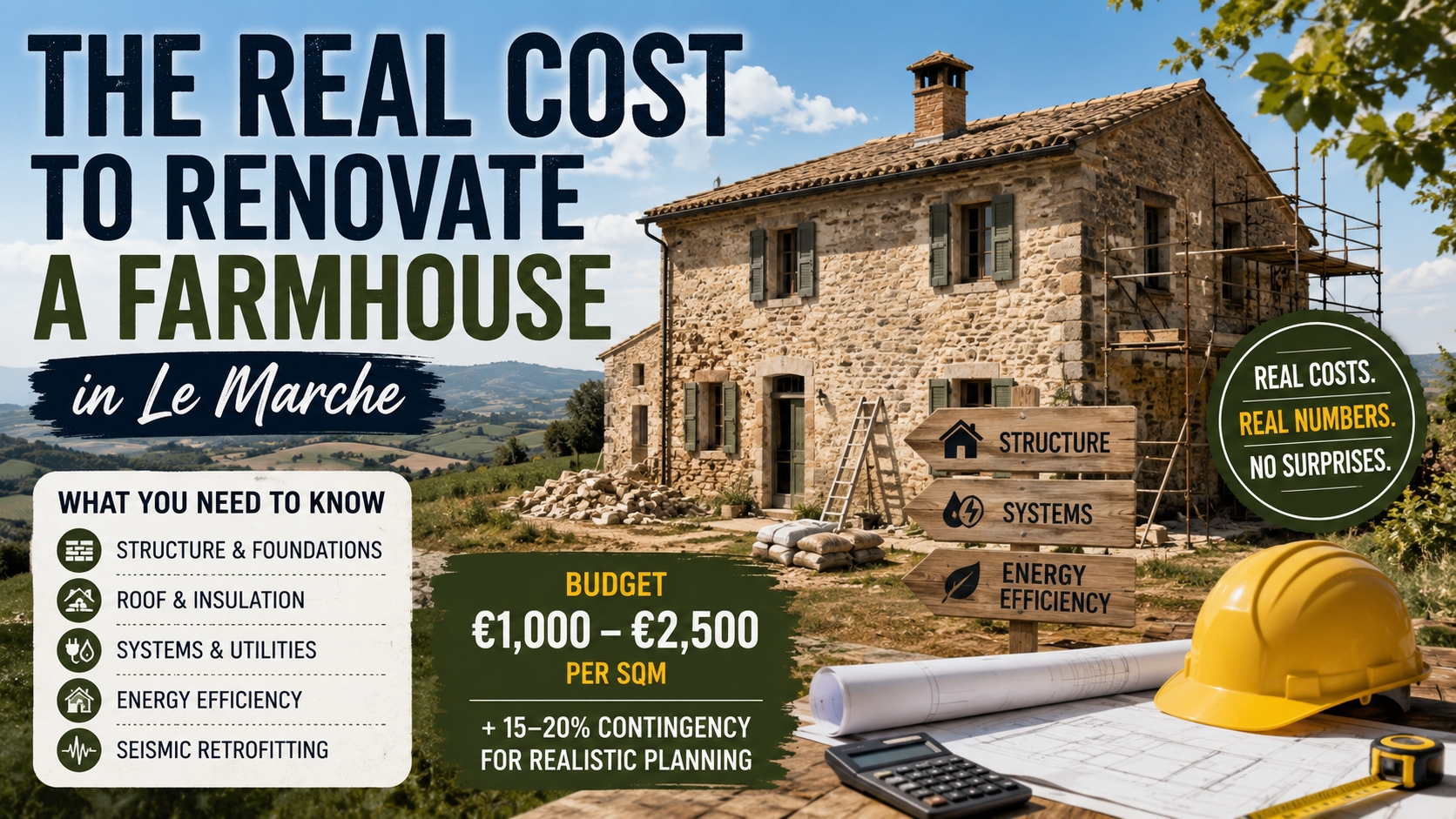
For a full, non-luxury restoration of a stone farmhouse in Le Marche, expect to budget between €1,000 and €2,500 per square meter, with a genuine ruin requiring reconstruction starting closer to €1,500 per square meter and prestige finishes pushing costs toward €3,000. On top of whatever figure you land on, add a contingency of 15 to 20 percent — not as pessimism, but as the professional standard for buildings whose true condition only reveals itself once the plaster comes off the walls.
The Real Cost Breakdown, Line by Line
An estate agent will hand you a single number. An engineer breaks that number into the categories that actually drain a budget, because each one has its own risk profile and its own way of surprising you.
Structure and foundations. This is where a casale either behaves or betrays you. Cracked load-bearing walls, settling foundations, and rotten timber beams inside thick stone walls are common in farmhouses left empty for a decade or more, and consolidation work here — reinforcing masonry, underpinning foundations, replacing hidden structural timber — can consume a third of the entire budget before you have touched a single finish.
The roof. Traditional Marche roofs use heavy terracotta tiles over timber trusses that were rarely built with insulation or modern loads in mind. A full re-roof, including new insulation and updated waterproofing, is one of the few line items where cutting corners shows up literally overhead within a few winters.
Systems. Electrical, plumbing, and heating in an untouched farmhouse usually mean starting from zero rather than upgrading. Rural properties often need a new connection to the water main or an extended septic system, and these access-related costs rarely appear in a general renovation estimate.
Energy efficiency. Insulating a stone envelope without trapping moisture inside it is a specialized job, not an afterthought, and it typically adds a meaningful line item rather than a marginal one — though it also unlocks separate incentives worth discussing with your commercialista.
The seismic factor. Covered in full below, because it deserves its own explanation rather than a bullet point.
Finishes. Flooring, fixtures, doors, windows, kitchen and bathroom fit-out — this is the category buyers picture first and budget for accurately, and ironically the one least likely to blow the budget, since it is the most visible and therefore the most controllable.
Three Renovation Scenarios and What They Really Cost
Not every casale needs the same intervention, and the difference between these three scenarios is usually the single biggest variable in your final number.
Light turnkey. The structure is sound, the roof holds, and the work is largely cosmetic plus a systems update — new electrical, updated plumbing, fresh finishes. Budget roughly €600 to €1,000 per square meter. This scenario is rarer than buyers hope; most farmhouses that have sat empty for years need more than a refresh.
Heavy recovery. The structure stands but needs real intervention — partial consolidation, a new roof, full systems replacement, seismic retrofitting, complete finishes. This is the €1,000 to €2,500 per square meter range, and it is where most genuine Le Marche farmhouse projects land — including a good share of the interest I am seeing lately around Sarnano, where quietly-priced farmhouses have started attracting exactly this kind of buyer. One Marche-based renovation firm recently described a British client’s project in exactly this category: budgeted at €1,500 per square meter, the final cost ran slightly over after the owners chose eco-friendly heating and added solar panels — a useful reminder that even a careful budget moves once you start adding systems the original estimate didn’t anticipate.
Rudere — the ruin. Four walls, sometimes fewer, and a roof that exists mostly in memory. This is effectively new construction wearing an old stone shell, and costs start around €1,500 per square meter and climb from there, since nearly everything is being rebuilt rather than repaired. Buyers are often drawn to ruderi by the lower purchase price, without registering that the renovation budget will do more of the financial work than the acquisition ever did.
The Seismic Factor: What an Engineer Sees That an Estate Agent Doesn’t
Most of interior Le Marche — Macerata, Fermo, much of Ascoli Piceno and the inland areas of Ancona province — sits in seismic zone 2, Italy’s second-highest risk classification. A small cluster of towns in the Sibillini foothills, including Visso, Castelsantangelo sul Nera, and Pieve Torina, sit in zone 1, the highest classification, following the 2016–2017 earthquake sequence that reshaped how this region builds and rebuilds. Zone 4, the lowest-risk category, barely exists inland at all.
For a foreign buyer, this changes two things at once: how the building needs to be reinforced, and what it costs you at tax time. Seismic retrofitting on a stone farmhouse typically means catene (steel tie-rods threaded through the walls to stop them spreading outward) and cordoli (reinforced concrete ring beams tying the top of the walls together before a new roof goes on). These interventions are what separates a house that survives shaking from one that doesn’t, and they are also what the Sismabonus tax incentive is designed to subsidize.
Here is the detail an agent rarely volunteers, and it is the one insider correction I make in nearly every consultation: as of the 2026 budget law, Sismabonus gives a 50 percent deduction on seismic work, but only for a prima casa — a primary residence. A second home, which is what a Le Marche farmhouse is for the overwhelming majority of American buyers, qualifies for 36 percent instead, on a spending cap of €96,000 per property unit, spread across ten annual installments. Buyers who plan their budget around the 50 percent figure they read on a random forum are planning around a rate that likely does not apply to them. It’s a separate matter from the 7 percent flat tax available to qualifying new residents on foreign-sourced income, but the two are easy to conflate, and a good commercialista should walk you through both before you budget either one.
The Hidden Costs Nobody Puts in the Brochure
Beyond the categories above, a handful of costs consistently ambush foreign buyers because no one has an incentive to mention them upfront. Site access for a rural property — widening a track, running a new utility connection — can run into thousands of euros before construction even starts. Demolition debris has to be legally disposed of, and disposal fees for a full gut renovation are not trivial. Permits vary by scope: a CILA (a simplified filing for lighter interventions) costs little, while a full permesso di costruire for a change of use or major structural work involves municipal review and real professional fees for design and site supervision.
This is precisely why the 15 to 20 percent contingency is not a hedge against bad luck — it is an acknowledgment that a stone farmhouse hides its condition until you open the walls. I have yet to survey a casale over fifty years old that didn’t reveal at least one surprise once the plaster came down.
FAQ — Farmhouse Renovation in Le Marche
How much does it cost to renovate a farmhouse in Le Marche?
A full, non-luxury restoration typically runs €1,000 to €2,500 per square meter, with lighter turnkey projects starting around €600 to €1,000 and prestige finishes pushing past €3,000. Always add a 15 to 20 percent contingency on top.
How much does it cost to rebuild a ruin per square meter?
A genuine rudere — a structure reduced to little more than walls — typically starts around €1,500 per square meter and climbs from there, since the work amounts to new construction inside an old stone shell.
How much contingency should I budget?
Fifteen to twenty percent of the total renovation estimate, held in reserve rather than spent on the initial scope. Older stone buildings routinely reveal structural or systems issues that only appear once demolition begins.
Does earthquake retrofitting add a lot to the cost?
Yes, and the amount depends on the building’s condition and its seismic zone. However, the Sismabonus tax deduction offsets a meaningful share of that cost — 36 percent for a second home, 50 percent only if the property becomes your primary Italian residence.
Is it cheaper to renovate or to buy a turnkey house?
Often the total cost lands close to comparable once you factor in the purchase price difference, but a renovation gives you control over layout, systems, and finishes that a turnkey property does not. The right choice depends on your timeline and tolerance for managing a foreign construction project.
What professional should oversee the renovation budget?
A licensed engineer or architect, ideally one who surveys the property before you make an offer rather than after. A structural assessment at the offer stage is what turns a rough €/m² estimate into an actual, defensible budget.
How long does a full farmhouse renovation typically take?
A heavy-recovery project on an occupiable structure generally takes nine to fourteen months; a full ruin reconstruction often runs well past a year once permits, structural work, and finishing are all accounted for.
The Bottom Line
The purchase price of a Le Marche farmhouse is rarely the number that determines whether the project makes financial sense — the renovation is. A realistic, itemized budget built before you make an offer is worth more than any discount the seller might give you on the sale price itself.
If you are weighing a property and want an independent technical read on what it will actually cost to bring it back to life, my Property Survey service is built for exactly this moment in the process — before the offer, not after the surprises. You can book a 60-minute orientation call directly and walk away with a realistic first read on the numbers.