Novello Olive Oil 2026: An Italian’s Guide to the New Harvest
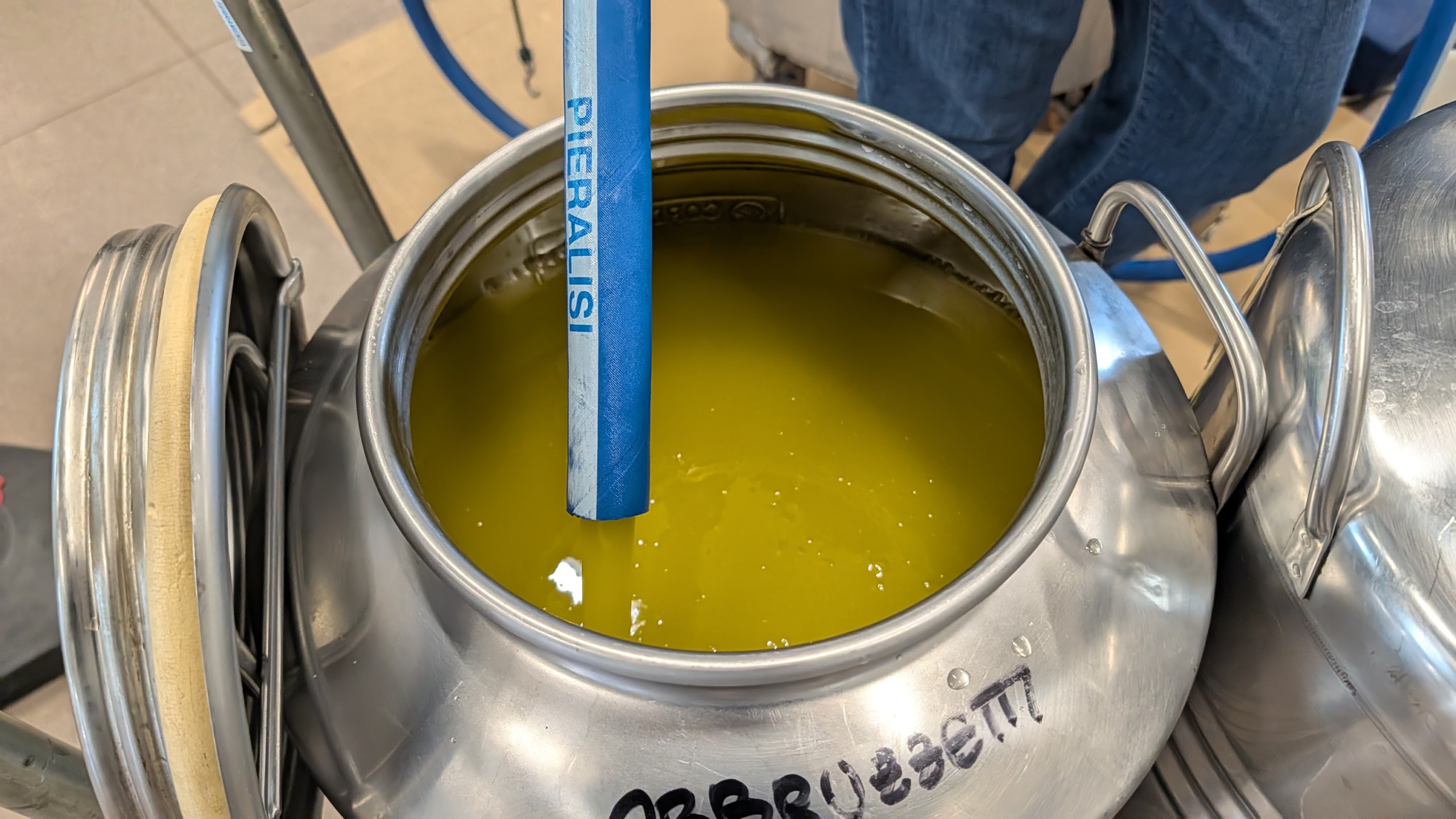
By early November, novello olive oil runs out of the separator so green it stains the glass, and the mill smells of cut grass and warm stone. This is the first extra virgin of the harvest, and in Italy it is less a product than a short season. It arrives in late October, it is gone by February, and nobody who has tasted it on grilled bread in a cold mill courtyard confuses it with the bottle on the supermarket shelf. Americans can now buy it too, flown over within weeks of pressing. What follows is what the new harvest actually is, what survives the Atlantic crossing, and how to drink it before it stops being what you paid for.
A note on the links below: the shop I point to is an affiliate link, which earns me a small commission if you buy through it, at no extra cost to you. Novello is a season, not a brand, and I only link to sellers who publish the harvest date and the producer name.

What novello olive oil actually is
Novello olive oil, also called olio nuovo (“new oil”), is extra virgin olive oil made from the first olives of the season, picked while they are still green, crushed within hours, and released within days or weeks instead of being stored for months. It is not a separate grade of oil and it is not a different production method. It is ordinary extra virgin olive oil caught at the one moment in its life when it is at maximum intensity, before time does what time always does to phenolic compounds. Everything that makes it distinctive — the fluorescent green, the bitterness, the pepper in the throat — comes from early picking and immediate bottling, not from any special process.
A word that means everything in wine and nothing in oil
Here is the part that confuses visitors, and that no American retailer has an incentive to explain. In Italian wine law, novello is a protected traditional mention. The ministerial decree of August 13, 2012 restricts it to DOP and IGP wines whose production rules explicitly allow it, fixes the release at 00:01 on October 30 of the harvest year, and ends its commercial life on December 31. There is a legal minute at which the bottles may be opened.
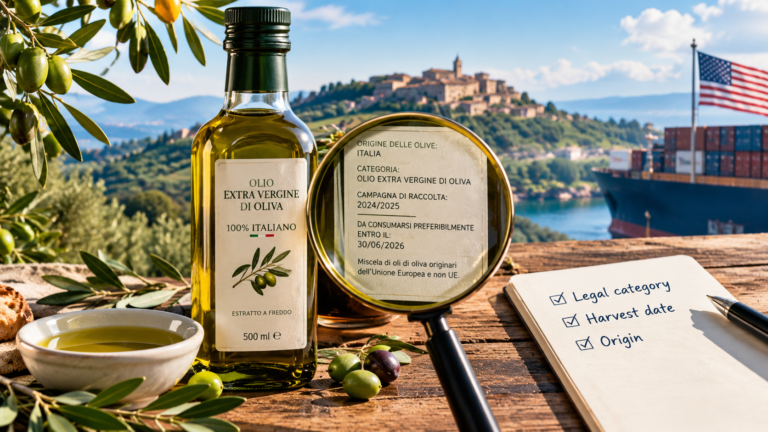
For olive oil there is no such rule. No decree defines novello, no release date exists, no authority checks the claim. A producer can print the word on a label in March. Which means the term is only as good as the number printed next to it: the harvest date. Look for that, and if a bottle gives you a “best by” date instead, you are being told when the oil expires rather than when it was born — and for new oil, the birthday is the only date that matters.
Why it tastes like that

Green olives contain more phenolic compounds than ripe ones and yield less oil, which is why early picking costs the producer money. Those compounds are what you taste as bitterness and what you feel as a sting at the back of the throat two or three seconds after swallowing. That sting has a name: oleocanthal, identified in a 2005 paper in Nature by Beauchamp and colleagues, who found that it inhibits the same COX-1 and COX-2 enzymes as ibuprofen, despite having an entirely different chemical structure.
Americans routinely read both sensations as flaws. They are the opposite. In a formal tasting panel, bitterness and pungency are scored as positive attributes, and their absence in a fresh oil is the thing worth worrying about.
The cloudy-bottle problem
Ask most American food writers what novello olive oil is and you will be told it is the cloudy, unfiltered one. That definition is half right and, for anyone buying from across an ocean, actively misleading.

Cloudiness comes from suspended olive fragments and residual vegetation water. Those solids carry enzymes and moisture, and both work against the oil from the moment it is bottled. The International Olive Council recommends a maximum moisture content of 0.2 grams per 100 grams for good conservation; unfiltered oils routinely start above it. A 2023 literature review in Foods summarizes the consensus plainly: filtration removes sediment and moisture and protects shelf life, because the water and enzymes in veiled oil alter the product during storage. Research comparing veiled and filtered oils from the same batch has recorded the fusty defect appearing in unfiltered samples in under five days — fast enough to push an oil out of the extra virgin category altogether.
The counter-argument is real and should be stated. Filtration also strips out part of the phenolic fraction and some volatile compounds, so a filtered oil gives up a measure of its initial intensity in exchange for a slower, more predictable decline. This is a trade, not a verdict.
Now look at what the trade produces in practice. Of the eighteen novello oils in the 2026 Olive Oil Lovers release, only six are sold unfiltered; one is lightly filtered and the remaining eleven are filtered. The producers shipping to the United States are not cutting corners. They are making the correct engineering decision for a product that has to survive a flight, a customs warehouse, a distribution center, and a mail truck before anyone opens it.
This is the insider point, and I will put it bluntly: in Italy we drink our new oil unfiltered because it travels forty kilometers. For six thousand, you filter. The cloudiness romanticized in American food writing is precisely the part of the oil that ages worst.
What the 2026 harvest actually looks like

The 2026 Italian campaign is a strange one, and knowing its shape helps you read the bottles.
Heat pulled the calendar forward. Picking began in the earliest Tuscan areas in late September, with the bulk of the country working through October and November. Volume is the problem: Carapelli’s October estimate puts national production near 250,000 tonnes, hurt mainly by water scarcity and the alternate-bearing cycle of the olive, with Puglia, Calabria and Sicily carrying most of the damage. The picture is not uniform, though. Coldiretti expects Abruzzo to gain roughly 30 percent over 2025, and growers on Lake Garda describe one of their healthiest crops in years, helped by an almost complete absence of the olive fruit fly.
Less fruit, but clean fruit. For novello olive oil specifically that combination is good news, because fly damage is the defect that most reliably ruins an early-harvest oil.
One figure explains the pricing you are about to see. ISMEA recorded an average origin price for Italian extra virgin of €5.12 per kilogram in July 2026, down 46.7 percent year on year. Bulk oil has collapsed. Novello has not, and it never does, because what you are paying for is a hand-picked early harvest, a dedicated bottling run, and air freight — none of which get cheaper when the commodity market falls.
The freshness clock, and why November matters

Phenolic content falls from the day of milling and never recovers. Storage research on virgin olive oil kept in the dark records losses of 39 to 45 percent of total phenols at six months and 50 to 62 percent at twelve. Exposed to diffuse light, alpha-tocopherol can drop by about 79 percent in four months. A bottle that met a given phenolic threshold at the mill may well be under it by the time it reaches a kitchen in Boston.
This is why the shipping schedule is the single most important specification of any novello olive oil sold in America, more important than the producer, the cultivar or the price.
For the 2026 harvest, Olive Oil Lovers opened preorders in October and expects shipping to begin around November 23, fulfilling orders first-in, first-out as each producer’s oil lands, and air-freighting rather than containerizing to compress transit time. Verified October 22, 2026, that is roughly three to six weeks between the mill and an American door, which is as close to the Italian experience as logistics currently allow. You can see the 2026 novello release here.
Once it arrives, treat it as perishable. Dark cupboard, away from the stove, cap closed, and finish it. An unfiltered novello olive oil deserves a few weeks of your attention, not a place of honor on a shelf for next Easter. The most common mistake I see Americans make with good Italian oil is saving it, which is the one certain way to waste it.
Reading the 2026 collection: what $45 buys
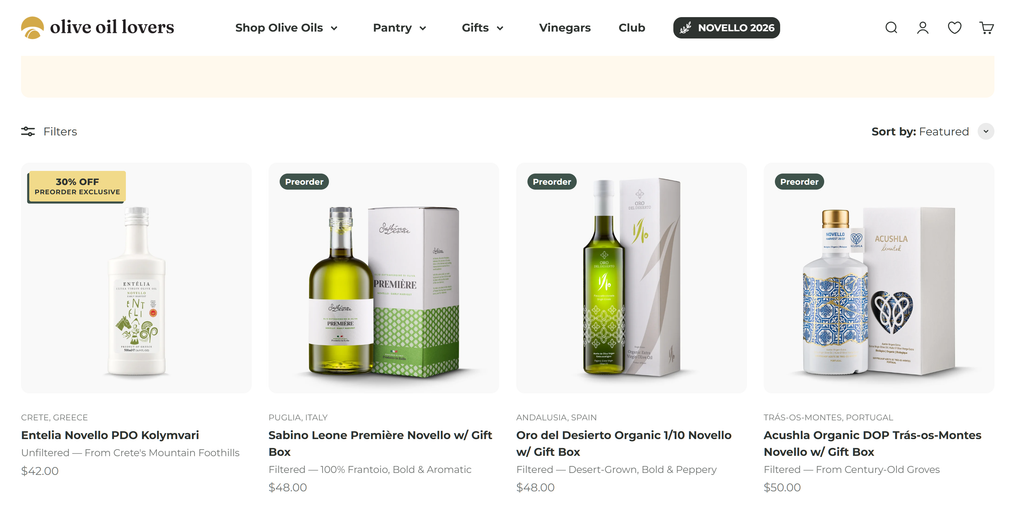
Prices verified October 22, 2026: single bottles in this year’s novello olive oil release run from about $42 to $55, mostly for 500 ml, with free shipping above $100. Curated sets run $131.50 for three organic oils and $166.50 for a four-bottle tour of Italy or Spain.
Two things inflate that number relative to what an Italian pays at the mill. One is air freight. The other is the 15 percent duty applied to European goods entering the United States since 2025, which lands on the shelf price of every imported bottle and which no retailer advertises.
What interests me more than the price is the list of cultivars, because it contains names that essentially never appear on an American shelf. Marina Palusci’s Novus from Abruzzo is made from Dritta, a variety grown almost nowhere else. Accademia Olearia’s bottle from Sardinia is Bosana. Guglielmi’s is Coratina from Puglia, among the most phenol-rich cultivars in Italy, with figures commonly reported in the 500 to 1,000 mg/kg range depending on source and picking date. Frantoi Cutrera blends Moresca and Biancolilla from Sicily. Viola sends a Nuovo down from Umbria; Tuscany contributes Pruneti and Pietre al Monte; Lazio adds Quattrociocchi and Tamia. Alongside the eleven Italians sit four Spaniards, a Greek, a Portuguese and a Californian — useful, as it happens, because tasting a Picual next to a Coratina teaches you more in ten minutes than any article can.
If you want one bottle and you want it to taste unmistakably of the new harvest, buy a monovarietal from a single estate and read the harvest date before you read anything else. The full 2026 selection is here.
Now the honest part, since it rarely gets said in print. Do not buy novello olive oil as your everyday cooking oil; it is a finishing oil, and at these prices using it in a sauté pan is simply expensive. And unless you cook professionally or are splitting it among friends, skip the eighteen-bottle complete collection. Nine liters of new oil cannot be consumed at peak condition by one household, and novello that sits around for a year is just olive oil with an expensive story attached.
The region that is missing
There is not a single bottle from Le Marche in this year’s release, and I live here.
That absence is not an accident of curation. The Marche grow cultivars that exist nowhere else in commercial quantity — Coroncina, Mignola, Raggia, Piantone di Mogliano, Orbetana, the Ascolana tenera better known for being stuffed and fried than for its oil. The mills pressing them are small, often cooperative, and almost none have export infrastructure, American distribution, or an English-language order page. A survey of thirteen American importers this autumn turned up exactly one Marche extra virgin on the entire United States market.
I am not going to pretend otherwise to sell you a bottle. If you want the oil I keep in my own kitchen, you will have to come here in November and buy it at the mill, which is the subject of a different article. What the American market gives you is an excellent cross-section of Italian early harvest, minus my own region.
How Italians actually drink the new oil

Bread first. The Tuscan name is fettunta — literally “greased slice” — and the method has no ingredients to speak of: thick country bread grilled over embers, rubbed lightly with raw garlic if you like, salted, then flooded with new oil until it pools. In Umbria and the Marche you will see the same thing called bruschetta, made with the same seriousness. In mill courtyards in November it is handed out free, because every producer knows that a slice of hot bread is a better advertisement than any label.
After that: on zuppa di farro and any soup of beans or lentils, poured in at the table rather than in the pot; over boiled greens; on grilled fish; on a plain beef carpaccio; on fresh ricotta with nothing but pepper. The rule is that the oil must arrive raw and last.
What about cooking with it? You will read that new oil burns and must never meet heat. That is a myth built on a misunderstanding of smoke point, which for extra virgin sits around 207°C (405°F), higher than most people assume, and which is in any case a poor predictor of stability. A 2018 Australian comparison of ten cooking oils found extra virgin produced the lowest level of polar compounds, outperforming oils with higher smoke points. The real objection to frying in novello is not chemistry but economics and aroma: heat drives off exactly the volatile compounds you paid a premium to buy. Fry in a decent everyday extra virgin. Finish with the new one.
And if the first spoonful makes you cough, you have bought the right bottle. Italians have a word for an oil that does this on the second sip. We call it correct.
FAQ: Novello olive oil, answered for American buyers
What is novello olive oil? It is the first extra virgin olive oil of the new harvest, made from green olives picked at the start of the season and bottled within hours or days of pressing. It is prized for intense green aromas, bitterness and a peppery finish. Unlike vino novello, the term has no legal definition for olive oil.
When can I buy the 2026 harvest? Italian picking ran from late September through November 2026. Preorders opened in October and shipping to American customers is expected to begin around November 23, 2026. Most novello sells out before spring, since it is produced once a year in limited quantities.
Is novello the same as unfiltered olive oil? No. Many novello oils are unfiltered, but filtering is a producer’s choice, not part of the definition. Eleven of the eighteen oils in the 2026 release are filtered, which is the sensible decision for oil that has to cross an ocean before it is opened.
How much does it cost? Verified on October 22, 2026, single bottles run roughly $42 to $55, usually for 500 ml, with multi-bottle sets from about $131. Prices include the 15 percent duty on European goods entering the United States, plus the cost of air freight.
How long does novello olive oil last? Treat it as a three-month product and ideally finish it within weeks of arrival. Phenolic compounds decline continuously after milling, with research recording losses of roughly 40 percent at six months and up to 60 percent at twelve. Unfiltered bottles decline fastest.
Can I cook with it? You can, but you should not. Extra virgin is more heat-stable than its reputation suggests, yet heat destroys the aromatic compounds that make new oil worth its price. Use an everyday extra virgin in the pan and save the novello for finishing.
Why does my bottle taste bitter and make me cough? Because it is fresh and phenol-rich. The throat sting comes from oleocanthal, the compound identified in Nature in 2005 for its ibuprofen-like inhibition of COX enzymes. Bitterness and pungency are positive attributes in professional tasting, not defects.
The takeaway
Novello olive oil is the one moment when it behaves like a seasonal fruit rather than a pantry staple, and the only way to understand what Italians mean by good oil is to taste one within weeks of its milling. Buy one bottle, not nine. Check the harvest date, not the expiration date. Open it the day it arrives, pour it over hot bread before you do anything clever with it, and pay attention to the cough.
If you would rather taste it at the source, November is when the mills of central Italy are open and working, and that trip is worth planning properly. I write about how to do it, region by region, at Tastes & Wonders of Italy.