Vincisgrassi: The Marche Lasagna That Predates Lasagna
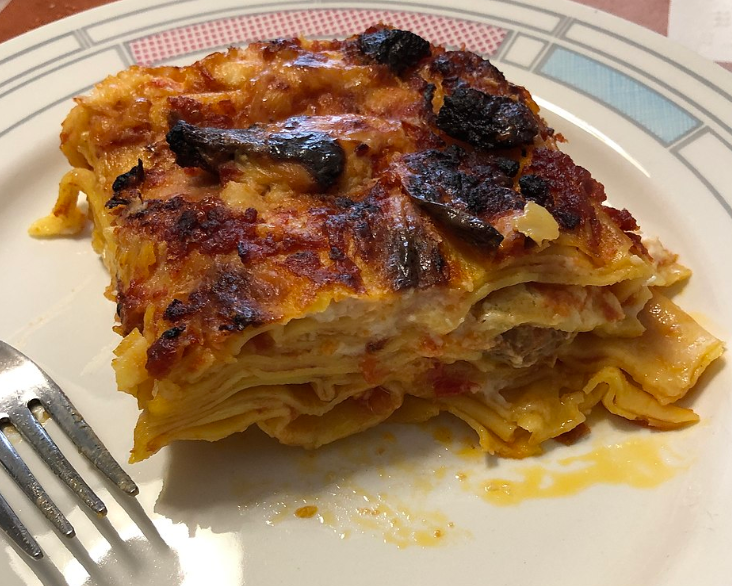
On a Sunday in the province of Macerata, the smell arrives before the dish does: clove and nutmeg, slow-cooked meat, and the unmistakable scorch of cheese turning gold against the rim of a baking pan. That pan holds vincisgrassi, the Marche lasagna that most Americans have never heard of, and the woman who made it spent the better part of two days getting there. I live and work in this corner of central Italy, and I can tell you that here, vincisgrassi is not “a kind of lasagna.” It is the original argument for what layered baked pasta can be — and the version on the page is older than the tomato that defines the dish you already know.
What vincisgrassi actually is
Vincisgrassi is a baked layered pasta from Le Marche, the region on Italy’s central Adriatic coast. It is built from thin sheets of hand-rolled egg pasta, called sfoglia, stacked with a dense meat sauce, a firm béchamel, and grated Parmigiano-Reggiano, then baked until the top layer crisps into a lacquered crust. The sauce is its signature: not the smooth minced-beef ragù of the north, but a coarse, hand-chopped mixture of mixed meats enriched with rigaglie (chicken giblets — hearts, livers, and gizzards), seasoned with clove and nutmeg, and simmered until it turns dark and concentrated.
Tradition fixes the layer count at seven. The béchamel is stiffer than what you would find in a Bolognese pan, which gives a cut portion the structure to stand on a plate instead of sliding into a puddle. In 2022 the recipe earned European recognition as a Traditional Specialty Guaranteed (STG), registered as Vincisgrassi alla maceratese, a label that protects how it is made rather than where the ingredients come from.
The 1779 question: does it really predate lasagna?
The provocation in this article’s title needs an honest answer, because the truth is more interesting than the slogan.
A recipe written down before the tomato
The earliest documented version of this dish appears in Il Cuoco Maceratese, a cookbook published in 1779 by Antonio Nebbia, a chef who worked for noble households around Macerata. Nebbia did not call it vincisgrassi. He called it princisgras, and his recipe describes a layered pasta dressed with prosciutto, black truffle, butter, and a milk-and-flour sauce that is the ancestor of today’s béchamel. It was a white dish, rich and aristocratic, with no tomato anywhere in sight.
Now place that against the timeline of the lasagna you picture when you hear the word. Tomato did not enter Italian layered pasta until around 1880, and it arrived first in Naples, not Bologna. Béchamel settled permanently into the Bolognese recipe only after the 1930s. The version most of the world treats as canonical — green spinach pasta, ragù alla bolognese, béchamel — was formally codified by the Italian Academy of Cuisine and deposited at the Bologna Chamber of Commerce in 2003. The Bolognese sauce that fills it had its own recipe registered there in 1982.
So the precise claim is this: the Marche’s layered baked pasta was written down in 1779, more than a century before tomato touched the Bolognese version, and more than two centuries before that version was set down as an official standard. In that sense, yes — vincisgrassi predates the lasagna you know.
Lasagne the word versus lasagne the dish
Here is the correction an Italian would make, and most travel guides skip it. Layered pasta itself is ancient. The Greeks had laganon and the Romans had laganum, thin wheat sheets cooked over fire; by the Middle Ages, those sheets were being boiled and stacked, and a friar from Parma was already complaining in 1284 about a monk devouring lasagne with cheese. Vincisgrassi does not predate that idea. Nothing does.
What it predates is the modern dish — the specific marriage of tomato sauce, minced-meat ragù, and béchamel that Americans now file under “lasagna.” That assembly is surprisingly young, a product of the late nineteenth and early twentieth centuries. Nebbia’s princisgras was on paper while Bologna’s lasagna was still finding its final form. The distinction matters, and getting it right is exactly the kind of thing this region cares about.
Where the strange name comes from
No one can prove how princisgras became vincisgrassi, and the leading folk story is almost certainly wrong — which makes it a perfect example of how culinary legend outruns the record.
The popular tale holds that an Ancona cook prepared the dish in 1799 to honor the Austrian general Alfred von Windisch-Grätz, who fought against Napoleon’s troops at the siege of the city; the soldiers supposedly garbled his name into vincisgrassi. The problem is chronological. Nebbia had already published his recipe twenty years earlier, so the dish cannot have been invented for a general who showed up later. A revised version of the legend tries to rescue it by moving the dedication to the Austrian siege of Ancona in 1849, which at least sidesteps the date conflict, though it still treats a centuries-old preparation as if it were a battlefield improvisation.
A more recent thread is stranger still. Researchers have pointed to a 1760 manuscript from Assisi, in neighboring Umbria, that describes a sauce alla Princisglasses — meaning “in the style of the Prince of Wales.” By this reading, Nebbia adopted an existing aristocratic preparation, simplified the foreign phrase into princisgras, and the Marche dialect later twisted it into vincisgrassi. Other food historians read princisgras more literally, as the rich dish reserved for the principino, the firstborn son of the noble family that employed the cook. Take your pick: none of them is settled, and that uncertainty is part of the dish’s character rather than a flaw in it.
How it’s made, and why it isn’t lasagna
The differences between vincisgrassi and lasagna are not cosmetic. They run through the structure of the dish.
The meat is the first divergence. A Bolognese ragù relies on finely minced beef and pork; the Marche sauce uses cuts chopped coarsely by hand, so you meet the meat in distinct pieces rather than a uniform paste. Into that sauce go the chicken giblets that give vincisgrassi its deeper, slightly mineral flavor, and in some traditional kitchens animelle (sweetbreads) as well. The seasoning leans on whole spices — clove and nutmeg — that perfume the sauce in a way the comparatively austere Bolognese version does not. These exact additions, along with tomato and béchamel, were recorded in Il cuoco perfetto marchigiano in 1891, which is when the white aristocratic princisgras began turning into the red, full-bodied dish served today.
Assembly is patient work. The sfoglia is rolled thin, cut into rectangles, briefly boiled, and laid out to dry on cloth before the layering even begins. Then come the strata: pasta, sauce, béchamel, cheese, repeated until the pan is full, with sauce and Parmigiano crowning the top so the surface caramelizes in the oven. Done properly, this is a two-day project, which is precisely why it belongs to feast days. In a region where meat was once a luxury reserved for celebration, a pan of vincisgrassi was the edible proof that the day mattered.
Where to experience it authentically
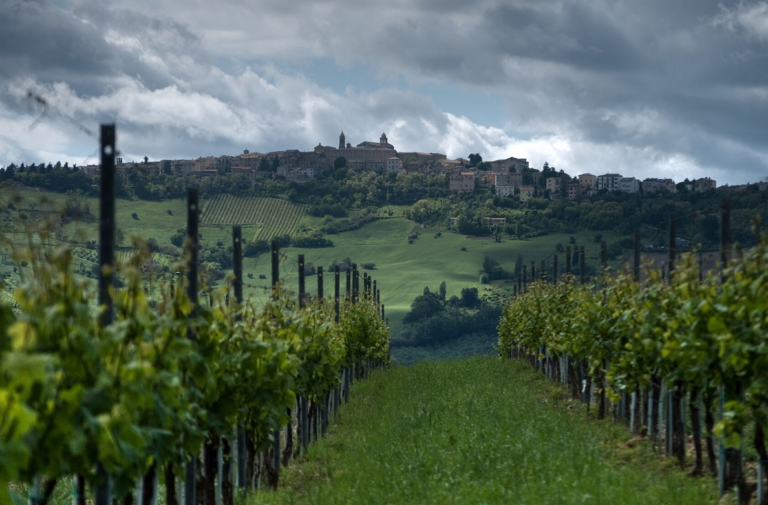
The dish belongs to the province of Macerata and the broader Marche interior, and it tastes most like itself where the STG protects it.
The maceratese heartland
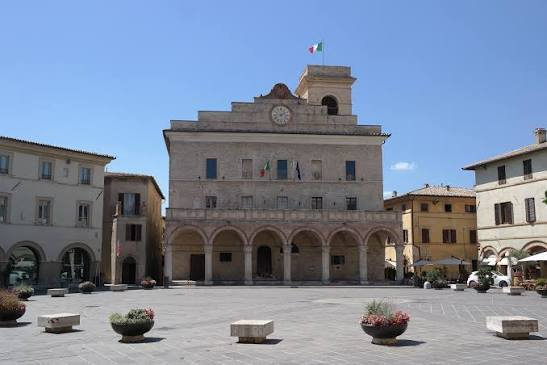
The hill towns around Macerata are the home ground, and family-run trattorie across the province still treat vincisgrassi as the Sunday centerpiece rather than a tourist curiosity. Because good restaurants come and go, I will not send you to a specific address that may have changed by the time you arrive; instead, look for kitchens in the Macerata and Fermo provinces that advertise the maceratese version and make their own sfoglia in house. That detail — pasta rolled on the premises — separates the real thing from a frozen approximation.
If your timing allows, the most vivid encounter is a sagra (a community food festival rooted in a single dish). Every June, the town of Monte Urano in the province of Fermo holds the Sagra de li vincisgrassi cotti su lu furnu a legne — vincisgrassi baked in a wood-fired oven — where the dish is made at village scale and eaten at long communal tables. It is the closest a visitor can get to how the food was meant to be shared.
When it shows up
Outside festival season, vincisgrassi is most reliably found on weekends and around holidays, when restaurants prepare it in quantity. It is rarely an everyday menu item precisely because it takes so long to make well, so calling ahead to confirm is worth the effort.
The cultural layer
To understand why a region defends a single baked pasta, you have to see what it stands in for. In Marche households, the person who makes vincisgrassi — historically the grandmother — guarded the recipe and rolled the sfoglia alone, often forbidding help in the kitchen. The dish became shorthand for family, for the deliberate generosity of a feast, and for a slower way of cooking that resists shortcuts. The seven-layer tradition, the hand-chopped meat, the two-day rhythm: these are not inefficiencies to an engineer’s eye so much as a deliberate insistence that some things are worth doing the long way. The 2022 STG recognition was, in effect, a formal vote to keep doing them that way.
Tips for the visiting American
A few practical notes will help you meet the dish on its own terms.
First, do not order it expecting lasagna. The texture is firmer, the flavor is gamier and more spiced, and the giblets are a feature, not a mistake. Second, treat it as a primo, the pasta course, but be honest with yourself about its weight — a full portion of vincisgrassi followed by a meat course is a serious undertaking, and there is no shame in making the pasta your main event. Third, drink local: a Rosso Piceno or a structured Marche red stands up to the richness far better than anything delicate. And finally, eat it in the interior, in the Macerata and Fermo hills, rather than along the resort coast, where the cooking bends toward seafood and the baked pastas can be an afterthought.
FAQ — Understanding vincisgrassi
What is vincisgrassi? Vincisgrassi is a baked layered egg-pasta dish from Le Marche, made with a coarse meat sauce that includes chicken giblets, a firm béchamel, spices like clove and nutmeg, and a crisp Parmigiano crust. It is richer and more structured than standard lasagna and carries STG protected status.
Does vincisgrassi really predate lasagna? It predates the modern dish, not the concept. Layered pasta is ancient, but the tomato-and-béchamel lasagna most people picture took its current form between roughly 1880 and the twentieth century. The Marche version was documented in 1779, before tomato entered the recipe.
When is the best time to eat it? Weekends and holidays, when restaurants prepare it in quantity, and especially June, when the town of Monte Urano in Fermo province holds its wood-fired vincisgrassi festival. It is a feast-day dish by nature.
Where can I try authentic vincisgrassi? In the provinces of Macerata and Fermo, at family-run trattorie that make their own sfoglia and serve the maceratese version. The Monte Urano sagra each June is the most immersive option.
How much does a plate cost? As of 2026, a portion in a Marche trattoria typically falls in the range of roughly 10 to 16 euros, depending on the establishment. Prices shift over time, so confirm when you book.
Is vincisgrassi a starter or a full meal? Technically it is a primo, the pasta course, but it is dense and generously portioned. Many visitors find a full plate is plenty on its own, with no second course required.
Why isn’t it as famous as Bolognese lasagna? Le Marche has long been one of Italy’s quietest regions, never marketed to international tourists the way Tuscany or Emilia were. The dish stayed local because the region did, which is exactly why it still tastes like a discovery rather than a brand.
A final note
Vincisgrassi is what happens when a region keeps cooking the way it always has, indifferent to whether the rest of the world is paying attention. It is not a footnote to lasagna; if anything, lasagna is the famous cousin who got the publicity. Come to the Marche hills hungry, order it where the pasta is rolled by hand, and you will understand why a single baked pan can stand in for an entire way of life.
If you want more stories like this from an Italian insider’s perspective, explore more on Tastes & Wonders of Italy or subscribe to our YouTube channel for video dispatches from around the country.
Food like this is usually the first thing that makes people want to stay in Le Marche for longer than a holiday. If a house here has crossed your mind, I inspect them for a living, and offer buyers an independent survey before they sign.
—
Written by Mirco Vitellozzi, a structural engineer from Le Marche who writes about Italy from the inside. More essays at Tastes & Wonders of Italy, and short films on YouTube.