How to Buy Real Italian Olive Oil When You Are Not in Italy
How to buy real Italian olive oil changes completely once you leave Italy. At a frantoio in the hills above Fermo, I have watched the same ritual every autumn for years. Fresh oil comes off the press in a cloudy, grass-green stream. Someone tastes it from a shot glass while it is still warm. Then it settles into steel tanks to rest. Most of it fills unlabeled jugs for local kitchens. One pallet gets wrapped more carefully. It gets an export label and a slow crossing to a warehouse near Newark or Oakland. Everything that protects a buyer here, the tasting panel, the lab certificate, the law, stops at that container door. What happens after is a different problem. Almost nobody explains it honestly.
A note on the links below: some of the shops I point to are affiliate links, which means I earn a small commission if you buy through them, at no extra cost to you. I only link to sellers whose listings pass the same checks this article asks you to make.
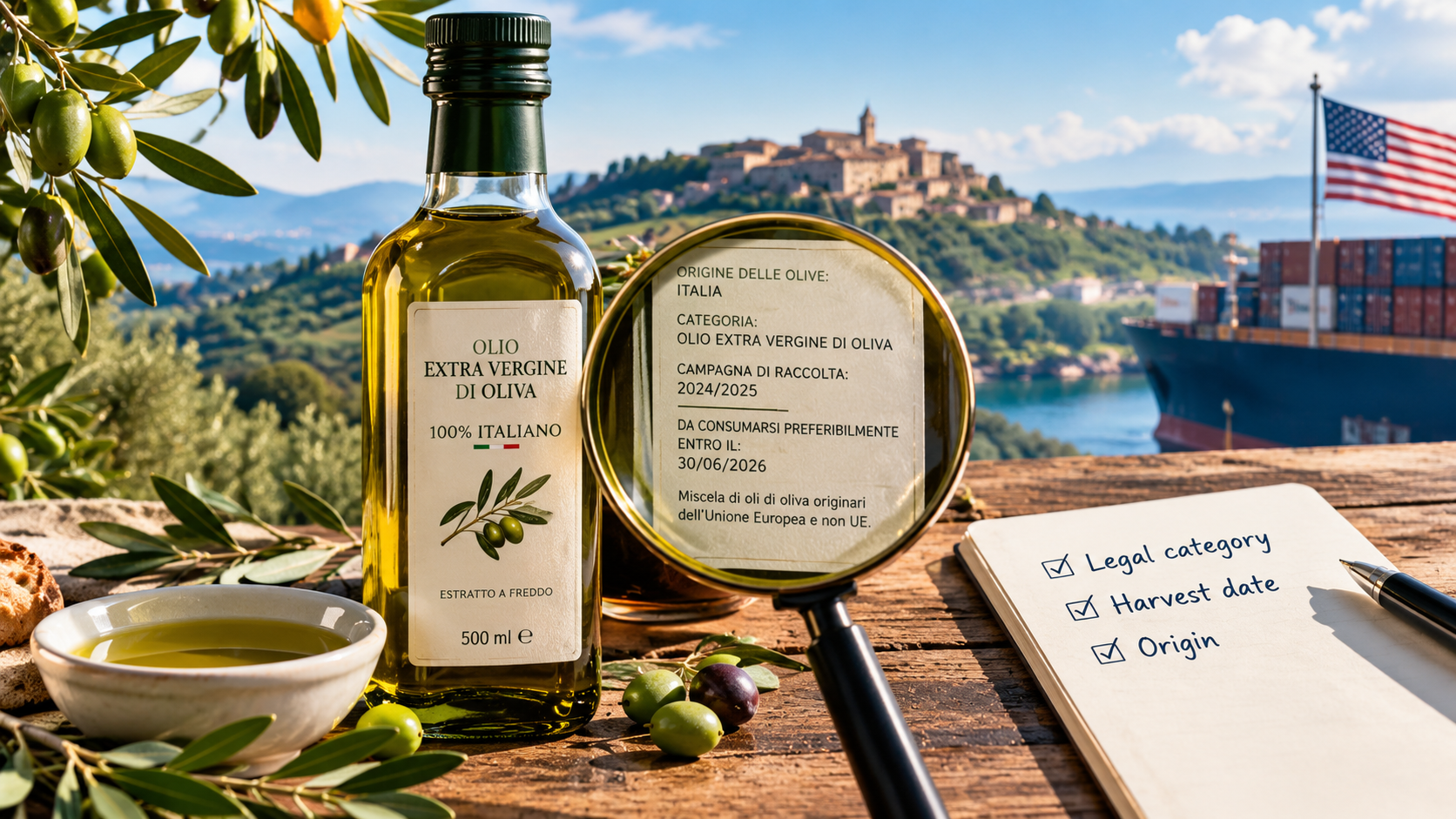
In short: buying real Italian extra virgin olive oil in the United States means reading three things the front label cannot fake. The legal category. The harvest date against the best-by date. The origin wording that separates a single-country oil from a blend. None of these needs a lab. All three are printed, by law, somewhere on the bottle. Add a realistic sense of what fresh, honest oil costs to land on a US shelf, and most of the guesswork disappears.
What the Certificate Already Settles — and Where It Stops Mattering
I already walked through that certificate in full in What Extra Virgin Olive Oil Means. It covers the eight laboratory limits, the acidity ceiling, the tasting panel that scores a bottle before it reaches a shelf. Start there if you want the lab report. Here is the short version instead.
Commission Delegated Regulation (EU) 2022/2104 requires a place of origin on the label for extra virgin and virgin olive oil. The harvest year may appear only when the entire bottle comes from a single season’s picking. Cross the Atlantic, and the ground shifts. The USDA grading program that mirrors many of those same limits is voluntary. A bottler can skip it and still print extra virgin on the front. General food-labeling rules only catch a false claim after the fact, not before it ships.
None of that tells you what to do standing in front of a shelf with a dozen brands and no agreed story between them. That is the part worth working through properly.
Why “Italian” on the Front Is Often Just a Bottling Address
“Italian” on a bottle is often a claim about where the oil was packaged, not where the olives grew. Under EU rules, a blend of oils from more than one country must say so. The wording looks like “blend of olive oils originating in the European Union and non-EU countries.” It usually sits in tiny type under the ingredients line. Few shoppers in Ohio or Oregon go looking for it. That is exactly why it stays unread.
The scale behind that fine print is not small. Coldiretti, Italy’s largest farmers’ association, reported that Italy imported more than 540 million kilograms of olive oil in 2021. That was nearly double the country’s own production that year. The pattern has not slowed. In early 2026, Coldiretti flagged more than 500,000 tons of foreign oil crossing Italian borders during 2025 alone. The group said it was pressuring domestic extra virgin prices and feeding an opaque market. A fair share of that imported oil gets blended, bottled, and shipped onward under a label that reads, at a glance, entirely Italian. The fix is not suspicion. It is reading one sentence most bottles already print.
The 69 Percent Everyone Misquotes
A single number drives most of the “Italian olive oil is fake” panic online: sixty-nine percent. It comes from a 2010 University of California, Davis Olive Center study. Researchers tested imported oils labeled extra virgin, bought off supermarket shelves in three California metro areas. Sixty-nine percent of those samples failed to meet the chemical or sensory standards for the extra virgin grade. That finding is real. It is also fifteen years old now, drawn from specific brands in three cities during one buying season.
What is not real is the conclusion blogs and talk shows drew from it. The UC Davis researchers were explicit on one point. Their study found no evidence that the failing samples were adulterated with non-olive oils, like soybean or canola. The failures were almost entirely about grade, not substance. Some oil had simply aged past its window. Some oil never quite earned the extra virgin label and got sold under it anyway. That distinction matters. Grade fraud and genuine adulteration are different problems, with different consequences for your kitchen.
Real adulteration does happen. It gets documented and prosecuted, not just speculated about online. Italian Carabinieri seized forty-two tons of fake extra virgin in Puglia in 2024, worth close to a million dollars. Chlorophyll was used to fake the color. A joint Italian-Spanish operation with Europol broke up a counterfeiting ring moving 260,000 liters in 2023. Inspectors found seed oil sold as extra virgin in fifty Rome restaurants that same year. On the supermarket side, one clear case against a major brand ended differently. Deoleo settled over its Bertolli extra virgin line. The company moved to darker bottles, tighter testing, a printed harvest date, and a shorter best-by window. The fix was procedural, not criminal.
Italy’s own inspectors stay busy, too. Trade press reporting on official figures counted more than 8,200 olive oil inspections in 2024. Irregularities turned up in 23 percent of samples. Fraud exists on both ends of the supply chain. It is just smaller, and more specific, than the headline percentage suggests.
What a Liter of Real Extra Virgin Cannot Cost
Here the numbers help more than any adjective. A genuinely fresh extra virgin needs five to eight kilograms of olives to produce one liter of oil. That range holds for oil pressed from early-harvest olives, chosen for flavor and polyphenols rather than maximum yield. Early picking sacrifices yield for character. Every serious frantoio makes that trade on purpose.
In central Italy, the Marche, Umbria, and Abruzzo hills I know best, mill prices for quality extra virgin ran roughly eleven to sixteen euros per kilogram through the 2025/2026 season. Compare that to the Puglia bulk market. There, commodity oil trades at six to seven euros a kilo. That cheaper oil is what ends up anonymous in most blends. One Italian mill’s own published cost breakdown puts the raw olive cost alone at six and a half to fifteen euros per liter of finished oil. Total production cost, milling, bottling, labor, already tops six euros a liter before any margin is added. A fair, sustainable price straight from the mill lands around nine to ten euros a liter. On an Italian supermarket shelf, after domestic distribution takes its cut, that same liter commonly sells for eighteen to twenty-two euros.
Now send it across an ocean. US import duty on olive oil is modest on paper, a few cents per kilogram under the published tariff schedule. Duty alone is not the main driver. Ocean freight, a customs broker, and inland trucking on both sides add their own costs. A US distributor’s margin comes next. A retailer’s margin comes after that. Both stack on top of a wholesale price that was already roughly double what the olives cost to pick and press.
Run that chain forward, and it is hard to land much under fifteen to twenty dollars a liter. That is the floor for oil that is both genuinely extra virgin and genuinely fresh by the time it reaches an American shelf. A liter priced at ten dollars or less, with an early harvest date and an Italian flag on the label, is not a bargain someone is passing on to you. Somewhere in that chain, a step got skipped. Maybe it was the olives. Maybe the harvest timing, the freight, or the honesty of the label. The front of the bottle will not say which.
What Your Palate Has Been Trained to Like
Bitterness and a sharp, peppery catch in the back of the throat are not flaws in a genuine extra virgin. They are polyphenols, the same antioxidant compounds behind most of the oil’s health reputation, doing exactly what they should. A real early-harvest oil from the Marche or Umbria can make a newcomer cough on the first taste. That is not a defect. It is often the clearest sign the oil is fresh and intact.
The official tasting panels I described in What Extra Virgin Olive Oil Means score a defect median, called Md, without naming which specific fault pushed it above zero. In practice, trained tasters listen for a short list of recognizable faults, each with its own Italian name. Rancido is rancidity: oxidized oil gone stale, tasting faintly of walnut shells or old paint. Riscaldo, sometimes called fusty in English, comes from olives piled too long before milling. They ferment gently in their own heat before ever reaching the press. Morchia is a muddy, sediment-heavy note from oil left sitting too long on its lees. Avvinato is winey or vinegary, the mark of olives that began fermenting toward alcohol, then acetic acid, before pressing.
Here is the uncomfortable part. A lot of the mild, buttery, almost sweet olive oil on the American mass market is not simply a gentler style. Often it is oil that has already lost, through age or poor handling, the bitterness and bite a fresh extra virgin should carry. Or it is oil pressed from olives so ripe, so late in the season, that it never had much bite to begin with. An American palate trained for years on that softness can mistake a real, sharp, grassy Tuscan or Marchigiano oil for something gone wrong. It has not gone wrong. It has simply arrived. Recalibrating a palate is easier with several small bottles than with one large commitment: a mixed tasting set of single-estate oils costs less than a single premium liter and teaches you where your own threshold sits.
How to Buy Real Italian Olive Oil in a US Store
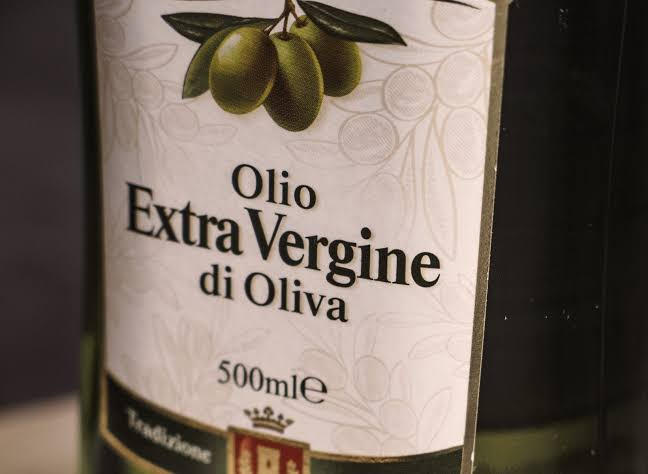
In an actual American store, I work through a short, fixed order. I do not trust a single clue.
First, the legal category on the front. It has to say extra virgin olive oil, written exactly that way. Pure, light, and olive oil alone are refined grades wearing a softer name. None of them carry the polyphenols or the flavor extra virgin is sold on.
Second, the origin and blend wording near the ingredient line. A single named country, Italy on its own, without a blend disclaimer, tells you more than a brand story ever will. A blend sentence is not a scandal. It just means the bottle is not quite what the front implies.
Third, the harvest date against the best-by date. A best-by date alone, often eighteen to twenty-four months out, says nothing about when the olives were picked. A harvest month and year is the strongest voluntary signal a bottle can carry. EU rules allow it only when the whole container comes from one season. Between late October and December that line matters more than at any other point in the year, because that is when the current season’s oil, what Italians call olio nuovo, finally reaches American shelves still tasting of the field it came from.
Fourth, a third-party seal. The North American Olive Oil Association and the California Olive Oil Council both run real chemistry and tasting checks on member oils. They do more than simply license a logo.
Fifth, the container: dark glass or tin, never clear glass under store lighting, never a shelf flooded with window light.
Sixth, price per liter, worked out by hand rather than trusted at a glance. A three-liter tin and a 500-milliliter bottle rarely cost the same per liter, even from the same producer.
Buying online changes the order, not the questions. Look for a product page that shows the actual back label, not just a styled front shot. Favor producers who publish a lab sheet or harvest report on request. If nobody on the listing can name the harvest month when asked, that silence is itself an answer. Specialist importers generally do this better than broad-catalogue retailers: on a shop like Olive Oil Lovers, which carries Italian estates one by one rather than by the pallet, harvest dates and back labels sit on the product page itself, so the six checks above can be run without leaving your desk.
What I Would Skip
A few habits are worth dropping entirely.
The fridge test. Putting a bottle in the refrigerator to see if it clouds or solidifies is one of the most repeated myths in food writing. It has been debunked for over a decade. Researchers at the University of California, Davis Olive Center refrigerated seven oils, genuine extra virgins included, for up to 180 hours. None of them fully solidified. The test told them nothing reliable about purity or quality either way.
“First cold pressed” as a buying argument. The phrase describes a mechanical method, not a quality tier. Under EU rules, a cold-extraction claim applies only to oil processed below a fixed temperature by mechanical means alone. It is not meaningless. It is just not the signal most shoppers treat it as.
DOP certification as a daily-cooking requirement. Protected designations earn their keep on a gift bottle or a special dinner. For the oil you cook with four times a week, a clear harvest date and an honest producer matter more than a certification seal.
Large tins for small households. A three- or five-liter tin looks economical. It also sits open on a counter for months, losing freshness with every exposure to air and light. For most households, a one-liter bottle finished within two months beats a large tin finished in eight.
One more, and it surprises most Americans coming from an Italian. In May or June, think about the calendar. California and the Southern Hemisphere, Chile, Argentina, South Africa, Australia, are harvesting fresh olives right then. Italy is not. By that point, an Italian oil on the same shelf is six to nine months past its own harvest. The newer oil from elsewhere is often the fresher bottle. An honest Italian will tell you that. Buy the fresher oil.
FAQ — Buying Italian Olive Oil in the United States
What does “extra virgin” actually guarantee on a US bottle? In the US, extra virgin guarantees only what general food-labeling law requires: an accurate claim, checked after the fact, not certified before sale. USDA grading would verify it chemically, but that program is voluntary. The word alone is weaker evidence than it looks.
Is most Italian olive oil sold in American supermarkets fake? No. Most is genuine olive oil, sometimes blended or aged past its best window, not adulterated with other oils. True adulteration shows up in specific, prosecuted cases, not spread evenly across the shelf.
Does the fridge test tell you whether olive oil is real? No. UC Davis Olive Center testing found the fridge test unreliable for judging purity or quality. Genuine extra virgin oils did not fully solidify even after extended refrigeration.
How much should real Italian extra virgin olive oil cost per liter in the US? Count the mill price, Italian distribution, ocean freight, and two layers of US margin. Add them up, and a genuinely fresh Italian extra virgin is hard to find much under fifteen to twenty dollars a liter.
How long does opened extra virgin olive oil actually stay fresh? Most quality loss happens after the bottle is opened and exposed to air and light. A one- or two-month window of regular use, stored away from heat and sunlight, keeps an oil closer to its certified quality.
Is a blend labeled “product of Italy” automatically lower quality? Not automatically, but it is a different product than a single-country oil. EU-mandated blend wording is the only way to tell the two apart. Read the fine print near the ingredient list, not the brand name on the front.
What is the single most useful word to look for on a label? The harvest month and year. It is voluntary. It can legally appear only when the entire bottle comes from one season’s picking. Almost no other line on a US label carries as much verified meaning.
The Final Word
Buying real Italian olive oil outside Italy is less about hunting for a perfect bottle. It is about reading the handful of lines a bottle is legally required to carry. It also means knowing what your own kitchen habits, storage, speed of use, price expectations, do to whatever quality survived the trip. None of this needs a lab, a trip to Umbria, or blind trust in a brand story. And if you want to know why the best oil in Italy is so rarely for sale at all, that is Italian olive oil culture.
Want the fuller picture? How the European certificate actually works, what happens inside a frantoio during pressing season, where olive oil sits inside the wider Mediterranean diet: those pieces are linked throughout this one. Maybe the next step for you is seeing a harvest in person, rather than reading about it from a distance. Frantoi Aperti in Umbria and a supervised olive harvest in Le Marche are both still open to visitors most autumns.
For more dispatches like this, practical, sourced, written from the Italian side of the question, the newsletter is the best way to follow along.
—