Brodetto: The Five Versions of Marche’s Fish Stew (and Why Each Town Hates the Others’)
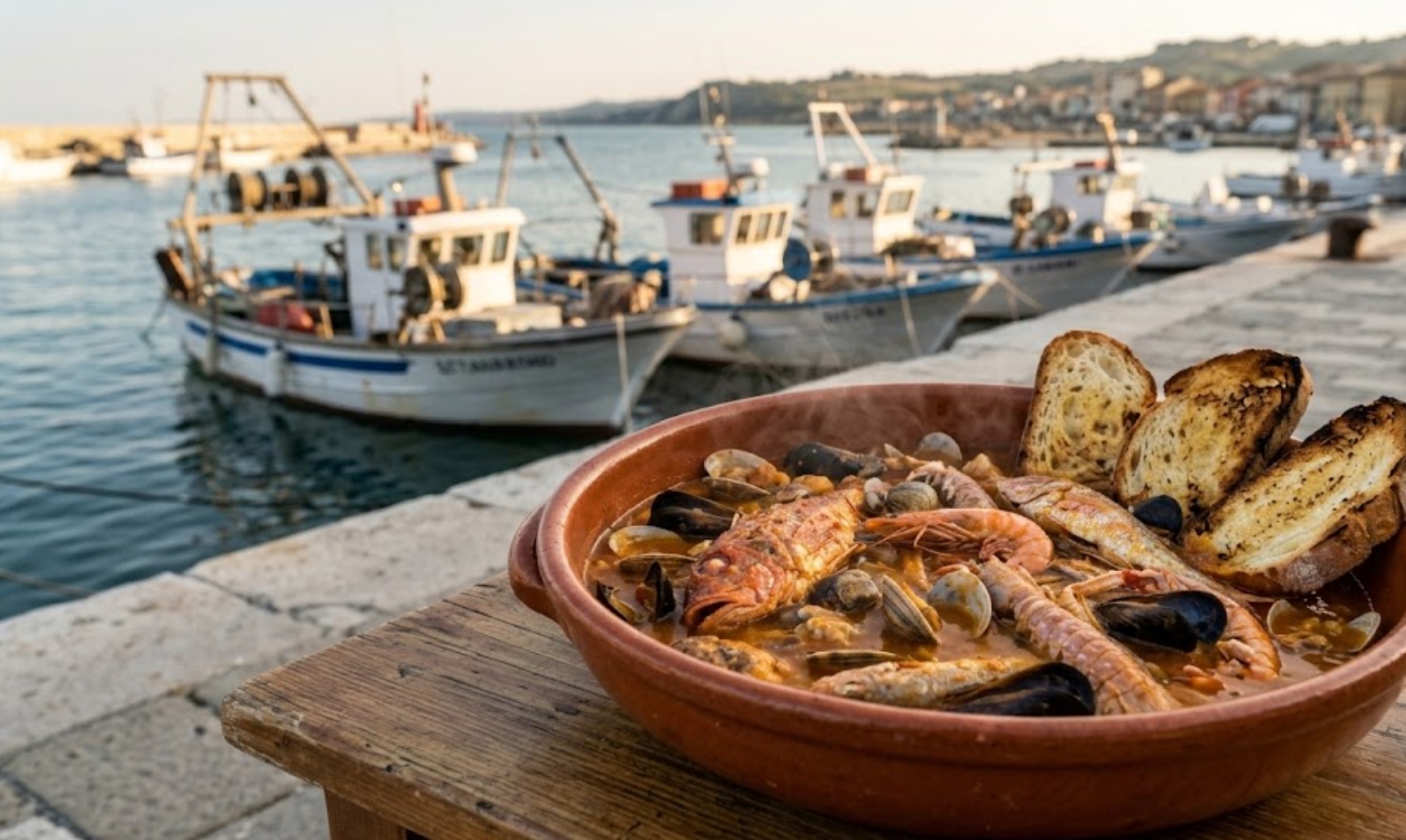
Brodetto starts on the dock, not on the stove. In Porto Recanati at five in the morning, crates of scorfano, tracina, and gallinella still slick from the overnight net come off the boats before the town’s cafés have raised their shutters, and whatever doesn’t sell by seven becomes lunch. I have watched this exchange from Fano down to San Benedetto del Tronto, and it has never produced the same fish stew twice. The Adriatic coast of Le Marche holds at least five brodetto recipes that each consider themselves the only legitimate one, and the disagreement between them is not folklore staged for visitors. It is a live, ongoing argument that fishmongers, chefs, and grandmothers keep having, forty kilometers and one pot apart.
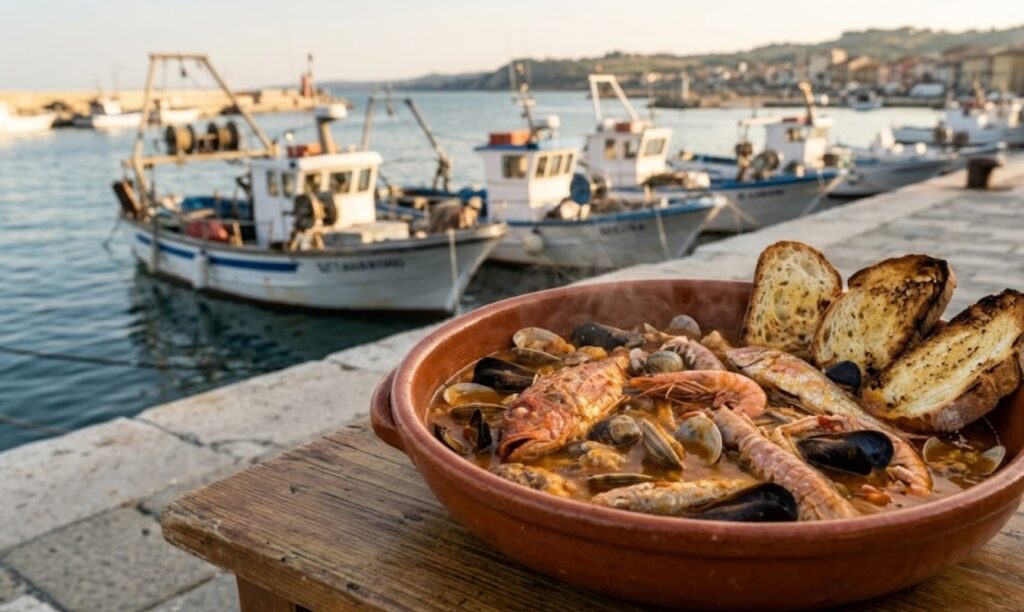
Brodetto is the Adriatic fish stew of Italy’s Marche region, made by simmering the day’s least marketable catch — small, bony, or simply unglamorous fish — in a shallow terracotta pot with olive oil, onion, and, depending on the town, tomato, vinegar, or saffron. It is not a single dish but a family of them: Fano, Ancona, San Benedetto del Tronto, Porto Recanati, and Civitanova Marche each claim a distinct and disputed version, differing in which fish qualify, whether tomato belongs in the pot at all, and how the broth gets its final color. Every version, without exception, follows two unwritten rules: the pot is shaken, never stirred, so the fish stays whole, and the stew is ladled over toasted bread rather than rice or pasta.
What Brodetto Actually Is
Before getting into the rivalry, it helps to understand why this dish exists at all. Brodetto was never designed to impress anyone.
A Recipe Born From What Couldn’t Be Sold
Every version of brodetto traces back to the same practical problem. A day’s catch off the Marche coast came home in two piles: fish worth selling at the market, and everything else — the scorfano too spiny to bother filleting, the coda di rospo too ugly to display, the tracina whose venomous spines scared off buyers, the gallinella, canocchie, seppie, moscardini, San Pietro, palombo, and triglie that were either too small, too damaged by the nets, or simply unfashionable that week. Fishermen’s wives took that unsold pile and turned it into dinner, because nothing on a working boat’s income went to waste, and nobody bothered writing the recipe down. That absence of a written original is exactly why five towns can each insist, with a straight face, that theirs is the authentic one: there was never one to begin with, only five independent solutions to the same problem of poverty and abundance.
The dish is traditionally served for at least two people, since a proper brodetto rarely makes sense in a smaller batch, and it comes exclusively with pane abbrustolito — bread sliced thick and toasted until it can survive being soaked in the broth. The fish, always Adriatic, arrives at the table with bones, skin, and shells intact: filleting it would strip out the collagen and marrow that give the broth its body, so a fork-and-fingers approach is simply how the dish is meant to be eaten.
The Unwritten Law: Shake the Pot, Never Stir It
Every regional variant shares one piece of technique that no cook I have met has ever questioned. Brodetto is cooked in a tegame — a low, wide earthenware pot, usually terracotta — and once the fish goes in, nobody touches it with a spoon. To move the ingredients, the cook grips the pot by its two handles and gives it a short, controlled shake, so no utensil ever breaks the flesh apart. As an engineer, I find this detail more interesting than folkloric: terracotta’s thermal mass holds heat evenly and releases it slowly, exactly the gentle simmer that delicate whole fish needs to survive without disintegrating. The earthenware pot isn’t sentimentality; it’s the correct engineering choice, arrived at generations before anyone would have called it that.
The dish’s name changes with the dialect as readily as its recipe changes with the town. Anconetani call it brudétu; in Fano it is brudèt; in San Benedetto del Tronto, vrudètte. Even the spelling of the name itself refuses to sit still along this coast.
Five Ports, Five Recipes That Refuse to Agree
Italians have a word for the fierce, often good-humored territorial pride between neighboring towns: campanilismo, an attachment to one’s own bell tower so strong it shapes opinions on everything from soccer to soup. Brodetto is where Marche’s campanilismo shows up on a plate. Each of the following towns sits within roughly an hour’s drive of the next, shares the same sea, and cooks a version of the same poor fisherman’s stew that its neighbors regard, at best, as a respectable imitation.
Fano — Brodetto alla Fanese, the Self-Declared Mother Recipe
Fano’s version leans on tomato concentrate and a generous pour of wine vinegar, simmered with a catch that traditionally runs to around thirteen species of Adriatic fish and shellfish. Fanesi will tell you, without much room for negotiation, that theirs is the original from which every other Marche brodetto descended — a claim Ancona rejects just as flatly. What isn’t in dispute is Fano’s institutional weight behind the dish: the town hosts BrodettoFest, an international festival dedicated to brodetto and fish soups from around the world, organized by Confesercenti of Pesaro and Urbino together with the municipality. Its 2026 edition, the twenty-fourth, ran from May 30 through June 2 along Fano’s seafront, with a national cooking competition, boat excursions tracing the local mussel and clam beds, and an international guest section that has recently hosted rival fish-stew chefs from as far as Provence. Dates shift by a week or two each year, so check the current calendar before booking a visit around it.
Ancona — Brodetto all’Anconetana, the Disciplined Thirteen
Ancona’s version is thicker and more restrained than Fano’s, built on the same principle of using whatever the boats couldn’t sell, but finished with only a modest amount of tomato and always a splash of vinegar — never white wine, a distinction Anconetani are quick to point out. The defining feature is the insistence on exactly thirteen varieties of fish: seppie, triglie, sogliole, palombo, coda di rospo, pannocchie, scorfano, merluzzo, calamari, razza, gallinelle, San Pietro, and vongole or other shellfish, depending on who is cooking. Ask why thirteen and you’ll get two competing answers with equal conviction: some say it honors the thirteen guests at the Last Supper, others point to the thirteen spouts of Ancona’s Fontana del Calamo. Both explanations are recited as settled fact by people who have never met the other camp. Ancona also claims the title of oldest unchanged brodetto recipe on the coast — a claim Porto Recanati, a few pages down, makes with equal certainty about its own stew.
San Benedetto del Tronto — Brodetto alla Sambenedettese, the Southern Heresy
Head south past the Conero promontory and the recipe changes character entirely. San Benedetto’s brodetto — lu vrudètte in the local dialect — replaces ripe tomato with green, unripe ones, or skips it almost entirely, leaning instead on fresh peppers and a sharp edge of vinegar. The result tastes noticeably more acidic and vegetal than its northern cousins, a difference tracing back to the nineteenth century, when fishing families here enriched the stew with whatever the countryside offered: onions, peppers, green tomatoes. To a Fanese or Anconetano palate, peppers in a fish stew read as an almost foreign addition, marking San Benedetto as culturally closer to the Piceno south — the old Ascoli and Fermo territory — than to the Ancona coast to the north.
Porto Recanati — The Brodetto With No Tomato at All
Porto Recanati’s version breaks the pattern the other three towns share. There is no tomato in it whatsoever — a fact that some historians point to as evidence this is actually the oldest of Marche’s brodetti, since a tomato-free recipe would predate the vegetable’s widespread arrival on Italian tables from the Americas. In its place goes zafferanella, also called zafferanone: a wild, saffron-colored spice that, despite the name, is often closer botanically to safflower than to true saffron (Crocus sativus), the flower used in Provence’s bouillabaisse. Whatever the botany, it turns the broth a warm gold that locals nickname occhiu de gallu, “rooster’s eye.” The recipe is generally credited to Giovanni Velluti, whose seafront chalet served it to guests in the early twentieth century; a 1923 Touring Club Italiano publication already described a “white brodetto made south of Monte Conero” that was, remarkably, cooked, packed, and shipped as far as Milan even then. For a visitor raised on tomato-based Italian cooking, a brodetto with none at all can look like an outlier. In Porto Recanati, it is the other four versions that look like they are trying too hard.
Civitanova Marche — The Pick That Starts the Real Argument
Civitanova’s brodetto splits the difference between its neighbors: tomato passata, a glass of dry white wine, and a pinch of saffron. It has produced its own local champions — Civitanova’s Da Enzo restaurant, run for half a century by the same family, won recognition as the best brodetto in Marche in a 2013 regional competition. I have picked Civitanova as this article’s fifth recipe because it is the version most consistently named alongside the other four in regional food writing, but I want to be honest about something most articles on this topic gloss over: the “fifth seat” in Marche’s brodetto lineup is genuinely contested. Porto San Giorgio has its own recipe, formally registered with a municipal Denominazione Comunale d’Origine and its own dedicated festival; Senigallia, further north, makes its own claim; and food writers surveying the coast have counted anywhere from four historically codified recipes up to seven distinct port-town versions. Even the headcount of “official” brodetti is a fight nobody has settled — which tells you almost everything you need to know about how this region relates to its own food.
Why They Actually Can’t Stand Each Other’s Version
The disagreements above are not academic footnotes. They surface at dinner tables with real heat. An Italian food writer covering Ancona once described watching two elderly men nearly come to blows over whose family recipe for brodetto was correct — and having spent time in enough seaside trattorie along this coast myself, I can say that anecdote reads as entirely plausible rather than exaggerated.
The Fano-versus-Ancona dispute runs on two axes at once: who invented brodetto first, and how much tomato belongs in the pot. Fano’s version is redder and more assertively seasoned; Anconetani describe Fano’s approach, diplomatically, as heavier-handed. Porto Recanati’s tomato-free stew occupies an even more extreme position: to a cook raised on Fano’s or Ancona’s recipe, a brodetto with no tomato conserva barely qualifies as brodetto at all — it earns the separate nickname “brodetto bianco,” an admission, even from its own defenders, that it sits outside the coast’s standard. San Benedetto’s peppers and green tomatoes read, to northern palates, as a genuinely different dish wearing the same name. None of this stops any of the five towns from serving their version with complete confidence, because in every case it is the version their own grandmother made.
The Adriatic Family, and Why It Isn’t Cacciucco
Brodetto belongs to a wider family of Mediterranean fish stews, and travelers who already know one relative sometimes assume they have met them all. They haven’t. Cross to Italy’s western, Tyrrhenian coast and the closest relative is Tuscany’s cacciucco, a Livorno specialty built around a five-word mnemonic all starting with C, typically finished with more red pepper heat and a thinner broth than an Adriatic brodetto. Liguria’s buridda and Provence’s bouillabaisse belong to the same extended family, the latter using true Crocus sativus saffron rather than Marche’s humbler zafferanella. Cross the Adriatic itself, to Croatia’s Dalmatian coast, and the dish reappears almost unchanged in spirit as brudet — a reminder this sea connected fishing cultures on both shores long before borders mattered to anyone catching dinner. Even within Italy the word plays tricks: in Florence, “brodetto” means an unrelated egg-and-lemon Easter soup, so specifying the Adriatic fish stew is necessary, not excessive caution.
Planning Your Brodetto Trip Along the Marche Coast
None of this is a reason to avoid ordering it. If anything, the rivalry is the best reason to try more than one version.
When to Go
Brodetto is available at coastal trattorie throughout the year, and many locals consider the cooler months, when the Adriatic’s white fish are at their best, preferable to the height of summer. That said, the calendar rewards travelers who time a visit around the dedicated events: Fano’s BrodettoFest runs annually in late May and early June, and Porto Recanati holds an annual Settimana del Brodetto in June, when participating restaurants serve the local recipe at a fixed price for a full week. Both shift their exact dates yearly, so confirm the current schedule before building an itinerary around either one.
How to Order It Like Someone Who Isn’t a Tourist
Order brodetto for at least two people, since a single portion undersells the dish. Expect bones, shells, and skin, and expect pane abbrustolito to arrive with it, meant to be torn and used, not admired. A glass of Verdicchio dei Castelli di Jesi, the crisp white wine grown in the hills behind this same coastline, is the standard local pairing, and one I would recommend over anything imported. And resist the temptation to ask a local which town’s brodetto is objectively the best. You will get a confident, immediate answer, and it will be different in every town you ask.
A Practical Note on Restaurants
Rather than naming specific trattorie, whose menus change faster than any guide can track, I’d point visitors toward the coastal ports themselves: Fano’s Fuori Brodetto circuit and Porto Recanati’s Settimana del Brodetto both list current participating restaurants on their official event pages each year, a more reliable filter than any single recommendation. Look for a place near the working fishing dock rather than the postcard end of the seafront, and order the town’s own named version rather than a generic “zuppa di pesce” — the difference in what arrives can be substantial.
Planning a food-focused trip along this coast and want an Italian’s help sequencing which ports, festivals, and detours are worth the drive? I take on a small number of planning consultations each month — details are on the About page.
FAQ — Understanding Brodetto
What is brodetto? Brodetto is the Adriatic fish stew native to Italy’s Marche region, traditionally made from a mix of small, bony, or otherwise unsellable local fish simmered in a shallow terracotta pot with olive oil, onion, and a town-specific combination of tomato, vinegar, or saffron.
What’s the difference between brodetto, cacciucco, and generic zuppa di pesce? Brodetto is specific to Italy’s Adriatic coast and tends to be thicker and less spiced than Tuscany’s Tyrrhenian cacciucco. “Zuppa di pesce” is a generic term for any Italian fish soup and carries none of brodetto’s regional or town-specific identity.
Which town makes the best brodetto? There is no neutral answer to this question inside Marche itself, since Fano, Ancona, San Benedetto del Tronto, Porto Recanati, and Civitanova Marche each consider their own version definitive. The most honest approach for a visitor is to try at least two or three versions and form an opinion firsthand.
What kind of fish goes into brodetto? Traditional recipes draw on Adriatic species that were historically hard to sell, including scorfano, coda di rospo, tracina, gallinella, canocchie, seppie, moscardini, San Pietro, palombo, and triglie, with the exact mix varying by town and by what the day’s catch provides.
When is the best time to visit for brodetto season or festivals? The dish is served year-round, but late May through June brings Fano’s BrodettoFest and Porto Recanati’s Settimana del Brodetto, both offering tastings and events built specifically around the stew.
Why is the Porto Recanati brodetto yellow? Porto Recanati’s recipe omits tomato entirely and gets its golden color instead from zafferanella, a wild, saffron-colored spice locally nicknamed “occhiu de gallu,” or rooster’s eye, for its warm hue.
Is there really an official number of Marche brodetto recipes? No. Four recipes — Fano, Ancona, San Benedetto del Tronto, and Porto Recanati — appear most consistently across historical sources as the region’s codified originals, but towns including Civitanova Marche, Porto San Giorgio, and Senigallia all press their own claim to a place in the lineup, and even food writers surveying the coast disagree on the final count.
A Final Note
I grew up on this coast, and I still could not tell you, in good conscience, which of these five pots holds the real brodetto. That refusal to settle is, in the end, the most honest thing about the dish: it was never built to be standardized, only to use up what a boat brought home that day, in whichever kitchen happened to be waiting. If you want more stories like this from an Italian insider’s perspective, explore more on Tastes & Wonders of Italy or subscribe to our YouTube channel for video dispatches from around the country.