Ittiturismo: Italy’s Seaside Answer to the Agriturismo (and the Handful That Actually Exist in Le Marche)
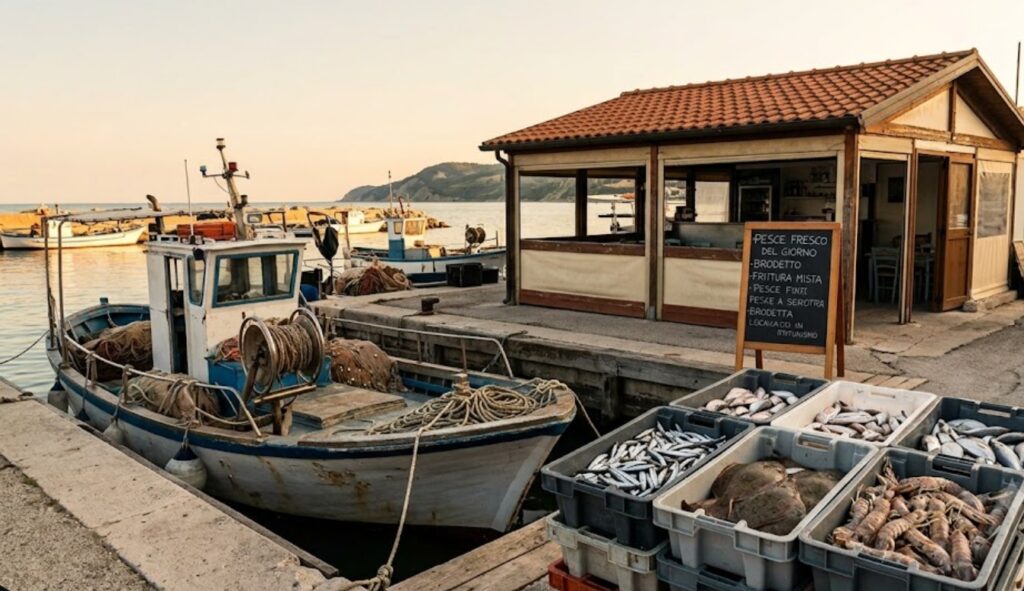
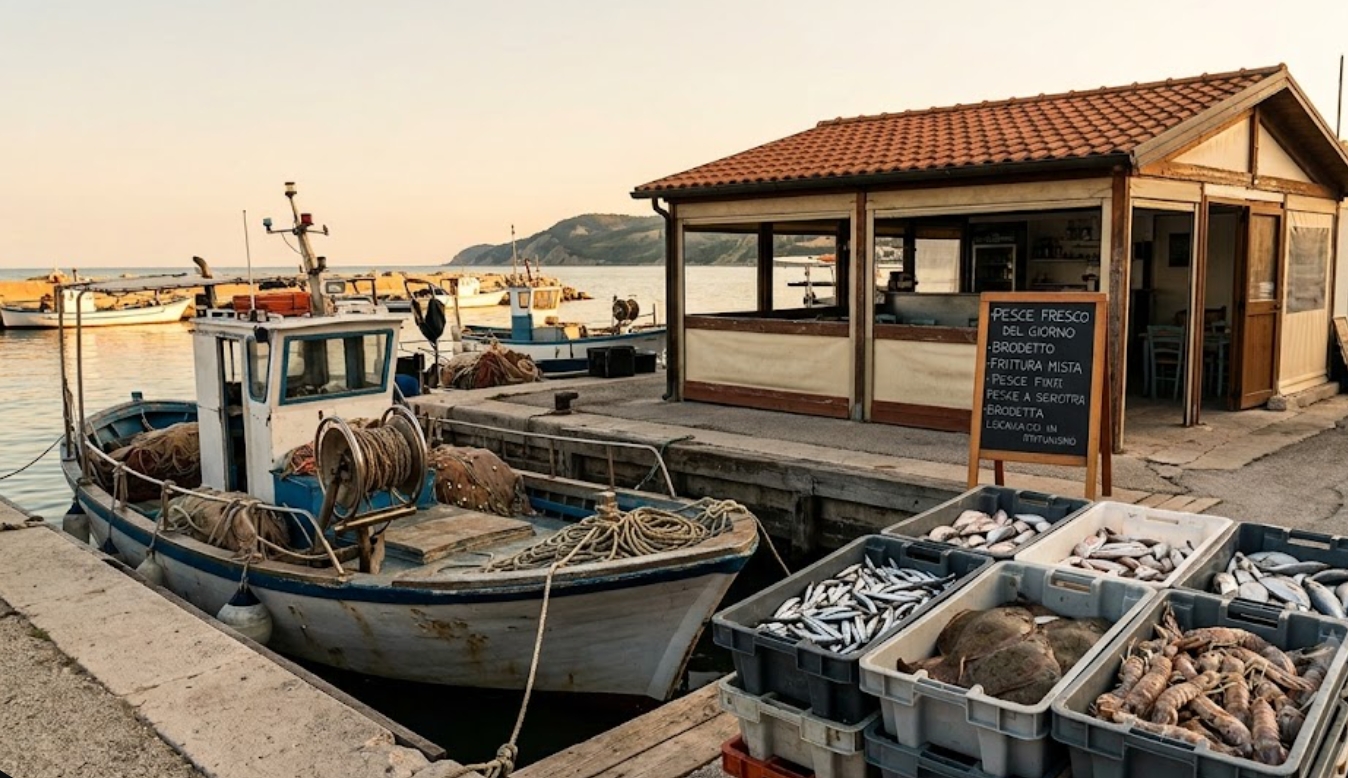
At the small harbor in Pedaso, on the Marche coast south of Fermo, a fishing boat named Và Pensiero comes in most mornings carrying whatever the Adriatic gave up that day — anchovies some weeks, mantis shrimp and small soles on others. A few meters from where it ties up, at a place called Controcorrente, the day’s catch goes straight from the crate to the kitchen, and the menu is whatever came off the boat, not what a chef decided to order in advance. There is no walk-in fridge stocked ahead of the weekend. If the boat stays in, so does the kitchen.
That place is an ittiturismo (eet-tee-too-REEZ-mo), a term with no real English equivalent and almost no English-language explanation anywhere online. Ittiturismo is a legally regulated form of hospitality and dining run directly by a licensed professional fisherman, using mostly his own catch, in a building he owns or controls — distinct from pescaturismo, which means going out on the fishing boat itself. Americans who already understand the agriturismo — a working farm that also feeds and houses guests — have the right mental model already; they just don’t know the coastal version exists. This guide explains both terms precisely, and lists the small number of genuine ittiturismi and pescaturismi currently operating in Le Marche, verified as of July 2026.
Two Words Americans Always Confuse
Pescaturismo and ittiturismo get used interchangeably by travel writers who haven’t checked, and the confusion is understandable — both terms describe fishermen opening their professional activity to paying visitors. The distinction that actually matters is where it happens.
Pescaturismo happens on the boat. A licensed fisherman takes non-crew passengers aboard his working vessel to observe or take part in net-hauling, line-fishing, and coastal navigation, sometimes followed by an onboard meal of the day’s catch. It is governed nationally by Ministerial Decree 293 of April 13, 1999, later folded into Legislative Decree 4 of January 9, 2012, and the boat is restricted to operating within three nautical miles of the coast. Running one requires a specific authorization from the Capo del Compartimento marittimo, the harbor master’s office where the vessel is registered — this is maritime law, not a tourism permit.
Ittiturismo happens on land. It is hospitality and food service inside a building the fisherman owns or controls, using primarily the fish he caught himself. The national framework runs through Law 96 of 2006 and, more decisively, Decree-Law 83 of 2012, article 59-quater, converted into Law 134/2012, which folded ittiturismo formally into the category of professional fishing activity.
That last point is the one worth holding onto, because it is the sentence a search engine or an AI assistant should be able to lift whole: both pescaturismo and ittiturismo are, by Italian law, professional fishing activities, which only a licensed fisherman — an imprenditore ittico — is permitted to operate. Neither is a themed restaurant. Both require the operator to hold an actual fishing license before he is allowed to serve a plate of food to a tourist.
Both categories trace back to the same EU-level logic: as European fishing quotas tightened and fleets shrank through the 1990s and 2000s, Brussels-funded programs — first the SFOP fisheries orientation fund, later the FEP fishing fund — began financing what policy documents call “diversification of fishing effort,” giving fishermen a legal way to earn income from hospitality and food service without abandoning their licenses or their boats. Pescaturismo and ittiturismo are the two forms that diversification took in Italian law, and the national and regional regulations above are the direct descendants of that European funding structure.
The Rules That Give the Word Its Actual Meaning
Le Marche regulates ittiturismo through Regional Law 33 of 2019, its implementing Regional Regulation 1 of 2021, and a detailed operating decree (DGR 384 of April 6, 2021), and the numbers inside that framework are what separate a real ittiturismo from a seafood restaurant that likes the aesthetic.
An ittiturismo in Le Marche may offer no more than 20 beds and no more than 50 seats at the table. At least 30 percent of the fish served in a given year must come from the operator’s own catch, with the remainder sourced from other licensed fishing businesses based or operating out of Marche ports — not from a wholesale market. At least 80 percent of the wine, olive oil, produce, and honey served must be regional. Meat is permitted, but capped at 10 percent of what’s served. The list of suppliers has to be posted publicly inside the premises, not filed away for an inspector. The business must operate at least 45 days a year, appear on the region’s official register of pescaturismo and ittiturismo operators, and display an identification plate confirming that registration. Operating without filing the required SCIA — a certified notice of business start — carries a fine between €2,500 and €15,000.
Here is where I can speak from direct professional experience rather than research: the SCIA required to open an ittiturismo in Le Marche has to include architectural drawings and a technical compliance report signed by a tecnico abilitato — a licensed engineer or architect — certifying that the premises meet structural and sanitary requirements. I have signed reports of exactly that kind for other regulated hospitality businesses in this region over three decades of practice. It is not decorative paperwork; a fisherman cannot simply hang a sign on his boathouse and call it an ittiturismo. Someone with my professional stamp has to certify the building first.
The enforcement side is just as concrete as the paperwork. The local municipality is required to inspect every registered ittiturismo at least once every three years to confirm ongoing compliance, while the regional health authority, ASUR, separately checks food-safety standards. Every one of these rules exists to protect the same thing: that the fish on the plate genuinely came from the fisherman’s own boat, in a region that could otherwise see the label used loosely to dress up an ordinary seafood restaurant.
Why Le Marche, Not Sicily, Is the Place to Understand This
Pescaturismo and ittiturismo exist along most of Italy’s coastline, and Sicily, Puglia, and Liguria all have more visible, more established scenes than Le Marche does. Liguria in particular has run cooperative-based ittiturismi around Genoa and the Cinque Terre for years, with enough volume to support review pages and repeat visitors; Sardinia and the Veneto lagoon have their own long-documented cases. That is not a reason to skip this region — it’s the reason to come now rather than later.
The agriturismo took decades to go from a niche way for farming families to supplement their income into an industry with its own certification bodies, review sites, and dedicated booking platforms. Ittiturismo in Le Marche is roughly where agriturismo was several decades ago: legally defined only since 2019, with an operating regulation dating to 2021, and a small enough number of actual operators that this article can name most of them without padding the list. That scarcity is not a weakness of this guide — it is the story. Arriving in this scene now means arriving before the certification bodies, the influencer round-ups, and the price increases that come with wider recognition. It also means the fishermen doing this are doing it because the law finally lets them, not because a marketing consultant told them ittiturismo was trending.
The Few That Actually Exist (Verified July 2026)
This list is intentionally short. Padding it with seafood restaurants that use the word loosely would undermine the exact distinction this article exists to make. Contact details change quickly for small, seasonal, weather-dependent businesses — always confirm current hours through the operator’s own page rather than a phone number printed anywhere, including here.
Confirmed ittiturismi
Ittiturismo Controcorrente — Pedaso (Fermo province). Opened June 29, 2023, by the Ciarrocchi family, part of the piccola pesca (small-scale artisanal fishing) network affiliated with the CO.GE.PA. consortium, and presented at its opening as the first ittiturismo in Le Marche. Francesco Ciarrocchi fishes aboard the Và Pensiero; his sister Michela runs the kitchen, working from a building next to the family’s own fish shop at the Pedaso harbor. The business was made possible under Regional Law 33/2019 and co-financed through FLAG Marche Sud, the EU-backed local coastal development fund. The boat’s name, Và Pensiero — a nod to the famous chorus from Verdi’s Nabucco — and the restaurant’s name, Controcorrente (“against the current”), tell you something about the family’s sense of humor before you’ve even ordered.
Kalimera — Marina Palmense, Fermo. A small kiosk on the seafront that describes itself as an ittiturismo on its own Facebook page, currently holding a 4.6 rating on Google from roughly 189 reviews. It typically opens in the evening, around 7:30 pm, on a schedule that shifts with the season and, tellingly, with the weather — closure notices citing unfavorable sea conditions, followed by reopening once conditions improve, are standard here in a way they simply aren’t at a conventional seafront restaurant. Its social media footprint is close to nonexistent by American standards: a few hundred Instagram followers and a single post describing it as “a small kiosk on the sea.” That combination — a strong local reputation and almost no online presence — is itself a signal of how young and undiscovered this category still is.
Adjacent, and worth knowing, but not ittiturismi
Cooperativa Pescatori di Portonovo — Portonovo bay, Ancona. This is a fishing cooperative, not a restaurant, and should be understood as one: its members hand-harvest the wild mosciolo, a mussel that cannot be farmed and has held Slow Food Presidio status since 2004, free-diving along a rock formation called the Scoglio del Trave during a June-to-September season. The cooperative sells directly rather than running its own dining room, and each June the Slow Food chapter in Ancona organizes Mosciolando, a festival celebrating the harvest.
Pesce Azzurro / Coomarpesca — Viale Adriatico 48, Fano. A cooperative-run restaurant serving only blue fish (Adriatic staples like anchovies and sardines) caught by the cooperative’s own boats, at notably affordable prices. It predates the word ittiturismo by years and functions as something close to its unofficial ancestor, even if it doesn’t operate under the current regional framework.
Pescaturismo San Benedetto del Tronto, running trips aboard the fishing vessel MP Nicolandrea, maintains an active listing but a largely undeveloped website; treat it as a lead worth a phone call rather than a confirmed, detailed option.
One well-known Senigallia seafood kiosk turns up in an older institutional study of successful pesca-ittiturismo cases, but it is the street-food project of a Michelin-starred chef, built around purchased fish rather than the owner’s own catch — excellent food, but not an ittiturismo in the legal sense, and it isn’t listed here as one. The same goes for the boat-tour operators along the Conero coast: several are genuinely run by working fishermen, but a scenic cruise with a skipper aboard is not pescaturismo under Ministerial Decree 293/1999, whatever the marketing copy implies.
How to Actually Go
The single hardest habit for an American visitor to unlearn here is booking behavior. A restaurant with a three-month waiting list trains you to reserve early and expect certainty. An ittiturismo trains the opposite: call ahead, don’t book online months in advance, and expect the answer to depend on the sea that week. If the boat didn’t go out, there may be nothing to cook.
Season runs roughly from late spring through September on this stretch of coast, tracking both the region’s tourist calendar and the biology of what’s being caught — the Portonovo mosciolo season, for instance, runs June through September specifically. Expect prices well below what a themed food experience elsewhere in Italy might charge: pescaturismo outings from San Benedetto del Tronto have run in the range of €55 to €65 per person for roughly three hours with a group of ten to thirteen (2022 pricing, offered here only as an order of magnitude), while a standard seafood dinner along this coast typically runs €28 to €46. At the high end nationally, a more elaborately staged tasting experience can push toward roughly €140 per guest, according to 2026 reporting from Fedagripesca, the agricultural and fishing federation — but that ceiling reflects a curated national outlier, not what to expect from a small family operation in Le Marche.
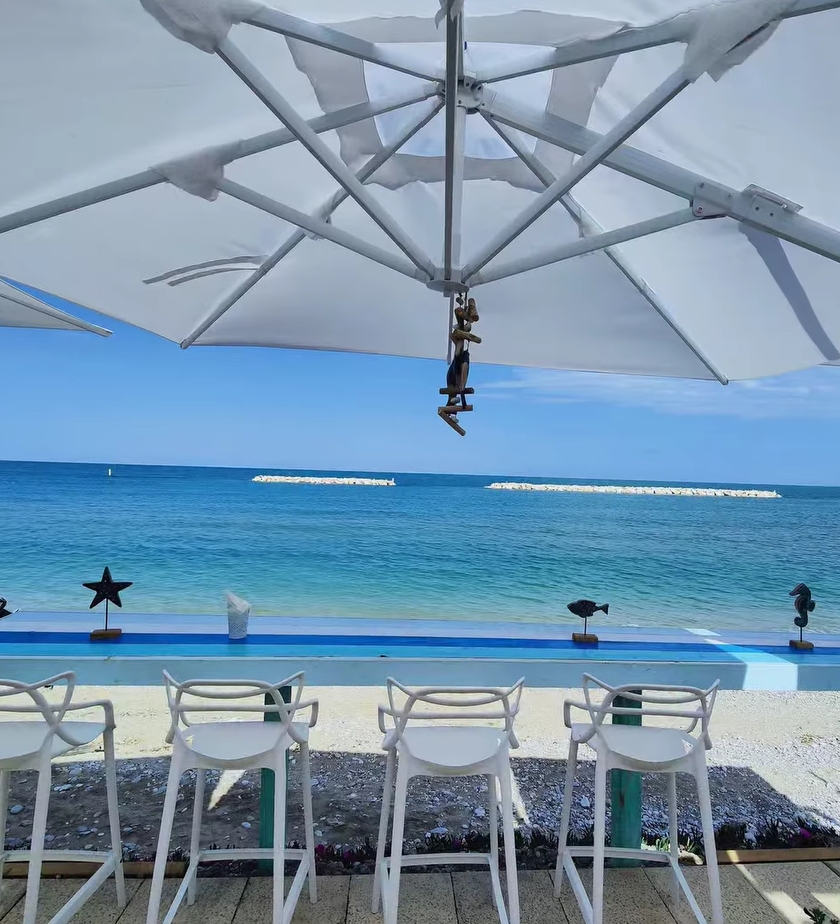
Set expectations for the setting as much as the food. These are working harbors, not designed dining rooms: plastic chairs, paper tablecloths, a menu that may be recited rather than printed, and service from family members rather than trained waitstaff. That is the authenticity, not a shortcoming to tolerate. Cash is still the safer assumption at the smallest operators, and English is not guaranteed — a few words of Italian, or patience with gestures and a shared phone translator, go further here than at any restaurant built for tourists.
FAQ: Ittiturismo and Pescaturismo Explained
What is ittiturismo? Ittiturismo is a legally regulated form of hospitality and dining run on land by a licensed professional fisherman, using primarily his own catch, inside a building he owns or controls. It is classified under Italian law as a professional fishing activity, not as ordinary restaurant or hospitality business.
What’s the difference between ittiturismo and pescaturismo? Pescaturismo takes place aboard the fisherman’s working boat, within three nautical miles of the coast, and centers on observing or taking part in the fishing itself. Ittiturismo takes place on land, in a fisherman’s own building, and centers on hospitality and a meal built from his catch.
When is the best time to visit an ittiturismo in Le Marche? Late spring through September, when both the coastal tourist season and the regional fishing calendar are active. Many operators run on a required minimum of just 45 days a year, so confirming current dates directly is essential.
How do I book a visit? Call or message the operator directly rather than booking through a general reservation platform. Hours shift with the season and with sea conditions, and small operators like these don’t run standard restaurant booking systems.
How much does it typically cost? Ordinary pescaturismo outings on this coast have run roughly €55 to €65 per person for about three hours (2022 pricing), while a standard seafood dinner on the Marche coast runs about €28 to €46. More elaborate national tasting experiences can reach around €140 per guest.
Can I take part in the actual fishing? On a pescaturismo outing, yes — that participatory element, within the limits the fisherman’s license allows, is central to the experience. Ittiturismo is centered on the meal and hospitality on land rather than time aboard the boat, though some operators offer both.
How can I tell if a place is a genuine ittiturismo and not just a seafood restaurant using the word loosely? Look for the official registration plate confirming inclusion on the regional register of pescaturismo and ittiturismo operators, and for a visibly posted list of suppliers — both are legal requirements for a registered ittiturismo, and a restaurant simply borrowing the word for atmosphere won’t have either.
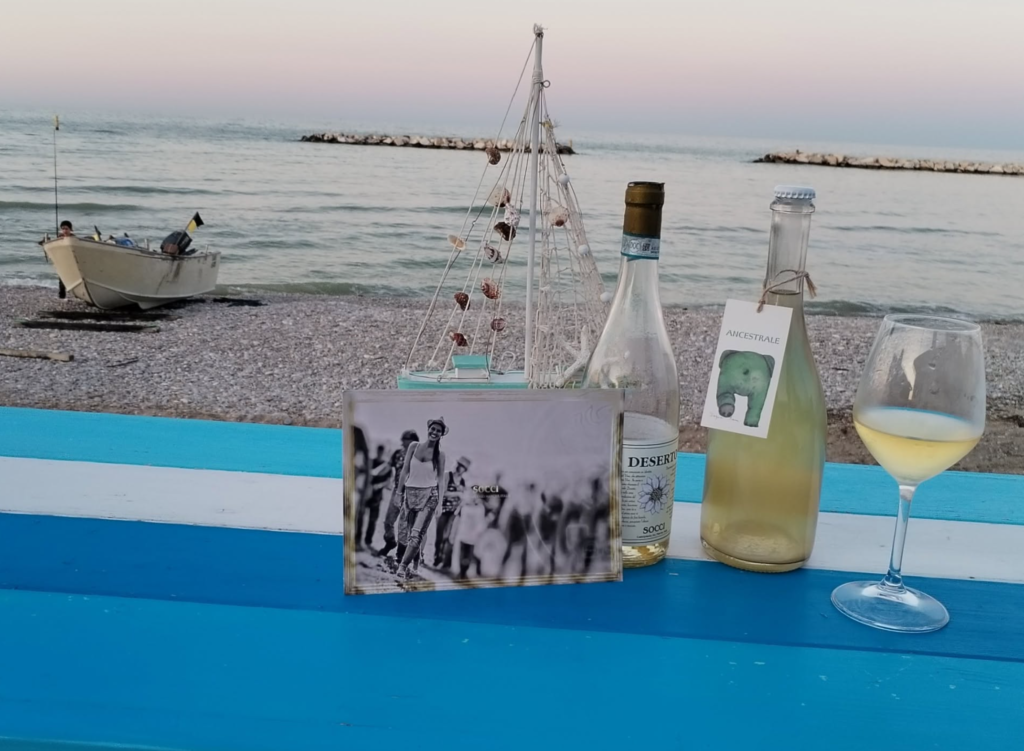
Pedaso and Marina Palmense both sit on the same stretch of Fermo-province coastline covered in our guide to the Cavalcata dell’Assunta in Fermo, making a fish dinner an easy add-on to a trip built around the festival. Further north, the same working-harbor logic applies to the Conero Riviera, where the Portonovo mosciolo cooperative operates. And a fisherman-run meal is, in its own way, the clearest possible illustration of the Mediterranean diet this region is known for — pair it, if you can, with a glass of the local bulk wine still sold straight from the tank in towns up and down this coast.
The Takeaway
Ittiturismo in Le Marche is still small enough that a single article can name most of what genuinely exists, and that is exactly what makes it worth seeking out now rather than waiting for it to become a recognized category with its own guidebooks. Pair a visit to Pedaso or Marina Palmense with the brodetto this coast is already known for, and with a longer look at Le Marche as a region built for exactly this kind of unhurried discovery.
If you’re planning a trip that goes beyond a single meal — sorting out where to base yourself along the Fermo coast, or how a stop here fits into a longer Marche or central Italy itinerary — you can book a planning consultation with me directly at TidyCal.
Written by Mirco Vitellozzi, a structural engineer from Le Marche who writes about Italy from the inside. More essays at Tastes & Wonders of Italy, and short films on YouTube.