Notte della Taranta 2026 Melpignano Tickets: What’s Actually for Sale and What’s Free
https://tasteandwondersofitaly.com/ – https://www.youtube.com/@TasteWondersofItaly
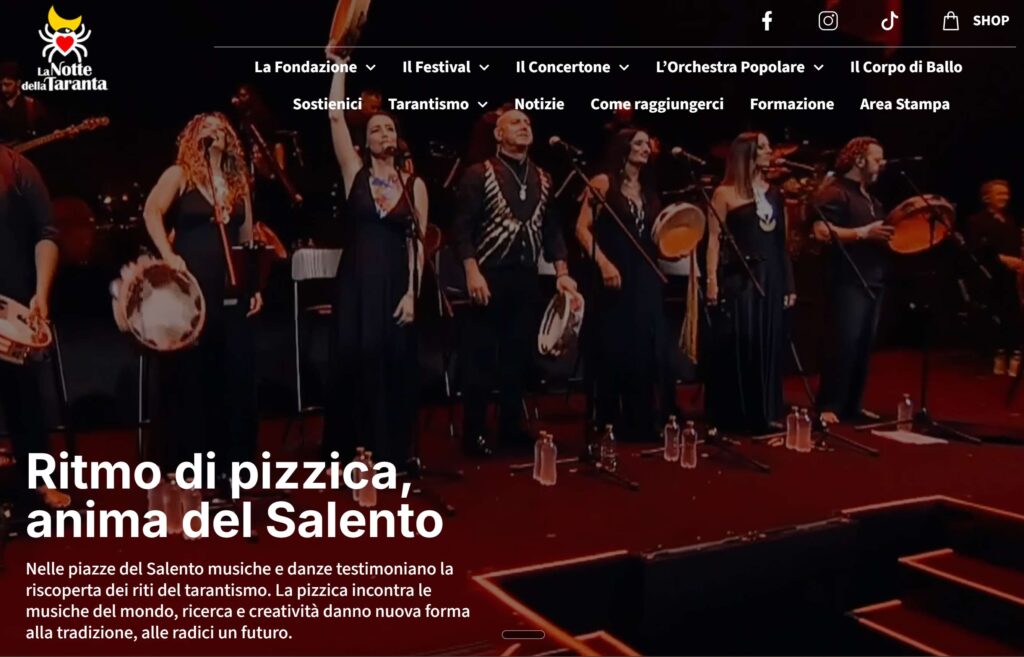
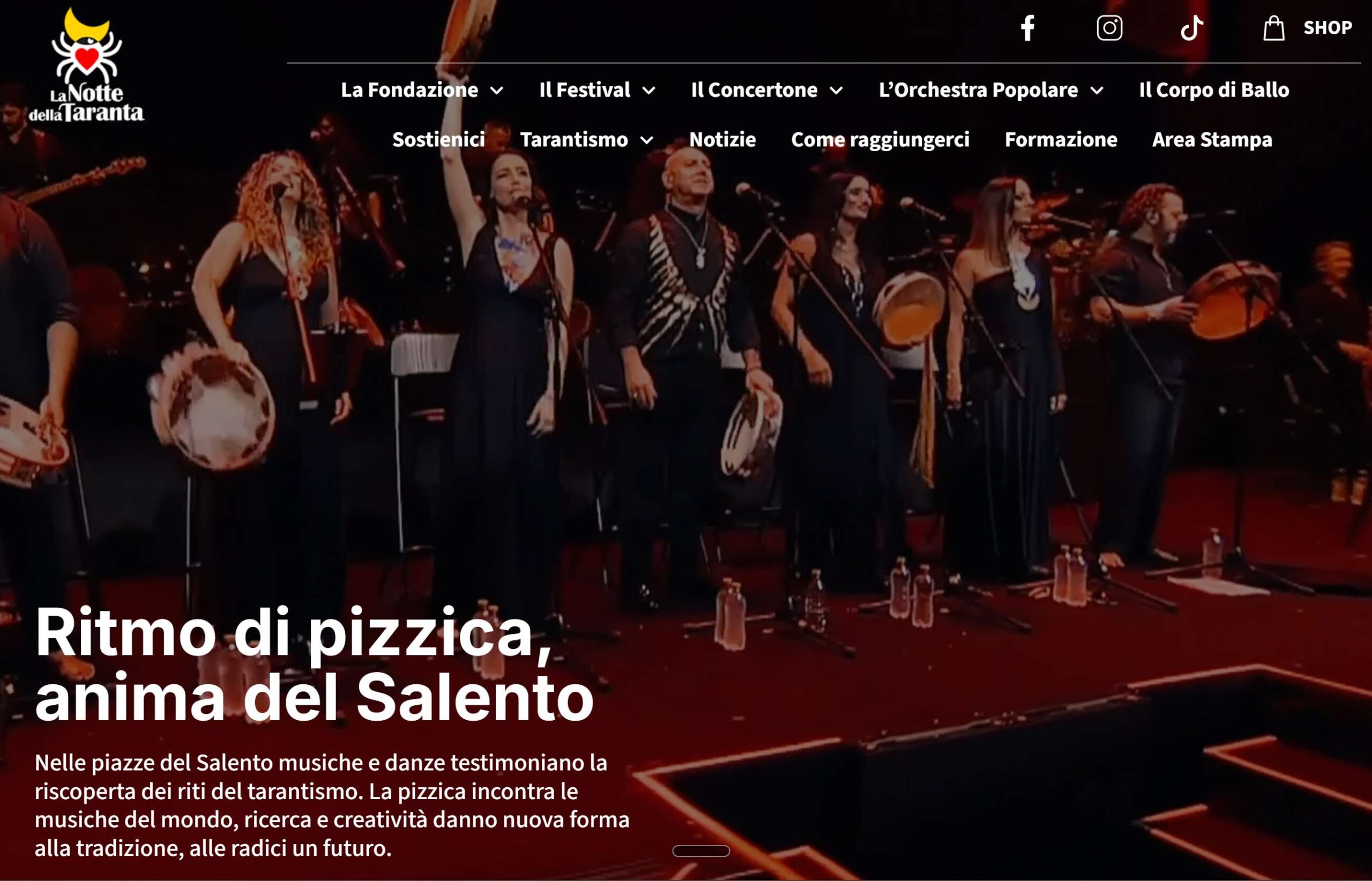
There is a moment, somewhere past midnight in the Piazzale ex Convento degli Agostiniani in Melpignano, when the pizzica (the ancient tambourine-driven folk dance of the Salento peninsula) stops being a performance and becomes something else entirely. Two hundred thousand people pressed against one another in air so salt-heavy and warm it feels solid — and a single tamburello (frame drum) finding a rhythm that every body in the square begins to answer, involuntarily, before the mind has caught up with what is happening. I have driven six hundred kilometers south from the Marche to Melpignano three times to stand in that square. Each time, the experience has surprised me.
The honest answer the festival’s marketing won’t quite say out loud is this: admission to the Concertone — the massive closing concert of Italy’s largest folk music festival — is free. If you have landed on this page searching for Notte della Taranta 2026 Melpignano tickets and expecting a booking portal, what you will actually find here is a clear account of what costs nothing, what has a price, and — more usefully — where the real money goes if you want to experience this event at its fullest. The 29th edition of La Notte della Taranta closes in Melpignano on Saturday, August 22, 2026, with Albanian-Italian singer-songwriter Ermal Meta serving as Maestro Concertatore (artistic director and conductor).
What La Notte della Taranta Actually Is
To understand why hundreds of thousands of people converge on a town of two thousand inhabitants in the provincial interior of Puglia, you need to go back further than the festival itself — to the phenomenon it was built to honor and, in its way, exorcise.
Tarantismo (tarantism) was a condition documented across the Salento peninsula for centuries: a form of psychosomatic crisis, most commonly afflicting women, attributed to the bite of the taranta (the wolf spider). Those afflicted fell into a state of profound collapse and could be brought out of it only through days of continuous dancing to a specific driving rhythm — the pizzica — under the supervision of musicians, priests, and the community. The anthropologist Ernesto De Martino, in his landmark 1961 study La terra del rimorso (The Land of Remorse), documented the last surviving cases in the early 1950s and argued that tarantism was not superstition but a socially sanctioned rite of crisis, a coded language for expressing pain — most often the pain of women in a rigidly circumscribed society — that had no other legitimate channel.
The Grecia Salentina (Salentine Greece), the cluster of nine towns in the province of Lecce where La Notte della Taranta is rooted, is itself a remarkable anomaly. These villages — Calimera, Castrignano de’ Greci, Corigliano d’Otranto, Martano, Martignano, Melpignano, Soleto, Sternatia, Zollino — have maintained for centuries a residual form of the Greek language called grika, a dialect descended from the Byzantine-era population of the “tacco” of Italy. Grika is still spoken today by a shrinking but living community of elders and enthusiasts. The festival was founded in 1998 precisely by the Unione dei Comuni della Grecia Salentina and the Istituto Diego Carpitella as an act of cultural recovery — an attempt to preserve and revitalize a musical and choreographic tradition that was in danger of disappearing into mere ethnographic memory.
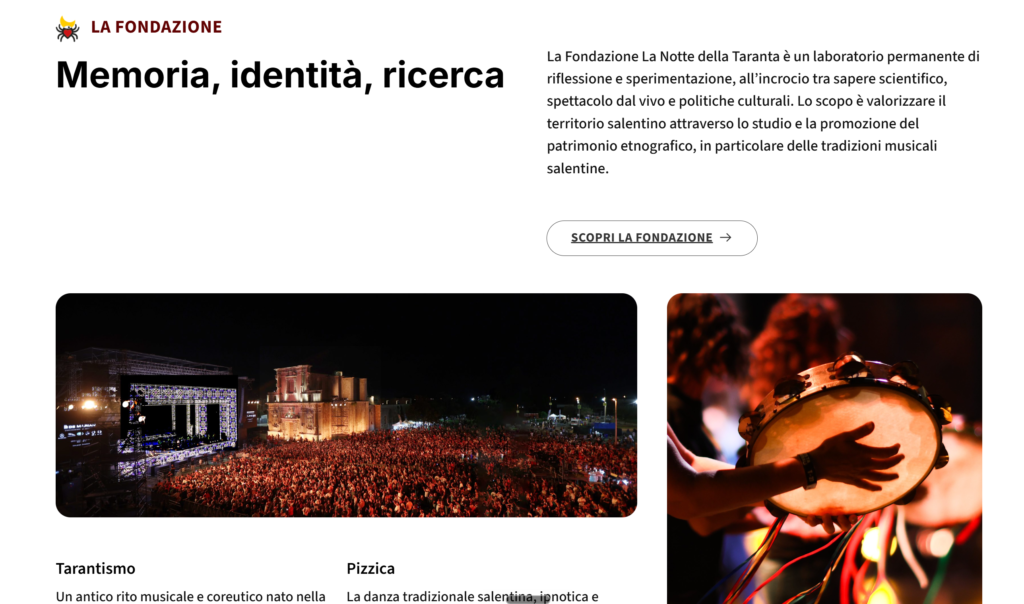
The Concertone at Melpignano, which has grown to become one of the largest outdoor concerts in Europe, is the spectacular apex of this project. Each year a different Maestro Concertatore takes charge of reworking the traditional repertoire together with the festival’s Orchestra Popolare (Popular Orchestra) and an ensemble of national and international guests. Past conductors have included Stewart Copeland of The Police, Ludovico Einaudi, Goran Bregović, Carmen Consoli, Fiorella Mannoia, and Stefano Bollani, which gives a sense of the cultural latitude the festival navigates. The full program and the lineup of guest artists are announced progressively in the weeks leading up to the event; follow La Notte della Taranta official festival website for confirmed announcements.
The 2026 Festival Schedule and the Concertone Date
La Notte della Taranta has a double structure. The festival itinerante (touring festival) runs through the towns of the Grecia Salentina and other Lecce province municipalities across the first three weeks of August 2026, with concerts held in village squares beginning typically around 9:30 PM. Each evening belongs to a different municipality — Calimera on one night, Sternatia on another, Soleto the next — with the Orchestra Popolare, solo artists from the pizzica tradition, and occasional international guests from the world of global folk music. The great majority of these concerts are free; a small number, particularly those featuring high-profile guests, may carry a nominal admission charge in the €15–40 range. The 2026 itinerant calendar will be published on the official site in early summer; check lanottedellataranta.it for the confirmed dates and venues.
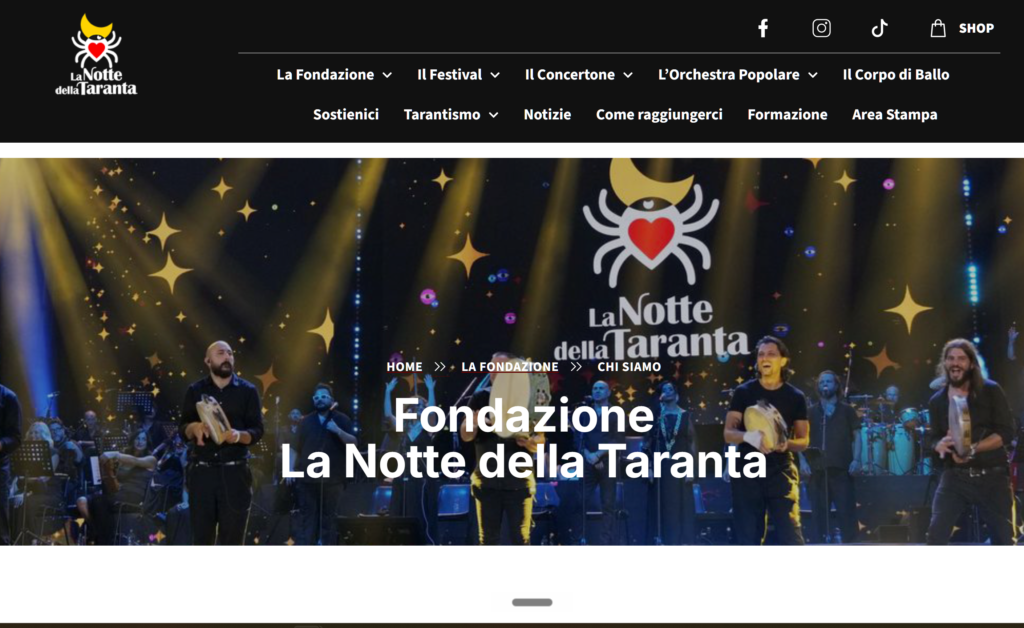
The Concertone itself takes place at the Piazzale ex Convento degli Agostiniani in Melpignano on Saturday, August 22, 2026. The site is a former Augustinian convent complex, now the headquarters of the Fondazione La Notte della Taranta, and its courtyard and surrounding piazza expand on the night of the concert to accommodate crowds that have historically reached 200,000–250,000 people. The pre-concert program (Pre-Concertone) opens at 7:00 PM with students from the Progetto Matria, the Associazione I Sempre Vivi, and singer Enza Pagliara with the Festa Adriatico Balcanica — a warm-up sequence that weaves together different voices and roots before the main event. The Concertone proper begins at 9:00 PM and typically continues well past 1:00 AM.
For 2026, Maestro Concertatore Ermal Meta — born in Fier, Albania, and raised in Bari after arriving in Italy at age thirteen during the mass exodus that followed the collapse of communism — brings the festival’s Mediterranean theme into sharp biographical focus. The Fondazione’s stated theme for this edition is the Mediterranean as a space of encounter rather than division: “not one civilization, but a thousand civilizations layered on top of one another,” in the words of historian Fernand Braudel. Meta, a Sanremo Festival winner and one of the most distinctive voices in contemporary Italian songwriting, performed at the 2025 edition as a guest artist, premiering Lule Lule — an ancient love song in arbëreshe, the Italo-Albanian language — alongside Mediterraneo from his most recent album. His appointment as Maestro Concertatore for 2026 carries a thematic coherence that is anything but accidental.
Notte della Taranta 2026 Melpignano Tickets: What’s Actually for Sale
Let this be clear from the outset: entry to the Concertone finale at Melpignano is free. Anyone can walk into the Piazzale ex Convento degli Agostiniani, occupy a position behind the reserved area, and remain until the last notes fade. This has been the organizing principle of the event since its founding, and it is not incidental — it is the philosophical backbone of a festival that was conceived explicitly as a public cultural act, not a commercial entertainment product.
What does carry a price are three specific things.
Reserved seats in the protected area in front of the stage. The Fondazione La Notte della Taranta offers a limited number of numbered, assigned seats in an enclosed zone immediately in front of the stage — capacity varies by configuration but is typically in the range of 800 to 1,500 places. These are sold exclusively through the official ticketing portal at lanottedellataranta.it. Prices for 2026 have not yet been announced at the time of writing; based on previous editions, the range has fallen between €70 and €150 per seat. The package typically includes early-entry access, a numbered chair, water service, and access to a dedicated area with improved sightlines to the stage. Presale generally opens in July; seats sell out within two to three weeks. If you intend to purchase them, bookmark the official site now and check it in late June.
Bus-and-reserved-seat packages from nearby cities. Several authorized operators offer combined transportation and entry packages departing from Lecce, Otranto, Gallipoli, Bari, Brindisi, and in some years from Rome and Naples. Prices have historically ranged from €80 to €180 for the combined package. These are worth considering if you prefer not to manage parking logistics on the night of the event — driving to Melpignano on August 22 means parking at a designated interchange 3–4 kilometers from the center and boarding a shuttle. The shuttles are well-organized, free of charge, and run continuously until the early hours, but the walk in 28-degree heat with near-tropical humidity is not for everyone. Bus-and-seat packages from Lecce appear on the major experience platforms from May onward, listed by the local operators who run the shuttles. Search by date rather than by festival name: the listings are often titled as Salento evening transfers rather than as Notte della Taranta packages.
Tickets for individual touring festival concerts with paid admission. As noted above, the majority of the itinerant festival concerts are free. Those featuring internationally recognized guests may carry an admission fee; consult the official site as the calendar is published.
As for official Notte della Taranta reserved-seat tickets — this is the page to watch when presale opens.
Free Standing or Reserved Area?
The reserved area is worth its price under specific circumstances: if you are traveling with children under twelve, if you have mobility limitations, if heat management is a concern, or if you want an unobstructed sightline to the stage and intend to remain seated through the longer orchestral passages. It is also the right choice if you are attending primarily to watch Ermal Meta conduct — the stage experience is more legible from the reserved zone.
The free standing area is the correct choice if you are between twenty and forty-five, have good physical endurance, came to Melpignano to dance the pizzica rather than observe a concert, and understand that being pressed into a crowd of two hundred thousand bodies as the tamburello reaches its highest frequency is itself the event. The cultural experience of the Concertone is not seated. If budget is a constraint, spend on the hotel and the itinerant festival stages, not on reserved seating.
Where to Stay in Salento for La Notte della Taranta 2026
Accommodation is the real logistical challenge of the event, and it is where money either locks in an extraordinary experience or gets wasted on whatever scraps remain after everyone else has booked.
Lecce. The Baroque capital of the Salento — its cathedral, amphitheater, and stone-carved palazzi built from the warm, cream-colored pietra leccese — is the natural hub for festival-goers who want a three-day cultural stay alongside the event. Distance from Melpignano: roughly 30 kilometers, 35–40 minutes by car. Hotel rates in August run €120–500 per night; the best properties at those prices book by March. Lecce is also the easiest departure point for bus-and-seat packages to the Concertone. You can compare Lecce hotels for the festival week well in advance; by June the sensible options at sensible prices are gone.
Otranto or Gallipoli. For those who want to combine the festival with the Adriatic or Ionian coast — Otranto’s castle-shadowed harbor and crystalline sea, or Gallipoli’s baroque island center with its night-thick beaches — both towns are viable bases, though the drive to Melpignano (35–55 kilometers) requires planning, and taxi rates from the coast at 1:00 AM on a Saturday in August are steep. August rates: €180–700 in Otranto, €150–600 in Gallipoli.
Masserie of the inland Salento. The most compelling choice for a couple or honeymoon visit: the masseria-style farm estates scattered across the countryside between Maglie, Cutrofiano, Galatina, Corigliano d’Otranto, and the Melpignano surroundings. These olive-grove-pressed stone complexes, with their pools and working farms, have become the prestige accommodation category of the Salento summer. August rates run €350–1,200 per night, and the best properties are booked by late February. The advantage is proximity: a masseria 10 kilometers from Melpignano means no traffic anxiety on the night of the Concertone. The masserie of central Salento are the category to search, and February is not too early.
B&Bs in the Grecia Salentina villages. The most immersive option for the committed festival-goer: small guesthouses in Calimera, Martano, Soleto, or Sternatia, often within walking distance of the itinerant concert stages. Rates are lower — €80–180 per night — but availability at this price evaporates by May. If this is your preference, book before the Maestro Concertatore announcement, because that news reliably triggers a booking surge.
Whatever your choice: accommodation prices across the entire Salento rise 40–80% in the week of the Concertone. The best structures are gone before Easter. Do not wait for the lineup announcement to book.
Practical Tips from a Local
Melpignano on the night of August 22 is not navigable by private car from within 4 kilometers of the center. Arrive by bus-and-seat package from Lecce or another hub, or park at one of the designated interchange areas — the Fondazione organizes free shuttle buses that run continuously to and from the Piazzale until the early hours. Follow signage and the official transport instructions published in July; the system is well-rehearsed.
The Salento in late August is not the gentle warmth of Tuscany or the Cinque Terre. It is salt-baked heat that has been accumulating since June, and at 11:00 PM in the middle of the Piazzale, the temperature will still be above 28 degrees with humidity to match. Carry a full water bottle, wear a hat for the early evening, eat something substantial before entering, and resist the temptation to drink alcohol before midnight — the combination of heat, crowd, and dehydration sends people down regularly.
For food on the night: panzerotti (fried dough pockets filled with tomato and mozzarella), rustici leccesi (béchamel-and-tomato-filled pastry rounds), and pasticciotti (custard-filled shortcrust pastries) are available from street vendors throughout the festival area. Do not attempt to book a sit-down dinner in Melpignano on August 22; the town’s restaurants are saturated for days, and the lines will outlast your patience.
The stronger argument for attending the itinerant festival: the true spirit of the Notte della Taranta is not the Concertone. It is a Thursday night in Sternatia or Calimera with five hundred people in a lamplight-washed square, two tamburello players finding each other’s rhythm in the dark, and a pizzica circle forming spontaneously in the stone-paved center. It costs nothing. It is not on any international travel radar. And it will leave a more durable mark than two hundred thousand strangers pressing toward the same stage.
Plan Early, Book First, Then Enjoy the Free Part
Notte della Taranta 2026 Melpignano tickets are, in their most important form, not tickets at all. The Concertone on Saturday, August 22, 2026, is open to anyone who walks in — a fact that distinguishes this event from every similarly scaled European music festival and that reflects a founding commitment to culture as public rather than private experience. Ermal Meta’s appointment as Maestro Concertatore for the 29th edition brings a story of migration, encounter, and Mediterranean identity directly into the music, and the pre-concert program beginning at 7:00 PM extends the evening into something closer to a full cultural evening than a single show.
What is genuinely scarce, genuinely time-sensitive, and genuinely worth money are the reserved seats (when presale opens in July, move that day), the organized bus-and-seat packages, and above all, the accommodation. Reserve your Salento masseria or Lecce hotel before the end of March 2026 and monitor the official ticketing portal through June and July: the Concertone itself is free, but everything that makes it comfortable and memorable is a high-demand commodity in the most booked stretch of the Italian summer.
Written by Mirco Vitellozzi, a structural engineer from Le Marche who writes about Italy from the inside. More essays at Tastes & Wonders of Italy, and short films on YouTube.