San Ginesio, Le Marche: The Hill Town That Shares Its History With Siena
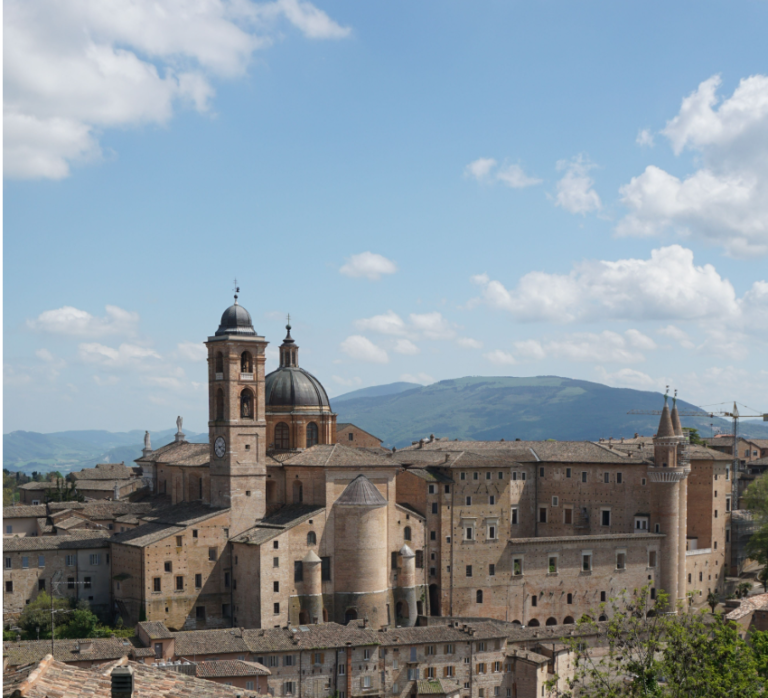
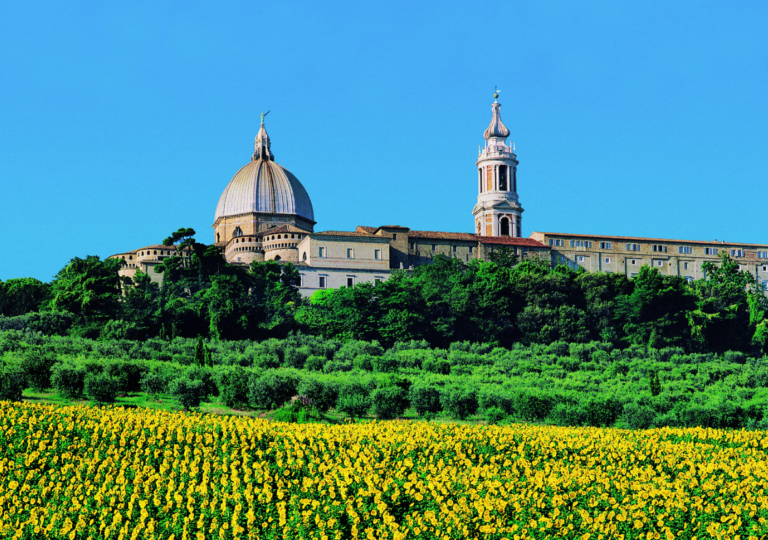
The road into San Ginesio climbs through oak woodland and then opens, without warning, onto a ridge. On one side, the terraced rooftops of a medieval hilltop comune in the Marche; on the other, on clear days, the grey-blue silhouette of the Monti Sibillini stretching south toward Abruzzo. The view is the first thing you notice. The second is the silence. Not the performed quiet of a heritage site, but the ordinary silence of a town of two thousand people going about its morning — a dog, a tractor somewhere below, the bell of the Collegiata marking the hour.
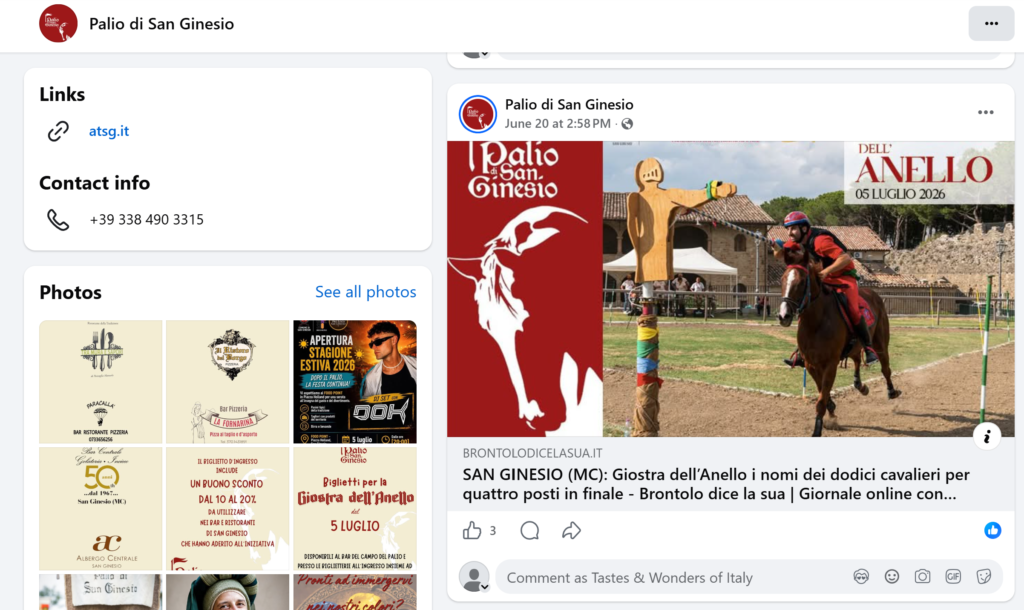
San Ginesio is one of the Borghi più belli d’Italia — Italy’s association of the most beautifully preserved historic towns — and it sits in the Monti Azzurri area of the Maceratese hinterland, roughly thirty minutes from both Macerata and the Adriatic coast. I have driven this road in all four seasons. The town looks different in November fog and in July heat, but the quality it projects — a kind of contained civic dignity — does not change. This is a place that knows what it is and does not need to explain itself to visitors.
What brings me here most often, and what should bring the American traveler who plans central Italy with more than the usual care, is the Palio di San Ginesio: a medieval contest between the town’s four historic Porte (Gates) that reaches its summer peak on two dates — July 5 and August 15, 2026. The 55th edition of the Palio is a good moment to discover it.
—
What San Ginesio Is, In Brief
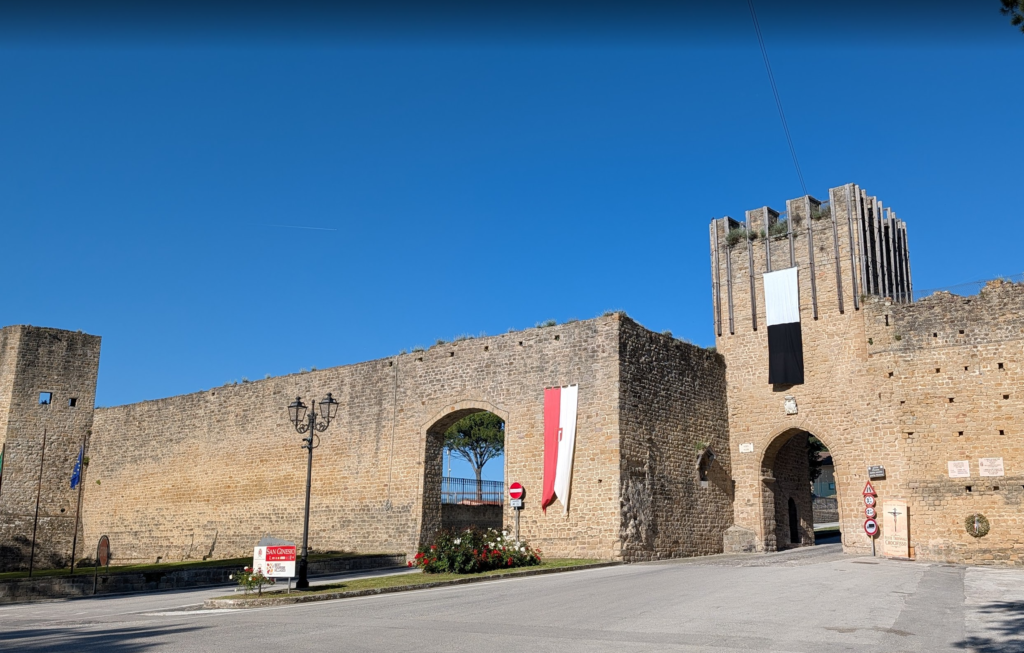
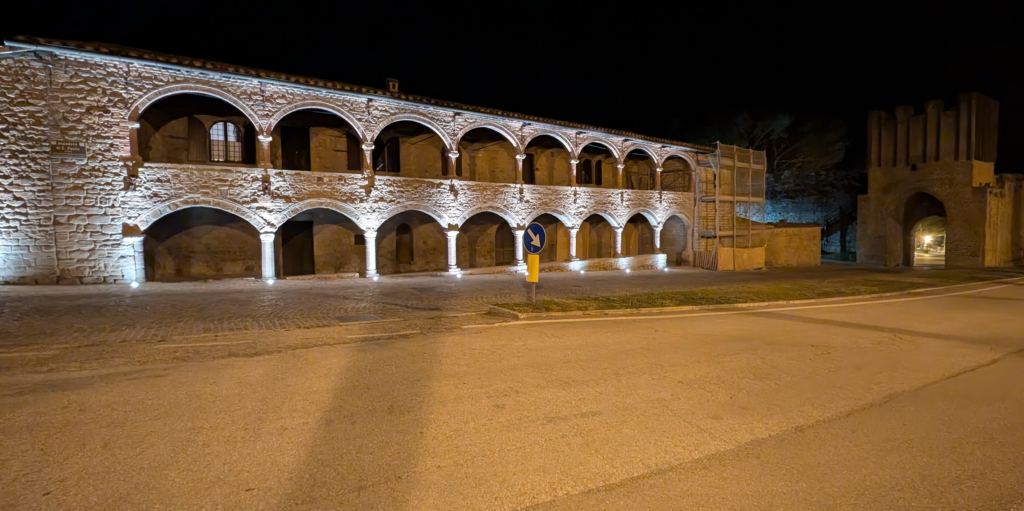
San Ginesio sits at 691 meters above sea level in the foothills of the Sibillini, within the territory of the Unione Montana dei Monti Azzurri. It takes its name from Saint Genesius of Rome, the patron of actors and musicians — a detail that resonates in a town that has hosted the Ginesio Fest, an international theater festival, alongside its medieval jousting for the past several years. The historic center, encircled by fourteenth-century walls, is compact enough to walk in twenty minutes but layered enough to occupy a full afternoon. The Romanesque Collegiata dell’Annunziata, the Loggia dei Priori and the Ospedale dei Pellegrini (Pilgrims’ Hospital) stand around the main piazza in a composition that has not changed significantly since the sixteenth century.
For the purposes of planning a visit, the essential geographical fact is this: San Ginesio is equidistant from the coast and the mountains, an hour from the sea at Civitanova Marche and forty minutes from the Sibillini trailheads at Bolognola. It belongs, culturally and historically, to the Le Marche region that shaped the Mediterranean diet and produced some of central Italy’s most distinctive food traditions. The kitchen follows: lentils from Castelluccio, aged sheep’s cheese from the hills, lamb from the Sibillini pastures, and the local bread that carries no salt, a Marche-wide custom that confuses visitors from outside the region and should not be mistaken for an error.
—
A Friendship Forged in Exile: San Ginesio and Siena
To understand why the Palio di San Ginesio matters — not as a re-enactment in period costume but as a living act of civic memory — you need to know what happened in the 1450s.
San Ginesio was, at that period, a minor but proud commune caught in the factional turbulence of late medieval central Italy. The struggle between those who favored the Da Varano lordship and those who preferred to live as a free commune under the Church produced, as such struggles invariably did, a forced exile. Around three hundred Ginesini were expelled from their own town. Homeless and without prospects, they made their way to Siena — then a powerful republic, a city of resources and hospitality.
The Sienese received them well. The exiles served for months in the city guard, conducting themselves, by all accounts, with such discipline and loyalty that the citizens took notice. When the Sienese were eventually asked who these steady, dignified soldiers were and why they had remained so long, the exiles explained their situation: driven from their hometown, uncertain of return, with no hope of going back. The Sienese response was practical and generous. They sent ambassadors to San Ginesio to negotiate the return, arranged a reconciliation between the exiled and their opponents, and accompanied the three hundred home. The exiles arrived at Porta Picena carrying a wooden Crucifix of Sienese origin — still venerated in the Collegiata today — and the statutes of Siena, which the Ginesini used as a model for their own reformed governance.
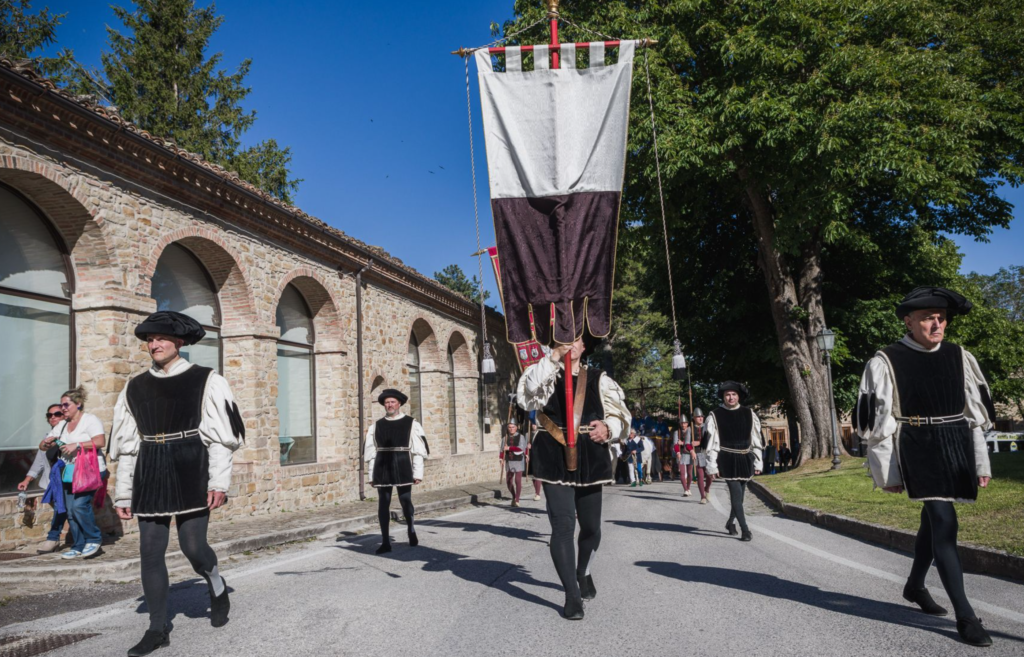
That episode is now six hundred years old. What is remarkable is that it is not simply commemorated but physically renewed. Every three years, in late May, the Ritorno degli Esuli (Return of the Exiles) brings a delegation from the Municipality of Siena — in full costume, with the banner of the Magistrato delle Contrade and, in recent years, representatives of specific Sienese contrade — to walk through Porta Picena and repeat the reconciliation. The most recent edition took place on May 23 and 24, 2026, and was the 22nd since the re-enactment began in 1963. The next will be in 2029.
There is a detail about this event that I have never seen mentioned in any English-language travel writing about Le Marche, and it tells you something essential about the authenticity of the relationship. Each time the Ritorno takes place, Siena does not merely send people. It sends the monture — the historic costumes, its own medieval dress — to clothe the Ginesini who represent the returning exiles. The cloth that dresses San Ginesio’s participants on that day is Sienese. It crosses the Apennines by arrangement. It has been doing so for over sixty years. This is not a heritage performance. It is a maintained friendship between two Italian towns, expressed in the language those towns still understand.
—
The Four Gates and the Logic of the Palio
The social structure of the Palio di San Ginesio is built on the Porte — the four historic gates of the medieval town — rather than the contrade or rioni that organize similar events elsewhere. Each Porta corresponds to an actual gate in the town walls and to the community that historically lived closest to it.
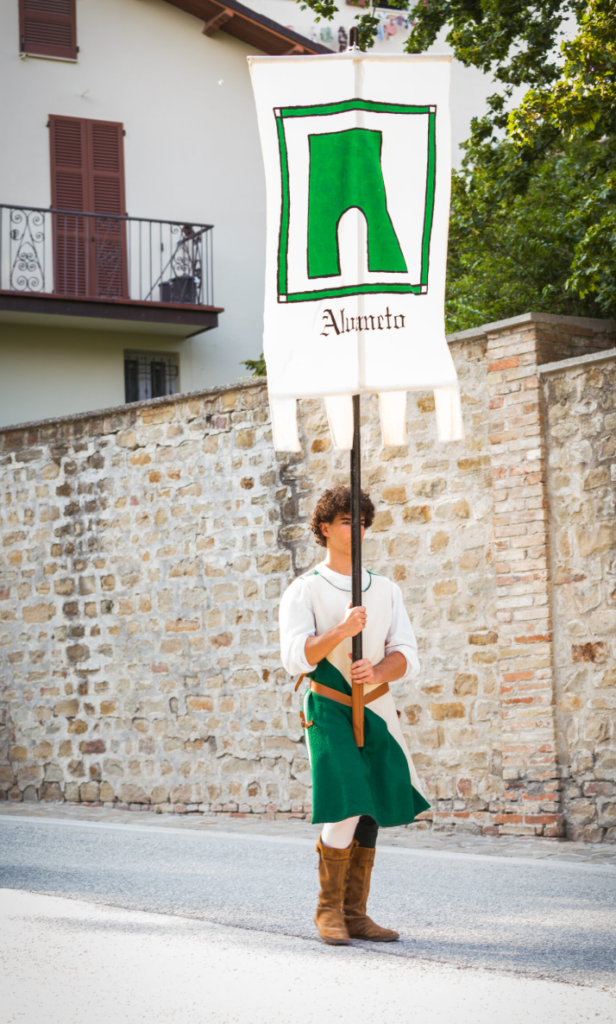
Porta Alvaneto occupies the northern sector of the town; its name preserves the memory of a medieval hamlet that no longer exists as a separate settlement. Porta Ascarana takes its name from the Colle Ascarano, the hill on which the town stands, and is associated with the area around the old hospital. Porta Offuna (sometimes written Offune in older documents) corresponds to the eastern approach and to a spring that once made this sector the most populated. Porta Picena is the most charged with historical meaning: it is the gate through which the returning exiles entered in the fifteenth century, the gate that faces south toward the Adriatic and the ancient Picene territories.
These are not teams assembled for a competition. They are civic subdivisions with their own colors, their own heraldry, their own sections of the old town, and their own identity within the community. The rivalry between them has been going on since the fourteenth century. Each Porta fields a single rider in the Palio’s two competitive events, and the overall champion — the Porta whose combined performance across both events produces the best score — receives the palio, a painted banner commissioned each year from a different artist.
—
The 55th Palio di San Ginesio: Two Contests, One Champion
The 2026 edition is the fifty-fifth overall. It unfolds in two separate events, with a gap of six weeks between them: enough time for the town’s competitive energy to build, settle, and build again.
July 5, 2026 — Giostra dell’Anello
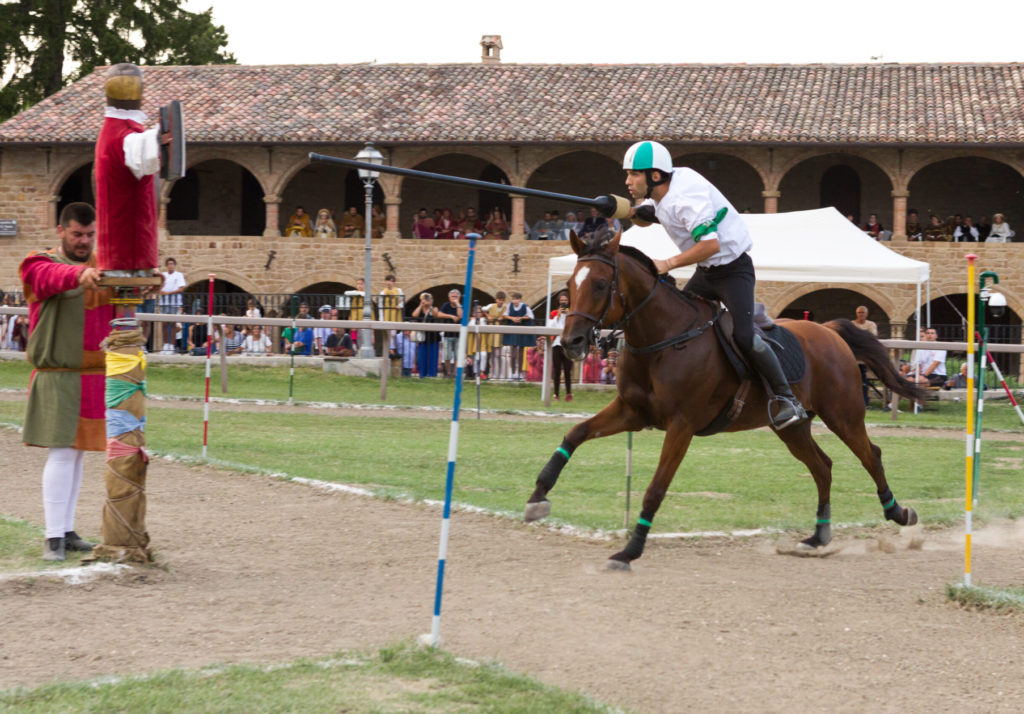
The ring joust is the more recently formalized of the two events, having been restructured in 2024 as a standalone morning-to-afternoon competition. The format is a qualifying round followed by a final: twelve riders compete in the morning eliminations, from which four qualify; those four are then assigned by lottery to the four Porte and contest the Giostra dell’Anello in the afternoon at the Campo del Palio.
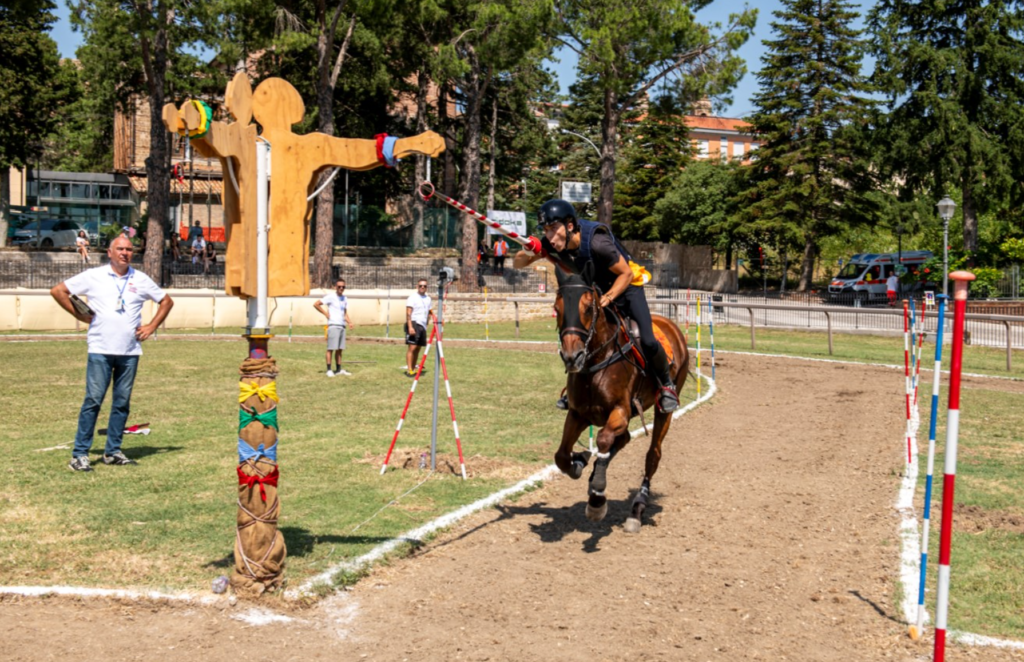
The mechanics: a brass ring is suspended on a crossbar. The rider charges at full gallop with a lance and must thread the ring’s opening cleanly with the lance tip. Speed matters; precision matters more. The scoring penalizes imprecision and rewards both clean passes and consistency across multiple runs. This is not a horse race — there is no finish line, no collision, no disqualified jockey. It is a test of the specific skill that medieval lance training was designed to produce, now performed in a hillside field below the town walls while the Porte’s supporters watch from the embankments.
The 2026 edition introduces, for the first time, a historical corteo in costume before the equestrian competition — a procession of the municipality and the four Porte that reinforces the link between the pageant and the joust. The sorteggio (draw for starting order) and the presentation of the painted banner take place on June 27 at the Auditorium di Sant’Agostino, a week before the event.
August 15, 2026 — Palio della Pacca
The older of the two events, the Palio della Pacca has been held since 1972. Its name requires explanation: pacca, in the dialect of the Maceratese hills, is the porchetta — the whole-roasted suckling pig that has been a central feature of central Italian festivity since the Renaissance. The winning Porta takes the porchetta as its trophy and consumes it during the Contrada’s celebration that evening. The trophy is not symbolic. It is eaten.
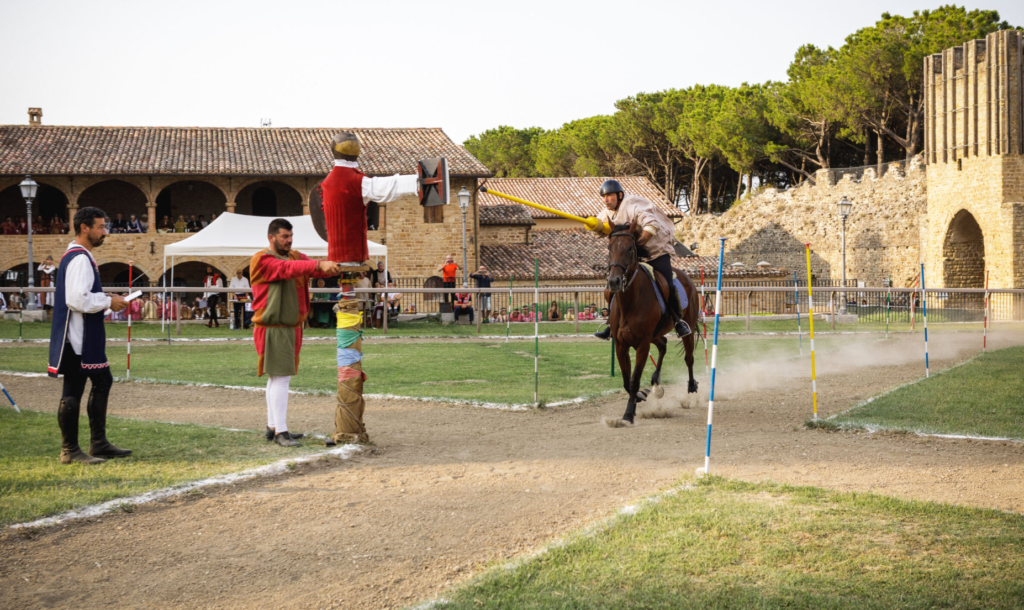
The competition is a colpo al Saraceno: each rider charges the silhouette of a knight at full speed along a winding course and must strike the Saraceno’s shield cleanly. The scoring accounts for accuracy, speed, and the cleanness of the hit across multiple runs. Where the ring joust is about threading a small target with precision, the Pacca is about impact — power delivered at the right angle on the right point. The two events test complementary skills and produce, in practice, different champions. The Porta that wins the overall Palio di San Ginesio is the one whose riders have performed best across both disciplines.
August 15 is the more ceremonially elaborate of the two days. The morning begins with a solemn Mass and the blessing of the drappo at Colle Ascarano at 11 a.m. At 4 p.m. the corteo storico — approximately two hundred figurants in late-medieval costume — files through Piazza Alberico Gentili and down to the Campo del Palio. The procession is led by the municipality’s standard bearers, followed by the priors of the four Porte, the officers of the medieval commune, the captain of the fair and the town’s historical functionaries, all in costumes that are reproduced from period documents and maintained with scholarly attention to the fabrics and dyes of the era. The joust follows at 5 p.m. The winning Porta receives its trophy at 7:30; the taverna opens at 8 p.m. and the evening belongs to San Ginesio.
—
Planning Your Visit
Getting there. San Ginesio is not served by rail. The nearest train stations are Macerata (about 35 kilometers northwest) and Civitanova Marche (about 40 kilometers northeast on the coast). From either, you need a car or a taxi for the final stretch. The SS78 from Macerata climbs through the Chienti valley and delivers you to San Ginesio in under forty minutes. From the A14 motorway (Bologna-Bari), exit at Civitanova Marche and take the SS485 inland.
When to go. July 5 is the quieter of the two dates — the town is not yet at summer peak, the event is newer, and the crowd is predominantly local. August 15 is Ferragosto, Italy’s national holiday, and the town fills with Marchigiani returning from the coast and with visitors from the wider province. Both dates repay attendance, but for a first visit with full access to the town before and after the competition, July 5 offers a more intimate entry point.
The night before. The Porte open their taverne the evening before each joust: long tables set in the medieval streets near each Porta’s seat, with vincisgrassi, lamb, lentil soup from the Sibillini, local Verdicchio and Rosso Piceno. The energy at these dinners — competitive, communal, occasionally loud — is as much a part of the Palio experience as the joust itself. There are no reservations; you arrive, find a seat with one of the four Porte, pay a modest per-person amount, and spend the evening with the neighborhood whose colors you are about to watch compete. It is, unambiguously, the thing to do.
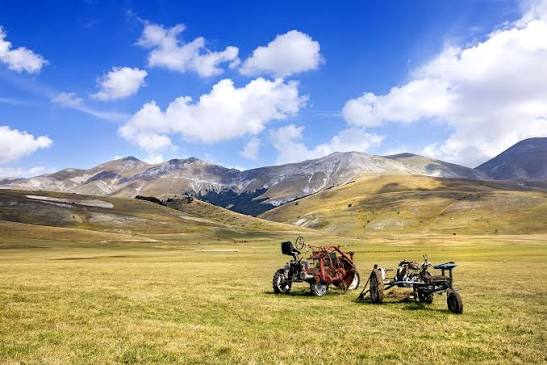
What to combine. San Ginesio sits at the center of a radius that includes several of the most remarkable landscapes and historic towns in Le Marche. The Sibillini Mountains are thirty minutes to the southwest: Castelluccio di Norcia and its lentil plain are accessible from the Ginesino side via Bolognola. Sarnano, a spa town ten minutes south, has thermal baths that operate through August. Tolentino (with its fine basilica) and Camerino (the university town, and a beautiful centro storico recovering from the 2016 earthquake) are both under thirty minutes away. Macerata, capital of the province and home to the Sferisterio opera festival in July and August, is forty minutes north.
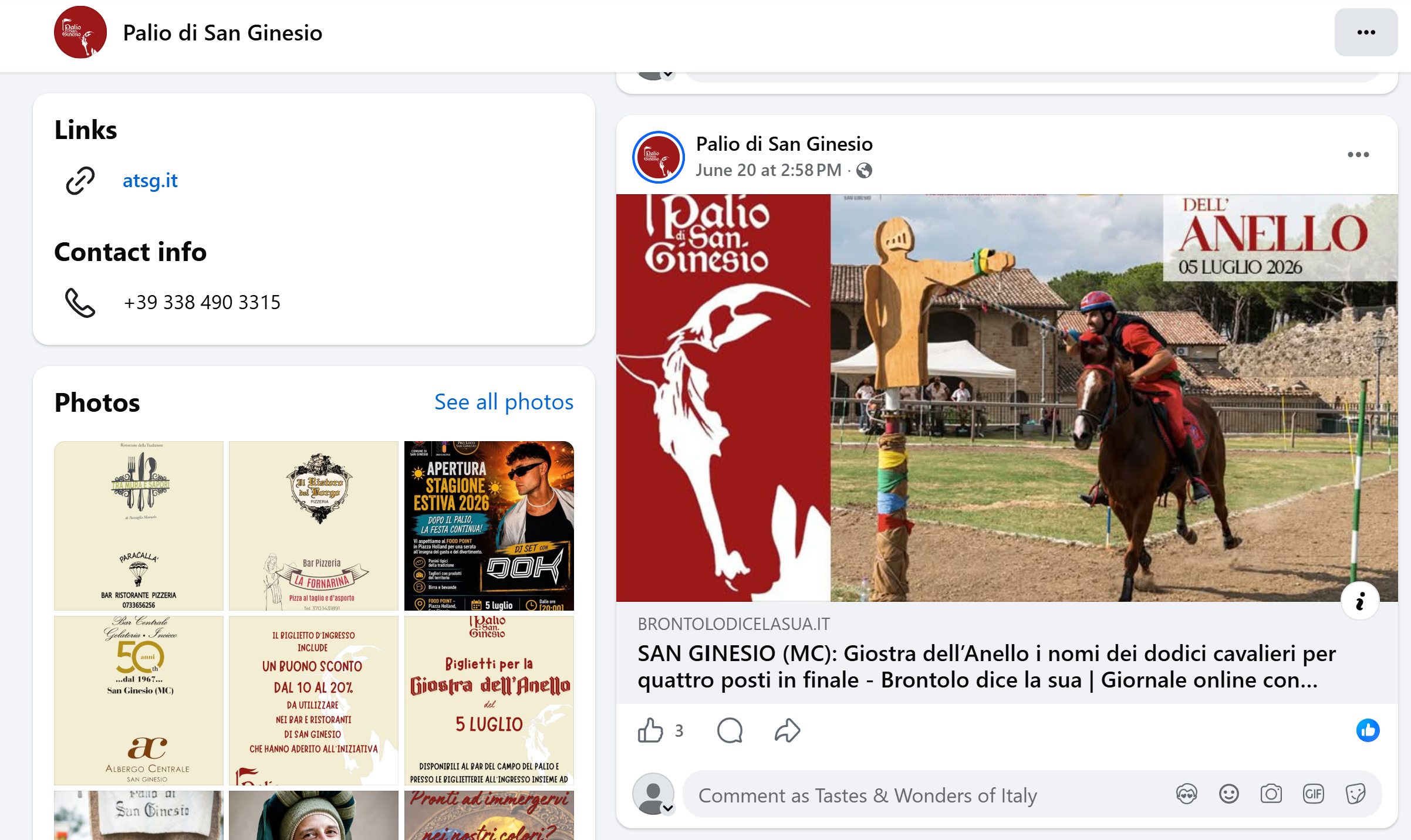
A practical note on the Palio itself. Tickets for the Campo del Palio are available through the ATSG (Associazione Tradizioni Sanginesine) website at atsg.it. Seating is in temporary stands along the joust course. Bring sun protection for the afternoon heat in July; the August 15 event begins later and catches the cooling of early evening. The Campo del Palio is outside the town walls, a ten-minute walk downhill from the center: follow the medieval corteo when it moves.
—
FAQ — Planning a Palio di San Ginesio Visit
What is the Palio di San Ginesio? The Palio di San Ginesio is an annual medieval competition between the town’s four historic Gates — Alvaneto, Ascarana, Offuna and Picena — held in two events each summer: the Giostra dell’Anello (a lance ring joust on July 5, 2026) and the Palio della Pacca (a strike-the-Saraceno joust on August 15, 2026). The Gate with the best combined score across both events wins the painted banner and the town’s honor for the year. The 2026 edition is the fifty-fifth overall.
What is the Giostra dell’Anello and how does it differ from a horse race? The Giostra dell’Anello is a ring joust, not a horse race. A single rider from each of the four Gates charges at full gallop with a lance and must thread a suspended brass ring with the lance tip. Points are awarded for clean passes, speed and consistency across multiple runs. There is no finish line, no collision between horses, and no disqualified jockey. It is a precision sport, closer to archery on horseback than to the Sienese Palio.
What is the Palio della Pacca? The Pacca is the older of San Ginesio’s two jousting events, running since 1972. The name comes from the local dialect word for porchetta — the whole-roasted pig that serves as the winning Porta’s actual trophy, consumed at the Contrada’s celebration dinner that evening. The competition is a colpo al Saraceno: riders charge the shield of a knight-silhouette target and are scored for accuracy, speed and clean impact.
When should I visit to see the Palio? There are two dates: July 5 (Giostra dell’Anello, a Sunday afternoon) and August 15 (Palio della Pacca, Ferragosto). July 5 is the more accessible date for visitors — fewer crowds, still hot, with the full day available before the late-afternoon competition. August 15 is more ceremonially elaborate, with a morning Mass, an afternoon corteo storico of two hundred figurants, and a festive evening, but it falls on the busiest national holiday in Italy.
Is there a connection between San Ginesio and Siena? Yes, and it is one of the most unusual diplomatic friendships in Italian history. In the fifteenth century, around three hundred Ginesini exiled by factional conflict were sheltered by Siena for months, serving as city guards. Siena then sent ambassadors to negotiate their return, accompanied them home, and provided them with the Sienese statutes as a model for governance. This friendship is re-enacted every three years in the Ritorno degli Esuli — the last edition was May 2026, the next will be 2029 — during which Siena sends both a formal delegation and its own historic costumes (the monture) to clothe San Ginesio’s participants. The exiles’ Crucifix, carried home from Siena in the fifteenth century, is still venerated in the Collegiata.
How do I get tickets for the Palio di San Ginesio? Tickets are available through the ATSG website at atsg.it. The events take place at the Campo del Palio, a short walk downhill from the historic center. For the August 15 event, the corteo storico begins in Piazza Alberico Gentili at 4 p.m. and moves to the Campo for the 5 p.m. competition; following the procession on foot from town is part of the experience and requires no ticket.
What else is worth seeing in San Ginesio? The Romanesque Collegiata dell’Annunziata with its Venetian-Marchigiano altarpiece tradition; the fourteenth-century walls and the four named Gates, each with its own character; the Loggia dei Priori; the Ospedale dei Pellegrini (medieval pilgrims’ hospice, still standing with its original arcades). The panoramic terrace near Porta Picena offers the view south toward the Sibillini that announces San Ginesio before you reach the town walls. The Ginesio Fest theater festival occupies the same summer weeks as the Palio and adds evening programming of a different register — outdoor performances in the piazza and in the Auditorium di Sant’Agostino.
—
The Final Word
San Ginesio is not a difficult place to understand. It is a medieval hill town in the Maceratese that has kept its history alive not through tourist infrastructure but through the community’s own insistence on re-enacting it every year. The Palio is not organized for visitors, which is exactly why it is worth attending as one. You are watching something that would happen whether you were there or not.
The Siena connection is real, documented, and maintained by two communities that chose to preserve it across six centuries. The four Porte compete because competition is how they have been relating to each other since the fourteenth century. The porchetta is eaten by the winners because that is what the winners have always done. None of this requires explanation in Italian. In the context of the blog you are reading now, it requires only the one explanation that every piece of this kind should offer: that what looks, from the outside, like a picturesque tradition is, from the inside, simply how a town measures itself against its own history once a year.
Planning a Le Marche itinerary around the Palio di San Ginesio or other medieval festivals? I offer 30-minute travel consultations for exactly this kind of trip — contact me via TidyCal to plan the details.
For the broader context of Italy’s medieval contests and how the Palio di San Ginesio fits into the ring-joust circuit across central Italy, read our complete guide: The Italian Palio, Decoded: Horse Races, Ring Jousts and Four Living Contests of the Middle Ages.
—
Written by Mirco Vitellozzi, a structural engineer from Le Marche who writes about Italy from the inside. More essays at Tastes & Wonders of Italy, and short films on YouTube.