Ascoli Piceno: Italy’s Most Beautiful Piazza Is in a Town You’ve Never Heard Of
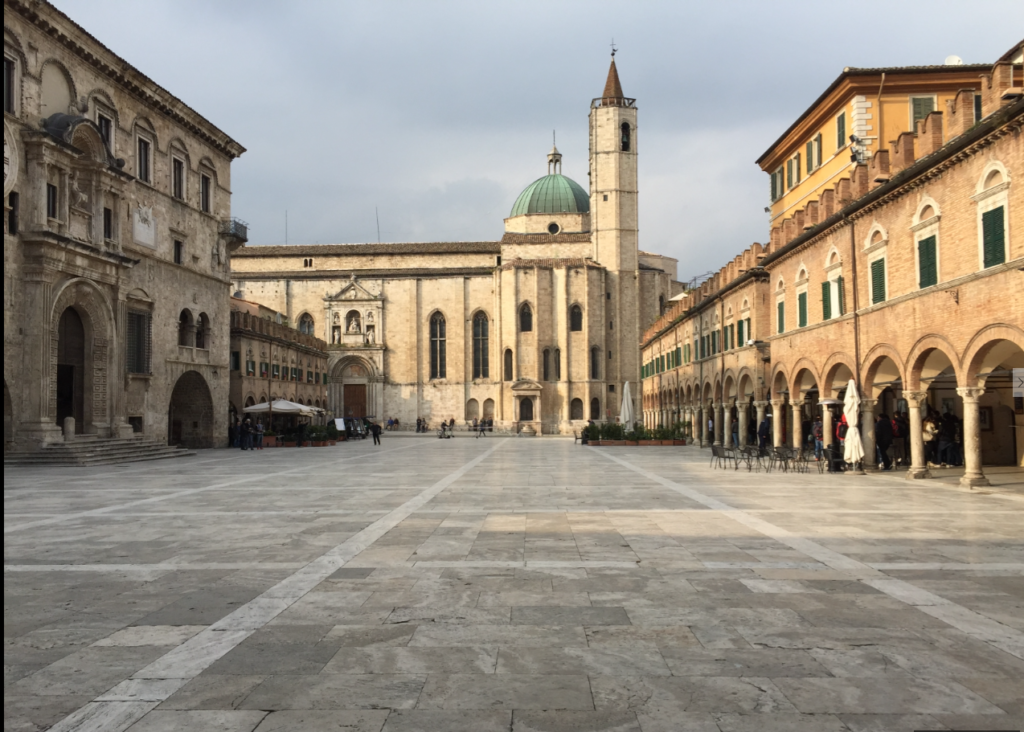
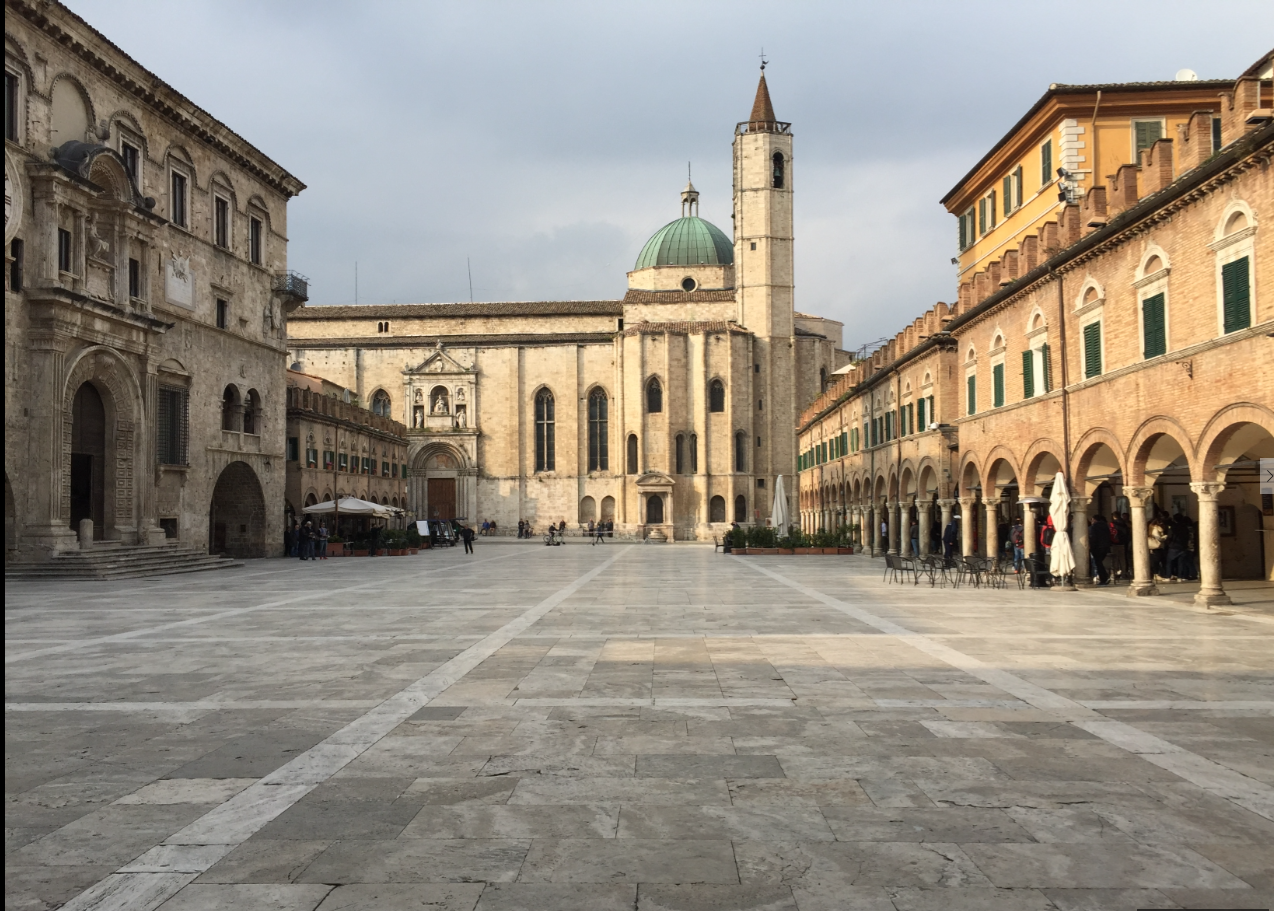
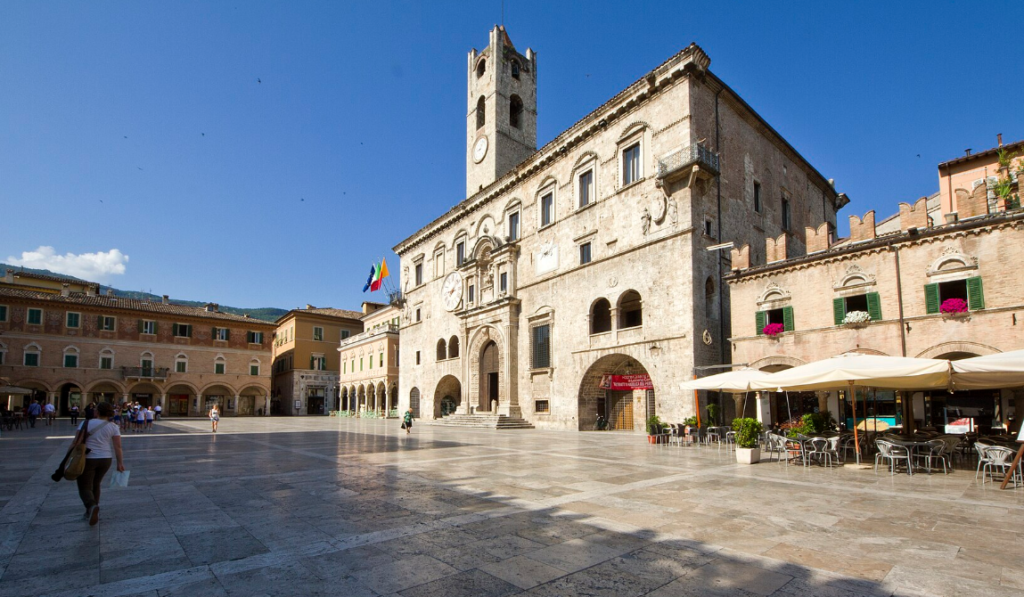
The first time you walk into Piazza del Popolo in Ascoli Piceno, your eye does something it cannot quite explain: it settles. The square is paved end to end in polished travertine, the pale local limestone that turns honey-gold at midday and softens to rose at dusk, and the buildings around you rise to nearly the same height, framed by the same arcade and pierced by the same shape of window. As an engineer from Le Marche, I can tell you this calm is no accident. It is the product of a deliberate Renaissance building code, written more than five centuries ago, that most visitors feel in their bodies long before they understand it with their minds.
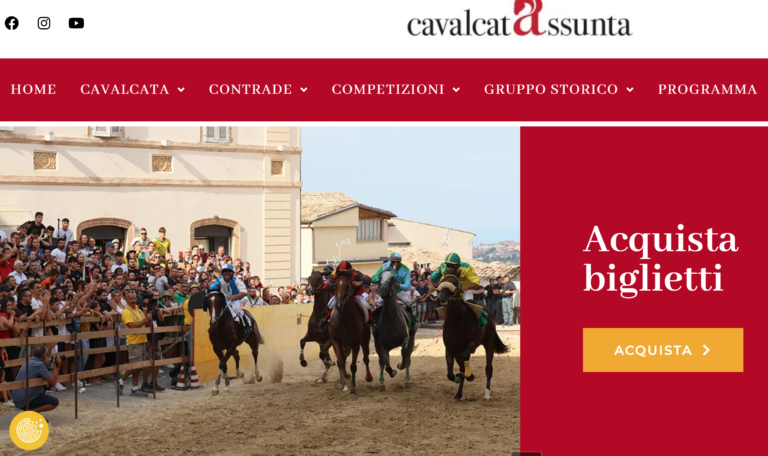
A note on links: some of the booking links in this article are affiliate links, and if you reserve through them I earn a small commission at no additional cost to you. One thing you cannot book that way is the Quintana joust. Those tickets exist only at the official box office in Ascoli, and any site claiming otherwise is reselling something it does not hold.
Why Ascoli Piceno deserves your attention
Ask an Italian what Ascoli Piceno is famous for, and the honest answer is usually a food: olive all’ascolana, the breaded and fried stuffed olives that turn up on antipasto plates from Milan to Palermo. The piazza, which deserves the headline far more, tends to come second. That inversion tells you something useful before you ever arrive. This is a town that has never sold itself hard, sitting in a region that Italians themselves treat as a well-kept secret, far enough from the Florence–Rome–Venice circuit that American itineraries routinely skip it.
A quick orientation
Ascoli sits in the southern corner of Le Marche, on a travertine plateau wedged between the Tronto and Castellano rivers, with the Sibillini and Laga mountains rising behind it. It is a compact town of fewer than 50,000 people, and its historic center is almost entirely built from a single material. That stone, quarried from the surrounding hills, is what the Romans used when they rebuilt the town they called Asculum, and what every later builder reused, recut, and stacked again. The result is a center of unusual visual unity, where Roman, medieval, and Renaissance fabric all speak the same chromatic language.
Piazza del Popolo is the heart of it. The square rose on the site of the Roman Forum, at the crossing of the cardo and decumanus, the two axes of the ancient grid. For two thousand years this has been where the city does its public business, and it still is.
The Italian insider angle
Here is the detail no travel guide will hand you. The reason Piazza del Popolo feels so resolved is that its Renaissance planners followed a strict geometric idea. Reading Vitruvius through the theories of Alberti and Filarete, they aimed for a roughly 1:3 ratio between the square’s width and length, wrapped in porticoes that gave the space its commercial rhythm. Then, after the colonnade was completed in 1509, the city imposed rules on every private owner who wanted to build above it: one floor only over the arcade, the same travertine for the window frames, the same reddish brick for the vaults, and an identical window type, squared with rounded pediments and palmette decoration.
In modern terms, this was a Renaissance zoning ordinance, an early act of urban design enforced down to the shape of a single window. When you sense that the square is in tune with itself, you are reading five centuries of disciplined repetition. That is the engineer’s reading of beauty, and it happens to be the truest one.
What to see and do
The piazza itself
Give the square time before you start ticking off monuments. Cross it slowly. After rain, the polished travertine takes on a faint mirror effect, doubling the arcades in the wet stone. In the early evening you will watch the struscio, the slow up-and-down stroll that is the local form of the more familiar passeggiata (the ritual evening walk), as Ascolani of every age fill the space simply to see and be seen. The contrast with the great tourist squares is sharp: where Venice’s Piazza San Marco can feel like a stage set, this is a piazza that is still genuinely used by the people who live around it.
The Palazzo dei Capitani and the Church of San Francesco
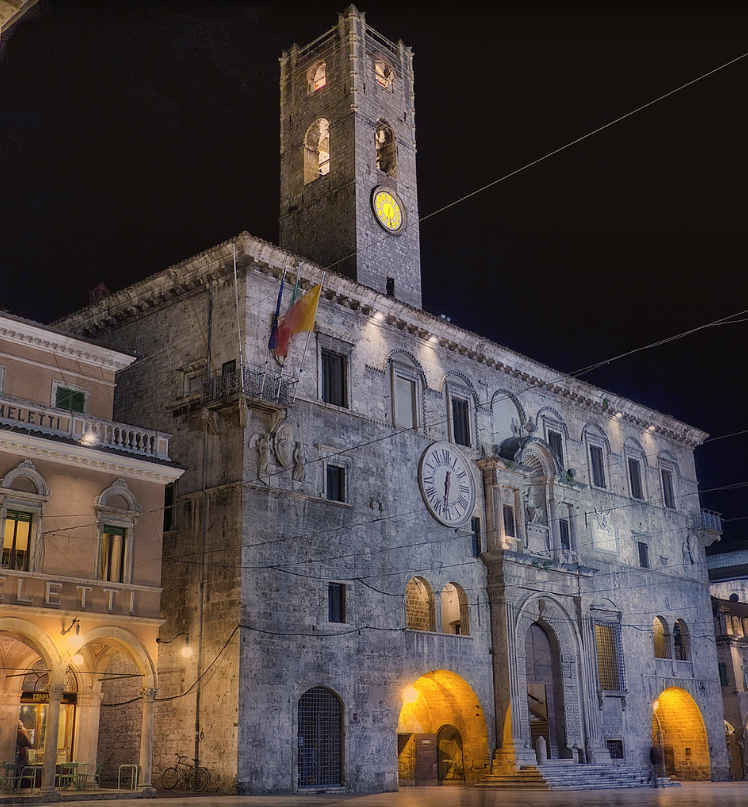
The square’s three sides carry a deliberate message about power. To the west stands the Palazzo dei Capitani del Popolo, a building assembled from twelfth-century structures over Roman remains and reshaped in 1520 by the architect Cola dell’Amatrice. It was the seat of the Capitano del Popolo and the Podestà, the medieval officials who held military and judicial authority, and it remains the town hall today. Look for the grand sculpted portal and the monument to Pope Paul III: they commemorate a violent episode in 1535, when rioters barricaded themselves inside and the papal commissioner ordered the palace burned, destroying its archive before peace was restored.
At the opposite end rises the Church of San Francesco, a Gothic basilica begun in 1238 to honor Saint Francis’s visit to the city in 1215. Set against its flank is the Loggia dei Mercanti, a graceful row of five travertine arches raised in the sixteenth century by the Wool Guild as a covered display for their cloth. Together the three structures encode what historians call the square’s symbolic program: political power in the palace, religious authority in the church, and commerce in the merchants’ loggia and the arcades that ring the whole.
Beyond the piazza
Ascoli rewards anyone who keeps walking. A few minutes away lies Piazza Arringo, older and larger than Piazza del Popolo and far less photographed; its name shares a root with the English word “harangue,” a memory of the public assemblies once held there. It holds the Cathedral of Sant’Emidio, whose interior guards a fifteenth-century polyptych by Carlo Crivelli, along with the civic art gallery in the Palazzo dell’Arengo.
Drop toward the rivers and you reach the Ponte di Cecco, a stone bridge of Roman origin over the Castellano, and the Forte Malatesta, a Renaissance fortress at the confluence that now serves as a museum. None of this requires a car. The whole historic center is walkable in an afternoon, though it deserves more.
Where to eat and drink like a local
You cannot separate Ascoli’s table from its square. The town’s signature dish is the oliva ascolana, made from the local Oliva Ascolana Tenera DOP: a tender green olive that is pitted, packed with a mixture of meats, breaded, and fried until it crackles. They were reportedly beloved by the opera composers Gioachino Rossini and Giacomo Puccini, and they remain the perfect partner to an aperitivo. Pair them with a cold local Verdicchio or a glass of Rosso Piceno DOC, the area’s Montepulciano-and-Sangiovese red, and you have understood the place faster than any monument could teach you.
Understanding the olive is a different matter from eating it. The pitting is what defeats visitors: the flesh has to come away from the stone in one continuous spiral, and doing it badly is the difference between a stuffed olive and a wet lump of breadcrumb. A half-day cooking course at Montefiore dell’Aso, in one of the Piceno hill villages north of Ascoli, works through the spiral, the meat filling and the breading, then moves on to hand-rolled egg pasta and sits you down to eat what you made. For the wine rather than the food, the most productive use of an afternoon is the half-hour drive up to Offida to taste Rosso Piceno DOC Superiore at the estate that produces it, poured alongside Ascolana Tenera DOP oil and a board of Piceno salumi and cheese. A denomination tasted next to the food it grew up beside explains itself in a way no label does.
Then there is Caffè Meletti, the antique-pink Art Nouveau café anchoring the southern corner of the piazza. Opened on May 18, 1907, in a building first raised as the post and telegraph office, it became the town’s intellectual drawing room. Hemingway, Jean-Paul Sartre, and the poet Trilussa sat at its tables; the composer Pietro Mascagni is said to have begun writing his opera Lodoletta here. Its fame rests on Anisetta Meletti, an anise liqueur whose recipe was perfected in 1870 using the green anise of nearby Castignano. King Vittorio Emanuele bought it in person in 1908 and 1910 and named it a supplier to the royal household.
The insider move is to order your anisetta con la mosca, “with the fly,” meaning with three coffee beans floating in the glass. Sip it under the arcades, in no hurry, and you are doing exactly what Ascolani have done for over a century.
That unhurried version is the one I would defend, and it costs the price of a glass. If you would rather have the history in your ear before you slow down, a guided evening walk ends at Meletti with the anise-laced coffee in front of you, having crossed Piazza Arringo, the Romanesque baptistery, Piazza del Popolo and the medieval rue after dark, when the travertine holds lamplight instead of sun and the day visitors have gone. Take it on your first night if you want the framework. Then come back alone on the second and order the glass yourself, which is the part that matters.
When to go
Ascoli is good in every season, but the timing of your visit changes the experience completely.
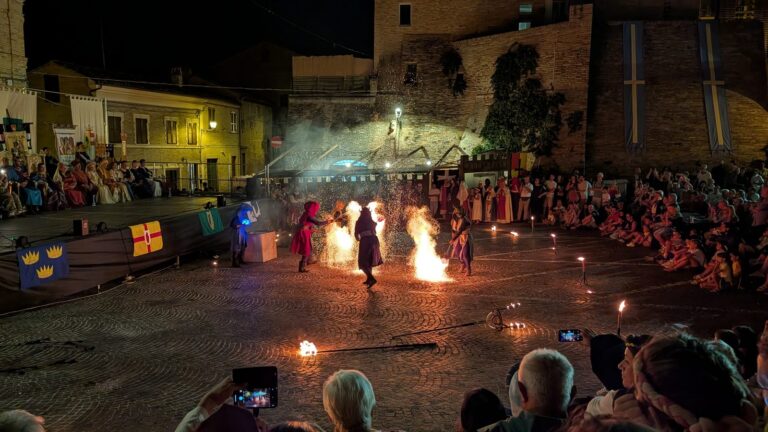
Spring and early autumn are the gentlest, with mild light on the stone and few crowds. Summer brings the town’s defining spectacle. The Giostra della Quintana, a fifteenth-century jousting tournament revived in 1955, fills the streets with roughly 1,500 costumed participants and pits the city’s six historic sestieri (districts) against one another in a horseback contest of skill. It runs twice in 2026: the July joust on Saturday, July 11, dedicated to the Madonna della Pace, and the August joust on Sunday, August 2, in honor of Sant’Emidio, the city’s patron. The mounted competition takes place at the Campo dei Giochi near Forte Malatesta, but the historical procession winds through the center and is free to watch. In the weeks before Lent, the Carnevale di Ascoli takes over the square instead, built on satirical masks and costume competitions rather than giant floats.
One practical warning that the guidebooks bury: on Wednesday and Saturday mornings, a general market spreads its stalls across Piazza del Popolo and hides the pavement entirely. If you have only one day and want the square at its uninterrupted best, plan around those two mornings.
Getting there and getting around
Ascoli sits off the main rail spine, which is part of why it stays uncrowded. The nearest airports are Ancona–Falconara, about 70 miles north, and Pescara, a similar distance south; from either you can continue by train or car. By road, the A14 Adriatic motorway puts you within reach via the Ascoli–San Benedetto link, and renting a car gives you the freedom to explore the Piceno countryside and the Sibillini foothills afterward. Trains connect through the coastal hub of San Benedetto del Tronto. Once you arrive, leave the car outside the center: the historic core is pedestrian-friendly and best covered on foot.
Where to stay
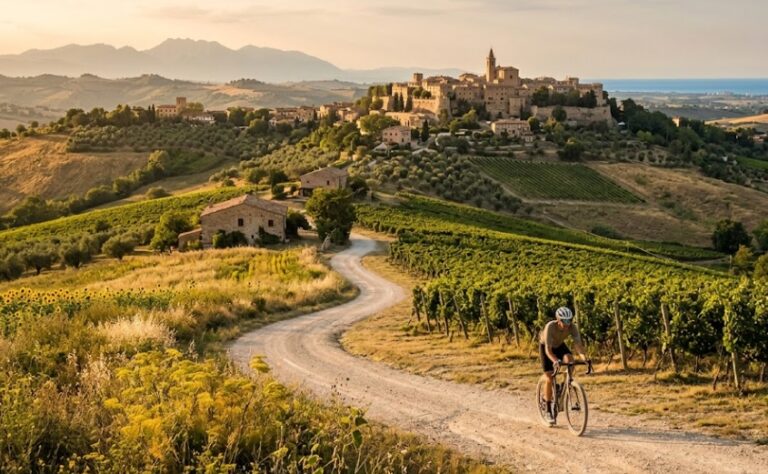
For a first visit, stay inside the historic walls. Sleeping within the center means you can step into the piazza at dawn, before the day-trippers and before the market, and watch the travertine catch the first light with the square nearly to yourself. The town offers small hotels and residenze in restored historic buildings, and because Ascoli draws fewer international tourists than the Tuscan hill towns, you generally find better value here than in better-known destinations. For a slower trip, base yourself in the surrounding Piceno hills among the vineyards and olive groves and treat the town as your cultural anchor.
Booking Notes: What Is Actually Worth Reserving
Reserve the rooms you cannot walk into, not the square. The piazza is free at every hour and no guide improves the act of crossing it slowly. What is worth paying for in the Piceno is access: a working olive mill, a cellar, a kitchen. If you have half a morning rather than half a day, the olive oil tasting at a family mill outside town is the compact version, with the old millstone press and the modern line side by side and a trained taster walking you through what you are smelling. It is the fastest way to learn why two oils pressed six miles apart taste nothing alike.
The private tour only makes sense above a certain group size. The private walking tour of the historic squares is priced per group of up to twenty-five rather than per person, which reads as generous until you run the arithmetic against the shared departures: it breaks even somewhere around seven or eight participants. For a couple it costs several times more for the same route. Book it if you are traveling as a family group or a party of friends. Below that, take a shared walk and put the difference into dinner.
What I would skip: any guided tour that starts on a Wednesday or Saturday morning. This is the one scheduling error that undoes the whole visit. The general market covers the travertine end to end on those two mornings, and in Piazza del Popolo the pavement is the monument. The guides will still run the route, the history will still be accurate, and you will spend it looking at stalls instead of the surface that five centuries of building code were written to protect. Shift the booking to the afternoon, or to any other day of the week.
FAQ — Planning your Ascoli Piceno visit
What is Piazza del Popolo in Ascoli Piceno? It is the main square of Ascoli Piceno, a Renaissance space paved entirely in travertine and ringed by porticoes. Built on the site of the Roman Forum, it is widely considered one of the most harmonious public squares in Italy.
When is the best time to visit Ascoli Piceno? Spring and early autumn offer the mildest weather and smallest crowds. For spectacle, visit during the Quintana joust in July or August, or during Carnevale before Lent. Avoid Wednesday and Saturday mornings if you want the square free of market stalls.
Do I need tickets to see the piazza or the Quintana? The square is open and free at all hours. The Quintana’s historical procession is free to watch, but the mounted joust itself requires a paid ticket, available through the official Quintana box office.
How much should I budget for food and drink? A plate of olive ascolane and a glass of local wine is an inexpensive ritual; a sit-down dinner of regional dishes runs higher, especially at historic venues on the square. Prices vary by season, so confirm locally rather than relying on figures online.
How long should I spend in Ascoli Piceno? You can see the main square and monuments in a single full day, but two nights let you experience the evening struscio, an unhurried morning in the piazza, and a day trip into the Piceno hills.
What else can I pair with a visit to Ascoli? Combine Ascoli with the Adriatic coast at San Benedetto del Tronto, the medieval hill towns of the southern Marche, or the dramatic landscapes of the Monti Sibillini National Park, all within easy reach.
What is the one thing most visitors get wrong? They treat the piazza as a photo stop and leave within twenty minutes. The square is meant to be inhabited, not photographed and abandoned. Sit down, order an anisetta, and let the place reveal its rhythm.
The final word
Ascoli Piceno is the kind of Italian town that rewards travelers willing to look past the famous names. Its great square is not famous, and that is precisely its gift: you experience a near-perfect work of Renaissance urban design without the queues, the crowds, or the sense of being processed. The harmony you feel there was engineered on purpose, by people who believed that the way a city looks shapes the way its citizens live. Five centuries later, they were right.
If you want more stories like this from an Italian insider’s perspective, explore more on Tastes & Wonders of Italy or subscribe to our YouTube channel for video dispatches from around the country.
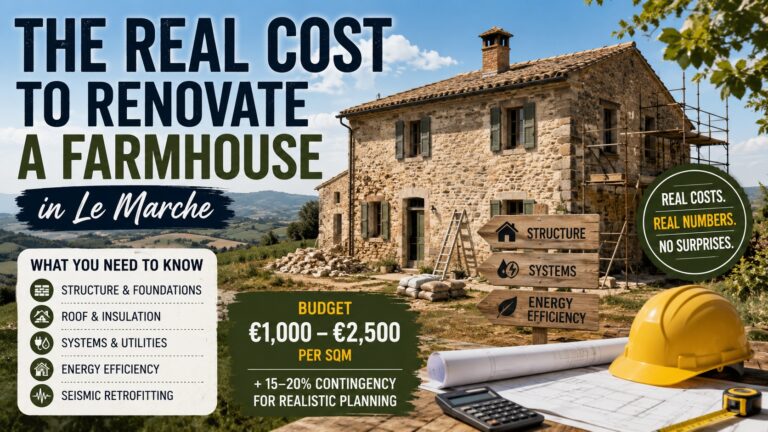
Standing in a piazza like this, more than one visitor has quietly asked what it would cost to stay for good. When that question turns serious, an engineer’s survey is how you find out what a house here really needs before you buy it.
Written by Mirco Vitellozzi, a structural engineer from Le Marche who writes about Italy from the inside. More essays at Tastes & Wonders of Italy, and short films on YouTube.