Palio di Siena Tratta: How to Watch the Horse Draw in 2026
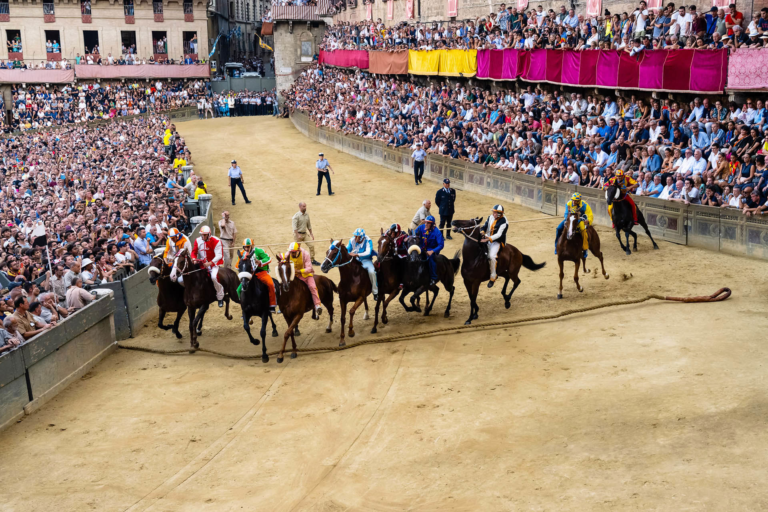
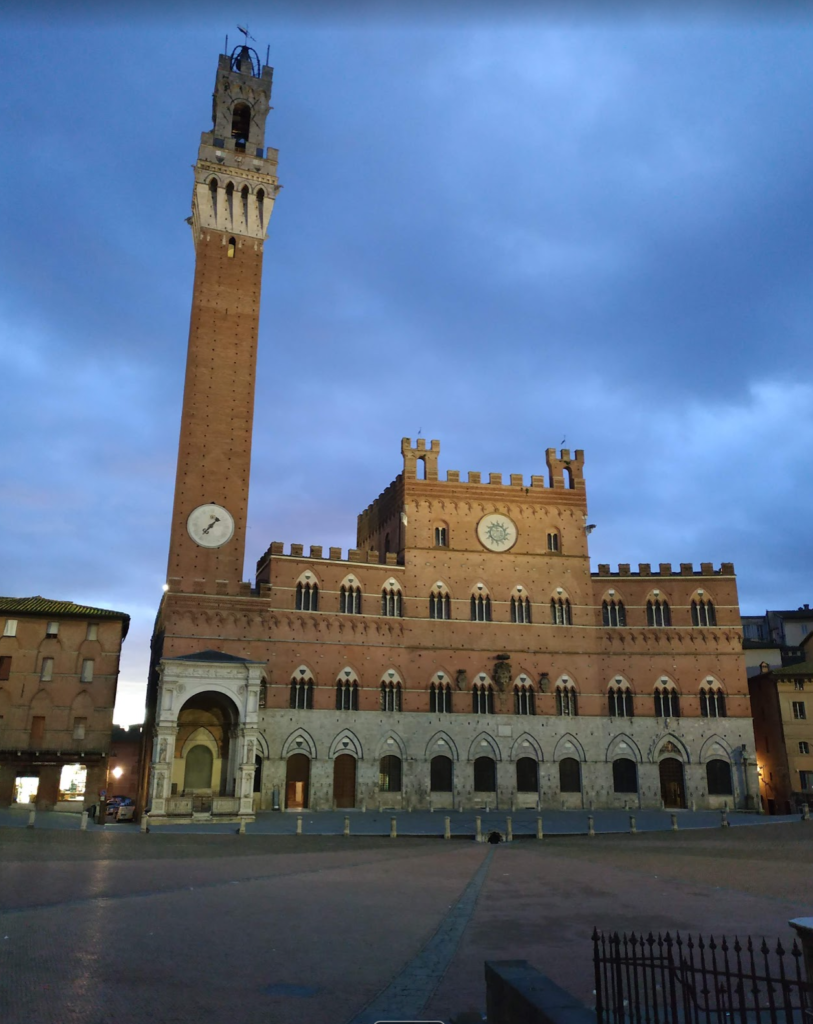
At nine in the morning a mortar fires under the Torre del Mangia, and the Palio di Siena tratta begins. Thirty-odd horses come out of the Entrone, the arched mouth of the Palazzo Pubblico courtyard, onto a ring of ochre earth laid over the medieval brick of Piazza del Campo. They run in heats of six or seven, three laps each, ridden by jockeys the city has hired for the morning. By early afternoon, ten of those animals will have been drawn by lot to the ten districts that race on August 16, 2026, and a year of preparation will have been rewritten by two wooden balls. Admission costs nothing. Almost no visitor knows it is happening.
What the tratta is, and why it settles the Palio before the Palio is run
The tratta is the morning on which the horses of the Palio are selected and then assigned to the ten competing contrade (the city wards, seventeen in total, of which ten run each race) by public lottery. It takes place on the morning of the third day before each race: June 29 for the Palio di Provenzano on July 2, and August 13 for the Palio dell’Assunta on August 16. Owners present their horses at dawn, the animals run selection heats in the Campo, the ten Captains choose the ten they consider fit for the track, and a draw in front of the town hall decides which contrada gets which. No district may choose, refuse, or trade its horse. Once assigned, it cannot be substituted for any reason.
That last sentence is the whole point, and it is the thing most visitors misunderstand. Americans arrive in Siena assuming the Palio works like the Kentucky Derby, where a stable brings its own horse and its own rider. It does not. The horse arrives by chance; the jockey is hired afterward, in negotiations that run through the night and are still being revised hours before the race. A contrada that has waited a year, sometimes decades, can draw an animal that everyone in the piazza recognizes as a winner, or one that everyone recognizes as a passenger. Both outcomes are decided in about twenty minutes, in the open, in front of the people they will affect. Watching that happen is watching the Palio’s plot get written.
Tratta dates for 2026 and 2027
| Race | Race date | Tratta (horse draw) | Regulated trials before the tratta |
|---|---|---|---|
| Palio dell’Assunta 2026 | Sunday, August 16, 2026 | Thursday, August 13, 2026 | August 11–12, from 6:00 a.m. |
| Palio di Provenzano 2027 | Friday, July 2, 2027 | Tuesday, June 29, 2027 | June 27–28, early morning |
| Palio dell’Assunta 2027 | Monday, August 16, 2027 | Friday, August 13, 2027 | August 11–12, early morning |
The dates of the two Palios are fixed and do not move for weekdays, holidays, or convenience. Rain is the one thing that can shift the calendar: the July 2026 race was postponed by a day and run on July 3, the third consecutive July postponement for weather. The tratta can be deferred by the municipal authority for the same reason.
The tratta hour by hour: what actually happens
6:30 a.m. — the segnatura
Owners bring their horses into the Cortile del Podestà, the courtyard behind the Palazzo Pubblico, between 6:30 and 7:30 in the morning. The 2026 municipal ordinance sets that closing time as absolute; after a horse is registered it can no longer be withdrawn. Each animal is marked with a number painted on its hindquarters, and for the rest of the morning that number is its only identity. Nobody in the piazza shouts a horse’s name during the heats. They shout numbers.
You cannot follow this stage closely — the courtyard is restricted — but the street outside it at seven in the morning, with horse trailers unloading at Piazza del Mercato and half the city’s Palio insiders standing around with coffee, is its own kind of theater.
9:00 a.m. — the batterie
Clearing of the track begins at 8:40. At nine, the mortar fires and the first heat comes out. In recent years the field has run between thirty and thirty-five horses, grouped into five batterie of six or seven. Each heat runs the standard three laps of the Campo under the starter, and the Captains may ask for a horse to be tried more than once.
These heats are not a race, and if you expect drama you will misread them. They are a reading exercise. The Captains are watching how an animal takes the descending right-hand turn at San Martino, whether it settles at the start ropes, whether it fights the rider on the uphill drag at the Casato. As a structural engineer I find the surface itself the most interesting part: the tufo is a temporary layer of earth laid over brick paving a few days earlier, watered and rolled, and it behaves differently at nine in the morning than it will at seven in the evening. The Captains know that. It is one reason a horse can look transformed between the tratta and race day.
Late morning — the ten are chosen
When the heats end, the horses go through veterinary examination and the ten Captains withdraw into the Palazzo Pubblico with the mayor to argue. There is no clock on this. It can take forty minutes; it can take two hours. Each of the chosen ten is then given a new number, from one to ten, fixed to the bridle.
Early afternoon — the assegnazione
A platform is set up in front of the Palazzo Pubblico. The mayor presides, with the ten Captains, the Deputati della Festa, a secretary, and two pageboys in livery. Twenty small wooden capsules, called ghiandine because they are shaped like acorns, are loaded into two urns: ten carrying the numbers of the horses, ten carrying the names of the contrade. One pageboy draws a horse. The other draws a contrada. The mayor reads both aloud.
The fenced area in front of the town hall is closed to everyone except Captains, Fiduciari, Barbareschi and staff — so the public stands in the Campo, pressed toward the barrier, in ten distinct clusters of color. What you hear next is the thing worth traveling for. A contrada that draws a strong horse detonates: scarves in the air, the district’s anthem starting before the mayor has finished the sentence. A contrada that draws badly goes quiet in a way that is not sulking. It is arithmetic. Within minutes its Captain will be reconsidering which jockey he can afford, which neighbor he can pay to obstruct, and which rival he now exists only to defeat.
And then the horse walks home
This is the part almost every guide omits, and it is the best forty minutes of the day. As each pairing is announced, the contrada’s barbaresco — the groom who from that moment sleeps beside the animal and does not leave it until the race is over — takes the horse and leads it out of the Campo, on foot, through the streets, to the district’s stable. The contradaioli walk with it, singing, and the crowd thins around them.
You can follow. Nobody will stop you, provided you stay behind the group, keep off the horse’s flank, and do not photograph a barbaresco’s face at close range with a flash. A horse being walked up Via di Città to the Selva or down toward the Onda’s territory, escorted by four hundred people singing in dialect on a Thursday afternoon, is the single clearest lesson in what a contrada actually is that a visitor can receive in an hour.
How to watch the tratta in person
Free, and no ticket exists to buy. The center of the Campo — the shell, in Sienese usage, the flat area inside the ring of track — is open to the public during the tratta, the trials, and the race itself. There is no central box office for the Palio at all: the wooden grandstands and the balconies around the piazza belong to private operators and residents, and they are sold directly by them. For the tratta, none of that is necessary.
When to arrive. Be inside the shell before the track is cleared at 8:40 a.m. Once clearing begins you will not be allowed to cross the track, and the heats start twenty minutes later. Arriving at 8:15 is comfortable. There is no crowd remotely comparable to race day, and in the two hours of heats you can move around the inside of the shell and change your view — something that is physically impossible on August 16.
Where to stand. For the heats, take the stretch of shell facing San Martino, the descending curve near the Palazzo Pubblico, which is where the horses show what they can do and where every serious observer stands. For the assignment, move toward the front of the Palazzo Pubblico and toward one of the color clusters; the ceremony faces the piazza and the emotional information is in the crowd, not on the platform.
The rules that get people fined. The mayor’s ordinances for 2026 prohibit standing on the stone bollards around the track, leaning out over it, or extending objects toward it — a ban that applies to the regulated trials, the tratta, the trials, and the race. Violations during trials carry a €100 administrative fine and during the race €500, with immediate removal in either case. Glass and metal containers cannot be sold in the piazza or the surrounding lanes during any of these phases. Take a bottle you can refill, a hat, and low expectations about finding a bathroom.
Language. Nothing is announced in English, and nothing is explained. Read the pillar piece on the contrade and the meaning of the Palio before you go, or you will spend the morning watching numbered horses trot past a shouting crowd without knowing why anyone cares.
The three days after: the prove
The tratta opens what the Sienese call the four days of the Festa. From the evening of the tratta until the morning of the race, the ten assigned horses run six trial races, the prove, two a day, in the Campo. They are free, they are open, and they are the most underrated public spectacle in Tuscany in high summer.
| Trial | July Palio | August Palio |
|---|---|---|
| Track clearing, morning trials | 8:40 a.m. | 8:40 a.m. |
| Horses out, morning trials | 9:00 a.m. | 9:00 a.m. |
| Track clearing, evening trials | 7:15 p.m. | 6:45 p.m. |
| Horses out, evening trials | 7:45 p.m. | 7:15 p.m. |
Before each trial the horse is walked from the contrada’s stable to the Entrone by a dense escort of its own people, often singing the whole way. The fifth trial, on the evening before the race, is the prova generale, and it is followed by the propitiatory dinners: long tables down the middle of the streets in each of the ten districts, several thousand people eating outdoors. For the August Palio that dinner falls on the night of August 15, which is Ferragosto — the reason Siena on that particular night is unlike anywhere else in the country. The sixth trial, on the morning of the race, is the provaccia, the “bad trial,” ridden without commitment because nobody risks a horse eight hours before it matters.
If your schedule allows only one Palio-adjacent day in Siena, and you do not have a seat for the race, the tratta plus that evening’s first trial is a better use of it than standing packed in the Campo on race day. If you do want a seat for the race itself, the practical mechanics are covered in the guide to booking Palio seats, and they need to be dealt with months ahead.
The horse question, answered plainly
American readers ask this, and they deserve a straight answer rather than either a defense or an evasion. The Palio is a bareback race on a temporary earth surface with two tight corners, and horses have been injured and killed on it. It is also, by now, one of the most heavily regulated equine events in Italy.
Horses must complete a municipal training program before they can even be pre-registered, then pass veterinary pre-checks — held on August 6 and 7 in 2026 — and regulated trials before they may be presented at the tratta. They are blood-screened for pharmacological substances, and a horse that is not clear is excluded from every phase of that year’s Palio with no appeal. They must carry an annual test for equine infectious anemia, an annual influenza vaccination, and a €1.5 million third-party liability policy. Whips are banned in the regulated trials. Jockeys must be adults, must wear a CE-approved helmet and body protector, are subject to alcohol and drug testing, and must declare that they have no conviction for animal cruelty offenses in the previous five years. The dangerous descending curve at San Martino was rebuilt with a high-absorption protective barrier in 1999, and since 1991 the Comune has funded a retirement facility at Radicondoli for Palio horses that can no longer run.
Whether that adds up to acceptable is a judgment you are entitled to make for yourself. What is not accurate is the claim that nobody is watching.
Building a trip around the tratta
Siena has roughly 54,000 residents and no airport. The workable bases are Florence (about ninety minutes by bus, and the bus is faster and more direct than the train), Siena itself, or a farmhouse in the Crete Senesi, which is where I would stay. Book the accommodation before you book anything else: rooms inside the walls for the nights of August 12 to 16 disappear early and are priced accordingly.
Arrive the day before. That gives you the regulated trials at dawn on August 11 or 12 — six in the morning, an almost empty piazza, and horses running under a raking light that photographers spend careers chasing — plus a full afternoon for the city itself, which is at its best on exactly the days when everyone assumes it is unbearable. The Siena that most visitors walk straight past is more interesting than the checklist version.
Two notes on August. The heat is real: on the Campo, at midday, in an unshaded shell of brick, plan around it rather than through it. And the country as a whole is on holiday, which changes what is open and what is not — the honest version is in the guide to Italy in August.
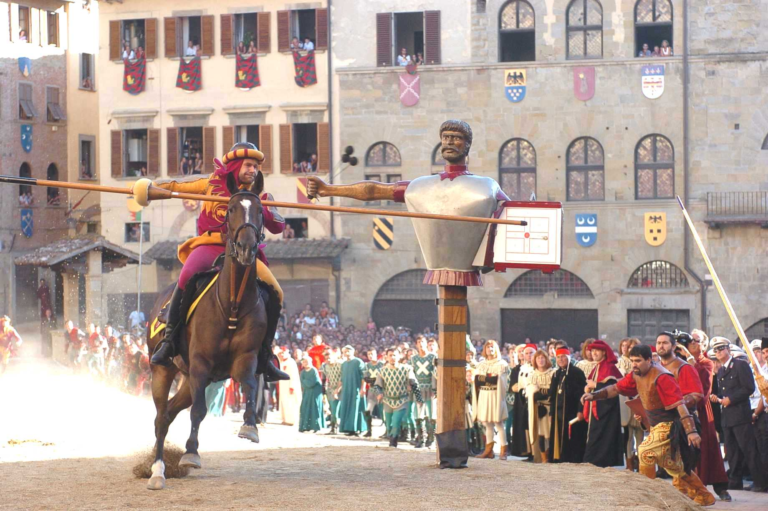
One last thing, from someone who lives three hours east of Siena. Le Marche has its own living contests — the Quintana of Ascoli Piceno, the Palio of San Ginesio — and I have spent enough time inside them to say that the difference between a costumed reenactment and a real one is visible in about four seconds. In a reenactment, the participants perform for you. At the tratta, nobody is performing for you at all. You are standing inside somebody else’s most important morning of the year, and you have been allowed in for free. Behave accordingly, and it will be one of the days you remember.
FAQ
What is the tratta at the Palio di Siena?
The tratta is the morning selection and lottery assignment of the ten horses that will run the Palio. Roughly thirty to thirty-five horses run selection heats in Piazza del Campo, the ten contrada Captains choose ten of them, and a public draw in front of the Palazzo Pubblico pairs each horse with a contrada. No contrada may choose or refuse its horse.
When is the tratta held?
On the morning of the third day before each race: June 29 for the July 2 Palio and August 13 for the August 16 Palio, every year. In 2026 that means Thursday, August 13. The heats begin at 9:00 a.m., and the assignment follows in the early afternoon once the Captains have finished deliberating.
Do you need a ticket to watch the tratta?
No. Watching from inside the shell of Piazza del Campo is free for the tratta, the six trial races, and the Palio itself, and there is no central ticket office. Paid grandstand and balcony seats around the piazza exist for race day only and are sold directly by private operators and residents.
What time should you arrive?
Be inside the piazza before 8:40 a.m., when clearing of the track begins. After that you cannot cross to the center. The crowd is a fraction of race-day size, so 8:15 a.m. is early enough to get a good position along the San Martino side.
How long does the tratta last?
The heats run from 9:00 a.m. until roughly late morning. The Captains’ deliberation and the veterinary checks have no fixed duration, and the assignment usually happens in the early afternoon. Budget the whole day, and use the gap in the middle for lunch away from the Campo.
Can you watch the trial races too?
Yes, and you should. Six prove are run between the evening of the tratta and the morning of the race, twice a day, free to watch from the center of the piazza. Be inside before the track is cleared: 8:40 a.m. for morning trials, and 6:45 p.m. in August or 7:15 p.m. in July for evening trials.
What should you do the moment the assignment ends?
Follow a horse home. Each barbaresco leads his contrada’s horse on foot from the Campo to the district stable, escorted by singing contradaioli. Pick a group, stay behind it, and walk. It is the closest a visitor gets to the interior life of a contrada, and it costs nothing but attention.
The takeaway
The race lasts about ninety seconds and is nearly impossible to see properly unless you have paid months in advance for a seat. The tratta lasts a morning, costs nothing, and shows you the mechanism underneath — chance, negotiation, and a city that organizes its emotional year around both. If you are anywhere near Tuscany on August 13, 2026, or on June 29 and August 13 of any year after it, be in Piazza del Campo at a quarter past eight.
If you want more of Italy explained from the inside rather than described from outside, there is more of it on Tastes & Wonders of Italy — and the monthly letter goes out to readers planning trips two to six months ahead.