The Regata Storica of Venice: What It Actually Is, and What It Isn’t
For a few hours on the first Sunday of September, the Grand Canal stops being a street. Every other day, it carries vaporetti, delivery boats, and the ordinary traffic of a working city. On this one afternoon, it turns into something closer to a stadium: a straight water track, over three thousand feet long, lined on both sides by crowds standing four and five deep. They stand on stone that has held the same crowd, for the same reason, long before anyone thought to sell it as a tourist event. The Regata Storica is what Venice does with its main street once a year. It is worth understanding before you plan a trip around it.
The Regata Storica is Venice’s annual historic boat parade and rowing race, held on the Grand Canal on the first Sunday of September. It opens with a costumed water parade of sixteenth-century boats, carrying figures who play the Doge, the Dogaressa, and the top officials of the old Republic. Four separate rowing races follow, run on flat-bottomed boats rowed by people standing and facing forward. Watching from the public banks costs nothing. Reserved seats, on the floating stands and on the Machina grandstand at Ca’ Foscari, are sold apart. In practice, the parade and the races are two different shows, staged back to back. Most visitors only stay for one of them.
The first thing you notice, standing on the bank, is how the water sound changes. Boat traffic on the Grand Canal usually hums low and steady. On regatta day, it goes quiet just before each start, then breaks into splashing, shouting, and a brass band somewhere behind the leading boats. That shift, more than any single image, is what tells you the canal has switched roles for the afternoon.
The parade and the race are not the same event
This is the split that trips up almost every American visitor planning a first trip to the Regata Storica. It matters, because it decides how long you actually need to stand on that bank.
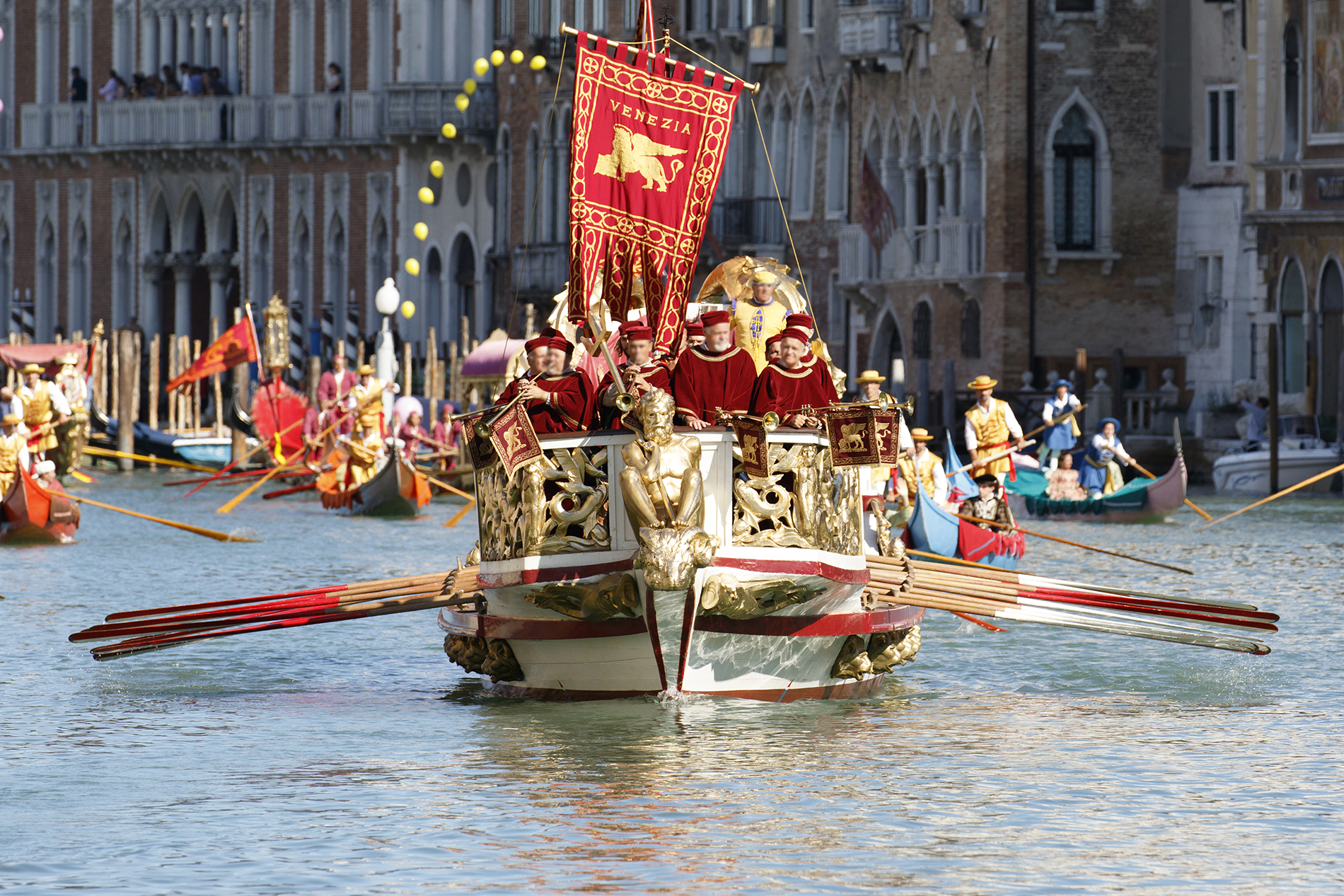
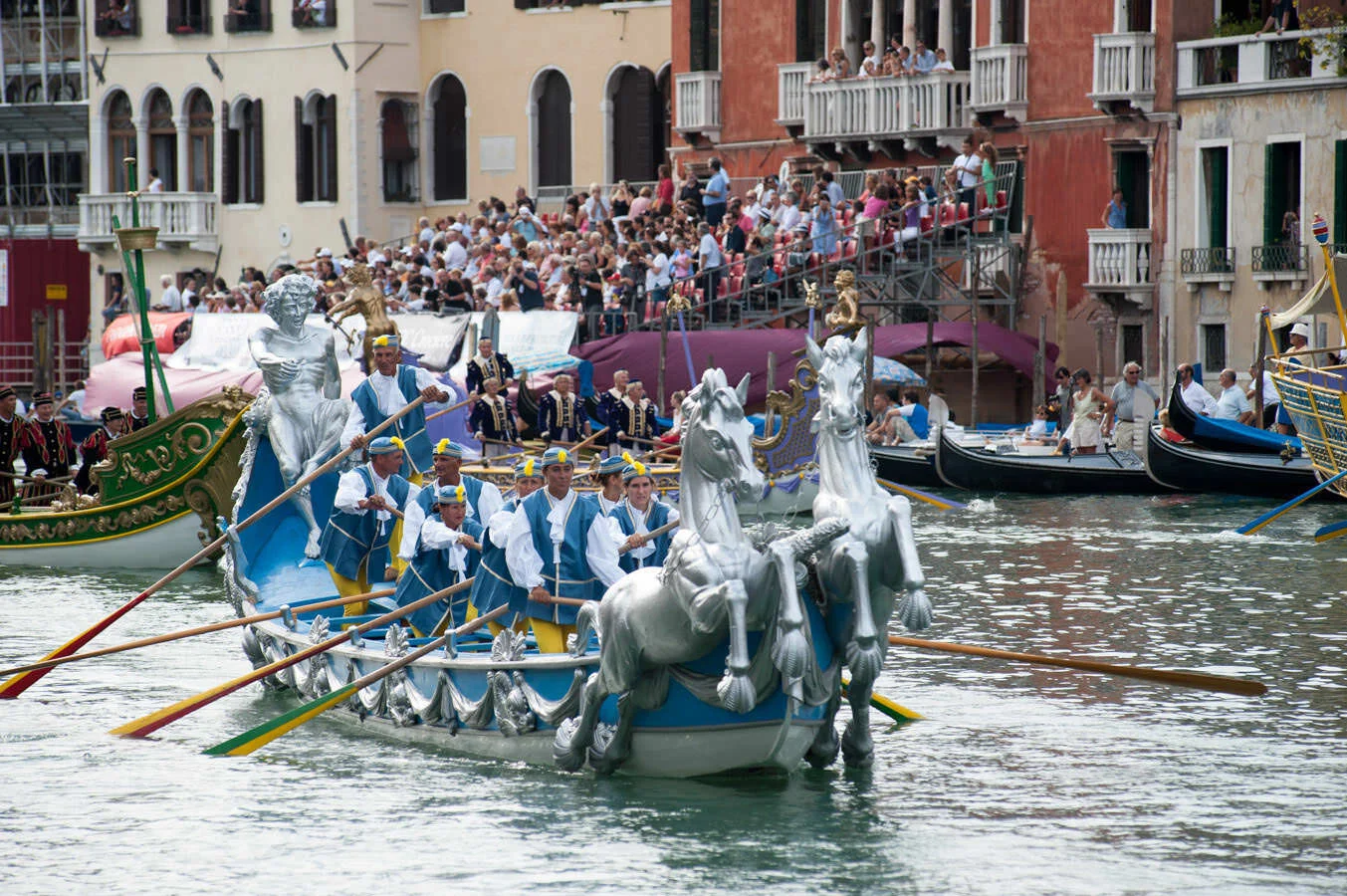
The costumed parade that opens the afternoon is a re-enactment, not a race. Gondoliers in sixteenth-century dress row decorated boats down the Grand Canal. They carry costumed figures who stand in for the Doge, his wife, and the senior officials of the Republic. The scene they stage is specific: the welcome Venice gave Caterina Cornaro in 1489, after she gave up her throne as Queen of Cyprus and handed the island to the Republic. In return, she got a comfortable retirement on Venetian terms. This part is pure theater, done well, and it is what every camera on the canal points at.
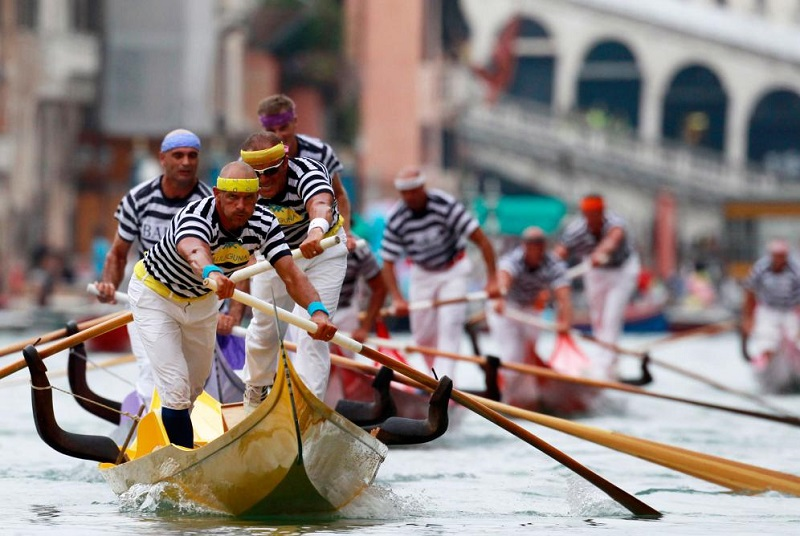
The races that follow are not theater. Four groups run in order, each with its own boat and its own crowd. The pupparini are raced by children learning the sport. The mascarete are raced by women. The caorline are six-oar boats raced by men. Last come the gondolini, raced by the sport’s top names on light, two-oar boats built for pure speed. This final race is the one Venetians actually stay for. Local crews have followings the way neighborhood soccer clubs do elsewhere in Italy. The shouting along the banks during the gondolini final has nothing staged about it. Watch the parade and leave before the gondolini finish, and you have seen the postcard. You have missed the part the city itself cares about.
Voga alla veneta: rowing built for shallow water, not for show
The rowing style on display has a name: voga alla veneta. It exists because of the lagoon’s shape, not because someone thought it would look good.
Rowers stand upright and face forward, toward where they are going. Each works one oar, resting on a forcola, the carved wooden rest that lets the blade swing through a wide arc without ever fully leaving the water. Compare that to a normal rowing shell. There, the crew sits, faces backward, and pulls a blade that dips and clears the water on every stroke. That method needs a deep, open channel. Venice never had one. Its canals run narrow and shallow, crossed by low bridges, and its boats had to turn sharply while the rower kept a full view ahead. Standing and facing forward solves both problems at once. Pushing the oar, instead of pulling it, lets a lagoon boat clear a shallow bottom that would ground a normal blade.
Once you see the mechanics, the boat types stop looking like costume pieces. They read as engineering choices, each built for a different job. The gondolino is the sprint boat: narrow, genuinely hard to balance if you have not trained on it, built for raw speed over the roughly two-mile course. The pupparino is a wider, more forgiving hull, suited to children still learning balance on moving water. The mascareta, raced by women, sits lower and narrower than the caorlina, the six-oar boat. The caorlina once moved goods and people across the lagoon; here, it is repurposed as a team event. None of this is decoration. It is the same logic behind every regional Italian boat along this coast: the hull follows the water it has to cross.
Most of these boats spend the rest of the year at local rowing clubs scattered across the lagoon, where voga alla veneta is still taught to children and practiced by adults as ordinary weekend sport, not as a museum piece kept alive for one Sunday in September.
A tradition invented twice
Ask when the Regata Storica began, and you get two honest answers, not one. Both matter.
The first written trace of an organized Venetian rowing race survives in a note inside an anonymous medieval codex, dated 1274. It reads, in Latin: Splendor magnificissime Urbis Venetorum, die 16 septembris, indicta regatta cum navigiis habentibus remos viginti — in the splendor of the magnificent City of the Venetians, on the sixteenth of September, a regatta was called for boats with twenty oars. By 1315, the Venetian Senate had made the practice official, tying it to the Festa delle Marie, a religious and civic festival with even older roots of its own. The first picture of it comes later still: a cluster of small boats labeled “regata,” tucked into Jacopo de’ Barbari’s huge 1500 woodcut view of the city, the earliest surviving image of the race in progress.
That thread is real. It does not, though, run in an unbroken line to the event you would actually watch today. The Republic of Venice fell in 1797, and the century that followed had little patience for anything that celebrated the old Serenissima’s pageantry. What brought the tradition back was not Venetian nostalgia. It was city government. In 1841, Venice’s municipal council asked the Austrian authorities then ruling the city to fund a public regatta on the Grand Canal. The stated reason was practical: to keep the city’s gondoliers sharp and competitive. That 1841 request, not the 1274 codex, is the direct ancestor of today’s calendar and its city sponsorship. The name “Storica” is younger still. It was added only in 1899, on a proposal from mayor Filippo Grimani, to mark the third International Art Exhibition of the Biennale — the same institution that would later give Venice its film festival and its contemporary art show, both covered elsewhere on this site.
This gap is worth sitting with, because the same pattern shows up in nearly every Italian civic tradition sold to American visitors as ancient and unbroken. Marostica’s human chess match is the only other Veneto event to share the Regata Storica’s status as national living heritage, and its founding story does not hold up well under a close look: a sixteenth-century love story, almost certainly invented after the fact to justify a much later town pageant. The Regata Storica’s medieval roots are a different kind of claim. The 1274 codex is a documented fact, not a folk tale built to order. But the event Venice stages every September owes its actual shape to an 1841 city request and an 1899 rebrand, not to an unbroken line from the thirteenth century. Honest history and living tradition are not the same claim. A city that knows the difference tends to trust its visitors with both.
The Marche connection no guidebook makes
Here the story leaves the lagoon. This is where three decades spent surveying churches and old buildings across Italy’s Adriatic coast gives me a detail that never shows up in the English-language coverage of this event. It takes knowing the Marche as more than a name on a map.
Reniero Zeno was the forty-fifth Doge of Venice, ruling from 1253 to 1268. His entry in the Dizionario Biografico degli Italiani says he was elected on January 25, 1253, while serving as podestà of Fermo, in the Marche. A podestà was the outside magistrate a medieval Italian city hired to run its government, brought in specifically so local factions could not control the office. Zeno was not even in Venice for his own election. He had held the post in Fermo since the year before, and he only reached Venice and took office on February 18, arriving by galley from the Adriatic.
His successor as doge, Lorenzo Tiepolo, followed an almost identical path through the same region. The Dizionario Biografico lists his posts in order: Padua in 1264, Fermo in 1266, and Fano in 1268, right before his election that July. Two doges of Venice in a row, in other words, spent the years right before their election running towns in the Marche. One of them ran the very city the other would also run two years later.
That overlap is not a coincidence of two separate careers. It is a sign of how the Adriatic actually worked in the thirteenth century. This was not a coastline Venice occasionally visited. It was a political system Venice actively ran, town by town, through officials it sent out and then promoted at home. Tiepolo’s own time as doge makes the stakes plain. As doge, he crushed a league of Romagna and Marche towns that had banded together because they resented Venice’s grip on Adriatic trade. Fermo’s own neighbors were pushing back against the power its former podestà now held in Venice itself.
Ancona, the Marche’s other major Adriatic port, spent much of this period as Venice’s trade rival rather than its subject. This is the detail most American readers miss entirely. Not every Adriatic city bent to Venice, and the towns that resisted are as much a part of this story as the ones that supplied its doges.
The first documented regatta on the Grand Canal, dated 1274, falls squarely inside Tiepolo’s time as doge. It is a dogeship that began with him arriving in Venice fresh from running a Marche town his predecessor had also run. The pageant you watch every September, in other words, sits inside a stretch of years when the men running Venice had spent their formative careers on this coast, not that one. It is a fact you will not find in any brochure sold at the vaporetto stop. It takes someone who already knows Fermo is a real place with a real medieval archive, not a name used only to be compared unfavorably to Florence.
Fermo itself carries almost no trace of this today, at least not one that jumps out at a visitor. Its medieval Palazzo dei Priori and its Roman cisterns get the tourist attention, when Fermo gets any at all. Two Venetian doges once running the town from that same civic center is the kind of fact that survives only in academic volumes and provincial archives, not on any plaque.
Fermo keeps its own civic memory alive a different way, through its own historic pageant, the Cavalcata dell’Assunta, staged every summer with the same mix of costume, procession, and documented medieval roots that defines the Regata Storica. The two towns never trade visitors in any real number, but they are running the same kind of civic machine, decades apart on the calendar and a full sea apart in geography.
What surprises Americans on the day
A few things catch first-time visitors off guard, beyond the parade-versus-race split already covered above.
The first is scale. This is not a small event with a handful of boats gliding past a few dozen onlookers. Dozens of vessels take part in the costumed parade alone, and the crowd along the banks routinely runs into the tens of thousands, packed shoulder to shoulder on every bridge with a clear line to the water.
The second is noise. Venice, for most of the year, is a quiet city by European standards. Its lack of car traffic makes it feel almost hushed next to Rome or Naples. The Regata Storica breaks that silence completely, with brass bands on escort boats, drumbeats setting the parade’s pace, and a wall of shouted support from the banks once the races start.
The third is how local it still is. Despite the crowds of visitors, this remains a Venetian family event first. Several generations of the same rowing families race across the different categories, year after year, and the crews you cheer for in the gondolini final often carry names that have shown up in regatta records for a century or more.
The fourth is simpler: the heat. Early September in Venice still runs warm, and the banks offer almost no shade along most of the route. Bring water, and expect the crowd to hold its ground for hours once a good spot along the canal is found.
Watching the day: what actually happens, and when
The costumed parade opens the afternoon, leaving from the Bacino di San Marco and moving up the Grand Canal. It is led by the Bucintoro, the ceremonial boat built to stand in for the Doge’s lost state galley, followed by a train of colorful bissone escorting it. The races follow in order: children first, then women, then the six-oar men’s crews, then the gondolini champions, finishing in front of Ca’ Foscari as afternoon turns into early evening.
Watching from any public bank, bridge, or fondamenta along the route costs nothing. Reserved viewing on the floating stands, or on the Machina at Ca’ Foscari, is sold apart through official channels. If you want the practical details on where exactly to stand, what a reserved seat costs, and how far ahead you actually need to book, I have laid all of that out in a companion guide to buying Regata Storica tickets. The next edition falls on the first Sunday of September 2027.
The takeaway
Most guides to the Regata Storica stop at the costumes, because the costumes photograph well and need no local knowledge to describe. The race itself, and the six centuries of civic history behind it, take more work to explain. That work is worth doing. Once you know the boats are shaped by the lagoon rather than by fashion, and that the men who ran Venice in the years this tradition first shows up in writing had spent their early careers governing towns on the opposite coast, the Grand Canal on that Sunday in September stops being a pretty backdrop. It becomes something you can actually read.
FAQ: The Regata Storica of Venice, explained
What is the Regata Storica? The Regata Storica is Venice’s annual historic boat parade and rowing race on the Grand Canal, held every year on the first Sunday of September. It combines a costumed parade of sixteenth-century boats with four rowing races on traditional lagoon boats.
When is the Regata Storica held? Always on the first Sunday of September. The next edition falls on September 5, 2027.
Is the Regata Storica the same as a gondola race? Not quite. Gondolas themselves are not raced. The fastest race, the gondolini final, uses a narrower, purpose-built racing boat based on the gondola but stripped down for speed. The other three races use entirely different boats: pupparini, mascarete, and caorline.
Do I need a ticket to watch? No, not to watch from the public banks, bridges, or fondamente along the Grand Canal. That access is free, as long as you arrive early enough to find a spot. Reserved seats on floating stands or the central Machina grandstand are sold separately.
How long does the Regata Storica last? The full afternoon, from the opening parade through the final gondolini race, runs roughly three hours. It moves from the Bacino di San Marco to the finish near Ca’ Foscari.
Is the Regata Storica worth pairing with other September events in Venice? Yes. It regularly overlaps with the tail end of the Venice Film Festival and falls within the long run of the Biennale Arte, so one September trip can reasonably cover all three without stretching your stay.
What do Venetians themselves care most about at the Regata Storica? The gondolini final, not the costumed parade. Local rowing families and crews have followings much like neighborhood sports clubs elsewhere in Italy, and the mood along the banks during that last race has nothing staged about it.