The Italian Palio, Decoded: Horse Races, Ring Jousts and Four Living Contests of the Middle Ages
On a warm Saturday evening in late May, on the cobblestones of a hilltop piazza in Le Marche, a rider in a fifteenth-century doublet leans low over his horse’s neck and drives a lance through a brass ring no wider than a tennis ball. The crowd does not applaud. It exhales — the sound of three hundred people releasing breath they did not know they were holding. This is the palio. Not the thundering Sienese spectacle you have seen in films, but one of the dozen versions that play out every summer across central Italy, in towns most Americans have never heard of, with intensity that rivals anything on the Piazza del Campo.
The word “Italian palio” is one of the most misleading terms in the vocabulary of Italian travel. Most visitors associate it with a single event: the horse race in Siena. The reality is considerably richer and more varied. Across Italy, and concentrated above all in Le Marche, Umbria and Tuscany, the palio takes at least four distinct forms — a horse race, a lance-jousting contest, a processional tribute, and a neighborhood field game — and each one carries a different history, a different logic, and a different way of drawing a visitor inside the experience. Knowing which form you are watching, and why it exists, is the difference between a spectator and someone who actually understands what they are seeing.
—
What Does “Palio” Actually Mean?
The confusion starts with the word itself. In Italian, palio derives from the Latin pallium, meaning a length of fine cloth — a cloak, a banner, a ceremonial drape. In medieval Italy, the pallium was the prize: a strip of precious fabric, often silk or velvet, awarded to the winner of a contest. The contest, over time, absorbed the name of its own trophy. So when you hear someone say “the palio,” they are literally saying “the banner” — which tells you nothing about how the winner earns it.
This matters because across Italy’s medieval towns, that banner has been won by horses galloping bareback, by knights driving a lance through a metal ring at full gallop, by runners sprinting a kilometer through uphill stone streets, and by teams competing in something resembling medieval basketball. Every one of these events is, correctly, a palio. The prize is always a cloth — an artist’s painted silk, a ceremonial drapery, a woven trophy. The competition to win it is whatever a particular town decided, sometime between the twelfth and seventeenth centuries, best expressed its own identity and history.
The earliest documented palio on record is in Ferrara, from 1259. Siena’s modern-format race dates to 1656, though earlier versions existed from at least 1238. Fermo’s horse palio, strikingly, predates both: its origins are documented from 1182, making it the oldest such contest in Italy.
—
The Four Living Forms
Form One: The Horse Race
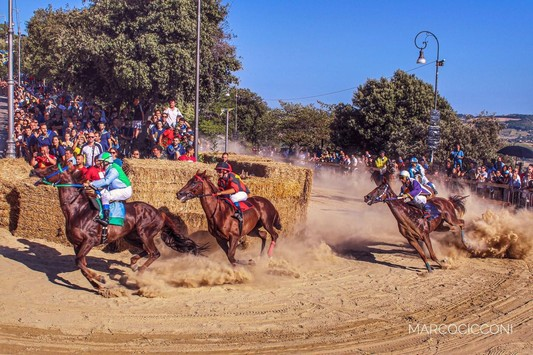
This is the type that comes to mind first, and with reason — the Sienese version has been photographed, filmed, and written about more than any other Italian folk spectacle. The horse race is at its core a cavalry exercise turned civic ritual: ten horses, ridden bareback by professional jockeys called fantini, circle a piazza or track three times, and the first horse to finish — with or without its rider — wins the prize for its contrada (city ward).
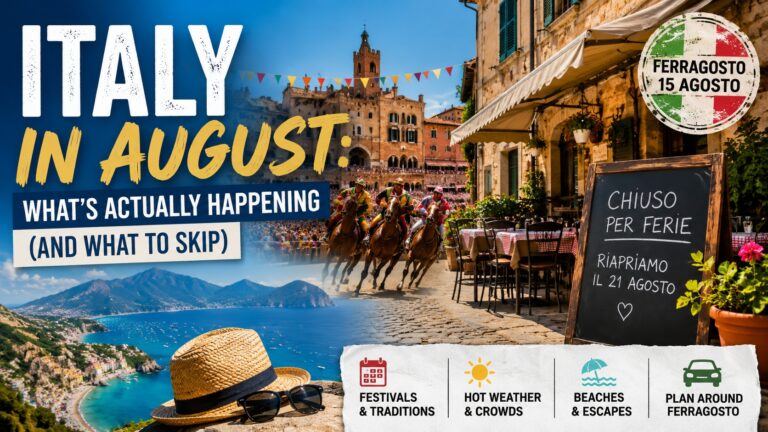
What most American visitors do not register, because they see Siena and conclude, is that the same logic operates in a city just one hour to the north that almost nobody mentions abroad. Fermo, the ancient hilltop capital of the Fermano province in Le Marche, has been running its own horse palio since 1182. The Palio dell’Assunta is a horse race among ten of Fermo’s contrade, held every August 15 — the feast of the Assumption — preceded by a historical procession in fifteenth-century costume along the same streets where the horses will run. The track climbs 850 meters from the lower city to Piazza del Popolo, entirely uphill, making it technically demanding in ways that flat-track racing simply is not. This makes Fermo’s Cavalcata dell’Assunta the oldest historical re-enactment in Italy, with documented origins from 1182. The Sienese race, for all its fame, is a relative newcomer by comparison.
For the American traveler, the practical distinction matters: Siena is massively crowded on race days (July 2 and August 16), and the piazza fills hours before the ninety-second event. Fermo runs its palio on Ferragosto, August 15, in a city that receives a fraction of Siena’s international visitors. You can watch the corteo the night before — over fourteen hundred figurants in torchlight — and be inside the action in a way that Piazza del Campo, with its seating economics and crowd dynamics, rarely permits.
Form Two: The Ring Joust and Quintana
This is the form that defines Le Marche, and the one that most English-language travel writing has never adequately explained.
The quintana is a military training exercise that predates chivalric tournaments by centuries. Its name comes directly from Latin: quintana via, the “fifth street” of a Roman military camp, positioned between the fifth and sixth maniples, where soldiers drilled and traded. The quintana pole — a target for lance practice — stood there. By the medieval period the exercise had become sport, and by the seventeenth century it had split into two technical variants that are now distinct events.
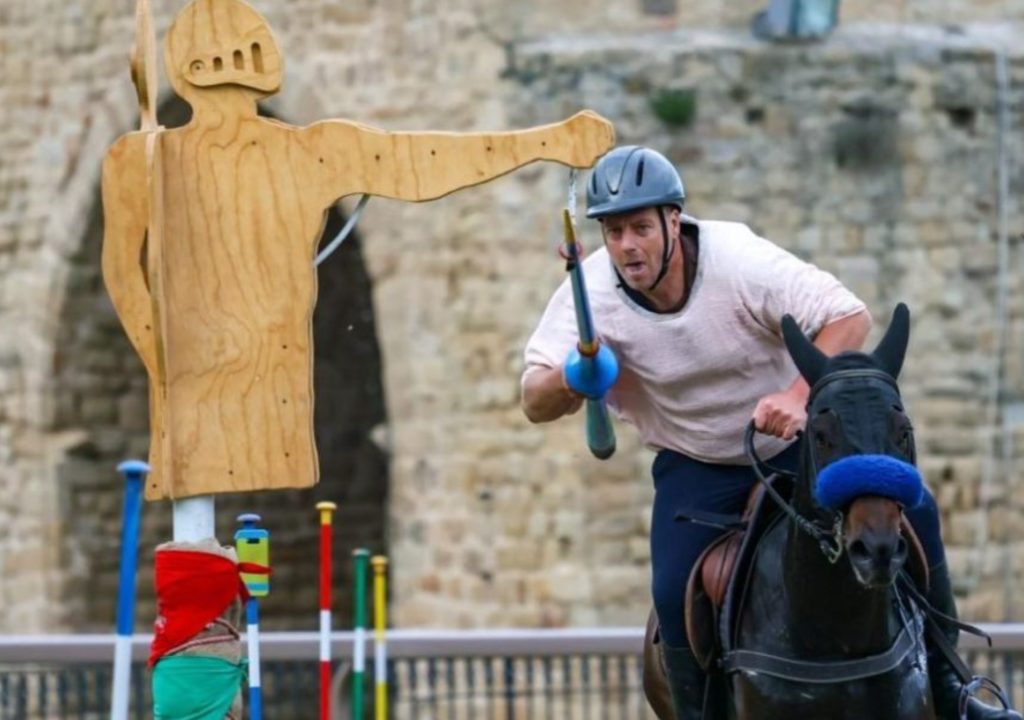
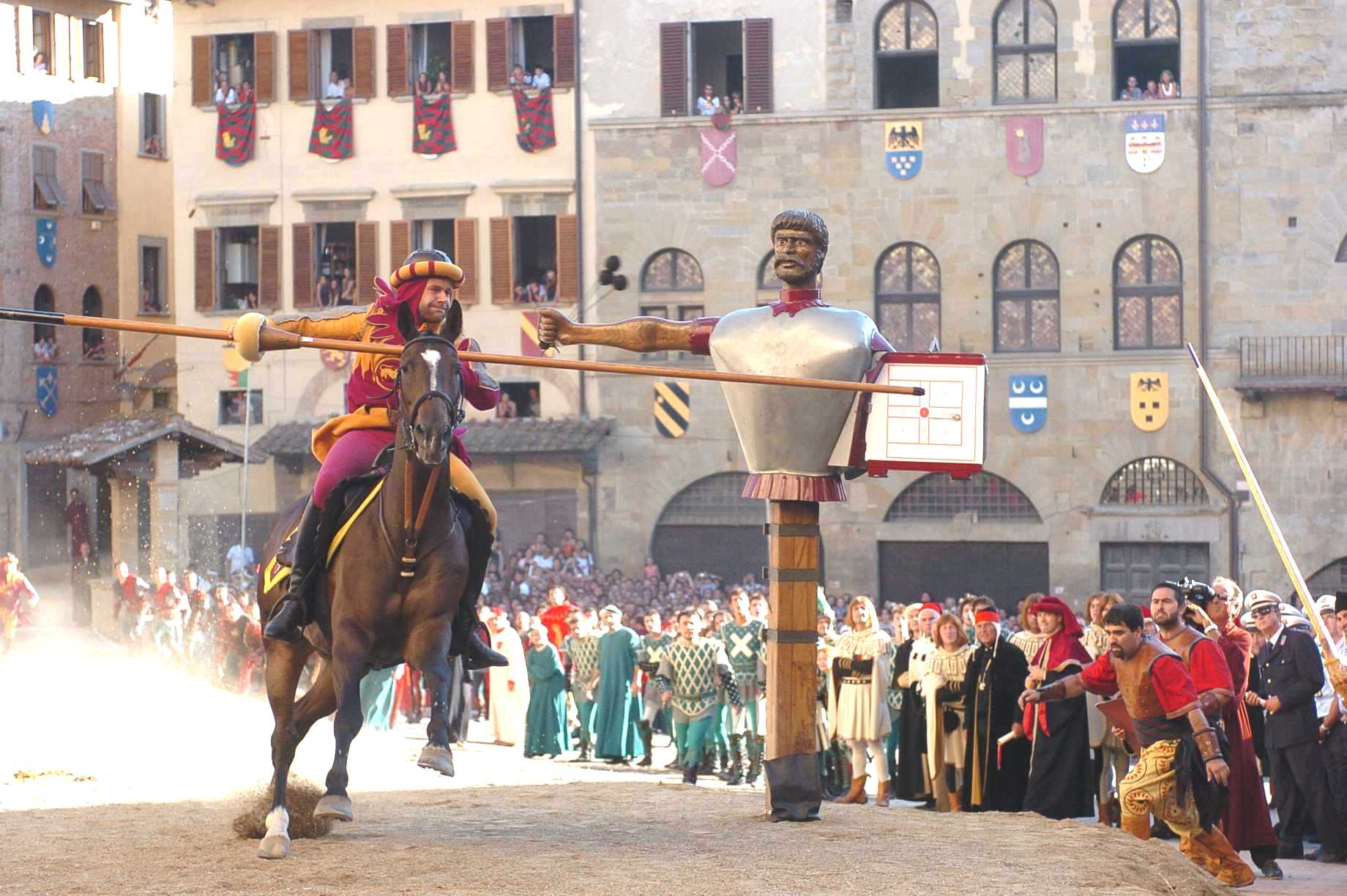
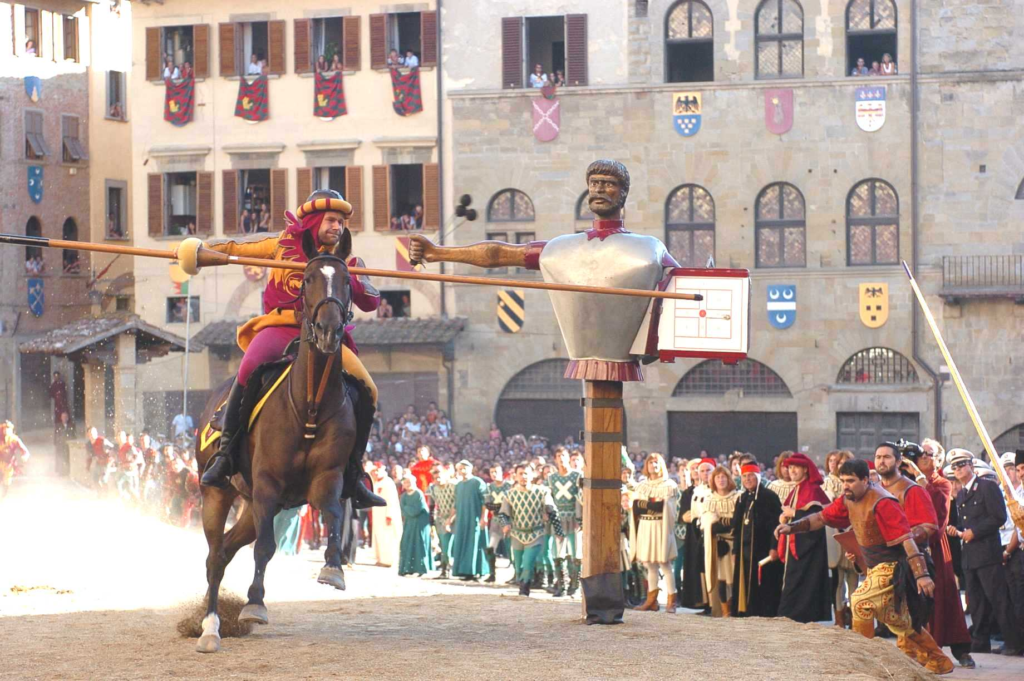
The Giostra del Saracino — the Saracen Joust — pits a rider against a rotating mechanical figure. At Arezzo, the oldest and most technically refined version in Italy, this figure is called the Buratto and represents the legendary King of the Indies. The rider charges at full gallop with a lance, aiming for a numbered shield on the figure’s left arm. The complication: the shield’s impact causes the Buratto’s right arm to swing around with a weighted mazzafrusto — a chain ending in three iron balls — and any rider who hits the shield but fails to clear the arc gets struck. The scoring system is precise; the penalty is physical. Arezzo’s records show jousting tournaments from the eleventh century, with the Buratto figure documented in its current form from 1605. Today four quartieri — Porta Crucifera, Porta del Foro, Porta Sant’Andrea and Porta Santo Spirito — compete twice a year in Piazza Grande.
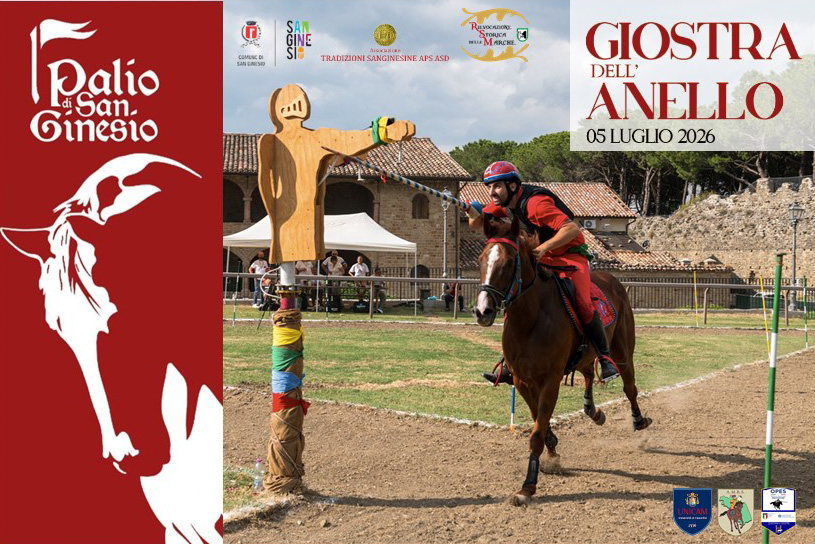
The Giostra dell’Anello — the Ring Joust — requires no defensive alertness from the rider: the target is inert. A small brass ring, typically between four and seven centimeters in diameter, hangs suspended on a crossbar. The rider charges at full gallop and must thread the tip of the lance cleanly through the ring. The scoring depends on how many rings are collected across multiple passes and how fast they are made. There is no figure swinging back at you. The entire contest is about precision, timing and the partnership between rider and horse.
This second form is the heartland of Le Marche. Ascoli Piceno runs the Quintana di Ascoli Piceno, one of the most prestigious ring-jousting events in Italy, twice a year in Piazza del Popolo. San Ginesio, a hilltop comune in the Maceratese hinterland, holds its Giostra dell’Anello in early July and its Palio della Pacca on August 15, organized around four Porte — Alvaneto, Ascarana, Offuna and Picena — that correspond to the four gates of the medieval town. Servigliano, in the Fermano valley, has been running its Torneo Cavalleresco di Castel Clementino since 1969: the ring joust is preceded by a corteo of over three hundred figurants in costumes reproduced from the paintings of Carlo Crivelli and Domenico Ghirlandaio. Monterubbiano’s festival, the Armata di Pentecoste, ties its ring joust to a ceremony so old its origins are traced to the Picene tribal migrations of pre-Roman antiquity.
What few outside the world of Italian equestrian re-enactment know is that these events are connected by something more than regional proximity. Since 2018, an annual national competition called the Miglior Cavaliere d’Italia — Italy’s Best Knight — has been running, awarding points to riders who compete across the full circuit of ring jousts and quintane. The season opens each spring and culminates with a gala ceremony in San Gemini, in Umbria. The riders are not amateurs with regional allegiances: they are professional horsemen who travel across central Italy on consecutive weekends, accumulating points. The same names — Innocenzi, Paterni, Diafaldi — appear at Ascoli, at Foligno, at Servigliano, at Tarquinia. It is, effectively, a medieval equestrian championship series, invisible to the international travel press but very much alive.
Form Three: The Processional Tribute
A third type of palio is organized around a completely different logic. Here the central act is not a competition at all, or not primarily: it is an act of communal homage. Castles and villages come to the city to offer tribute — the presentation of the palio cloth, candles, agricultural produce — to the patron saint or the city’s authority. The contest, if there is one, follows the ritual; it does not define it.
Fermo’s Cavalcata dell’Assunta belongs to both this category and the first: on the evening of August 14, over fourteen hundred figurants process through the city in the full apparatus of a fifteenth-century court — musicians, flag-throwers, ladies in brocade, armored knights — delivering the painted palio to Piazza del Popolo. The artistic drappo is commissioned each year from a different painter and kept concealed until it is ceremonially unveiled that night. Only the following day does the horse race happen.
Monterubbiano’s Sciò la Pica occupies this same territory, though its origins are deeper and stranger. The name means, in local dialect, “shoo the magpie away” — a reference to the ancient Picene ritual of following a woodpecker (pica, sacred to Mars) across the landscape to find fertile land. The festival, held on Pentecost Sunday, begins with a procession in which the four Corporazioni — Artisti, Mulattieri, Bifolchi and Zappaterra — carry votive candles to the church of Santa Maria del Soccorso. The ring joust in the afternoon is, in some sense, a second act. The first act is a ceremony so old that Roman historians wrote about its precursor.
Form Four: The Neighborhood Field Game
The fourth form is the most unexpected, and the one that draws the most skeptical double-take when described to visitors. Here the competition between contrade takes the form not of horses or lances but of a team sport, played by athletes who train for months.
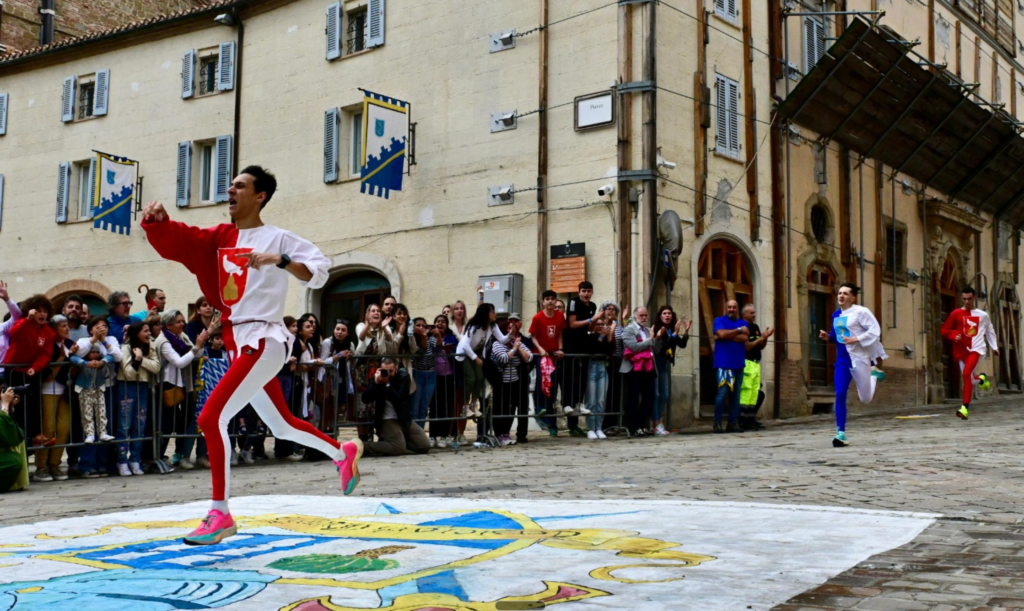
Camerino, the ancient university town in the Maceratese, runs its Corsa alla Spada e Palio every May around the feast of its patron Saint Venanzio. The contest is a foot race: thirty athletes, ten for each of the city’s three terzieri (Sossanta, Di Mezzo and Muralto), sprint 1,130 meters through the uphill streets of the centro storico. The first to finish wins the sword — a blade forged specifically for the occasion, symbolizing the chivalric legacy of the Da Varano lords who ruled Camerino for three centuries. The terziere that places the most runners in the top ten wins the palio. Medieval documents from the city archive, dated to 1220, record this foot race as already existing — making it the oldest attested pedestrian palio in central Italy, predating the modern Sienese format.
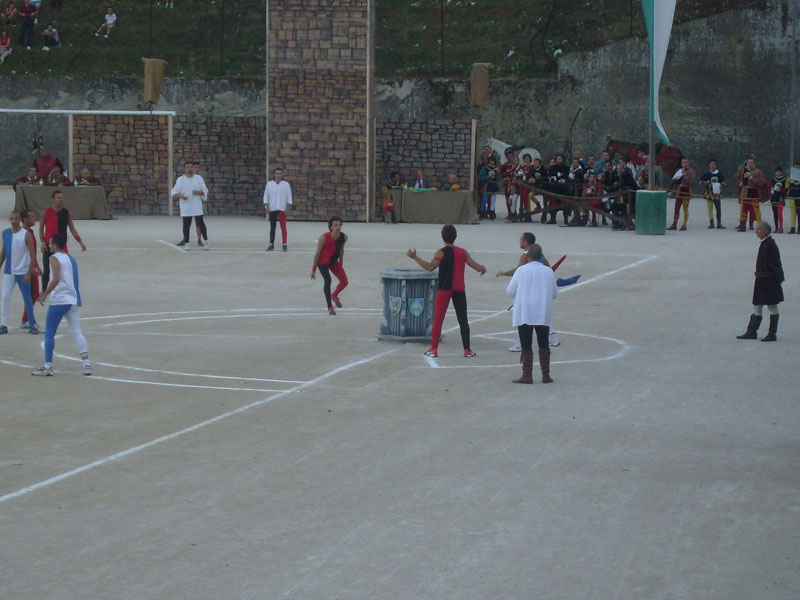
Sant’Elpidio a Mare, in the Fermano lowlands, goes further still. The Contesa del Secchio — Contest of the Bucket — is played with a ball, a target, and a scoring system that a modern observer would recognize as a primitive form of basketball. Four contrade — San Giovanni, Sant’Elpidio, Santa Maria and San Martino — field teams of six players who compete in a round-robin tournament to score the most “wells,” throwing the ball toward a suspended target representing the contested pozzo (well). The legend behind the game is vivid: in the late Middle Ages, when the town had only one communal well, the contrade quarreled daily over the right to draw water. The Capitano del Popolo resolved the dispute by turning priority rights into a game — the winning contrada drew water first for the following year. The event was formalized in 1953 and has not missed a year since, which gives it the title of the oldest running historical re-enactment in Le Marche. Alessandra Gramigna, president of the organizing body, has said of it: “What we do is not replicate the palios, the saracen joust, or the horse race. Our game involves athletes who train five months a year to compete.”
Why Le Marche Is the Heartland
No other Italian region concentrates as many active medieval contests as Le Marche. The geography explains part of it: the region’s parallel river valleys produced dozens of fortified hilltop towns within a few kilometers of each other, each with its own identity, its own church, its own rivalry with the neighbors. That competitive energy was never absorbed into a single dominant city the way Rome absorbed Lazio or Florence absorbed Tuscany. Instead it persisted in these annual contests.
The other reason is the Crivelli connection. Carlo Crivelli, the Venetian-born painter who worked in the Fermano and Maceratese for most of his career in the fifteenth century, documented the clothing, heraldry and pageantry of the regional courts with unusual precision. When, in the twentieth century, the towns revived their medieval festivities, Crivelli’s polyptychs — many still in local churches — provided the costume designers with source material of extraordinary specificity. The figurants at Servigliano wear colors drawn directly from his altarpieces. The effect, when you see three hundred of them filing through a medieval piazza at dusk, is of a painting come alive.
—
What to Expect as a Visitor
Arriving at a ring joust or a medieval palio in Le Marche is a different experience from arriving at the Palio di Siena. There are no organized international tour packages. The stands are local, the crowds are largely Italian, and the protocol of each event has its own specific logic that no printed program fully explains.
The single most useful thing to understand is the social structure behind the competition. Every event is organized around contrade, rioni, terzieri or porte — different words for the same basic unit: the neighborhood division of a medieval Italian commune. These are not arbitrary teams. They are civil institutions, some of them continuous since the thirteenth century, with their own insignia, their own patron saints, their own colors and — crucially — their own bars and restaurants where members gather before and after the event. When a Sienese contradaiolo says that belonging to the Contrada dell’Aquila is not like supporting a sports team, but more like a second family, they are expressing something that applies equally to the Porta Picena of San Ginesio or the Corporazione dei Mulattieri of Monterubbiano.
Tickets for the jousting events are modest — rarely more than fifteen or twenty euros for a tribuna seat — and should be purchased in advance for the main spectacle. Arriving early matters less here than at Siena, but for the ring joust specifically, proximity to the track is worth the premium: the sound of a horse at full gallop on stone, the percussion of lance against ring or shield, is experienced rather than watched.
For the processional events, the corteo is free to observe from the streets. The figurants file past at arm’s reach. The protocol of silence during religious moments is strict; Italians observe it naturally, and visitors should follow the crowd’s lead. Applause during the flag-throwing sequences is expected and encouraged.
Avoid the assumption that the “real” event is the horse race or the joust and everything else is decoration. The pre-event weeks — the tournaments between neighborhood groups, the archery contests, the drum competitions, the hostarie (outdoor taverns in medieval costume) — are where the community’s emotional investment lives. Attending a dinner at the Porta Alvaneto osteria in San Ginesio the night before the ring joust, eating vincisgrassi in the open air with the neighborhood’s supporters, is as authentic an Italian experience as you will find anywhere in the country.
—
FAQ — The Italian Palio for the American Visitor
What does “palio” mean in Italian? Palio comes from the Latin pallium, meaning a length of fine cloth or banner. In medieval Italian cities, this cloth was the prize awarded to the winner of competitive events — horse races, jousting contests, foot races. Over time, the word came to describe the contest itself. Because different towns competed for their palio in different ways, the word today covers four distinct event types: horse races, lance jousts, ceremonial cavalcades, and neighborhood field games.
Is the Palio di Siena the only Italian palio? No — it is the most famous internationally, but dozens of Italian towns hold events under the same name. Fermo’s horse palio predates Siena’s modern format by several centuries, documented from 1182. In Le Marche alone, Ascoli Piceno, San Ginesio, Servigliano, Monterubbiano, Sant’Elpidio a Mare and Camerino all hold active annual medieval competitions. The ring-jousting circuit across central Italy is especially rich, with a national championship series called the Miglior Cavaliere d’Italia now in its ninth annual edition.
What is the difference between a Giostra del Saracino and a Giostra dell’Anello? Both are forms of the quintana — a medieval lance-training exercise on horseback. In the Saracino, the rider charges a rotating mechanical figure (called Buratto at Arezzo, or a similar Saracen effigy elsewhere) and must hit a shield target while avoiding a swinging counterweight arm. In the ring joust (Giostra dell’Anello), the target is a suspended brass ring: no counterattack, pure precision. The ring sizes typically decrease across three rounds — often from seven to four centimeters in diameter — demanding extreme accuracy at speed.
When is the best time to attend a medieval palio in Le Marche? The season runs from late May through mid-August. Monterubbiano’s Sciò la Pica falls on Pentecost Sunday (late May or early June). San Ginesio’s Giostra dell’Anello is on the first Sunday of July, with the Palio della Pacca on August 15. Servigliano’s Torneo Cavalleresco takes place the third weekend of August. Fermo’s Cavalcata dell’Assunta peaks on August 14-15. Camerino’s Corsa alla Spada runs through May around the feast of San Venanzio (May 18). For weather and festive atmosphere, the July-August period is optimal; for fewer visitors and more intimate access, the May events at Camerino and Monterubbiano are worth the earlier trip.
Do you need to book tickets in advance? For major jousting events, yes — the tribuna seats at Ascoli Piceno and Servigliano fill quickly, particularly in the days before the event. San Ginesio and Monterubbiano are smaller and more accessible, but advance purchase is still advisable. For Fermo’s palio, tickets to the horse race are available through the official Cavalcata dell’Assunta website. Attending the corteo (processional) component of any of these events is free, requires no reservation, and offers some of the most remarkable viewing of the festivities.
How long should I plan for one of these events? The competition itself — whether a ring joust or a horse race — typically occupies two to three hours on the main day. But treating the event as a single-day excursion misses most of what makes these festivals significant. The week or ten days leading up to the major contests includes neighborhood dinners at the contrada osterie, drum and flag-throwing competitions, archery tournaments, and increasingly elaborate cortei. Spending two nights in the area, arriving the day before the main event, gives you access to the evening corteo plus the competition itself — the full arc of the experience.
Is there anything at these events that visitors often misunderstand? The most common misunderstanding is treating the medieval costume as theater. It is not a performance for tourists. The figurants at Servigliano spend months fitting and preparing costumes reproduced from fifteenth-century paintings; the families of San Ginesio have belonged to the same Porta for generations; the athletes of Sant’Elpidio a Mare train five months for their neighborhood’s game. When you attend one of these events, you are entering a community’s living calendar, not a heritage park. The appropriate response to the corteo passing in silence is silence; the appropriate response to a joust point is whatever noise the crowd around you makes. Follow the locals, not the other visitors.
—
The Takeaway
The Italian palio is not one thing. It is a word that different communities — over seven centuries — have filled with their own history, their own rivalry, their own way of translating a medieval contest into a contemporary act of belonging. A horse race in Siena and a ring joust in San Ginesio share nothing mechanically. They share the pallium: the cloth that someone will earn, and that the town will remember for another year.
For the traveler willing to leave the Chianti valleys and the Florentine circuit, the concentration of living medieval tradition in Le Marche and neighboring Umbria offers something increasingly rare in Italian tourism: events that exist entirely for the communities that run them, where the foreigner who arrives respectfully and on the community’s own terms is genuinely welcome.
I have stood in the Piazza di San Ginesio when Porta Picena’s rider landed the ring in the final pass, and the sound from three hundred Marchigiani was not polite applause. It was something older and more urgent — the sound of a town recognizing itself in what it has kept alive. That is what any palio, in any of its four forms, is actually for.
Planning a trip to Le Marche and want to experience one of these events from the inside? You can book a 30-minute consultation with me at TidyCal to plan your itinerary around the festivals that fit your travel dates.
These contests are living history, and history like this makes people want to put down roots. If a house in Le Marche has entered your thinking, I give foreign buyers an independent structural read of the building before they buy.
Written by Mirco Vitellozzi, a structural engineer from Le Marche who writes about Italy from the inside. More essays at Tastes & Wonders of Italy, and short films on YouTube.