Umbria Jazz 2026: Tickets and Accommodation, by an Italian from the Next Region Over
A marching band turns into Piazza IV Novembre just after seven, brass-thick and tight, and the late sun cuts the facade of the Cattedrale di San Lorenzo into pink and shadow. The travertine warms underfoot. A tenor saxophone laces through the smell of porchetta from a street stall two streets over. This is Perugia, second week of July, the city wearing Umbria Jazz like a second skin for ten consecutive days — and if you have landed here looking for Umbria Jazz 2026 tickets and accommodation, this article is for the planning, not the postcard.
As an Italian engineer from the Marche, the region next door, I have been making the ninety-minute drive to Perugia for Umbria Jazz since the days when you could still buy a ticket at the gate two hours before showtime. That margin closed years ago. The festival now runs from Friday, July 3 to Sunday, July 12, 2026, the 53rd edition, and the math of attending it has shifted: you need to book your seat and your bed in the same week, in some cases on the same day, before the Arena Santa Giuliana headliners and the historic-center hotels both run out.
What follows is everything you need to plan the trip in the right order: how the festival is actually structured across the city, which concerts cost money and which are free, where to buy your tickets, and where to put your suitcase so the night does not end with a frantic taxi search at midnight.
A note on links: some of the booking links in this article are affiliate links. If you book through them, I earn a small commission at no additional cost to you. Festival tickets are not among them — Umbria Jazz sells its own, and buying anywhere else is how people end up with nothing.
What Umbria Jazz Actually Is
Umbria Jazz was founded in 1973, and Perugia in 2026 hosts its 53rd edition. It belongs in the same conversation as Montreux, Newport, and North Sea — one of the half-dozen jazz festivals in the world whose programming is taken seriously by the international jazz press, and one of the very few that has refused to sequester itself inside an arena complex.
What makes it different is geography. Umbria Jazz does not happen at the festival. It happens to the city. For ten days, the program occupies fourteen stages spread across Perugia’s Etruscan-walled center: Arena Santa Giuliana for the international headliners, Teatro Morlacchi for the more concentrated jazz acts, the Sala Podiani inside the Galleria Nazionale dell’Umbria for chamber sets, Giardini Carducci as the evening free stage on the panoramic terrace, Piazza IV Novembre as the main daytime free stage in front of the Fontana Maggiore, the Bottega del Vino for late-night jams, plus the Terrazza Swing on the rooftop of the Mercato Coperto and a handful of smaller secret venues that change by edition.
The roster over the past two decades reads like a who’s-who of late-career American and international music: Stevie Wonder, Tony Bennett, Lady Gaga and Tony Bennett together, Quincy Jones, Bob Dylan, Brad Mehldau, Diana Krall. Critics underrate the festival in the United States because it does not market itself there. Italians and Europeans treat it as essential. For broader context, the Umbria Jazz official festival website also runs a winter sibling, Umbria Jazz Winter, held in Orvieto between December 28 and January 1 — a smaller, more intimate cousin and a separate trip.
Umbria Jazz 2026 Dates and Headliners
Umbria Jazz Perugia 2026 runs from Friday, July 3 to Sunday, July 12. A free pre-opening concert in Piazza IV Novembre on Thursday, July 2 acts as the runway into the official program. The 53rd edition is built around roughly 274 announced events, more than half of them free, distributed across 80 bands and 14 stages between piazzas, theaters, and gardens.
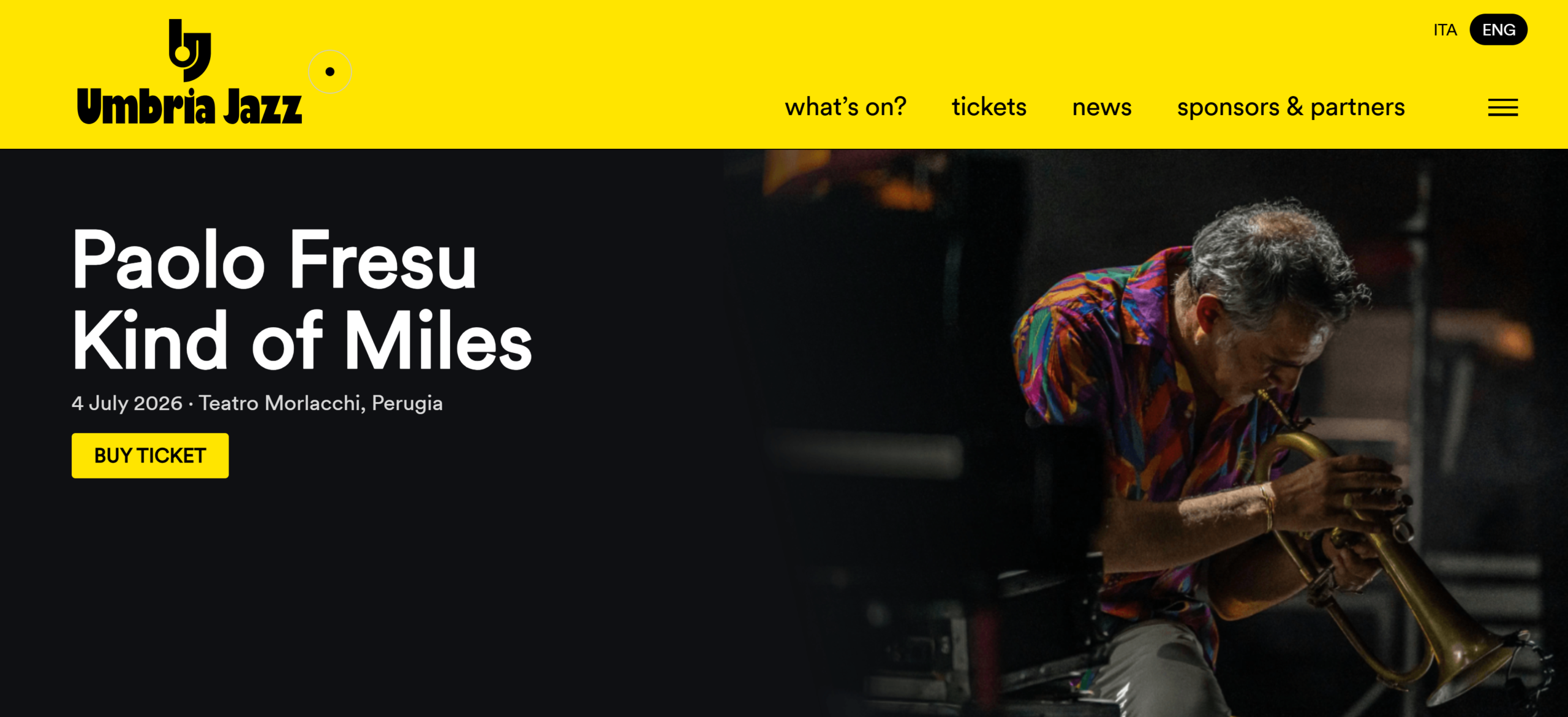
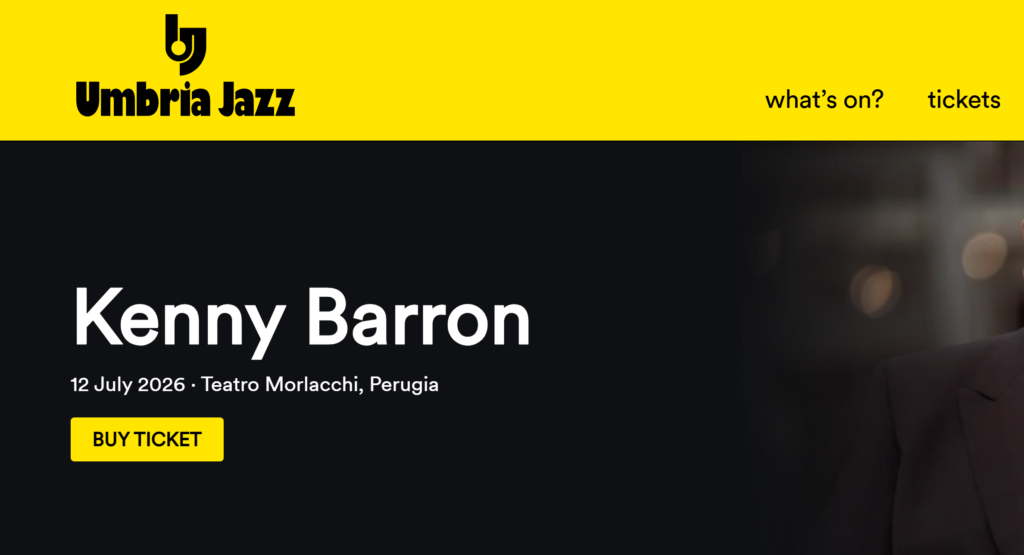
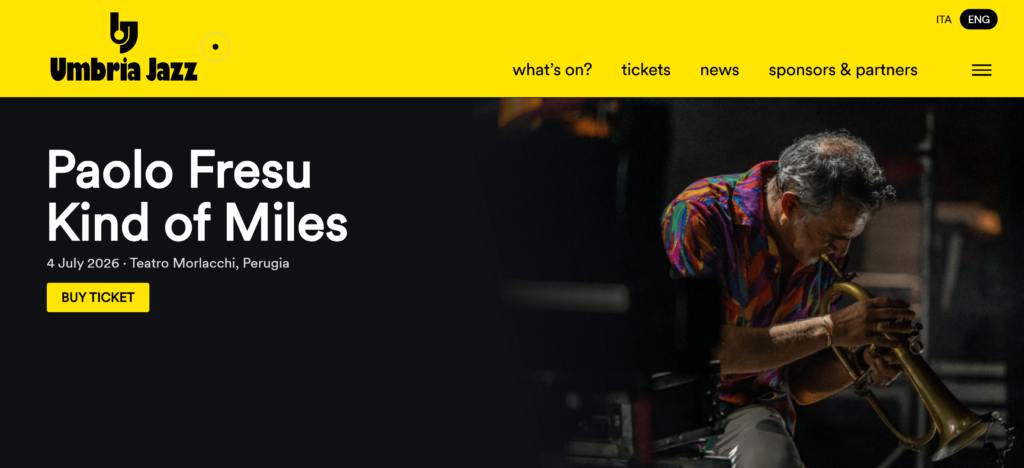
The Umbria Jazz 2026 lineup at Arena Santa Giuliana opens on July 3 with Sting on his 3.0 World Tour, in trio formation with Dominic Miller on guitar and Chris Maas on drums. The week then alternates jazz, soul, songwriter, and blues across nine more Arena evenings: Jon Batiste, Charles Lloyd, the Terence Blanchard / Ravi Coltrane Miles–Coltrane Centennial Celebration, Laurie Anderson with Sexmob, Christone “Kingfish” Ingram, Snarky Puppy with Metropole Orkest, Stefano Bollani All Stars, Gilberto Gil, Zucchero, and a closing-night double bill with Elvis Costello and Judith Owen on July 12. Teatro Morlacchi balances the jazzier side of the program with Paolo Fresu Kind of Miles, Cécile McLorin Salvant, Kenny Garrett, and Kenny Barron, among others, and Brandee Younger performs in the Sala Podiani of the Galleria Nazionale on July 10.
A note on the Arena experience: Arena Santa Giuliana is an open-air summer arena, capacity around six thousand, numbered plastic seating, no roof. It is not the Hollywood Bowl. The sightlines are clear, the sound is excellent, the evenings are pleasant, and the venue is functional rather than spectacular.
How to Buy Umbria Jazz 2026 Tickets
There are two layers to buying Umbria Jazz tickets, and they need to be handled separately.
For the paid concerts at Arena Santa Giuliana and Teatro Morlacchi, the festival sells through its own tickets page on umbriajazz.it, with transactions handled by four authorized partners: Boxol, TicketOne, Ticketmaster, and Vivaticket. Each Arena event lists multiple selling platforms; start on the official Tickets Umbria Jazz page, then cross-check the others if your preferred seat is gone. For Sting specifically, the primary on-sale ran through Live Nation — a quirk of the Sting 3.0 Tour worth knowing if you are still hunting for that one. Anyone under twenty-six gets a 20% discount, applied automatically once the age-verified ticket type is selected.
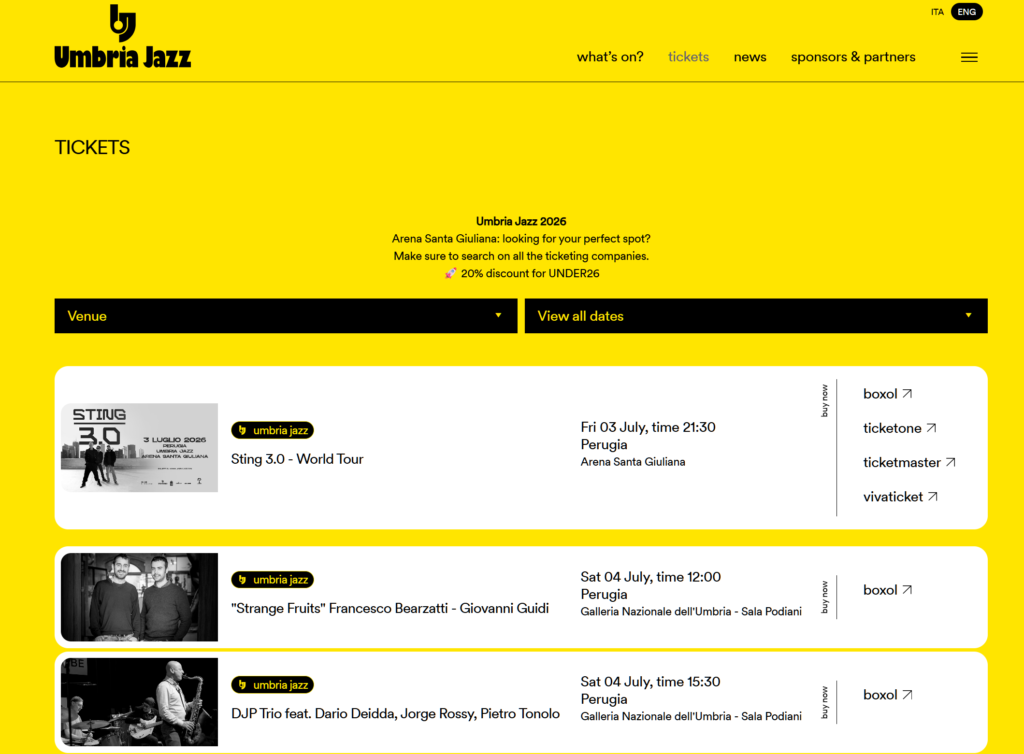
Arena Santa Giuliana concerts in 2026, based on confirmed 2025 pricing patterns and headliner pricing visible on the platforms, fall in a range of roughly €40 to €120 per show depending on artist and section — numbered parterre seats up front cost more than the higher gradinata. Teatro Morlacchi tickets cluster roughly between €30 and €60 per show, with stalls priced above gallery. Verify the actual 2026 figure on the platform when you check out; Sting, Zucchero, and Elvis Costello sit in the upper part of that band.
Free programming — Piazza IV Novembre afternoon and early-evening sets, the Conad Stage at Giardini Carducci, the marching bands rolling through Corso Vannucci, the Bottega del Vino late-night jams (some of which carry a separate door fee) — requires no ticket. Arrive about an hour before showtime to claim a viewing position near the Fontana Maggiore.
Sold-out risk is real and already documented. Zucchero’s July 11 Arena date was marked sold out on the festival ticket page in the first week of May 2026. Treat any Arena date you want as a date to book this week, not next month.
Is There an Umbria Jazz Festival Pass for 2026?
The official 2026 ticketing infrastructure on umbriajazz.it sells single tickets per event. There is no formal festival pass or multi-concert subscription advertised on the official channels for this edition; the only structural discount is the UNDER26 20%. This matters for planning. A traveler attending two Arena nights and one Morlacchi night assembles three separate purchases on the same platforms, not one bundled fee.
The logic of the decision is therefore simpler than at other European festivals. If a single headliner is the reason you are coming — Jon Batiste, Snarky Puppy, Elvis Costello — buy the one ticket and build the rest of the trip around the free programming, which carries real artistic weight at the Giardini Carducci and the IV Novembre stages. If you intend to follow the broader paid program across five days or more, plan three or four ticketed evenings and treat the daytime piazze as the spine of the experience, not as filler.
Where to Stay in Perugia for Umbria Jazz 2026
Perugia’s historic center sits inside a tight medieval perimeter, roughly a kilometer in diameter, surrounded by a modern ring. Every festival stage is inside that perimeter and walkable from any other. The accommodation question is therefore about which perimeter, not about distance from a venue.
Inside the walls. Sina Brufani, Brufani Palace, Hotel La Rosetta, Locanda della Posta, Sangallo Palace — all within ten minutes on foot of Piazza IV Novembre and all roughly doubled in rate during the festival week. They sell out around six months in advance for the headliner nights and the closing weekend; by mid-May for July, availability is the exception, not the rule. Best for travelers who want to walk back from the Arena at midnight and continue the night in the historic center.
Perugia’s modern belt. Fontivegge near the train station, Madonna Alta, Borgo XX Giugno just below the historic center. Chain hotels, three- and four-star independents, B&Bs at non-festival prices. Reach the center on the Minimetrò automated shuttle from Fontivegge to Pincetto in seven minutes — but the Minimetrò closes around 22:45, which means returning from a 21:30 Arena concert requires a taxi. Practical choice for late bookers and budget-conscious travelers who plan for rideshare on the post-Arena leg.
Another Umbrian town. Assisi, Spello, Bevagna, Montefalco, Foligno. Twenty to forty minutes from Perugia by car, far cheaper than the perugino center during festival week, and an experience in their own right — Sagrantino tastings around Montefalco, Spello’s Roman geometry, the Basilica Inferiore at Assisi at dusk. Basing yourself in Assisi has one specific advantage: a lunch and five-wine tasting at a family estate eight hundred metres below the Basilica sits within walking distance of the town, which means the daytime half of your festival week costs you no driving at all. The trade-off is night-time logistics: the last train from Perugia toward Assisi leaves around 22:00, before any Arena set is over, so this option requires a rental car or a budget for late-night taxi back.
Practical Tips from a Local
If you arrive by car, do not try to drive into the historic center. The perimeter inside the walls is ZTL — restricted traffic zone, camera-enforced, the fine arrives at your rental return in Rome a month later. Use one of the three escalator-equipped park-and-ride lots: Mercato Coperto, Pellini, or Piazza Partigiani. The Partigiani lot is the most theatrical: you exit on mechanized escalators through the Rocca Paolina, the underground sixteenth-century fortress built into the city’s south flank, and you surface in Piazza Italia with the Umbrian valley spread below you. First-time visitors should make their first city entrance this way.
Dinner before a 21:30 Arena concert is best handled in the small osterie of Via dei Priori and Via Bartolo — locally owned, slower service, fair prices — rather than the tourist menus along Corso Vannucci. After the Arena empties around midnight, Corso Vannucci fills with the same six thousand people walking back toward the center; the more pleasant late drinks happen one block east, in and around Piazza Matteotti, where the wine bars and the smaller terraces have room.
Use the free daytime slots between Arena nights to escape the festival heat: a half-day in Assisi, a slow lunch in Bevagna, a Sagrantino tasting at one of the cantine outside Montefalco. Umbria Jazz pays for itself faster when you treat Perugia as a base, not a confinement. The cantine take reservations rather than walk-ups, and in the second week of July they fill: a private cellar visit and tasting at Bocale runs ninety minutes and is small enough that the owner does the pouring himself.
One detail no festival brochure prints: Perugia sits at 493 meters of altitude, and the temperature gap between a July afternoon at 33°C and a midnight set on the Arena floor at 19°C is ten to twelve degrees. A linen shirt is not enough. Bring a light jacket or a long-sleeve layer for the high-altitude evenings. Locals do.
Booking Notes: The Daytime Half of the Week
Umbria Jazz is an evening festival attached to ten free daytime slots, and the visitors who enjoy it most are the ones who plan those daytimes with the same seriousness as the concerts. Perugia in mid-July is thirty-three degrees on the travertine by two in the afternoon. The valley below is not.
The Sagrantino afternoon. Montefalco is forty minutes from Perugia and the grape does not exist anywhere else in any quantity — a tannin so aggressive it needs thirty months of ageing before it becomes drinkable, which is the whole reason the wine is interesting. Two versions worth the drive: the barrel cellar and lunch over the vineyards at Antonelli San Marco, a family estate running since 1883 and the more formal of the two, or the jeep run through the Sagrantino vineyards with the producer driving for something less seated. Both include tasting and food; neither requires you to be back before the doors open at the Arena.
The cheapest good hour in Umbria. A guided visit and tasting at a working oil mill near Bevagna costs about the price of two coffees on Corso Vannucci and teaches you more about Umbrian cooking than most restaurant meals. Olive oil here is a January product tasted in July, which is exactly the mismatch that makes it worth having explained by someone who presses it.
If you want the countryside rather than a cellar. The Vespa route linking Bevagna, Montefalco and Gualdo Cattaneo follows secondary roads with a suggested route rather than a guide in front of you, which suits the kind of traveller who came to Perugia for the music and does not want a second schedule. Ride it in the morning; the heat after two makes it less pleasant than it sounds.
What I would skip. The Umbria day trips that depart from Rome. They exist in large numbers, they cost three or four times a locally-run tasting, and they spend six of their ten or eleven hours on the A1. If you are in Perugia for the festival you are already in Umbria; there is no reason to buy a product designed for people who are not.
Booking the Week: Final Word
Umbria Jazz 2026 tickets and accommodation lock together as a single planning problem: the Arena Santa Giuliana headliners and the historic-center hotels run out together, and the calendar is already moving — Zucchero’s July 11 Arena date was sold out within days of its on-sale, and the May reports already flag downstream pressure on the rest of the week. Book your Umbria Jazz 2026 tickets through one of the authorized platforms — TicketOne, Boxol, Ticketmaster, or Vivaticket — and your Perugia hotel through Booking the same week, ideally in a single sitting. The festival runs from July 3 to July 12, 2026; the lineup is one of the strongest in the past decade; the city does this better than any other in Italy. Pick your night, pick your bed, and arrive in time for an evening set in Piazza IV Novembre on the day you check in.
Written by Mirco Vitellozzi, a structural engineer from Le Marche who writes about Italy from the inside. More essays at Tastes & Wonders of Italy, and short films on YouTube.