Macerata Opera Festival: An Engineer’s Guide to the Sferisterio
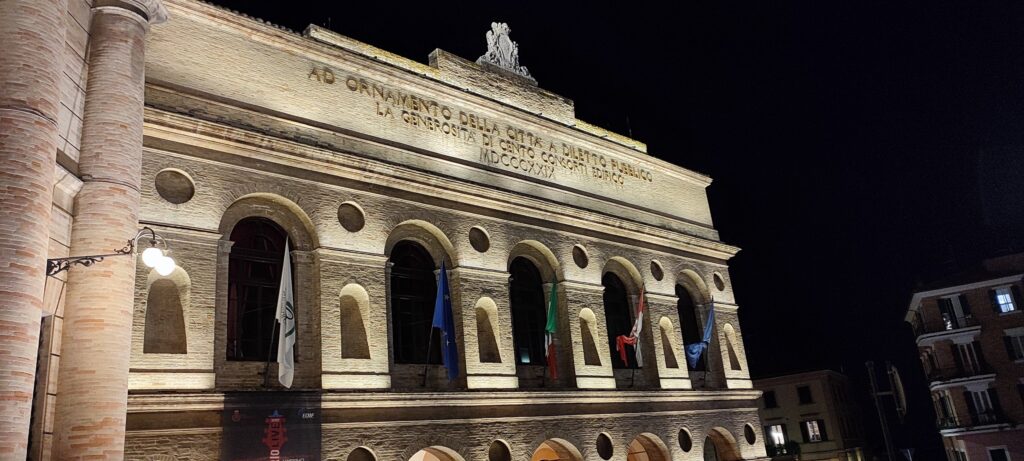
The wall goes up first, before the music does. On a July evening in Piazza Nazario Sauro, the stone flank of the Sferisterio catches the last of the light while ushers set up outside the ticket gates, and for a few minutes the building looks less like a theater than what it originally was: an oversized handball court backed onto the medieval walls of Macerata. Then the doors open, roughly 2,500 people find their way to seats carved into a Neoclassical horseshoe, and by 9:00 p.m. an orchestra is filling a space that was never meant to hold music at all.
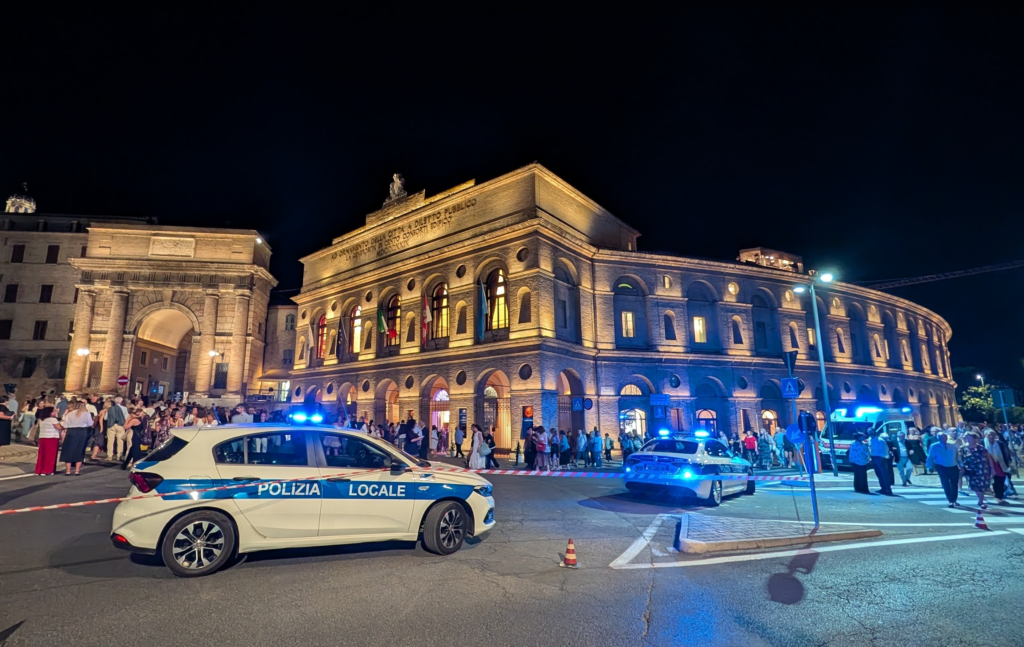
The Macerata Opera Festival runs at the Sferisterio arena, in the historic center of Macerata, in the Marche region of central Italy. The 2026 edition is the 62nd, staged from July 17 through August 9, with three full operas — Verdi’s Nabucco, Rossini’s Il barbiere di Siviglia, and Verdi’s Il trovatore — plus a single special performance of Orff’s Carmina Burana on August 7. What makes it worth a detour from Rome or Florence isn’t just the singing: it’s an open-air arena built in the 1820s for a completely different sport, discovered almost a century later to have some of the best natural acoustics in Italian opera, in a small university city most American itineraries skip entirely. I live and work in Macerata as an engineer, and I’ve spent enough evenings under that wall to have opinions about why it sounds the way it does.
What’s happening: the Macerata Opera Festival at the Sferisterio
The 62nd edition, in brief
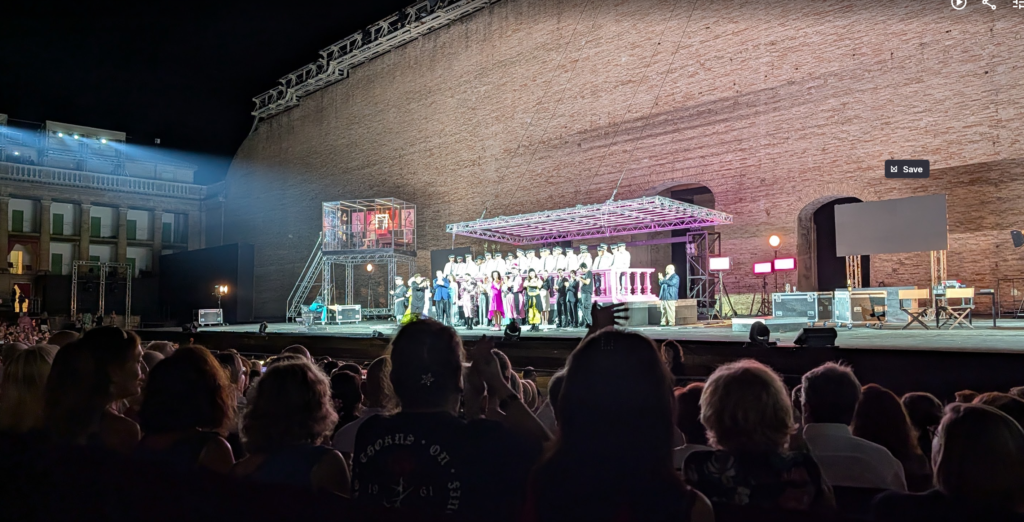
The festival’s home, the Arena Sferisterio, sits inside Macerata’s old town, a few minutes on foot from the train station. Every summer from mid-July into August, it converts from empty stone bowl to full opera house, with all performances starting at 9:00 p.m. and gates opening 45 minutes earlier. The 2026 program leans on the core Verdi-Rossini repertoire that built the festival’s reputation, framed by a single symphonic-choral evening that functions almost as an intermission from the main season.
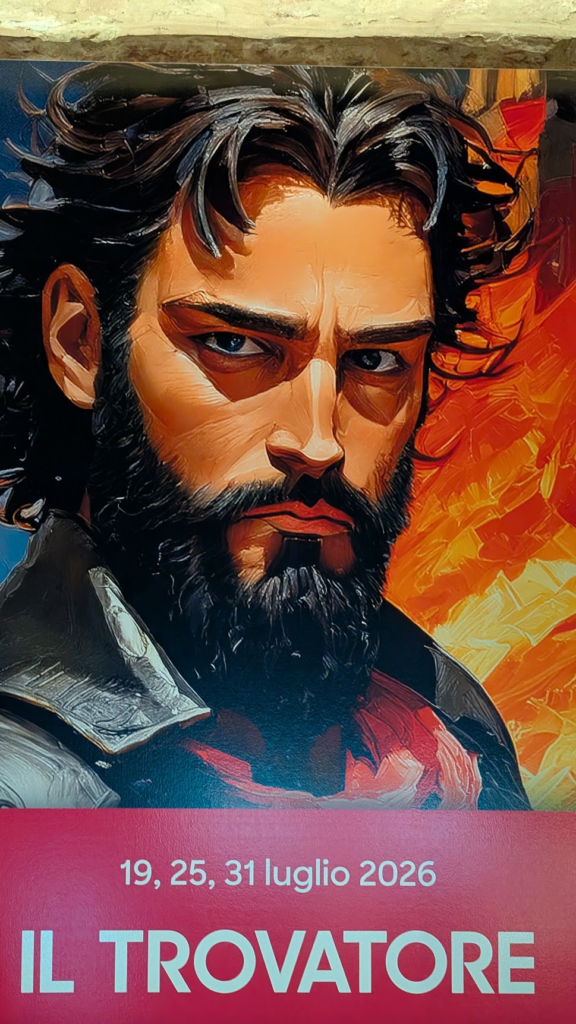
The lineup: Nabucco opens the season as a new production, staged by Paul-Émile Fourny and conducted by Fabrizio Maria Carminati, with Anastasia Bartoli as Abigaille and Ariunbaatar Ganbaatar in the title role. Il barbiere di Siviglia returns in Daniele Menghini’s staging under conductor Gianluca Martinenghi, with Grisha Martirosyan as Figaro. Il trovatore runs in Francisco Negrin’s well-known production, conducted by Dmitri Jurowski, with Piero Pretti as Manrico. Carmina Burana closes out the special-event slot on August 7, conducted by Ramón Tebar.
The backstory: an arena that wasn’t built for opera
From ball game to opera house
Here’s the detail that surprises most American visitors: the Sferisterio isn’t a Roman ruin repurposed for music, the way people sometimes assume when they hear “open-air arena in Italy.” It’s a 19th-century civic project, and for its first ninety-odd years it had nothing to do with opera at all.
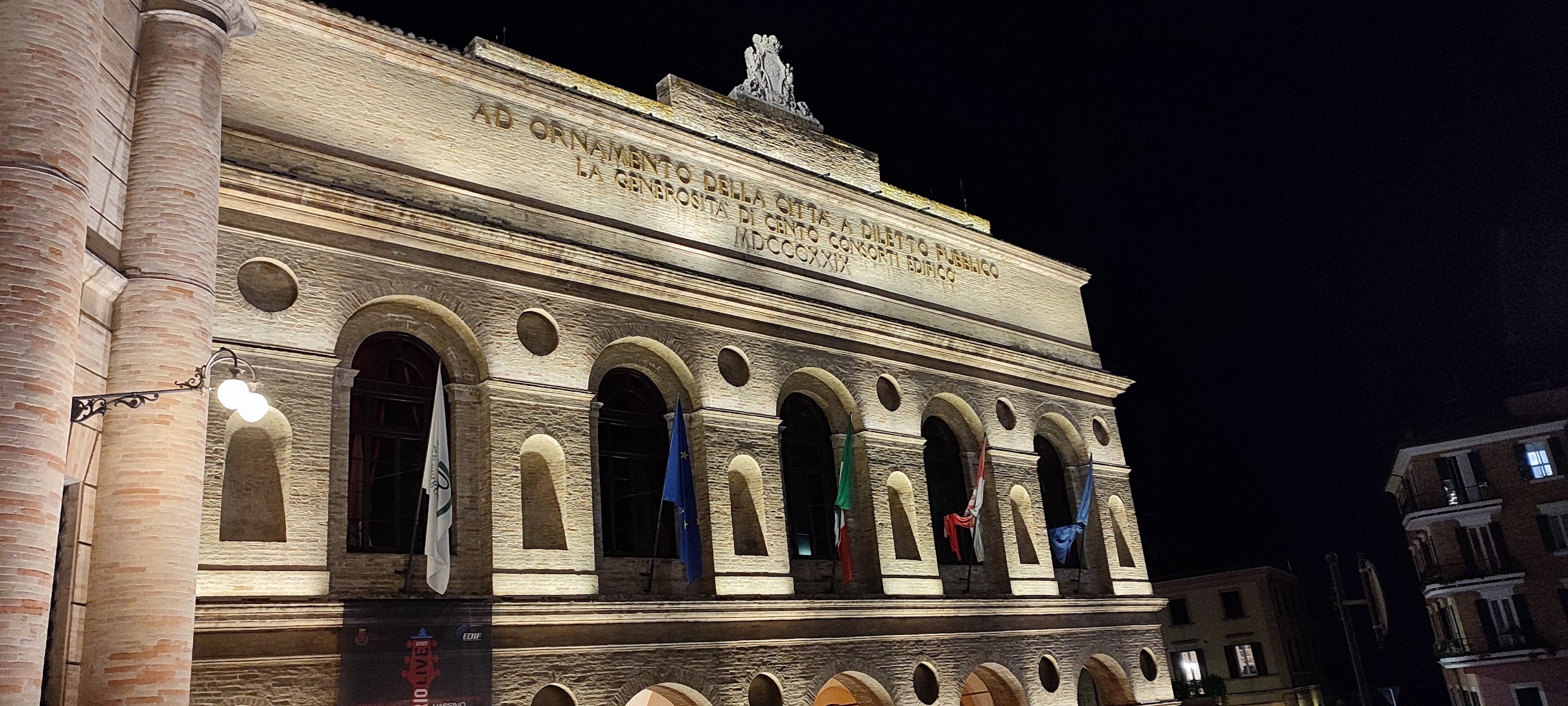
A group of roughly a hundred well-off Macerata families, remembered locally as the Cento Consorti (literally, “the hundred shareholders,” the citizens who financed the building and are still credited on an inscription across its facade), commissioned the structure in the early 1820s. The architect most associated with the final design is Ireneo Aleandri, a Neoclassical builder who later worked on Spoleto’s theater and the viaduct at Ariccia. Construction ran from roughly 1820 to 1829, and the finished building was designed for pallone col bracciale (a fast, now largely vanished Italian handball game played with a wooden armguard), plus the general-purpose civic events of the era: jousts, equestrian parades, political rallies, traveling circuses, even the occasional bullfight.
Opera arrived almost by accident. In the early 1920s, a group of Macerata residents attended a performance at the Arena di Verona, came home wondering whether their own arena could do something similar, and tested the Sferisterio’s acoustics. It worked well enough that Count Pier Alberto Conti organized a production of Verdi’s Aida in 1921 — the building’s first opera, staged after a hasty 1920 restoration. It became a fixture only decades later, following a 1967 reopening built around Mario Del Monaco. Everything that followed, including the international reputation the Sferisterio now carries, grew out of that one after-the-fact discovery.
An engineer’s read of the wall
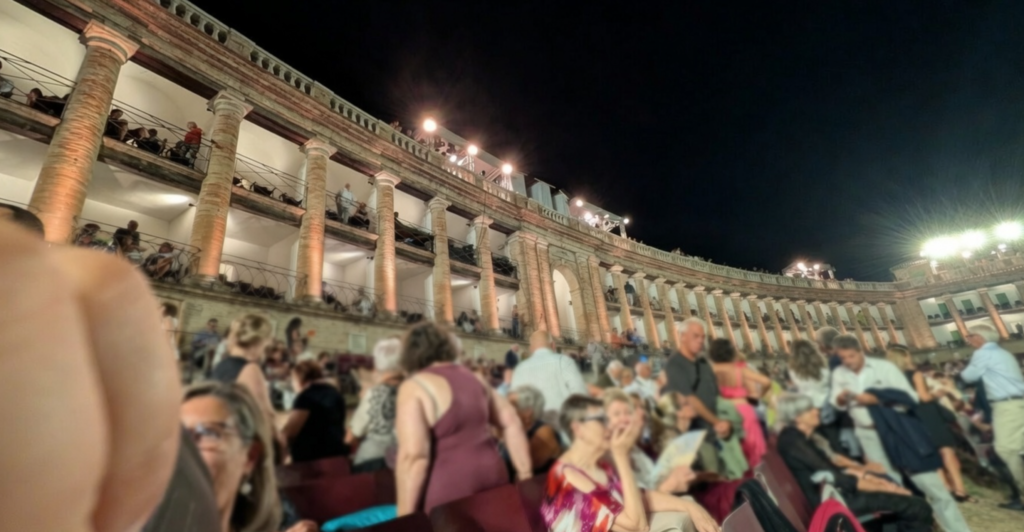
I’ll put my professional hat on for a paragraph, because this is the part most guides skip. The Sferisterio isn’t a bowl or a horseshoe in the Roman sense — it’s a long, roughly 90-meter arena closed on one side by a straight, tall stone wall set directly against Macerata’s medieval fortifications, with the opposite side curving into tiered seating behind 56 Doric columns and 104 boxes, originally reserved for the Cento Consorti families and their heirs. That flat back wall is doing more acoustic work than most visitors realize: with no roof and no vaulted ceiling to bounce sound the way an indoor opera house does, the wall becomes the arena’s one large reflecting surface, projecting the orchestra and voices outward toward the seating rather than letting them dissipate into open sky. It’s a geometry problem more than a mystery, which is probably why nobody set out to design it for music and it still works.
Dates, program and tickets (2026)
This section covers the 2026 edition specifically and should be checked against sferisterio.it before booking, since dates, casts, and prices are confirmed by the festival annually.
The four productions and remaining performances
As of July 20, 2026, the festival’s opening weekend (July 17–19) and the Under-30 preview nights (July 14–16) have already taken place. The performances still open for booking are:
- Il barbiere di Siviglia — July 24, August 2, August 8
- Il trovatore — July 25, July 31
- Nabucco — July 26, August 1, August 9
- Carmina Burana — August 7 (single evening)
Ticket prices by sector
The Sferisterio’s seating runs in color-coded sectors, from standing-room Balconata to the premium Platino rows nearest the stage. Full-price tickets for the three operas run from 15 euros (Balconata) to 200 euros (Platino, opening-night pricing only; repeat performances in Platino run 170 euros). Oro sector runs 120 euros, Verde 80 euros, Blu 65 euros, Rosso 50 euros, and Giallo 25 euros. Carmina Burana has its own, lower price scale, from 15 to 60 euros. Travelers under 30 or over 65 get a 20 percent discount on every sector except Balconata, and multi-opera carnets (three or six tickets across different titles) bring 25 to 30 percent off Oro and Platino specifically.
How to book
Official sales run through the festival’s own site and Vivaticket, the designated online partner; the box office in Piazza Mazzini also sells in person from Tuesday through Saturday and on performance evenings from 8:00 p.m. Buying through secondary resellers is a common trap for international visitors and usually means paying a commission on top of face value for no added benefit.
Where to sit: what the sectors actually mean
This is where the building’s shape matters practically, not just historically. Because the Sferisterio’s stage runs unusually wide by opera-house standards, seat position affects your experience of the staging more than it would in a conventional horseshoe theater. Front-and-center sectors (Platino, Oro) put you closest to the singers but can mean turning your head to follow action at the far edges of a wide set. Sectors further back and toward the sides (Verde, Blu) trade a little vocal presence for a fuller view of the stage picture as a whole — often the better trade for a first Sferisterio opera, when the building itself is half the show. Balconata, standing at the very back, is the cheapest way in and still delivers sound reasonably well, given how much of the acoustic work is happening off that back wall rather than close to the stage.
Planning your visit
Getting to Macerata and the Sferisterio
The arena sits in Piazza Nazario Sauro, inside the historic center, an easy walk from Macerata’s train station. Coming from Rome or the north by car, the A14 motorway toward Civitanova Marche connects to the SS77 superstrada, exiting at Macerata Sud/Corridonia. The Parcheggio Sferisterio, a covered lot minutes from the arena, is free after 8:00 p.m., which lines up conveniently with a 9:00 p.m. curtain. By train, connections run through Ancona or Civitanova Marche, with a short local hop into Macerata itself; the nearest airport is Ancona-Falconara, roughly an hour away by car or train.
What to bring for an open-air evening
Gates open 45 minutes before curtain, and arriving early is worth it: once a performance starts, latecomers wait for the first intermission to reach their seats. There’s no formal dress code, but a stone arena at 9:00 p.m. in July runs noticeably cooler than the piazza a few streets over — pack a light jacket or wrap, especially for children. Glass containers, bottles over half a liter, outside food and drink, and professional cameras aren’t permitted, and there’s no coat check. Performances go ahead even if it rains at the start; a downpour can push the curtain back by up to two hours, but once a show has begun there’s no refund for weather.
Where to eat before curtain
Macerata is a university town before it’s a tourist town, which means dinner doesn’t need to be an event in itself — but if you want a proper Marche meal before a 9:00 p.m. curtain, look for a kitchen serving vincisgrassi (a rich, layered baked pasta closer to a regional cousin of lasagna than a variation on it) or, if you’re closer to the coast on a day trip, brodetto, the Adriatic fish stew that changes recipe from one fishing town to the next. Reserve ahead on performance nights specifically: the restaurants nearest the Sferisterio know exactly when the festival crowd needs to be fed and out the door by 8:30.
Pairing the festival with the rest of Le Marche
Macerata rewards arriving a few hours early rather than rushing in for curtain and leaving straight after. The old town around the Sferisterio is walkable end to end, with a university-town rhythm of small bars and trattorias that get busy right before performance nights. For a broader sense of why this region rarely makes it onto first-time Italy itineraries, our guide to Le Marche covers the region’s geography and character in more depth. Travelers building a longer Marche itinerary around the festival often add the underground galleries of the Frasassi Caves or the porticoed main square of Ascoli Piceno, both reachable as day trips, along with a stop for brodetto on the coast. If the festival puts you in an opera mood for the rest of your trip, the Marche’s other major lyric event, the Rossini Opera Festival in Pesaro, runs on a similar summer calendar about ninety minutes north, and it’s worth comparing both against the more famous Arena di Verona opera season if you’re weighing which open-air Italian opera experience fits your trip.
FAQ — Common questions about the Macerata Opera Festival
What is the Macerata Opera Festival? It’s an annual summer opera season staged at the Sferisterio, an open-air 19th-century arena in Macerata, in Italy’s Marche region. The 2026 edition is the 62nd, running July 17 through August 9 with three operas plus one special symphonic-choral event.
When is the best time to attend? Any night in the run works, but early August tends to bring the warmest, most reliably dry evenings, while mid-July can still carry a stray thunderstorm. Weeknight performances are generally easier to get good seats for than weekend dates.
How do I book tickets? Through the festival’s own website or its official partner, Vivaticket, both of which sell the same seats as the box office in Piazza Mazzini. Buying from secondary resale sites usually just adds a commission.
How much do tickets cost? Opera tickets run from 15 euros for standing-room Balconata up to 200 euros for opening-night Platino seats; repeat performances in Platino cost less. Carmina Burana has a separate, lower scale from 15 to 60 euros, and under-30 or over-65 visitors get 20 percent off most sectors.
How long is an evening at the Sferisterio? Plan for roughly three to three and a half hours including one or two intermissions, plus 45 minutes before curtain for gate opening and finding your seat. Performances start at 9:00 p.m., so figure on an 11:00 p.m. to 12:30 a.m. finish.
What should I pair this trip with? Macerata sits within reach of the Rossini Opera Festival in Pesaro and, further afield, the Arena di Verona season, if you want to compare Italy’s open-air opera traditions in one summer. Within the Marche itself, the region rewards a few extra days beyond the festival evening alone.
Is the Sferisterio actually an ancient Roman arena? No, and this trips up a lot of first-time visitors who assume any Italian open-air arena is antique. The Sferisterio was built in the 1820s for a now-obscure handball game, not for music, and only became an opera venue in 1921 after locals tested its acoustics and liked what they heard.
The takeaway
What makes the Sferisterio worth building a trip around isn’t that it’s old — plenty of Italian theaters are older — it’s that nobody designed it to sound this good. A building meant for a ball game and the occasional bullfight ended up, by a mix of geometry and luck, hosting some of the most acoustically respected open-air opera in Europe, and the city that built it never quite let go of the coincidence. Macerata doesn’t perform its history for visitors the way some Italian towns do; it just keeps using the building it already had.
If you want more stories like this from an Italian insider’s perspective, explore more on Tastes & Wonders of Italy or subscribe to our YouTube channel for video dispatches from around the country. And if a week in the Marche has you daydreaming about a stone house of your own in this part of Italy, an engineer’s eye on the structure before you sign anything is worth more than a glossy listing photo — feel free to reach out for a conversation.
Written by Mirco Vitellozzi, a structural engineer from Le Marche who writes about Italy from the inside. More essays at Tastes & Wonders of Italy, and short films on YouTube.