A Vespa Tour of Le Marche: An Italian Insider’s Guide
By six in the morning, the ridge road above the Aso valley in Le Marche is still wet with dew, and the only traffic is a farmer’s Ape three-wheeler climbing toward the frantoio (the olive mill). This is the hour a Vespa tour of Le Marche makes the most sense, before the light goes flat and the coast fills up. I have driven these back roads in all four seasons, usually on my way to inspect a stone farmhouse for a client, and I can tell you the region does not reveal itself from the autostrada. It reveals itself at the speed of a small engine, on the secondary roads that thread between one hill town and the next.
A Vespa tour of Le Marche means renting a 125cc scooter and following curated day routes through the region’s medieval borghi (fortified hill villages), river valleys, and coast, typically from a base near Porto San Giorgio, Numana, or Loro Piceno. Expect to pay roughly €80 for a one-day rental and around €150 for two days as of 2026, helmet, insurance, and a route road book included. The best months are May, June, September, and early October. The one thing you must sort out before you go is whether your driver’s license actually authorizes you to ride a 125 in Italy, and for most Americans the honest answer is more complicated than the rental websites suggest. I will get to that in detail below.
Why Le Marche is a region you should read at Vespa speed
There is a structural reason a Vespa suits Le Marche better than it suits, say, Tuscany’s wide Val d’Orcia. The Marche landscape is built like a comb: a spine of the Apennines to the west, and a series of parallel river valleys — the Aso, the Tenna, the Chienti, the Potenza — running down to the Adriatic, each separated by a long ridge crowned with towns. To drive across the region is to climb a ridge, drop into a valley, cross a river, and climb the next ridge, over and over. In a car, sealed off and looking through glass, you register this as tedious. On two wheels, it is the whole point. Every ridgeline is a new panorama, every descent a change of temperature and smell.
Le Marche is also, still, genuinely under-visited by international travelers, which is the second half of the argument. In its Best in Travel 2020 list, Lonely Planet ranked Le Marche the second-best region in the world to visit, behind only the Silk Road corridor of Central Asia — the only Italian region on the list that year. That ranking is now several years old, and yet the roads have not filled with tour buses the way the guide’s endorsement might have predicted. The Marche remains the quiet understudy to its famous neighbors, which is exactly why a scooter can still find an empty road here on a July afternoon.
The insider point is this: what you come for is not the individual town. It is the transition between towns — the fifteen minutes of switchbacks through sunflower fields and oak woodland where you meet no one. Most itineraries sell you the destinations. The Marche rewards the spaces in between.
The roads and the routes: what a day actually looks like
Rental operators here organize their day routes around three geographic clusters, and each has a distinct character. You do not have to be an expert rider to handle them — these are secondary roads with light traffic, not mountain-pass heroics — but they do ask for attention and a little stamina.
The Valdaso and the medieval borghi
The lower Aso valley, the Valdaso, is the classic first day. This is a landscape of terracotta hill towns that have barely changed their footprint in five centuries. Moresco, with its heptagonal tower and a piazza the size of a large living room, is the postcard, but the reward is Torre di Palme, a tiny borgo on a bluff above the sea where the streets end in balconies over the Adriatic. The riding is gentle here, along roads that once carried horse-drawn carts between market towns, and the pace is deliberately unhurried. You are meant to stop, drink a coffee standing at a bar, and move on before the heat builds.
The Sibillini and the Monti Azzurri
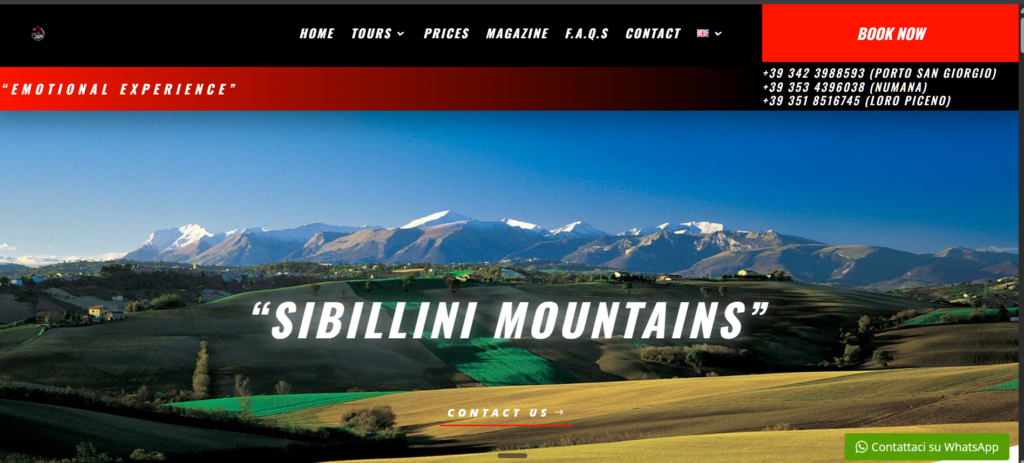
Head inland and the terrain changes entirely. The Monti Sibillini rise to nearly 2,500 meters, and the roads that climb toward Amandola, Montegallo, and eventually the high plain of Castelluccio are the most spectacular the region offers. This is a full day, sometimes two, and it is where a 125 shows its limits — it will get you there, but you will not be overtaking anyone uphill. The foothills between the mountains and the coast are the Monti Azzurri, the “blue mountains,” a cluster of small towns including Sarnano that have quietly become a target for foreigners buying and restoring stone houses. If you have read my notes on the Sibillini or on why Italians are quietly buying property in this corner of the Marche, this is the country those pieces describe, seen from the saddle.
The Conero and the coast
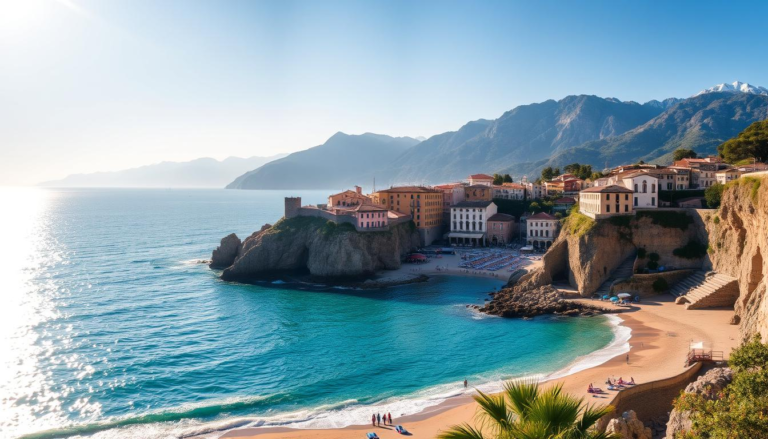
North, near Numana, the coast does something it does almost nowhere else on the Italian Adriatic: it rises into a cliff. The Monte Conero headland drops white limestone straight into clear water, and the roads that skirt it, ducking in and out of holm-oak forest, are a genuinely different ride from the inland valleys. This is the cluster to choose if you want to end the day on a beach reachable only on foot or by a short scooter hop. It pairs naturally with the region’s Blue Flag beaches, several of which sit within an easy ride.
What you actually need to ride: the license question, answered honestly
Here is where I have to be an engineer rather than a travel writer, because the rental industry’s shorthand on this point is not quite the truth, and the gap matters if anything goes wrong.
The rule Italians use
In Italy, a standard car license — category B — lets the holder ride a scooter or light motorcycle up to 125cc, provided the machine also stays within 11 kW of power and a power-to-weight ratio of 0.1 kW/kg. A Vespa Primavera 125, the workhorse of the region’s rental fleets, sits comfortably inside those limits. This is why you see teenagers and grandmothers alike on 125s all over the Marche. What almost no one mentions is the fine print: according to the legal review published by the Automobile Club d’Italia and a licensing sheet from the Polizia di Stato, this permission is a national authorization only. It is not printed anywhere on the license, and it does not extend beyond Italy’s borders — an Italian with a B license who rides a 125 into France is, technically, riding without a valid title there.
What that means for an American
Follow the logic and the implication for a visitor becomes clear. That B-to-125 permission is a domestic feature of the Italian and EU license. It is not a property of the vehicle, and it does not transfer to a foreign, non-EU license. A traveler from the United States may legally drive in Italy with a valid home license carried together with an International Driving Permit (an official translation of that license), but only for the vehicle categories the home license actually covers. A typical U.S. car license does not carry motorcycle privileges. So, strictly, a standard American car license plus an IDP does not authorize you to ride a 125cc Vespa in Italy, even though many rental desks will hand you the keys anyway.
The clean way to do this is to travel with a U.S. license that carries a motorcycle endorsement (a Class M designation), plus an International Driving Permit that reflects that motorcycle category, plus your original license. Get the IDP before you leave home through your national automobile association — in the United States, that is AAA — and be wary of “instant online IDP” sellers, which are not valid. Confirm the deposit and insurance terms with the operator in writing before you arrive.
Why does this matter if desks rarely check? Because the moment it matters is the worst possible moment. If you are stopped at a routine checkpoint, or if you have even a minor accident, riding a category you are not licensed for can mean a fine, and it can give an insurer grounds to contest coverage. On a two-wheeler on an unfamiliar road, that is not a risk worth taking to save a paperwork step.
If you would rather not deal with it
None of this should scare you off. It should simply push you toward the right choice for your situation. If you do not hold a motorcycle endorsement, ask the operator about an accompanied option — several offer a guided arrangement where a local rides with the group — or ride as a passenger while a licensed companion drives. The experience of the Marche from the back of a Vespa is nearly as good as from the front, and considerably more relaxing. The point is to make the choice deliberately, not to discover the problem at the roadside.
How a Vespa rental works in Le Marche
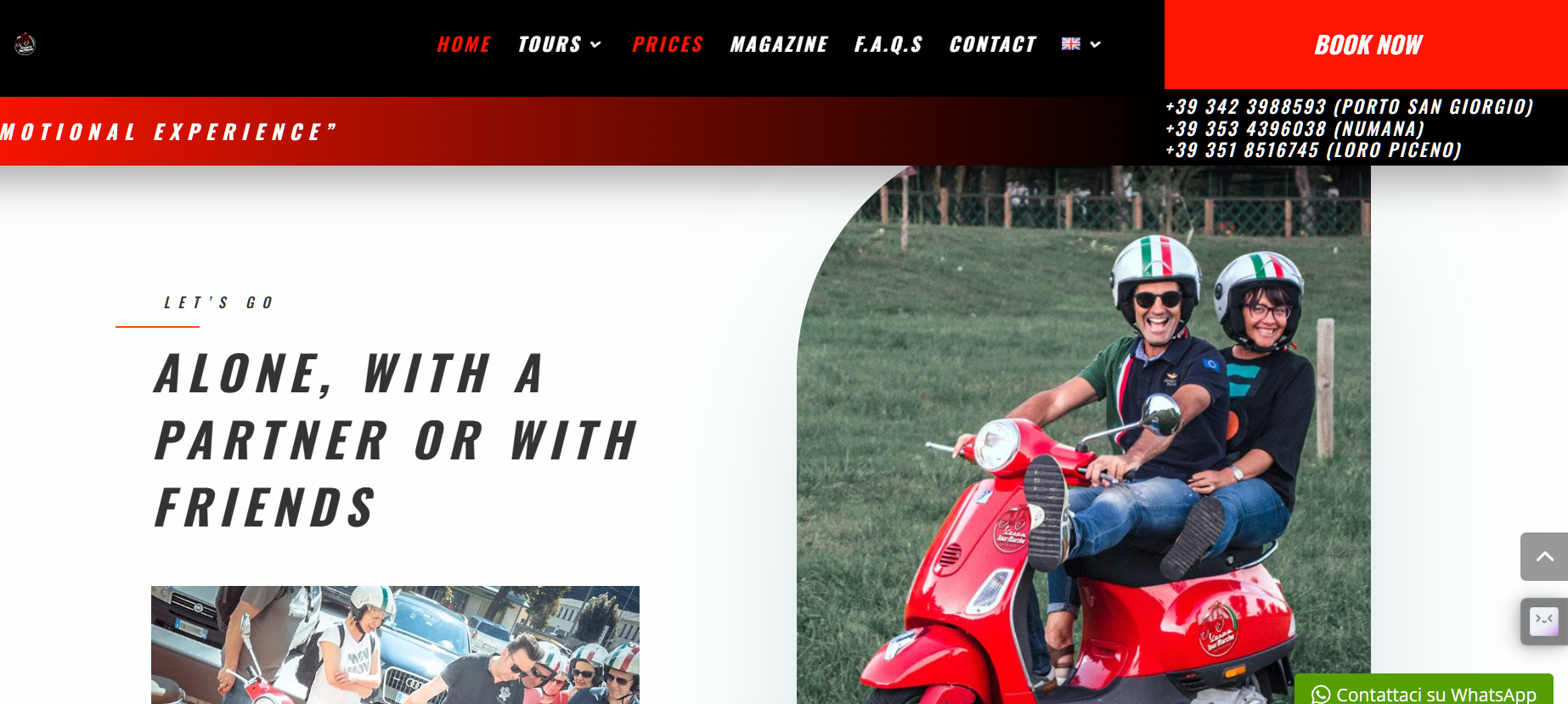
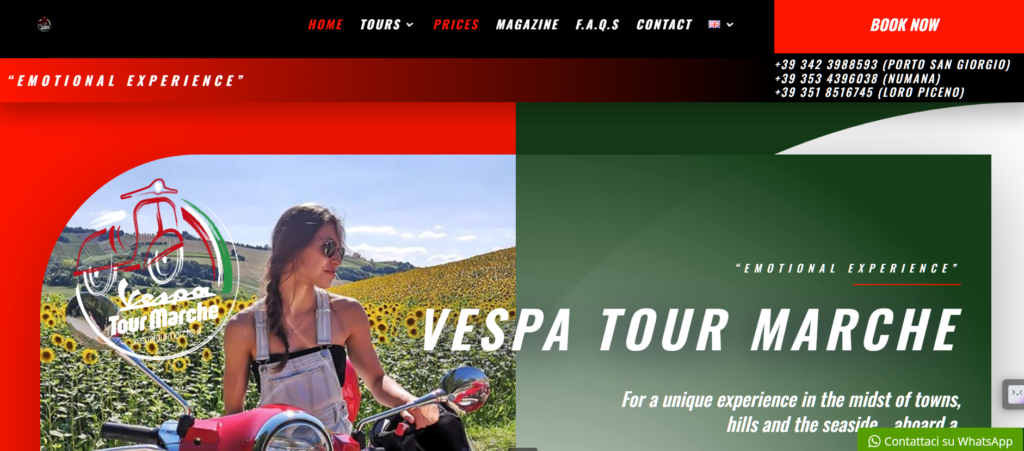
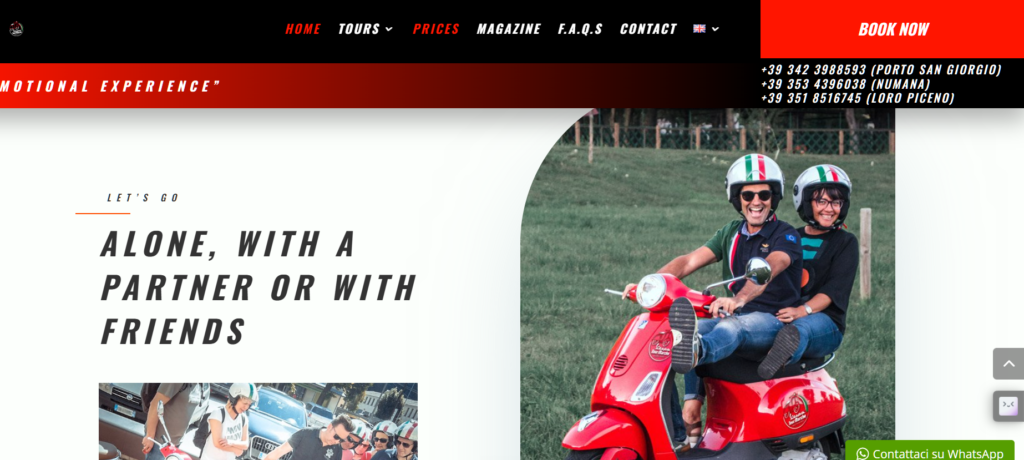
The most established operator running curated routes in the region, Vespa Tour Marche, works from three rental points — Porto San Giorgio on the southern coast, Numana near the Conero, and Loro Piceno inland toward the Sibillini foothills — which conveniently map onto the three route clusters above. Their site is published in English, German, and Dutch as well as Italian, which tells you who already comes here.
The fleet is built around the Vespa Primavera 125, a modern four-stroke machine with ABS braking, rated at 7.9 kW and returning around 43 kilometers per liter, so a full 8-liter tank goes a long way. A rental typically includes the scooter, one or two new helmets, third-party insurance, a printed road book with the route marked, a rain kit on request, and local contacts who can explain the places you pass. As of the operator’s 2026 pricing, a one-day rental runs about €80, a two-day “Gold” package about €150, and a family formula around €150 for a single household; a refundable deposit of roughly €400 is held at pickup, either as a card pre-authorization or in cash. Prices and terms change, so confirm directly before booking.
Bring closed shoes, sunglasses, a light layer even in summer for the inland climbs, and sunscreen — the wind hides how much sun you are getting. Helmets are mandatory for rider and passenger, and the law is enforced. Do not plan to take a 125 onto the autostrada; these routes are designed for secondary roads, which is where you want to be anyway.
When to go
The riding season in Le Marche runs from April to October, but the sweet spots are narrower. Late spring — May and June — gives you green hills, wildflowers, cool mornings, and the ginestra (broom) in yellow bloom along the ridges. September and early October are arguably better still: the light turns gold, the grape and olive harvests are underway, the sea is still warm, and the coastal towns have emptied of August crowds. Avoid the deep heat of late July and August inland, when midday on an exposed ridge is punishing, and skip winter entirely — the mountain roads can ice, and a cold, wet Vespa day is a miserable one. If you can only travel in high summer, ride early and late and spend the afternoon off the bike.
What to pair it with
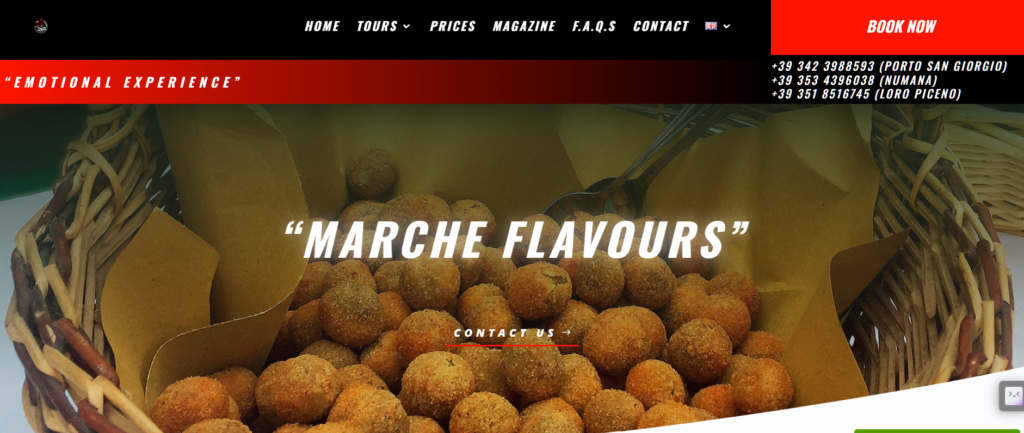
A Vespa day in the Marche is really an eating and drinking day with riding in between, and the region gives you an unusually deep table for a place so few outsiders know. The Valdaso is the home of maccheroncini di Campofilone, an egg pasta cut so fine it is almost thread, protected by IGP status and traditionally dressed with a long-cooked meat ragù. Inland you will find vincisgrassi, the Marche’s baroque older cousin of lasagna, and along the whole route the fried stuffed olive, oliva all’ascolana, turns up as bar food and as art.
The wines are the region’s quiet advantage. The white Passerina and Pecorino — the latter a grape, not the cheese — are crisp, mineral, and made in quantities small enough that you will rarely see them abroad, while Rosso Piceno is the honest red that accompanies the local table. Any of the cantine (wineries) along the Sapori routes will pour them for you, though, obviously, taste before you ride, not during. For a fuller sense of the region’s food identity and why it produced one of the last living Mediterranean-diet cultures, the Marche’s culinary story deserves its own read.
For where to sleep, an agriturismo — a working farm that takes guests — is the natural match for this kind of trip: you end the day where the food and wine are grown, and you start the next morning on a quiet country road rather than in traffic. Book one near your chosen rental point so you are not shuttling far to collect the scooter.
FAQ — Planning a Vespa tour of Le Marche
What is a Vespa tour of Le Marche? It is a self-guided or accompanied scooter trip through the Marche region of central Italy, riding a 125cc Vespa along curated day routes that link medieval hill towns, river valleys, mountains, and coast. Operators provide the scooter, helmet, insurance, and a marked route book; you supply the riding.
When is the best time to go? Late spring (May–June) and early autumn (September–early October) are ideal, with mild temperatures, good light, and thin crowds. Deep summer is hot on exposed inland ridges, and winter is unsuitable because mountain roads can ice.
Do I need a special license to ride a 125cc Vespa in Italy? You must be licensed for the vehicle category. Italy’s rule allowing a car license to cover a 125 is a national-only provision tied to the Italian or EU license and does not transfer to a foreign license. Americans should carry a U.S. license with a motorcycle endorsement plus an International Driving Permit reflecting that category, or choose a guided or passenger option.
How much does it cost? As of 2026, expect roughly €80 for a one-day rental and about €150 for two days, with helmet, insurance, and route book included. Operators typically hold a refundable deposit of around €400 at pickup. Confirm current prices directly, as they change.
How many days do I need? One day covers a single valley or the Conero coast comfortably. To combine the Valdaso, the Sibillini foothills, and the coast, plan two or three days. The mountain routes toward Castelluccio are best given a full day of their own.
Is it safe to ride a scooter in Le Marche? The region’s secondary roads carry light traffic and are far calmer than Rome or Naples, but a scooter is still a scooter. Ride within your experience, wear the mandatory helmet, avoid the autostrada, and do not treat the Sibillini switchbacks as your first-ever ride. Confirm the machine and brakes at pickup.
What can I combine with a Vespa tour here? Pair it with the region’s food and wine — Campofilone pasta, oliva all’ascolana, Passerina and Pecorino whites — and with a stay on an agriturismo. The Conero routes pair with the Blue Flag beaches; the inland routes pair with the hill towns of the Monti Azzurri and the Sibillini national park.
The final word
The Marche will not perform for you the way the famous regions do. There is no single view everyone photographs, no town that resolves the whole place into an image. What there is, instead, is a landscape best taken in sequence, ridge after valley after ridge, at a pace slow enough to notice the change in the air as you drop toward each river. A Vespa is simply the right instrument for reading it. Sort the license properly, pick your two or three days, and give yourself over to the roads in between the towns — that is where the region actually lives.
If you want more of the Marche from someone who works and drives here rather than visits, there is a growing shelf of it on Tastes & Wonders of Italy, from the hill towns of the interior to the food that never made it onto an export menu.