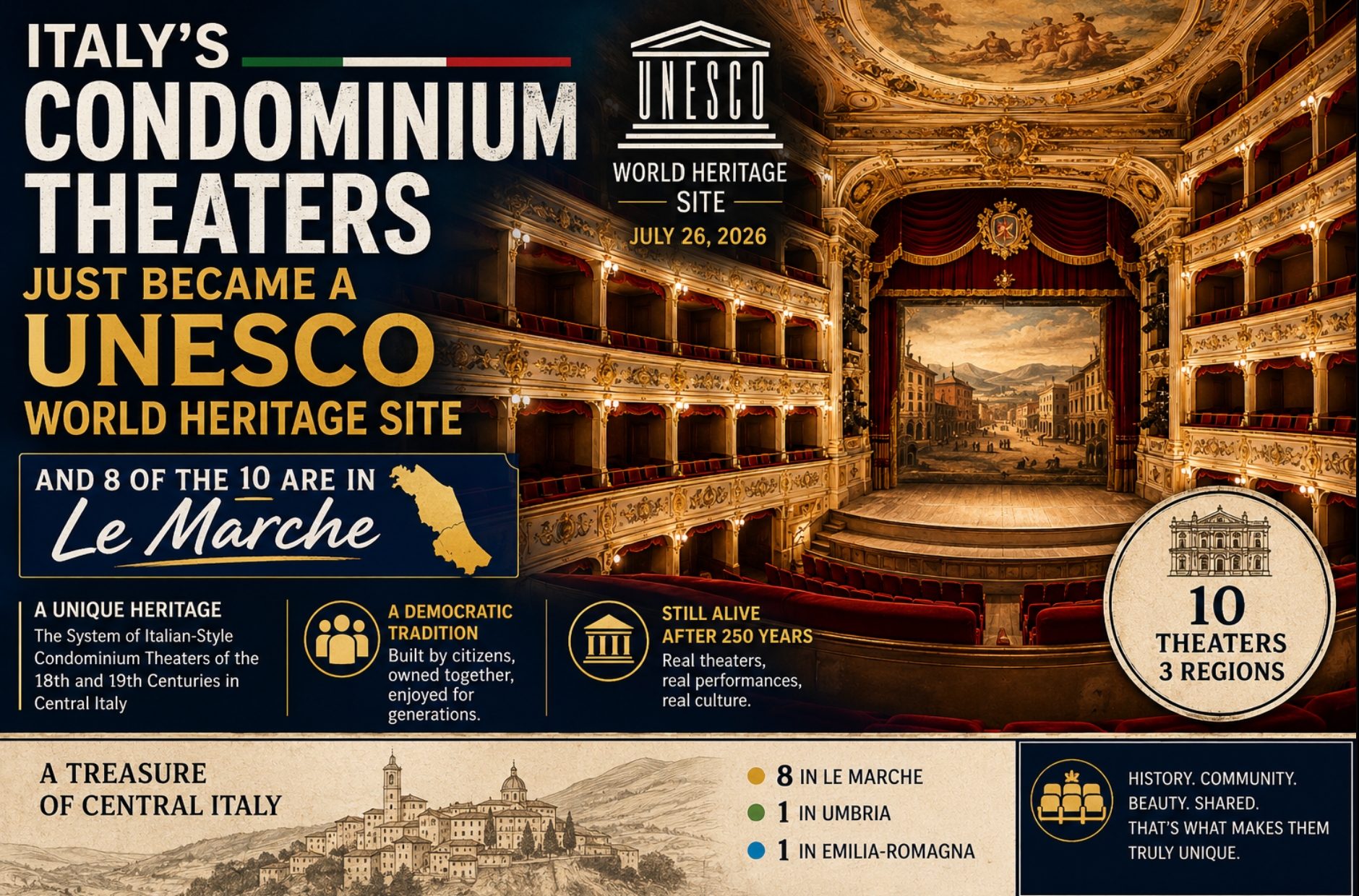
Italy’s “Condominium Theaters” Just Became a UNESCO World Heritage Site — and Eight of the Ten Are in Le Marche
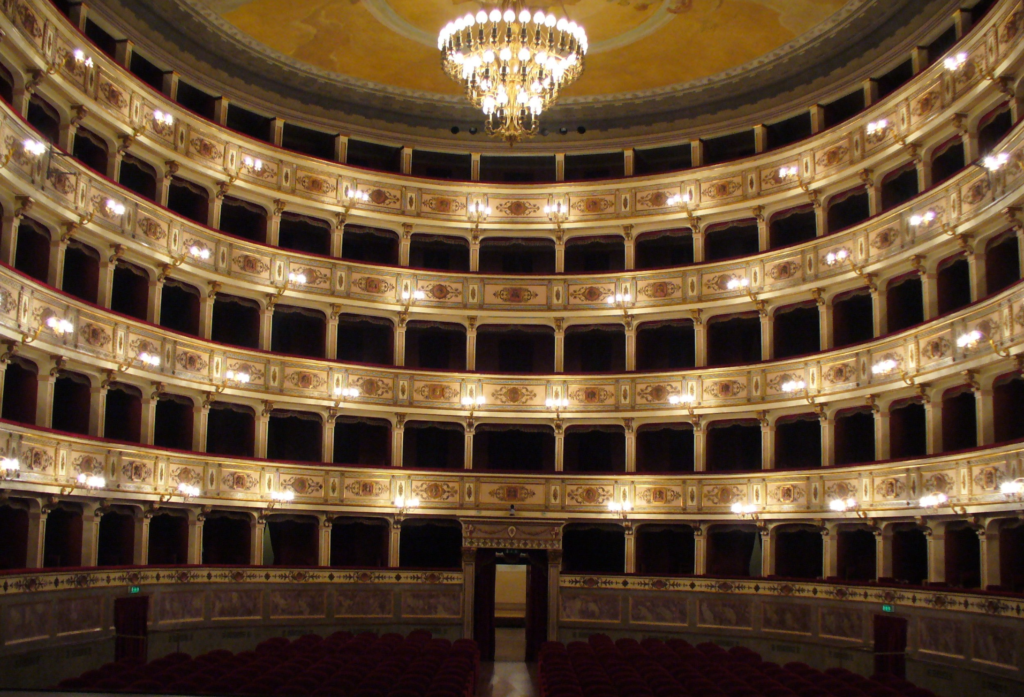
Walk into an empty teatro all’italiana before a performance and the first thing you notice is the wood. Tier after tier of it, curving around in a horseshoe, each level broken into small private boxes stacked like a honeycomb turned on its side. Two and a half centuries ago, a family from a small provincial town would have bought one of those boxes outright — not a ticket, a share of the building itself — and their descendants might still be sitting in it tonight. Somewhere behind that box, painted plaster and gilt frame a stage that has hosted the same kind of provincial opera season, year after year, since before the United States existed as a country.
On July 26, 2026, UNESCO’s World Heritage Committee, meeting in Busan, South Korea, inscribed “The System of Italian-Style Condominium Theaters of the 18th and 19th Centuries in Central Italy” onto the World Heritage List. The site is a serial inscription covering 10 historic theaters across three regions — Marche, Umbria, and Emilia-Romagna — and 8 of those 10 are in Le Marche, a region most American travelers couldn’t place on a map. A teatro condominiale (kon-doh-mee-NYAH-leh) is a theater financed and owned collectively by local citizens who purchased individual boxes as shares, turning the building itself into what was, functionally, a condominium — the word survives in Italian real estate law to this day, applied here two centuries early to a shared cultural asset instead of an apartment building.
What UNESCO Actually Decided, and Why It Took Six Years
The inscription came during the 48th session of the World Heritage Committee, held in Busan from July 19 to 29, 2026, one of roughly 30 nominations reviewed at that meeting alongside sites from dozens of other countries. With this addition, Italy’s total climbs to 62 UNESCO World Heritage sites, extending its position as the country with more inscriptions than any other nation on earth — a fact Italian officials, from the Prime Minister’s office down to regional presidents, were quick to repeat on the day of the announcement.
The nomination itself was not a last-minute idea, and it’s worth understanding the timeline, because it explains why this is a serial site rather than a single monument. Italy’s Ministry of Culture, through its UNESCO office within the Directorate-General for European and International Affairs, began the formal candidacy process around 2020–2021, with the Marche regional government under President Francesco Acquaroli acting as lead proponent and the regions of Umbria and Emilia-Romagna joining as co-applicants, alongside numerous municipalities that each had to document, restore, and defend the condition of their own theater as part of a single, coordinated technical dossier. That kind of multi-region, multi-municipality coordination is genuinely difficult to pull off over five or six years, and it’s part of why the recognition landed as such a significant moment locally rather than a routine bureaucratic checkbox.
It is also worth being precise about what did and didn’t make the final cut, because the regional candidacy originally advanced a longer list of theaters than the ten ultimately inscribed. Several towns that had campaigned for inclusion — Porto San Giorgio’s Teatro Comunale among the most publicly disappointed — were not part of UNESCO’s final decision. That selectivity matters: this was not a rubber stamp on every historic theater in central Italy, but a curated shortlist chosen to represent the type at its most complete and best preserved. Culture Minister Alessandro Giuli described the network as an exceptional piece of cultural infrastructure that, in an unusually democratic way, gave generations of people in small central Italian towns — not just aristocrats in major capitals — regular access to opera and classical music. That framing matters more than it might first appear, because it points directly at what distinguishes this UNESCO site from most others: it isn’t a single monument frozen for preservation. Nearly all of these ten theaters are still in active use, hosting real opera seasons, concerts, and festivals the same way they have for two centuries.
For the small municipalities that own and maintain these buildings, the practical upside of inscription is straightforward: World Heritage status typically opens doors to restoration funding, both national and European, that a municipal budget alone in a town the size of Offida or Urbania could never cover on its own, and it raises the profile of these theaters internationally in a way that supports exactly the kind of cultural tourism this blog covers. Regional officials have already framed the recognition explicitly in those terms — not as an endpoint, but as the start of a renewed, better-funded phase of upkeep for buildings that, as this article’s next section explains, require constant technical attention just to remain standing and usable.
What a Condominium Theater Actually Is
The term sounds, to an English speaker, like a translation error. It isn’t. A teatro condominiale was financed by a società condominiale — literally a “condominium society,” a partnership between local government and private citizens, typically the leading families of a town, who bought individual boxes and became joint owners of the building. At the Teatro Lauro Rossi in Macerata, the forty-six citizens who financed the 1765 rebuilding were recorded, in the documents of the time, under the exact phrase Nobili Condomini — “Noble Condominium-Owners.” The word wasn’t a later scholarly label applied to the phenomenon; it’s what the people doing the financing called themselves at the time.
Functionally, this was community-financed infrastructure centuries before the term existed: a town that wanted a proper theater, and lacked a wealthy single patron to build one, spread the cost across dozens of local families in exchange for permanent ownership stakes, represented physically by a box with their name on it. Ownership, management, and use of the building were shared among the citizenry rather than controlled by a single court or noble house, and that structure marks a real shift in what theater was for. Through the second half of the 18th century and into the 19th, as Italy’s merchant and professional classes grew in wealth and influence, these theaters moved the experience of opera and spoken drama out of exclusively aristocratic settings and into an institution the entire town had a literal stake in. It’s a small but telling detail that several of these theaters were later sold outright to their municipal governments once the original shareholding families could no longer or no longer wished to fund upkeep collectively — Macerata’s Lauro Rossi passed to the comune in 1872, ending its era of private box ownership and folding it into the same kind of public cultural asset an American reader would recognize from a city-owned concert hall, just two centuries older and considerably more ornate.
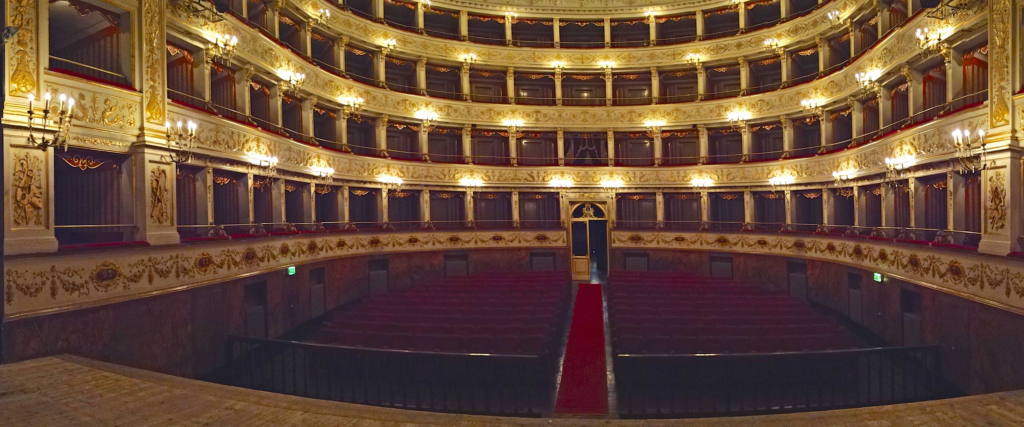
Architecturally, the type is recognizable across all ten buildings: a horseshoe-shaped auditorium, several tiers of boxes stacked around the curve, and a seating plan — orchestra stalls below, boxes and a gallery above — that mapped the social hierarchy of the town onto the room itself, the way pew assignments once did in a church. A box near the stage, on the first tier, signaled exactly the kind of standing a family held in town; a bench in the top gallery meant something very different, and everyone in the room understood the difference without needing it explained.
Why These Buildings Are Still Standing
I’ve spent thirty years evaluating buildings professionally in this exact region, and a theater like this poses a specific structural puzzle that a modern concert hall doesn’t. The horseshoe auditorium is built almost entirely from timber — the boxes are cantilevered out from the perimeter wall on wooden brackets, and that same wood is doing two jobs simultaneously: carrying the load of the tiers above, and shaping the room’s acoustics. You cannot swap the material for something stiffer and more “modern” without ruining the sound the building was designed to produce. Every restoration campaign on a theater like this is a negotiation between structural safety and acoustic integrity, not a simple reinforcement job. Add to that the fact that most of these halls were built or substantially rebuilt across several distinct campaigns — Jesi’s Teatro Pergolesi replaced an earlier wooden theater lost to fire, and Macerata’s Lauro Rossi went up on the site of a 17th-century predecessor and was then revised by a second architect after the original design — and what you’re really assessing is several overlapping structural systems from different eras, layered on top of one another, rather than a single coherent design.
That puzzle is considerably harder in Le Marche than it would be in, say, Tuscany, because this is active seismic territory. The 2016 Central Italy earthquake sequence caused serious damage across exactly the provinces where most of these theaters stand — Macerata, Fermo, and the surrounding areas — and kept several historic public buildings in the region closed for years afterward while engineers assessed and reinforced them. Keeping a two-and-a-half-century-old timber-framed theater not just standing but certified safe for a paying audience, in a zone where the ground itself is a known variable, is a genuine ongoing engineering commitment for these communities — not a footnote to the UNESCO citation, but one of the reasons the inscription matters practically as well as symbolically. The certification alone, in Italian building code terms, requires a structural compliance assessment not unlike the kind I sign off on for other historic buildings in this region, and it has to be periodically renewed as codes tighten. It’s worth saying plainly: I haven’t worked on any of these specific ten buildings, and I’m not claiming otherwise. But I’ve assessed enough historic masonry and timber structures in this same seismic zone to recognize exactly what kind of ongoing technical commitment keeping them open represents, year after year, long after the ribbon-cutting is forgotten.
The Ten Theaters
The network breaks down geographically into three clusters. Eight sites sit in Le Marche, one in Umbria, and one in Emilia-Romagna.
The Fermo and Ascoli Cluster
Teatro dell’Aquila, Fermo. Built between 1780 and 1792 to a design by the papal-state architect Cosimo Morelli, with an elliptical hall ringed by 124 boxes across five levels and capacity for roughly a thousand spectators — one of the largest historic theaters in the region. Named for the eagle, Fermo’s heraldic civic symbol.
Teatro Ventidio Basso, Ascoli Piceno. Built 1840–1846, originally designed by Ireneo Aleandri — the same architect behind Macerata’s Sferisterio arena — before local architects Marco Massimi and Gabriele Gabrielli took over the project. It seats 842 across an oval hall with four tiers of boxes, and is named for Publio Ventidio Basso, an Ascoli-born Roman general.
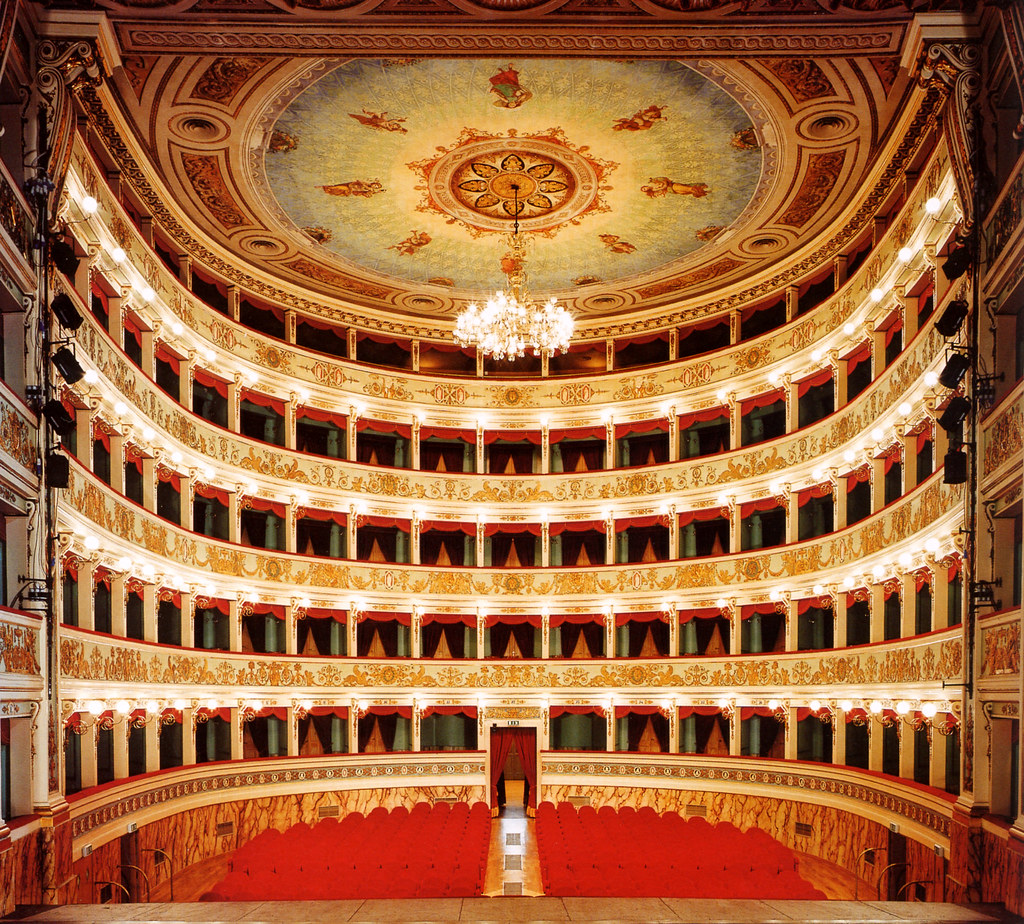
Teatro Serpente Aureo, Offida, a smaller, intimate hill-town theater whose name — “Golden Serpent” — is as distinctive as its close-knit relationship with the community it serves. Offida itself is already known in this region for its lace-making tradition and its wine, and a theater this size makes clear how thoroughly the condominium model reached down even into towns with populations in the low thousands, not just regional capitals.
Macerata and the Interior
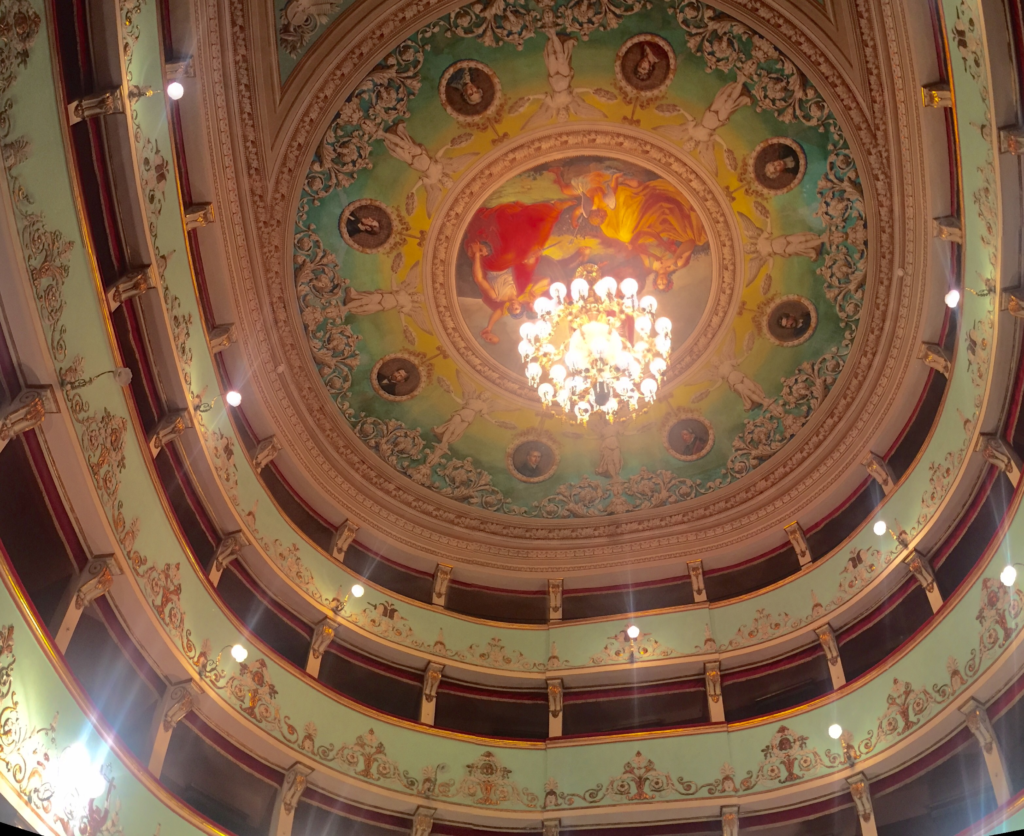
Teatro Lauro Rossi, Macerata. The oldest of the group in terms of continuous documented theatrical use on the same site, dating to a 1663 predecessor and rebuilt from 1765 under Antonio Galli, known as Bibiena, one of the most celebrated theatrical architects of the era, with the project later revised by Cosimo Morelli. It’s the theater whose financing records give us the phrase Nobili Condomini. Sold to the municipal government in 1872, ending the era of private box ownership, and renamed in 1884 for the Macerata-born composer Lauro Rossi. Today it functions as one of the venues of the Macerata Opera Festival at the Sferisterio, the arena a short walk away.
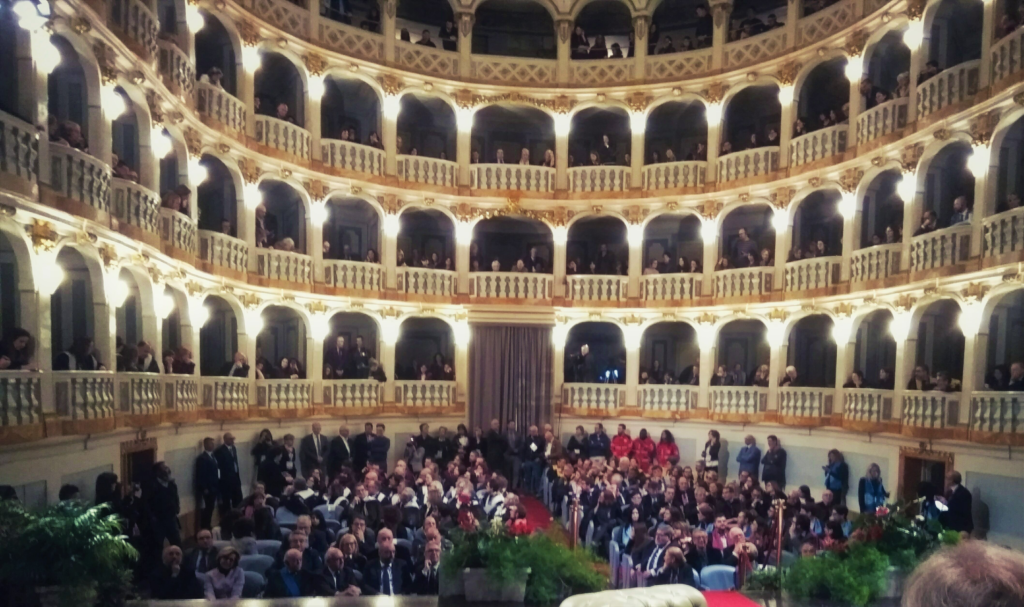
Teatro Feronia, San Severino Marche, overlooking one of the region’s most striking historic squares, in a hill town deep in the Macerata interior.
Jesi, Fabriano, and Urbania
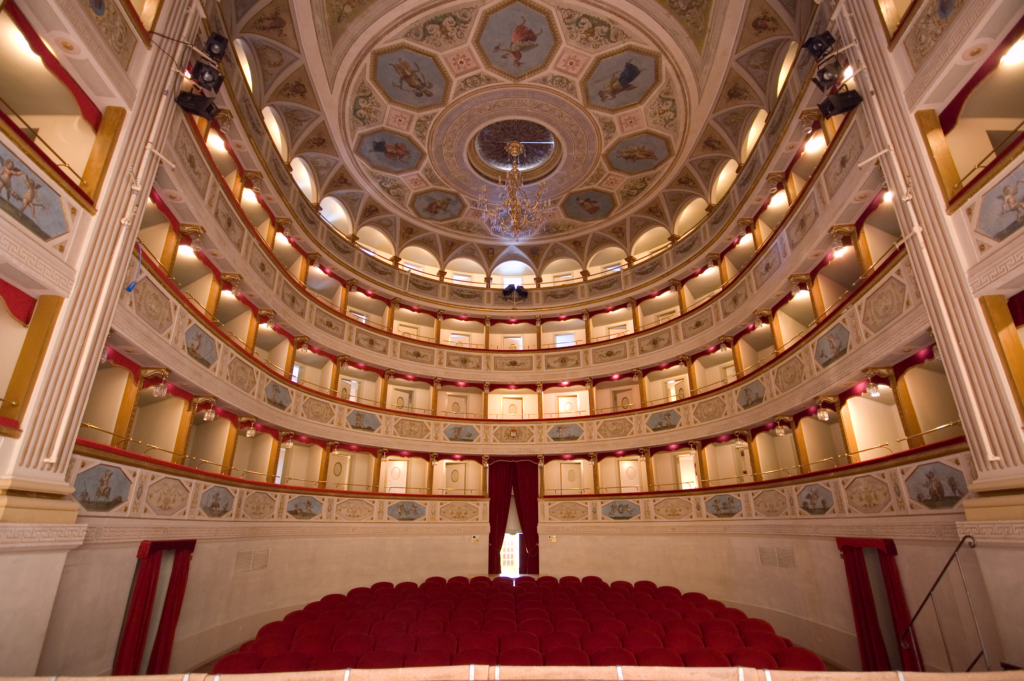
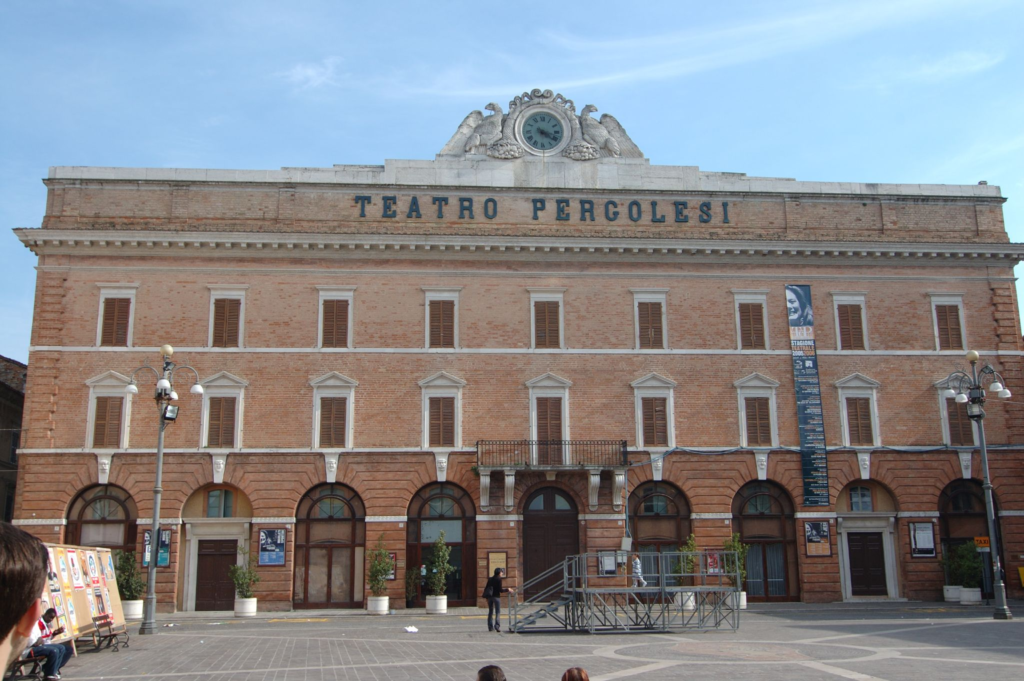
Teatro Pergolesi, Jesi. Opened in 1798 as the Teatro della Concordia, funded by wealthy subscribers who bought all 100 boxes across four tiers, replacing an earlier wooden theater destroyed by fire. Later renamed for Giovanni Battista Pergolesi, the 18th-century composer born in Jesi.
Teatro Gentile da Fabriano, Fabriano, named for the early Renaissance painter born in the town, in a city better known internationally for its centuries-old papermaking tradition.
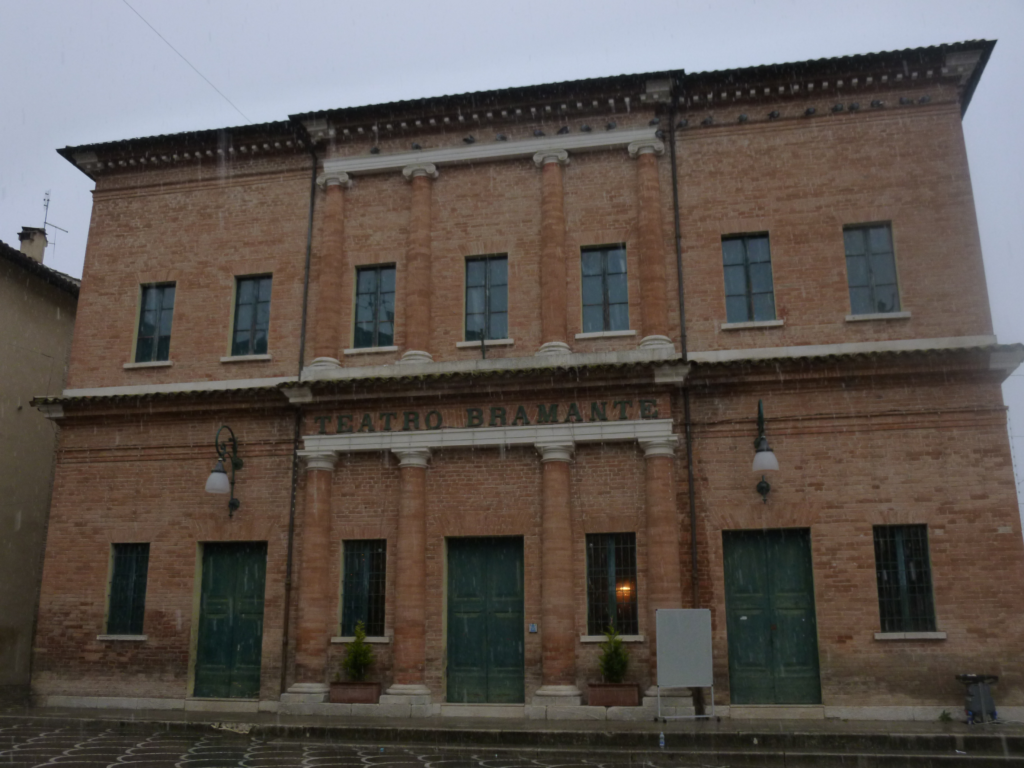
Teatro Bramante, Urbania, named for the Renaissance architect Donato Bramante, who was born nearby — the northernmost of the Marche sites, in the Pesaro-Urbino hills close to Urbino itself.
Umbria and Emilia-Romagna
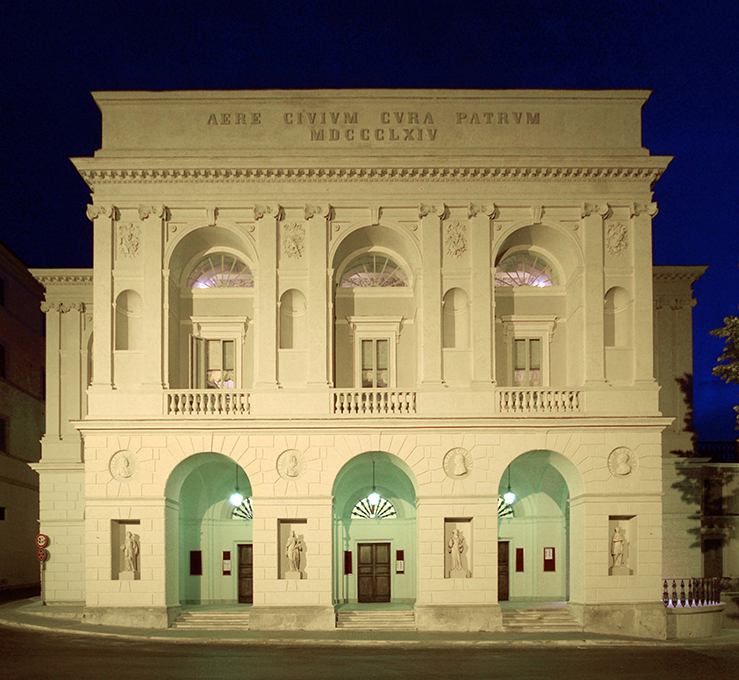
Teatro Nuovo Gian Carlo Menotti, Spoleto. Built 1854–1864 to a design by Ireneo Aleandri — the same architect responsible for Ascoli’s Ventidio Basso — this 772-seat horseshoe hall has served since 1958 as the main stage of the Festival dei Due Mondi, and was renamed in 2010 for the festival’s founder, composer Gian Carlo Menotti. American readers may already know Menotti’s other legacy without realizing the connection: in 1977 he founded Spoleto Festival USA in Charleston, South Carolina, explicitly as an American counterpart to his Italian festival, meaning one theater in this UNESCO network has a working sister festival on the other side of the Atlantic.
Teatro Angelo Mariani, Sant’Agata Feltria, in the hills of Emilia-Romagna near the Marche border, named for the 19th-century conductor born in nearby Ravenna. Its wooden hall, dating to the 17th century, is among the oldest surviving examples of the type anywhere in Italy.
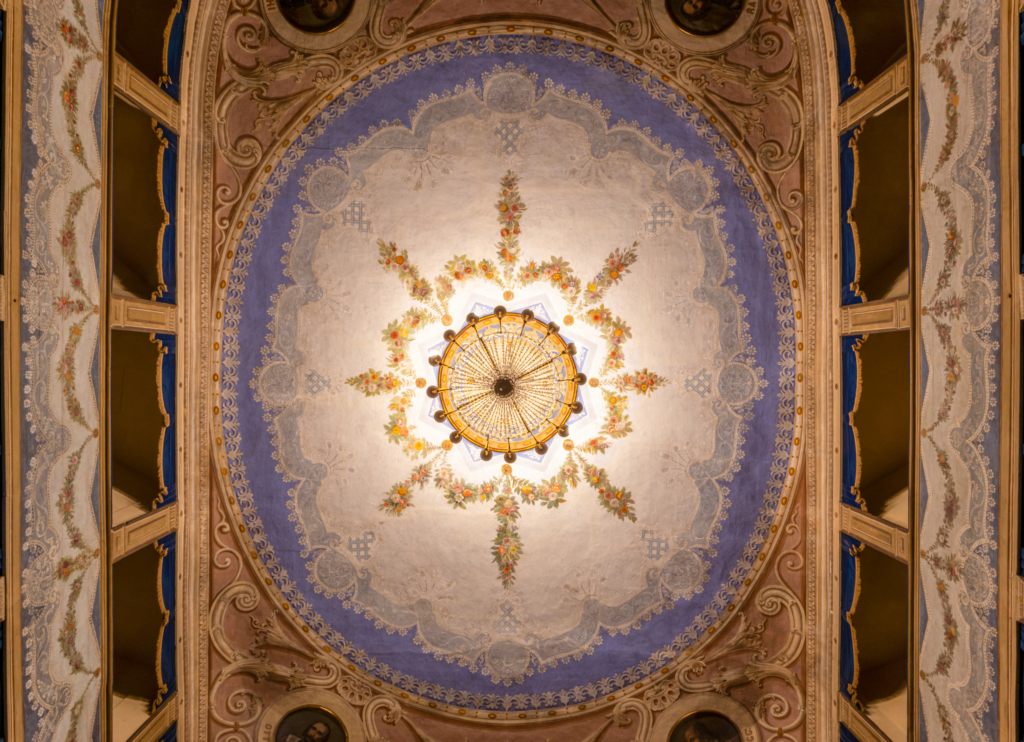
The single Umbrian and single Emilia-Romagna entries make a point about this UNESCO site that’s easy to miss if you focus only on Le Marche: the condominium theater wasn’t a strictly Marche invention, but a broader central-Italian phenomenon that simply reached its highest concentration, and arguably its finest surviving examples, in Le Marche specifically.
How to Actually Visit Them
The single most important thing to understand about this UNESCO site is that it isn’t a museum circuit. Nearly all ten theaters still run live seasons — opera, prose theater, concerts, festivals — meaning the best way to experience one is to see an actual performance rather than book a daytime guided tour, though several, including the Teatro dell’Aquila and Teatro Lauro Rossi, do offer visiting hours outside of performance dates for travelers whose schedules don’t line up with a show.
That distinction changes how you should plan around this. A conventional museum can be visited on demand, any afternoon, at your own convenience; a working theater operates on its own season, typically autumn through spring for regular programming, with the notable exception of the summer opera festivals this region is already known for. That means the ideal visit often isn’t a quick stop on a driving itinerary at all, but a stay timed around an actual ticket — which, in turn, means checking each theater’s own program rather than assuming you can simply show up and be let in.
Distances between them are real, and the eight Marche sites are spread across five provinces, so no one should plan to see all ten in a single trip. If you’re building an itinerary around this region, Macerata and Fermo sit roughly forty minutes apart by car, Ascoli Piceno and Offida are under an hour further south, and Jesi and Fabriano cluster together further north near Ancona — meaning a base in central Le Marche can realistically put four or five of these theaters within a comfortable day-trip radius. Late summer is the strongest window, when the Macerata Opera Festival and the Cavalcata dell’Assunta in Fermo overlap on the calendar, and the Rossini Opera Festival runs on the coast at Pesaro — the last of these not part of the UNESCO site, but very much part of the same regional opera culture that produced it. If you can only choose one theater, the Teatro dell’Aquila in Fermo and the Teatro Lauro Rossi in Macerata make the strongest case: both are large, both are active, and both sit inside towns already worth a full day on their own merits — a comparison this blog has made before when arguing that Le Marche deserves the attention Tuscany already gets.
For visitors with more time, working outward from that central cluster toward Ascoli Piceno and Offida to the south, or Jesi and Fabriano to the north, turns a two-theater visit into a genuine regional tour — one that also happens to move through some of the food and wine territory this blog has covered elsewhere, since none of these towns exist in isolation from the rest of what makes this region worth the trip.
FAQ: The UNESCO Condominium Theaters, Explained
What is a condominium theater? A teatro condominiale is a historic Italian theater financed and owned collectively by local citizens who purchased individual boxes as shares, forming a “condominium society” that held joint ownership of the building — centuries before the word “condominium” came to mean an apartment building.
How many theaters are on the UNESCO list, and where are they? Ten theaters across three regions of central Italy: 8 in Le Marche (Fermo, Ascoli Piceno, Offida, Macerata, San Severino Marche, Jesi, Fabriano, and Urbania), 1 in Umbria (Spoleto), and 1 in Emilia-Romagna (Sant’Agata Feltria).
When and why were they inscribed by UNESCO? The inscription was announced on July 26, 2026, during the 48th session of the World Heritage Committee in Busan, South Korea. It recognizes both the theaters’ architecture and the unique community-ownership model that shaped how they were built and used.
Can visitors actually go inside these theaters? Yes, in most cases. Nearly all ten remain active performance venues rather than museum pieces, and the best way to experience one is to attend a real opera, concert, or theater performance; several also offer daytime visiting hours outside of the performance calendar.
Why are so many of these theaters concentrated in Le Marche? Eight of the ten sites are in Le Marche, reflecting the region’s unusually dense historic network of these community-financed theaters relative to its size — a density regional officials describe as unmatched anywhere else in the world.
How many UNESCO World Heritage sites does Italy have now? This inscription brings Italy’s total to 62, maintaining its position as the country with the most sites on the UNESCO World Heritage List.
What’s the difference between a “condominium theater” and any old teatro all’italiana? Every teatro all’italiana shares the horseshoe-shaped hall and stacked boxes, but a teatro condominiale specifically describes the ownership structure — individual boxes bought and held as shares by a defined group of citizen-owners — rather than a theater built and owned by a single patron, court, or later, a public authority from the outset.
The Takeaway
Eight of the ten theaters recognized by UNESCO sit in a region most American travel itineraries skip entirely, and that imbalance is worth sitting with for a moment rather than rushing past. This blog has argued for a while that Le Marche holds up better than its reputation suggests; UNESCO just made that case with considerably more institutional weight than a travel writer ever could.
If you’re planning a trip built around these theaters and the towns that hold them — working out how Macerata, Fermo, Ascoli, and the coast fit into a single realistic itinerary — you can book a planning consultation with me directly at TidyCal.
Written by Mirco Vitellozzi, a structural engineer from Le Marche who writes about Italy from the inside. More essays at Tastes & Wonders of Italy, and short films on YouTube.