Rossini Opera Festival Pesaro: Italy’s Best-Kept Opera Secret
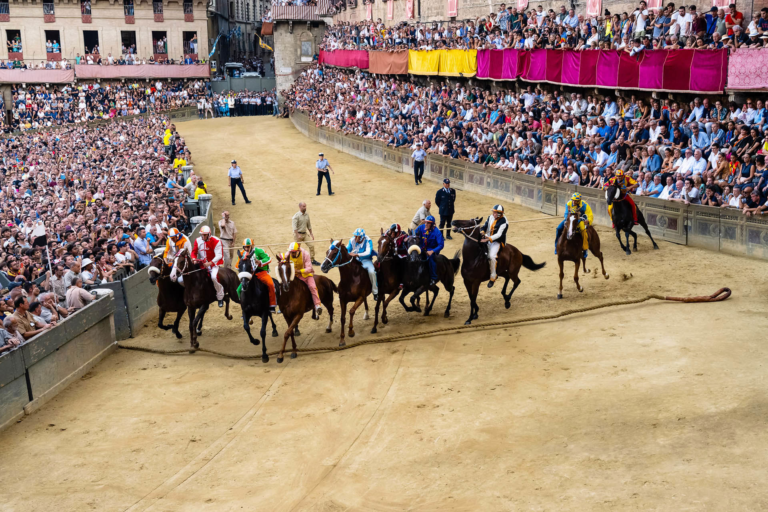
On the morning of 28 August 1980, Gianandrea Gavazzeni raised his baton inside the Teatro Rossini and opened the very first edition of a festival nobody outside Italy had heard of. The opera was La gazza ladra, performed in the first-ever critical edition published by the Fondazione Rossini. The audience was small, the international press absent, the global opera circuit indifferent. Forty-seven editions later, the Rossini Opera Festival — universally known as the ROF — draws audiences from more than two dozen countries, files accreditation for journalists from Japan’s Mainichi Shimbun to London’s Financial Times, and has revived operas that had not been heard since Rossini himself conducted them. The city that hosts it, Pesaro, holds a UNESCO Creative City of Music designation. And yet most Americans planning their first trip to Italy have never considered attending.
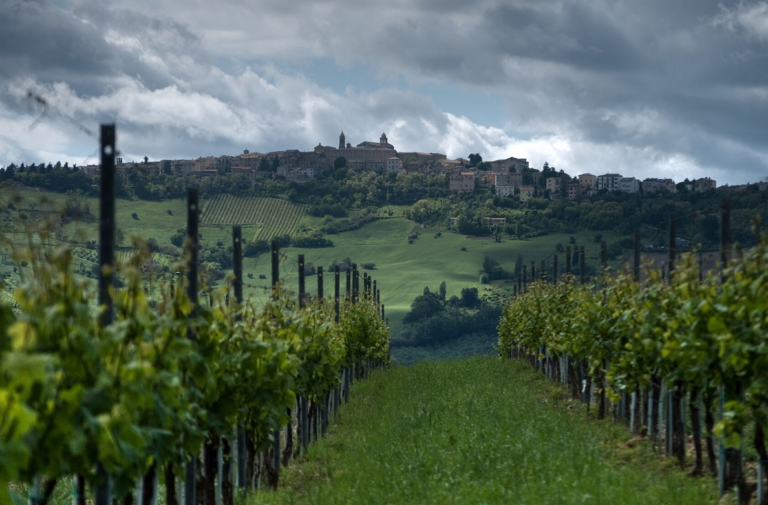
I have lived and worked in Le Marche for fifty years. Pesaro is forty minutes from my home in Macerata by car — a stretch of the SS16 that runs close to the Adriatic, passing through a coast I know in every season. I have attended the ROF in years when the programme was conservative and in years when a young director named Damiano Michieletto staged a production that would make his international career. The festival is, without qualification, one of the most serious and exciting events in the European classical music calendar, and the fact that it remains largely unknown to American travelers is the kind of cultural anomaly that deserves a direct explanation.
Who Was Rossini, and Why Does He Need a Dedicated Festival?
Gioachino Rossini was born in Pesaro on 29 February 1792 — a leap-day birthdate that he found quietly amusing throughout his life. His parents were working musicians: his father played horn in town bands, his mother sang. By his mid-twenties he was the most performed composer in Europe, producing operas at a rate that the nineteenth century found extraordinary and that later critics found implausible. The Barber of Seville (1816), Cinderella (1817), The Italian Girl in Algiers (1813), William Tell (1829) — these entered the permanent repertoire and have remained there.
The paradox of Rossini’s legacy is this: he wrote approximately thirty-eight operas, and for most of the twentieth century, fewer than five were regularly performed. The rest — comic operas, serious operas, sacred works, experimental pieces — had essentially vanished. Some had never been professionally staged since his lifetime. The musicological problem was not negligible: the scores existed in incomplete, corrupt, or conflicting editions, and nobody had done the systematic work of reconstruction that Bach, Handel, and Mozart had received from German scholarship.
When Rossini died in Paris in 1868, he left his considerable fortune to the Municipality of Pesaro with instructions to establish a free music school. That bequest created the Conservatorio Rossini and, eventually, the Fondazione Rossini — the scholarly body that would spend decades producing the critical editions that made the festival possible. Without the critical editions, there was no serious repertoire to stage. Without the festival, there was no reason to produce the editions. The two institutions grew together, and the result was unique in the operatic world.
A Festival Built on Musicological Rescue
The ROF was founded in 1980 by the Municipality of Pesaro, following a project conceived by Gianfranco Mariotti, who served as its intendant until 2017. The founding ambition was specific and unusual: not simply to celebrate Rossini’s famous works, but to systematically revive everything he had written, using newly prepared critical editions, in productions of international calibre. The Italian parliament recognized this mission as exceptional enough to pass a dedicated Special Law — N. 319 of 13 August 1993 — supporting the festival’s work of recovery and documentation.
What this means in practice is that the ROF has staged operas that no living musician had ever heard in a theatre. It has reconstructed orchestrations from fragmentary manuscripts, corrected centuries of performance tradition built on corrupt editions, and returned to audiences works that Rossini composed between the ages of eighteen and thirty-seven — the most fertile decade in operatic history. Several of these recovered works subsequently entered the mainstream repertoire. Semiramide, La donna del lago, Zelmira, Armida — these now appear in major opera houses partly because Pesaro proved they could hold a stage.
The festival uses three main venues. The Teatro Rossini seats 860 in a classic horseshoe auditorium with four tiers of boxes; it was inaugurated on 10 June 1818 — by Rossini himself, conducting La gazza ladra. The Auditorium Scavolini handles larger-scale productions. Outdoor performances take place in the Piazza del Popolo, the city’s main square, and in other historic sites across the province. Since 2000, a dedicated Teatro Sperimentale has offered the opportunity to present smaller-scale works by Rossini’s contemporaries — composers like Mosca, Generali, and Coccia, whose music had been even more thoroughly forgotten.
The Accademia Rossiniana and the Next Generation of Singers
One feature of the ROF that distinguishes it from comparable festivals is the Accademia Rossiniana “Alberto Zedda” — a training programme for young singers specializing in Rossini’s bel canto style. Named after the conductor and musicologist who was central to the Rossini revival for decades, the Accademia gives emerging international talent the chance to study and perform under the guidance of established Rossinian specialists.
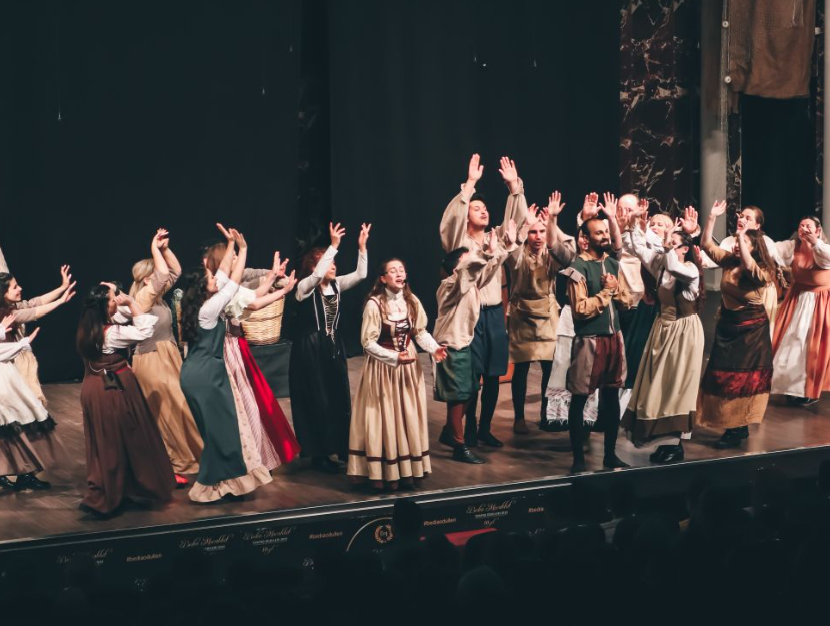
Every year, students of the Accademia perform a full production during the festival. The work almost always chosen is Il viaggio a Reims — a one-act extravaganza Rossini composed for the coronation of Charles X of France in 1825, so specific in its occasion that he withdrew it after the initial performances and it disappeared until Claudio Abbado conducted its modern premiere in Pesaro in 1984. For forty years since that premiere, Il viaggio a Reims has been the great training ground for Rossinian bel canto. Every significant Rossini tenor of the past thirty years passed through this production at some point.
The 2026 edition of the ROF features the Accademia’s Il viaggio a Reims in the version staged by Emilio Sagi, first created for the 2001 festival. When Juan Diego Flórez made his debut at the ROF in 1996, it was in this production. The 2026 edition includes a gala concert — Flórez 30 — celebrating the thirtieth anniversary of that debut. The career arc from Accademia student to internationally established tenor, traced over three decades in the same festival, is the kind of institutional continuity that can only exist when a festival takes its training mission seriously.
What to Expect at the 47th Edition (August 2026)
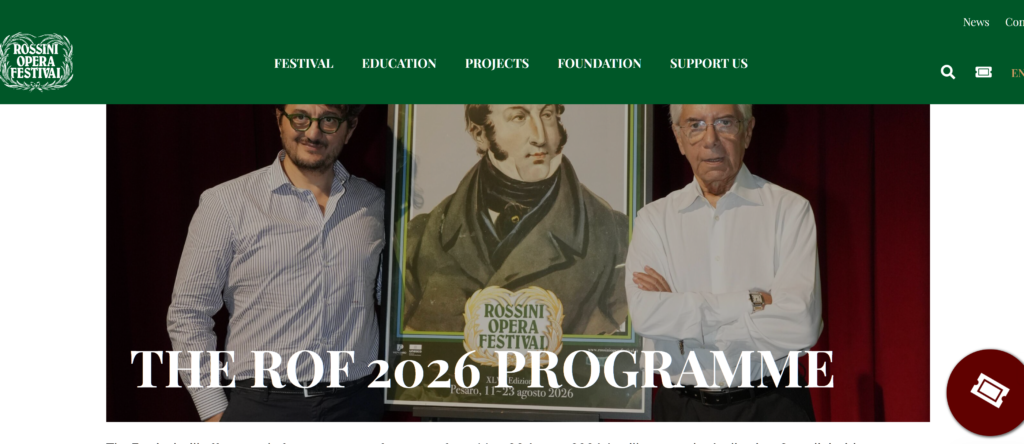
The 47th ROF runs from 11 to 23 August 2026, presenting twenty-two performances across the festival’s venues. The season opens with a new production of Le Siège de Corinthe at the Auditorium Scavolini, conducted by Carlo Rizzi and directed by Davide Livermore — his fifth directorial engagement at the ROF. The work is among Rossini’s most substantial serious operas, a French-language drama about the fall of Corinth to Ottoman forces, and it is rarely staged. The cast includes Adrian Sâmpetrean, Maxim Mironov, and Vasilisa Berzhanskaya.
Two revivals of significant past productions complete the operatic programme. L’occasione fa il ladro returns in the staging by Jean-Pierre Ponnelle — one of the twentieth century’s great opera directors — conducted by Alessandro Bonato. La scala di seta appears in Damiano Michieletto’s 2009 production, conducted by Iván López-Reynoso. Michieletto made his international debut in Pesaro; his career subsequently moved through La Scala, the Royal Opera House, and the Metropolitan Opera. The ROF functions, in this sense, not only as a festival but as a laboratory where directors prove themselves before the wider world notices.
The concert programme includes four Belcanto Concerts at the Teatro Rossini and closes on 23 August with the Stabat Mater, Rossini’s great sacred work, conducted by Domingo Hindoyan.
Pesaro Beyond the Festival
The city that Rossini left to as a child — and to which he returned only in memory and in testamentary generosity — repays a visit of several days even outside the festival dates. The historic centre holds the Palazzo Ducale, built initially under the Malatesta family in the thirteenth century and expanded under the Della Rovere dukes in the sixteenth and seventeenth centuries. The Musei Civici house an important collection that includes Bellini’s Coronation of the Virgin and a substantial ceramics collection, Pesaro being historically one of the centres of Italian majolica production.
Casa Rossini, on Via Rossini in the heart of the old city, is a fifteenth-century building where the composer was born on 29 February 1792 and which now functions as a museum. It contains portraits, engravings, manuscripts, and personal objects — an intimate record of a man whose public persona as the most celebrated composer in Europe masked a private character of considerable complexity. Rossini retired from opera composition entirely at the age of thirty-seven, in the peak of his fame and creative power, and spent the remaining four decades of his life writing piano pieces he called Péchés de vieillesse — Sins of Old Age — and cooking. His tournedos Rossini remains a standard of French haute cuisine.
UNESCO recognized Pesaro as a Creative City of Music in 2017, placing it alongside Bologna and Bolzano as Italy’s three UNESCO music cities. In 2024, Pesaro served as Italy’s Capital of Culture, hosting more than three hundred events across its province. The designation acknowledged not only the festival but the broader musical ecosystem: the Conservatorio Rossini with around 850 full-time students, more than seven hundred active local musicians, and a contemporary music scene that co-exists with the classical heritage.
The coastline north of Pesaro, within the Parco Naturale del Monte San Bartolo, offers cliffs, small coves, and beaches inaccessible by car — a fifteen-minute drive from the festival venues and entirely unlike the flat, crowded Adriatic shore further south. In August, the combination of morning opera rehearsals, afternoon sea, and evening performances under the Marche sky constitutes a cultural itinerary with no direct equivalent in Italy.
Practical Information
When to attend. The 47th ROF runs 11–23 August 2026. August is high season on the Adriatic coast; book accommodation at least three months in advance. Shoulder-season visitors interested in the city itself may consider September, when the coast empties and the cultural institutions remain open.
How to get here. Pesaro is reachable from three airports: Rimini (36 km), Falconara/Ancona (45 km), and Bologna (164 km). By rail, the city sits on the Milan–Bologna–Ancona–Lecce line, with additional direct connections from Rome via Falconara. By car: the A14 motorway, Pesaro-Urbino exit. Driving from Florence takes approximately 2 hours 30 minutes; from Rome, approximately 3 hours 30 minutes.
Tickets. Online sales open on Vivaticket from mid-April (from 13:00 Italian time). Travel agencies and groups may book from January. Special rates apply for under-14 and under-30 audiences. The official booking page is rossinioperafestival.it/en/festival/ticketing/. Budget between €30 and €130 depending on venue, production, and seat position.
Where to stay. Pesaro has a range of accommodation from three-star hotels along the seafront promenade to boutique options in the historic centre. For the festival, the historic centre is preferable: most venues are walkable. Mid-range hotels in the centre run between €90 and €160 per night in August. Agriturismi in the hills behind Pesaro offer a quieter alternative within 20 minutes by car.
What to budget. Dinner at a trattoria in the centre: €20–€35 per person including wine. The city’s proximity to the Adriatic means the fish — brodetto in particular — is direct from the boats at Pesaro and Fano. Gelato at Gelateria Sfa, which has operated near the Piazza del Popolo for decades, requires no further endorsement than its longevity.
Combine with nearby destinations. Urbino is 37 km inland — a 45-minute drive on a road that climbs through oak-covered hills into one of the most intact Renaissance cities in Italy. The Frasassi Caves are 80 km south, reachable in under an hour. The combination of ROF evenings, Urbino’s Ducal Palace, and a morning in the caves constitutes a week in Le Marche that most American Italy travelers do not know is possible.
Explore further:
- Urbino: The Renaissance City That Most Americans Have Never Visited — (published)
- Frasassi Caves: The Underground Cathedral Most Italy Itineraries Miss — (published)
- Rossini Opera Festival official website: rossinioperafestival.it/en
- Verdicchio: The Italian White Wine That Beats Sancerre at Half the Price — (forthcoming)
FAQ
What is the Rossini Opera Festival and why is it important?
The Rossini Opera Festival (ROF) is an international opera festival held every August in Pesaro, Italy — the birthplace of Gioachino Rossini. Founded in 1980, it is the only festival in the world entirely dedicated to Rossini’s work, and its mission is to revive, stage, and document every opera the composer wrote, including works that had been unperformed for over a century. Working in collaboration with the Fondazione Rossini’s critical editions programme, the ROF has restored dozens of lost or forgotten operas to the international stage. It is one of Europe’s premier music festivals and holds a designation in EU cultural law via Italy’s Special Law N. 319 of 1993.
How does the ROF differ from other major Italian opera festivals?
Most Italian summer opera festivals — Verona’s Arena, the Sferisterio in Macerata, Torre del Lago’s Puccini Festival — present canonical repertoire: well-known works in spectacular settings. The ROF is the only Italian festival where the primary mission is musicological recovery. Productions use critical editions, casts are selected specifically for Rossinian bel canto technique, and the festival regularly stages operas no living singer had ever performed before the ROF gave them the opportunity. It is simultaneously an academic project and a world-class opera festival — a combination found nowhere else.
What is the bel canto style and why does Rossini require it?
Bel canto — Italian for “beautiful singing” — refers to a vocal technique developed in the late eighteenth and early nineteenth centuries, characterized by smooth legato phrasing, extended coloratura passages, breath control over long melodic lines, and tonal clarity throughout the full range. Rossini’s operas, particularly the serious works, require tenors and mezzo-sopranos trained to perform elaborate ornamentation at speed without sacrificing tone or intonation. This is a specialized skill that fell out of fashion in the late nineteenth century with the rise of Verdi and Wagner. The ROF’s Accademia Rossiniana trains young singers specifically in this technique, producing vocalists who have subsequently transformed the international opera world.
How international is the ROF’s audience?
Very. Recent editions have recorded that around 50–55% of ticket purchasers come from outside Italy, with France, Germany, Austria, Switzerland, the United States, the United Kingdom, and Japan consistently among the most represented nationalities. Journalist accreditation for recent editions covered reporters from 23 countries including the United States, the United Kingdom, Japan, Germany, Argentina, and China. This international profile is unusual for a festival based in a city of 90,000 people on the Adriatic coast.
Is the ROF suitable for someone who does not usually attend opera?
It depends on the production and the frame of reference. The Bel Canto Concerts and outdoor events in Piazza del Popolo offer lower-stakes entry points. For the operas themselves, English-language surtitles are standard. A visitor with genuine curiosity about Italian musical culture but no prior opera experience will find the ROF’s environment — a mid-size city transformed by August heat and festival atmosphere, conductors and singers visible in cafés and on the beach — more accessible than La Scala or Covent Garden. The audience is knowledgeable but not intimidating.
When do tickets go on sale and how far in advance should I book?
Online ticket sales for the 2026 edition open on Vivaticket from 15 April at 13:00 Italian time. Travel agencies and group bookings open from January. Popular productions — opening night and gala concerts in particular — sell out weeks before the festival. For the 47th edition, advance planning of two to three months is advisable. Special rates apply for under-14 and under-30 audience members.
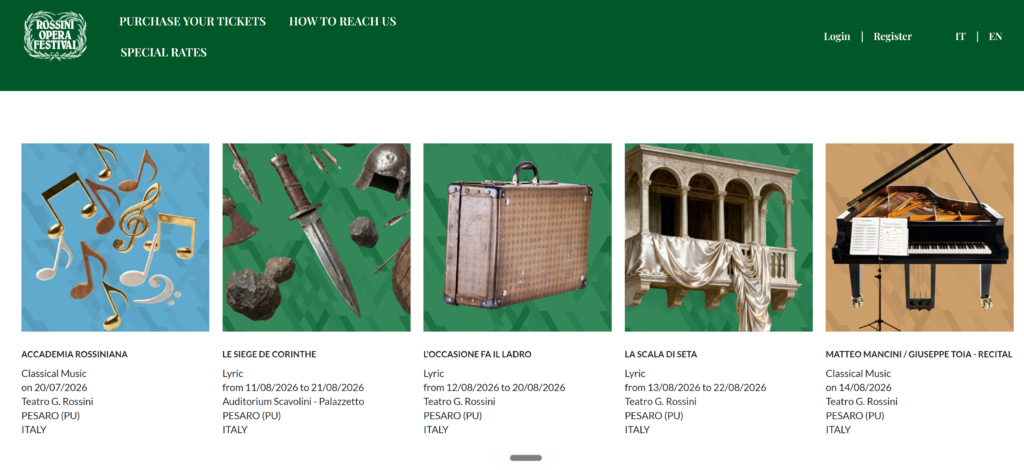
https://rossinioperafestival.vivaticket.it/index.php
What else is worth seeing in Pesaro beyond the festival?
The Palazzo Ducale, the Musei Civici (which hold Bellini’s Coronation of the Virgin and an exceptional majolica collection), the Conservatorio Rossini, and Casa Rossini — the fifteenth-century building where the composer was born, now a museum. The Parco Naturale del Monte San Bartolo begins at the northern edge of the city and offers cliff walks and coves that most visitors never reach. Urbino, 37 km inland, is one of the most intact Renaissance cities in Italy and should not be missed if you are in the province.
Is there a best time to visit Pesaro outside August if I cannot attend the festival?
September is the local consensus. The beach season has ended, the city returns to its residents, restaurants shift to their autumn menus — local fish, early truffle from nearby Acqualagna, fresh pasta with game. The Musei Civici and Casa Rossini remain open. Hotel prices drop by 30–40%. The light on the Adriatic in September is the same light that has been described in this region since the Romans built their roads along this coast: low, amber, and long.
Plan Your Trip to the Rossini Opera Festival
Planning a music-focused trip through Le Marche or central Italy? I offer trip planning consultations from my home in Macerata — one hour from Pesaro, forty minutes from Urbino, fifteen minutes from the Adriatic. If you want to build an itinerary that combines the ROF with the region’s food, architecture, and less-visited corners, I take a limited number of one-on-one sessions each month. Book a 45-minute call at tidycal.com/mircovitellozzi.
Sign up for the monthly newsletter to receive new articles as they publish, plus a free PDF: The Hidden Marche: A 7-Day Slow Travel Itinerary from an Italian Engineer.