Panettone vs Pandoro: How an Italian Chooses, and What the Label Says
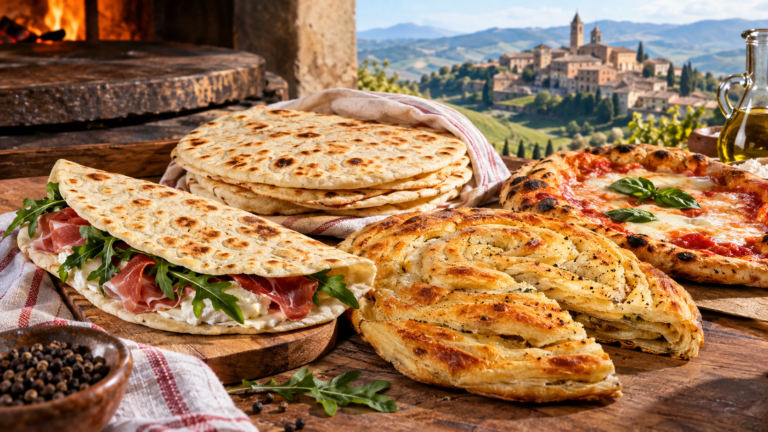
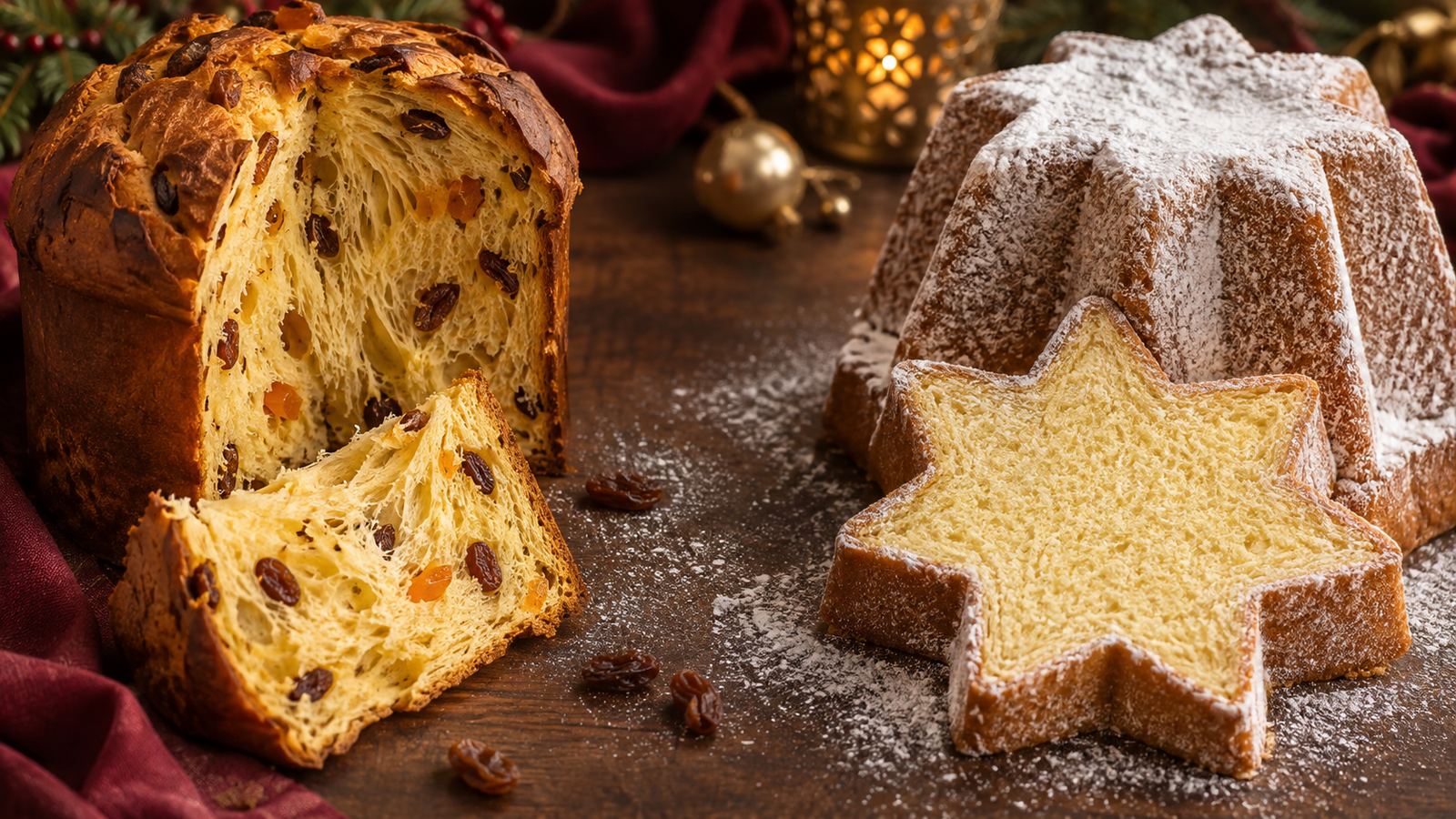
Panettone vs pandoro is the question every American faces in December. A tall, ribbon-wrapped box lands on the counter. Pop the lid and the two look nothing alike. Panettone’s cracked dome releases a waft of candied orange and butter, studded with dark raisins. Pandoro, plain and golden, waits under its own cloud of vanilla-scented powdered sugar. Panettone is leavened with natural sourdough and carries candied fruit, built on at least 16 percent butter by Italian law. Pandoro skips the fruit, leans on at least 20 percent butter, and tastes mostly of vanilla. Pick panettone for a tart edge with your sweetness, pandoro if there are kids at the table.
This article contains affiliate links. I may earn a small commission if you buy through them, at no extra cost to you.
Panettone vs Pandoro at a Glance
Before the history and the fine print, here is the panettone vs pandoro comparison in one table. It is the part search engines and quick readers usually want first.
| Panettone | Pandoro | |
|---|---|---|
| City of origin | Milan | Verona |
| Shape | Round dome, cracked top | Eight-pointed star, tapered cone |
| Minimum butter by Italian law | 16 percent | 20 percent |
| Fruit | Raisins and candied citrus peel, at least 20 percent combined | None |
| Leavening | Natural sourdough starter (pasta acida), multi-day rise | Same natural sourdough starter |
| Texture | Soft, with long, fibrous strands | Soft, silky, fine and even crumb |
| How it’s served | Cut in vertical wedges from the dome | Cut in horizontal star-shaped slices, dusted with sugar |
| Pairs with | Moscato d’Asti, a passito dessert wine | Sweet spumante, or hot chocolate |
| Best for | Readers who like a tart, fruity edge | Kids, and anyone who wants pure butter and vanilla |
What Makes a Panettone a Panettone
The panettone vs pandoro divide starts with a birthplace: Milan. But the origin story depends on which Milanese you ask. The most-repeated version has a kitchen boy named Toni saving a burned Christmas dessert. The setting is the court of Ludovico il Moro, Duke of Milan. Toni bakes a rich bread with butter, eggs and raisins, and the duke names it pan de Toni, Toni’s bread. A gentler version swaps the hero for Ughetto, a nobleman who learns to bake. He wants to win over a baker’s daughter named Adalgisa. Food historians treat both tales as folklore.
What is actually documented is older and less romantic. Milan’s bakers had permission to bake a special wheat loaf as a Christmas gift. That custom dates back to the late 14th century. A Milanese dictionary from 1606 already records a “panaton de Danedaa,” a large Christmas loaf. That is generations before any duke or kitchen boy enters the picture.
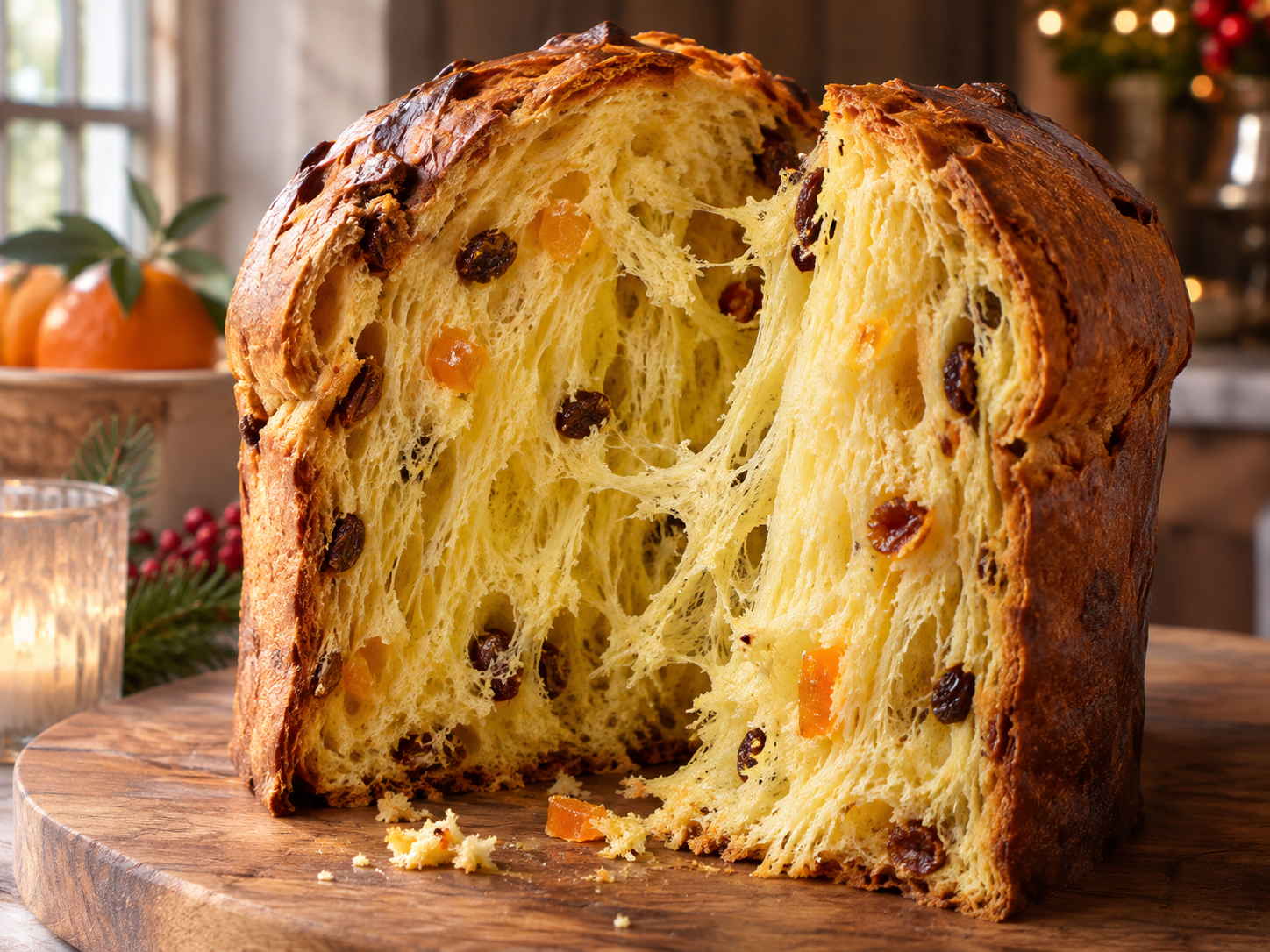
Legend aside, what actually makes a panettone a panettone is the pasta acida, the natural sourdough starter Italian law requires. Some bakeries feed and refresh this starter for decades. Production runs roughly 20 hours across three rises. That slow fermentation builds the long, fibrous crumb no quick-yeast shortcut can fake. A nine-dollar supermarket panettone and an eighty-dollar artisan one can list almost the same ingredients. What separates them is time, far more often than any secret recipe.
One letter a month from inside central Italy.
The places, seasons and stories I don't put on the blog. No itineraries, no spam.
What Makes a Pandoro a Pandoro
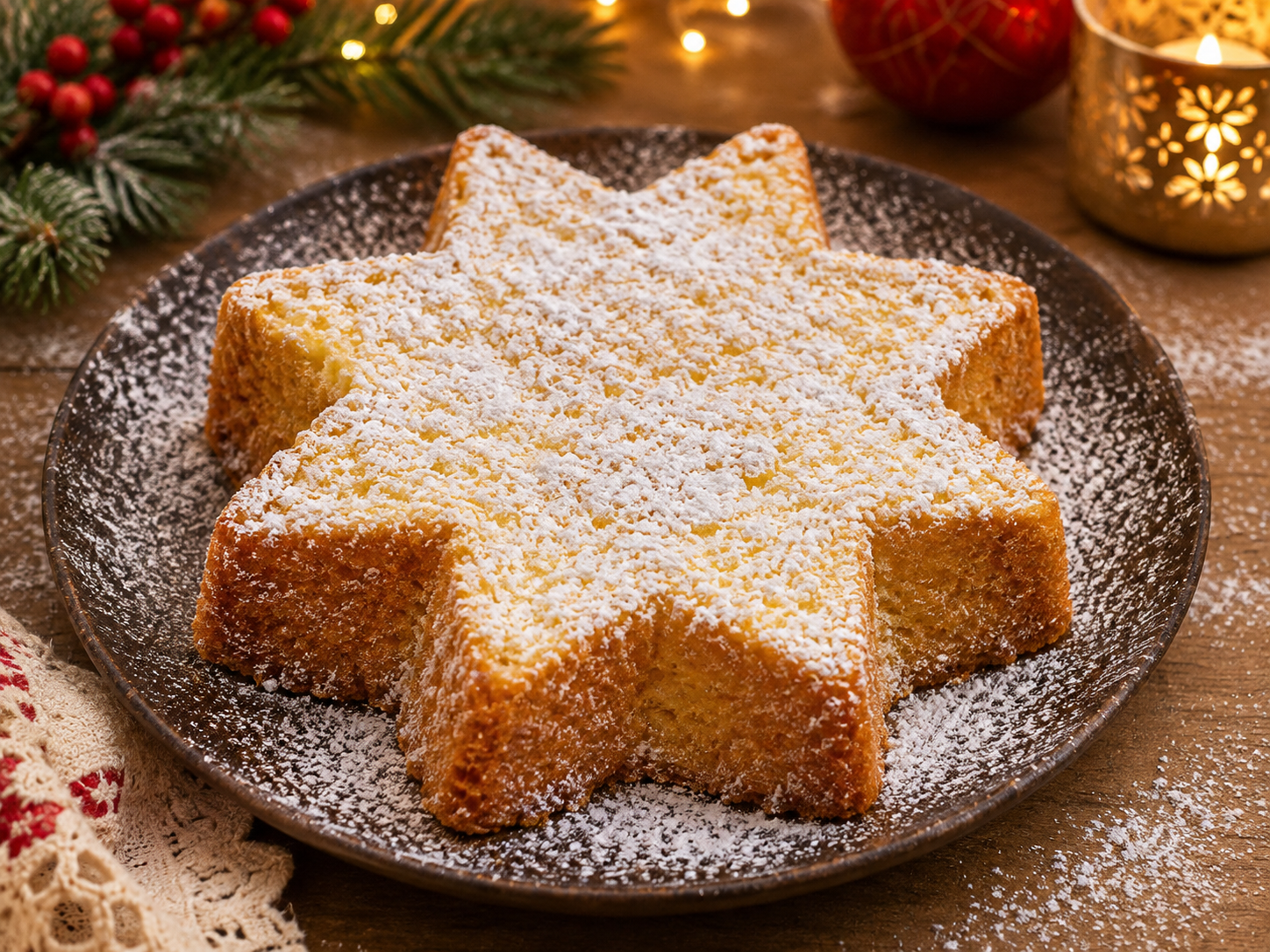
On the other side of the panettone vs pandoro comparison, the history comes with a patent and a date. On October 14, 1894, a Veronese pastry maker named Domenico Melegatti filed a patent. The office was the Kingdom of Italy’s Ministry of Agriculture and Commerce. The patent covered a star-shaped leavened cake. Melegatti reportedly commissioned a local Impressionist painter, Angelo Dall’Oca Bianca, to design the star-shaped mold. The cake built on Verona’s older Christmas loaf, the nadalin.
Italian law treats pandoro as panettone’s leaner, richer cousin. It uses the same pasta acida, no fruit at all, and a legal butter floor of 20 percent instead of 16. The conical shape, baked in that eight-point star mold, cooks evenly. The result is a soft, close, velvety crumb, unlike panettone’s open, stringy texture. Dust it with vanilla-scented powdered sugar and the pointed tips look like snow-capped peaks.
The Italian Law That Defines Both
Both cakes are legally defined in Italy, and the panettone vs pandoro distinction is written into law, not just tradition. Decreto Ministeriale 22 luglio 2005 (full text) was published in the Gazzetta Ufficiale n. 177 of August 1, 2005, and has been in force since early 2006. It reserves the names “panettone” and “pandoro” for products meeting a precise recipe. This is a legal requirement, not a marketing choice, and sanctions were added in a 2017 amendment.
For panettone, the rules require natural leavening from pasta acida. They also require a round base with a cracked top, and a soft crumb with long, elongated air pockets. At least 4 percent of the dough must be egg yolk. At least 16 percent must be butter, roughly a sixth of the cake. At least 20 percent must be raisins and candied citrus peel combined, around a fifth. Pandoro drops the fruit entirely. It raises the butter floor to 20 percent, also about a fifth of the dough, while keeping the same yolk minimum and sourdough leavening.
One detail surprises most label-readers. These percentages are calculated on the dry matter of the dough, net of “inert” additions such as the raisins. They are not calculated on the finished weight of the cake. A separate rule caps any commercial baker’s yeast at 1 percent of the whole dough. Yeast can help the rise along, but by law the real lift must come from the sourdough starter.
The decree also covers filled and coated versions, pistachio cream, chocolate, glazes, now common on store shelves. Article 7 allows them on one condition. The base dough must still account for at least half the finished weight, with no fat other than butter in that base. That is the rule a lot of “gourmet” panettone quietly bends by leaning on cream rather than dough.
Article 9 is the clause that matters most to an American buyer. It exempts products legally made or sold in other EU countries, Turkey, or EFTA states from the Italian recipe. But it says nothing about the United States. Italian law simply has no reach over producers outside the EU and its trading partners. A bakery in New Jersey or São Paulo can print “panettone” on a box and meet none of these percentages. On an American shelf, the name is never the legal guarantee it is on an Italian one.
The recipe itself may not stay fixed much longer. On October 13, 2026, two Italian trade groups presented a Manifesto per il Panettone Italiano in Rome. They were the Accademia dei Maestri del Lievito Madre e del Panettone Italiano and AEPI. It proposes letting bakers substitute extra-virgin olive oil for some or all of the butter. Olive oil is the same ingredient at the center of so much of Italy’s broader olive oil culture. The new labels would be tied to traceable, Italian-grown ingredients. For now it is only a proposal. The panettone vs pandoro debate for Christmas 2026 still runs on the 2005 recipe, exactly as written.
How to Read the Box Before You Buy
Before the box goes in the cart, four label checks settle most of any panettone vs pandoro question. I used this same read-the-law approach before, to work out what extra virgin olive oil actually means under EU rules.
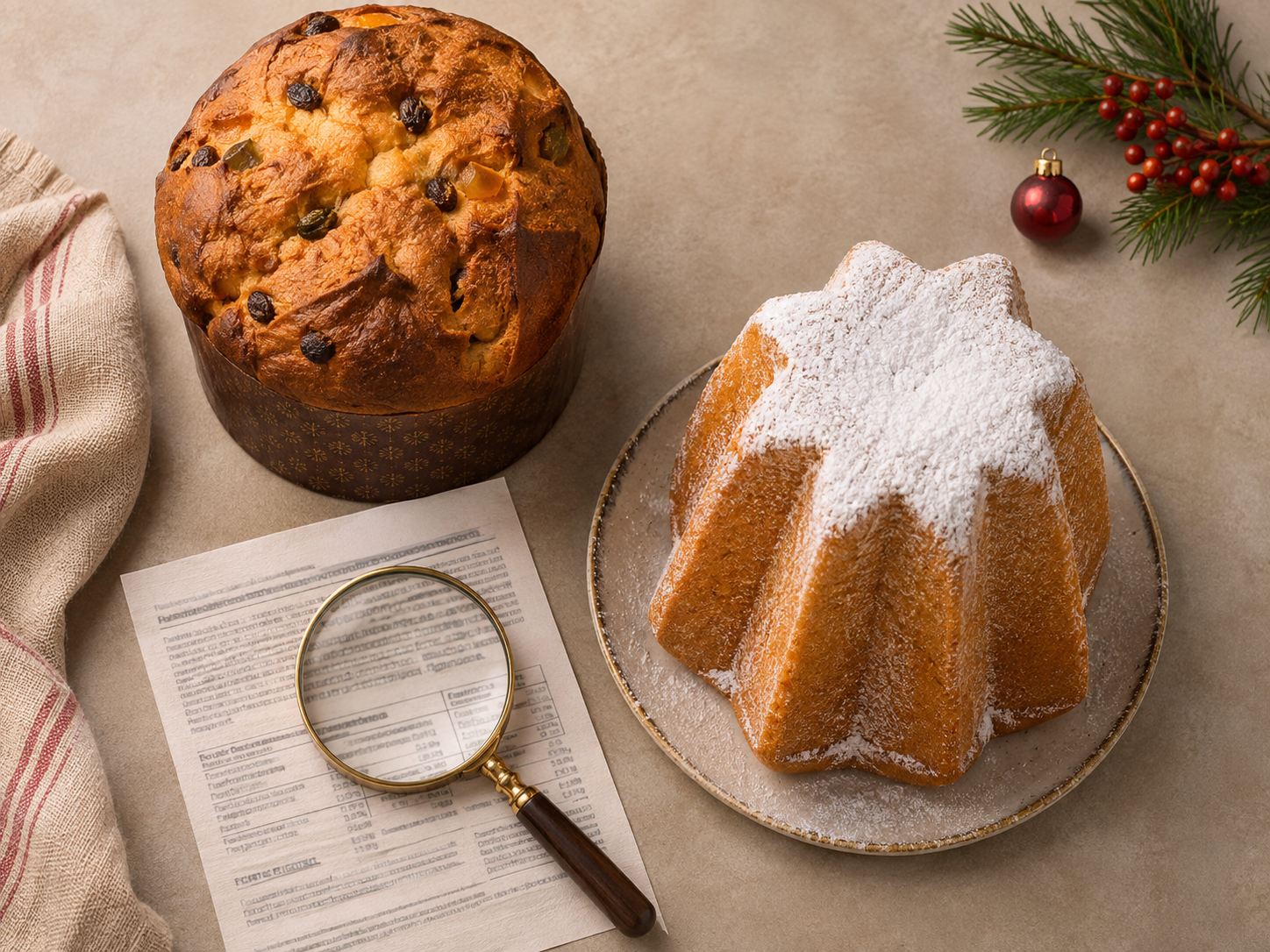
Start with the full name. If a panettone is missing raisins, candied peel, or both, Italian rules require the label to say so plainly. A box that simply reads “panettone,” with no exclusion noted, should contain both under Italian law. American packaging doesn’t always carry this disclosure. Treat its absence as a reason to check the ingredient list, not the front panel.
Next, look for pasta acida among the ingredients, or simply “natural sourdough.” Some labels use the equivalent term lievito madre instead (the natural sourdough starter). Don’t settle for only “yeast” or an unspecified “leavening agent.” A panettone built on commercial yeast alone skips the sourdough step. That step is the part of the process that actually takes days.
Third, check what supplies the fat. “Butter” should sit well up the ingredient list. “Vegetable oil,” “palm oil,” or “shortening” on a box labeled panettone is a warning sign. The cake was likely made outside the reach of Italian law, whatever the typeface or tricolor ribbon suggest.
Fourth, look for “Prodotto in Italia” or “Made in Italy,” plus a named producer rather than a generic importer. Country of origin is usually printed small, near the barcode.
One more case is worth flagging: a filled or glazed panettone, pistachio cream, triple chocolate, a liqueur-soaked center. It only follows Italian rules if the base dough still makes up at least half the finished weight. A cream-heavy “panettone” can turn out to be mostly filling, with a thin shell of actual cake. That version would not pass the test even on an Italian shelf.
Which Panettone to Buy in the US, by Price
Price is where the panettone vs pandoro choice turns practical for an American shopper. Both cakes sell across the same three tiers.
Under $15: Industrial, and Worth Checking the Label
At this price, you are buying a machine-made panettone, and that isn’t automatically a problem. Madi Gran Panettone is a 2.2-pound cake made in Italy by Maina Panettoni S.p.A. and sold at Costco. It has sat in the under-$15 range through the fall of 2026. Its ingredient list names a natural sourdough starter and real butter.
The brand worth watching, because it’s the one most Americans already own, is Bauducco. It’s the best-selling “panettone” in the United States, by the company’s own account. It’s made in Brazil, not Italy. There’s nothing dishonest about that. Bauducco’s founder genuinely did bring a sourdough starter and family recipe from Turin to São Paulo in 1948. The cake says “Made in Brazil” plainly on the label, but it falls entirely outside Italy’s 2005 decree. It’s a perfectly serviceable holiday bread. It simply isn’t what an Italian means by the word.
$15 to $35: Italian-Made, Mid-Tier Quality
This band is where “Made in Italy” starts to be the norm rather than the exception. De Milan’s panettone line is sold at Costco through the 2026 holiday season. Its pistachio-and-dark-chocolate and chocolate versions have run from roughly $16 to $17. Each is a 750-gram cake made in Italy with butter, eggs and milk on the label, and no palm oil in sight.
This tier suits a reader who wants a legitimately Italian cake without artisan prices. The sourdough character tends to be milder than a bakery-made loaf.
Above $35: Artisanal, Bakery-Made
Above $35, the money generally goes to a bakery, not a factory. The sourdough starter behind it has often been fed for years or decades. Bindi, a pastry house near Milan, sells its classic 2.2-pound panettone here for roughly $40 to $45. Fiasconaro, based in Castelbuono, Sicily, prices its Tradizionale in a similar range, with limited editions running past $90. A 17.6-ounce Gran Frutta panettone from the Veneto producer Filippi runs about $32, just under the line.
Claudio Gatti heads Italy’s Accademia dei Maestri del Lievito Madre e del Panettone Italiano. He has said an artisan panettone made with true lievito madre is hard to sell for less than roughly 30 euros a kilogram, even inside Italy. That floor tracks with the price of these cakes on an American shelf.
How Italians Serve Them
The panettone vs pandoro difference carries over to how each is served, not just what’s inside it.
Panettone is warmed for a few minutes before it’s cut, never in a microwave, ideally in a low oven. Warming loosens the long fibrous strands and releases the orange and butter aromas a cold slice keeps locked in. It’s sliced vertically, in wedges from the crusty top down to the base. Think of how you’d cut a round layer cake.
Pandoro is simpler. Still wrapped, it’s shaken inside its own small bag of vanilla sugar before unwrapping. That way the star-shaped ridges catch the powder evenly. Then it’s cut horizontally into star-shaped slices, stacked points-up on the plate. Many home cooks swap the sugar bath for a bowl of lightly whipped mascarpone cream instead.
Either cake is usually poured alongside something sweet and sparkling. Panettone goes well with a glass of Moscato d’Asti or an Italian passito dessert wine. Pandoro, plainer and more buttery, pairs naturally with a chilled flute of sweet Italian spumante. For the kids, a cup of hot chocolate works just as well.
Whatever is left by December 27 rarely goes to waste. Leftover panettone turns into bread pudding or gets toasted with mascarpone. Pandoro, already sweet, often becomes the next morning’s French toast.
What Not to Buy
Three honest warnings apply on either side of the panettone vs pandoro choice. All three come from what the label actually says, not what the box costs.
The first is the panettone that costs almost nothing. Read past the front panel and it turns out not to be one under Italian law. There’s no mention of pasta acida. Vegetable oil stands in for butter, and a flat “yeast” sits on the ingredient line where a sourdough culture should be. It will still taste like a holiday cake. It isn’t the cake the name promises.
The second is the heavily filled “gourmet” panettone, pistachio cream wall to wall. Cut into it and it turns out to be mostly filling, with a thin disc of actual dough at the center. Even Italy’s own rules wouldn’t call that panettone, since the base falls under half the finished weight. Plenty sold on American shelves would fail that same test.
The third is the ornate gift tin. The heavy metal canister and cardboard sleeve often cost more to produce than the cake rattling around inside. If you’re shopping for a food gift rather than a cake for your own table, consider a lower-risk option. My Italian olive oil gift guide covers one that travels just as well. With panettone, if the packaging outworks the dough, that’s usually the point.
FAQ
What is the actual difference between panettone and pandoro?
The panettone vs pandoro difference comes down to shape, fruit and fat. Panettone is a round, dome-shaped sourdough cake with raisins and candied peel, built on at least 16 percent butter by law. Pandoro is a star-shaped cone with no fruit. It is built on at least 20 percent butter and flavored mainly with vanilla.
Which one do kids usually prefer?
Pandoro, by a wide margin, in most Italian households. It has no fruit to pick out, and it tastes mostly of butter and vanilla. The powdered-sugar coating reads as dessert, not bread.
How long does an open panettone or pandoro last?
An industrial one, made with preservatives, keeps for weeks once opened if wrapped tightly. An artisanal one, made without preservatives, is best eaten within about a week. Natural sourdough leavening shortens its shelf life once the package is cut.
Should panettone be warmed before serving?
Yes. A few minutes in a low oven loosens the crumb and brings out the aroma. A cold panettone is noticeably denser. Pandoro doesn’t need warming; it’s served at room temperature, dusted with sugar or layered with cream.
Why does an artisanal panettone cost so much more than a supermarket one?
Mostly time, not marketing, on either side of the panettone vs pandoro price gap. An artisanal panettone needs a mature sourdough starter and roughly three days of fermentation. An industrial version needs only a few hours. Genuine butter and candied fruit also cost more than their substitutes.
Is a panettone made in the United States a “real” panettone?
Not under Italian law. That law only governs products made or sold in Italy, the rest of the EU, Turkey, and EFTA states. A US-made panettone can still be excellent, but nothing requires it to follow the 2005 recipe. The label is the only way to know what’s inside the box. The panettone vs pandoro question works the same way for pandoro made outside Italy.
What’s the one ingredient line that tells an Italian everything, at a glance?
Pasta acida. Some labels call it lievito madre instead. Suppose a panettone’s ingredient list shows plain yeast and nothing else for leavening. Most Italians would say, gently, that what’s in the box is a Christmas-shaped bread. It’s not a panettone, whatever the label claims on the front.
The Takeaway
Panettone vs pandoro was never really a contest. Most Italian households keep both on the table and let people choose. What changes the experience is whether the box actually followed the recipe the name implies. Read the label the way the Italian government does: sourdough or plain yeast, butter or oil, half-dough or mostly filling. The nine-dollar supermarket panettone and the forty-five-dollar bakery one stop being a mystery. They become an informed decision instead.
For the rest of the season, from Milan’s shop windows to the markets further south, my guide to spending December in Italy covers it. It picks up right after the panettone is gone.