Is Truffle Oil Fake? What an Italian Buys Instead
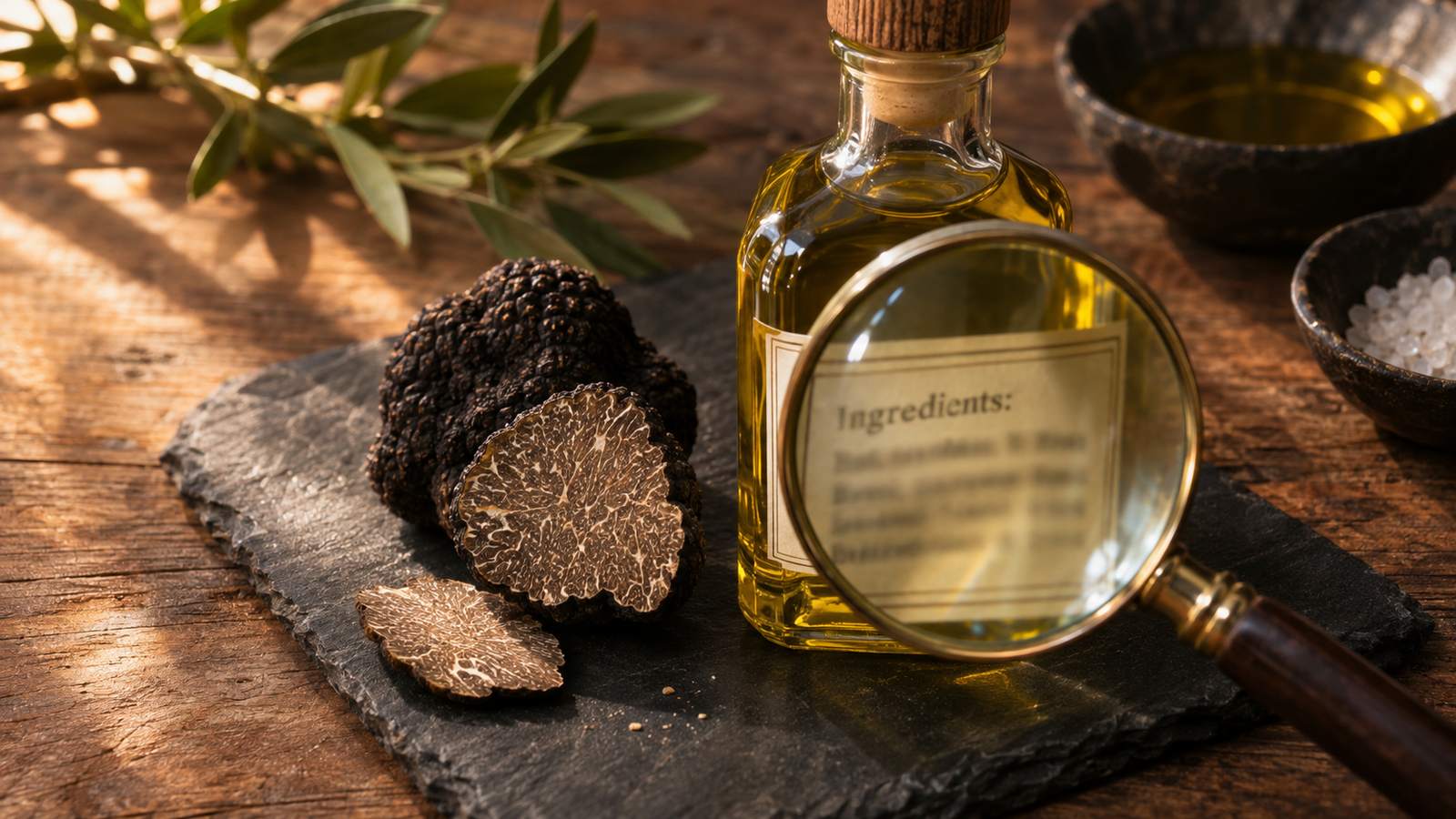
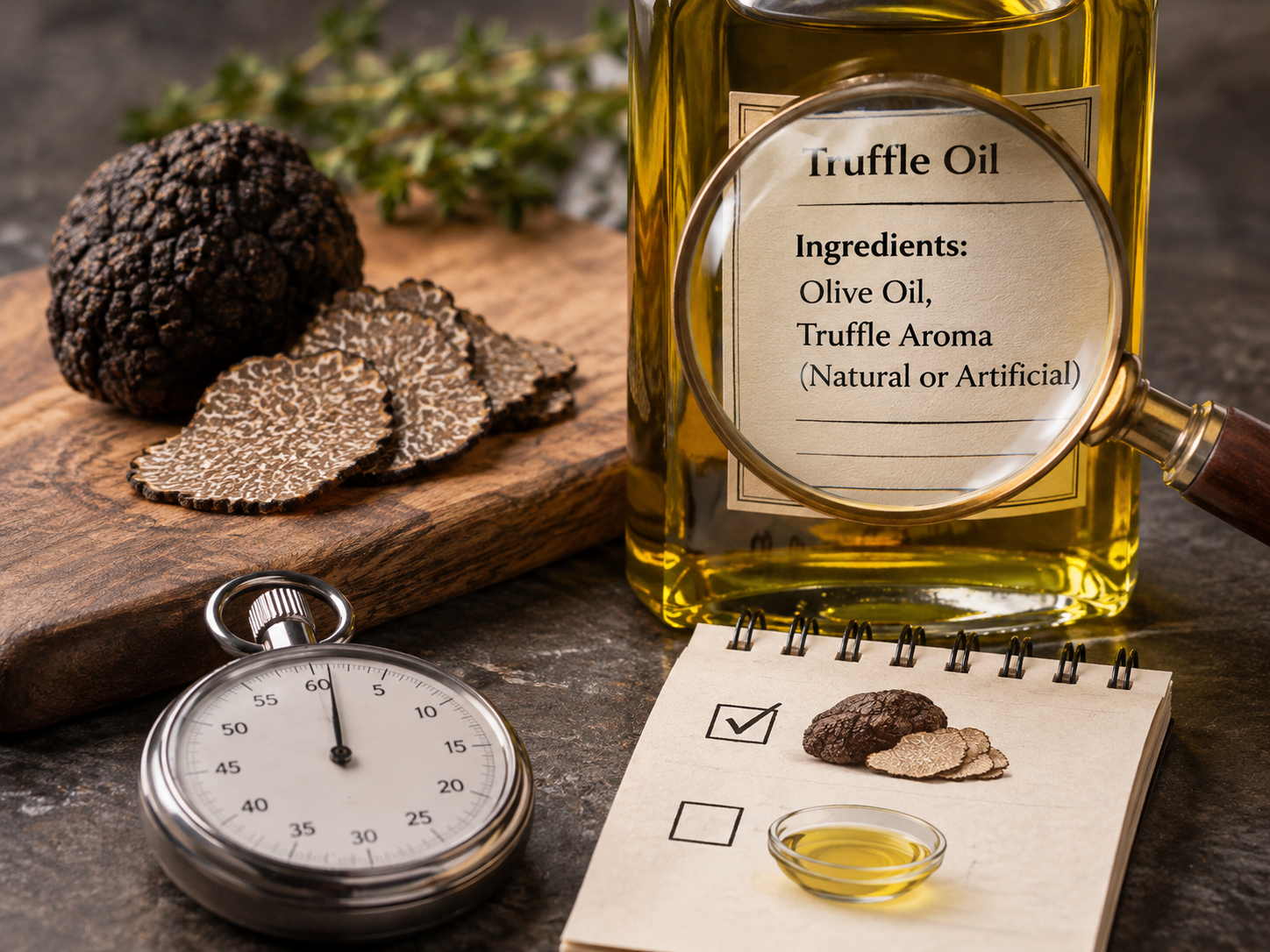
Most people who type “truffle oil fake” into a search bar already suspect the answer. The ingredient panel on the bottle in their own pantry usually confirms it. There is no truffle in it, just a lab-made aroma called 2,4-dithiapentane standing in for one. It is the same sharp, garlicky note that fills a steakhouse the moment the fries land. Real truffle, sliced raw on a cutting board in Acqualagna or Alba, smells quieter and stranger. Think wet forest floor, a trace of gas, something that builds slowly instead of announcing itself. The difference sits in plain sight on the label. Reading it correctly takes about thirty seconds. This guide shows how, and what an Italian buys instead.
This article contains GetYourGuide affiliate links. If you book through them, this site earns a small commission at no extra cost to you.
What Is Truffle Oil Made Of?
The compound behind most truffle oil fake claims has a number for a name: 2,4-dithiapentane, also called bis(methylthio)methane. Italian chemists first isolated it from white truffle (Tuber magnatum Pico) in 1967. They identified it as one of the molecules responsible for the truffle’s smell. It occurs naturally in real truffles, but the food industry now makes it synthetically, from methyl mercaptan and formaldehyde. It is sold as an approved flavoring to the entire food business, not only to truffle brands.
What it does not do is reproduce the truffle. Researchers have mapped the aroma of fresh Tuber magnatum and Tuber melanosporum. They count dozens of volatile compounds working together: sulfur, earth, something close to garlic, something close to ripe fruit. These shift as the truffle breathes. 2,4-dithiapentane supplies exactly one of those notes, at a concentration no real truffle reaches on its own. That is why a few drops of truffle oil fill a kitchen before the pan is even hot. A shaving of real truffle, by contrast, needs a warm, quiet room to make its case.
A single-note aroma also behaves differently on the palate. Cooks who have used both often describe the synthetic version as loud at first and flat by the second bite. Real truffle keeps shifting the longer it sits on warm food. Neither effect shows up on a label. The chemistry behind a truffle oil fake claim never does either. Only the ingredient list does. That is where this guide starts.
Truffle Oil Fake or Real? The Thirty-Second Label Test
Is truffle oil real or fake? Settling that question takes thirty seconds once you know where to look. Skip the marketing copy on the front of the bottle. Go straight to the ingredient panel on the back. Real producers list real truffle by its Latin name and a percentage. Everyone else lists an aroma. The table below shows what each common label phrase usually means. It is checked against the actual ingredient lists of bottles sold in the United States.
One letter a month from inside central Italy.
The places, seasons and stories I don't put on the blog. No itineraries, no spam.
| What the label says | What is usually in the bottle |
|---|---|
| “Truffle flavor” or “truffle aroma,” no species named | A synthetic or lab-cultured aroma compound, most often 2,4-dithiapentane, with no truffle solids at all |
| “Natural truffle flavor” or “natural truffle extract” | An aroma that meets the FDA’s definition of “natural” — derived from some natural source — which does not have to be truffle at all |
| A named species with a percentage, such as Tuber aestivum 2% | Real truffle, in a small but verifiable amount, usually listed behind mushrooms or oil |
| Tuber magnatum Pico vs. Tuber aestivum Vitt. | Prized white truffle vs. the milder, far cheaper summer black truffle — the species named tells you which one you are paying for |
| Truffle listed after “oil” or “aroma” in the ingredient order | Under both EU and US labeling rules, ingredients are listed by weight — truffle mentioned last usually means the smallest amount in the bottle |
The variation is real, not hypothetical. One jar of Urbani’s organic white truffle oil lists five ingredients: extra-virgin olive oil, white truffle extract, natural flavors, and white truffle at 0.1 percent. Truffle comes last, in a fraction of a percent. A differently packaged bottle from the same brand’s standard line skips the percentage and the truffle solids entirely. It names only “olive oil, white truffle aroma.” Tartufi Morra’s white truffle oil runs the same pattern. It lists 0.1 percent named truffle, with aroma doing the rest of the work.
None of this makes these brands dishonest. The labels are accurate, as far as EU and US law require. But the name on the front tells you nothing about what is inside. That is exactly the truffle oil fake pattern worth learning to spot on sight. Read every bottle, even within the same product line. Formulations vary by batch and retailer.
The Rules on Both Sides of the Atlantic
In the European Union, Regulation (EC) No 1334/2008 governs what a bottle can call itself. It is the clearest legal answer anywhere to the truffle oil fake question. Article 16 is specific. A flavoring can only be labeled “natural [source] flavoring” — natural truffle flavoring, for instance — under one condition. At least ninety-five percent of the flavoring component, by weight, must genuinely come from that named source. Below that threshold, EU law requires something more honest and less appetizing. The bottle must say plain “flavoring” or “natural flavoring,” with no truffle named at all.
Italy adds a second layer for anything sold as a truffle product, rather than a flavored one. Legge 16 dicembre 1985, n. 752 requires conserved truffle — the whole or sliced product, not the oil — to carry a sealed label. That label must name the packer, the production site, the Latin and Italian species name, the collection zone, and the drained weight in grams. Any added wine or spirits must also be declared. Selling conserved truffle without that label, immature, unclean, or under the wrong species is illegal under Article 14 of the same law.
American rules work differently, and the difference matters at the cash register. Under 21 CFR 101.22, the FDA lets a flavor be labeled “natural” as long as it comes from some natural source. That source can be any plant, fruit, or spice. That source does not have to be the thing being imitated. A “natural truffle flavor” on a US bottle can legally be a natural compound that never touched a truffle. That is a truffle oil fake pattern the EU’s ninety-five-percent rule would not allow in Italy. The word “natural” reassures an American shopper in a way the law never promised it would.
The gap between marketing and chemistry ended up in federal court. In May 2017, three consumers sued Sabatino Truffles New York LLC and Sabatino North America LLC. The case went to the U.S. District Court for the Central District of California. The plaintiffs argued that oils labeled “White Truffle Infused” and “Black Truffle Infused,” marketed as “all natural,” were flavored with 2,4-dithiapentane rather than real truffle. A federal judge dismissed some claims in September 2017, while letting others proceed. The plaintiffs’ amended complaint cited DNA testing they said showed no truffle material at all. The court never ruled on that allegation. The parties settled in October 2018, and the case closed without its terms made public.
A near-identical suit against Urbani Truffles USA was voluntarily dismissed the same year, for undisclosed reasons. Neither case produced a court finding on whether the labeling was actually false. What both show is simpler: American lawyers, not just European regulators, now read truffle oil ingredient lists as closely as this guide is asking you to.
What an Italian Buys Instead
Everything above is about the bottled product on an American shelf, not the fresh truffle you might bring home from a market in Acqualagna or Alba. That is a different purchase, with its own rules, covered fully in how to buy real truffle in Italy, cartellino and all. What follows is the answer to the truffle oil fake question: real truffle products, in the order I would actually spend money.
Whole or Sliced Preserved Truffle
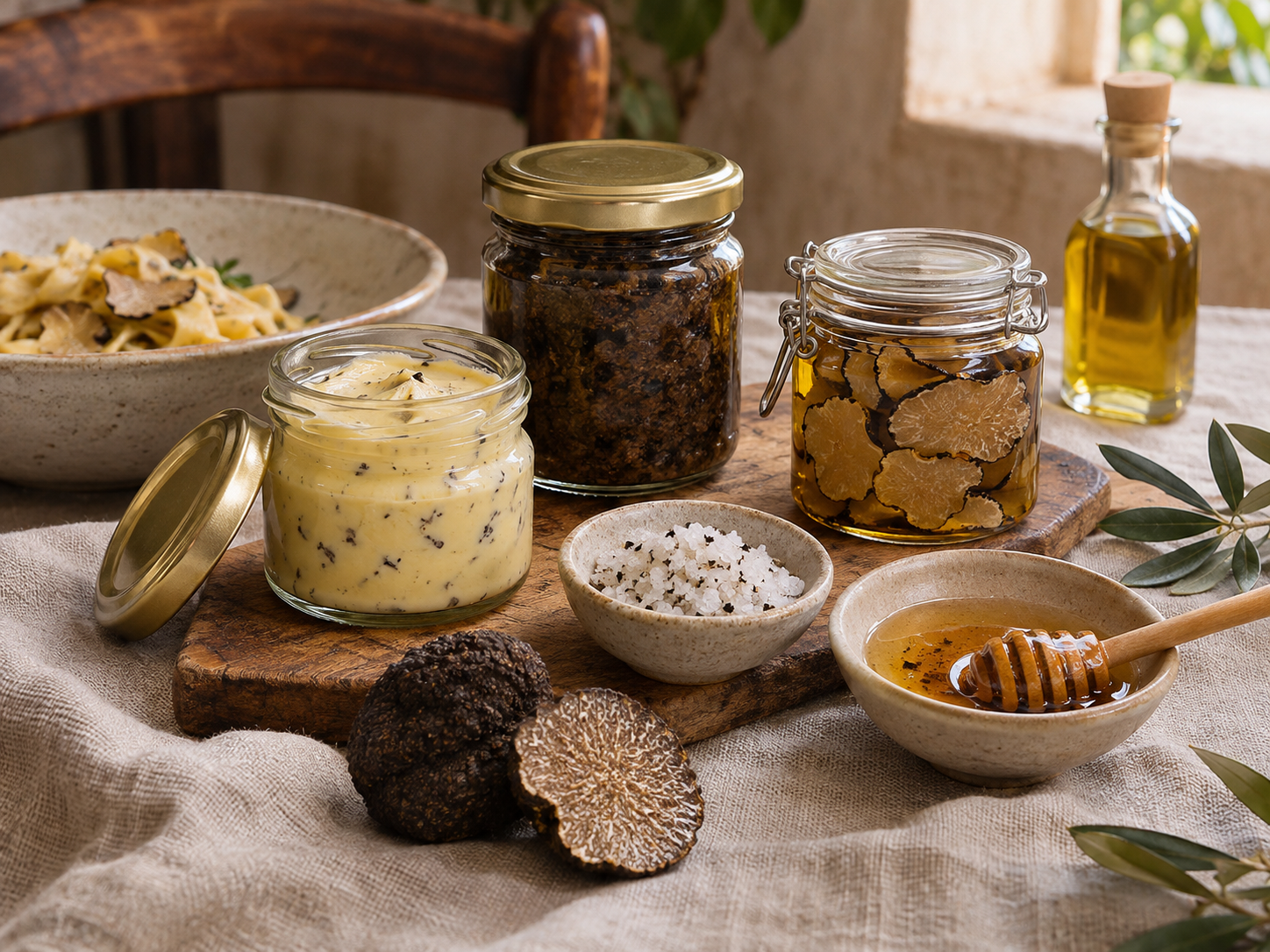
This is the only category where real truffle regularly makes up most of the jar, rather than a trace of it. A carpaccio or tartufo intero packed in salamoia (in brine) can run from a few percent of truffle up to roughly half the net weight, depending on the producer. Check the percentage next to the Latin species name before you buy. Do it the same way you would check the proof on a bottle of spirits. Urbani’s black truffle carpaccio, for instance, lists Bagnoli black truffle slices at fifty percent. That is Tuber mesentericum, the more everyday black variety, ahead of the olive oil and salt that carry it. This is about as close to eating truffle itself as a shelf-stable jar gets. It is also a fair trade for something this much more affordable than fresh.
Expect a softer, muskier flavor than fresh truffle. Brining and sterilizing mellow the same compounds that make fresh truffle so aggressive on a warm plate. Acqualagna and Alba disagree, politely, about which of their truffles deserves the premium, a rivalry I have mapped out here. Both towns sell this category at every stand during fair season. If reading percentages on a jar sounds less fun than finding your own, truffle hunting in Italy is a real, bookable activity. This private hunt near Acqualagna includes lunch or dinner. It is the version I would send a first-time visitor to.
Truffle Butter
Truffle butter earns its price when the percentage sits in the low single digits or higher, and the ingredient list stays short: butter, truffle, salt, maybe a named flavoring. Savini Tartufi’s version lists butter at ninety-three percent. It names five percent summer truffle (Tuber aestivum) ahead of flavoring, salt, and pepper, a label worth using as a benchmark. Below that percentage, you are paying truffle prices for butter with a memory of truffle in it. It makes the most sense on anything hot enough to melt it slowly: a resting steak, plain pasta, scrambled eggs. Skip the sauces, where the aroma just competes with stronger flavors. Because it is dairy, refrigerate the open jar. Use it within the week the label suggests, not the month a shelf-stable oil would allow.
Salsa Tartufata
Tartufata is a mushroom-based spread carrying a small share of real truffle. That is not a trick, even though the ingredient list usually puts cultivated mushrooms first and truffle second, often in the low single digits by weight. One widely sold Urbani tartufata lists mushrooms at eighty-five percent and summer truffle crumbs at two percent. Savini Tartufi’s “Gatherer’s” line runs ninety percent mushroom content, with three percent named truffle, alongside anchovies and capers. Both are honest recipes. Italians have made tartufata this way for generations, because truffle alone would be too expensive and too one-note to spread on bread. The giveaway of a bad jar is not a low truffle percentage, which is normal. It is a list that never names a truffle species at all, relying on “truffle flavoring” to do the work real crumbs should do. Use it on toast, stirred into risotto, or spooned over a soft egg.
Truffle Salt and Honey
These are the cheapest honest way into the category. They are also the easiest to get wrong. Truffle salt should list a real species and a percentage, the same as everything else here. Most of what is sold as “truffle salt” near tourist sites is flavored salt with no truffle at all, priced as if it had some. Truffle honey works the same way. Look for shavings visibly suspended in the jar, not just a dissolved aroma. Both belong at the end of cooking, not the start: a pinch of salt over finished pasta, a spoonful of honey next to hard cheese. Like truffle oil, heat ruins them fastest.
If You Still Want a Truffle Oil
A truffle oil fake label is not always a dealbreaker. Plenty of good cooks keep a bottle of it around on purpose. If you are buying truffle oil anyway, look for a species name and a percentage, not just the words “natural” or “gourmet” on the front. Treat it strictly as a finishing oil, added after the pan is off the heat. Buy the smallest bottle available, since the aroma fades within weeks of opening. One widely marketed American brand, TRUFF, lists five ingredients for its black truffle oil: olive oil, black truffle oil concentrate, capsicum oleoresin, arbol chili pepper seeds, and black winter truffle (Tuber melanosporum). Truffle is named, but listed last. It sits behind a concentrate the label does not break down any further. That is the same question mark this whole guide is about, on one more bottle (ingredient list verified November 2026).
What I would not buy is the Christmas gift box. Picture a half-liter of truffle-flavored oil in a decorative bottle, sold for ten times what a good bottle of plain extra-virgin olive oil costs. Nobody reads the ingredient list before it goes under the tree. The tartufata or the butter above will do more for less money. Both tell the truth about what is in the jar.
The Real Thing, in Season

No bottle is needed to answer the truffle oil fake question in season. White truffle season in Italy runs roughly from October through December. The market peaks in November, when fresh Tuber magnatum Pico is at its most fragrant and most expensive. Acqualagna’s own fair, the Fiera Nazionale del Tartufo Bianco, runs across weekends. It closes on November 14 and 15, 2026.
If you will be in Italy during the season, hunting one yourself beats reading about it. This half-day experience near Acqualagna walks you from the forest to the table, with a trained dog and its handler. This truffle hunt in the Langhe hills near Alba covers Piedmont’s side of the rivalry, with a wine tasting built in. Either one teaches you more about what real truffle smells like than any bottle on a shelf.
FAQ
Is truffle oil fake, and is it bad for you?
No. 2,4-dithiapentane is an approved food flavoring in both the EU and the US, regulated the same way any other flavoring compound is. The truffle oil fake complaint is about honesty and price, not safety. You are paying truffle prices for an ingredient with no particular health claim attached to it.
Why do chefs still use truffle oil if it is not real truffle?
Because it is cheap, shelf-stable, and consistent in a way fresh truffle never is. A few drops deliver a recognizable, crowd-pleasing aroma for a fraction of the cost of fresh shavings. That matters on a menu that needs the same dish to taste the same way every night. Chefs who use it tend to know exactly why.
How long does an opened bottle of truffle oil last?
Expect two to four weeks of real aroma after opening, even stored cool and dark. The volatile compounds that carry the smell break down quickly, once the bottle lets in air and light. An unopened bottle lasts closer to a year. If a bottle you opened months ago still smells as strong as the day you bought it, that is worth noticing, not reassuring.
What does “natural truffle flavor” mean on an American label?
Under FDA rules, it means the flavoring compound comes from some natural source, not necessarily truffle. The European Union does not allow that distinction. EU law requires at least ninety-five percent of a “natural [source] flavoring” to genuinely come from the named source. The same two words mean different things, depending on which side of the Atlantic prints the label.
Does tartufata actually contain truffle?
Usually, yes, in a small percentage behind cultivated mushrooms. An honest label names the species and the share by weight. Treat an unlabeled percentage, or a list with no named species at all, as a sign to put the jar back on the shelf.
What is a good gift for someone who loves truffle?
A small jar of genuine truffle butter or a well-labeled tartufata beats a decorative bottle of truffle oil almost every time. Both let the recipient actually taste real truffle, rather than its loudest imitation. Pair it with a short note on how to use it: on warm food, not in the pan. Skip the oversized gift set entirely.
Why don’t Italians keep truffle oil in the pantry?
Because the places that grow the real thing do not need to fake it. In the trattorie around Acqualagna and Alba, during truffle season, white truffle arrives fresh at the table, shaved over the dish in front of you. Truffle oil has nothing to add to a plate that already has the real ingredient on it. It rarely appears on the shelf behind the bar in the first place.
If the truffle oil fake question got you this far, the full truffle season calendar on Taste and Wonders of Italy goes deeper into the Italian side of it. The YouTube channel has video dispatches from Le Marche and beyond.