Sagrantino di Montefalco: The Wine That Almost Disappeared
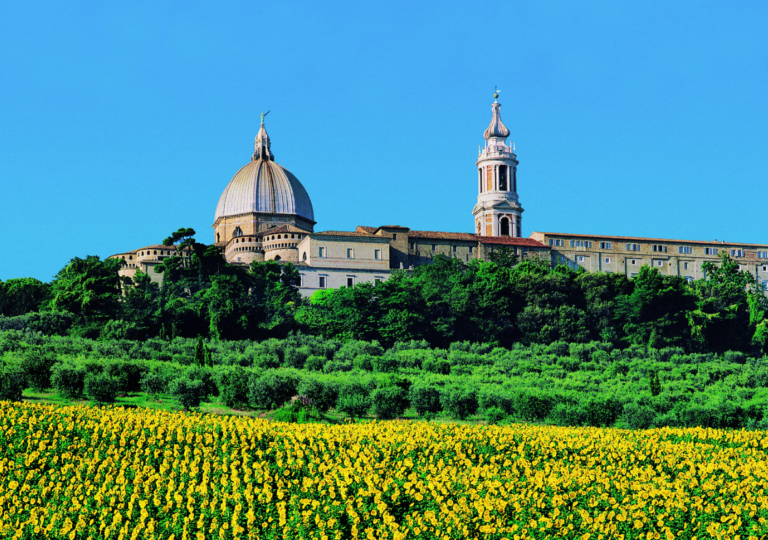
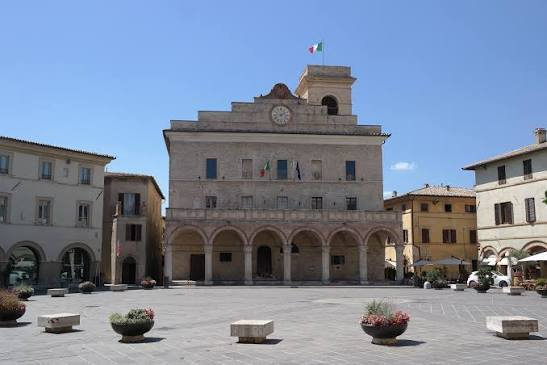
Sagrantino di Montefalco almost disappeared from the rest of Umbria. By the mid-twentieth century, the grape survived in only a handful of scattered plots below this walled hill town. Farming families kept it alive as a dark, heavy passito. They fermented it for Christmas and for Mass, not for sale.
Then, starting in the 1970s, a small group of growers replanted it as a dry red. Within twenty years, it became one of the most structurally serious wines in Italy. It is a red built almost entirely from tannin, grown on a single ridge of clay and limestone above Umbria’s Valle Umbra. This guide explains what Sagrantino di Montefalco actually is, why its tannin behaves the way it does, and how to taste it in Montefalco without wasting a day getting it wrong.
A note on links: some of the booking links in this article are affiliate links. If you book through them, I earn a small commission at no additional cost to you. I only link producers and experiences I would actually recommend, and I say so plainly when I would skip something instead.
What Is Sagrantino di Montefalco? The Short Answer
Sagrantino di Montefalco is an Italian red wine made entirely from the Sagrantino grape. Growers can plant it only within five small communes around Montefalco, in the province of Perugia. The zone covers Montefalco itself, plus parts of Bevagna, Gualdo Cattaneo, Castel Ritaldi, and Giano dell’Umbria. The wine has held Italy’s highest classification, DOCG (Denominazione di Origine Controllata e Garantita), since 1992, after first earning DOC status in 1979.
It comes in two legally separate styles. One is dry, labeled Montefalco Sagrantino DOCG Secco. The other is sweet, made from dried grapes, and called Montefalco Sagrantino DOCG Passito — actually the older and historically more common of the two. According to a study by Italy’s Edmund Mach Foundation, Sagrantino carries one of the highest tannin and polyphenol contents of any red grape variety in the world.
Secco, Passito, and Montefalco Rosso — Not the Same Wine
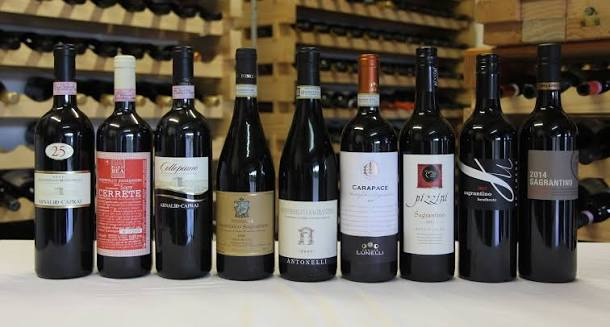
Visitors often assume “Sagrantino” and “Montefalco red wine” mean the same thing. They do not. Montefalco Sagrantino DOCG Secco is 100 percent Sagrantino: dry, tannic, and built to age for decades. Montefalco Sagrantino DOCG Passito uses the same grape, but the clusters dry on straw mats for at least two months before pressing. That process concentrates sugar into a dense, dark dessert wine, closer to 14 percent alcohol.
Then there is Montefalco Rosso DOC, a completely different wine most producers also make. Its rulebook calls for roughly 60 to 70 percent Sangiovese, with 10 to 15 percent Sagrantino added for structure. A recent amendment eased that further, allowing a leaner Sangiovese-Sagrantino blend with less of other varieties. Montefalco Rosso is friendlier, cheaper, and ready to drink young. Order it if a full-strength Sagrantino sounds like more wine than you want on a Tuesday.
A Vine That Nearly Disappeared
From Sacred Wine to Near-Extinction
The written record for Sagrantino goes back further than most Italian grapes can claim. Archival documents from Montefalco and nearby Assisi mention it by name from the mid-1500s. Some historians trace its cultivation to Franciscan friars, who may have used a sweet, dark wine for sacramental purposes. That is one theory behind the name itself, linked to the Italian sacro, or “sacred.”
Other researchers reject that story entirely. They argue Sagrantino is a genuinely local variety, with no relation to any known grape. One hypothesis connects it to the ancient Itriola vine that Pliny the Elder described growing near Montefalco two thousand years ago. No one has settled the question. What both theories agree on is simpler: Sagrantino stayed a farmhouse wine, made in small quantities, for centuries.
The Vignaioli Who Brought It Back
By the 1960s, Sagrantino was nearly gone. Decades of war, rural depopulation, and the postwar rush toward higher-yield grapes had pushed it to the edge of extinction across Umbria. A handful of growers refused to let it go. Among them, the Arnaldo Caprai estate began replanting Sagrantino in 1971. It is widely credited as the producer that proved the dry style could work commercially, not just as a devotional wine.
The comeback had earlier roots than most people assume. At a regional wine and oil exhibition in Montefalco in 1899, Sagrantino won formal recognition as a superior dessert and table wine. The grape already had a reputation worth rebuilding. The Consorzio Tutela Vini Montefalco formed in 1981 to organize that rebuilding, coordinating growers who had spent the previous decade replanting.
Their persistence paid off quickly by wine-industry standards. The grape earned DOC recognition in 1979, then DOCG status in 1992. That is a jump of just thirteen years, fast for an Italian denomination. The growth since has been dramatic. The area registered under the Sagrantino DOCG grew from roughly 66 hectares in 1992 to about 380 hectares today. That figure comes from the Camera di Commercio dell’Umbria and the Consorzio Tutela Vini Montefalco. Bottle production followed the same curve, moving from around 660,000 bottles in 2000 to more than a million today.
Why This Hillside and No Other
Reading the Slope Like a Structure
I have spent thirty years reading the stone walls of hill towns like this one for a living. Sagrantino makes the same kind of sense a load-bearing wall does, once you look at what is underneath it. The DOCG zone sits on a low ridge between 220 and 470 meters above sea level, overlooking the Valle Umbra between Assisi, Foligno, and Spoleto. The soil is a mix of clay and limestone: well-draining, but water-retentive enough to stress the vine during the growing season.
That stress is not incidental. Vines that struggle slightly for water push more energy into thick skins and concentrated tannin. That is exactly the raw material Sagrantino needs, and exactly what a vine on flatter, richer ground would never produce. A different hillside, a different drainage pattern, and the grape would likely taste like something else entirely.
What the Tannin Is Actually Doing
Sagrantino’s tannin is not a marketing claim. It is measurable. Wine Folly reports that a study by Italy’s Edmund Mach Foundation compared Sagrantino to Cabernet Sauvignon, Nebbiolo, and Tannat. It found Sagrantino carried more tannin than any of them, with a structure researchers compare to pure cocoa.
In practical terms, that means a young Montefalco Sagrantino DOCG Secco can taste closed and almost chalky. It grips the inside of your cheeks rather than showing fruit. The rulebook accounts for this: Secco wines must age at least 37 months before release, including at least 12 months in oak, so the tannin has time to soften. Open a bottle too young, and you are tasting an unfinished structure, not a flawed wine.
A Walled Town Still Standing on Its Own Roots
Montefalco sits inside seismic zone 2, Italy’s second-highest hazard category. It is part of the same Appennino Umbro-Marchigiano seismic belt that produced the destructive 1997 Umbria-Marche earthquake. That quake hit hardest in Foligno, Nocera Umbra, Assisi, and other towns to the north and south. Montefalco itself was not among the places most damaged.
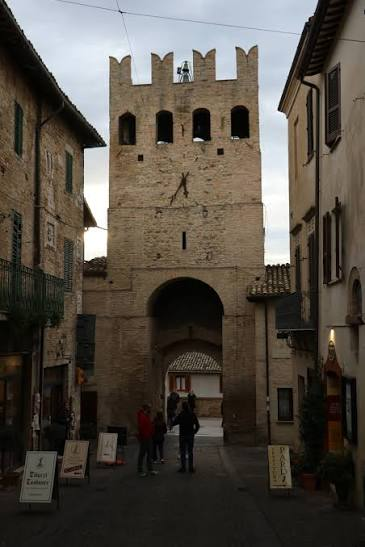
That does not make the town’s relationship with its own ground simple. In March 2026, a ten-meter stretch of Montefalco’s medieval walls near Borgo Garibaldi suddenly collapsed at dawn. The failure exposed an old underground passage that heavy rains appear to have destabilized. No one was hurt. The region moved fast, allocating more than 3.6 million euros for repairs, through the same seismic-reconstruction funding structure that has managed Umbria’s earthquake recovery for decades.
For a structural engineer, that collapse says more than any tasting note. It shows a town whose walls, streets, and vineyards all sit on the same unstable, water-sensitive ground. The clay-limestone slope that gives Sagrantino its tannin also moves, drains, and occasionally fails underfoot.
Montefalco has spent decades reinforcing its historic core against exactly this kind of risk. That work is not a response to a single dramatic disaster. It is ongoing maintenance of a town that never stopped being lived in. That, more than any wine list, is the honest version of “authentic Umbria”: a place still doing the unglamorous work of staying standing.
How to Taste Sagrantino Without Looking Like a Tourist
Wine tourism around Montefalco runs on Italian rules, not American ones. A few habits separate visitors who get a real tasting from those who get the standard ten-minute pour. Most producers require booking ahead, usually by phone or email rather than a walk-up website form. Expect to commit a real block of time: a proper cellar visit plus tasting runs 60 to 90 minutes, not fifteen. Ask before you assume. Not every winery has an English-speaking guide on every day of the week, so confirm language along with the appointment.
For a first cellar visit, a private tour and tasting at Azienda Agricola Bocale is a reasonable benchmark: a small, family-run estate outside Montefalco that pours exactly the three wines this guide explains side by side — Trebbiano Spoletino, Montefalco Rosso, and Montefalco Sagrantino — over a ninety-minute visit through the vineyard and cellar, with olive oil and bruschetta alongside. It is the kind of appointment this section describes, not a bus-tour substitute for one.
Tipping is not expected the way it is at home, and no one will hover to upsell you into a bigger purchase. That said, buying a bottle or two after a paid tasting is customary, even if the price sits above what you would spend on impulse. Most estates ship internationally, so a case can follow you home if a single bottle is not enough.
A few practical numbers worth knowing before you book:
- Booking window: most family-run cantine want at least 24 to 48 hours’ notice. Larger estates can sometimes accommodate same-day requests.
- Typical cost: guided tastings generally run from about €15 to €40 per person. Expect more for tastings paired with food or a cellar tour.
- Group size: many smaller producers cap tastings at 6 to 10 people. Solo travelers and couples often get more attention than tour groups.
- What to ask for: a vertical or near-vertical tasting, if offered. Trying a Sagrantino from two or three vintages side by side shows the aging curve the wine’s rulebook makes mandatory.
Do not rush the pour. Sagrantino needs air more than most reds. A young bottle can taste tight and closed for the first twenty minutes in the glass, then open into fruit and spice. If a producer offers to decant, say yes. And resist ordering only the Secco. Tasting a Passito alongside it, even in a small pour, is the fastest way to understand why this grape spent four centuries as a sacred wine before anyone thought to make it dry.
What to Eat With It
Sagrantino’s tannin needs fat and protein to soften. That is exactly what Umbrian cooking has offered it for centuries. Wild boar ragù, a regional staple made from the cinghiale that still roam these hills, is the textbook pairing. The meat’s richness absorbs the wine’s grip instead of fighting it.
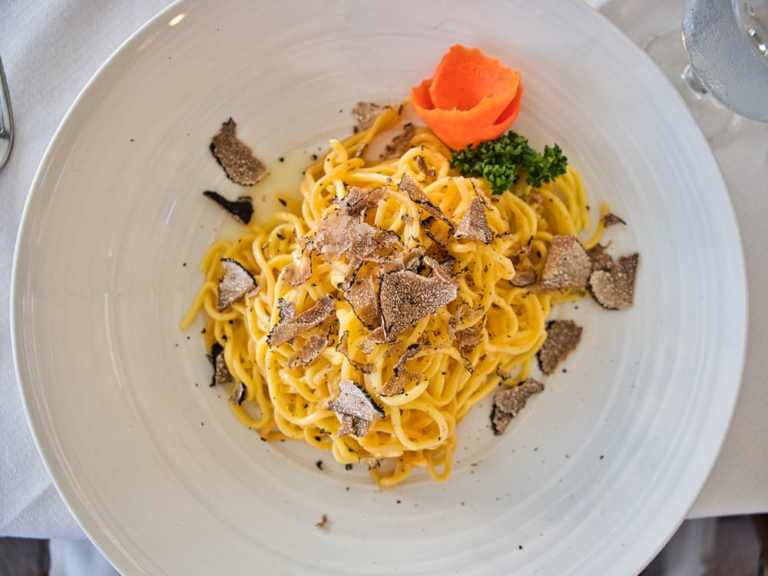
Aged pecorino works the same way, particularly the sharper wheels cured for six months or more. So does anything cooked with the region’s black truffle, which grows through the same limestone hills that shape the wine. For something closer to home, grilled lamb or a slow-braised beef stew does the job almost as well.
Skip delicate dishes entirely. A Sagrantino Secco will flatten a simple pasta al pomodoro or overwhelm most fish. The Passito version goes the opposite direction at the table. Umbrians traditionally serve it with dark chocolate or aged cheese at the end of a meal — not as an aperitivo, and definitely not chilled.
What I Would Skip
Skip any tasting room that pours you a single generic sample of “the Sagrantino,” without telling you which style or vintage you are drinking. If a producer cannot answer a basic question about aging time or vintage on the spot, that is a warning sign. The visit is built for volume, not for understanding the wine.
I would also skip visiting in the height of summer, if you want a quiet, contemplative tasting. August brings tour buses to the region’s better-known estates, and appointment slots fill fast. Go in late September or October instead, during harvest. Producers have more reason to talk about the vintage in front of you, and the town itself is at its best.
And do not buy a bottle of Passito to drink that same evening. It is a wine built for a special occasion months or years down the line, not a Tuesday dinner.
Getting There, When to Go, and What to Pair the Trip With
Montefalco sits roughly in the geographic center of Umbria. It is about 30 minutes by car from Perugia, and 20 minutes from Foligno, the nearest train station on the Rome-Ancona line. From Rome, expect about a two-hour drive south through the Valle Umbra. From Florence, plan closer to two and a half hours.
Perugia’s small regional airport handles limited seasonal routes. Most visitors fly into Rome Fiumicino and rent a car instead, since Montefalco’s hill towns are not well served by public transport. There is no train station in Montefalco itself. Renting a car in Foligno or Perugia, then driving the last stretch, is the standard approach. It also makes visiting two or three wineries in a single afternoon realistic.
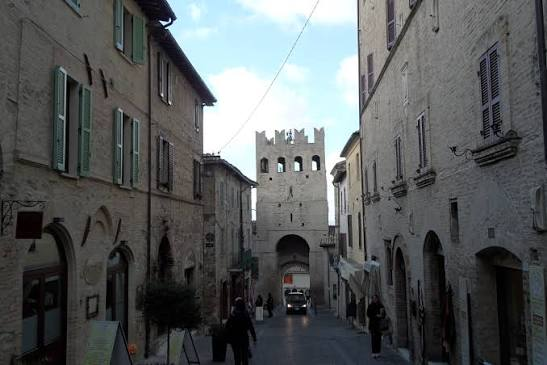
If renting a car is not an option, a private day trip from Rome covering Spoleto, Montefalco, and Bevagna solves the same logistics problem with a driver instead of a rental agreement. It is a newer, private-group listing with a thin review history so far, worth weighing against the flexibility of a car for anyone who wants to linger at a single cellar longer than a group itinerary allows.
Late September through October is harvest season, and the best time to visit if you want to see the vineyards working rather than just resting. Enologica Montefalco, the Consorzio’s autumn festival pairing local wine with food, art, and music, runs September 18 to 20 in 2026. It is the single best public event for tasting widely without booking individual cellar appointments.
That timing overlaps with Umbria’s broader olive harvest, which starts around the same weeks in the hills just beyond the vineyards. It also overlaps with the quieter, emptier version of Italy that shows up once August crowds clear out. Spring has its own case, too: April brings “A Montefalco,” a press-and-trade preview of the new vintage, plus wildflower color across the valley below town.
Montefalco rewards a slow, multi-town itinerary rather than a single day trip. Assisi is 25 minutes away. Spello — famous for its flower-carpeted Corpus Christi procession — sits just past it. Bevagna and Spoleto are close enough to fold into the same loop. Hikers following the Way of St Francis pass directly through this stretch of Umbria on their route south.
If your trip lands in July instead, Umbria Jazz in Perugia is worth building the schedule around. And if you are weighing Umbria against Tuscany, or against Le Marche just over the Apennines to the east, Montefalco makes its own case. It has fewer crowds, lower prices, and a wine culture that has not yet been fully discovered outside Italy.
Booking Notes: What I Would Actually Reserve
Book the small producer over the big bus. The Bocale tasting linked above works because it is capped small and led by the family itself — reviewers name the host by name, which tells you it is the intimate visit this guide has been describing, not a scaled-up version of it. Several boutique Montefalco producers now take bookings this way, through an online listing rather than a phone call, which is worth knowing if your Italian is not up to a booking call.
Take the driver, skip the multi-region bus loop. If a car is off the table, the private day trip linked above stays focused on Montefalco and its neighbors. Skip the wider multi-region day trips out of Rome that advertise an “Umbria wine tasting” but actually pour a Brunello di Montalcino at a farmhouse near Montepulciano, in Tuscany. That is a real wine and a real region, just not the one, or the grape, this article is about.
FAQ — Understanding Sagrantino di Montefalco
What is Sagrantino di Montefalco?
Sagrantino di Montefalco is an Italian red DOCG wine made entirely from the Sagrantino grape, grown only around Montefalco in central Umbria. It comes in a dry style (Secco) and a sweet, dried-grape style (Passito). It is known for having one of the highest tannin contents of any red wine grape in the world.
When is the best time to taste Sagrantino in Montefalco?
Late September through October, during harvest, offers the most active wineries and the best chance to talk with producers about the current vintage. Enologica Montefalco, held September 18 to 20 in 2026, is the best single event for tasting widely without individual appointments.
Do I need to book winery visits in advance?
Yes. Most Montefalco producers require booking by phone or email at least 24 to 48 hours ahead. A proper tasting typically runs 60 to 90 minutes, and same-day walk-ins are uncommon outside the largest estates.
How much does a Sagrantino tasting cost?
Guided tastings generally range from about €15 to €40 per person, with higher prices for tastings that include a cellar tour or food pairing. Prices vary by producer and should be confirmed when booking, since they change from year to year.
How long does a winery visit take?
Budget at least 60 to 90 minutes for a proper cellar tour and tasting, plus travel time between estates. Fitting more than two or three wineries into a single afternoon usually means rushing the part worth slowing down for.
What should I eat with Sagrantino di Montefalco?
Wild boar ragù, aged pecorino, and dishes built around the region’s black truffle are the classic pairings, since the wine’s tannin needs fat and protein to soften. Avoid delicate dishes like plain tomato pasta, which the wine will overwhelm.
Is Sagrantino di Montefalco the same as Montefalco Rosso?
No. Sagrantino di Montefalco DOCG is 100 percent Sagrantino. Montefalco Rosso DOC is a different, Sangiovese-based wine with a smaller share of Sagrantino added for structure. Montefalco Rosso is lighter, less expensive, and ready to drink much sooner.
A Final Note
Sagrantino di Montefalco is not an easy wine, and it was never meant to be. It survived four centuries as a sacred, occasional drink before anyone tried to sell it. The tannin that once made it a special-occasion passito now makes it one of Italy’s most serious dry reds. Taste it slowly, pair it with something rich, and give it the twenty minutes in the glass it needs to open.
If you want more dispatches on the parts of central Italy most guidebooks skip, explore more on Tastes & Wonders of Italy.
Explore more at Tastes & Wonders of Italy.