Cingoli: The Marche Hill Town Italy Voted Its Most Beautiful Village
On the evening of Easter Sunday 2026, just after nine o’clock, a presenter named Camila Raznovich stood in a television studio in Rome and opened an envelope in front of roughly a million people watching Rai 3. The competition was Il Borgo dei Borghi, the thirteenth running of a national contest that pits twenty Italian villages against one another — one for each region, chosen for their history, their landscape, and the quality of life inside their walls. The name she read out was Cingoli, a town of about 9,400 people perched at 631 metres on a ridge in the province of Macerata, in my own region of Le Marche. The year before, the title had gone to Militello in Val di Catania in Sicily; the year before that, to Peccioli in Tuscany. Now it belonged to a place that most Americans, and frankly most Italians outside this region, had never heard pronounced aloud.
I have lived and worked in Le Marche my entire life, as a civil engineer in Macerata, and Cingoli sits a little over half an hour up the road from my front door. I have driven that road in every season — through the heat-flattened light of August and the wet ochre afternoons of November — and I can tell you that the award the town just won is not a marketing accident. It is the recognition of something that has been quietly true here for two thousand years. What follows is not the tourist-board version. It is what I would tell you over an espresso if you asked me, honestly, whether the new “most beautiful village in Italy” is worth your time.
What Il Borgo dei Borghi Actually Is
Before we walk into the town, it helps to understand what Cingoli won, because the title carries more weight in Italy than its origins suggest. Il Borgo dei Borghi is a spin-off of Kilimangiaro, a long-running Sunday-evening travel programme on Italian public television. Each year a panel selects twenty small towns — one per region — and the public votes alongside a jury of experts in art, food, and landscape. The proclamation traditionally lands on the Easter special, which is why Cingoli’s victory was announced on 5 April 2026.
The contest is not a beauty pageant in the shallow sense. Selection weighs documented historical fabric, the integrity of the surrounding landscape, environmental management, and whether a town is genuinely alive rather than embalmed for visitors. Cingoli finished first ahead of Arenzano in Liguria and Zungoli in Campania. For a region like Le Marche — which has spent decades being described, when described at all, as “the next Tuscany” — the win matters because it shifts a national audience’s attention east, toward a part of central Italy that the international tourism machine has largely skipped.
The Balcony of the Marche
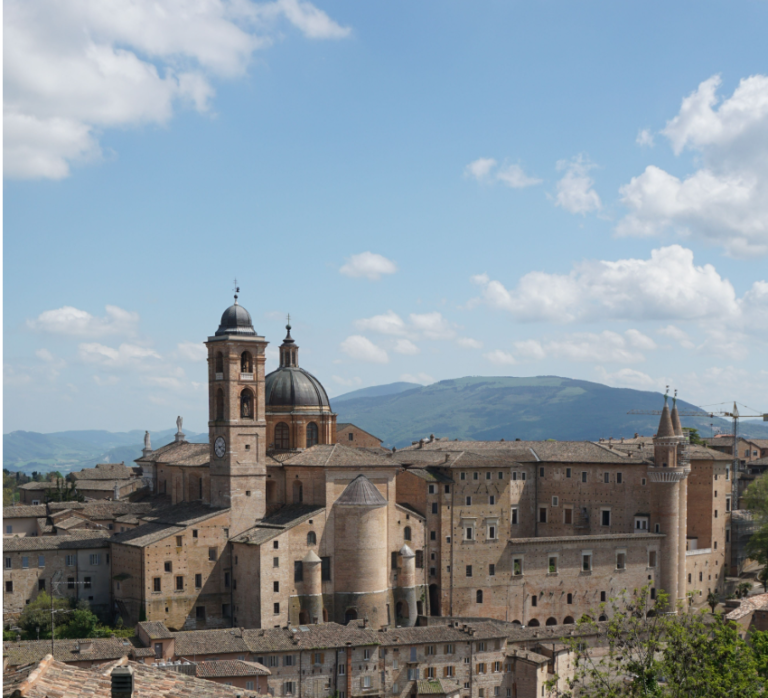
Cingoli’s oldest nickname tells you almost everything before you arrive: il Balcone delle Marche, the Balcony of the Marche. It is not a recent invention of a tourism office. The town sits more than 1,900 feet above sea level on the eastern flank of Monte Cingolo, in the upper valley of the Musone river, and from its ramparts the land falls away in long folds of hill country toward the Adriatic. On the clearest winter mornings — the kind that follow a night of north wind — local tradition holds that you can make out the far Dalmatian coast across the sea. I am an engineer and I am sceptical of such claims by temperament, but I have stood at the belvedere on a hard, transparent January day and understood exactly why people insist it is possible.
What You Actually See From Up Here
The view is not a single postcard but a slow rotation. To the east, the patchwork of cultivated hills runs down to the silver line of the sea. To the west and south rise the higher silhouettes of the Apennines, often snow-tipped into April. The painter Donatello Stefanucci, a Cingoli native, spent much of his career trying to fix this light on canvas, and the local archives still describe his work as a record of “boundless panoramas.” What strikes a first-time visitor most is the quiet. Cingoli has the elevated air of a town that decided, several centuries ago, that it did not need to be on the way to anywhere. That isolation is precisely what preserved it.
A Town Older Than Its Own Legends
Italians have a habit of handing the origins of a place to mythology before history can get a word in, and Cingoli is no exception. Local lore claims that the sorceress Circe — the same enchantress who detained Odysseus — lived among these heights and chose this spur of rock for a settlement, which is how Monte Cingolo earns its alternative name of Monte Circe. It is a charming story and almost certainly nonsense, but it tells you how far back the human imagination has been reaching to explain this place.
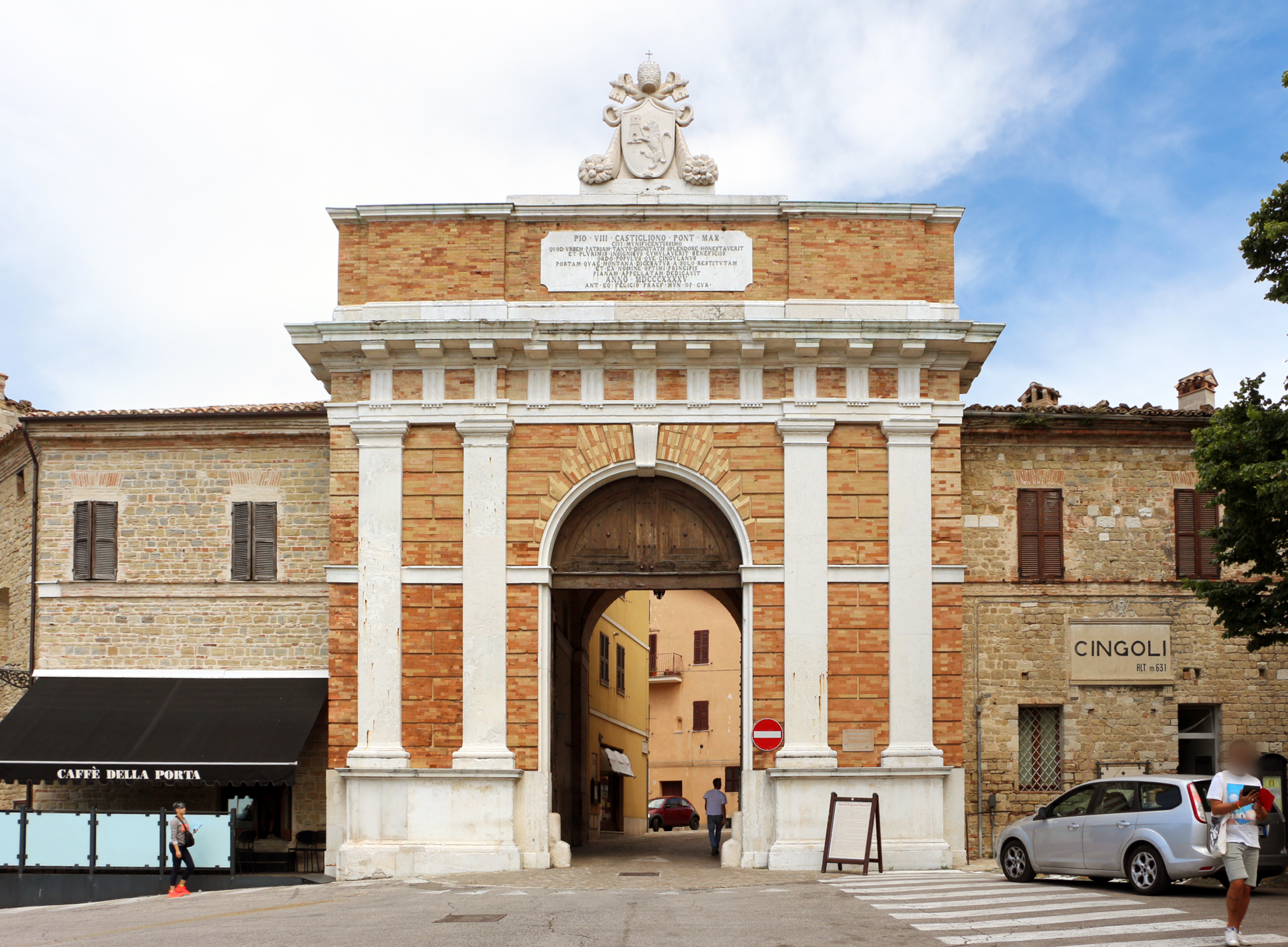
The documented history is older than the legend deserves. The hilltop was inhabited in the Eneolithic period, roughly 5,000 years ago, by flint-working peoples, and later by the Piceni, the Iron Age culture that gave this part of Italy its identity. The town’s real name comes from Rome: Cingoli is the heir of Cingulum, and the connection is not antiquarian guesswork. Julius Caesar himself names it in his account of the civil war, recording that the oppidum had been founded and fortified by Titus Labienus — his own lieutenant during the Gallic Wars — who paid for the works with the wealth he had accumulated in Gaul, including from his defeat of the Parisii at Lutetia, the future Paris, in 52 BC. Two limestone markers carved with that passage of Caesar still stand at the eastern entrance to the town, a piece of two-thousand-year-old civic branding that no modern tourism campaign could improve upon. From there the layers continue without a break: Byzantines, Lombards, the long medieval centuries, the Renaissance, the aristocratic eighteenth and nineteenth centuries. The Italian historians who survey the place like to say that every era left its mark here, and for once the cliché is accurate.
The Lorenzo Lotto Most Tourists Never Reach
If you visit Cingoli for one object alone, make it this one. In the spring of 1537, the Dominican friars of the town commissioned the Venetian painter Lorenzo Lotto to produce a large altarpiece on the theme of the Madonna of the Rosary for their newly restored church of San Domenico. The municipal records preserve the moment with unusual intimacy: the prior petitioned the town council for help because the confraternity that ordered the work had not raised enough in alms, and the council agreed to contribute forty florins, payable only once the painting was finished. Lotto completed the canvas in 1539. It measures 389 by 264 centimetres, and it is one of the most psychologically complex works the artist ever made.
Lotto was a strange and brilliant figure — a Venetian who never quite found favour in Venice, who wandered the provinces of central and northern Italy taking commissions that the Titians of the world were too grand to bother with, and who eventually became a lay brother at the Holy House of Loreto, less than an hour from here, in 1554. He signed the Cingoli painting “L. Lotus,” using the Latin form of his name partly for the pun he loved: loto, the forget-me-not, a flower of memory and oblivion at once. In the painting, the Virgin hands the rosary to Saint Dominic while Saint Esuperanzio, the patron saint of Cingoli, kneels on the opposite side holding a model of the town itself — rendered from life, seen from the east. It is worth walking up to the canvas to find that little portrait of Cingoli inside a Cingoli altarpiece, because it means the painting contains the very view you climbed the hill to see.
The work is now displayed in the Sala degli Stemmi of the thirteenth-century Palazzo Comunale on Piazza Vittorio Emanuele II, the broad, theatrical square at the heart of the old town. The plain stone exterior gives no hint of what hangs inside, which is exactly the kind of understatement that defines this region.
A Pope Was Born Here
Cingoli’s second claim on history is a man. Francesco Saverio Castiglioni was born here in the family palace and went on to be elected Pope Pius VIII in 1829. His pontificate was brief — he died little more than a year later — but the town has never let go of him. Palazzo Castiglioni, a seventeenth-century residence on the main street, survives as a house-museum where the family preserved his personal effects: his library, his bedroom, the rooms hung with the objects of a churchman’s life, lit in the central salon by a Murano glass chandelier. Beneath the building runs a subterranean grotto, accessible through the restaurant that now occupies the ground floor — the kind of layered, lived-in reuse of old fabric that you find everywhere in Italian towns and almost nowhere else.
Pius VIII left the town a tangible gift. In 1830 he donated a Rosa d’Oro, a Golden Rose, a piece of neoclassical goldwork now kept in the sacristy of the Collegiata of Santa Maria Assunta. It is a reminder that a place this small was, within living memory of its older residents, plugged directly into the central nervous system of the Catholic world.
Where the Town Ends and the Water Begins
Step outside the walls and the register changes entirely. A few kilometres below the historic centre lies the Lago di Castreccioni — also called the Lago di Cingoli — the largest artificial lake in Le Marche and one of the largest in central Italy. It was created by damming the Musone river, and the water sits an intense turquoise against the dark green of the wooded slopes around it. Today it is a place for kayaking, sailing, and long shoreline walks.
Here I will allow myself one paragraph as an engineer, because the lake is not a natural feature and I find the honest version more interesting than the brochure one. An earthen dam of this scale is a serious piece of hydraulic infrastructure: it has to hold back an enormous static load of water while managing seepage through and beneath the embankment, regulating outflow, and surviving the seismic stresses that come with building anything in the central Apennines. What looks, to a visitor, like a tranquil mountain lake is in fact a managed reservoir doing quiet daily work — water supply, flow regulation, irrigation for the valley below. Italians tend to read such landscapes purely as scenery. I cannot help reading them as systems, and the system here happens to be a beautiful one.
Beyond the lake, the territory keeps giving. The Cascatelle di San Vittore — modest waterfalls reached by a short, discreet trail — reward the kind of traveller who is willing to walk a little. And not far away, in the broader Monte San Vicino and Monte Canfaito reserve, stands the Faggeta di Canfaito, a beech forest famous for a single monumental tree believed to be around five centuries old and for an October foliage display that draws photographers from across the region. If you come in autumn, this is reason enough to extend the trip by a day.
What to Eat Around the Balcony
Cingoli’s table is the table of inland Le Marche, and it rewards an appetite. The defining first course of the Macerata province is vincisgrassi, a baked layered pasta richer and older than the lasagne most Americans know, built on a long-simmered ragù and, in the traditional version, chicken giblets that give it a depth the tourist menus rarely bother to explain. The local cured meat to seek out is ciauscolo, a soft, spreadable salami protected by IGP status — you eat it on bread, not sliced like a salami you would recognise. To drink, you are in the orbit of Verdicchio, the white wine grown in the Castelli di Jesi and around Matelica just to the west, mineral and built to age in a way that surprises people who assume Italian whites are all interchangeable. None of this is invented for visitors. It is what the families here have eaten for generations, and most of it has never crossed the Atlantic.
Practical Information
When to visit. Late spring (May and June) and early autumn (September and October) are the ideal windows. The summer light is magnificent but central Italy gets hot, and August empties of locals as Italians go to the coast. October is my personal recommendation: the Canfaito beech forest turns, the light sharpens, and the town belongs to itself again. Avoid the depths of winter only if you need guaranteed warmth; the views are arguably best on cold, clear January days, but services run shorter hours.
How to get here. Cingoli is not on a railway line, and this is the single most important thing to know: you will want a car. The nearest airport is Ancona–Falconara (Raffaello Sanzio), roughly 54 kilometres and about 45 minutes by road, with direct connections to several European cities. From the airport or Ancona, the drive runs through Jesi and up into the hills. Without a car, the route is train to Jesi and then a regional bus to Cingoli — possible, but it will cost you flexibility you will wish you had. From Rome, plan on about three hours by car; from Bologna or Florence, similar.
Where to stay. Cingoli is best experienced as a base for the inland Macerata hills rather than a single afternoon’s stop. Expect agriturismi in the surrounding countryside (often the best value and the most genuine experience), a handful of small hotels and B&Bs in and near the town, and self-catering apartments in the historic centre. Budget roughly €70–120 per night for a comfortable double in a B&B or agriturismo, more for the few higher-end options.
What to budget. A sit-down lunch of regional cooking runs around €25–40 per person with local wine; a casual meal considerably less. Museum and palazzo entries are modest, typically a few euros each. The real cost of a Marche trip is the rental car and fuel — budget for it and the region opens up.
Explore further. If you are building a Marche itinerary around Cingoli, these companion guides on Tastes & Wonders of Italy are worth pairing with this one: my overview of Le Marche as a region (the case for visiting before it is famous), my piece on Macerata, my hometown and the natural base for this area, and the guide to the Frasassi Caves nearby. (Forthcoming: a dedicated Verdicchio wine guide and a Sibillini Mountains slow-travel itinerary — link these in once published.)
FAQ
What makes Cingoli worth visiting after winning Borgo dei Borghi?
Cingoli combines three things that rarely coexist in one small town: a genuinely panoramic setting at 631 metres known as the Balcony of the Marche, a major Renaissance masterpiece in Lorenzo Lotto’s Madonna of the Rosary (1539), and a fully intact medieval and historic centre that is still a living town rather than a museum. The 2026 national title simply confirmed what the layered history already proves.
Where exactly is Cingoli in Italy?
Cingoli is in the province of Macerata, in the Le Marche region of central Italy, on the eastern slopes of the Apennines in the upper Musone valley. It sits roughly 54 kilometres inland from Ancona on the Adriatic coast, about a 45-minute drive.
How do I get to Cingoli without a car?
It is possible but inconvenient: take a train to Jesi and then a regional bus up to Cingoli. Because the town is not on a rail line and the surrounding hills are best explored independently, I strongly recommend renting a car at Ancona–Falconara airport. The Marche reward drivers and frustrate those without wheels.
What is the must-see artwork in Cingoli?
Lorenzo Lotto’s Madonna del Rosario, painted in 1539 for the Dominican church of San Domenico and now displayed in the Sala degli Stemmi of the Palazzo Comunale on the main square. The canvas includes a portrait of the town itself, held by its patron saint Esuperanzio — meaning the painting contains the very view you climbed the hill to see.
When is the best time of year to visit?
Late spring (May–June) and early autumn (September–October) offer the best balance of weather, light, and open services. October is especially rewarding because the nearby Canfaito beech forest turns colour. Summer is beautiful but hot and quieter on locals, who decamp to the coast in August.
How does Cingoli compare to a Tuscan hill town?
Cingoli offers the same medieval atmosphere, hilltop views, and artistic depth that draw visitors to Tuscany, but without the crowds, the inflated prices, or the sense of a town performing for tourists. The trade-off is fewer services and the need for a car. If you have already done Tuscany and want the version Italians have kept for themselves, this is it.
Is there anything to do around Cingoli beyond the town?
Yes. The Lago di Castreccioni (Lago di Cingoli), the largest artificial lake in Le Marche, offers kayaking, sailing, and shoreline walks a few kilometres below town. The Cascatelle di San Vittore waterfalls and the Faggeta di Canfaito beech forest, with its monumental centuries-old tree and famous autumn foliage, are both easy day-trip distance.
Is Cingoli really an “undiscovered” place, or is that just marketing?
Honestly, it is one of the genuinely under-visited corners of Italy by international standards — most Americans have never heard of it, and even many Italians outside Le Marche have never been. The 2026 title will change that, which is exactly why now is the moment to go. Within a few years it will be busier; right now it is still itself.