Glamping in Sardinia: Seven Curated Stays on an Island That Plays by Its Own Rules
In the spring of 2004, the American journalist and explorer Dan Buettner arrived in the Barbagia — the mountainous interior of Sardinia — with a National Geographic research team to investigate why the region produced more male centenarians per capita than anywhere else on earth. He had already spent years studying longevity in Okinawa and Costa Rica, but the Sardinian case was different. The men he interviewed in the villages of Oliena, Orgosolo, and Arzana were not extraordinary in any obvious sense. They ate pane carasau — the twice-baked flatbread made from durum wheat and water, thin as paper — with pecorino sardo matured in local caves. They drank Cannonau, the island’s dark Grenache-based wine, in small quantities with every meal. They walked steep terrain daily until their nineties. When Buettner published his findings, the Barbagia joined Okinawa, Nicoya in Costa Rica, Ikaria in Greece, and Loma Linda in California as one of the five Blue Zones — the regions of the world where, for reasons partly dietary, partly social, and partly geological, people regularly live past 100 in good health.
I mention this not because it is a health article, but because it explains something important about what Sardinia is for the traveler who wants to understand it rather than simply photograph it. The island is not Italy in the way that Naples is Italy or Tuscany is Italy. It is an island of 24,000 square kilometers with a language — Sardinian, recognized under Legge n.482 of 1999 as a distinct historical minority language — that linguists classify as the closest living language to Vulgar Latin, closer even than Romansh or old Sicilian. It has 3,500 nuraghi: tower-fortresses built from basalt and limestone between 1,700 and 700 BCE by a civilization that left no written records and whose descendants still carry genetic markers distinguishable from those of mainland Italians. The Phoenicians came to trade and stayed. The Romans named it Sardinia, extracted its grain for five centuries, and left roads. The Byzantine administration lasted until the 11th century. The Aragonese arrived in 1323. The island joined the Kingdom of Italy in 1861 and has been formally Italian since, but the architecture, the food calendar, the grazing patterns, and the silence of the interior remain stubbornly, specifically themselves.
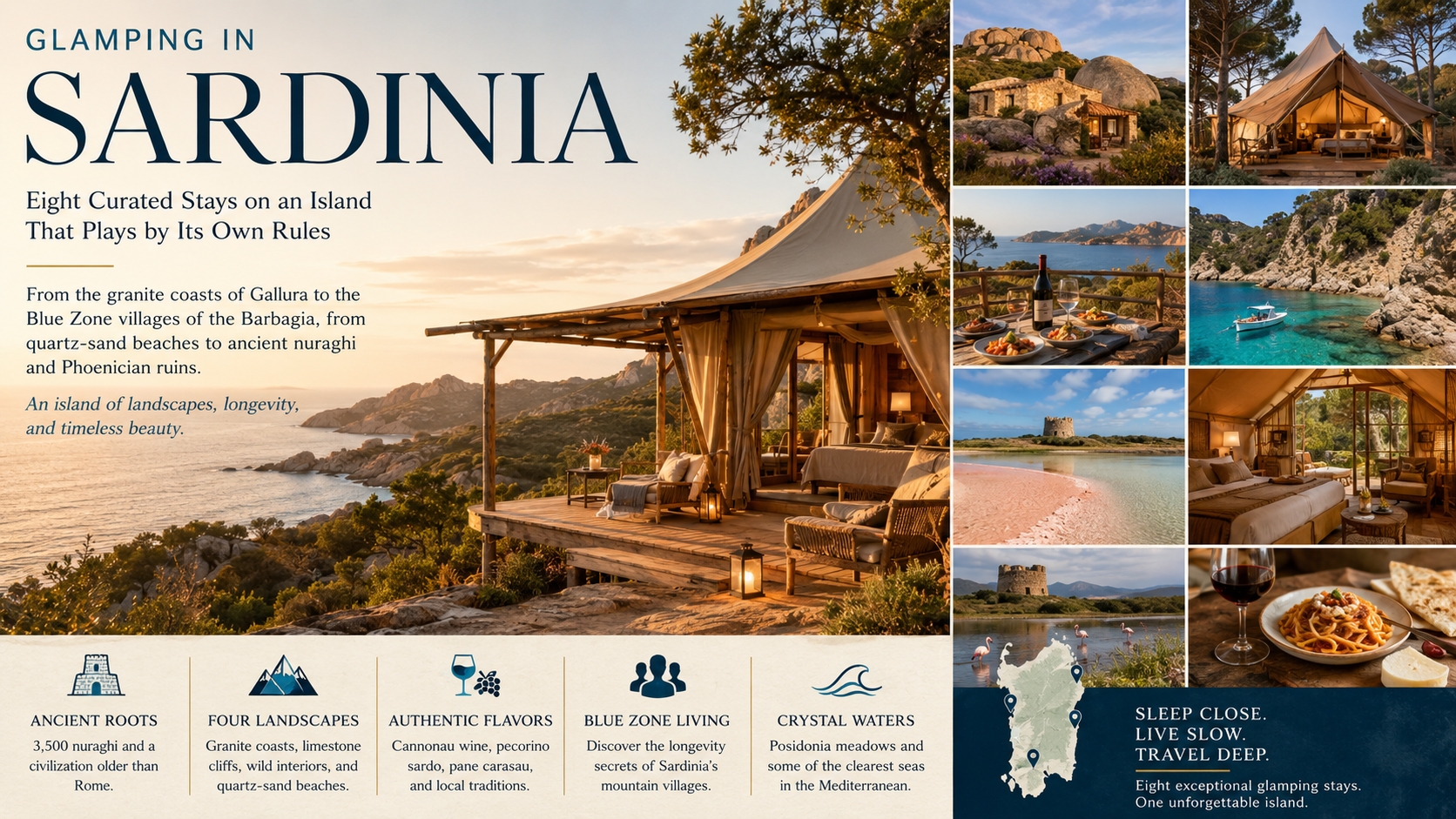
Glamping in Sardinia is not, therefore, simply a matter of sleeping in a well-appointed tent near a beautiful beach. It is a format that, at its best, places you in direct relationship with a landscape and a culture that have been shaped by forces — geological, biological, and historical — with no equivalent on the mainland. The eight stays in this guide were selected because each one uses the specific geography of its location as a participant in the experience rather than a backdrop.
An Island of Four Landscapes
The geography of Sardinia can be read from altitude. The island rises from four coastlines — northern Gallura with its pink granite outcrops wind-polished to abstract shapes; the eastern Ogliastra coast with its limestone cliffs dropping 300 meters to turquoise coves accessible only by sea or by goat track; the western Sulcis and Sinis peninsula with their red-sand dunes, Phoenician ruins, and lagoons dotted with flamingos; the southern Campidano plain reaching to the salt lagoons of Cagliari — toward an interior of limestone plateaus and granite massifs that constitute the Barbagia, the least-visited and most specifically Sardinian zone of the island.
The clarity of Sardinian coastal water — the crystalline quality that appears in every travel photograph and is, unusually, not an overstatement — has a specific cause. Beneath the surface along much of the eastern and southern coast lies Posidonia oceanica: a seagrass endemic to the Mediterranean, protected under D.Lgs. 152/2006, that photosynthesizes enormous quantities of organic matter and filters the water column to a transparency that reef-less northern coasts cannot replicate. The beaches of Cala Gonone, Cala Goloritzè (ranked first in Italy by Legambiente and first in the world by World’s 50 Best Beaches in 2025), and the Sinis Peninsula’s Is Aruttas — where the sand is composed of pink quartzite granules rather than silica — are what they are because of this submarine meadow, not despite it.
The eight properties in this guide are distributed across all four of these landscapes. The Gallura properties give access to the granite and juniper country behind the Costa Smeralda and to the La Maddalena Archipelago. The Barbagia property places you at the foot of the Supramonte — the limestone massif that constitutes the most dramatic interior trekking in Italy — in the territory that Dan Buettner identified as a Blue Zone. The Sinis Peninsula property places you adjacent to Phoenician and Roman ruins, with access to a beach whose sand is unlike any other in the Mediterranean. The coastal Ogliastra property gives you a pine forest base from which to reach Cala Gonone and the ranked beaches of the Gulf of Orosei by boat. The northern dune reserve property is built on the ecological boundary where the Coghinas river meets the Gulf of Asinara in the largest dune system in northern Sardinia. The Alghero property is inside a Natural Park, five minutes from the private beach and within day-trip distance of the Nuraghe di Palmavera — a nuragic complex of the Middle Bronze Age with a circular meeting court of a type unique to the Sassari province.
Eight Curated Stays
1. Petra Segreta Resort & Spa — Stazzi Among the Granite, San Pantaleo
The stazzu — the low stone farmhouse of the Gallura, walls laid from the granite outcrops that protrude through every hillside in the northeast of the island — is to the Gallura what the trullo is to Puglia: a vernacular building form shaped by the specific material at hand and by the specific social organization of the people who built it. The granite of the Gallura is pink and white, sculpted by wind and seasonal temperature change into organic shapes that the local tradition has named: the Roccia dell’Orso (Bear Rock) near Arzachena is the most cited, but the formations appear in every field and on every hillside with the specificity of found sculpture.
Petra Segreta is built from these stones and in their language. The 27 rooms and suites — 10 of which have private heated pools — are distributed across low stazzi structures set in five hectares of Mediterranean maquis: myrtle, rock rose, mastic, juniper. The property is a Relais & Châteaux member, and its restaurant Il Fuoco Sacro received its first Michelin star in the 2026 guide, with Chef Alessandro Menditto working on a menu designed with owner Luigi Bergeretto and collaborating chef Enrico Bartolini — the most Michelin-starred Italian chef active today. The Osteria del Mirto serves lighter lunches on the veranda overlooking the sea and the La Maddalena Archipelago. The Malchittu nuragic temple — a lesser-known Nuragic complex contemporary with the better-publicized Nuraghe Albucciu — is 4.6 kilometers from the property.
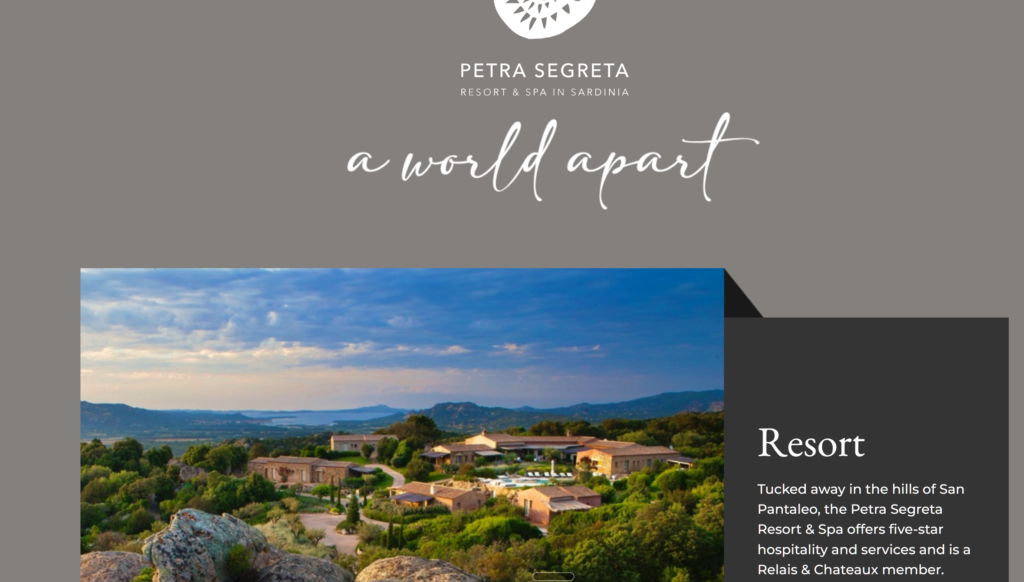
San Pantaleo, two kilometers from Petra Segreta on foot, is one of the genuinely functional Gallura villages that have maintained their artistic character independently of the Costa Smeralda: the weekly market and the summer art exhibitions in the old farmhouses are not curated for tourism. Porto Cervo and the Costa Smeralda are 15 kilometers by road — close enough for a dinner or a boat trip, far enough that you feel no obligation to participate in their specific economy.
Book and information: petrasegretaresort.com/en Location: Valle di Buddeo, San Pantaleo, 07021 Olbia (SS) Getting there: 30 km from Olbia Costa Smeralda Airport (OLG). Car essential.
2. Tenuta Pilastru — A 150-Hectare Stazzo, Arzachena
If Petra Segreta is the most aesthetically refined interpretation of the Gallurese stazzu format, Tenuta Pilastru is the most operationally authentic. The farmhouse at the center of the estate was built in 1840 and run as a cattle farm by the Signora Maddalena’s family — the Minnannu, which in Gallurese dialect means “grandfather,” having been the sole custodian of the property for decades before passing it to his daughter — until the architect Savin Couelle redesigned the buildings in 2005, integrating them into a country resort of 39 rooms across the original farmhouse and surrounding cottages. Couelle, a French architect best known for designing several of the most significant residential structures on the Costa Smeralda, approached the project from the perspective of archaeological restoration rather than hospitality renovation: the stonework, the dry-stone boundary walls, the irregular floor plans of the buildings were maintained as the primary design language, and the furnishings — local woods, wrought iron, cotton and linen textiles in natural dyes — were sourced from Gallura craftspeople.
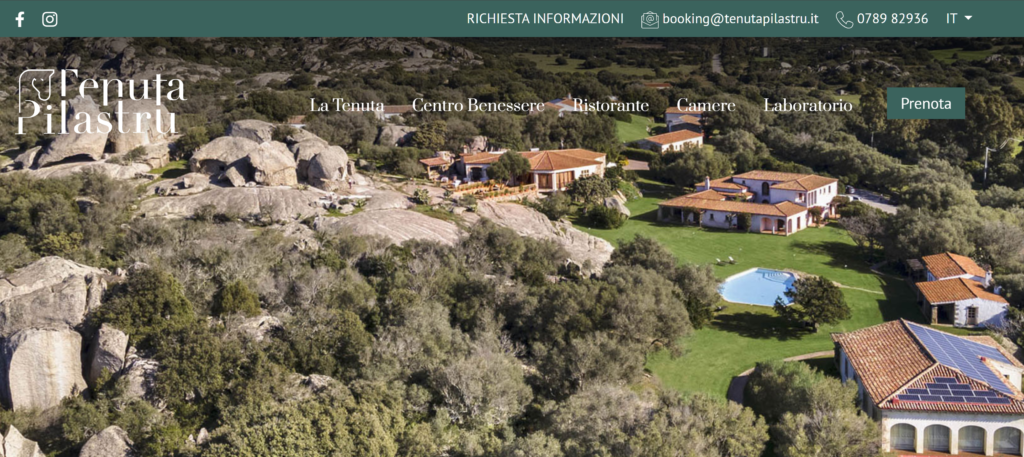
The estate produces its own beef from the cattle herd, its own wine from vineyards on the property, and its own olive oil. The restaurant — operating on a menu of gallurese cuisine, pasta made by hand to traditional recipes, and meats grilled over local wood — is the most convincing zero-kilometer experience on this part of the island. The wellness center includes a thermal pool, sauna, steam room, and massage facilities. The necropoli di Li Muri — a Copper Age megalithic cemetery dating to approximately 3,500 BCE, contemporary with Stonehenge and the earliest phase of Maltese temple construction — is within walking distance of the property boundary.
Book and information: tenutapilastru.it Location: Loc. Pilastru, 5 km from Arzachena on the Bassacutena road, 07021 Arzachena (SS) Getting there: 25 km from Olbia airport. 15 km from the nearest Costa Smeralda beaches.
3. Centro Vacanze Isuledda — Lodge Tents on the Costa Smeralda Peninsula, Cannigione
The Costa Smeralda — the stretch of northeastern Sardinian coast between Baia Sardinia and Porto Cervo, developed by the Aga Khan’s consortium from 1962 onward as a controlled-architecture luxury resort destination — is the version of Sardinia that appears most frequently in international travel media. It is genuinely beautiful and genuinely expensive. The Costa Smeralda architecture commission, established by the Aga Khan and still operative, has required since 1964 that all new construction use only natural materials, earth tones, and forms derived from traditional Sardinian vernacular — which is why Porto Cervo looks different from the concrete-block resort developments of equivalent periods in Spain and southern France, and why it holds its aesthetic coherence despite decades of intensification.
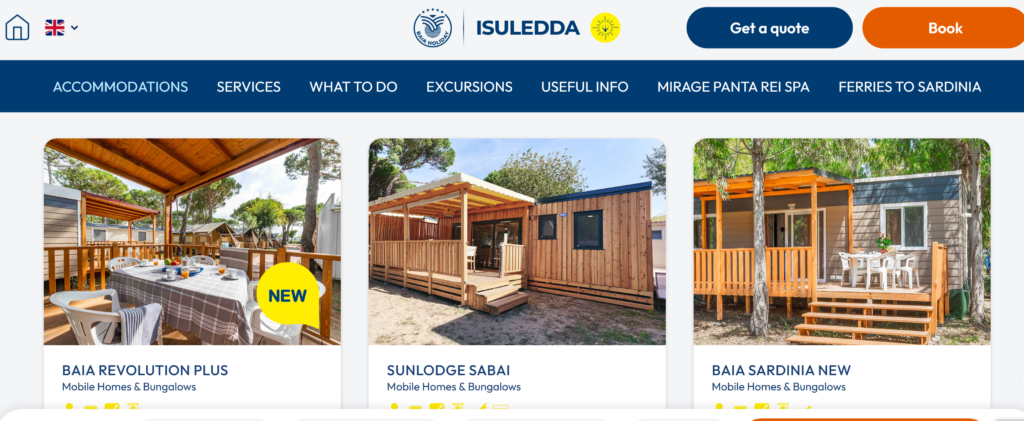
The Centro Vacanze Isuledda provides access to the marine environment of this coast at a price point that bypasses the Porto Cervo hotel economy. Located on a private peninsula in the Gulf of Arzachena, three kilometers from Cannigione, the property is 30 minutes’ drive from Porto Cervo and five minutes from eight free sandy beaches and rocky coves with direct access to the Maddalena Archipelago waters. Lodge tents with private bathrooms and verandas, surrounded by Mediterranean maquis, allow the sensory experience of the Costa Smeralda coastline — the color of the water, the smell of the juniper in the heat, the specific quality of the light at golden hour on pink granite — without requiring the Porto Cervo rate card.
The Spa Mirage Panta Rei wellness facility on the property adds a thermal dimension available in few other coastal glamping contexts in the Mediterranean. Boat excursions to the La Maddalena Archipelago — a National Park since 1994, the former NATO submarine base converted to protected nature after the base closed in 2008 — can be arranged directly from the property’s private marina.
Book and information: isuledda.it/en/accommodations/lodge-tents Location: Loc. La Conia, 07021 Cannigione di Arzachena (SS) Getting there: 30 km from Olbia airport. 30 min from Porto Cervo.
4. Su Gologone Experience Hotel — At the Spring, in the Blue Zone, Oliena
The Su Gologone spring — where the property takes its name — emerges from the base of the Supramonte limestone massif at a rate of up to 1,000 liters per second after winter rains, running cold and clear from a karst aquifer system that has been accumulating water since the last glacial period. The limestone massif above it contains the Grotta del Bue Marino — the cave of the monk seal, named for the Mediterranean monk seal (Monachus monachus) that used to shelter in its marine entrance before the species was hunted to local extinction — and the canyon system of the Gola di Gorropu, which at 400 meters depth is the deepest natural gorge in Europe. The trekking trails that leave from Oliena and Dorgali into this territory are among the most technically demanding in Italy outside of the high Alps, and they are traversed by a small number of internationally recognized mountain guides who have been leading clients through them for decades.
Su Gologone began in the 1960s as a restaurant, opened by the founding family when the spring’s location became a Sunday excursion destination for Nuoro’s inhabitants. It grew into a hotel over four decades, accumulating contemporary art — the walls carry original works by Sardinian painters including Mario Delitala and Giuseppe Biasi — Sardinian textiles, and a collection of traditional agricultural tools that constitutes a functioning museum of the Barbagia’s material culture. The 31 rooms are individually decorated using traditional furniture, local textiles, and art; they are not identical, and the difference between rooms is legible in character rather than in category. The kitchen’s focus is Barbagia: porceddu (suckling pig roasted on juniper spits over an open wood fire), malloreddus (semolina pasta ridged on a basket weave, served with sausage and saffron ragu), and seadas (fried semolina pastry filled with fresh pecorino and honey from Barbagia beehives). The spring-water pool draws from the aquifer rather than from municipal supply.
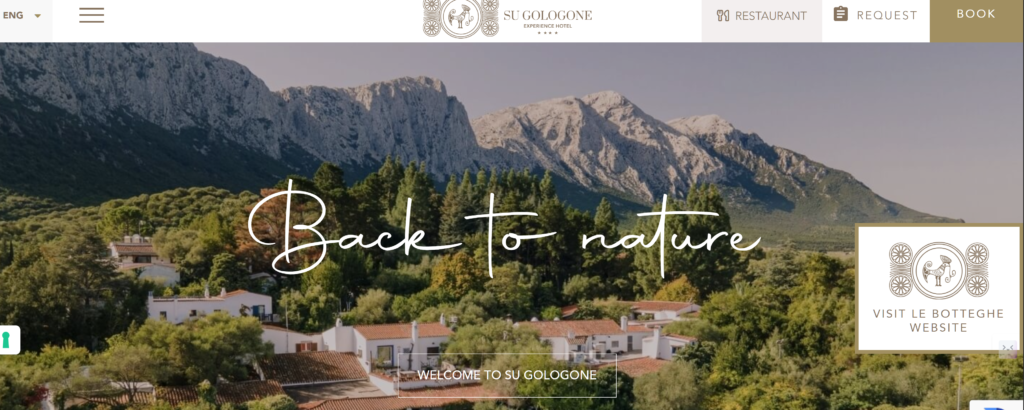
This is the property most directly located in the Blue Zone territory that Dan Buettner documented. The villages where his centenarians lived — Oliena, Orgosolo, Arzana — are within a 30-minute drive. The Cannonau wine served at dinner is grown in these same sun-blasted limestone soils; the polyphenol concentration in Barbagia Cannonau is genuinely among the highest measured in any red wine globally, a fact related both to the variety’s pigmentation genetics and to the ultraviolet stress levels on grapes grown at this latitude and altitude.
Book and information: sugologone.it/en Location: Loc. Su Gologone, 08025 Oliena (NU) Getting there: 100 km from Olbia airport. 10 km from Oliena. 30 km from Nuoro.
5. Torre del Porticciolo — Lodge Tents in a Natural Park, Alghero
Alghero occupies a specific linguistic and cultural position in Sardinia that no other city on the island reproduces. In 1354, the Aragonese expelled the Sardinian population of the city and repopulated it with Catalan settlers — a deliberate colonial act of ethnic replacement. The Catalan language spoken by those settlers’ descendants survived in Alghero until the late 20th century as a living vernacular; it still survives in the street names, in the church services, and in the formal documents of the Città Metropolitana di Sassari, which classifies algherese Catalan as a local co-official language. The old city’s red sandstone towers, the loggia of the Palazzo d’Albis where Charles V spent a night in 1541 and reportedly said “Por cierto, Alguer es bona terra” — Catalan for “Certainly, Alghero is a good land” — and the sardana folk dances still performed in the central square represent a continuity of Iberian-Mediterranean culture that persists seven centuries after the original colonization.
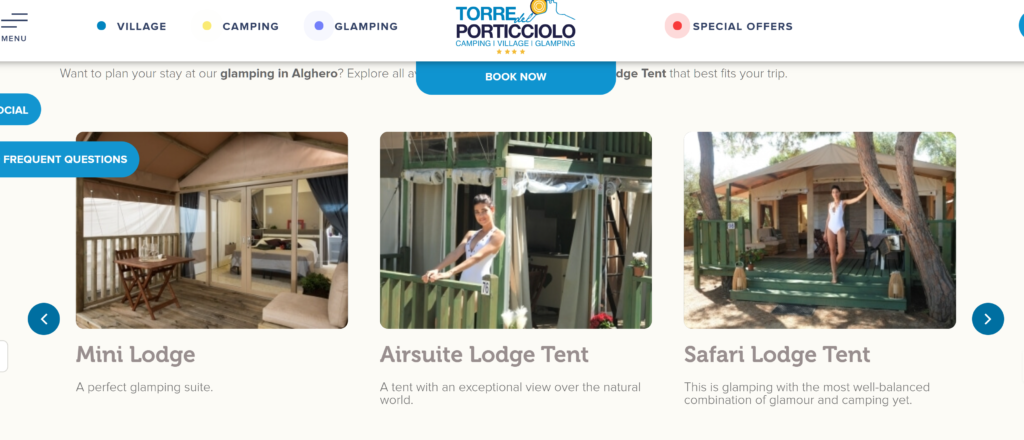
Torre del Porticciolo, 15 kilometers north of Alghero, is the only glamping facility within the Porto Conte Natural Park — a protected area covering the headlands and bays between the Torre Nuova and Capo Caccia, where the Grotta di Nettuno (Neptune’s Cave, accessible by boat or by the 654-step “Escala del Cabirol” goat-track staircase carved into the cliff face) constitutes one of the most dramatic cave systems in the western Mediterranean. The glamping lodge tents — Airsuite, Safari, and Sun formats for two to five guests, each with private bathroom, kitchen, and veranda — are set within 150,000 square meters of Mediterranean pine forest, ten kilometers from Alghero airport. The Nuraghe di Palmavera, a Middle Bronze Age complex with a circular meeting court unique to the Sassari area, is 20 minutes by car.
The property operates from mid-May to mid-October, consistent with the park’s seasonal patterns. The pine forest’s ambient temperature is measurably lower than the open coast in summer, making it one of the more comfortable coastal glamping positions for July and August visitors who are committed to a specific date range.
Book and information: torredelporticciolo.com/glamping-sardinia.html Location: Loc. Porticciolo, 07041 Alghero (SS) Getting there: 10 km from Alghero Fertilia Airport (AHO). Private beach access on-site.
6. Camping Cala Gonone — Pine Forest Base for the Gulf of Orosei, Dorgali
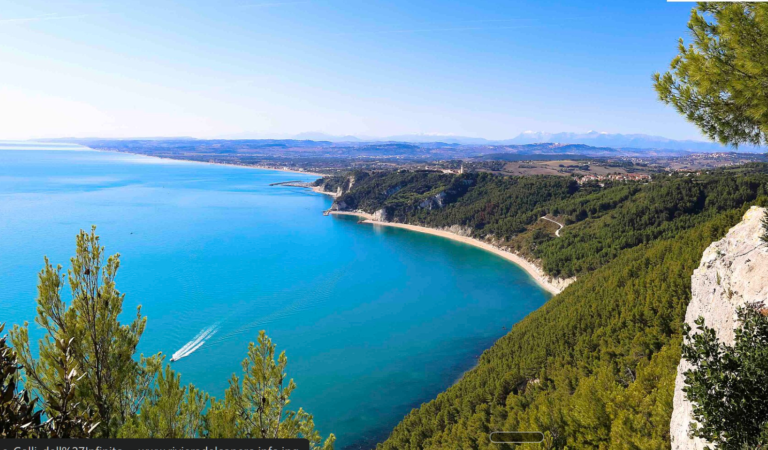
The Gulf of Orosei is the most protected stretch of coastline in Sardinia, bounded by limestone cliffs that reach 300 to 400 meters and interrupted by coves — Cala Gonone, Cala Luna, Cala Sisine, Cala Biriola, Cala Mariolu, Cala Goloritzè — accessible only by boat from Cala Gonone or by multi-hour treks descending from the Supramonte plateau. In 2025, Cala Goloritzè received the ranking of first beach in the world by World’s 50 Best Beaches; Cala Mariolu ranked second in the world in 2024. These rankings reflect water transparency, geological drama, and the practical inaccessibility that preserves both: no road reaches either beach, and the boat operators who run the Gulf excursions from Cala Gonone’s small harbor operate under capacity limits enforced by the Regional Park authority.
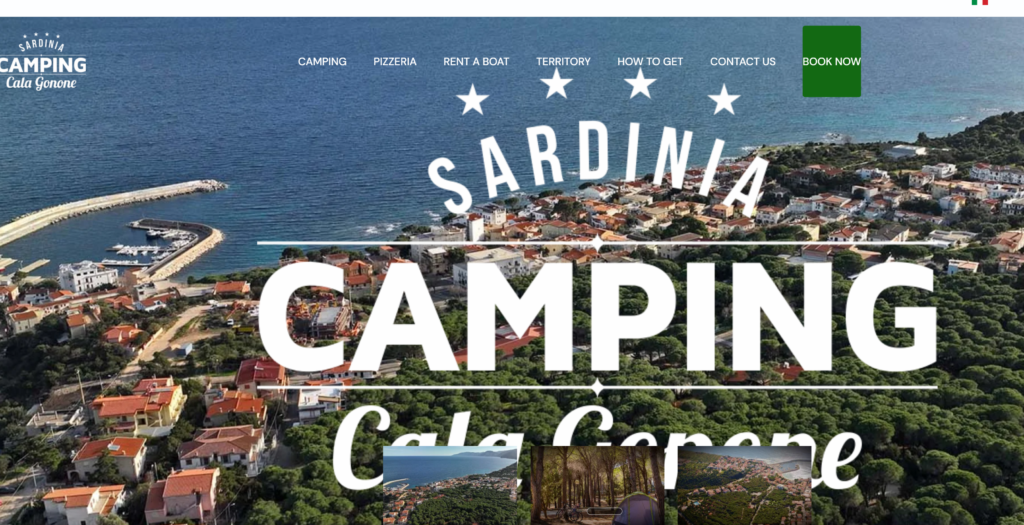
Camping Cala Gonone is positioned 200 meters from the sea within a four-hectare pine forest at the edge of the coastal town. The bungalow and glamping-style wooden accommodation units — equipped with air conditioning, private bathrooms, and terraces — provide a comfortable base for the boat excursions that are the property’s primary asset. Rubber boat rentals from the affiliated Azzurra company allow independent exploration of the Gulf’s sea caves and coves, including the Grotta del Bue Marino, which still holds a colony of rare stalactites accessible only at low sea level. The campsite’s restaurant serves Sardinian cuisine daily; the town of Cala Gonone itself has a small selection of restaurants focused on Ogliastran seafood and the excellent Cannonau production of the Dorgali cooperative.
Book and information: calagononecamping.com/en Location: Via Collodi 1, 08022 Cala Gonone, Dorgali (NU) Getting there: 110 km from Olbia airport via SS125. 40 km from Nuoro. Car essential.
7. Kampaoh Valledoria — Eco-Glamping at the Coghinas Dune Reserve, Valledoria
The Coghinas river meets the Gulf of Asinara at Valledoria in a hydrological event that produces the largest dune system in northern Sardinia — a coastal landform classified as a Site of Community Interest under the EU Habitats Directive and protected as a regional nature reserve. The dunes are active: wind from the northwest moves their crests a measurable distance each decade, and the rare plant assemblages — Pancratium maritimum, Calystegia soldanella, Ammophila arenaria — that colonize their faces are the specific flora of a transitional coastal system that cannot be replicated inland. Flamingos and other migratory birds use the river mouth seasonally; the Asinara National Park, a former penal colony and now a wildlife reserve with white Asinara donkeys and a population of Mouflon, is visible from the dunes across the Gulf.
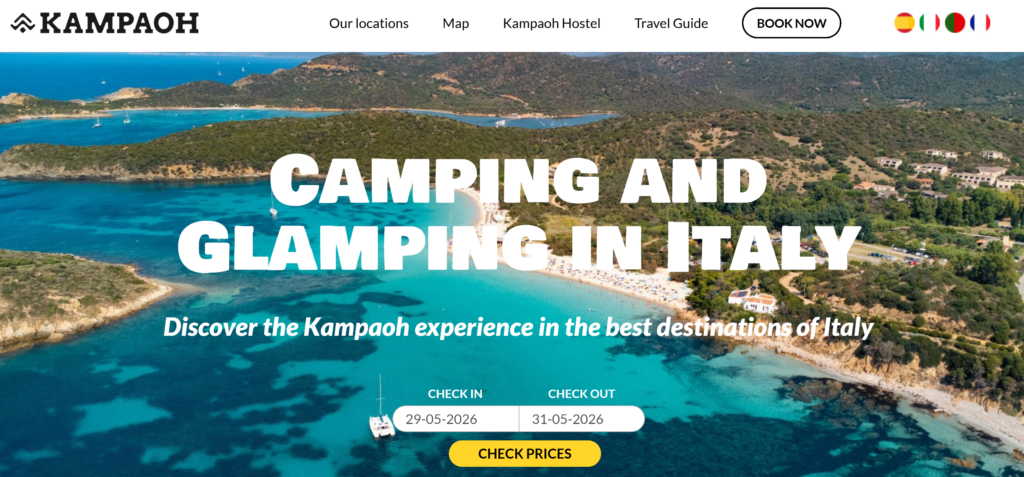
Kampaoh Valledoria operates within the Camping La Foce on this dune reserve, under the eco-certification framework that makes La Foce one of the more rigorously sustainable camping operations in Sardinia: solar panels produce 70% of the site’s electricity and hot water, guests are transported within the site by electric golf carts and eco-friendly boats, and the waste management system is certified for separate collection. The glamping tents — equipped with beds, linen, towels, lighting, a small refrigerator, and cooking utensils for outdoor preparation — are positioned in a eucalyptus grove at the quieter perimeter of the campsite, separated from the main village facilities. The beach at San Pietro a Mare is five minutes by car; Castelsardo, the coastal fortified village of the Doria family that gave its name to the Castelsardo coral-working tradition, is 15 minutes.
Book and information: kampaoh.com/italy — search Valledoria Location: Camping La Foce, Valledoria (SS) Getting there: 55 km from Sassari. 100 km from Olbia airport.
Practical Information
When to visit. May and June are the months that most consistently match the promise of Sardinian tourism: the macchia is still green and fragrant with cistus and myrtle, the sea temperature has risen to 22–24 degrees Celsius, and the density of visitors on the roads and beaches is a fraction of the July–August peak. The Sinis Peninsula’s quartz beach at Is Aruttas becomes extremely crowded in high summer — the paradox of a beach famous for its preservation is that its fame threatens it; the reserve authority has imposed visitor quotas during peak season. September and October offer sea temperatures that remain at 24–26 degrees Celsius through mid-October, dramatically reduced crowds, the olive harvest on the estates near Oliena and Arzachena, and the wild mushroom season in the Barbagia forests.
July and August are hot — interior Sardinia regularly reaches 40 degrees Celsius and above, and coastal tourism intensity at the Costa Smeralda peaks to a density that produces the traffic congestion and restaurant waiting times that characterize any major Mediterranean resort in high summer. The Gallura coastal properties manage the heat better than the interior ones; the pine forests of Torre del Porticciolo and the coastal position of Isuledda maintain cooler ambient temperatures. If July and August are unavoidable, choose a northern coastal property and restrict inland excursions to early morning.
A November visit for the Barbagia di Oliena autumnal festivals — when the villages of the interior open their homes to visitors in the Cortes Apertas programme, serving roasted chestnut, Cannonau, and pane carasau in farmhouse courtyards — is the most underrated Sardinian travel experience available, and it is almost entirely without international competition in the tourism market.
Getting here. Sardinia is served by three international airports: Olbia Costa Smeralda (OLG) for northern Sardinia and the Gallura, Alghero Fertilia (AHO) for the northwest, and Cagliari Elmas (CAG) for the south and the Sinis Peninsula. For Ogliastra and the Gulf of Orosei, Olbia is the closest airport at roughly 110 kilometers via the SS125; there is no airport in the eastern coast zone. Car rental is available at all three airports and is non-negotiable for every property on this list. Reserve at least four weeks in advance for summer dates.
The ferry option deserves specific attention for a slow travel audience. Grimaldi Lines, Tirrenia, and Sardinia Ferries operate connections from Civitavecchia, Genova, Livorno, and Naples to Olbia, Cagliari, Arbatax, and Porto Torres. The overnight crossing from Civitavecchia to Olbia takes approximately seven hours; the cabin decks of the larger vessels are functional if not luxurious. For an American traveler who has already flown to Rome and is building a two-week slow Italy circuit, the ferry is not just logistically convenient — it is the structurally correct way to arrive on an island. You leave the mainland from a Roman harbor and arrive at dawn with the pink granite coast materializing from the sea, which is a different kind of arrival than the descent into OLG over uniform scrubland.
What to budget. Nightly rates across this list range from approximately 80–120 euros per night for equipped tents at Camping Is Aruttas and Camping Cala Gonone to 350–500 euros per night for rooms and suites with private pools at Petra Segreta. Tenuta Pilastru and Su Gologone run consistently at 180–260 euros per night for a double including breakfast. Isuledda lodge tents and Torre del Porticciolo glamping range from 120–200 euros per night in shoulder season to 200–320 euros in late July and August. Minimum stays of five to seven nights are standard at most properties in high season; confirm policies directly before booking.
Further reading. For the full geological and archaeological context of the nuraghi and how to read them as engineering structures — the tholos vault, the load distribution logic of the bronze-age tower, the relationship between nuragic territory and water sources — see our forthcoming article on Sardinia’s nuragic civilization for non-specialist travelers. For the Blue Zone dietary and social practices of the Barbagia and what they actually mean for travelers in the territory, see our forthcoming article on longevity food and culture in Sardinian villages. For the ferry crossing as a slow travel experience, see our forthcoming guide to arriving in Italy by sea. And for visitors building a combined Puglia–Sardinia circuit, our guide to glamping in Puglia provides the mainland southern Italian counterpart to this guide.
FAQ
How is Sardinia different from Sicily for a slow traveler?
The comparison is worth making directly because both are Mediterranean islands with pre-Roman civilizations, regional languages, and strong culinary identities that American travelers often conflate. Sicily is physically large (25,000 km²), densely populated, and marked by overlapping colonial layers — Greek, Arab, Norman, Aragonese, Bourbon — that produced an extraordinarily rich architectural and culinary synthesis visible from Palermo to Agrigento. Sardinia is slightly smaller, far less densely populated, and less visibly palimpsested: the Nuragic civilization left no texts and no figurative architectural decoration, only the towers themselves, which means the island’s pre-Roman history communicates through landscape and material form rather than through narrative. The slow traveler who wants culinary and architectural density should go to Sicily. The slow traveler who wants geological solitude, water transparency, and a landscape that resists easy reading should go to Sardinia — and specifically to the interior and eastern coasts, not the Costa Smeralda.
What are nuraghi, and why do archaeologists consider them unique?
A nuraghe is a tower structure built from locally quarried stone — basalt in the western highlands, limestone on the eastern coasts, granite in the Gallura — using a corbelling technique that creates a tholos vault: an internal conical chamber without mortar or keystone, where each successive stone ring overhangs the one below until the aperture closes. More than 7,000 nuraghi have been identified in Sardinia, of which approximately 3,500 survive to a height sufficient for study; the earliest date to around 1,700 BCE, placing the Nuragic civilization as a contemporary of Mycenaean Greece, New Kingdom Egypt, and the Shang Dynasty in China. What makes the nuraghi unique is not the construction technique — corbelling was used across the prehistoric Mediterranean — but their density, their systematic distribution across the island’s agricultural territory (consistent with a theory that they functioned as territorial markers and defensible grain storage rather than purely as military installations), and the complete absence of written records that might explain the civilization that built them. The Nuragic people remain, in a technical sense, prehistorical: they left objects, buildings, and genetic material, but not text.
Is the ferry from mainland Italy to Sardinia worth it for slow travelers?
From a slow travel perspective, yes — with specific caveats. The overnight crossing from Civitavecchia (Rome’s port, 80 kilometers west of the city by regional train) to Olbia takes seven to eight hours on vessels that offer cabins, restaurants, and deck space. The arrival at dawn with the pink Gallura granite emerging from the sea is a genuinely distinct experience from airport arrival, and it avoids the airport-to-car-rental queuing that constitutes the worst of Olbia’s seasonal congestion. The practical caveats: cabin availability sells out four to six weeks in advance in July and August; the lower-deck cabin standard is functional but not comfortable; the connection between Rome Termini and Civitavecchia requires a 70-minute regional train and an airport-style embarkation process. The ferry rewards the traveler with flexibility in dates — ideally May, June, or September — and a genuine interest in the transition experience. For families with young children or travelers with limited mobility, the airport remains the simpler option.
Is Sardinia really a Blue Zone for longevity, and what does that mean for travelers?
Yes, with precision about which part of Sardinia. Dan Buettner’s identification in 2004, published in National Geographic and later in the book The Blue Zones (2008), was specifically about a zone covering nine villages in the Barbagia, concentrated around Nuoro and Oliena. The population demographic was real: the male-to-female ratio of centenarians in this zone was 1:1, where the global average is 1:5 (far more women than men survive to 100 elsewhere). Subsequent research identified several contributing factors: the Cannonau wine’s high polyphenol content (specifically from resveratrol and proanthocyanidins), the physical activity demanded by steep terrain, the social cohesion of small mountain communities with strong multi-generational family structures, and the diet high in complex carbohydrates (pane carasau, fregola, malloreddus) and low in processed food. For travelers, the Blue Zone designation means that staying at Su Gologone in Oliena, eating the property’s kitchen-garden cuisine and drinking local Cannonau with dinner, places you literally in the territory whose daily practices Buettner spent years documenting. Whether that produces measurable health effects in a two-week visit is a question not worth taking seriously; whether it produces a specific quality of understanding about what slow living in an old landscape actually looks like is a question worth taking very seriously.
What makes Cannonau different from other Italian red wines?
Cannonau is the Sardinian name for Grenache — the same grape variety called Garnacha in Spain, Cannonao in Corsica, and grown in southern France’s Roussillon and the Rhône’s Gigondas appellation. The variety arrived in Sardinia either through Spanish colonial trade routes or (as some Sardinian ampelographers argue, controversially) originated on the island before being exported to Spain: the debate is unresolved. What is not debated is that the island’s specific conditions — limestone and granite soils, ultraviolet intensity at Mediterranean latitude, low rainfall — produce a wine with a polyphenol concentration measurably higher than the same variety grown elsewhere. The Cannonau DOC requires a minimum 90% Cannonau grape and a minimum alcohol of 12.5%; the best producers in the Barbagia and Ogliastra zones make structured, dark-fruited, tannic wines that drink well young or after five to ten years of aging. Tasting a Cannonau Riserva from a Dorgali or Jerzu cooperative while looking at the limestone massif where the grapes were grown is, in the most literal sense, a territorial experience that no wine bar replication can substitute.
Is Sardinia better in May or September, and how different are they?
Both months are excellent and serve different travelers. May offers maximum landscape greenery: the cistus is still flowering, the macchia has its full aromatic intensity, and the water temperature has reached 20–22 degrees Celsius — cold for sustained swimming but acceptable for snorkeling and sea kayaking. The beaches are effectively empty; Is Aruttas in May is a different beach from Is Aruttas in August. The Nuraghe di Palmavera and Tharros are walkable without crowds. The ferry booking is straightforward. September offers sea temperatures of 24–26 degrees Celsius — the best swimming month — with post-summer light that is lower, warmer in color, and more cinematically beautiful than the high-summer bleach. The Cortes Apertas autumnal festival programme in the Barbagia villages begins in October and is preceded in September by the first Cannonau harvest activity. The roads and beaches lose their peak-season density around September 10th with a suddenness that Sardinians describe as clockwork. The honest recommendation: May if you prioritize landscape and archaeology, September if you prioritize sea and food.
Can you go glamping in Sardinia with children?
Yes, and several properties on this list are specifically appropriate for families. Camping Cala Gonone and Camping Is Aruttas both welcome children of all ages and offer facilities oriented toward families: beach access, animation programs, playgrounds, and accommodation units suitable for groups of four or five. Kampaoh Valledoria at the Coghinas dune reserve, with its protected nature area and eco-educational programming, is a particularly well-suited choice for families who want an outdoor educational experience alongside the beach. Centro Vacanze Isuledda at the Costa Smeralda has children’s animation programming, multiple beaches with gentle entry, and watersports instruction. Torre del Porticciolo in the Porto Conte Natural Park has a family-specific programming and is one of the very few glamping properties in Sardinia with the operational maturity to manage the full range of family logistics. Properties to approach with caution for very young children: Su Gologone, which has steep terrain and a trekking-oriented culture, and Petra Segreta, which is most naturally suited to couples.
How much does a glamping stay in Sardinia cost, and is it worth it compared to a standard hotel?
The price range on this list — approximately 80 euros per night at the lower end (Camping Is Aruttas equipped tents) to 500 euros per night at the upper end (Petra Segreta suites with private pool) — spans a wider range than the Tuscany or Puglia equivalents because Sardinia’s accommodation market is more internally differentiated by season and geography than the mainland. The relevant comparison is not glamping versus standard hotel in absolute price terms, but glamping versus hotel in terms of what you get for the specific price. A 180-euro-per-night tent at Kampaoh Valledoria within a Site of Community Interest dune reserve gives you an ecological experience that no 180-euro hotel room on the Sardinian coast produces. A 350-euro-per-night room at Petra Segreta includes access to a Michelin-starred restaurant kitchen and a property architecture that is, objectively, more beautiful than what most Sardinian hotels at the same rate deliver. The value proposition of Sardinian glamping is that it aligns accommodation cost with landscape access rather than with hotel-room specification, which is a trade-off that rewards travelers whose primary interest is the outdoor environment.
Plan Your Stay with an Italian Perspective
Building a Sardinian itinerary that integrates the Gallura coast, the Barbagia interior, the Sinis Peninsula archaeology, and the Ogliastra sea cliffs into a coherent two-week circuit requires a level of logistical knowledge that standard guidebooks provide only partially. I take a limited number of one-on-one consultations each month for readers planning detailed Italian itineraries. Book a 45-minute session at tidycal.com/mircovitellozzi/tuoingegnere-linkedin.
For independent research, sign up for the monthly newsletter to receive new articles as they are published, plus a free PDF: The Italian Slow Travel Companion: A Practical Handbook for the Traveler Who Wants to Go Deeper.
Dolce Glamping launches in 2026: Italy’s first hand-curated directory of outdoor stays, with verified hosts, editorial reviews from Italian residents, and no algorithm. Properties from this guide — and dozens more from Sardinia, Puglia, and Tuscany — will appear in the first version. Join the waiting list at dolceglamping.com to access it first.