Urbino: The Renaissance City That Most Americans Have Never Heard Of
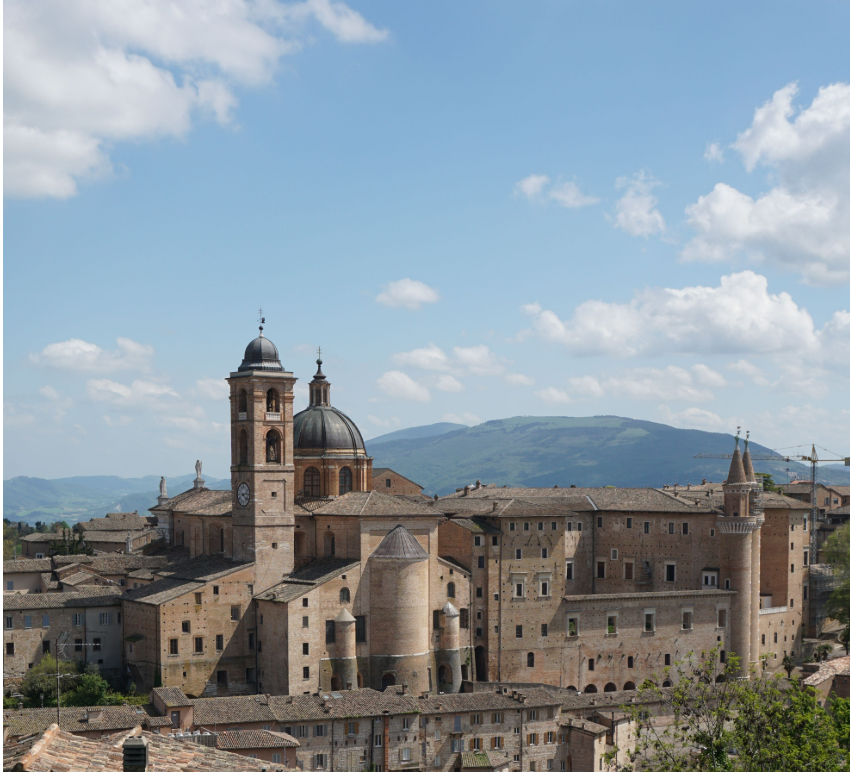
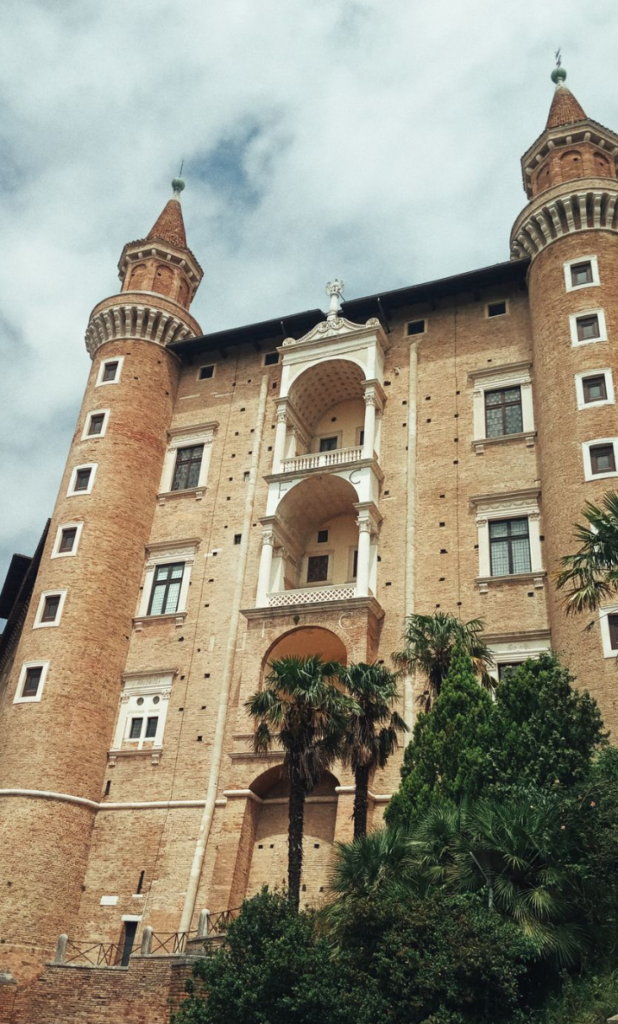
In 1444, a twenty-two-year-old condottiere named Federico da Montefeltro inherited the small duchy of Urbino in the hills of central Italy. He was illegitimate, had lost his right eye in a tournament, and governed a territory of perhaps 150,000 people in a region without a navigable river or a port. Forty years later, the court he built on that ridgeline was described by the diplomat and writer Baldassare Castiglione as “a city in the form of a palace” — and the palace he built was recognized by contemporaries as one of the most refined structures in Europe. The art historian Frederick Hartt, in his standard survey of Italian Renaissance art, called it “perhaps the most complete expression of humanist ideals in Italian architecture.”
In the same four decades, a painter was born in Urbino whose work would later hang in the Vatican, the Uffizi, the Louvre, and the Prado. His name was Raffaello Sanzio. Americans know him as Raphael.
Both facts — the palace and the painter — are documented, celebrated in Italian schools, and almost entirely absent from the mental map of Italy that most American travelers carry. Florence gets Raphael. Florence gets the Renaissance. Urbino, which produced him and shaped his eye during the years that matter most in a painter’s formation, receives a fraction of one percent of the visitors that Florence receives each year.
I have lived forty minutes from Urbino for most of my adult life. I have worked as a civil engineer in this region for thirty years. I have walked into the Palazzo Ducale more times than I can count, and I have watched the expression on the faces of visitors who did not expect what they found. That expression is the reason I am writing this.
What Urbino Actually Is
Urbino is a walled city on a double-peaked hill in the northern Marche, at an elevation of 485 meters, roughly 35 kilometers from the Adriatic coast and 75 kilometers southeast of Rimini. The population of the municipality is approximately 15,000 people, of whom several thousand are university students: the Università degli Studi di Urbino Carlo Bo, founded in 1506, is one of the oldest universities in Italy and gives the city a character that oscillates between Renaissance monument and active college town.
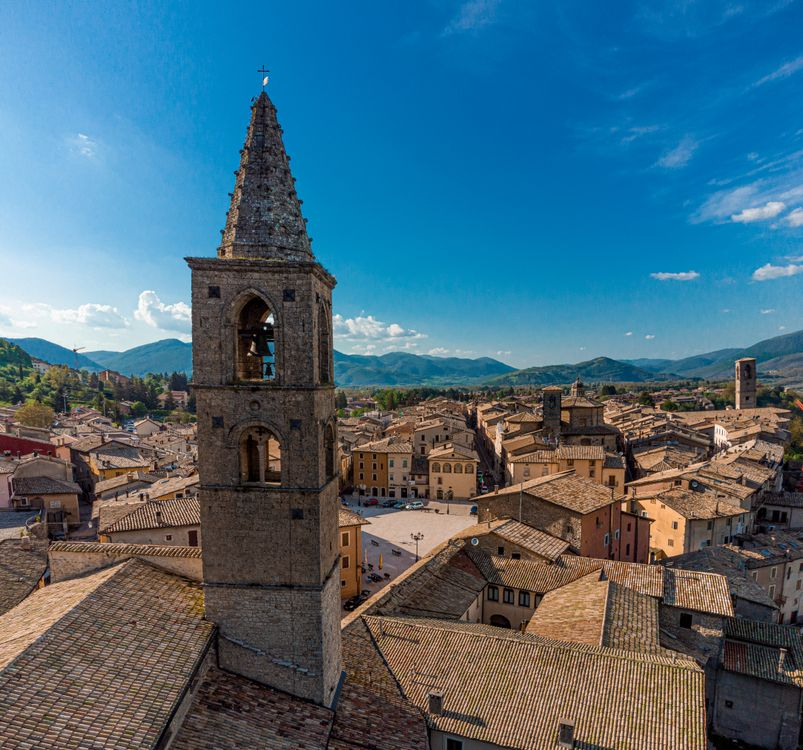
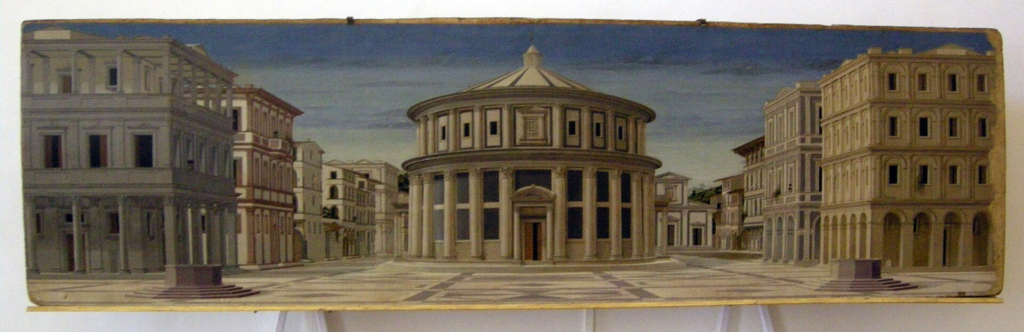
The historic center is a UNESCO World Heritage Site, inscribed in 1998. The inscription covers the entire urban fabric of the Renaissance city — not a single building, but the complete spatial organization of streets, palaces, churches, and public spaces that Federico da Montefeltro commissioned or encouraged between the 1440s and the 1480s. What UNESCO recognized, and what visitors who arrive with some preparation can read in the streets themselves, is that Urbino is not a medieval city with some Renaissance buildings. It is the most intact Renaissance urban plan in Italy.
That distinction matters for how you experience it. In Florence, the Renaissance is layered on top of, between, and around everything else: Roman foundations, medieval tower-houses, Baroque interventions, nineteenth-century urban restructuring. Florence is richer, more complex, more contested. Urbino is more legible. The city you see today corresponds closely to the city that Castiglione described in Il Cortegiano — the book he wrote in Urbino around 1508, which became the defining manual of Renaissance courtly behavior across Europe for the following century.
The Palazzo Ducale: What to Look For
The Palazzo Ducale dominates the city’s skyline from the west, its two cylindrical towers visible from the road long before you enter the gates. It was designed primarily by Luciano Laurana, a Dalmatian architect whom Federico brought to Urbino in 1465, though the building reflects contributions from multiple architects and craftsmen over several decades. Construction continued after Federico’s death in 1482 under his son Guidobaldo.
The palace is now the Galleria Nazionale delle Marche, the national art gallery of the region, and it contains works by Raphael, Piero della Francesca, Paolo Uccello, Titian, and Luca Signorelli, among others. The Piero della Francesca Flagellation of Christ, housed in the same building where it was almost certainly painted, is one of the most debated paintings in Italian art: a small panel measuring 58 by 81 centimeters that has generated more scholarly literature per square centimeter than almost any other work in the Italian canon. The spatial geometry — the relationship between the foreground figures and the recessed flagellation scene — is a demonstration of linear perspective so precise that architects and engineers still analyze it.
But the building itself is the primary exhibit, and the room that most rewards attention is not the main gallery hall: it is the Studiolo of Federico da Montefeltro.
The Studiolo is a small private study, approximately 3.6 by 3.4 meters, decorated from floor to ceiling in intarsia — wood marquetry assembled from hundreds of individually cut pieces of walnut, beech, rosewood, fruitwood, and other materials, creating an elaborate trompe-l’oeil representation of open cabinets, musical instruments, scientific tools, books, and armor. The craftsman most often credited with the work is Baccio Pontelli, though the design concept is connected to Francesco di Giorgio Martini, one of the most versatile intellects of the fifteenth century — architect, engineer, military theorist, sculptor. Federico employed him at Urbino for years.
What the Studiolo demonstrates, in a room you can stand in for as long as you are willing to stand, is the full synthesis of the Urbino court’s ambitions: scientific precision, artistic virtuosity, humanist scholarship, and the specific pleasure of a mind that wanted its private space to reflect everything it valued. As an engineer, I find the spatial geometry of the intarsia extraordinary — the foreshortening of the depicted objects is calculated with a rigor that anticipates techniques formalized in technical drawing manuals two centuries later.
Raphael’s Urbino: The Years That Formed His Eye
Raphael was born in Urbino on April 6, 1483, the son of Giovanni Santi, a court painter in Federico’s service. His father died when Raphael was eleven, but the formation had already happened: Raphael grew up inside the Palazzo Ducale, in a household connected to the court, surrounded by the architectural proportions that Laurana had embedded in every corridor and courtyard. He saw the Piero della Francesca paintings before he could name what made them work. He lived in a city whose spatial organization was itself an education in proportion and light.
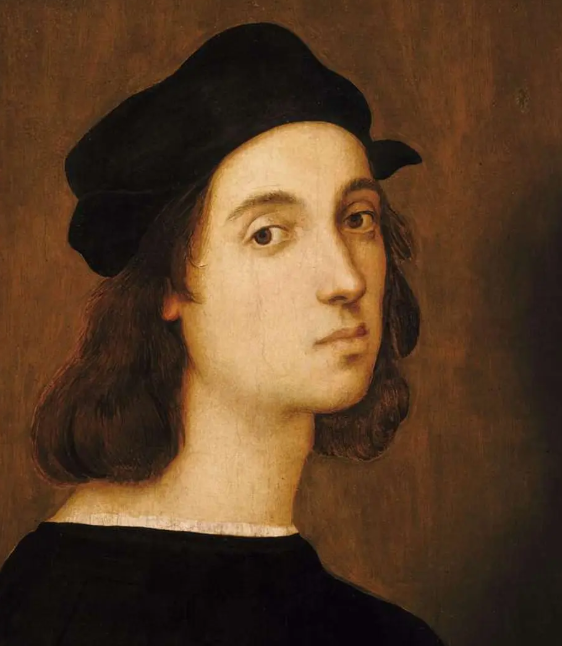
The Casa Natale di Raffaello — Raphael’s birthplace — is a few hundred meters from the Palazzo Ducale, on Via Raffaello. It is a modest fifteenth-century house, now a museum, containing some of his early work and a fresco fragment in the room where he was born, attributed to Giovanni Santi, that shows the Virgin and Child with a softness of expression that you can trace directly into his son’s later paintings. The museum receives perhaps 30,000 visitors a year. The Uffizi, which holds his mature work, receives more than that in a single day.
The house is worth an hour of your time not because it contains his greatest work — it does not — but because it answers a question that the Uffizi and the Vatican cannot: what did he see first? What was the physical and visual context that formed the eye that later produced the School of Athens? The answer is this city, this palace, these proportions. Urbino did not produce Raphael by accident. It produced him because Federico had built a court that treated art and mathematics and philosophy as continuous activities, and Raphael was born into that continuity.
The University and the Living City
The Università degli Studi di Urbino Carlo Bo was founded in 1506, twenty-four years after Federico’s death, by his son Guidobaldo. It has operated without interruption for five centuries, which makes it one of the oldest functioning universities in Europe. Today it has approximately 17,000 enrolled students across faculties including law, science, education, and — notably — the Faculty of Design and Art, which occupies spaces within the historic center and gives Urbino a specific contemporary energy that many pure monument-cities lack.
This matters for the visitor in a practical way: Urbino in term time is alive. Bars and restaurants are open for students as well as tourists. The piazza della Repubblica, the central square, has actual residents sitting at tables in the evening, not only visitors photographing the facade. The city does not close at five in the afternoon the way that some strictly touristic hill towns do. There is a bookshop that sells philosophy and a coffee bar that has been run by the same family since the 1950s.
The best time to experience this quality of inhabited city is May, June, or the first three weeks of September, when the university is in session and the summer tourist peak has not yet arrived or has just ended. In August, the student population disperses and the city tilts more heavily toward visitor traffic. In November and December, the streets are quiet in a different way — the cold coming off the Apennines is real at this altitude — but the Palazzo Ducale has no lines, and the Studiolo is yours alone for as long as you want it.
What Else to See: The City Beyond the Palace
The Cathedral of Urbino — the Cattedrale Metropolitana di Santa Maria Assunta — faces the Palazzo Ducale from across the piazza Duca Federico. The current neoclassical facade dates from the eighteenth century, a reconstruction after the earthquake of 1789 damaged the earlier Renaissance building. The interior holds a Last Supper by Federico Barocci, the Urbino-born painter who was one of the most significant Italian artists of the late sixteenth century and who has, like his city, received far less international attention than his work warrants. Barocci’s color — vivid, almost fluorescent pinks and blues in some canvases — anticipates the Baroque in ways that Caravaggio’s contemporaries noticed and that art historians are still debating.
The Oratorio di San Giovanni Battista, a few minutes’ walk downhill from the main square, contains a complete cycle of late Gothic frescoes by the Salimbeni brothers, Jacopo and Lorenzo, dated 1416. The color is still intense after six centuries. The oratorio has irregular opening hours and requires some coordination to visit — this is precisely the kind of site that rewards patience and a minimal amount of advance planning.
The city walls are mostly intact and walkable. The walk along the eastern perimeter, below the towers of the Palazzo Ducale, gives a view of the Apennine foothills that extends south toward the Sibillini on clear days. In the evening, with the stone warm from the day’s sun and the light going oblique across the valley, it is one of the more compelling views in central Italy — and one that no one is selling you a ticket to see.
Getting There and Getting Around
Urbino has no train station. This is a fact that surprises visitors and explains, partially, why the city receives fewer of them than its significance deserves. The nearest train connections are at Pesaro (approximately 40 kilometers to the northeast) and Fano (35 kilometers east), both on the Adriatic coast and both served by regular trains from Bologna, Ancona, and Rome. From Pesaro, buses run to Urbino in approximately one hour; from Fano, similar connections exist. The bus system is functional but infrequent — checking the Adriabus timetable before departure is essential.
The practical solution for most American visitors is a rental car. Urbino is 2.5 hours from Rome by car via the A24 and the SS73bis, 2 hours from Bologna via the A14 and inland roads, and 45 minutes from Pesaro or Rimini on the coast. Driving to Urbino from the Adriatic through the Metauro Valley is one of the more pleasant approaches to an Italian hill city: the valley road climbs steadily through walnut groves and tobacco fields — tobacco cultivation in the Marche is historically significant and the dark-leafed plants are visible in fields near Urbino in summer — before the city appears on its ridge above the last curve.
Parking is outside the city walls; the historic center is ZTL (restricted traffic zone) and pedestrian. From the main parking areas, the walk to the piazza della Repubblica is five to ten minutes uphill. There is a lift from the lower parking to the upper city, which functions with the reliability of Italian public infrastructure — which is to say, often.
Accommodation: Urbino has several small hotels and agriturismi in the surrounding countryside. For the experience of waking inside the Renaissance city, the options within the walls are limited but exist; book several months in advance for May through September. The surrounding countryside, particularly the Metauro and Foglia valleys, has agriturismi and small relais that offer the combination of rural Marche setting with easy access to the city.
Practical Information
Entry to the Galleria Nazionale delle Marche (Palazzo Ducale): €15 standard, reduced rates available for EU citizens under 25 and over 65. Open Tuesday through Sunday; closed Monday. In summer, extended evening hours on Fridays. Booking in advance is advisable in July and August; unnecessary the rest of the year.
Casa Natale di Raffaello: €4 entry. Open daily, mornings and afternoons with a midday closure; hours vary seasonally. The museum is small enough to visit in 45–60 minutes.
Getting to Urbino without a car: Pesaro is the most practical rail hub. Trenitalia and Italo serve Pesaro from Bologna (approximately 1 hour 20 minutes), Ancona (45 minutes), and Rome (3 hours). Adriabus runs Pesaro–Urbino approximately every 1.5–2 hours; journey time 50–60 minutes.
When to go: May–June and September are optimal. In July–August the city is busier but manageable. November–March is cold but uncrowded; the Palazzo Ducale is effectively yours.
How long you need: A focused one-day visit can cover the Palazzo Ducale, Casa Natale, Cathedral, and a walk of the walls. Two days allows for a more relaxed pace and time in the surrounding countryside. Three days is ideal for combining Urbino with nearby sites: the Frasassi Caves (45 minutes south), the Furlo Gorge, or the coast at Pesaro.
FAQ
Why haven’t most Americans heard of Urbino?
Urbino has no direct train connection, no airport, and has received less international marketing than Tuscany or Rome. Its significance — as a Renaissance court, as Raphael’s birthplace, as a UNESCO World Heritage city — is well understood in European and Italian academic contexts but has not translated into mainstream American travel awareness. This is changing slowly.
Is Urbino worth visiting if I’ve never been to Italy before?
Yes, though it works best as part of a broader itinerary that includes a more internationally familiar city — Rome, Florence, or the Marche coast — to provide context. For a first-time visitor to Italy who wants something less crowded than the standard circuit, Urbino is among the most significant undervisited sites in the country.
How does the Palazzo Ducale compare to the Uffizi in Florence?
They are not directly comparable in scale or collection size: the Uffizi holds thousands of works; the Galleria Nazionale delle Marche has a smaller but carefully significant collection. What Urbino offers that Florence cannot is the building itself as the primary exhibit: you are walking through a fifteenth-century palace whose architecture, proportions, and decorative program were conceived as a unified intellectual statement. The Uffizi was built as a government office. The Palazzo Ducale was built as a model of humanist civilization.
Can I visit Urbino as a day trip from other cities?
Yes. From the Marche coast (Pesaro, Fano, Senigallia), Urbino is an easy day trip by car or bus. From further afield — Ancona, Rimini, even Bologna — a day trip is feasible but leaves limited time. Spending at least one night in or near Urbino is significantly better.
Is there good food in Urbino?
Yes, with realistic expectations. Urbino is a small city and the restaurant scene reflects it: a handful of solid trattorias serving the cooking of the northern Marche — hand-rolled pasta, local salumi, roast meats, Verdicchio and Bianchello del Metauro as the local whites. The university population keeps prices reasonable and ensures that quality establishments stay open year-round.
What is the Studiolo and why does it matter?
The Studiolo of Federico da Montefeltro is a small private study in the Palazzo Ducale decorated entirely in wood marquetry (intarsia) creating optical illusions of open cupboards, books, musical instruments, and scientific tools. It is considered one of the masterpieces of fifteenth-century decorative art and a technical demonstration of perspective theory applied to craft. It takes about twenty minutes to look at carefully and rewards every one of them.
Who was Federico da Montefeltro?
Federico da Montefeltro (1422–1482) was the Duke of Urbino who commissioned the Palazzo Ducale and built one of the most significant humanist courts in fifteenth-century Italy. He was a successful military commander who used his income from mercenary contracts to fund an extraordinary program of architecture, art collection, and intellectual patronage. The portrait of him in profile by Piero della Francesca — with the famously distinctive nose resulting from his tournament injury — is one of the iconic images of the Renaissance.
Is Urbino accessible for travelers with mobility limitations?
The historic center is hilly and paved with uneven stone, which presents real challenges for mobility-limited visitors. The Palazzo Ducale has some elevator access but is not fully wheelchair accessible throughout. The lift from lower parking to upper city assists with the initial ascent but does not eliminate the cobblestone character of the streets. Travelers with significant mobility concerns should contact the museum directly before visiting.
Visit Urbino — With Someone Who Knows It
If you are planning a trip to Le Marche and want to build an itinerary that goes beyond the standard circuit — Urbino combined with the Frasassi Caves, the truffle country around Acqualagna, the Sibillini foothills, or the opera season at the Sferisterio in Macerata — I offer online consultations for exactly this kind of planning.
Book a consultation via TidyCal
And if you want to receive articles on the Italy that most travel writing hasn’t reached yet, the newsletter is the place to start.
[Subscribe to the Tastes & Wonders newsletter]
Related reading on this blog:
– Cingoli: The Marche Hill Town Italy Voted Its Most Beautiful Village
– Le Marche: The Italian Region Where the Mediterranean Diet Was Born
– Tuscany vs Le Marche: Which Italian Region Should You Actually Visit? (forthcoming)
– Frasassi Caves: The Underground Cathedral Most Italy Itineraries Miss (forthcoming)