The Quintana di Ascoli Piceno: Le Marche’s Most Prestigious Medieval Joust
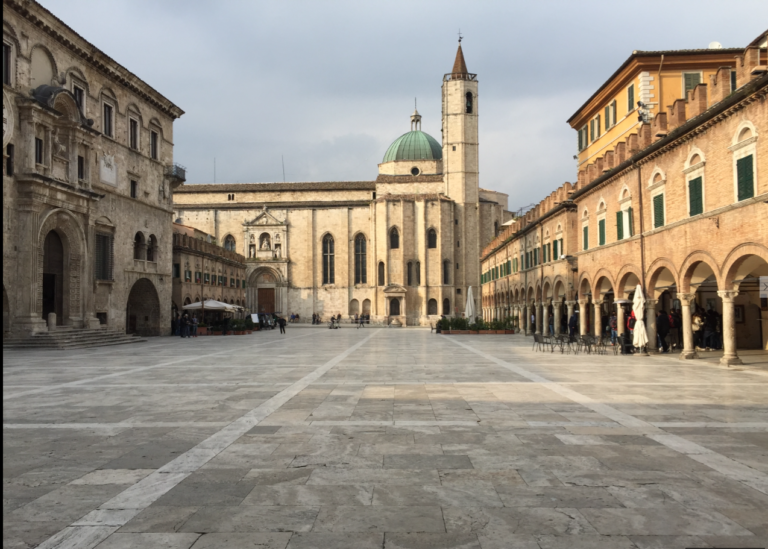
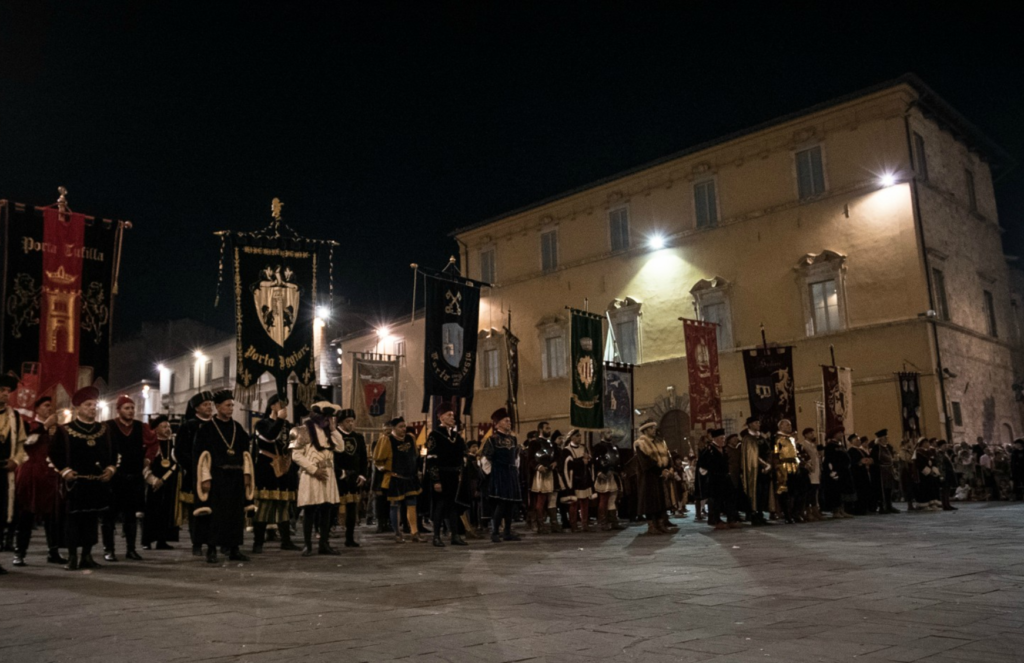
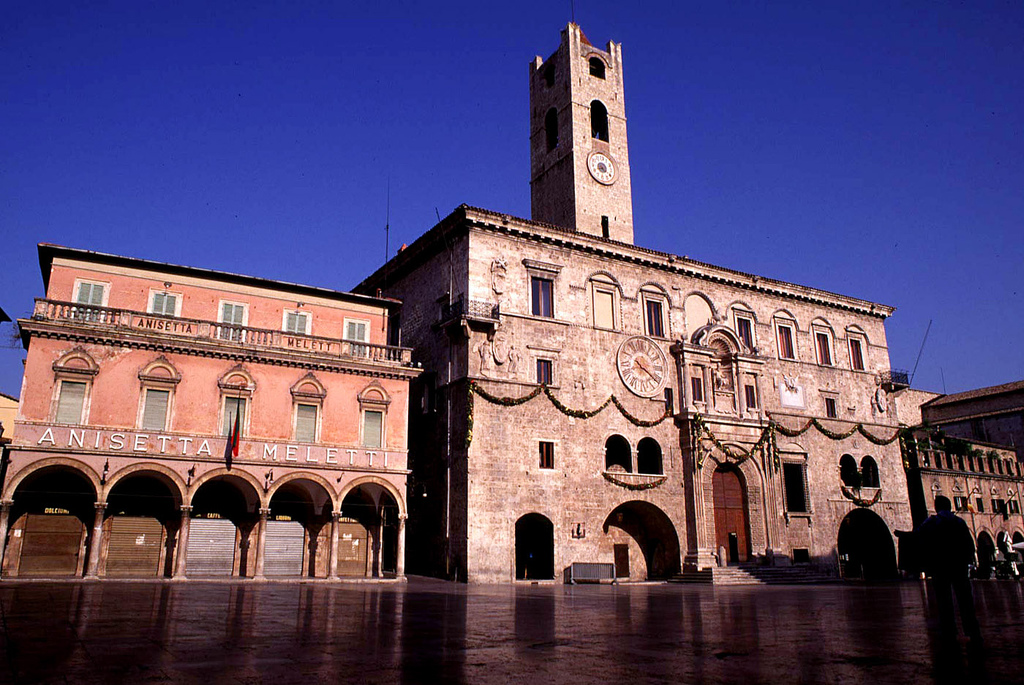
The evening before the joust, Piazza del Popolo does not look like a city preparing for a festival. It looks like itself — the same travertine square it has been since the thirteenth century, cream-white in the fading light, the loggia of the Caffè Meletti throwing yellow lamp-glow onto the stones. You sit with a glass of anisetta at one of the outside tables and watch the square function at its usual pace: a few tourists with cameras, locals cutting through on their way somewhere, a pair of nuns from the Franciscan complex that occupies the entire eastern flank. Then you notice the flags. Each of the six Sestieri has hung its colors from its own windows and doorways, and the geometry of the square, which you thought you knew, reveals itself as a map of loyalties that have been accumulating for seven centuries.
The next day, at the Campo dei Giochi below the old city walls, six riders will charge a Saracen mannequin on a figure-of-eight course at full gallop, separated from each other by centuries of neighborhood rivalry and a scoring system of severe precision. This is the Quintana di Ascoli Piceno: Le Marche’s most celebrated medieval joust, and one of the most technically demanding in Italy.
—
What Is the Quintana di Ascoli Piceno?
The Quintana di Ascoli Piceno is a twice-annual medieval jousting competition in Ascoli Piceno, a travertine hill city in the southern Marche, near the border with Abruzzo. Revived in 1955, it takes place at the Campo dei Giochi at Ponte Majore each summer in two editions: the Giostra della Madonna della Pace on Saturday, July 11, 2026, and the Giostra di Sant’Emidio on Sunday, August 2, 2026. Each edition is preceded by a historical procession of 1,500 figurants in fifteenth-century costume through the city center. Six riders, one representing each of Ascoli’s historic Sestieri (city quarters), charge a Saracen mannequin called the moro on a figure-of-eight track, scoring points for accuracy against the target and speed through the course. The Sestiere with the highest combined score across three rounds of three runs wins the painted palio banner.
This is not a horse race in the Sienese sense and not a ring joust of the type practiced at San Ginesio or Servigliano. It is a precision-and-speed discipline that rewards the rider who can balance the competing demands of a clock and a concentric target, on a winding course, at a gallop. The distinction matters and is worth understanding before you arrive.
—
A City That Earns Its Piazza
Ascoli Piceno occupies a position in the Italian urban hierarchy that most American travelers have not yet mapped. It sits at the confluence of the Tronto and Castellano rivers in the southernmost corner of Le Marche, surrounded by the first ridges of the Apennines. The city is not a hill town in the standard Marchigiano sense — it sits in a river valley bowl, which gives its centro storico a compressed, walkable density that larger Marche cities like Macerata or Fermo do not have.
The material that defines it is travertine: the pale limestone quarried from the nearby hills that gives every major building in the historic center — the Piazza del Popolo, the Palazzo dei Capitani, the church of San Francesco — a uniform color that changes through the day from near-white at midday to amber at sunset. Walking through Ascoli in the hour before the joust, when the Sestieri flags are out and the streets are full of figurants in assembly, you are moving through a fifteenth-century city that has not been substantially interrupted since.
The olive all’ascolana — large, brined olives stuffed with a mixture of minced meat, egg and Parmesan, breaded and fried — are the city’s gastronomic signature and should be treated as such: not as a bar snack but as the specific product of a specific place, available here in a quality you will not replicate elsewhere. They belong to the pre-joust evening the way anisetta belongs to the Caffè Meletti terrace.
I should say at this point what this article is not: it is not a complete guide to Ascoli Piceno as a destination. A fuller treatment of the city — its Roman bridge, its Romanesque baptistery, the Pinacoteca Civica and the Crivelli altarpieces — belongs to a dedicated piece. What this article covers is the Quintana, and enough of Ascoli to situate it.
—
The Moro and the Figure of Eight
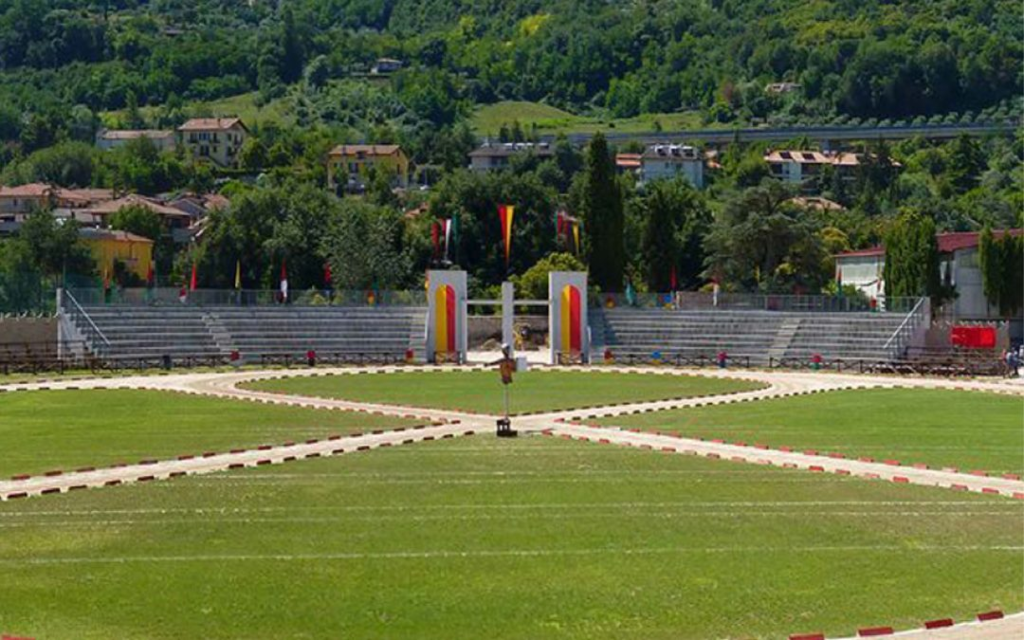
The Campo dei Giochi at Ponte Majore, situated between the Forte Malatesta and the church of San Vittore, is the Quintana’s sacred ground. On the figure-of-eight track, the fates of the six Sestieri are decided. What makes Ascoli’s joust genuinely distinctive within the Italian medieval circuit is the nature of the target.
The challenge of Ascoli is unique in its kind because the target consists of a shield held by a mannequin in the likeness of a Saracen called the moro. The moro remains an insidious and selective adversary, because the impact the riders must face in the assaults is tremendous. This is not a static ring suspended at a fixed height. It is a figure with a body, a shield, and the physical resistance that a weighted mannequin generates when struck at speed.
The scoring system is precise and unforgiving. The base score is 300 points for 55 net seconds, with 2 points added for every tenth of a second saved and 2 points deducted for every tenth over. No score is assigned beyond 60 seconds. The rider must hit a concentric target with scores ranging from 100 at the center to 20 at the outer edge. Touching a hedge with the horse’s hooves incurs a 30-point penalty; putting all four hooves beyond the line, losing the lance during the assault, or being unseated results in a null round.
The competition runs across three tornate (rounds), each composed of three assalti (runs). The first two rounds follow the order drawn the previous evening; the third and decisive round runs in reverse order relative to the provisional standings — meaning the leader goes last, under maximum pressure, with the trailing Sestieri’s scores already on the board. The dramatic mechanic is by design: the Quintana’s final round has reversed its outcome more than once.
The result is a competition that rewards three things simultaneously: accuracy against a graduated target, raw speed through a winding course, and the psychological capacity to ride a decisive final run knowing exactly what score you need to beat.
—
Six Sestieri, One Palio
The city’s six historic quarters are the Quintana’s structural engine. Piazzarola, Porta Maggiore, Porta Romana, Porta Solestà, Porta Tufilla and Sant’Emidio are not teams assembled for a competition. They are the medieval administrative divisions of Ascoli, mapped onto the city’s actual geography — each one centered on one of the old gates or on a historically significant piazza — and their rivalry has been generating energy since long before the 1955 revival gave it this particular channel.
Each Sestiere fields a single rider, chosen and backed by the neighborhood’s community. The selection of a Sestiere’s cavalier, the training schedule in the months before July, the collective analysis of the previous year’s scoring — these are not informal decisions. They are civic processes, with the seriousness of anything that implicates a community’s pride across generations. On joust day, the tribunes at the Campo dei Giochi are not seats for neutral spectators. They are the voice of each Sestiere’s supporters, organized, loud, and not particularly interested in being polite to the opposition.
The painted palio banner — commissioned each year from a different artist, unveiled at the presentation ceremony a week before each joust — is the trophy, but what it represents is a year’s worth of being right about something the other five Sestieri got wrong.
—
July 11 or August 2: Which Edition to Choose
Both editions follow the same competitive format. The differences are contextual and worth understanding.
Saturday, July 11 — Giostra della Madonna della Pace. The July joust is held in honor of the Madonna della Pace, a Marian devotion specific to the Ascolano religious calendar. The timing — a Saturday in mid-July — means the full weekend is available for visitors, with arrival on Friday evening for the pre-joust sestieri atmosphere, the joust on Saturday, and a rest day on Sunday. The city is lively but not yet at its August peak. This is the more accessible edition for visitors coming from outside the region who want to manage their itinerary without competing with Ferragosto travel.
Sunday, August 2 — Giostra di Sant’Emidio. The August joust is the more solemn of the two, held in honor of Sant’Emidio, the martyred bishop who is Ascoli’s patron saint. The lead-up is more elaborate: August 1 sees the Offerta dei Ceri, the ceremonial offering of candles to the saint, which is a civic-religious act with its own centuries of protocol. August 2 is a Sunday, which simplifies attendance for most visitors but places the event directly in the middle of the Ferragosto fortnight, when accommodation in the area books out. Reserve well in advance.
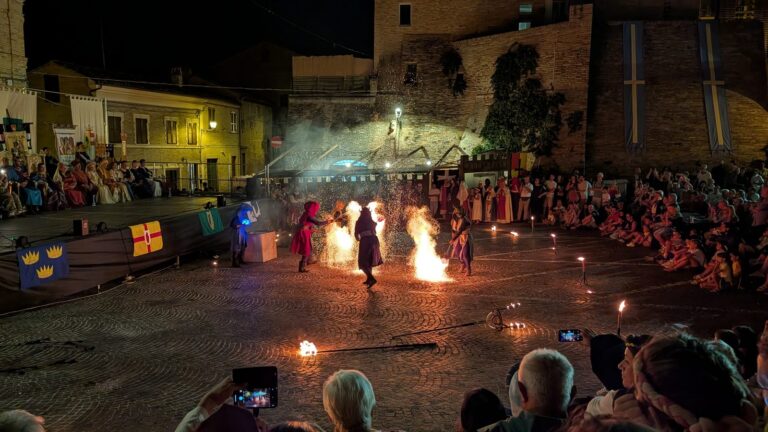
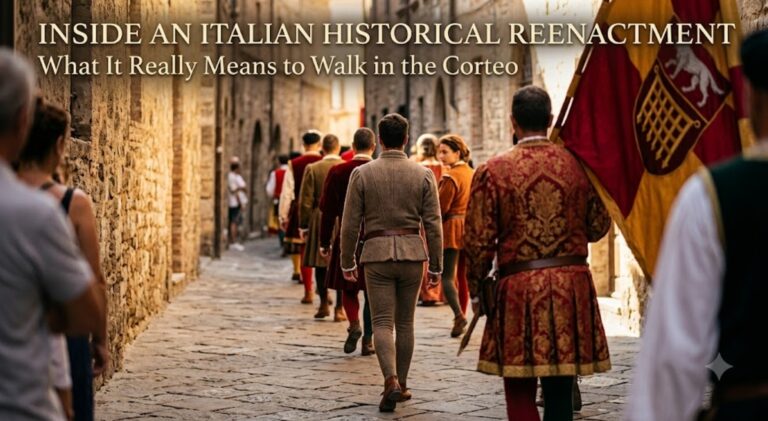
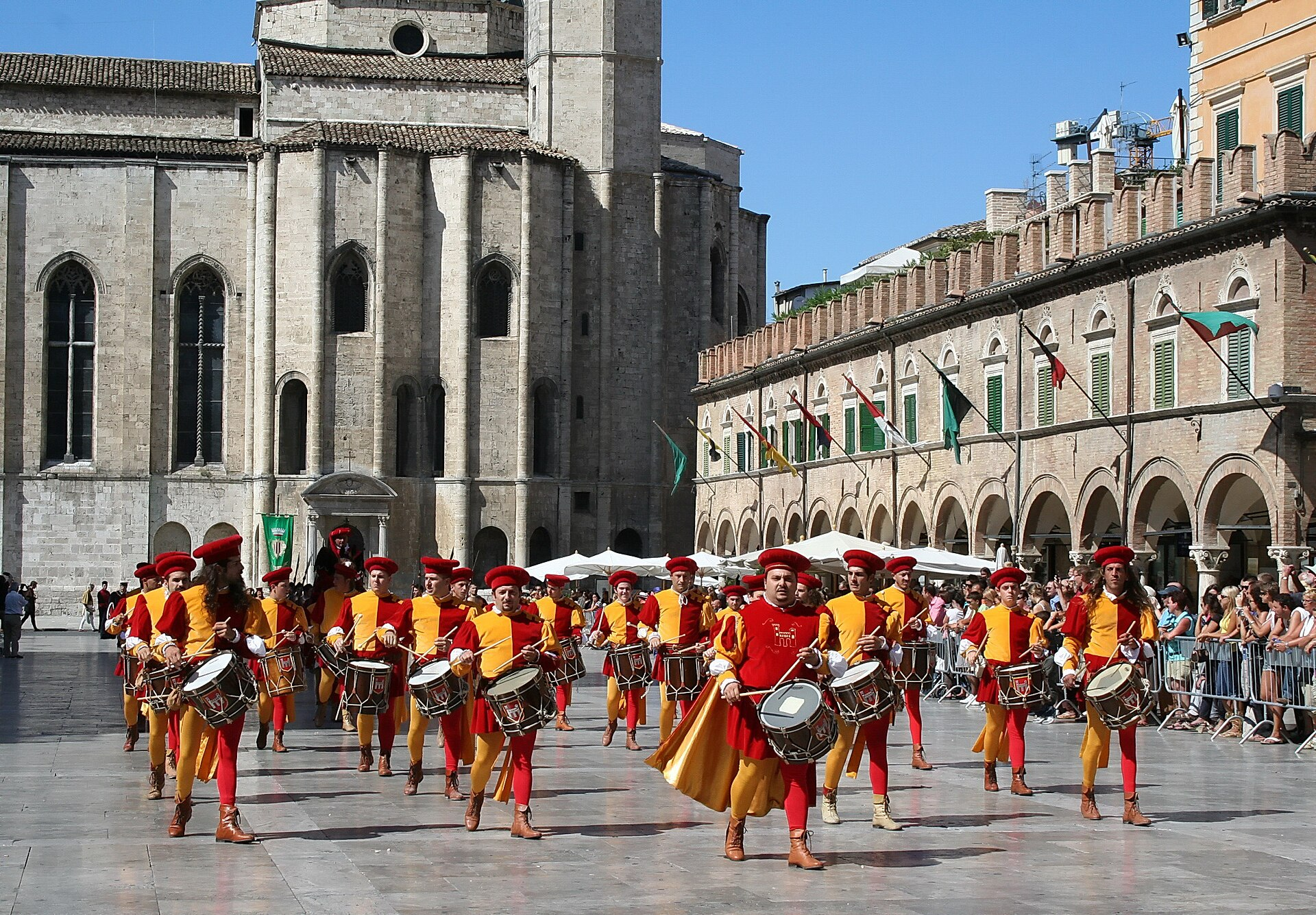
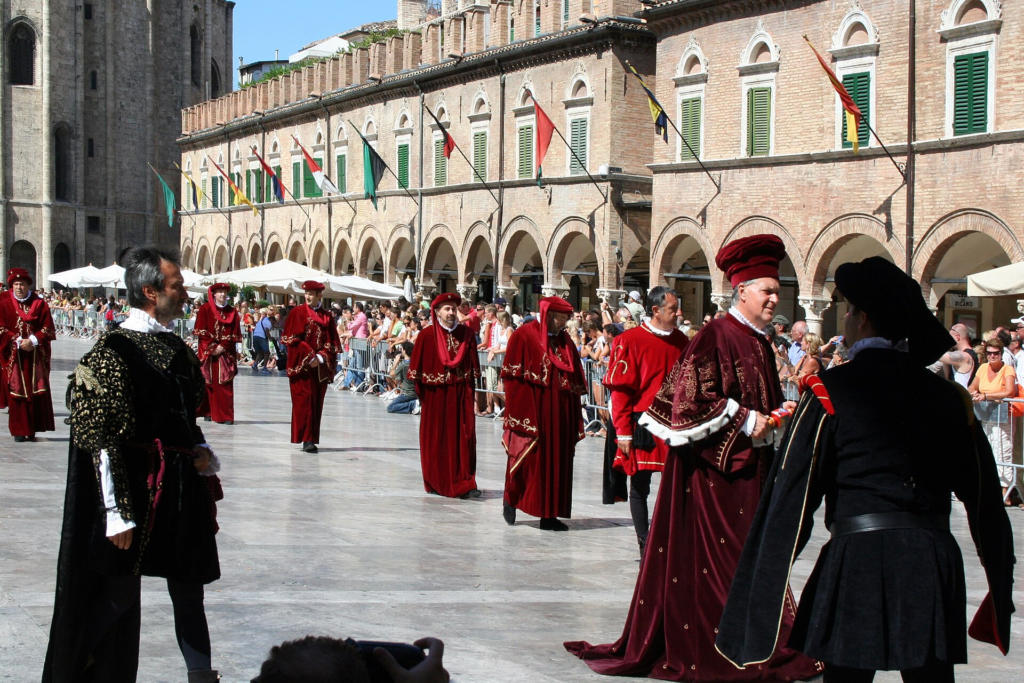
Both editions are preceded by the corteo storico: 1,500 figurants in Quattrocento-period costumes moving through the city center before descending to the Campo dei Giochi. The procession includes the Magistrature, the armed companies, the ladies of the Sestieri, the standard-bearers, and the six cavaliers themselves. It is one of the largest medieval processions in central Italy, and it can be watched from the streets at no cost. The joust itself requires a ticket.
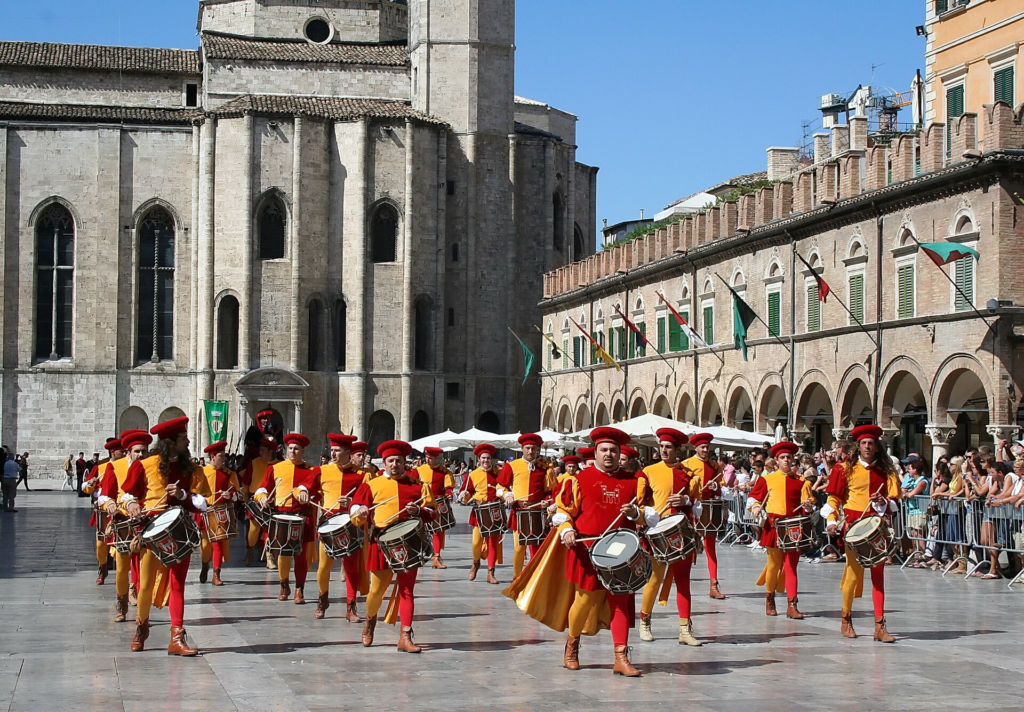
Beyond the two main giostre, the Quintana calendar extends across most of June and July: the Palio degli Arcieri (archery competition, June 20), the Palio degli Sbandieratori e Musici (flag-throwing and drumming, July 4-5 in Piazza del Popolo), and the Saluto alla Madonna della Pace on July 10. These satellite events are part of the same system and worth attending if your dates overlap.
—
The Technical Distinction: Ascoli, San Ginesio, Siena
For the visitor who has been reading about central Italy’s medieval contests, a clarification is worth making explicitly.
The Quintana di Ascoli Piceno, the Giostra dell’Anello di San Ginesio, and the Palio di Siena are three technically unrelated competitions that share the word palio (the cloth banner that is always the prize) but nothing else in their mechanics.
At Siena, ten horses race bareback around Piazza del Campo. There is no lance, no target, no precision element. The winner is the first horse to complete three laps, rider optional.
At San Ginesio, a rider charges a suspended brass ring and must thread the lance tip through the opening. The target is inert; the challenge is accuracy. There is no time pressure from a mechanical opponent, only from the clock.
At Ascoli, the rider faces the moro — a Saracen mannequin with a shield that must be struck with a calibrated blow — on a winding figure-of-eight course against a strict time limit with a complex penalty structure. The challenge combines precision (hitting the concentric target’s inner zones) with speed (the time bonus-and-penalty system) and technical horsemanship (navigating the figure eight without touching the boundary hedges).
Ascoli’s joust is the most mechanically complex of the three. It is also, for the viewer who has understood the scoring, the most legible: you can watch a run, observe where the lance struck the target, and calculate approximately what it was worth, then watch the leaderboard confirm it. This makes it unusually accessible to a visitor who has never seen a quintana before.
The fuller context of how these events relate to each other — and to the broader tradition of Italian medieval contests — is in our cluster guide: The Italian Palio, Decoded: Horse Races, Ring Jousts and Four Living Contests of the Middle Ages.
—
Planning Your Visit to the Quintana
Getting there. Ascoli Piceno has its own train station, connected to San Benedetto del Tronto on the Adriatic coast by a regional line. From San Benedetto (served by trains from Ancona, Pescara and Bari on the Adriatic coastal line), the Ascoli branch takes approximately 30 minutes. By car from the A14 motorway (Bologna-Bari), exit at San Benedetto del Tronto and take the raccordo autostradale toward Ascoli Piceno — about 20 kilometers. From Macerata, the SS4 Salaria (via Fermo) takes approximately 90 minutes. From Rome, the A24 to L’Aquila and then north through the Apennines takes around two hours and fifteen minutes. Ascoli is in the south of Le Marche, close to the Abruzzo border: it sits at the end of a valley, and all roads into it descend toward the river.
Tickets. Tickets for the Giostra Cavalleresca are available online through Vivaticket at vivaticket.com. The Campo dei Giochi at Ponte Majore has numbered tribuna seating along the course. The corteo storico through the city center is free to observe from the streets and requires no ticket — arriving an hour before the procession moves gives you time to find a position along the route.
Where to stay. Ascoli has a range of hotels and agriturismi in the city and surrounding hills. For the July edition, booking two weeks ahead is sufficient. For August 2, book as early as possible — the entire Ferragosto period fills quickly across the Marche coast and interior.
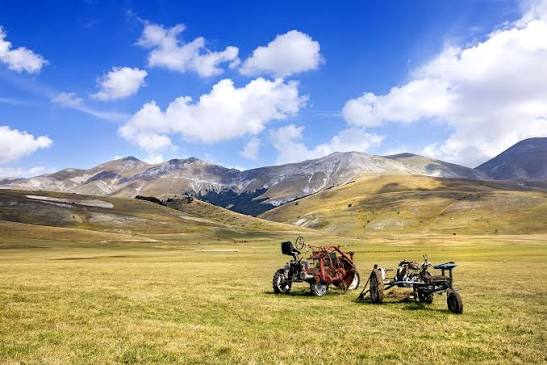
What to pair nearby. The Adriatic coast at San Benedetto del Tronto and Grottammare is 30 kilometers east — a practical combination if you are spending several days in the area. Offida, a small wine and lace town in the Piceno hills, is 20 minutes northwest and worth a morning. The southern Sibillini and the high-altitude Monti della Laga are accessible from Ascoli in under an hour, providing a cooler option for the August heat. If the Quintana is part of a wider Marche medieval-festival itinerary, San Ginesio (Giostra dell’Anello, July 5) and Servigliano (Torneo Cavalleresco di Castel Clementino, third weekend of August) are within 90 minutes by car.
The pre-joust evening. The Sestieri open their osterie in the neighborhoods the evening before each joust — informal outdoor dining under the Sestiere’s own colors, with local food and wine served at long communal tables. These are not tourist restaurants. They are neighborhood dinners, open to anyone who arrives and pays the per-person fee. No reservation is possible and none is needed. Arriving at the Sestiere that most interests you and sitting down is the entire protocol. The evening’s purpose is partly festive and partly strategic: the supporters of each Sestiere are analyzing the competition’s form over a plate of pasta, and the conversation is technical if you can follow it.
—
FAQ — The Quintana di Ascoli Piceno for the American Visitor
What is the Quintana di Ascoli Piceno? The Quintana di Ascoli Piceno is a twice-annual medieval jousting competition in which six riders, one from each of Ascoli’s historic city quarters (Sestieri), compete on horseback against a Saracen mannequin called the moro on a figure-of-eight track. The event takes place each summer in two editions: July 11 and August 2, 2026. The competition combines precision — striking a concentric target shield — with speed, on a scored system that rewards both accuracy and time. The Sestiere with the highest cumulative score wins the painted palio banner.
When exactly are the 2026 editions? The Giostra della Madonna della Pace is on Saturday, July 11, 2026. The Giostra di Sant’Emidio is on Sunday, August 2, 2026. Note that the July edition is a Saturday, not a Sunday — plan travel accordingly. Both editions are preceded by a corteo storico of 1,500 figurants through the city center.
What is the difference between this and the Palio di Siena? They share only the word palio — the cloth banner that is the prize. At Siena, ten horses race bareback around Piazza del Campo with no lance or target. At Ascoli, six riders charge a Saracen mannequin on a winding course with a lance, scored for both accuracy against a concentric target and speed through the course. They are mechanically unrelated competitions.
How does the scoring work? Each rider completes three rounds of three runs against the moro. The base score is 300 points for 55 seconds; 2 points are added for each tenth of a second saved, and 2 deducted for each tenth over the limit. The target is concentric: the inner zone scores 100 points, the outer zones progressively less, down to 20. Touching a boundary hedge costs 30 points; losing the lance or being unseated nullifies the entire round. The third round runs in reverse standings order, so the leader goes last under maximum pressure.
Do I need to book tickets in advance? Yes, for the Campo dei Giochi tribune seating. Tickets are available through Vivaticket (vivaticket.com). The corteo storico through the city center is free and requires no ticket. For the August 2 edition, book accommodation as early as possible — the Ferragosto fortnight fills the entire region quickly.
Which edition should I attend — July or August? July 11 (Saturday) is more logistically convenient and less crowded. August 2 (Sunday) is the more ceremonially significant edition, held in honor of Ascoli’s patron saint Sant’Emidio, with the additional Offerta dei Ceri ceremony on August 1. If your dates allow, August gives you a deeper experience of the event’s religious and civic dimension; if you want the joust without Ferragosto crowds, July is the practical choice.
What else is worth doing in Ascoli Piceno around the Quintana? The satellite events — Palio degli Arcieri (June 20), Palio degli Sbandieratori e Musici (July 4-5) — are part of the same system and worth attending if your dates overlap. In the city itself: the travertine Piazza del Popolo and the loggia of Caffè Meletti, the Roman Ponte di Cecco, the baptistery, and the Pinacoteca Civica’s Crivelli altarpieces. The olive all’ascolana should be eaten here, not taken as a reference point from elsewhere.
—
The Final Word
The Quintana di Ascoli Piceno was revived in 1955 by people who believed the city’s medieval contests were worth restoring to public life. Seventy years later, they have built something that functions on its own terms — with its own professional riders, its own scoring system of real technical complexity, and its own supporting calendar of archery, flag-throwing and drumming competitions that fill the six weeks between the Palio degli Arcieri in June and the Giostra di Sant’Emidio in August. The tourist dimension is real and accommodated, but it is not the reason the Quintana exists.
For the traveler who arrives at Ascoli Piceno on the evening of July 10 — sits with an anisetta in Piazza del Popolo, finds a table at one of the Sestiere osterie after dark, and watches the city orient itself around something it has been preparing for since January — the experience is not a background to the joust. It is the joust, conducted in the tense and pleasurable idiom of a city that knows what it’s for.
Planning a Le Marche itinerary that takes in the Quintana and other medieval festivals? You can book a 30-minute travel consultation with me at TidyCal to build the right sequence of events around your dates.
Ascoli seduces people into imagining a life here, not just a visit. If that is where your mind is going, I inspect property for foreign buyers across Le Marche — an independent technical survey before you commit to an old stone house.
Written by Mirco Vitellozzi, a structural engineer from Le Marche who writes about Italy from the inside. More essays at Tastes & Wonders of Italy, and short films on YouTube.