Glamping Tents on Italian Property: An Engineer’s Guide for Foreign Owners in 2026
Last spring I drove out to a farmhouse in the hills behind Fermo, in Le Marche, to look at two safari tents a British couple had installed at the edge of their olive grove. They had bought the property four years earlier, restored the main house with real care, and then done what a growing number of foreign owners are doing: they had put canvas on the lawn and started taking bookings.
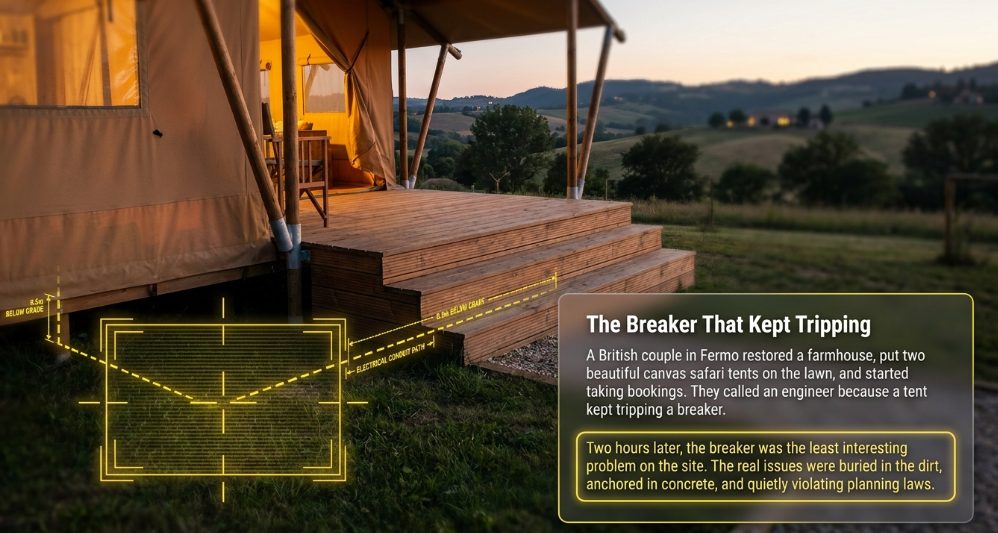
The tents looked wonderful. Cotton canvas, timber frame, a raised deck facing west so guests could watch the light go flat over the valley at eight in the evening. The couple were pleased, and they had reason to be. What they wanted from me was simple — a look at the wiring, they said, because one of the tents kept tripping a breaker.
I spent two hours there and the breaker turned out to be the least interesting problem.
This article is about what I found, and more broadly about what I have learned inspecting these installations across central Italy: where the money in glamping actually comes from, where it quietly leaks away, and which decisions made in the first week determine whether the whole thing is legal five years later. I am an engineer, not a property agent. I have no listings to sell you and no incentive to make this sound easier than it is.
The essentials: what you need to know
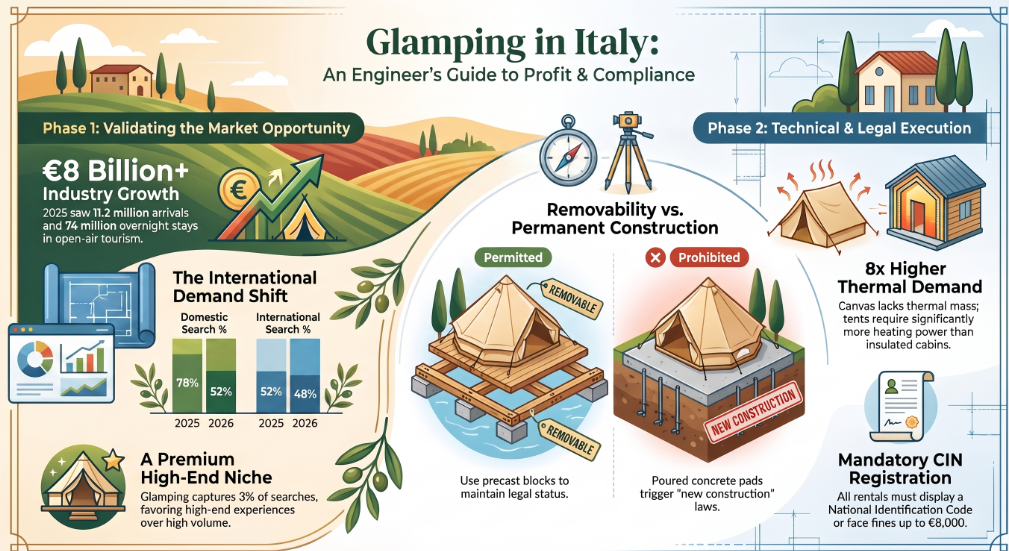
If you own property in Italy and are considering glamping tents as an income stream, four things matter more than the rest. The tent itself is a small fraction of the cost — the site works, connections, and compliance are the real investment. Your legal position depends on whether the structures remain genuinely removable, and a single concrete foundation can change that status permanently. If your property is a working farm, the agriturismo route has strict conditions about actual agricultural activity that owning land does not by itself satisfy. And every tourist rental in Italy now requires a national identification code before you can advertise a single night.
Get those four right and the economics can work. Get the third or fourth wrong and you have built something you cannot legally let.
Why the numbers look attractive
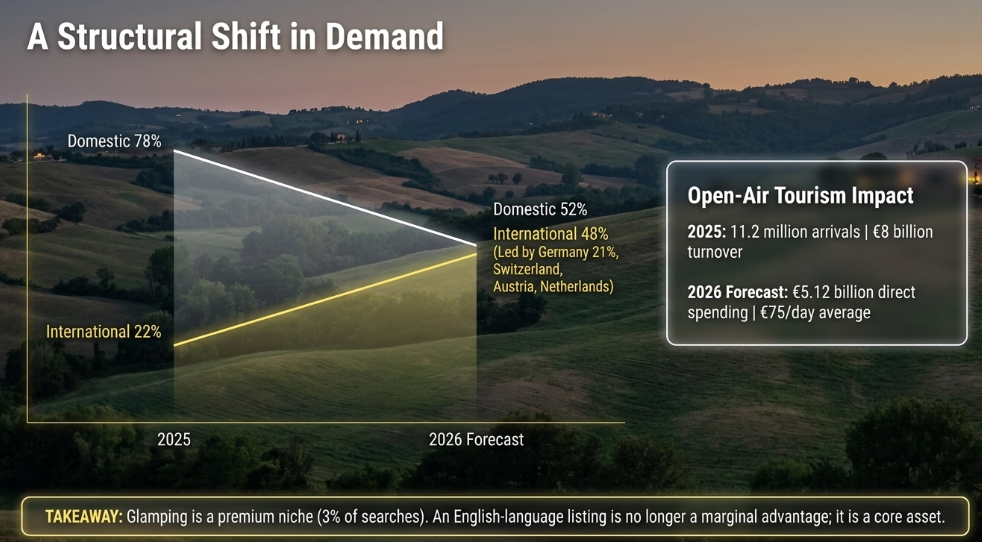
The interest is not imaginary. Italian open-air tourism has become a serious sector rather than a budget alternative. The national federation FAITA Federcamping recorded more than 11.2 million arrivals and almost 74 million overnight stays in 2025, with sector turnover above €8 billion. Forecasts for 2026 put total outdoor overnight stays at 68.4 million, with direct spending around €5.12 billion and average daily spend near €75 per person — figures that describe consolidation after a period of rapid post-pandemic expansion rather than a bubble.
The shift that should interest a foreign owner is in where the demand originates. In 2025, 78 percent of searches for Italian campsites and holiday villages came from within Italy and only 22 percent from abroad; by 2026 the domestic share had fallen to 52 percent and the international share had climbed to 48 percent, with Germany leading foreign markets at 21 percent, followed by Switzerland, Austria and the Netherlands. That is a structural change in a single year, and it means an English-language listing is no longer a marginal advantage.
Two cautions belong here, and I would rather give them now than bury them. Glamping remains a small slice of open-air demand at around 3 percent of searches, associated mainly with shorter stays and higher-end experiences. It is a premium niche, not a volume business. And the sector’s own analysts are explicit that high initial investment costs and seasonal demand fluctuations affecting revenue stability are the two structural restraints on the market. Both of those land directly on a small owner with two tents rather than on a large operator who can absorb them.
What I actually look at when I walk onto a site
The tent is not the investment
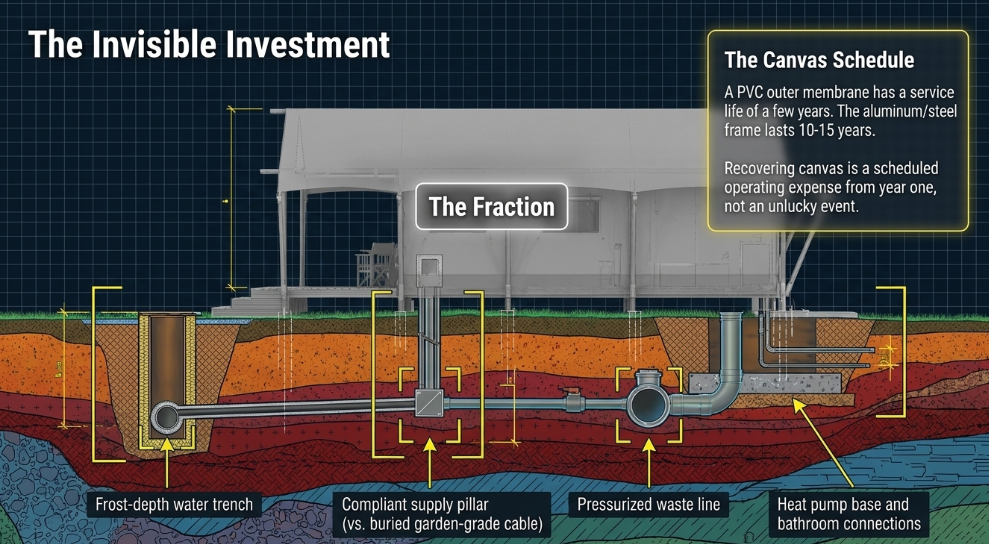
Owners consistently underestimate this. The canvas structure, the frame, the deck — that is the visible part, and it is quoted cleanly by the supplier. What is not quoted is everything that makes the tent habitable: the buried cable run and the pillar that feeds it, the water main and its frost-depth trench, the waste line, the heat pump and its base, the bathroom.
At the property near Fermo the couple had bought two beautiful tents and then asked a local builder to “sort out the services.” He had done what local builders reasonably do: run a spur off the farmhouse consumer unit, bury a garden-grade cable, and set the outdoor unit of an air conditioner on a small concrete pad he cast on site. Each of those three decisions was a problem, and the third was the expensive one. I will come back to it.
There is also a recurring cost nobody mentions at the point of sale. A PVC outer membrane has a service life measured in a small number of years, against ten to fifteen for the aluminium or steel frame beneath it. Recovering the canvas is a scheduled operating expense, not an unlucky event, and it belongs in the spreadsheet from year one.
Canvas behaves nothing like a stone farmhouse
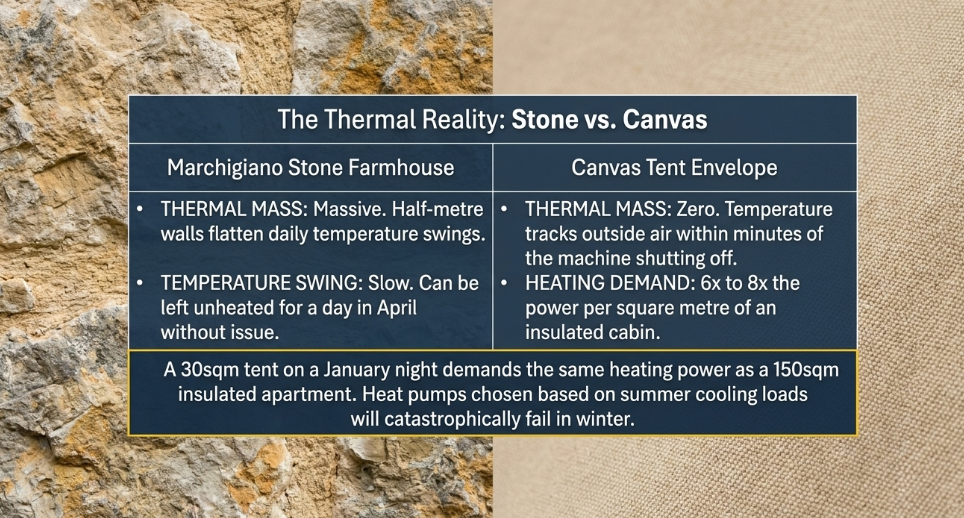
This is the part foreign owners find genuinely surprising, because their reference point is the house they have just restored. A Marchigiano farmhouse has half-metre stone walls that flatten the daily temperature swing; you can leave it unheated for a day in April and walk back into something reasonable. A tent has no thermal mass at all. The temperature inside tracks the temperature outside within minutes of the machine switching off.
In engineering terms the difference is stark: a well-built tent envelope needs somewhere between six and eight times the heating power per square metre of an insulated timber cabin. A thirty-square-metre tent can demand, on a January night in central Italy, roughly what a 150-square-metre insulated apartment demands.
The practical consequence is not that glamping is unheatable. It is that a heat pump chosen on the summer cooling load — which is how almost every installation I inspect has been specified — will be undersized in winter, because the winter temperature difference is larger. If your business plan assumes shoulder-season or year-round operation, and shoulder-season occupancy is exactly what makes these numbers work, the machine has to be selected on the January load. Manufacturers quote a minimum operating temperature, often around minus fifteen degrees. That is the point at which the unit still runs, not the point at which it still delivers its rated output, which by then may have fallen to little more than half.
The condensation problem nobody puts in the brochure
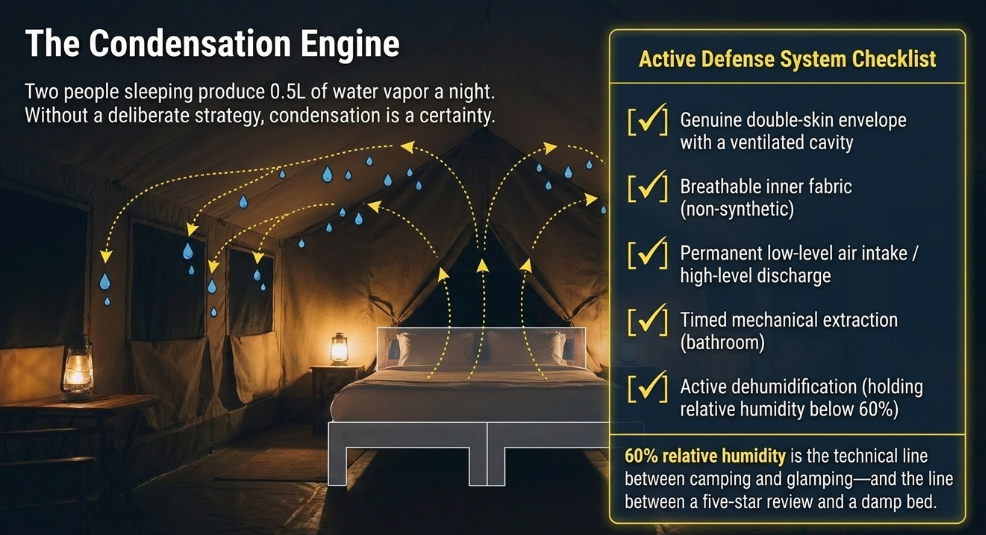
Two people sleeping produce roughly half a litre of water vapour a night. In a cold canvas envelope that vapour finds a cold surface a few centimetres away and returns to liquid. Without a deliberate strategy, condensation is not a risk in a glamping tent. It is a certainty.
The strategy is unglamorous and mostly invisible: a genuine double-skin envelope with a ventilated cavity, a breathable inner fabric rather than a synthetic one, permanent low-level air intake with high-level discharge, timed mechanical extraction in the bathroom, and active dehumidification holding relative humidity below sixty percent. That last figure is the technical line between camping and glamping, and it is also the line between a five-star review and a guest who writes that the bed felt damp.
I mention this because it is the failure mode most likely to hurt a remote owner. You will not see it. Your cleaner may not report it. It will appear in your reviews eight weeks after the season starts, and by then it has already priced your next season.
The legal question that decides everything
Here the article stops being about engineering and starts being about whether you are allowed to do this at all. This is also where I see foreign owners receive the most confidently wrong advice, usually from people who are not deliberately misleading them.
Are you an agriturismo, or just a landowner with tents?
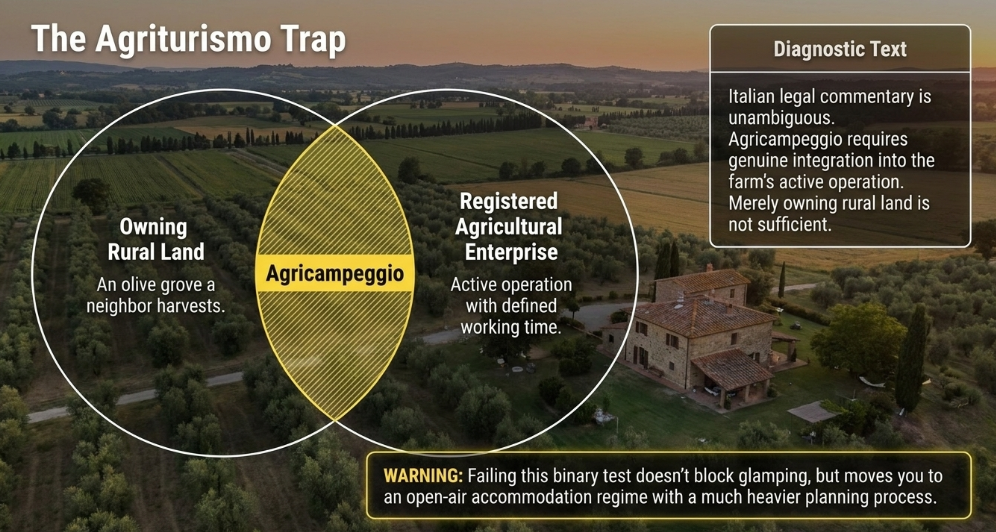
If your property is agricultural land, the obvious route is agricampeggio — open-air hospitality as part of an agriturismo. It is a real and well-established category, and every region regulates it. Tuscany, for example, sets out a detailed framework covering the number of pitches per hectare, maximum guest numbers, and the share of pitches that may be equipped by the operator as glamping.
But the qualifying condition is one that a foreign buyer, in particular, needs to read carefully. Italian legal commentary on the subject is unambiguous: agricampeggio can legitimately qualify as an agriturismo activity only if it is genuinely integrated into the farm’s agricultural operation, as an accessory and functionally connected expression of it; open-air hospitality carried out entirely separately from farming cannot be considered agriturismo, since merely owning rural land is not in itself sufficient to make the activity lawful. Regions typically enforce this through quantitative limits and through prevalence requirements measured in working time devoted to agriculture relative to hospitality, with periodic checks by agricultural services and local police.
Read that again if you own an olive grove that a neighbour harvests for you. The romance of the restored farmhouse and the reality of a registered agricultural enterprise are two different things, and the second is what the category requires. If you do not meet it, you are not blocked from glamping — but you are on a different regulatory road, likely as an open-air accommodation business, with different requirements and usually a heavier planning process.
This is the single question I would settle before signing anything, because it is binary and it sits underneath every financial assumption you are likely to make. It is also answerable in an afternoon by someone who reads the regional regulation in the original.
Removability, and the concrete that changes your status
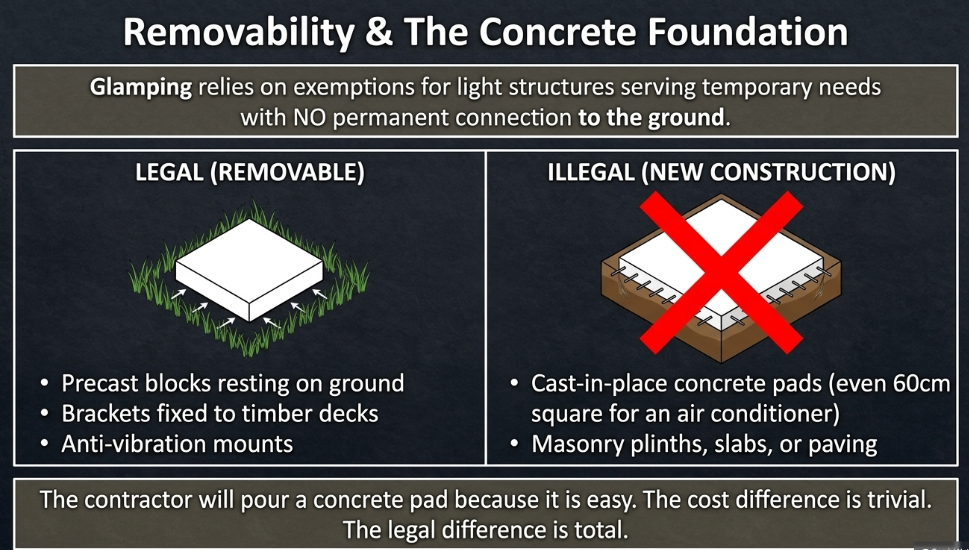
Italian planning law contains a provision that the entire glamping sector rests on. Light structures, including mobile homes, installed within already-authorised open-air tourist facilities are excluded from the definition of new construction, provided they serve the temporary accommodation needs of tourists and have no permanent connection to the ground.
Everything turns on those last words. Regional guidance spells out what removability means in practice, and the Veneto formulation is representative: tents and mobile accommodation units must involve no masonry works — understood as construction elements such as plinths, slabs, pillars, walls or paving in concrete — and must be built from assembled, fully recoverable components without cementing materials of any kind, and must be transportable without significantly compromising the possibility of reuse.
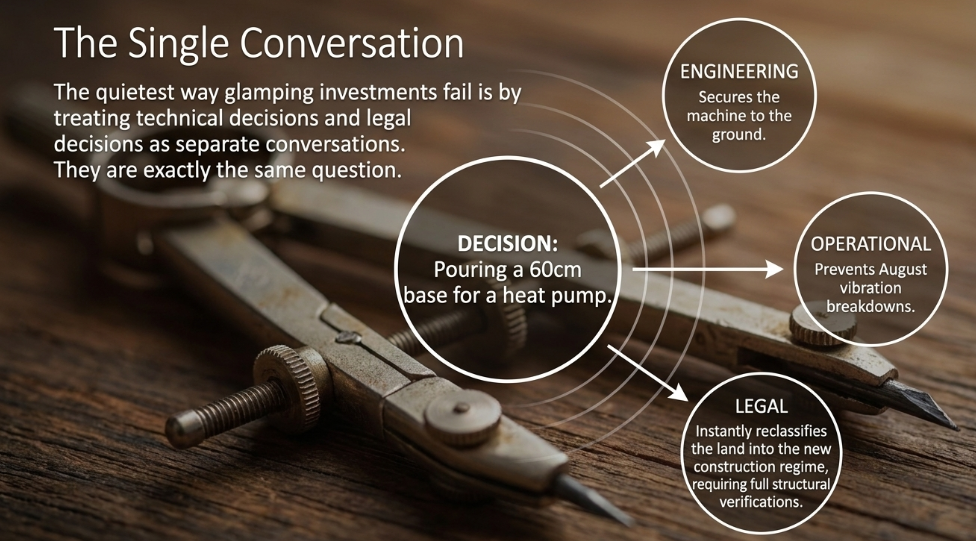
Which brings me back to the small concrete pad under the air conditioner outside Fermo. It was perhaps sixty centimetres square. It cost almost nothing. And it was cast in place, which is precisely the thing the rule excludes. The correct solution is a precast block simply resting on the ground, or a bracket fixed to the timber deck structure, with proper anti-vibration mounts. The cost difference is trivial. The legal difference is total.
I have now seen this specific mistake — a small poured base for a heat pump, a water tank, or a shower slab — on more sites than any other. It is never done maliciously. It is done because it is the easiest thing for the contractor standing there with a bag of cement.
The 2026 planning change, and why it may not help your tents
In 2026 Italy simplified landscape authorisation for open-air tourist facilities, and the change has been reported enthusiastically in the property press. The simplification is real, but the category it applies to matters enormously.
The exclusion is written around mobile accommodation vehicles — caravans, holiday mobile homes, motorhomes — placed in already-authorised equipped areas, and among its technical conditions is that the units retain the requirements for road circulation. A safari tent on a timber frame and a raised deck does not meet that condition and is not a mobile vehicle in that sense. It is a light removable structure, which is a distinct legal category.
The practical consequence for a foreign owner is worth stating plainly: if someone tells you the 2026 reform means you no longer need landscape authorisation for your glamping tents, ask them to show you the specific provision. In most cases the workable route for tents remains the simplified landscape procedure, not automatic exclusion — and given how recent the rule is, local heritage offices are still forming their practice. Confirm in writing with the competent office before you commit.
Registration and tax: the code you cannot skip
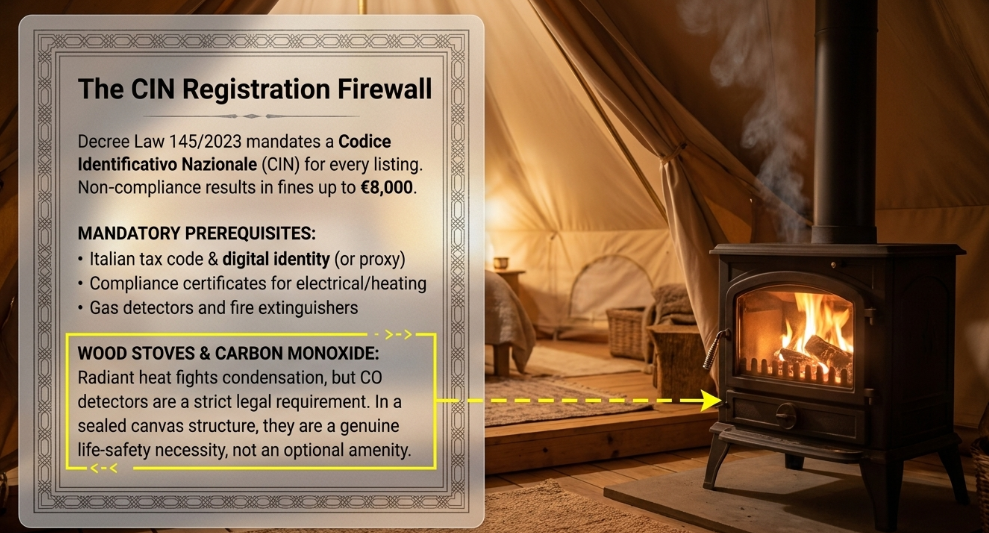
Whatever your planning route, you cannot advertise a night’s stay without a national identification code. The Codice Identificativo Nazionale is a unique alphanumeric code assigned to each property used for short-term rentals and non-hotel accommodation, which must appear in every advertisement and at the property itself, allowing tax and tourism authorities to match each listing to a real registered owner. It was introduced by Decree Law 145/2023 and administered through the Ministry of Tourism’s accommodation database, with mandatory safety equipment including gas and carbon monoxide detectors, fire extinguishers, and compliance certificates for heating and electrical systems, and fines reaching €8,000 for non-compliance.
Note the carbon monoxide detector in that list, because it connects directly to the engineering. If your tents have wood-burning stoves — and many owners want them, for good reasons, since dry radiant heat actively fights the condensation problem — a carbon monoxide alarm is not a nice touch. It is a legal requirement and a genuine safety necessity, in a structure where a guest is asleep and cannot perceive an accumulation.
Agriturismo operators are not exempt. Veneto’s guidance confirms that all agriturismi offering accommodation in rooms, units and agricampeggio must obtain classification and must request and display the CIN in order to submit statistical data.
For non-residents the procedure is manageable but front-loaded. You need an Italian tax code, obtainable at your consulate or through an Italian professional; access to the national database requires an Italian digital identity, though non-residents can delegate the registration to a property manager or professional with a power of attorney. An Italian bank account is recommended for tourist tax remittance and guest registration duties, and the flat-tax regime on rental income is available to non-residents. Rates and thresholds move with each budget law — tax provisions for 2026 have been subject to parliamentary debate — so treat any percentage you read online, including in an article written by an engineer, as something to confirm with a commercialista rather than to plan around.
What the season actually looks like
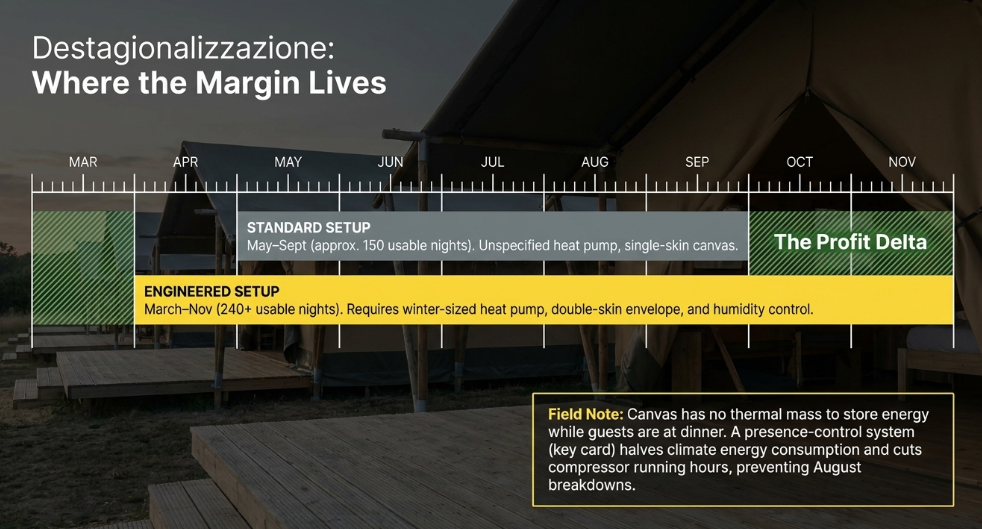
The seasonality question is where optimistic plans meet Italian weather. A tent without a properly specified heat pump is a May-to-September asset. That is roughly 150 usable nights, minus weather, minus the weeks nobody books.
Destagionalizzazione — extending into the shoulder seasons — is what changes the arithmetic, and it is entirely an engineering decision made at purchase. It requires a double-skin envelope, a heat pump sized on the winter load, and humidity control. Those three things cost more upfront and they are the difference between an asset that works five months and one that works eight.
There is one management measure I recommend without reservation, because it addresses a problem specific to canvas. In a masonry building, leaving the air conditioning running while guests are out at dinner wastes some energy but the building stores some of it. In a tent, with no thermal mass, that energy is lost completely. A presence-control system — a card the guest inserts, which cuts power to the climate unit when removed — roughly halves climate energy consumption per unit across a season. It also cuts compressor running hours, which matters more than the electricity bill, because it reduces the odds of a breakdown in August when every technician in the province is already booked.
Five ways I have seen this go wrong
The first is buying the tent before doing anything else, then discovering the model chosen cannot support the season length the business plan assumes.
The second is that poured concrete base, in all its small forms.
The third is assuming rural land equals agriturismo status, and building a business on a category the owner does not qualify for.
The fourth is remote management without a competent local presence. Canvas structures need seasonal maintenance — pre-season servicing, filter cleaning, condensate treatment, chimney inspection where there is a stove — and an owner three flights away cannot supply it.
The fifth is the quietest. It is treating the technical decisions and the legal decisions as separate conversations. They are the same conversation. The type of base, the way the electrical connection can be disconnected, the diameter of the pressurised waste line: each has an engineering meaning and a regulatory one simultaneously, and owners who separate them find out too late that they were always one question.
FAQ
Can a foreigner legally run glamping tents on property they own in Italy?
Yes. Foreign ownership does not restrict your ability to operate tourist accommodation. What restricts it is the planning status of your land, the category you operate under, and compliance with registration requirements. Non-residents can obtain the necessary tax code and national identification code, and may delegate the registration process to an Italian professional holding a power of attorney.
Do I need planning permission to install a glamping tent?
Usually not, if the structure genuinely qualifies as a light removable manufactured unit within an already-authorised facility and has no permanent connection to the ground. The qualification is lost if concrete plinths, slabs or paving are cast on site — even a small base for an air conditioning unit. Regional rules and municipal building regulations always apply on top of the national framework.
Does the 2026 landscape authorisation reform cover safari tents?
Not directly. The exclusion introduced in 2026 is built around mobile accommodation vehicles that retain road-circulation requirements. A tent on a timber frame and raised deck does not meet that condition and remains a light removable structure, a separate category. The practical route for tents is generally the simplified landscape procedure, and given how recent the rule is, confirmation from the competent office is advisable.
Is my olive grove enough to qualify as an agriturismo?
No. Italian regulation requires that open-air hospitality be genuinely integrated into an active agricultural operation as an accessory activity, with prevalence typically measured in working time devoted to farming relative to hospitality, and subject to periodic checks. Merely owning rural land does not establish the qualification.
What is the CIN and do I really need one?
The Codice Identificativo Nazionale is a mandatory national code for every property offered as short-term or tourist accommodation in Italy. It must appear in all advertising and at the property. Registration also requires confirmation of safety equipment, including carbon monoxide and gas detectors and fire extinguishers. Penalties for operating without it reach €8,000.
Can glamping tents be used outside the summer season?
Yes, but only if specified for it. Year-round or shoulder-season use requires a double-skin envelope with a ventilated cavity, a heat pump selected on the winter heating load rather than the summer cooling load, and active humidity control. Single-skin tents cannot be extended into cold months without operating costs that undermine the economics.
What is the most common expensive mistake?
Casting a small concrete base on site — typically for the heat pump’s outdoor unit — because it is the simplest thing for the contractor to do. It costs almost nothing and can remove the structure’s legal status as removable, moving the entire installation into the new-construction regime with the permits, contributions and structural verifications that follow.
The takeaway
Glamping on Italian property can work as an income stream. The demand is real, the international share of it is growing quickly, and the premium end of the market is where the margin sits. But it rewards owners who treat it as a small hospitality business with an engineering component, and it punishes owners who treat it as furniture placed on a lawn.
The couple near Fermo, for what it is worth, were fine. We lifted the concrete pad before it had done any harm, put the outdoor unit on a precast block, replaced the garden cable with a properly rated buried run and a compliant supply pillar, and specified a machine sized for October rather than July. They now let into November. The fix cost a fraction of what it would have cost to discover the problem during an inspection three years later.
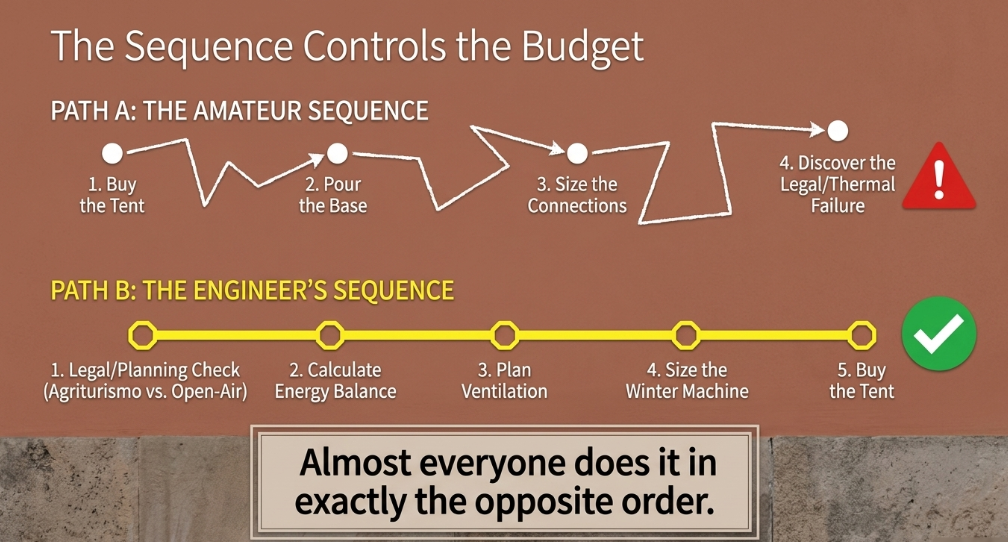
That is the whole argument of this article, really. In Italy the sequence matters more than the budget: check what you are legally permitted to do, work out the energy balance, plan the ventilation, choose the machine for winter, size the connections — and buy the tent last. Almost everyone does it in exactly the opposite order.
Before you buy: an engineer on your side of the table
Most of the problems described in this article are cheap to prevent and expensive to discover. The concrete base costs nothing to avoid at the design stage and thousands to unwind afterwards. The agriturismo qualification is a yes-or-no answer that takes an afternoon to establish and can invalidate a business plan built over two years. The heat pump sized for July instead of January is a single line in a specification.
None of it is difficult. It is simply not visible to someone reading a property listing from London, Boston or Sydney, and it is not what an estate agent is paid to look at.
I am a licensed civil engineer based in Macerata, in Le Marche, registered with the Order of Engineers of the Province of Fermo, with roughly thirty years of practice across central Italy. My work covers structural condition, energy performance, building services, planning and cadastral compliance for rural and tourist properties. I work regularly with foreign owners, including the British couple whose tents opened this article.
The point that matters most: I do not sell houses, I take no commission on your purchase, and I have no interest in whether you buy. That independence is the whole service.
If you are still weighing options, a free twenty-minute call is usually enough to establish whether what you are planning is permitted on that property, and which questions need answering before you commit.
Book a free 20-minute intro call
If you have a specific property in front of you, the next step is a one-hour orientation call. Bring the listings you are weighing and you will get an honest first read: which properties are worth pursuing, the red flags to watch for, and how the Italian buying process actually works. If you go on to commission a full property survey within sixty days, the call fee is credited toward it.
Book a Property Survey orientation call — €150
More about how a buyer-side survey works, and what it covers, is on the Property Surveys in Le Marche page.
An hour spent before the notary’s appointment is worth considerably more than the same hour spent afterwards.
If you want more of Italy explained from the inside rather than from the guidebook, there is more waiting for you on Tastes & Wonders of Italy.
🌍 https://tasteandwondersofitaly.com/ – 📺 https://www.youtube.com/@TasteWondersofItaly