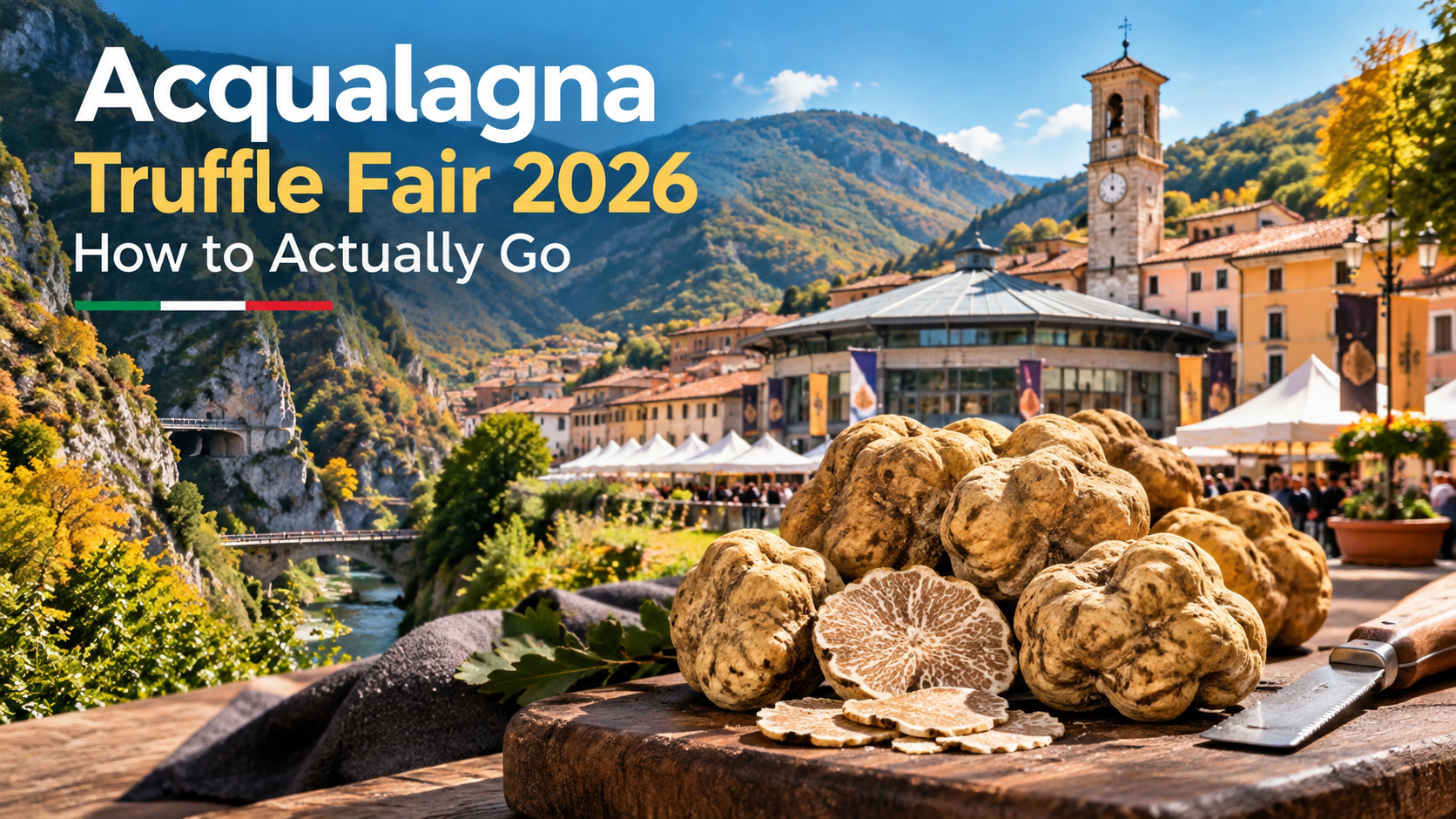
Acqualagna Truffle Fair 2026: How to Actually Go
The road into Acqualagna runs through a slot in the mountain that Vespasiano’s engineers cut by hand in the year 76, and for one week in late October the town on the other side of that gorge smells like nothing else on earth. The Acqualagna truffle fair 2026, officially the 61st Fiera Internazionale del Tartufo Bianco, unfolds across seven separate days between October 25 and November 15, and it is not a single weekend you can drop into on a whim. It is a working commercial season with a public face bolted on top of it, and knowing which of those seven days to pick, and what to actually do once you’re there, is the difference between a good afternoon and a wasted trip. This guide covers exactly that: which day fits your travel window, how to get in and out of a town with no train station of its own, where to sleep when the closest beds sell out weeks in advance, and how buying truffle in Acqualagna is a different transaction from buying it anywhere else in Italy.
The Short Answer
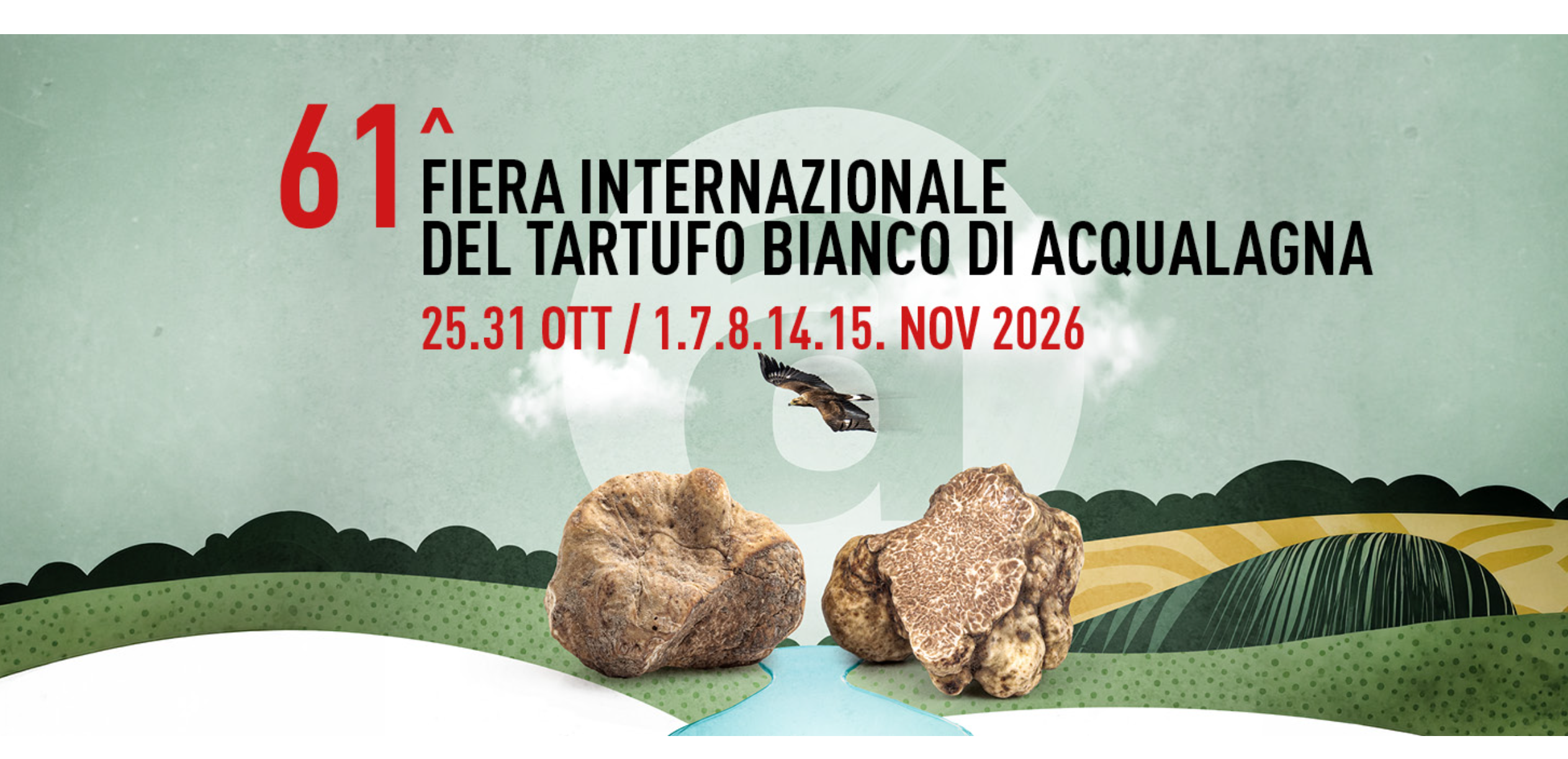
Acqualagna, in the Marche region’s Candigliano valley, holds its 61st International White Truffle Fair on seven days — October 25 and 31, and November 1, 7, 8, 14, and 15, 2026. Entry to the fair grounds is free; you pay only for the ticketed cooking shows inside the “Salotto da Gustare.” Acqualagna is not Alba’s smaller cousin — it moves roughly two-thirds of Italy’s white truffle trade, more than any other town in the country. For a side-by-side comparison with Alba’s fair, see our Alba guide.
What This Fair Actually Is
Here is the distinction that matters, and the one most travel articles get wrong: Alba’s truffle fair is built around visitors. Acqualagna’s truffle market is built around commerce, and the fair is what happens when that market opens its doors to the public for a week. Twelve dedicated truffle shops and ten trading and processing companies operate here year-round, moving product to restaurants and distributors worldwide. The fair doesn’t create that economy; it puts a stage in front of it.
That stage has a brand-new home in 2026. Behind the town hall on Via Leopardi, the Mercato del Tartufo (Truffle Market) — the octagonal building that has hosted the fair’s cooking demonstrations for decades — was demolished and rebuilt from the ground up with regional funding, and it opens on the fair’s first day, October 25. Mayor Pier Luigi Grassi has described it as more than a building: a year-round home for truffle culture that will also host concerts, film screenings, and civic events once November ends. It keeps the old octagonal footprint but meets current seismic and energy standards, which, as an engineer, I find more interesting than most of the marketing copy written about it.
Around that building and along Piazza Mattei runs the Percorso del Gusto (Taste Trail): the RistoTartufo food stands, a Truffle Bistrot with table service, the Piazza del Gusto market for regional agri-food and craft products, and a section for international exhibitors. None of it requires a ticket. The stands and the truffle market itself run from 10 a.m. to 7 p.m. on each of the seven fair days; only the individual cooking shows inside the Salotto da Gustare carry a cover charge, typically 20 to 40 euros per session, bookable at 334 252 6561.
The Seven Days of 2026, One by One
Fifty-plus separate events are scheduled across the seven days, and the program below reflects the town’s official 2026 calendar as of mid-September.
Sunday, October 25 opens the fair with the inauguration ceremony at Teatro A. Conti at 11 a.m. and the new market’s ribbon-cutting the same day. That evening, chef Michele Pidone runs a 5 p.m. cooking show built around leek and hazelnut velouté with white truffle.
Saturday, October 31, and Sunday, November 1 belong to the Tartufo Awards, the national Gara delle Città del Tartufo (Truffle Cities Competition). Cooking teams representing Acqualagna, Alba, Bondeno, Sant’Eusanio Forconese, the BIM Tronto consortium, and Molise face off across three sessions over the two days, ending in a Sunday-evening final.
Saturday, November 7, the Furlo dam opens for rare public tours, and the Salotto hosts a Belgian pairing: Michelin-starred chef Danny Horseele of Restaurant Moscou in Ghent, working with sommelier Nicolaï Vanquickelberghe. In the afternoon, kids get a free hands-on cooking lesson with chef Antonio Bedini, and the evening brings Culture di Vigna tra Alba e Acqualagna, a wine forum pairing four labels with a traditional dish.
Sunday, November 8 features an international truffle conference with Hungary’s national truffle association, followed by a midday cooking show from chef Érsek Gergely of Rábakecöl and an evening session with television chef Giorgio Barchiesi, known as “Giorgione.”
Saturday, November 14 pairs chef Emmanuele Guido’s truffle-forward tasting menu at midday with a second free children’s cooking workshop, and closes with a bread-and-truffle tasting led by the Il Gentil Verde restaurant team.
Sunday, November 15 closes the fair with chef Stefano Ciotti of Il Nostrano (Pesaro) at midday and a finale cooking show from television personality Sonia Peronaci that evening.
For the exhaustive minute-by-minute schedule, the town’s official program (updated through the fall) is the only source worth trusting; phone reservations for ticketed shows open in October 2026.
Which of the Seven Days to Pick
An American visitor with one shot at this rarely has seven days to spare, so here is how I would rank them.
Pick October 25 if you want the moment itself. You get the inauguration, the new market’s debut, and truffle at the very start of its season, when the aroma is sharpest and the crowds are still thin. This is the day for photographers and for anyone who wants to see the town before the trading really ramps up.
Pick November 1 if you want the spectacle and don’t mind a crowd. It’s an Italian national holiday, so this is the single busiest day of the fair, packed with domestic visitors, and it hosts the finale of the Tartufo Awards. Go here for energy, not for elbow room.
Pick November 14 or 15 if you want the truffle itself at its best. By mid-November the season has typically settled: more product is moving through the market, quality tends to be at its peak, and the crowds thin out from the November 1 spike. This is my pick for anyone whose priority is tasting and buying rather than spectacle.
If you can only manage a weekday, none of the seven fall on one; all seven are Saturdays or Sundays, which is worth building into your itinerary early.
Getting There
By car
Acqualagna has no motorway exit of its own, so the standard route runs along European route E78, the Fano–Grosseto highway. Coming from the north or south on the A14, exit at Fano, join the E78 toward Rome, and follow signs for Furlo–Acqualagna. From Pesaro, take the SS16 coastal road through Fano and pick up the E78 from there. The drive from Fano is roughly 40 kilometers and takes about 40 minutes outside fair-weekend traffic; on fair Saturdays, budget closer to an hour, since the E78 backs up near the Furlo exit. Parking areas cluster near the town center and around the Furlo Tunnel approach, and on the busiest days, expect to park outside the center and walk in.
By train
Acqualagna has no station of its own. The two useful ones are Fano (about 40 kilometers away) and Fossombrone (roughly 15 kilometers away), both on the Bologna–Ancona coastal line, with connecting buses run by Adriabus into Acqualagna. Trenitalia’s regional and high-speed services stop at Fano; from there, plan on a bus transfer of around 90 minutes to two hours depending on the connection, or a taxi of about 35 to 40 minutes. Check Trenitalia’s timetable and the Adriabus schedule close to your travel date, since fair-weekend bus frequency can shift.
By air
Ancona’s Aeroporto delle Marche (AOI) is the closest airport, roughly 90 kilometers and about 75 minutes by car via the SS73bis. Perugia’s Sant’Egidio airport (PEG) sits at a similar distance for anyone connecting through Umbria. Rimini’s Federico Fellini airport (RMI) and Bologna’s Guglielmo Marconi (BLQ) are both workable if you’re combining the fair with a broader Emilia-Romagna or Marche itinerary, but both add well over an hour of driving beyond what Ancona or Perugia require. None of these airports has a direct train or shuttle into Acqualagna itself; a rental car is close to essential unless you’re being met.
Where to Sleep, and When to Book
Acqualagna’s own room count is small, and on the two November weekends — the Città del Tartufo finale and the closing weekend — what exists sells out weeks ahead. Four nearby towns cover the gap, each with a different character.
Urbino, about 20 minutes away, is the obvious base: a walled Renaissance hill town with a genuine range of hotels and B&Bs, and worth a full day on its own beyond the fair. See our Urbino guide for what to do there.
Fano, on the coast about 40 minutes away, trades proximity for a wider hotel selection and easy train access if you’re arriving without a car.
Fossombrone, the closest of the four at roughly 15 minutes, is smaller and quieter, with fewer beds but a shorter drive back after an evening cooking show.
Cagli, about 25 minutes south, is the least touristed of the four and tends to have the most last-minute availability, at the cost of a slightly longer drive.
For the two weekends bracketing the Tartufo Awards final and the fair’s closing days, book at least a month out. For the quieter early-November Saturday-only date, two to three weeks is usually enough, but truffle season is not a good season to gamble on Acqualagna’s own limited stock.
Buying Truffle in a Town That Sells It All Year
This is the section where Acqualagna and Alba genuinely diverge, and it’s worth being explicit about why. At Alba’s fair, you are one visitor among thousands buying from vendors set up for a festival crowd. In Acqualagna, you are walking into a town whose truffle trade runs twelve months a year and simply has more foot traffic during fair week. The stalls in Piazza Mattei and the dealers around the new market are professionals who sell to restaurants in January as readily as to a tourist in November.
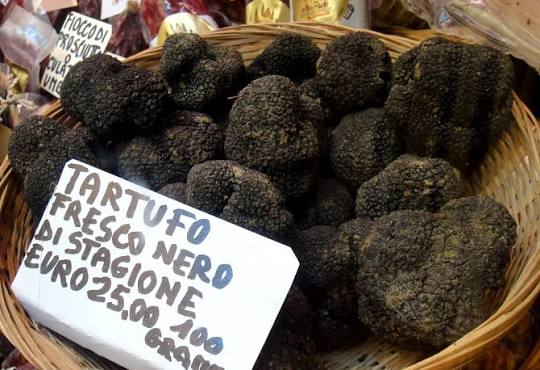
That changes how you should buy. Ask for the pezzatura — the size grade, since price per kilogram climbs sharply with size — and ask when the truffle was dug, not just where. A reputable dealer will weigh it in front of you on a scale you can see, not disappear behind a counter with it. Historically, Acqualagna’s own Borsa del Tartufo (the town’s official price board, unique in Italy and searchable online) has shown a clear seasonal pattern: prices tend to run highest in the fair’s opening weeks, when supply is still thin, and ease somewhat by mid-November as more product reaches the market. Recent seasons have put smaller pieces under 15 grams in the 1,300–1,800 euro-per-kilogram range and the largest, most prized specimens above 3,000 euros per kilogram, though these figures shift week to week with rainfall and demand — check the live Borsa del Tartufo listing on the days you’re actually there rather than trusting any number printed months in advance. For the full seasonal and legal picture — including which months each truffle species is in season — see our truffle season guide.
Pay cash for small purchases; card readers exist but aren’t universal at the outdoor stalls. Once you’ve bought, keep the truffle wrapped loosely in a paper towel inside a sealed glass container, refrigerated, and change the paper daily — it starts losing aroma the moment it’s out of the ground, so plan to use it within three or four days.
If you’re heading home to the United States afterward, current USDA guidance treats fresh truffles as a non-propagative plant product, distinct from most fresh produce, which the agency restricts far more heavily. That said, rules change, and the final call always sits with the Customs and Border Protection officer at your port of entry — declare it on your customs form regardless of what you’ve read here, and confirm current guidance on the APHIS website a few days before you fly. Don’t skip the declaration to save time; undeclared agricultural products carry real fines.
Half an Hour Away
Thirty minutes east, the Gola del Furlo gorge is where the Candigliano river cuts through the Apennines, and where Emperor Vespasiano’s engineers, in 76 A.D., carved a 38-meter tunnel through solid limestone with hand chisels — a tunnel still open to alternating one-way traffic on the old Via Flaminia today. A modern bypass now carries most of the highway traffic around it, which means the gorge itself has gone quiet again: golden eagles nest on its cliffs, and the walk through the old tunnel takes about ten minutes if you’re not stopping to read the Roman inscription above the northeast entrance.
Urbino, a UNESCO World Heritage hill town and the birthplace of Raphael, sits 20 minutes northwest and deserves more than a drive-by. Fossombrone, closer still, holds a Renaissance ducal palace worth an hour if you’re passing through anyway. And if your dates overlap with mid-October, nearby Sant’Angelo in Vado runs its own truffle exhibition, the Mostra Nazionale del Tartufo Bianco, through November 1 — a smaller, more local counterpoint worth checking if your travel window falls earlier in the season. For more of the region beyond the fair, see our Marche guide.
What I Would Skip
A day trip from Rome. The round-trip drive alone runs close to six hours, which leaves you with barely any real time in Acqualagna once you subtract it. Sleep somewhere in the Marche the night before.
November 1 if you dislike crowds. It’s the single most attended day of the fair by a wide margin. If your priority is a relaxed pace, take one of the November weekends instead.
Impulse-bought “truffle” products at the outer stalls. Truffle-scented oils and pastes sold cheaply at festival stands are frequently flavored with synthetic aroma compounds rather than actual truffle. If a jar of truffle products costs less than a fraction of the truffle itself would, read the ingredient label before you buy — genuine truffle products are not cheap, because truffle isn’t.
Booking Notes
Acqualagna doesn’t have the dense tour-booking infrastructure that Alba has built up around its fair, so most of what’s worth doing here — a guided hunt with a licensed tartufaio and dog, a tasting at one of the established dealers, a half-day in Urbino — is best arranged directly with the operator once you’ve confirmed dates, or through the town’s tourist office at the number above. If you’d rather have curated, bookable options handed to you in advance, check back on this page closer to the fair; we’ll be adding a shortlist of vetted experiences as the season firms up.
FAQ — Acqualagna Truffle Fair 2026
When is the Acqualagna truffle fair in 2026? The 61st Fiera Internazionale del Tartufo Bianco runs on seven days: October 25 and 31, and November 1, 7, 8, 14, and 15, 2026.
Is entry free? Yes. Walking the fair grounds, the market stalls, and the Piazza del Gusto costs nothing. You only pay to attend a ticketed cooking show inside the Salotto da Gustare, generally 20 to 40 euros per session.
Acqualagna or Alba? They’re not really competitors — Acqualagna is a working commercial hub that opens to visitors for a week; Alba is built as a visitor destination from the ground up. See our full comparison for which fits your trip.
Where should I stay? Acqualagna’s own lodging is limited and sells out fast on the two busiest weekends. Urbino, Fano, Fossombrone, and Cagli all sit within 40 minutes and offer more range.
Can I go truffle hunting during the fair? Yes, licensed hunts with a tartufaio and trained dog run throughout the season; arrange one in advance through the tourist office or a local operator, since fair-week slots fill quickly.
How much does fresh white truffle cost there? Historically, prices at Acqualagna’s Borsa del Tartufo have run from roughly 1,300 to over 3,000 euros per kilogram depending on size grade, typically higher early in the fair and easing somewhat by mid-November — check the live listing for current figures, since they shift weekly.
Can I take fresh truffle back to the United States? Current guidance treats truffles as a non-propagative plant product, generally easier to bring in than fresh fruit or vegetables, but you must still declare it to Customs and Border Protection, and rules can change — confirm on the APHIS website before you fly.
The Takeaway
If you want the scene at its most vivid, go October 25. If you want the truffle at its best and the crowds at their thinnest, go the weekend of November 14 or 15. Either way, book your bed in Urbino or Fossombrone well before you book anything else, because Acqualagna itself will not have room for you. What you shouldn’t do is treat this like Alba with a different name: it’s a working truffle town wearing its festival clothes for a week, and the best souvenir isn’t a jar off an outer stall — it’s a fresh truffle, weighed in front of you, eaten within three days of buying it.
If you’re planning a deeper trip through Le Marche or Italy’s central hill country and want an Italian engineer’s read on where to go and what to skip, you can book a 30-minute consultation with me.