Castelfidardo, the Italian Town That Built America’s Accordions
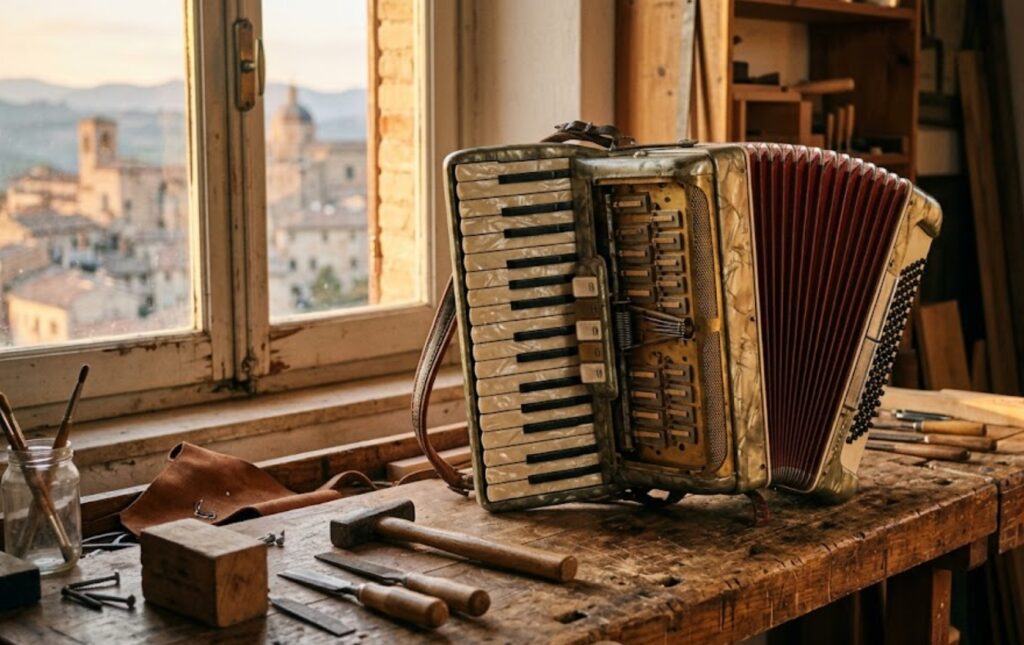
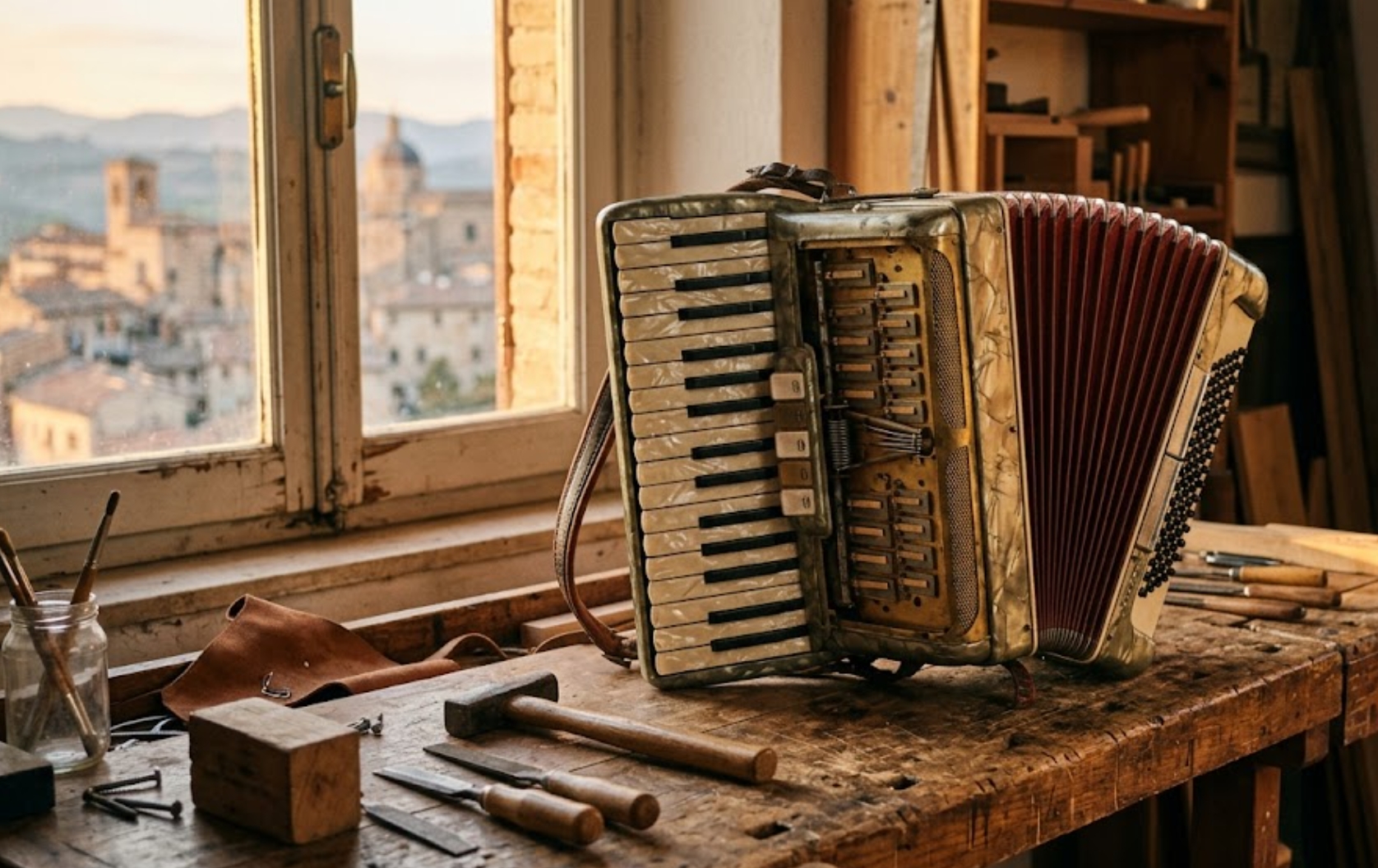
Somewhere in an American attic sits a Castelfidardo accordion nobody has opened in decades, wrapped inside a moth-eaten case with rusted latches. It probably belonged to a grandfather or a great-uncle, and the family story, if there is one, usually mentions a wedding band, a zydeco hall in Louisiana, or a polka circuit through the Midwest. What the story almost never mentions is where the instrument came from. The odds are good that it was built, or that its ancestor model was designed, in that same Marche hill town, a place most of those American owners could not find on a map.
Castelfidardo has been the center of Italian accordion manufacturing since 1863, when a farmer’s son named Paolo Soprani began building instruments in a converted stable on the outskirts of town. Within two generations, the accordions carried across the Atlantic by Marchigiani emigrants had become the sound of immigrant America — and, later, the sound American manufacturers themselves shipped back to Italy to have built. The instrument gathering dust in that attic is not a souvenir of Italy. It is a return address.
The night a pilgrim knocked on the wrong door
Every industry needs an origin story, and Castelfidardo’s has the shape of a folk tale, which is precisely why it should be handled with care. According to the account preserved by the town and repeated in Italy’s national biographical dictionary, in 1863 an Austrian pilgrim traveling to the nearby shrine of Loreto asked for a night’s lodging at a farmhouse belonging to the Soprani family, sharecroppers in the countryside outside Castelfidardo. He was carrying a crude wooden box that produced sound when squeezed — almost certainly a version of the accordeon, the instrument patented in Vienna in 1829 by Cyrill Demian. Paolo Soprani, then a teenager with no obvious talent for farm work, was transfixed by it.
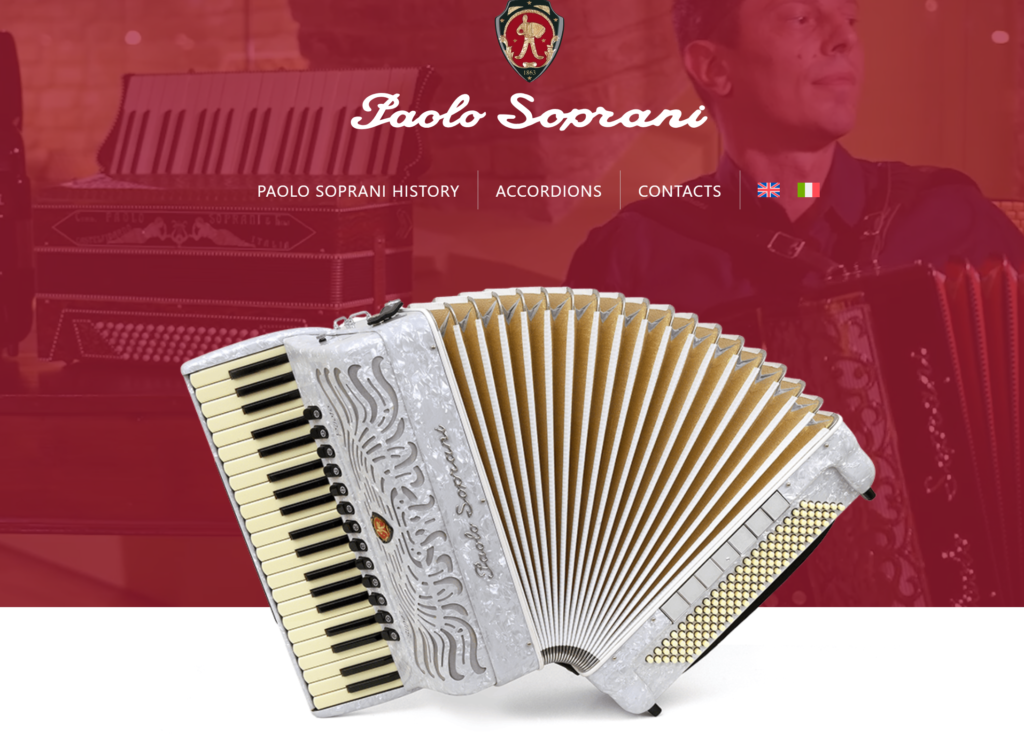
What happened next depends on which version you believe, and this is where an honest account has to stop smoothing the story into something tidier than it is. Some tellings say the pilgrim gave the box to Soprani as thanks for the hospitality. Others say Soprani bought it. At least one long-standing local account holds that he took it apart in secret while his family slept, to learn how it worked before anyone could stop him. Historians treat all three as equally plausible and equally unprovable, and the honest position — the one Castelfidardo’s own municipal archive takes — is to call it a legend that hardened into a founding myth, not a documented fact. What is not in dispute is the date, 1863, and what came after it: within a year, Soprani had opened a small workshop with his brothers, and within a decade Castelfidardo had a functioning accordion industry.
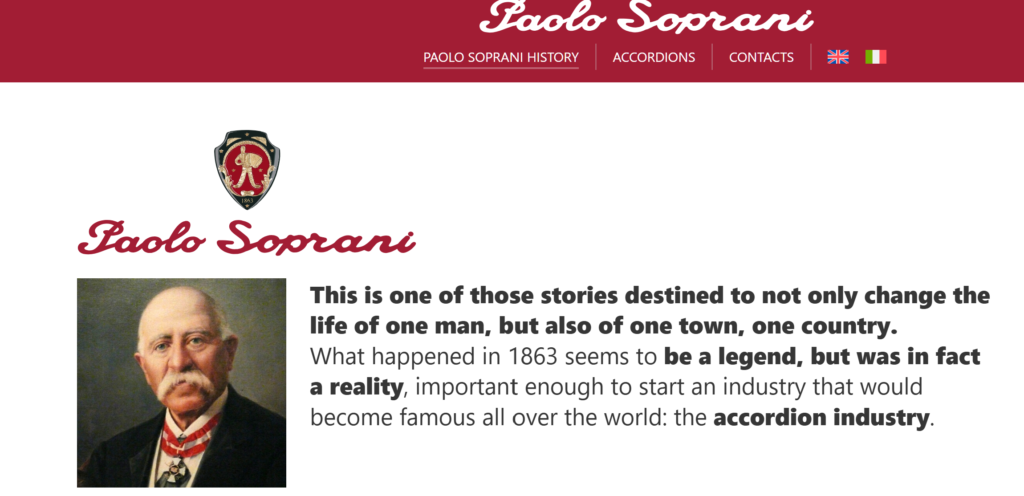
https://www.paolosoprani.com/en/paolo-soprani-history/
If you are looking for a short answer to where Italian accordions are made, this is it: the overwhelming majority of Italy’s historic accordion brands — Paolo Soprani, Scandalli, Excelsior, Bugari, Beltuna, Pigini, Victoria, and dozens of smaller workshops — trace their roots to Castelfidardo and the handful of neighboring towns (Loreto, Recanati, Osimo, Camerano) that make up what is now formally known as the Distretto degli Strumenti Musicali di Castelfidardo–Loreto–Recanati. One important exception belongs to a rival tradition entirely: Dallapé, another storied Italian accordion name, was founded independently in Stradella, in Lombardy, more than three hundred miles to the north, by a maker who never met or corresponded with Soprani. The two traditions are often confused online. They should not be.
What an engineer sees that a tour guide does not
I have spent thirty years assessing the structural condition of buildings across Le Marche, which is a strange qualification to bring to a musical instrument, except that an accordion is, at bottom, a mechanical assembly with more moving tolerances than most people would guess. It rewards the same kind of attention I give a load-bearing wall: not admiration for the surface, but curiosity about how the forces actually move through it.
A full-size piano accordion is built from two wooden shells — one carrying the piano keyboard, the other the bass buttons — joined by a pleated bellows that can run to more than a dozen folds of reinforced cardboard and cloth. Between the shells sit the voci, the reed plates: thin strips of tempered steel, arranged in banks, each tuned individually by hand-filing a fraction of a millimeter off its tip until it produces the correct pitch under the correct air pressure. A concert instrument can carry well over a thousand of these reeds. The bass mechanism alone, hidden behind the buttons a folk musician never sees, can involve hundreds of small levers, springs, and felts translating a single fingertip’s pressure into the right chord at the right volume.
This is the detail that no travel writer without an engineering background tends to register: the reason Castelfidardo’s accordion district survived mechanization, offshoring, and a century and a half of competition is that this tolerance work resists automation in a way a lot of manufacturing does not. A reed tuned by machine to a nominal pitch and a reed tuned by ear to sit correctly against its neighbors in a full chord are not the same object, even if a spectrometer says they are. That is not nostalgia talking. It is the same reason a stonemason’s eye still beats a laser level on an eight-hundred-year-old wall that has settled unevenly — some tolerances are relational, not absolute, and only a trained ear or hand catches the difference.
The crossing: how a Marche instrument became an American one
Le Marche sent enormous numbers of its people across the Atlantic between the 1880s and the 1920s, part of the wave that carried some fourteen million Italians abroad in a single generation. Musical instruments traveled second only to food as a marker of identity for those emigrants, and the accordion — compact, loud enough for a tenement courtyard, cheap enough for a laborer’s wages — became one of the standard possessions of the crossing. Marchigiano craftsmen followed the same route. Some set up small repair shops in immigrant neighborhoods of New York and San Francisco; a few turned those repair shops into full manufacturing operations.
The clearest case is also the most surprising, and it complicates the idea of a simple Castelfidardo accordion export story: Excelsior, one of the most recognizable accordion names in mid-century America, was not founded in Italy at all. It was established in New York City in 1924 by the Pancotti brothers, Marchigiani immigrants who had left Castelfidardo only a few years earlier. Excelsior instruments were soon in the hands of major American performers of the swing and radio era. Only in the late 1940s, once postwar demand had outgrown what a New York workshop could supply, did the Pancottis open a production plant back in Castelfidardo to build Excelsior-branded instruments for the American market — sending the industry, briefly, in reverse. A stretch of the town once nicknamed Via del Dollaro, “Dollar Street,” for the villas its accordion exporters built there, is a quieter monument to the same traffic.
By the years just after the Second World War, the pattern had become an industry unto itself. New companies in Castelfidardo took their names directly from the Hollywood studios and cinema chains their American distributors wanted associated with the instrument: Paramount, Universal, United Artists, Metropolitan, MGM. None of these had any connection to the film business. They were Marche accordion firms selling almost exclusively to the American market, borrowing glamour by name alone.
What broke it, and what it became instead
The postwar boom was real and, by most tallies, extraordinary: annual district production climbed from roughly seventy-two thousand instruments exported in 1937 toward figures several multiples higher in the years after the war, at the district’s mid-century employment peak, when the accordion trade across Castelfidardo and its neighboring towns reportedly supported something on the order of twelve thousand jobs. The war years had gutted it in the meantime — production is said to have collapsed from over fifty thousand units in 1938 to barely five hundred by 1944 — and the postwar recovery that followed made the crash of the 1960s and 1970s feel even sharper by comparison.
Two things did the damage. The first was musical fashion: rock and roll, and the electric guitar that came with it, displaced the accordion from the American bandstand within a single decade. The second was structural: Asian manufacturers entered the low end of the market with cheaper, mechanized production just as Castelfidardo’s craft-based model was least equipped to compete on price. Dozens of workshops closed. Some of the grandest family names — Borsini among them — did not survive as manufacturers at all.
The district did not vanish; it diversified. The same precision-mechanics know-how that built reed banks and bass mechanisms turned toward lighting technology, photovoltaic components, telecommunications equipment, and electronic keyboards — Farfisa, born from a merger of the historic Soprani and Scandalli firms, became far better known in the following decades for its electronic organs than for any accordion. Roughly thirty firms in and around Castelfidardo still build accordions today, a fraction of the postwar count, but enough that the town remains, by a wide margin, the largest concentration of accordion manufacturing anywhere in the world.
Who still builds them, and for whom
The customers have changed more than the craft, even if the label has not: a modern Castelfidardo accordion is far more likely to leave the workshop bound for a conservatory than for a wedding band. Today’s Castelfidardo workshops build far fewer instruments for wedding bands and far more for classical conservatory students, jazz and tango specialists, and a small but committed international revival of the accordion as a serious concert instrument — the kind of player likely to have first heard the sound at a Piazzolla concert rather than a polka hall. Firms like Pigini (which absorbed the historic Excelsior name decades ago), Beltuna, Bugari, Victoria, and Paolo Soprani’s own successor companies still produce entirely by hand at the top end of their lines, alongside more automated production for student and intermediate models. The reed-cutting and bellows trades have specialized further still: some small firms today supply only reeds, or only bellows, to the larger accordion houses, an internal division of labor that would have been unrecognizable to Paolo Soprani but that keeps the town’s overall expertise concentrated rather than dispersed.
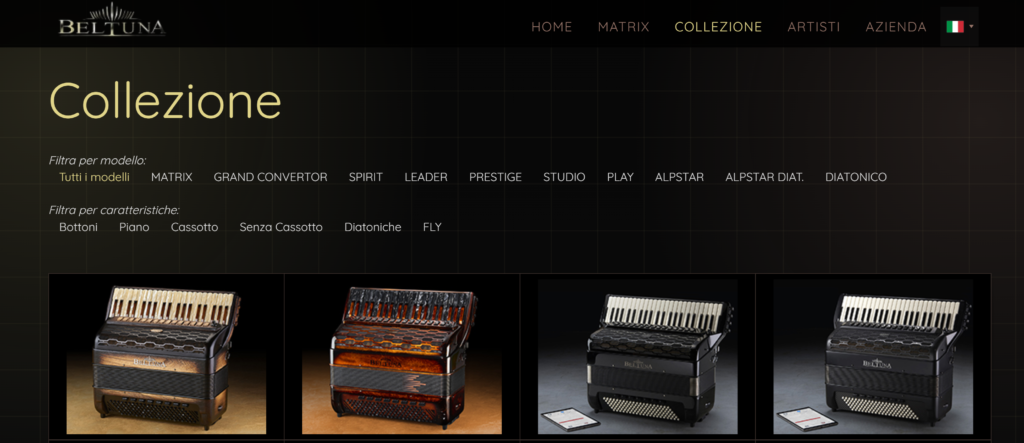
https://www.beltuna.com/collection?language=it
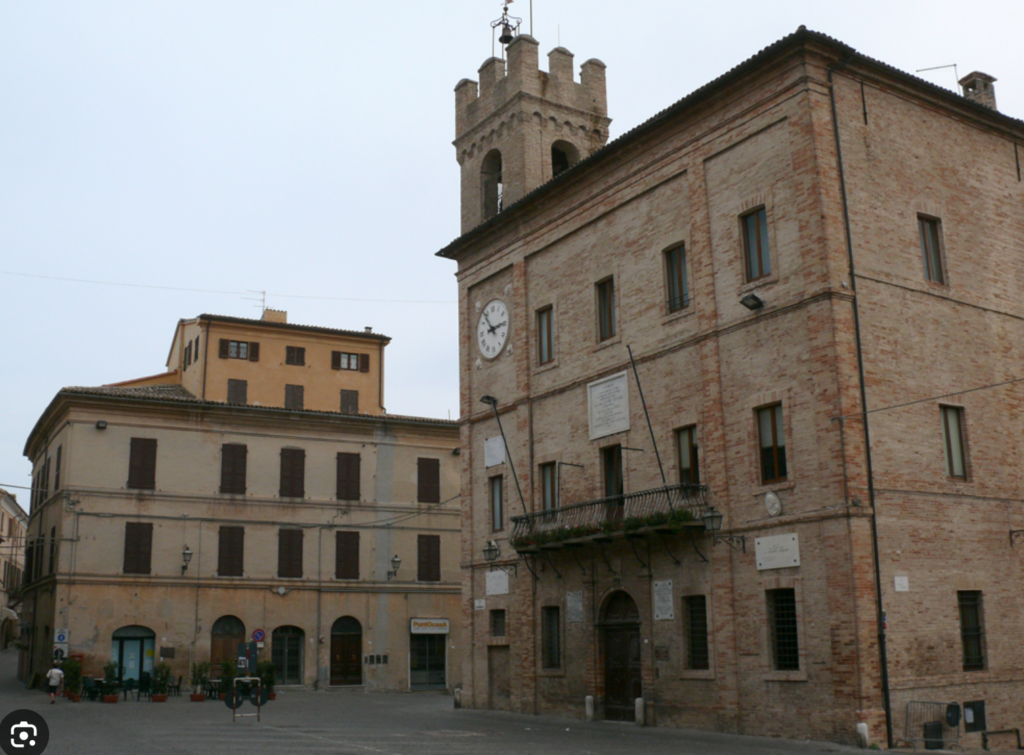
Castelfidardo does not perform its accordion identity for visitors the way a museum town performs its art. It is a genuinely modest hill town between the Aspio and Musone valleys, with the workshops mostly clustered in the valley below the historic center rather than in the piazza itself, and most of them are not set up for casual walk-in visits — these are working factories, not showrooms, and a request to tour one without a prior arrangement will usually be turned down.
The one reliable stop is the Museo Internazionale della Fisarmonica, housed in the seventeenth-century cellars of the town hall on Via Mordini. It holds roughly a hundred instruments on permanent display, drawn from a wider collection of several hundred, spanning models built between 1840 and the late 1960s, alongside sections on the accordion’s presence in coins, stamps, and popular iconography. Admission runs €5 for general visitors, with reduced rates for groups and school parties; hours shift with the season, running longer through the warmer months and shorter, with additional weekly closures, from November through February, so it is worth checking the museum’s own site (museodellafisarmonica.it) before planning a visit around it, and groups can arrange visits outside posted hours by prior booking.
If you can time a trip for September, the town’s real spectacle is the Premio Internazionale della Fisarmonica, known locally simply as the PIF: five days of competition, free public concerts, and masterclasses that have run in Castelfidardo since 1976. The 2026 edition, the fifty-first, is scheduled to run September 9 through 13, under new artistic direction from accordionist and composer Cesare Chiacchiaretta. Competitors arrive from dozens of countries to play everything from Baroque transcriptions to tango and jazz, and the town’s Piazza della Repubblica, Auditorium San Francesco, and Salone degli Stemmi fill with free concerts through the evenings. It is the one week of the year when Castelfidardo’s identity is fully, unmistakably on display, and it pairs naturally with the coastal towns of the Conero riviera — Numana and Sirolo are both a short drive away — for anyone building a longer stop in the region.
Castelfidardo works well as a half-day addition to a longer stay near Ancona, Loreto, or the Conero coast, rather than as a destination on its own. Budget an hour or so for the museum, and build in time simply to walk the streets below the historic center, where the valley workshops sit behind unmarked doors that give no hint, from outside, of what is assembled behind them.
The final word
A Castelfidardo accordion sitting in an American attic is not evidence of a family’s Italian roots in the way a surname or a recipe is. It is evidence of a specific transaction: a Marche craft tradition, carried west by people who needed the sound of home, sold back to the country that adopted it, and in some cases carried back east again to be built by the descendants of the people who left. Castelfidardo did not just make an instrument that traveled. It made an instrument that kept crossing the ocean in both directions, long after the people who first carried it had stopped counting the trips.
If you want more stories like this from an Italian insider’s perspective, explore more on Tastes & Wonders of Italy, including our companion piece on Le Marche and the Mediterranean diet.
FAQ — Castelfidardo and the Italian accordion
What is Castelfidardo, and why is it known for accordions? A Castelfidardo accordion is, historically, the real thing: Castelfidardo is the small Le Marche town where Paolo Soprani began building accordions in 1863, and it remains the largest concentration of accordion manufacturing in the world, home to historic brands including Paolo Soprani, Scandalli, and Excelsior.
When is the best time to visit Castelfidardo? September is the standout choice, timed to the Premio Internazionale della Fisarmonica (PIF), which fills the town with free concerts and a world-class competition. Spring and early fall offer quieter visits with full museum hours.
Do I need to book ahead to visit the accordion museum? Individual visitors can generally walk in during posted hours, but groups should book ahead, and it is worth checking current seasonal hours on the museum’s official site before traveling, since they shift several times a year.
How much does it cost to visit the Museo Internazionale della Fisarmonica? General admission is €5, with reduced rates of €3 for groups over twenty people and €2 for school groups; several categories, including Castelfidardo residents, visit free.
How long should I plan to spend in Castelfidardo? An hour is enough for the museum itself. A half-day visit, including a walk through the lower town where the workshops are clustered, fits naturally alongside a stay in Ancona, Loreto, or the Conero coast.
Can I visit an actual accordion workshop? Most Castelfidardo workshops are working factories, not showrooms, and do not accept casual walk-ins. The reliable way to see accordions being built or discussed up close is through the museum, or during PIF week, when the town’s accordion culture is most visibly on display.
Is my grandfather’s old accordion actually from Castelfidardo? It is entirely possible, though not guaranteed. Between the 1920s and the 1960s, a large share of accordions sold in the United States — whether branded with an Italian name or an American-sounding one like Paramount or Universal — were built in or supplied by Castelfidardo’s district. A maker’s label or stamp inside the bass mechanism is usually the best clue.
—