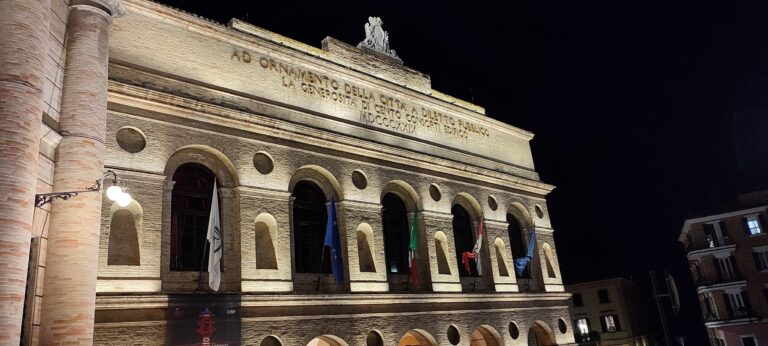
Umbria, Italy: The Region With No Sea and No Border
This is Umbria, Italy. It begins where the water changes direction. On the SS77 between Foligno and Colfiorito, the road climbs onto the Apennine watershed. For about ninety seconds, neither region below has any claim on you. To the east, valleys drain toward Le Marche and the Adriatic. To the west, the water runs toward the Tiber and Umbria. Nothing marks the crossing except a change in the road signs. Look closely and you will also see a shift in the color of the stone used to build the farmhouses. This guide covers why 2026 is a big year to visit Umbria. It also offers what a neighbor from across that ridge would tell you before you go.
A note on links: a few of the booking links further down are affiliate links. If you book through one, I earn a small commission at no additional cost to you.
What Is Umbria, Exactly?
Umbria sits in the exact center of Italy. Tuscany borders it to the west. Le Marche borders it to the east. Lazio borders it to the south. It is the only Italian region with no coastline and no border with another country. That one fact shapes almost everything else about it. The regional capital is Perugia. The territory splits into two provinces, Perugia and Terni. Together they hold roughly 852,000 people, per the latest ISTAT estimate. Umbria has only 92 towns. That is fewer than any other ordinary-statute Italian region. Yet those 92 towns spread across a surprising amount of hill and mountain ground.
Tourism brochures call it the green heart of Italy. The label is worn out by now. It has stopped meaning much to the people who live there. But the phrase does point, clumsily, at something real. A landlocked region has no beach economy to fall back on. So its towns built their identity around hills, rivers, and high, defensible ground instead. Le Marche, just over that ridge, is my home ground. Umbria is the neighbor region I have crossed into for work and for wine more times than I can count. It reads differently once you stop hunting for a coast that was never going to appear.
A Region Shaped by Having No Coast
Take away the sea, and a region has to explain itself another way. Umbria’s answer is water it kept close, not water it never reached. The Tevere, known to the world as the Tiber once it reaches Rome, cuts the region in half. It has done so since Roman surveyors first measured it. Lake Trasimeno, Italy’s fourth-largest lake, sits near the Tuscan border. It holds three small islands that most visitors never learn exist, let alone visit. Near Terni, a cluster of natural springs called the Fonti del Clitunno drew Roman poets. Centuries later, painters and Romantic writers came too, just to watch clear water rise out of flat ground.
Without a coastline to build resorts on, Umbrian towns grew upward instead of outward. They stacked themselves on rock outcrops for defense. They also stacked themselves there for access to spring water, back when both mattered more than convenience. Orvieto sits on a plateau of volcanic rock. Sheer cliffs drop away from it on every side. Spoleto climbs a hillside so steep that a Roman aqueduct still works as the shortcut between its upper and lower halves. To a visitor passing through, the landscape simply reads as scenery. To the people who built it, every terrace, staircase, and rooftop was forced by ground that offered no easier option nearby.
Francis, Benedict, and Why 2026 Matters
Umbria produced two of the most important figures in Western Christianity. In 2026, both are back in the news at once. Francis of Assisi died on October 3, 1226. This year marks eight hundred years since his death. Benedict of Nursia was born in the town that now carries his name. He founded the monastic rule that shaped European monastic life for a thousand years afterward. Rita of Cascia, a later and much-loved saint, rounds out a trio. Together, the three make this small region matter more to Catholic pilgrimage than its size would suggest.
The anniversary carries a legal footnote that says something about how seriously Italy takes it. A law passed on October 8, 2025, restored October 4 as a national holiday, starting in 2026. October 4 is the feast of Saint Francis. It had quietly disappeared from the calendar more than four decades earlier. In 2026, the date falls on a Sunday. That softens its practical disruption. It does nothing to shrink Assisi’s own events, though, which run across both October 3 and October 4. The plan includes an evening memorial service on October 3. An overnight pilgrimage walk through the town’s Franciscan sites follows that same night. The morning of October 4 brings a Mass attended by Italy’s president, broadcast across the country. For the first time, Assisi’s own mayor will light the ceremonial lamp traditionally lit in the saint’s honor. In past years, one rotating region did the honor instead. Anyone visiting Assisi on those two specific dates should expect a very crowded town. Plan around it. Anyone visiting the rest of the year will simply find that the anniversary has added depth to an already layered story. We cover that story in more detail in our guide to the Way of Saint Francis.
What’s Actually Here
Spoleto
Spoleto solved its hillside problem with a Roman aqueduct that still carries foot traffic across a gorge. That one fact tells you most of what you need to know about how this town handles a hard problem. Its full story, including what the summer festival does to hotel prices, is in our Spoleto guide.
Perugia: Jazz in July, Chocolate in November
Perugia runs on two very different rhythms, depending on the month you arrive. July brings Umbria Jazz. The festival has pulled major international names to the city for decades, and it reshapes the historic center around outdoor stages. November brings Eurochocolate, a street festival built around chocolate, top to bottom. It turns the same streets into something closer to a trade fair, with much better smells. Our Eurochocolate guide covers the logistics for the newer and less familiar of the two events.
Montefalco and the Sagrantino Hills
Montefalco sits above vineyards that grow Sagrantino, one of the most tannic red grapes in Italy. The wine nearly disappeared in the twentieth century. A handful of local producers rebuilt its reputation almost from scratch. The full story, and why the grape’s intensity makes it a poor match for casual sipping, is in our Sagrantino guide.
Spello and the Flower Carpets
Every June, Spello’s residents spend an entire night laying flower petals into elaborate street murals. They work ahead of the Corpus Christi procession. Family teams often hold the same stretch of street for generations. Then they watch the whole composition get walked over by morning. Our Infiorate di Spello guide explains how the tradition actually works, and how to see it without ruining someone else’s night of work.
The Olive Belt and Frantoi Aperti
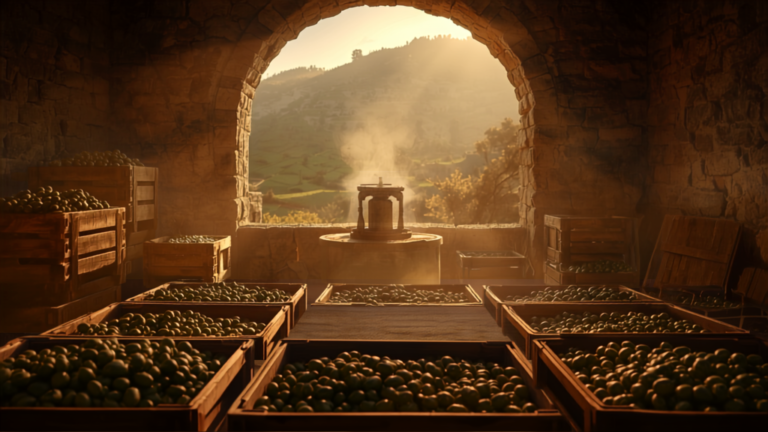
Between Assisi and Spoleto, roughly nine thousand hectares of terraced olive groves earned UN recognition in 2018. It is one of only a handful of sites in Italy to earn that kind of global heritage status. Each autumn, the Frantoi Aperti festival opens working mills across the region to visitors. You can watch, and taste, the actual pressing process. The weekend-by-weekend detail belongs to that dedicated guide, not here. The broader culture of visiting a working frantoio is covered separately too.
Norcia, Castelluccio, and the Sibillini
Norcia gave Italian cooking its word for a pork butcher, norcineria. The trade is so tied to this one town that the name traveled with it across the country. Norcia also gave the monastic world Saint Benedict himself. Above the town, the Sibillini mountains rise sharply enough to feel truly alpine, not just hilly. Below them, the Castelluccio plain turns into a startling patchwork of color each summer. Wildflowers bloom in rotation among the lentil fields. Both threads get fuller treatment in our Sibillini guide and our truffle season calendar. Black truffles come from these same slopes and the same limestone soil.
Orvieto and Todi: Two Towns Held Up by an Act of Parliament
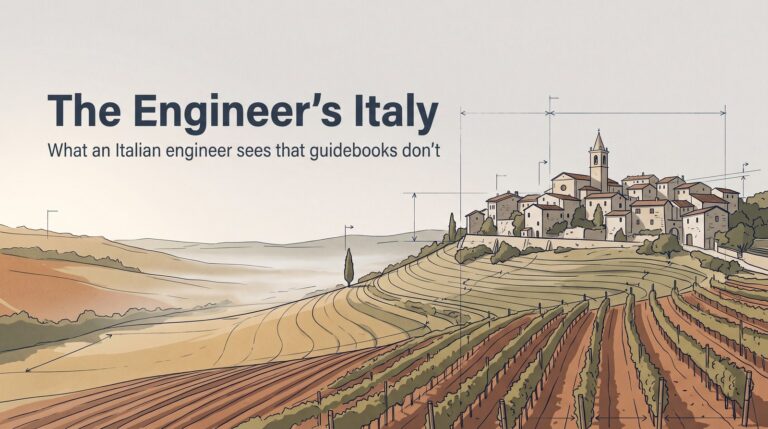
Orvieto and Todi share a problem most tourist towns never think about. The ground underneath them is failing. Both sit on unstable rock that has been sliding, slowly and unevenly, for centuries. Both needed national law just to survive in anything close to their current form. A 1978 law set aside the equivalent of several billion lire. The money went to stabilize Orvieto’s volcanic cliff and Todi’s hillside. It followed a run of landslides through the 1970s that made the danger impossible to keep ignoring. Earlier government decrees had already flagged both towns as at risk decades before that, as far back as 1916 and 1935. Tourists photograph today’s clifftop view as impossibly scenic. Underneath the postcard, it is one of the longest-running engineering projects in Italian history.
The Waterfall the Romans Built
Cascata delle Marmore, a short drive from Terni, is not a natural feature at all. Roman engineers built it in 271 BC. The consul Manius Curius Dentatus ordered a canal dug to drain a malarial swamp. The canal sent the diverted Velino River over a cliff and into the Nera below. At 165 meters across three drops, it ranks among the tallest waterfalls in Europe. It still makes hydroelectric power today. That is why the flow switches on and off on a published schedule, instead of running all day.
The Earthquakes, Honestly
Umbria sits on one of the more active fault lines in the Apennines. Pretending otherwise would insult both the region’s history and the engineering that keeps it standing today. On September 26, 1997, two strong earthquakes struck within hours of each other, along the border with Le Marche. The first hit near Cesi, in Terni province, at 2:33 in the morning. The second and stronger quake struck a few hours later, near Colfiorito, closer to Foligno, in Perugia province. Eleven people died. Roughly eighty thousand were forced from their homes, across forty-eight towns spanning both regions. The image that traveled worldwide was the collapse of a vault inside the Basilica of San Francesco in Assisi. A local television crew caught it live. Four people died inside: two friars and two heritage officials. They happened to be checking earlier damage at the exact moment the second shock hit.
I have spent thirty years assessing buildings in seismic zones much like this one. The failure I see most often in older Italian churches is not the wall itself giving way. It is the joint between wall and roof, exactly what failed at Assisi. The basilica’s rebuild reopened for worship on November 28, 1999, just over two years after the collapse. Workers cataloged and reset the original frescoed stone fragments piece by piece, rather than replacing them. A second, even worse quake hit nearby Norcia on October 30, 2016. It destroyed roughly eighty percent of its own Basilica of San Benedetto in one violent shock. That church reopened in October 2025, after a rebuild that cost around fifteen million euros. 2026 marks ten years since the quake that closed it. Most of both towns reopened long ago, to residents and visitors alike. Some scaffolding remains where the hardest restoration work continues. A handful of smaller churches in the Sibillini foothills may still be closed on any given visit. That says nothing about the safety of the wider area.
Umbria or Le Marche?
Travelers choosing between Umbria and Le Marche are usually asking a narrower question underneath the obvious one. Which version of central Italy, minus the coastal crowds, actually fits this trip? Umbria wins on concentrated, world-famous art and religious history. Assisi, Orvieto’s cathedral, and Perugia’s museums pack more famous names into a smaller radius than Le Marche can match. That makes planning simpler for a first visit. Le Marche wins on range within a single day. It pairs Adriatic beaches with mountains and Renaissance hill towns, all inside one province. Umbria’s landlocked geography simply cannot offer that mix, no matter how you plan the trip. Neither region carries the crowds that now define Tuscany, and neither should be treated as some discount version of it. For how Le Marche itself stacks up against Tuscany, see our Tuscany versus Le Marche guide, which lays out that distinction province by province. That neighboring region, just across the ridge, is covered in full in our Le Marche guide. Anyone weighing an actual property purchase, not just a visit, should also read our guide to buying a house in Italy first. A view can come with problems a rental never would.
When to Go
Late spring turns the olive terraces a deep, glossy green. It also fills the Corpus Christi calendar with flower festivals, Spello’s among the best known. Summer brings Umbria Jazz and the Castelluccio flower bloom. It also brings the heaviest crowds and the highest heat of the year, hard going on Orvieto and Assisi’s stone streets by early afternoon. Autumn is arguably Umbria’s strongest season on balance. Frantoi Aperti runs the olive mills from mid-October through mid-November. Black truffles come into season across the Sibillini foothills. Eurochocolate closes out the year in Perugia in November. Winter runs quiet almost everywhere. The exception is the October 4 holiday itself, when Assisi briefly fills again no matter the season around it. Our guide to Italy in October has a fuller month-by-month breakdown, including why October rewards a patient traveler over a rushed one.
Planning Your Visit
Getting There
Most American visitors reach Umbria through Rome Fiumicino or Florence, then continue by train or rental car. Direct trains connect Rome to Foligno and to Orvieto in roughly one and a half to two hours. That makes either city a realistic day trip, even without a car. Perugia’s own airport, San Francesco d’Assisi, runs a modest schedule of mostly European routes. It works well if a flight connection already exists. It is not a practical first choice when flying directly from the United States.
Where to Base Yourself
Spoleto and Orvieto both work well as a single base. Day trips radiate outward from either one, to smaller towns in under an hour. Perugia suits travelers who want city energy alongside serious museum time and a livelier evening scene. Montefalco or Bevagna suit anyone building the trip around wine, food, and slow afternoons, rather than a checklist of sights.
Driving, ZTL, and Hill-Town Parking
Nearly every hill town restricts vehicle access to a historic core. Italians mark this zone ZTL. Cameras enforce it automatically, not a person standing at a gate. Park outside the marked zone before you walk in. In towns like Perugia or Orvieto, use the escalators and funiculars built to move people up from parking down in the valley. That beats circling for a space near the top that rarely exists.
What I Would Skip
I would skip the bundled day-trip bus tours that promise Assisi from Rome and back in a single afternoon. They spend more time on the highway than inside the town itself. The math rarely works out better than a direct train ticket and a slower, calmer pace through the same streets. I would also skip driving into central Perugia when a funicular or the Minimetrò line does the climb for you. Neither one comes with the stress of finding parking on a medieval street built centuries before cars existed. And unless the centenary itself is the reason for the trip, I would avoid Assisi specifically on October 3 and 4, 2026. Every other week of the year hands you the same basilica, with enough room to actually stand in front of it and look.
Booking Notes: What I Would Actually Reserve
The one I would book ahead: the Old Town walking tour in Perugia. The Perugia Old Town Walking Tour around Piazza IV Novembre runs about ninety minutes, skips the ticket line, and takes you down into the Rocca Paolina passages mentioned above, the same escalators and tunnels that save you from hunting for parking on a medieval street. It holds a 4.7-star rating across more than three hundred reviews, and it runs for around thirty-five dollars a head, cheap enough that skipping it to save money is a false economy.
What I would skip: paying extra for a separate Rocca Paolina entry ticket. Walking into the Rocca Paolina passages on your own costs nothing; the fortress and its underground streets are open to the public free of charge. The guided version earns its price through the storytelling, not through access you would otherwise be denied, so treat any listing that prices the passages themselves as a paid attraction with some suspicion.
FAQ — Planning Your Umbria Visit
Where is Umbria?
Umbria sits in central Italy. Tuscany borders it to the west, Le Marche to the east, and Lazio to the south. It is the only Italian region with neither a coastline nor a border with another country.
How many days do you need?
Four days covers Assisi, Perugia, and one smaller town without rushing between them. A week to ten days allows time for Orvieto, Spoleto, and the Sibillini mountains at a comfortable, unhurried pace.
Can you visit Umbria without a car?
Yes, for the main towns. Trains connect Perugia, Assisi, Foligno, Spoleto, and Orvieto reasonably well, and run often enough to plan around. A car becomes genuinely useful mainly for reaching Montefalco, Castelluccio, and smaller villages that sit off the rail line entirely.
Umbria or Tuscany?
Both regions offer hill towns and serious wine country. Umbria is smaller, less crowded, and generally less expensive to visit. Tuscany carries wider name recognition abroad, plus a broader range of luxury options for travelers who want that.
What is happening in Assisi on October 4, 2026?
Assisi marks eight hundred years since the death of Saint Francis with a Mass attended by Italy’s president. An overnight pilgrimage walk happens the evening before. The date returns as a national holiday, after decades off the official calendar.
Is Umbria safe to visit after the earthquakes?
Yes. The towns hit hardest by the 1997 and 2016 earthquakes have been rebuilt to updated seismic standards. The specific sites travelers visit, including the basilicas in Assisi and Norcia, are open and certified safe for public use. A small number of buildings in outlying villages remain under restoration and closed to visitors.
What should first-time visitors pair Umbria with?
Many travelers combine Umbria with Le Marche. The two regions share a mountain border and a similarly uncrowded character on either side of it. See the comparison above for how the two actually differ, or how to combine both into one longer trip.
The Final Word
Umbria rewards the traveler willing to trade a beach for a basilica. It rewards you for trading a coastline for a river valley that has quietly run the same course since before Rome existed to measure it. Maybe 2026 draws you here for the Franciscan anniversary. Maybe it is the wine, or simply the absence of a crowd. Either way, the region tends to make its case slowly, one hill town at a time, rather than all at once from a highway sign. Want help building an itinerary around central Italy, including how Umbria and Le Marche fit together on one trip? Reach out through our About page for a consultation grounded in thirty years of work on this side of the Apennines.