Where to Eat Truffle in Italy: Acqualagna vs Alba, by an Italian Who Lives in Truffle Country
The first truffle I ever ate was not in a restaurant. It was shaved over scrambled eggs at a kitchen table in a farmhouse outside Cagli, in the northern Marche, on a November morning sometime in the early 1980s. The man who made the eggs was a farmer named Alvaro who had found the truffle that morning, two hours before sunrise, with a dog of uncertain breed and absolute certainty of purpose. The truffle weighed perhaps 80 grams. Alvaro treated it the way another man might treat a found banknote — pleased, unsurprised, matter-of-fact. He shaved it over the eggs with a pocket knife and a small tool he kept in his jacket, and we ate standing at the counter while the November light came slowly through the kitchen window.
That is the experience this article is actually about: not the truffle as luxury product, not the truffle as status symbol on a restaurant menu, but the truffle as a thing that grows in this specific soil, under these specific oaks, found by these specific people in these specific hills. Understanding that distinction is the difference between spending a lot of money to eat truffle in Italy and actually understanding what you are eating.
I live in the Marche. I have worked as a civil engineer in this region for thirty years, which means I have driven the roads through truffle country in every season and spent time in the farmhouses and small towns where the truffle economy is not a marketing concept but a weekly reality. When American friends ask me whether to go to Alba or Acqualagna for truffles, I give them a longer answer than they expected. This is that answer.
First: The Two Types of Truffle That Matter
Before the geography, the biology — because the most common mistake American travelers make when planning a truffle trip is conflating two entirely different fungi that happen to share a name.
The white truffle (Tuber magnatum Pico) is the one you have read about. It is the truffle that sells for €3,000 to €5,000 per kilogram in good years, occasionally more in exceptional ones. It cannot be cultivated. It grows in specific soil conditions — alkaline, clay-based, well-drained — in a mycorrhizal relationship with certain tree roots, primarily oak, poplar, and willow. The season runs from early October to late December, with the peak in November. When Alba and Acqualagna argue about supremacy, this is the truffle they are arguing about.
The black truffle (Tuber melanosporum, also called the Périgord or Norcia truffle) is more widely distributed, less aromantically volatile, and significantly cheaper — typically €300 to €800 per kilogram depending on the season and grade. It is the truffle most commonly used in restaurant cooking because it holds up to heat better than the white. It can be partially cultivated in inoculated hazelnut and oak plantations. Its season peaks in winter, January through March, with the most significant Italian production centered on Norcia in Umbria and Spoleto.
A third truffle worth knowing in this territory is the summer truffle (Tuber aestivum, known locally as scorzone) — harvested June through September, much less aromatic than either white or black, and the truffle most often used in the truffle products (oil, paste, cream) sold in Italian supermarkets and airport gift shops. If you buy a €12 jar of “truffle paste” at a souvenir stand, this is almost certainly what is inside it. It is a legitimate food product. It is not what anyone means when they discuss Italian truffle cuisine at its level.
Alba: The Famous One
Alba is a town of approximately 32,000 people in the Langhe hills of Piedmont, southwest of Turin, surrounded by the vineyards that produce Barolo, Barbaresco, and Barbera d’Asti. The Fiera del Tartufo Bianco d’Alba — the White Truffle Fair — has been held annually since 1929, runs for six weeks from mid-October through December, and has become one of the most internationally marketed food events in Italy. The truffle auction, held in early November, attracts buyers from Japan, the United States, the Gulf states, and across Europe. A single exceptional specimen has sold for more than €100,000 at charity auction.
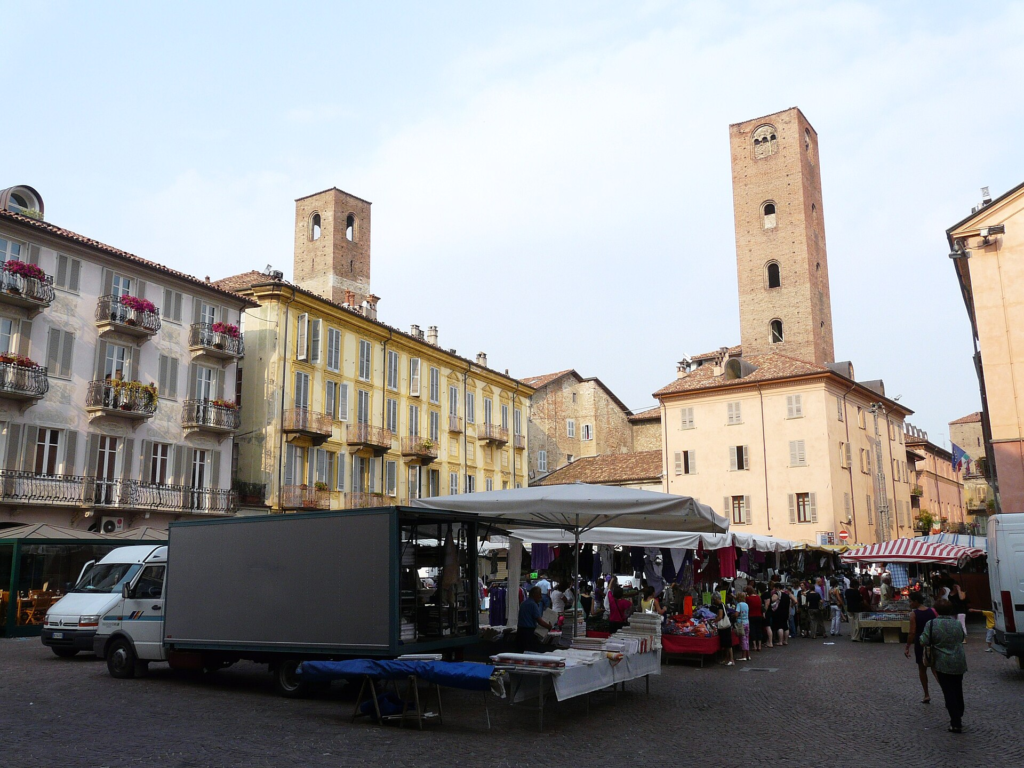
Alba is genuinely excellent. The town is beautiful in the Piedmontese manner — broad streets, substantial Baroque buildings, the specific quality of a prosperous agricultural city that has never needed to perform poverty. The restaurants in and around Alba represent some of the finest cooking in Italy: the combination of Langhe white truffle with Barolo, tajarin pasta (the thin Piedmontese egg noodle), fonduta, and aged Castelmagno cheese constitutes one of the great regional cuisines of Europe. This is not a controversial claim.
What Alba is, however, is famous. The Fiera receives between 600,000 and 800,000 visitors in its six-week run. The restaurants with the best truffle menus are booked weeks in advance in October and November. Hotel prices in the Langhe in truffle season are among the highest in northern Italy outside the major cities. The truffle market itself — where certified local truffles are sold each Saturday morning — is surrounded by photographers, journalists, tour groups, and the specific atmosphere of a product that has been successfully marketed to the world and priced accordingly.
None of this is a flaw. It is a description. If you want the full spectacle of Italian truffle season, expertly organized and beautifully presented, Alba delivers it with a reliability that reflects ninety-five years of practice.
Acqualagna: The One the Italians Know
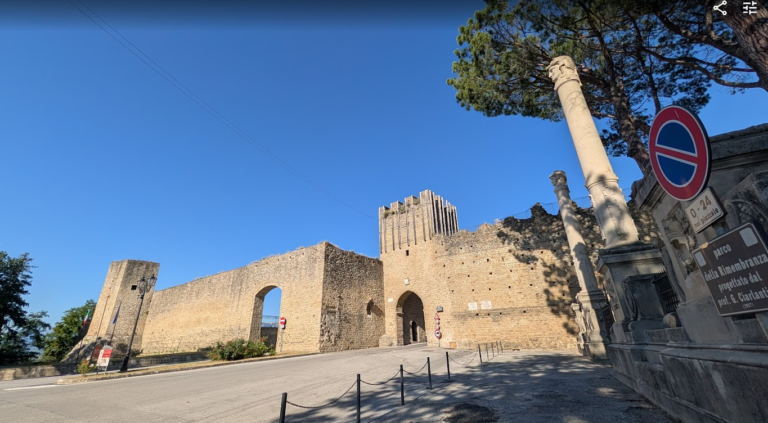
Acqualagna is a town of approximately 4,300 people in the Metauro Valley of the northern Marche, between Fano on the coast and Urbino in the hills. It has a thirteenth-century tower, a reasonable bar, a few trattorias, and several truffle dealers whose operations range from a room in a family house to a fully commercial enterprise with refrigerated storage and direct export relationships.
It also sits at the center of one of the three most productive white truffle territories in Italy — alongside Alba and the area around San Miniato in Tuscany — in a geological formation that the truffle hunters of the Marche have worked for generations. The triforaio (truffle hunter) culture here is not a heritage performance for visitors. It is an economic activity embedded in family life in a way that has not changed structurally since before the republic.
The Fiera Nazionale del Tartufo Bianco in Acqualagna is held on three weekends in October and November. Attendance is roughly 30,000 to 40,000 visitors per event — a fraction of Alba’s numbers. The truffle market is an actual working market, not a curated exhibition: hunters arrive with their truffles, dealers grade and buy, the price is negotiated directly, and by midmorning the best specimens have changed hands without being photographed for a press release. If you arrive at eight in the morning in late October, you will see truffle being sold in the same functional way it has been sold here for a century.
The price difference is real and consistent. White truffle purchased directly from hunters or small dealers in Acqualagna typically runs 15–25% cheaper than equivalent-grade truffle at the Alba market, for reasons that are partly logistical (lower operating costs, less international buyer competition) and partly structural (the Langhe has more Michelin-starred restaurants per square kilometer than almost anywhere in Italy, which compresses supply and elevates price). The truffle is the same fungus from the same Apennine geology. The markup reflects location, not quality.
What You Actually Eat: The Kitchens of the Marche
The more important difference between the two territories, for the traveling food lover, is not the price of the raw truffle but the cooking tradition that surrounds it.
In the Langhe, truffle is integrated into a cuisine of extraordinary refinement: tajarin with 40 egg yolks per kilogram of flour, agnolotti del plin, fonduta from Castelmagno, vitello tonnato. It is a rich, butter-based, cattle-country cuisine elevated by the proximity of the world’s most aromatic fungus. The combination is impeccable. It is also something that has been replicated, in varying degrees of success, in Italian restaurants on six continents.
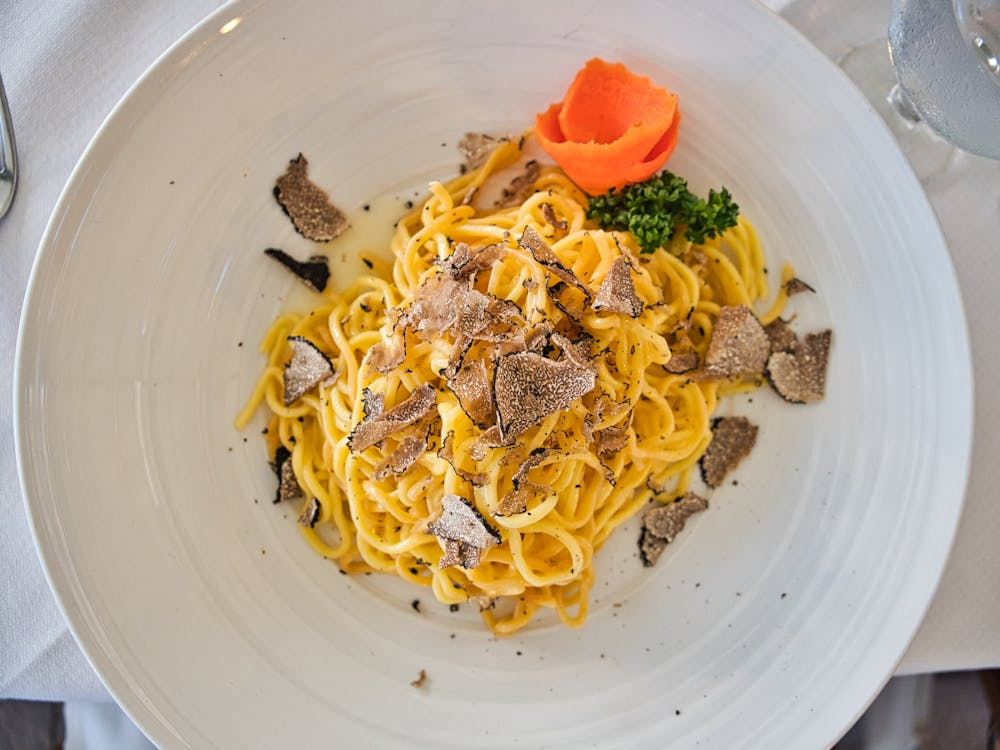
The Marche truffle kitchen is less internationally known and significantly harder to find outside the region. The local pasta is tagliolini — thinner than tajarin, made with fewer yolks, rolled by hand with a particular looseness that creates a rough surface for the sauce to grip. The sauce is sometimes just butter and a few drops of cooking water. The truffle is shaved over the top at the table, in quantity, without ceremony. There may also be crescia — the flatbread of the Marche, cooked on a griddle, served hot and folded around shaved truffle and nothing else. There may be scrambled eggs, the simplest possible vehicle and, in the opinion of most truffle hunters I have spoken with over thirty years, the correct one: the egg amplifies the aromatic compounds in the truffle in a way that more elaborate preparations sometimes obscure.
The farmhouse and trattoria context in which this food is served is not staged. In the towns around Acqualagna — Sant’Angelo in Vado (another significant truffle center, 20 kilometers to the south), Apecchio, Cagli — there are restaurants that have been serving essentially the same truffle menu for decades, to the same local clientele plus whoever arrives from outside and knows where to look. The tables are plain, the wine is local Verdicchio or a light red from the hills, the portion of truffle shaved over your pasta is determined by what is available and what the cook thinks is appropriate, not by a gram scale and a menu price.
I have eaten truffle in both territories many times, in contexts ranging from Michelin-starred to roadside. My honest view: the best truffle meal I have eaten was in a trattoria in the Marche with eight tables and no website. The truffle was from a hunter who had delivered it that morning. The tagliolini was hand-rolled by the owner’s wife. The bill was €35 including wine. I am aware this is not a reproducible data point. It is, however, an accurate one.
The Practical Question: Which Should You Choose?
The answer depends on what kind of trip you are planning and what you want from it.
Choose Alba if: you are spending a week in Piedmont, you want to combine truffle with Barolo and Barbaresco wine touring, you value organized infrastructure and a guarantee of quality, you are traveling in a group that benefits from English-speaking services, or you specifically want the spectacle of a famous Italian food event done at its highest level. Alba is worth every moment and every euro. It delivers exactly what it promises.
Choose Acqualagna if: you are already in the Marche or planning a trip that includes Urbino, the Sibillini, or the Adriatic coast — the truffle territory is immediately adjacent to the rest of the region’s itinerary. Choose Acqualagna if you want to buy white truffle directly and bring it home or cook with it at your accommodation. Choose it if you want to eat in a small trattoria where the proprietor knows the hunter who found your truffle that morning. Choose it if you want to attend a market where the transaction is a working economic exchange rather than a cultural performance.
The combined itinerary: It is not an either/or. A trip that begins in Turin with a day or two in the Langhe for Barolo and truffle, then crosses the Apennines east to the Marche for Urbino and the Frasassi Caves and a meal in the Metauro Valley, is one of the better autumn itineraries in central-northern Italy. The drive from Alba to Acqualagna via the A26, A7, and A14 is approximately four hours — feasible in a day with a stop.
The Truffle Fairs: Dates and Logistics
Fiera Nazionale del Tartufo Bianco di Alba
Held annually from mid-October through the first Sunday of December (approximately six weeks). The main truffle market is held each Saturday and Sunday morning in the Cortile della Maddalena. Tickets to the fair: approximately €5 entry. Restaurants and hotels in the Langhe require advance booking from late September; the first two weekends of November are the most competitive period.
Website: fieradeltartufo.org
Fiera Nazionale del Tartufo Bianco di Acqualagna
Three weekends in late October and November (dates vary slightly each year; check the official calendar). Free entry. The market is held in the town center. Accommodation in Acqualagna itself is limited; Fano (35 km east) and Urbino (30 km northeast) are practical bases with more options.
Website: acqualagna.com/tartufo
Sant’Angelo in Vado — Mostra Mercato Nazionale del Tartufo Bianco Pregiato
A smaller but genuinely local truffle fair held in October, 20 km south of Acqualagna in the Metauro Valley. Fewer visitors, more direct market character, excellent local trattorias. Often overlooked even by Italian visitors from outside the Marche.
Practical Information
When to go for white truffle: The reliable window is mid-October through late November, with the peak in the first two to three weeks of November. By early December, the season is winding down and quality becomes inconsistent. A cold, wet autumn produces more truffles and better aromatics; a dry September through October compresses the season.
Buying truffle to take home: White truffle does not travel well. The volatile aromatic compounds that give it its value dissipate within five to seven days of harvest, faster at room temperature. If you buy truffle at a market, consume it within three to four days. Wrap it in a dry paper towel changed daily, stored in a sealed glass jar in the refrigerator. Do not store it in rice — this is a widespread piece of advice that is incorrect; rice absorbs the aromatics rather than preserving them.
What to cook with it: The correct vehicles for fresh white truffle are those with a neutral fat base that carries the aroma: butter pasta (with very little else), scrambled or fried eggs, a fonduta, carpaccio of raw beef. White truffle is always shaved raw, never cooked. Heat destroys the volatile compounds within minutes.
How much do you need: At the table, a portion of 5 to 8 grams of shaved white truffle over a plate of pasta is considered generous. At current market prices (€2,500–4,000/kg depending on year and grade), that is €12–32 of truffle per portion at market price — less than the equivalent in most Italian restaurants, where the margin is substantial.
Getting to Acqualagna: By car from Rome, approximately 3 hours via A24 and SS3bis. From Bologna, approximately 1.5 hours via A14. From Ancona, approximately 1 hour via A14 and SS73bis. There is no direct train to Acqualagna; the nearest station is Fossombrone on the Fano–Urbino bus line, with connections from Fano on the Adriatic coast.
FAQ
Is Acqualagna truffle the same quality as Alba truffle?
Yes. Both come from the same species (Tuber magnatum Pico) growing in similar Apennine geological conditions. Quality varies by year, by individual specimen, and by how recently the truffle was harvested — not by geographic origin. The price difference reflects market conditions and the cost structure of the two territories, not a quality differential.
When is truffle season in Italy?
White truffle (Tuber magnatum) season opens on October 1 in most of central and northern Italy and closes anywhere between December 31 and January 31 depending on the region, peaking in November. The exact dates are set by regional law rather than tradition, and I have mapped them species by species in my guide to the legal truffle calendar. Black Périgord truffle (Tuber melanosporum) peaks in January through March, centered on Norcia and Spoleto in Umbria. Summer truffle (Tuber aestivum) is harvested June through September and has significantly less aroma than either.
Can I go truffle hunting in the Marche?
Yes. Several operators near Acqualagna and Sant’Angelo in Vado offer guided truffle hunting experiences with licensed hunters and trained dogs. These are not staged experiences: the hunters hold actual licenses, the dogs are working dogs, and you go into actual truffle woodland. Booking in advance is necessary for October and November. Expect an early start — most hunts begin before dawn.
What should I order in a Marche trattoria to eat truffle correctly?
Tagliolini al tartufo bianco — hand-rolled thin pasta with butter and shaved white truffle — is the standard. If the menu lists crescia al tartufo, order it: the Marche flatbread with raw truffle is one of the most direct expressions of the truffle’s flavor. Avoid anything involving cream, truffle oil, or heavy sauces in combination with fresh white truffle. Simplicity is correct here.
Is the truffle sold at the fairs guaranteed authentic?
At both Alba and Acqualagna, the market truffle is graded and certified by official inspectors. The risk of fraud (adulterated or misidentified truffle) is significantly lower at official market events than when purchasing from informal roadside vendors or online. If buying outside the fair, purchase from an established dealer with documentation.
How much does a truffle meal cost in the Marche?
In the trattorias around Acqualagna and Sant’Angelo in Vado, a full truffle menu — antipasto, tagliolini al tartufo, a secondo, wine — typically costs €40–60 per person. This is substantially less than the equivalent in the Langhe or in the major Italian cities, for food that is often more direct and less processed.
Can I buy truffle products (oil, paste) as souvenirs?
Truffle-flavored oils and pastes are widely available and make reasonable souvenirs, with one important caveat: most commercial truffle oil is made with synthetic truffle aroma (2,4-dithiapentane), not actual truffle. Check the label for tartufo vero or a specific truffle species. The jars of truffle paste from local Marche producers — made with summer truffle or black truffle at a minimum — are a more reliable choice than the generic products sold in tourist shops throughout Italy.
Is it worth visiting Acqualagna outside truffle season?
The town itself has limited tourist infrastructure outside the fair period. The surrounding territory — the Metauro Valley, the road to Urbino, the Furlo Gorge (a dramatic limestone canyon on the Via Flaminia approximately 15 km south) — is worth driving through in any season. For food, the area has good trattorias year-round serving Marche cooking without the truffle premium.
Plan a Truffle Trip to the Marche
If you are planning an autumn trip to Le Marche built around truffle season — combining Acqualagna or Sant’Angelo in Vado with Urbino, the Frasassi Caves, or the Adriatic coast — I offer online consultations for exactly this kind of itinerary planning. Truffle season in the Marche is also opera season at the Sferisterio in Macerata and harvest season in the Verdicchio vineyards. The overlap is not coincidental: this is when the region is fully itself.
Get in touch about itinerary planning
And if you want the articles I publish on the Italy that does not appear in most guidebooks — including advance notes on the truffle season each year — the newsletter is where to start.
[Subscribe to the Tastes & Wonders newsletter]
Related reading on this blog:
– Le Marche: The Italian Region Where the Mediterranean Diet Was Born
– Urbino: The Renaissance City That Most Americans Have Never Heard Of (forthcoming)
– Tuscany vs Le Marche: Which Italian Region Should You Actually Visit? (forthcoming)
– Verdicchio: The Italian White Wine That Beats Sancerre at Half the Price (forthcoming)