The Bargello: Florence’s Oldest Public Building, Its Former Prison, and the Room Where the Renaissance Began
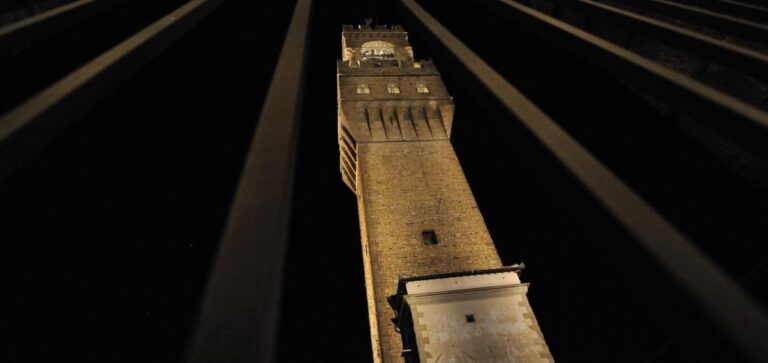
The Bargello Museum in Florence keeps its courtyard quiet at nine in the morning. A stone well sits at its center. Carved coats of arms line the walls above it, one for every podestà who once governed Florence from this building. Look up. The Torre della Volognana rises fifty-seven meters into the sky. A man named Geri da Volognano was the first prisoner locked in its cramped basement cell.
This courtyard once held a gallows. In 1479, a conspirator named Bernardo Bandini Baroncelli was hanged from a window just above your head. He was still wearing the clothes he had on when Ottoman authorities handed him over to the Medici. Leonardo da Vinci sketched him that same day. He even noted the color of the man’s doublet, in his own mirror-written hand.
Thirty-four years later, in the winter of 1513, a disgraced diplomat spent twenty-two days in a cell somewhere in this palace. His name was Niccolò Machiavelli. Guards dislocated his shoulders with the strappado. Between sessions, he wrote sonnets protesting his innocence.
None of this is on the ticket. Most visitors walk straight through this courtyard. They head for the stairs, phones already out, chasing one specific bronze boy on the floor above. They are not wrong to hurry. But the building itself is doing just as much work as anything inside it. I have spent thirty years reading historic buildings for a living. I rarely walk past a bricked-up arch without stopping to ask what it used to be.
A note on links: some of the booking links in this article are affiliate links, and I earn a small commission if you book through them, at no extra cost to you. The Bargello’s own admission is deliberately not among them. That ticket costs less from the museum’s official channel, and I say so below.
What the Bargello Museum in Florence Actually Is
The Bargello Museum, formally the Museo Nazionale del Bargello, occupies Florence’s oldest surviving public building. Construction began in 1255, for the city’s chief magistrate. The building later became a prison, then a police headquarters. In 1865, it reopened as Italy’s first national museum.
Today it holds the world’s most important collection of Italian Renaissance sculpture. That includes three separate statues of David, Michelangelo’s early Bacchus, and the two competing bronze panels that launched the 1401 Baptistery doors competition. Unlike the Uffizi or the Accademia, the Bargello rewards visitors who read the building itself, not only the objects inside it.
Reading a Building from 1255: What Six Centuries of Changed Use Leave Behind
Look closely at the exterior stone. You can date this building almost like tree rings. The original two-story structure went up starting in 1255. It absorbed an older tower and a scatter of houses that belonged to a Florentine family called Boscoli. A fire tore through the palace in 1323. The third story added afterward uses visibly smaller stone blocks than the floors below it. Any mason of the period would have recognized that detail instantly. So does any structural engineer today. The arcaded courtyard came later still, built out around 1280. The grand external staircase you climb to reach the upper galleries was added between 1345 and 1367, by the architect Neri di Fioravante.
For roughly three centuries after that, the building turned on itself. It became the seat of the Bargello, the chief of police, in the second half of the 1500s. From that point on, its open arcades were bricked up one by one. The generous council halls, where podestà once heard city business, were sliced into rows of narrow cells. Workers threw up hasty partition walls to make room for more prisoners. Frescoes disappeared under thick layers of plaster, not to protect them but to erase them.
This is the part I recognize from my own work, no museum label required. A walled-up arch is never neutral. It always marks the exact moment a building’s purpose changed against its own architecture. Someone, somewhere, decided the old function no longer mattered.
The reversal came only after Grand Duke Pietro Leopoldo abolished the death penalty here in 1786. He was the first ruler in Europe to do so. It ended the executions that had defined this courtyard for centuries. Even so, the building kept working as a police headquarters and prison for another seventy years.
Then, in 1857, Florence moved its prisons to the former convent of the Murate. Restoration of the Bargello finally began, under the architect Francesco Mazzei. Bricked arches reopened. Partition walls came down. A restorer named Gaetano Bianchi repainted several halls in a Gothic-revival style. As an engineer rather than an art historian, I would say he invented as much medieval atmosphere as he preserved. On June 22, 1865, a royal decree declared the palace Italy’s first national museum. It was dedicated to the arts of the Middle Ages and the Renaissance. The building had spent six centuries changing its mind about what it was for. The museum is only its latest chapter, not the ending.
The 1401 Competition: Two Panels, One Fork in the Road
In 1401, Florence’s wool merchants’ guild, the Arte di Calimala, announced a competition. They wanted a second set of bronze doors for the city’s Baptistery. The first set, on the south side, had taken Andrea Pisano more than sixty years earlier. Seven sculptors entered this time. Each was asked to cast the same scene, the sacrifice of Isaac from the Book of Genesis, into a gilded bronze quatrefoil of matching size. A jury of thirty-four judges reviewed the results.
Only two panels survive today. Both hang side by side on a single wall of the Bargello. You can stand exactly where the judges once stood, and compare them yourself.
Lorenzo Ghiberti’s panel is fluid and economical. He cast it in fewer pieces, using less bronze, with drapery that curls around the figures in continuous, almost musical rhythms. Filippo Brunelleschi’s version is rawer, more violent, Abraham’s hand gripping Isaac’s throat with a tension Ghiberti never risks. The jury favored Ghiberti. According to the most common account, Brunelleschi refused to share the commission. It had been offered to him as a joint project. Instead, he left for Rome to study the ruins of antiquity.
That single decision reshaped Florence twice over. Ghiberti spent the next fifty years on the Baptistery doors. First came the North Doors, finished in 1424. Then came the East Doors, completed in 1452, which Michelangelo himself later nicknamed the Gates of Paradise. Brunelleschi, meanwhile, came back from Rome with an understanding of ancient construction that no one else in Florence possessed. Decades later, he used that knowledge to raise the dome of the cathedral, without any wooden scaffolding beneath it. Engineers still study how he pulled it off. If you want that second half of the story rather than just the panorama, a guided Duomo visit that ends with the 463-step dome climb covers the Baptistery and the Opera del Duomo Museum on the same pass, which is where Ghiberti’s original doors now live. It runs around $115 and holds a 4.7 rating, checked in August 2026.
Two young sculptors lost the same competition on the same afternoon in 1401. One of them built the most celebrated doors in the history of bronze casting. The other built the dome that still defines the Florence skyline. Both outcomes started in this room.
Three Davids, No Line
Walk a few steps further, into the Salone di Donatello, and you find something no other museum in the city offers. Three separate statues of David stand here, made across roughly seven decades. You can compare all three in a single glance, with none of the crowds that gather two kilometers away for a fourth version by Michelangelo.
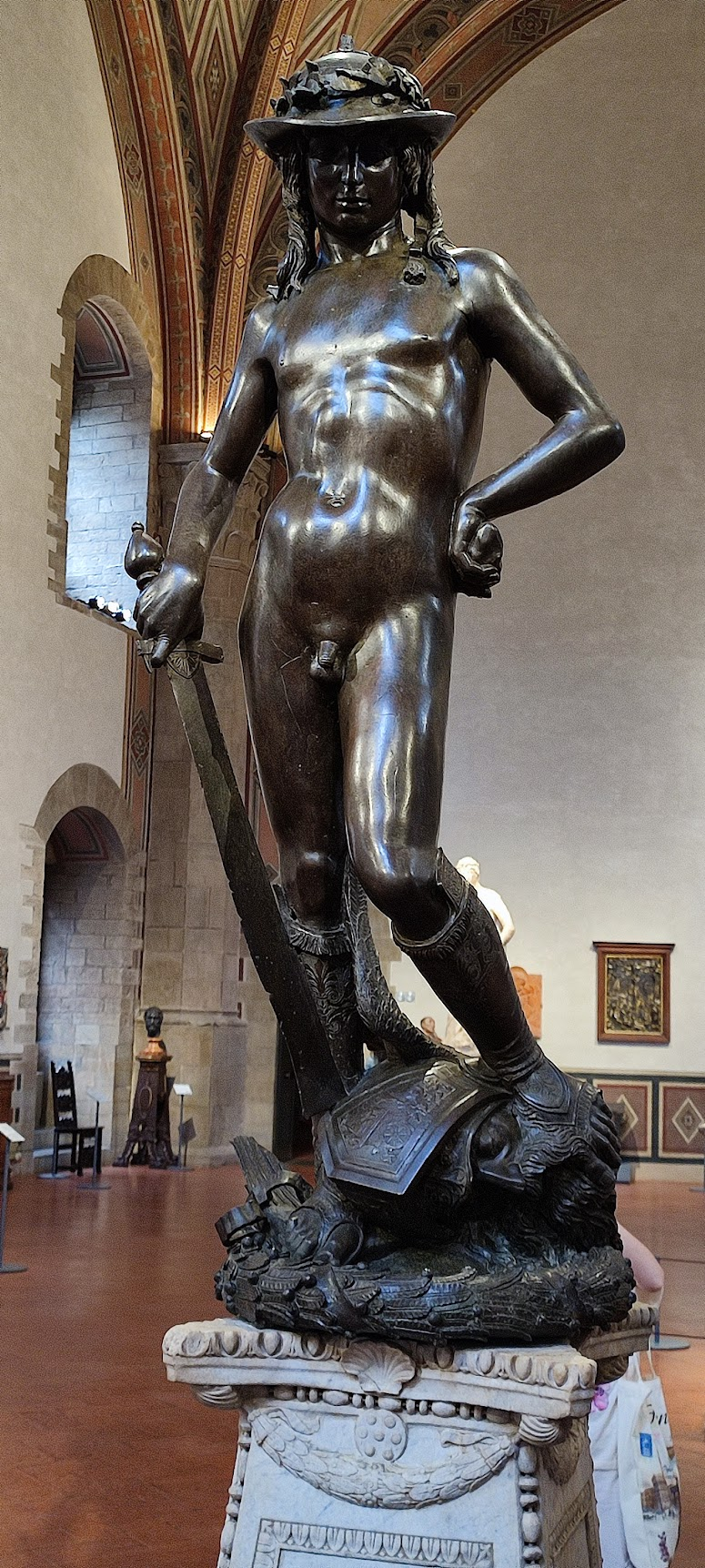
Donatello made the earliest one first, in marble, around 1408, for the cathedral’s building works. It is a clothed, almost Gothic figure. The Florentine government moved it to the Palazzo Vecchio in 1416, for political reasons. Decades later, Donatello returned to the subject, this time in bronze, and the result became one of the most important objects in Western sculpture. Scholars still argue fiercely over exactly when he made it. Proposed dates range from the 1420s to the 1460s, and no surviving document settles the question. The strongest current guess places it in the 1440s, tied to construction of the new Medici palace.
What is certain is what the statue accomplished technically. It is nude but for a laurel-topped hat and a pair of boots. Donatello’s bronze David was the first freestanding nude male statue cast since antiquity. It was also the first Renaissance bronze to stand entirely unsupported, without the stone tree-trunk or strut that marble sculpture almost always needs. Marble has to be propped. Bronze, cast hollow, does not. That distinction is a structural fact before it is an artistic one. It is also the reason Donatello’s David feels weightless in a way no marble figure quite manages.
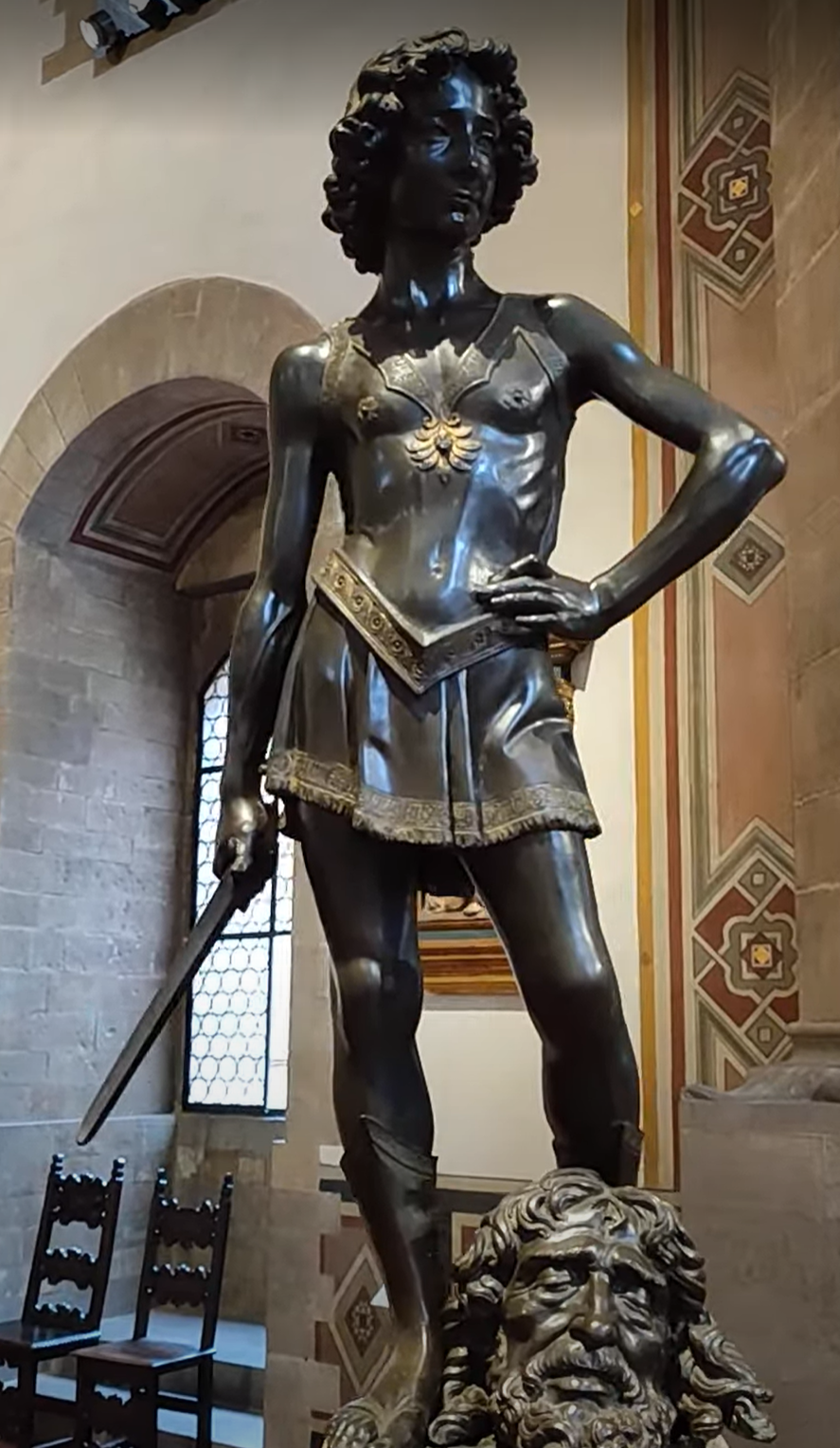
The third David arrived roughly three decades later. Andrea del Verrocchio cast it around 1473, for Piero de’ Medici. The Medici family sold it to the Florentine government in 1476. It was installed at the entrance to the Palazzo Vecchio’s Sala dei Gigli, where it briefly replaced Donatello’s own bronze David in the palace courtyard. Then a young Michelangelo’s marble giant displaced them both from public conversation entirely. Verrocchio’s David is clothed, confident, faintly amused. Tradition holds that he modeled it on his own workshop assistant, a teenager named Leonardo da Vinci, though the claim is impossible to confirm. For nearly two centuries, the statue was separated from Goliath’s severed head. The two pieces were finally reunited here, at the Bargello, in 1865.
None of this requires a reservation window or a fixed entry slot. You simply walk in.
The Rooms Most Visitors Skip
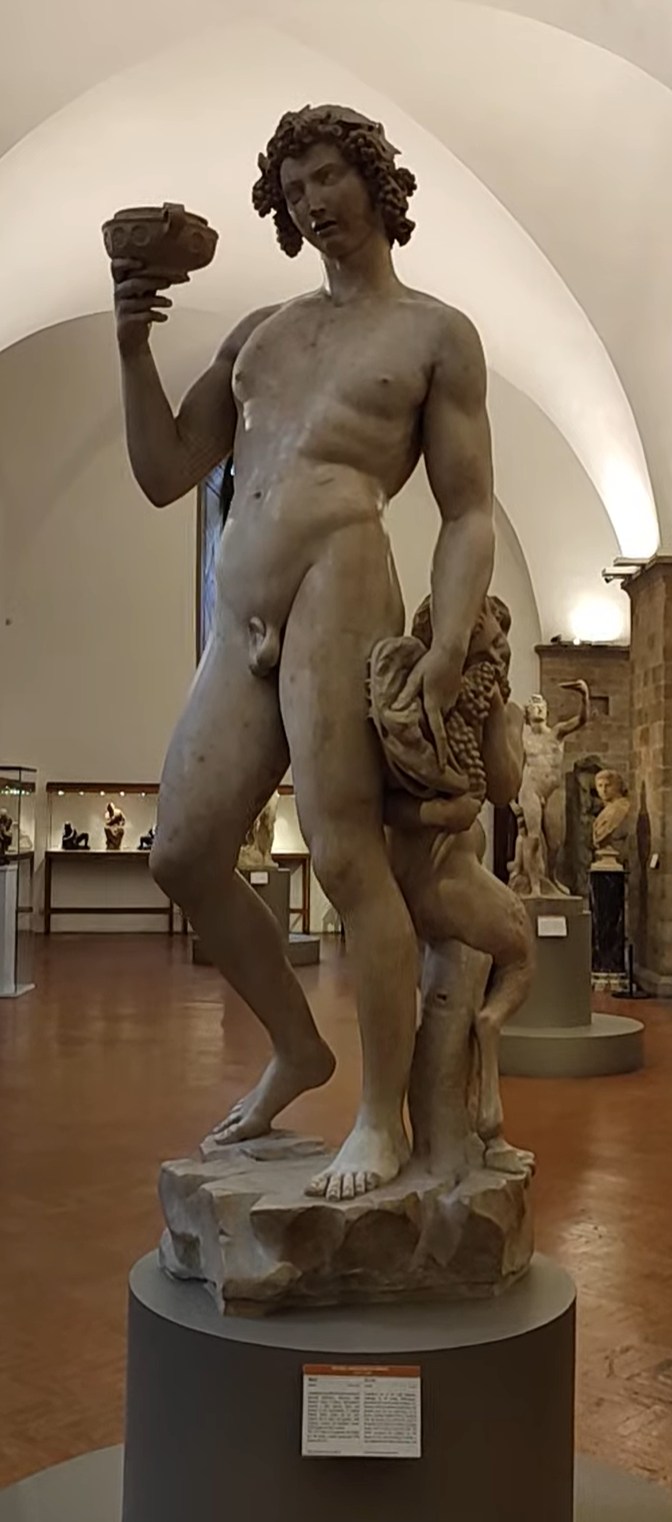
Past the Davids and the Michelangelo hall, most visitors head straight for the exit. That is a mistake. Several of the Bargello’s smaller rooms hold objects with no equivalent anywhere else in Florence.
The Sala degli Avori keeps the museum’s ivory collection. Its centerpiece is the Flabellum di Tournus, a liturgical fan carved in the ninth century. It is one of the rarest surviving objects of its kind in Europe. The Sala Islamica is easy to walk past entirely, but it holds Ottoman silk textiles and spherical perfume burners. They speak to Florence’s long trading relationship with the Islamic world, the same network that eventually returned Baroncelli to his execution.
The Cappella della Maddalena was the palace’s former chapel. Condemned prisoners once heard their last prayers here, before being led down to the courtyard. Its walls carry a portrait of Dante at the foot of Giotto’s Paradise. Scholars rediscovered it under layers of whitewash only in the 1840s, after decades of searching, convinced the fresco still existed somewhere.
In the Armeria, a ceremonial shield made by Gasparo Mola for Cosimo II sits near a Franco-Flemish tapestry depicting the fall of Jerusalem. The Sala della Scultura Barocca is easy to miss on the way out. Inside it, Gianlorenzo Bernini’s bust of Costanza Bonarelli captures his own mistress with an intimacy that has nothing formal about it.
None of these rooms will be crowded. That is precisely the point.
How to Visit
Hours and closures in 2026
Since March 15, 2026, the Bargello has shared unified opening hours with the Accademia Gallery. The museum opens Tuesday through Sunday, 8:15 a.m. to 6:50 p.m. It is closed every Monday. Last admission is fifty minutes before closing. Entry is free on the first Sunday of every month, and also on April 25, June 2, and November 4.
Tickets and prices
As of February 2026, full-price admission is twelve euros, up from ten euros the year before. A combined ticket covering both the Accademia and the Bargello costs twenty-six euros, valid for forty-eight hours. A broader pass covers the Accademia, the Bargello, the Medici Chapels, Orsanmichele, and Palazzo Davanzati. It costs thirty-eight euros, valid for seventy-two hours. Reservations are optional and add four euros. Book only through the official B-ticket platform, linked from the museum’s own website. Third-party sites routinely mark up the same tickets, without adding any real service.
How long to plan
Give the courtyard, the Salone di Donatello, and the Michelangelo room at least sixty to ninety minutes. Add another half hour if you want time in the ivory, armory, and Islamic rooms. Most visitors skip them, and they reward slower attention.
Pairing your visit
The Bargello sits a five-minute walk from the Duomo and the Baptistery. That is the same Baptistery whose 1401 competition set this entire story in motion. The two make an obvious pair on the same morning. The museum also draws a fraction of the crowds that gather for Michelangelo’s David at the Accademia. So it works well as a counterweight later the same day, when you want serious Renaissance sculpture without another timed queue. The queue at the Accademia is real, unlike the one here, which is why a small-group fast-track entry with a guide earns its keep there and earns nothing at all at the Bargello. It was about $56 with a 4.7 rating from 92 reviews when I checked in August 2026.
Booking Notes: What Is Worth Paying For Around the Bargello
The dome climb, guided. The 1401 competition only pays off if you see both halves of it. The panels are here at the Bargello; the doors Ghiberti spent fifty years on, and the dome Brunelleschi built instead, sit five minutes away. A guided climb costs more than a bare ticket, and in this one case the guide is the point: the herringbone brickwork that let Brunelleschi build without centering is genuinely hard to read on your own.
Fast-track at the Accademia, not here. Michelangelo’s David draws timed queues that a small-group entry actually shortens. Book that one if you want both Davids in a day.
What I would skip: any third-party Bargello ticket. Resellers list Bargello admission at around $22. The museum charges twelve euros at the door, and the optional reservation adds four. You are paying a markup for priority entry to a museum that does not have a line to skip. Buy this one from B-ticket, the ministry’s official channel, or simply walk up.
The Final Word
Most guidebooks describe the Bargello Museum in Florence as a quieter alternative to the city’s larger museums, as if quiet were the only thing it offers. That undersells it. The building itself is a six-hundred-year record of a city arguing with its own past. It walled up its own arches, then tore the walls back down. The art inside happens to include the moment the Renaissance chose its own direction, twice, in a single room. Very few museums anywhere let you read both stories at once, in the same building, in under two hours.
If you want more stories like this from an Italian insider’s perspective, explore more on Tastes & Wonders of Italy. Or subscribe to our YouTube channel for video dispatches from around the country.
FAQ — Planning Your Bargello Museum Visit
What is the Bargello Museum in Florence?
The Bargello Museum, or Museo Nazionale del Bargello, is Italy’s first national museum. It opened in 1865, inside Florence’s oldest public building. Today it holds the world’s top collection of Italian Renaissance sculpture, including three statues of David.
When is the best time to visit the Bargello Museum?
Weekday mornings, right at opening, are consistently the quietest. The Bargello never reaches Uffizi- or Accademia-level crowds. Timing matters less here than almost anywhere else in central Florence.
Do I need to book Bargello tickets in advance?
No, booking is optional. It adds a four-euro reservation fee. Outside major holidays and the first Sunday of the month, walk-up entry is usually straightforward.
How much does it cost to visit the Bargello in 2026?
Full-price entry is twelve euros. A forty-eight-hour combined ticket with the Accademia costs twenty-six euros. A seventy-two-hour pass covering five museums in the group costs thirty-eight euros.
How long should I plan for a Bargello visit?
Budget sixty to ninety minutes for the essential rooms. Plan closer to two hours if you also want to see the ivory, armory, and Islamic collections most visitors miss.
Is the Bargello worth visiting after seeing the Accademia’s David?
Yes. The Bargello holds three earlier statues of David, two by Donatello and one by Verrocchio. Together, they show the groundwork that made Michelangelo’s later version possible.
Was the Bargello really a prison?
Yes, for roughly three centuries, from the mid-1500s until 1857. Executions took place in the same courtyard visitors now walk through. The writer Niccolò Machiavelli was imprisoned and tortured here in 1513.