Giotto’s Bell Tower in Florence: A Masterpiece of Gothic Architecture
Published: May 26, 2025 | Category: Travel | Author: Taste and Wonders of Italy
—
Introduction: A Timeless Landmark in Florence
Among the many architectural marvels that define the skyline of Florence, Giotto’s Bell Tower stands as a crowning jewel of Gothic beauty, grace, and engineering brilliance. Rising beside the famed Florence Cathedral (Santa Maria del Fiore) and the Baptistery of Saint John, the Campanile di Giotto is not only a feast for the eyes but a testament to the ingenuity and vision of its creators. This slender, ornately decorated tower attracts millions of visitors each year, eager to ascend its 414 steps and witness breathtaking views over Florence’s historic heart.
But beyond its postcard-perfect façade, Giotto’s Bell Tower tells a story of artistic rivalry, technical challenge, and centuries of Florentine history. Whether you are a passionate art lover, architecture aficionado, or a traveler seeking the soul of Florence, this guide will reveal all you need to know about Giotto’s Campanile — its origins, design secrets, and practical tips for your visit.
—
A note on links: some of the booking links in this article are affiliate links. If you book through them, I earn a small commission at no additional cost to you. The official passes are always available direct from the Opera di Santa Maria del Fiore, usually for less.
The History of Giotto’s Bell Tower
The Visionary Artist: Giotto di Bondone
To understand the significance of the Campanile, one must first appreciate the genius of its namesake, Giotto di Bondone (1267–1337). Celebrated as one of the fathers of Renaissance art, Giotto was chosen in 1334 to oversee the works of the cathedral of Florence, including its monumental bell tower. His vision was to create a structure that was not merely functional but also a work of art in itself, harmonizing with the Cathedral and the Baptistery.
Construction and Artistic Continuity
Giotto laid the foundation of the tower in 1334, meticulously designing the base and the lower floors with his signature style. Sadly, he passed away just three years later, having completed only a small portion of the construction. His work was continued by Andrea Pisano, another master sculptor and architect, who followed Giotto’s plans closely and added his own artistic flourishes, particularly to the decorative reliefs and panels.
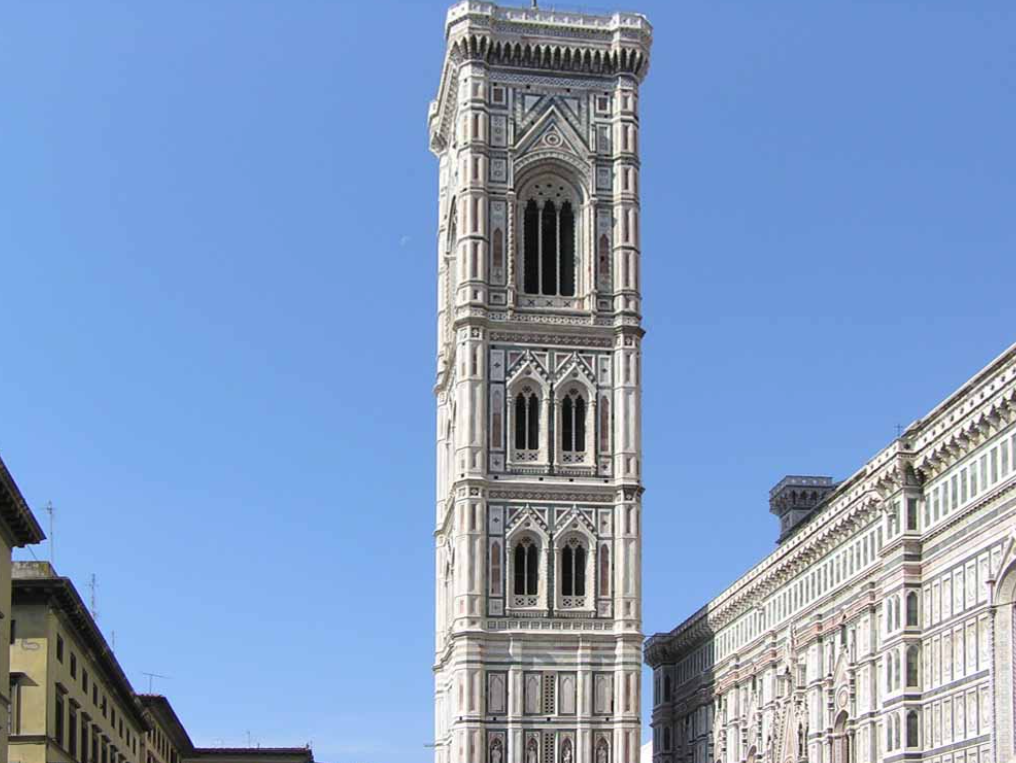
After Pisano’s death, Francesco Talenti took over and is credited with finishing the tower in 1359. Talenti introduced modifications, such as the elegant belfry windows, and raised the tower to its current height of approximately 84.7 meters (about 278 feet). Despite the succession of artists, the Campanile maintains remarkable stylistic unity — a seamless tapestry of Florentine Gothic art.
—
Architecture and Artistic Features
Exterior Decoration: A Symphony of Marble
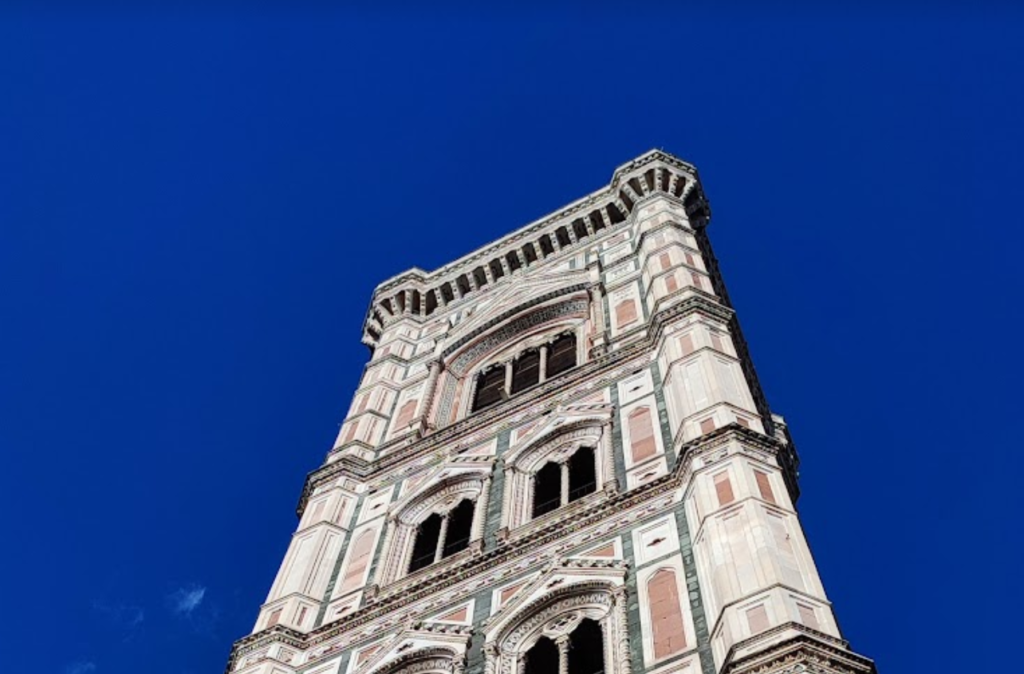
What sets the Campanile di Giotto apart from other bell towers is its stunning exterior. The façade is adorned with polychrome marble panels in green, white, and pink, mirroring the colors of the Cathedral itself. This vibrant cladding is both a nod to Florence’s local stone and a statement of the city’s artistic pride.
The lower levels are richly decorated with sculptural reliefs and hexagonal panels. These masterpieces depict themes from Genesis, allegories of the mechanical arts, the seven planets, and the virtues — a visual encyclopedia of medieval knowledge. While the original sculptures have been moved to the Museo dell’Opera del Duomo for preservation, faithful replicas remain in situ for visitors to admire.
The Tower’s Structure
Giotto’s Bell Tower is square in plan, each side measuring about 14.5 meters (nearly 48 feet). The tower rises in five distinct stages, each marked by elegant window groupings: single lancet windows at the bottom, followed by pairs, then triplets, and finally quadruplets at the topmost belfry, creating an airy, ascending rhythm.
Inside, a spiraling staircase of 414 steps leads to the panoramic terrace. There is no elevator, but each landing offers windows with tantalizing glimpses over Florence, rewarding climbers at every stage.
Symbolism and Artistic Significance
The bell tower is much more than an architectural element. In the Middle Ages, bell towers served as both spiritual and civic symbols, calling the faithful to prayer, marking the hours, and warning of dangers. The reliefs and statues on Giotto’s Campanile celebrate the harmony between faith, knowledge, and the flourishing of human arts — themes central to the Florentine Renaissance.
—
Giotto’s Campanile: Visiting Information (2025 Update)
Opening Hours
As of 2025, Giotto’s Bell Tower is generally open every day. However, hours may vary seasonally or for special events.
Regular Opening Hours: From 8:15 AM to 7:45 PM (last entry at 7:15 PM)
Closed on: January 1st · December 25th · Occasionally for extraordinary maintenance
It is always recommended to check the official website before your visit for up-to-date opening times and any changes due to holidays or maintenance.
How to Access Giotto’s Bell Tower
The entrance to Giotto’s Bell Tower is located in Piazza del Duomo, just a few steps from the Cathedral’s main entrance. Look for the sign “Campanile di Giotto.”
Access is by ticket only. You can buy tickets online in advance via the official Florence Duomo website, at the ticket office at Piazza San Giovanni 7 (near the Cathedral), or at authorized ticket machines and partners in the city. Tickets are NOT sold at the entrance of the tower itself.
Combined Tickets
The bell tower cannot be visited on its own. Instead, entry is included in several combined tickets covering all the monuments of the Piazza del Duomo:
Brunelleschi Pass: Includes the Dome (Cupola), Cathedral, Crypt, Baptistery, Bell Tower, and Opera del Duomo Museum.
Giotto Pass: Includes Bell Tower, Baptistery, Cathedral, and Museum (excludes Dome climb).
Tickets are valid for three calendar days from the date selected and allow one entry per monument.
Important Access Info
There is no elevator: the climb is entirely on foot. Wear comfortable shoes and be prepared for a moderate physical challenge. Large bags must be deposited at the cloakroom (included with ticket). The tower is not recommended for people with heart conditions, vertigo, or mobility difficulties.
—
Climbing the Tower: What to Expect
The Ascent
Climbing the Campanile is a rewarding experience. The interior staircase winds through a series of landings, each punctuated by windows that open up to increasingly stunning perspectives over the city. The stairwell is well-lit, but can be narrow and crowded during peak hours. Take your time, rest when needed, and don’t forget to look out at each window for unique photo opportunities.
The Panoramic Terrace
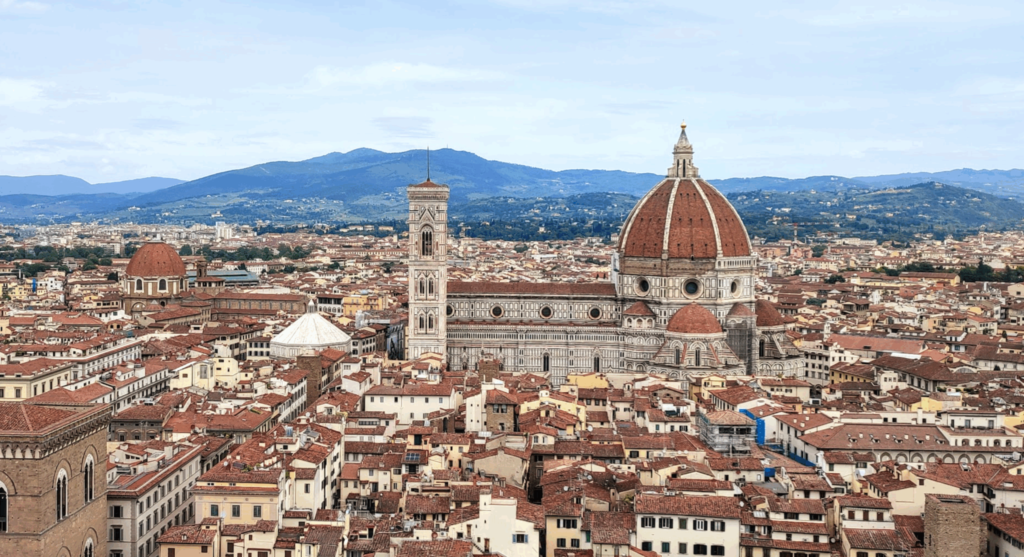
At the top, a protective parapet encloses the viewing platform. Here, you are treated to one of the finest panoramas in Florence: a bird’s-eye view of the Cathedral’s terracotta dome, the city’s red rooftops, the Arno River, the Tuscan hills, and beyond. Early morning or late afternoon climbs are especially magical, offering soft light and fewer crowds.
—
Highlights Around the Campanile
Florence Cathedral (Santa Maria del Fiore)
No visit to the Campanile is complete without admiring the magnificent Florence Cathedral beside it, with its revolutionary dome designed by Filippo Brunelleschi.
Baptistery of Saint John
Directly in front of the Cathedral, the Baptistery is famous for its golden mosaics and the Gates of Paradise by Lorenzo Ghiberti.
Opera del Duomo Museum
Here, you can see the original sculptures and reliefs from the Campanile up close, including masterpieces by Andrea Pisano and Donatello.
—
Fascinating Facts and Trivia
Height: The Campanile rises to 84.7 meters (278 feet), making it one of the tallest structures in Florence.
Steps: 414 steps to the top — there is no lift!
Marble: The colorful façade is built with marble from different Tuscan quarries: white from Carrara, green from Prato, and red from Maremma.
Bells: The tower once held seven bells; today, the bells are mainly used for ceremonial occasions.
—
Tips for Your Visit
Book in advance: Tickets sell out quickly, especially in high season (spring and summer).
Best time to climb: Early morning or one hour before closing for spectacular golden light and cooler temperatures.
Photography: The panoramic terrace is ideal for wide shots of Florence, so bring a camera or smartphone.
Clothing: Modest dress is required in the Cathedral, but there are no specific dress codes for the Bell Tower. However, comfortable, non-slip shoes are essential.
Accessibility: Due to the stair climb, the tower is unfortunately not accessible for visitors with reduced mobility.
—
Practical Information and Useful Links
Official Website: duomo.firenze.it
Location: Piazza del Duomo, Florence, Italy
Ticket office: Piazza San Giovanni 7
Public transport: The Piazza del Duomo is easily reached by bus, taxi, or on foot from anywhere in Florence’s historic center.
Nearest train station: Firenze Santa Maria Novella (10 minutes’ walk)
—
Booking Notes: Which Pass, and Why It Matters
The Duomo complex does not sell single-monument tickets. You buy one of three passes, all valid three days, and the choice is really a choice about how many staircases you intend to climb. Buy direct from the Opera di Santa Maria del Fiore whenever you can: their price is the lowest, and licensed resellers add roughly ten to fifteen per cent.
If the official site is sold out. This happens routinely two to four weeks ahead in high season, and it is the one situation where a reseller earns its markup. The Bell Tower climb with the full complex pass covers the Cathedral, the Baptistery, the Campanile, the Crypt of Santa Reparata and the Opera del Duomo Museum, with a reserved time slot only for the Tower — everything else stays open-access from that morning. The Dome climb version is the same arrangement with Brunelleschi’s cupola in place of the tower.
Tower or Dome, if you can only do one. Climb the Campanile. The reason is the obvious one and nobody says it plainly enough: from inside the Dome you cannot see the Dome. Giotto’s tower is the only place in Florence where you stand level with Brunelleschi’s cupola and read its ribbing and its lantern from the height it was designed to be seen at. The Dome climb is the more famous ticket; the Campanile is the better view of the more famous thing.
What I would skip. The combined David-and-Duomo tours. They compress two collections that deserve separate mornings, and you pay a guided-tour premium for a walk between two buildings that are eight minutes apart on foot.
Frequently Asked Questions (FAQ)
Is it possible to visit the Bell Tower without climbing? No, there is no elevator, and the only way up is to climb the internal staircase. The reward, however, is well worth the effort!
How long does the visit take? Allow about 45 minutes to an hour for the climb, time at the top, and descent. In peak season, waiting times may extend this.
Are children allowed? Children are welcome but must be accompanied by adults. The climb may be challenging for young children or those not used to stairs.
Can I take photos? Absolutely! Photography is encouraged, though drones and professional equipment require special permission.
Is the Bell Tower open in bad weather? The tower may close temporarily in the case of heavy rain, strong winds, or maintenance. Check the official site before your visit.
—
The Enduring Appeal of Giotto’s Bell Tower
Giotto’s Campanile is more than just a bell tower — it is a symbol of Florence’s artistic legacy, a triumph of Gothic design, and a living connection to the city’s medieval past. Climbing its steps, you follow in the footsteps of generations of Florentines and visitors who have gazed out over the red-tiled rooftops and felt the heartbeat of the Renaissance.
No matter how many cathedrals, museums, or towers you visit in Italy, the view from Giotto’s Bell Tower remains one of the most unforgettable. Whether you are savoring the intricate details of its marble cladding or standing atop its panoramic terrace, you will find yourself immersed in the timeless spirit of Florence.
For the latest information, opening hours, tickets, and safety guidelines, always refer to the official Giotto’s Campanile webpage.
—
Written by Mirco Vitellozzi, a structural engineer from Le Marche who writes about Italy from the inside. More essays at Tastes & Wonders of Italy, and short films on YouTube.