Chestnut Festivals in Italy 2026: The Marche Mountains
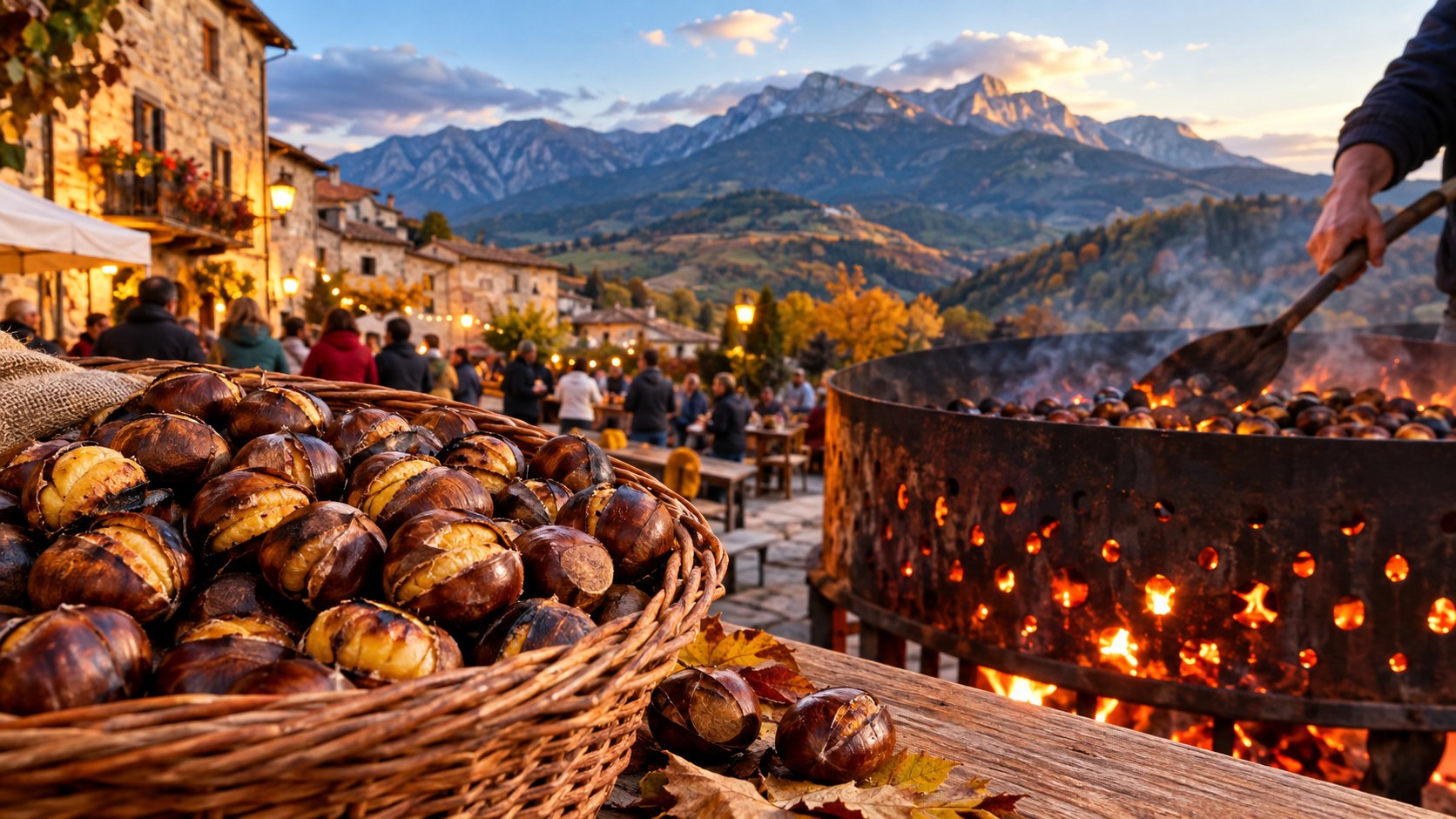
A chestnut festival in Italy rarely looks like much before it starts. By seven in the evening, the piazza in Uscerno is already cold. A metal brazier sits at the center, full of holes, and it glows orange from the coals inside. Someone shakes it, and the smell of roasting chestnuts drifts across the square.
This kind of chestnut festival has nothing to do with a stage or a ticket booth. It is a mountain village doing what it has done every October for generations. So the whole harvest goes into one square, for one night, around one fire.
The Marche region hides some of the best versions of this ritual. And you will find them high in the Sibillini and the Monti Azzurri mountains, far from any tour bus.
The Short Answer
Chestnut festivals in Italy’s Marche region run through October, mostly on Sundays. They cluster in small mountain towns between Ascoli Piceno and Fermo. Uscerno di Montegallo and Montemonaco hold the two oldest ones, both deep in the Sibillini mountains.
Expect roasted chestnuts, chestnut sweets, polenta, and vino cotto, a cooked wine typical of the area. A full evening usually costs under twenty euros a person. Because dates shift every year, always confirm them with the local Pro Loco before you drive up. If you have never been to one of these village festivals before, our guide to what a sagra actually is covers the basics first.
The Famous Ones, and Why I Send You Elsewhere
Two Italian chestnut festivals already have real fame outside Italy. Marradi, in Tuscany, holds its Sagra delle Castagne on all four Sundays of October 2026. That means the 4th, the 11th, the 18th, and the 25th.
The town is marking its 63rd edition this year. Its star is the Marron Buono di Marradi, part of the protected Marrone del Mugello. And on some Sundays, a vintage steam train even carries guests in from Florence.
Soriano nel Cimino, in northern Lazio, takes a different approach. Its 59th Sagra delle Castagne runs from October 2 to 18, 2026, across three weekends. Archers and knights open the festival in costume, and a Palio pits the town’s historic districts against each other.
So chestnuts share the stage here with medieval taverns and torchlit processions. The opening ceremony alone charges a small entry fee, a few euros, while the taverns themselves run on their own separate menus and prices. It is theater built around a harvest, not the other way around.
Both chestnut festivals deserve their crowds. I am not sending you elsewhere to prove they are overrated, because they are not. Instead, I am sending you to a quieter Italian chestnut festival because nobody has branded these mountains yet.
There is no IGP seal on a Sibillini chestnut. There is no tourist board managing the crowd flow, and no steam train either. What you get instead is a village of a few hundred people doing this for themselves, the way they always have. The setup is simple: a folding table, and a brazier borrowed from someone’s barn.
The Chestnut Belt of Le Marche
Central Marche has its own chestnut country, and it sits higher than most visitors expect. For the wider picture of the region these villages belong to, our guide to Le Marche lays out the full orientation. Uscerno di Montegallo and Montemonaco both climb past 800 meters, tucked inside the Monti Sibillini, a range we cover in more depth in our dedicated Sibillini mountains guide. Smerillo, further north near Fermo, sits at 806 meters on a rock spur so exposed that locals call it the roof of the Marche.
Montefalcone Appennino, Valfornace, and Acquasanta Terme round out this belt of old chestnut woods and worked terraces. Colmurano, lower and closer to Macerata, still keeps its own castagna festival, proof that the tradition reaches well past the high Sibillini villages. Between them runs a rough band from 600 to 900 meters, cool enough for chestnut trees and still warm enough for people to farm. This is the geography that grew the food you will eat at any Marche chestnut festival.
When They Happen, and Why the Date Moves
No chestnut festival in this belt runs on a fixed calendar date. That trips up most visitors who plan from an English-language listing found online. Instead, each town follows a rule, and the rule repeats every year even when the exact date does not.
Uscerno di Montegallo runs its Sagra della Castagna on the third Sunday of October. That is according to the Marche region’s own official fair calendar, which also lists a smaller Fiera della Castagna market day on November 7. So the rule places the 2026 sagra on October 18.
However, I found older village sources citing the second Sunday instead. A 2026 hiking event tied to the same festival was even announced for October 11. That gap is real, and I cannot close it from a desk. Because of this, call the Pro Loco before you commit a whole evening to Uscerno.
Montemonaco is more reliable. Its Sagra Mercato della Castagna has landed on the last weekend of October in every year I checked. That means October 28 and 29 in 2023, October 26 and 27 in 2024, and October 25 and 26 in 2025.
Following that same pattern, expect the 47th edition on Saturday, October 24, and Sunday, October 25, 2026. Still, a quick check closer to the date costs you nothing.
Smaller castagnate in Smerillo and nearby villages follow similar rules, but they change hosts and weekends more often. For the full method behind checking dates across the whole region, see our regional guide to Le Marche food festivals. It covers which municipal and Pro Loco sources to trust.
What You Actually Eat
Caldarroste come first at any chestnut festival: chestnuts roasted whole in that holed brazier, then served hot in a paper cone, shells cracked but still on. Castagnaccio follows, a dense, flat cake made from chestnut flour, olive oil, rosemary, and pine nuts, with no sugar added at all.
You may also find gnocchetti di castagne, small dumplings worked into chestnut flour. Locals serve them plain, with butter and sage, or tossed with wild boar sauce instead. Some stands also fry frittelle di castagne, small chestnut fritters dusted with sugar, a treat aimed more at children than at anyone chasing a full meal.
To drink, order vino cotto, a wine made by slowly reducing grape must over a wood fire until it turns dark and syrupy. Some stands pour sapa instead, the same reduction used as a sweetener rather than a drink. Both taste like autumn concentrated into a glass.
As of October 2025, a plate of caldarroste and a glass of vino cotto at a similar Marche sagra cost around three to five euros. A full seated dinner runs closer to fifteen or twenty. Because most food here comes straight from someone’s own trees rather than a supplier, prices at these smaller castagnate tend to sit even lower.
The Tree That Fed the Mountain
For centuries, the chestnut was not a seasonal treat in these mountains. Instead, it was bread. Families dried the nuts, ground them into flour, and lived on that flour through winters when wheat would not grow at this altitude.
A single well-kept grove could feed a household for a season. That is why individual chestnut trees in this belt were often owned and inherited like family property. Sometimes they were fought over the same way, too.
The wood built houses and fenced fields. Even the burrs found use: thrown down as rough mulch, or fed carefully to grazing pigs. So an entire mountain economy grew around one single tree.
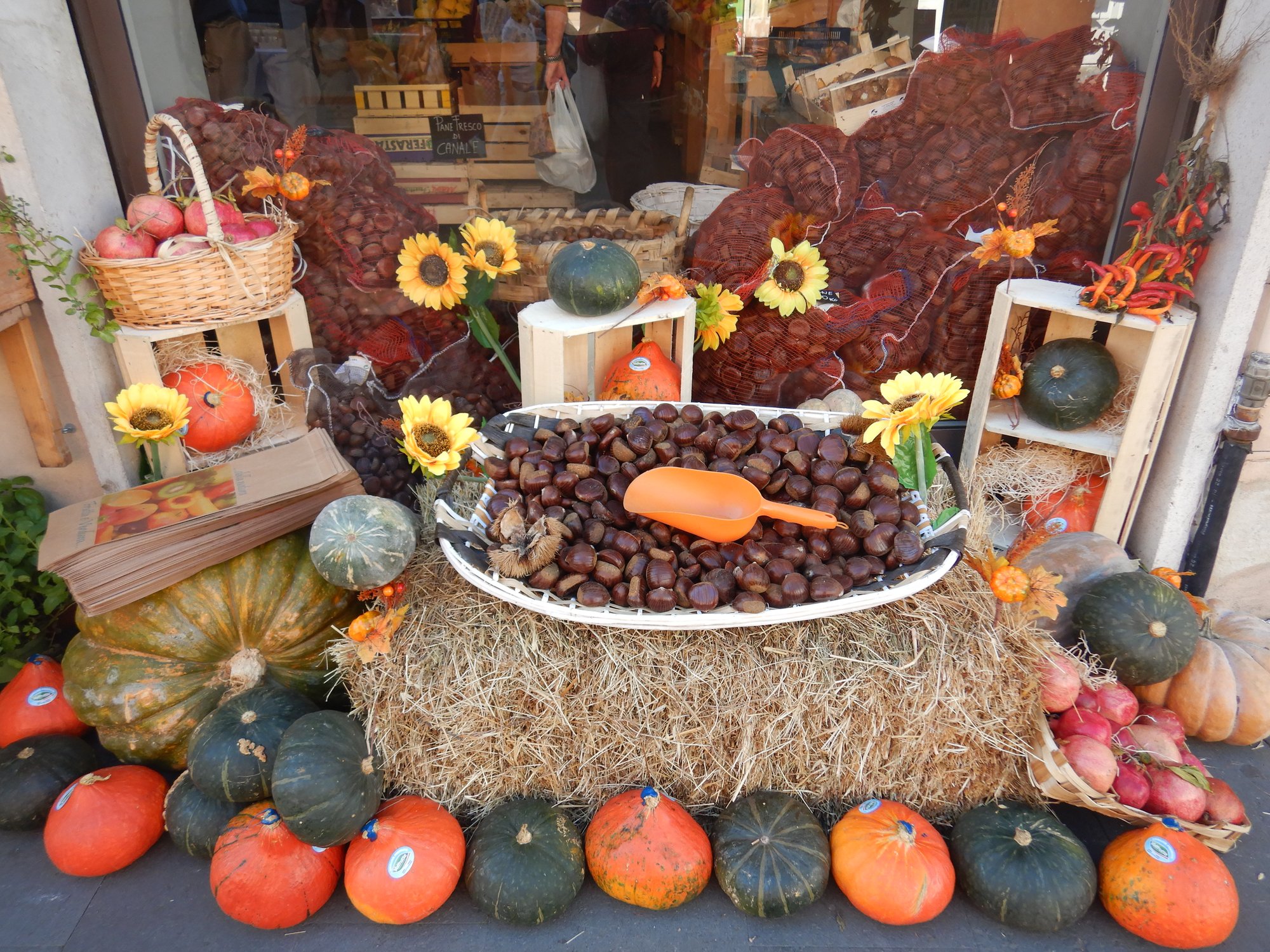
That economy nearly collapsed. In 2002, an Asian gall wasp called the cinipide reached the hills near Cuneo, in Piedmont, and then spread fast across Italy. It deforms chestnut buds, and it can cut a local harvest by well over half in the worst seasons.
National production fell to a historic low near 18,000 tonnes in 2014, down from roughly 52,000 tonnes before the insect arrived. Italy answered with another import: Torymus sinensis, a tiny parasitic wasp that attacks the cinipide’s own galls. Harvests have partly recovered since then, but they still swing hard from year to year. That is one honest reason no single date, or yield, ever holds steady in this belt.
These Are Earthquake Villages
Uscerno di Montegallo and Montemonaco both sit inside the zone the Italian government still lists as struck by the earthquake sequence of August 24, 2016. They also sit inside the wider Sibillini range covered in our dedicated mountain guide, in a chapter of that landscape’s story the trail notes rarely mention. This is not distant history. It shapes what you will actually see on the ground today.
As of 2026, public reconstruction work continues under Italy’s dedicated earthquake commissioner. Montegallo has an approved 1.2-million-euro project to repair the Santa Maria Lapide-Casone road. Beyond that, over 10 million euros are committed to landslide mitigation across seven of its hamlets, a program that touches the ground under Uscerno itself.
Montemonaco, meanwhile, has a 2.95-million-euro project underway to rebuild the Don Albertini school. Plans also call for converting its former Carabinieri barracks into public housing. A new museum dedicated to the Sibilla legend is moving through approval, too, alongside church restoration in both towns.
None of this should stop you from going. Instead, it should change how you look at what you see. Scaffolding sits beside a piazza that still hosts a festival.
A population under 500 has held on through a decade of paperwork and construction, and a school rebuilds while the town keeps its calendar of sagre alive. Buying a plate of caldarroste here is not charity. It is simply one of the few forms of support these places can actually use.
Getting There, and the Part About the Cold
Coming from the coast, plan on close to an hour and a half to reach Uscerno or Montemonaco. That applies from towns like San Benedetto del Tronto. It takes longer once the road narrows into switchbacks above Acquasanta Terme. From Fermo, or the Adriatic coast north of it, Smerillo and Montefalcone Appennino sit closer, usually under an hour by car.
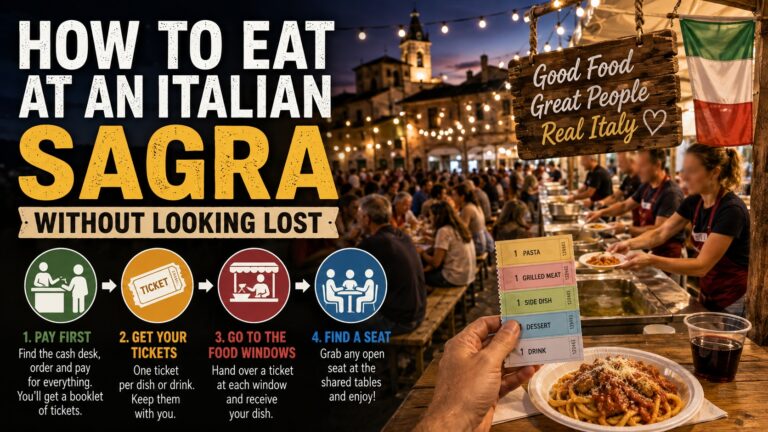
Parking is informal in villages this size: a field, a widened shoulder, whatever someone has cleared for the evening. Bring cash, because most stands, and even some cash desks, do not take cards this far from the coast. For how the payment system itself works, from cash desk to food ticket, see our guide to eating at an Italian sagra.
Pack for real cold, too. At 800 to 1,000 meters in October, evening temperatures often sit near freezing once the sun drops, even if the coast is still mild. A light jacket that felt fine in Ascoli Piceno at lunchtime will not be enough by nine at night in Uscerno.
Closed shoes matter on unpaved piazzas. If you plan to drive back down afterward, pace the vino cotto, since these are genuine mountain roads in the dark.
Make It a Weekend
October in this part of the Marche rewards chestnut festival travelers who stay past one evening. Truffle season overlaps directly with the chestnut calendar, and our truffle season guide covers when and where to look. Olive harvest and the first pressings of new oil run on a similar clock, detailed in our piece on visiting a working frantoio.
If you time it right, the beech forests above Montemonaco turn color in the same window, and the drive between towns becomes its own reason to go. Our October guide to Italy lays out what else moves across the country that month. In short, one good chestnut festival earns an evening, but a full weekend earns the drive.
What I Would Skip
A few practical warnings, gathered from what regularly goes wrong for first-time visitors. Do not trust a date pulled from an English-language aggregator without checking it first. Several I found while researching this piece were simply wrong.
Also, do not arrive at half past seven expecting an easy seat. These chestnut festivals are small, and a late arrival at Uscerno or Montemonaco can mean standing room only, or no chestnuts left at all. Above all, do not drive the mountain passes back down after a second glass of vino cotto. Call a taxi instead, or slow down and stay the night.
FAQ — Chestnut Festivals in Italy
When is chestnut season in Italy?
Chestnut season runs roughly from early October through mid-November. Most festivals cluster in the second half of October, when the harvest peaks in central Italy’s mountain areas.
Where are the best chestnut festivals?
Marradi in Tuscany and Soriano nel Cimino in Lazio draw the largest crowds, with steam trains and medieval pageantry to match. For a smaller, more local version of the same tradition, the Marche towns of Uscerno di Montegallo and Montemonaco are strong choices.
How do I find this year’s actual dates?
Check the comune’s own website, the Pro Loco’s Facebook page, or call the tourist office directly. Aggregator sites often just copy last year’s dates forward without updating them.
Do I need tickets or a reservation?
No. Entry to these chestnut festivals is free, and you pay only for what you actually eat and drink at the stands.
How much does an evening cost?
Budget roughly three to five euros for chestnuts and a drink, or fifteen to twenty euros for a full seated meal. These figures reflect prices confirmed at similar Marche sagre as of October 2025.
Can I get there without a car?
Not easily. Public transport to villages like Uscerno or Montemonaco is limited or nonexistent, especially in the evening, when the last bus down the mountain often leaves before a festival even peaks. So a rental car is the realistic option.
Is it safe to visit the earthquake area?
Yes. These towns remain open, inhabited, and actively hosting visitors and events throughout the year. Reconstruction work continues on specific buildings and roads, clearly marked and separate from festival areas.
The Takeaway
A chestnut festival in Italy’s Marche region will not photograph like Tuscany, and it does not try to. Instead, it offers a village pulling its whole year into one cold, smoky evening, for people who still live there year-round. Check the date twice, bring cash and closed shoes, and go hungry.
If you want more dispatches like this one, written from inside the region rather than about it, explore more of Tastes & Wonders of Italy.