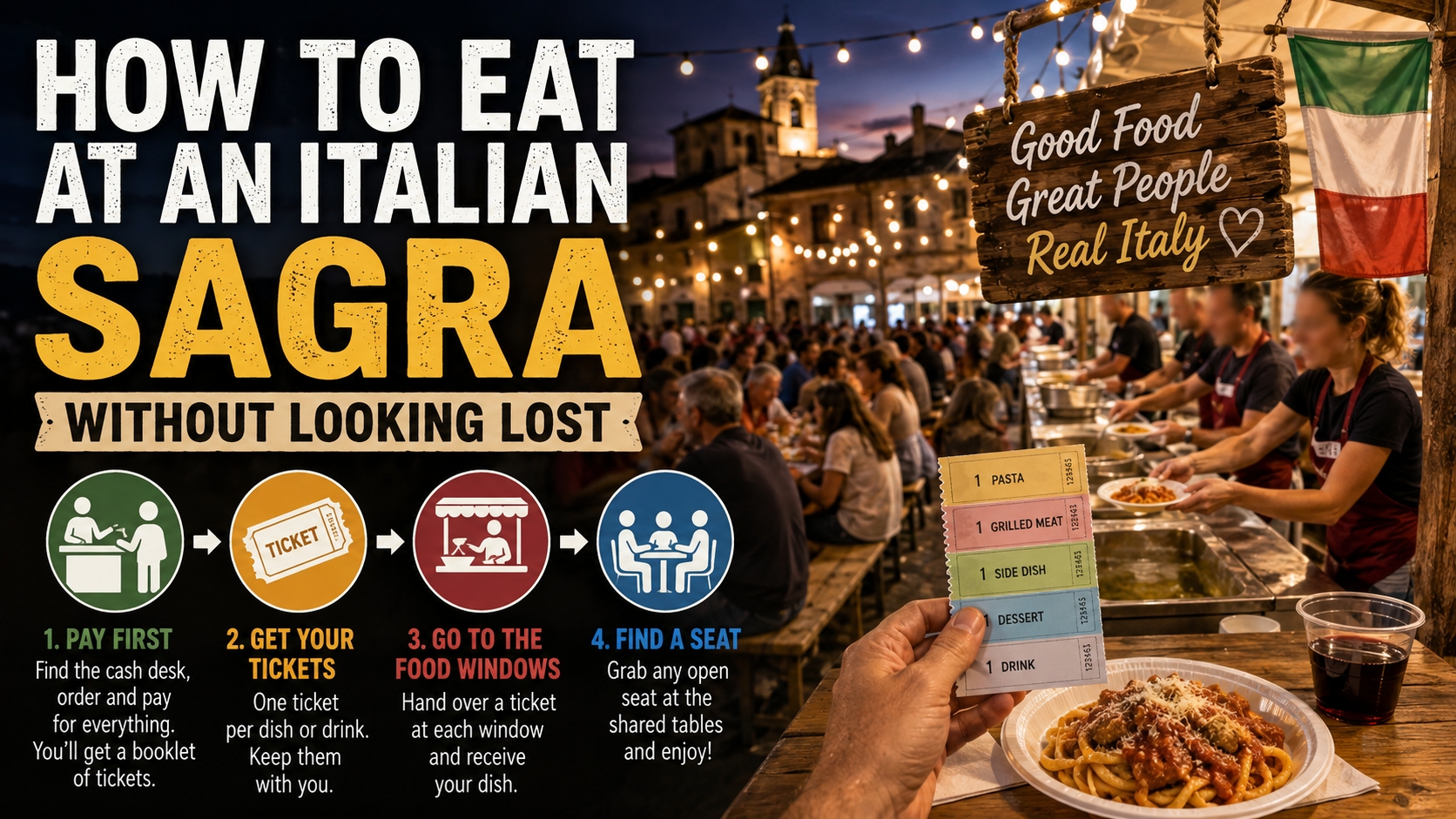
How to Eat at an Italian Sagra Without Looking Lost
Seven in the evening, and the piazza in front of the church has exactly one occupied table: a group of American visitors, sitting patiently in front of a stack of paper napkins and nothing else. They arrived first, because seven sounded like dinner, and now they’re watching a scene that makes no sense to them — volunteers ferrying trays past without stopping, a line forming forty feet away at a cash box nobody explained, and not one person who looks like a waiter in sight. They aren’t lost, and they haven’t picked the wrong sagra (a local food festival built around one dish, run by volunteers rather than restaurant staff). They’ve simply skipped a step every Italian at that festival learned as a child, and nobody thought to write down for them.
What to expect at a sagra, in practice, has almost nothing to do with the food and everything to do with the sequence you follow to get it — here it is, in order.
How to Eat at an Italian Sagra, in One Paragraph
The routine is the same at nearly every sagra across central Italy: find the cassa (the cash desk) before looking for a table or a menu board. Tell the cashier everything your group wants to eat and drink, pay for the whole order at once, and you’ll receive a blocchetto — a small stapled booklet of paper tickets, one per dish. Only then do you go looking for a seat, any open stretch of bench at any shared table, and carry that blocchetto to the sportelli (the serving windows), handing over the matching ticket for each course as the kitchen calls it or as you reach the front of that line. Nobody takes an order at the table, because at a sagra the order already happened at the register, well before anyone sat down.
Why Seven Is Too Early, and Nine Is Not Too Late
Posted opening times are aspirational. Volunteers cook in batches sized to that night’s turnout rather than holding a full menu ready at the stated hour, and the first thirty to forty minutes after doors open are usually spent watching the first tickets go in rather than eating one. Arriving closer to eight-thirty or nine drops you into full service, when every station is running and the wait between paying and eating shrinks considerably.
The calendar matters as much as the clock. Opening night runs thinner than closing night, while the final evening of a run tends to be busiest and best-stocked. Land your visit during Italy in August, when a large share of the country’s sagre run at once, and expect every bench full by eight. A sagra falling on Ferragosto itself will be the most crowded night of its run. Waiting instead for Italy in September, once the August crush has thinned, tends to buy a calmer evening and a shorter line at the cassa.
The Field, the Volunteer, and the Paletta
Most sagre outside a city center don’t have a parking lot; they have a field. Follow the signage — hand-lettered cardboard more often than anything official — toward the campo (the town’s sports ground), which doubles as overflow parking for one weekend a year. A volunteer in a reflective vest, carrying a small handheld traffic paddle called a paletta, will wave you into a row of grass that was a soccer pitch that same morning. Follow the paddle rather than your own instinct: he is fitting several hundred cars into a space built for a fraction of that number. A tip is not expected and tends to visibly confuse the volunteer holding it out; a nod and a grazie cover it.
Paying Before You Eat: How the Cassa and Blocchetto Actually Work
Here is the part that trips up nearly every first-time visitor from the United States, and it has nothing to do with the language barrier. Sagre run on a two-step payment system, in the reverse order from an American restaurant.
Step one is the cassa. Before sitting anywhere, you find the cash desk — usually the most visibly staffed table in the setup — and place your entire order there: every course, every drink, for every person in your group, in a single transaction, before a plate has been cooked. In exchange, the cashier hands over a blocchetto: a small stapled booklet of tickets, typically one per item, sometimes labeled or color-coded by course.
Step two happens only after you’ve claimed a seat. Carry the blocchetto to the sportelli — the serving windows, usually one per station, split between pasta, grill, fry station, and dessert — and hand over the matching ticket when your course is called or when you reach the front of that line. The volunteer tears it off, hands you the plate, and you carry it back to your table yourself. There is no third step where a server checks in or expects a tip; the bill was already settled at the cassa, before anyone ate a bite.
The logic, once visible, is straightforward: a volunteer kitchen can’t safely run an open tab for several hundred strangers, and the Pro Loco needs the evening’s money collected in one place, not scattered across half a dozen stations. Two steps are what let a handful of teenagers and a cash box run an evening that would otherwise need professional waitstaff.
This exact choreography — cassa first, sportelli second — describes how sagre in central Italy, including here in Le Marche, most commonly operate. Larger events further north increasingly run the same idea through a QR-code preorder app instead of paper, and some smaller sagre skip the ticket and simply take a shouted order at one combined counter. If you’re unsure which version you’ve landed in, watching the table ahead of you for ten seconds tells you faster than any posted sign.
Reading the Menu Board Before You Reach the Cassa
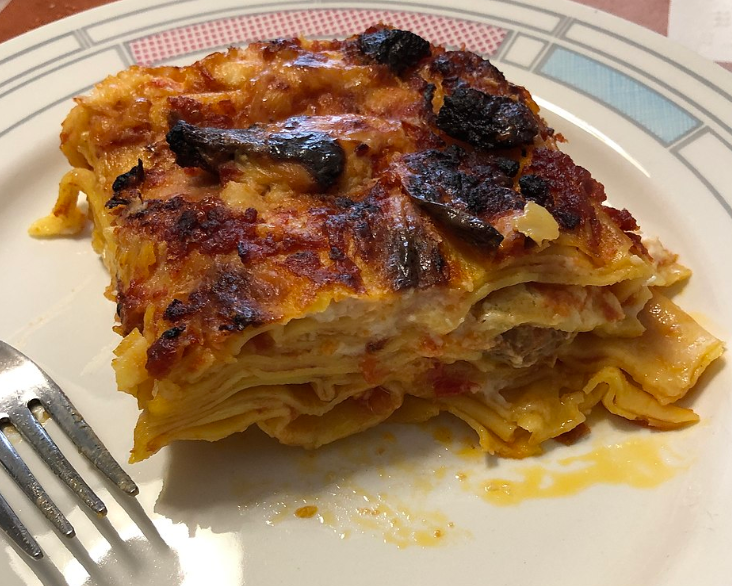
The menu is posted where you place your order, not handed to you at a table, so read it before you’re standing in front of the cashier with a line building behind you. It follows the same basic categories as an Italian restaurant menu — primo (a pasta or rice course), secondo (meat or fish), contorno (a vegetable side), dolce (dessert) — except most categories list one option rather than five. That’s not a limitation; it’s the point, the same logic that keeps vincisgrassi vincisgrassi rather than a lasagna with substitutions, or keeps brodetto whichever version the coastal town insists is correct. Prices are usually per dish rather than bundled, so total your order in your head before reaching the register — the cashier moves fast.
Finding a Seat: Shared Tables, No Reservations
Seating is first-come, communal, and unassigned. Long tables under paper cloths run the length of the tent or piazza, and you sit wherever there’s an open stretch of bench, next to whoever is already there. If a spot looks open but you’re not certain, è libero? (“is this free?”) is the only phrase needed — a gesture toward the bench works if the words don’t come easily.
The one exception is a table set differently from the rest: a different tablecloth color, place settings already laid, occasionally a small paper sign. That table is reserved, usually for the organizing committee or the parish priest, and it’s the one table not to sit at uninvited. Everywhere else, the bench belongs to whoever gets there first.
Self-Service: Carrying Your Own Plate
Once the volunteer at the sportello hands over a plate, it’s yours to carry — no one runs food to the table, and no one clears it between courses. Balancing several plates back to a shared table takes one trip of practice and looks harder than it is. When you’re finished, look for the return point, usually a folding table with bins near the sportelli, sometimes labeled restituzione vassoi (tray return), and bus your own plate, cutlery, and cup there. The volunteers are running a kitchen, not a full waitstaff, and the system depends on everyone handling this piece themselves.
The Bar Runs on Its Own Rules
Drinks and food are frequently separate operations, staffed by different volunteers and sometimes settled at a different counter entirely. Wine is typically vino sfuso — house wine served loose, from a tap or demijohn rather than a labeled bottle — sold by the quarter-liter, half-liter, or carafe rather than by the glass, almost always local production. If the food side runs on the cassa-and-blocchetto system above, don’t assume the bar does too; some bars use their own ticket line, others just take cash per round.
The bar behaves a little like the wider aperitivo culture found across Italy — order, pay, carry your own glass. Italian Aperitivo Decoded covers the broader version of those rules in full.
Cash: How Much, and Why the Card Machine Isn’t Coming
Card acceptance ranges from reliable to nonexistent, and the smaller the town, the more likely you’ll see a hand-lettered solo contanti (cash only) sign taped to the cassa. It isn’t stubbornness; it’s economics — a Pro Loco running a folding-table cash desk for three nights a year has little reason to rent a card terminal, and a small town may not have a working ATM within walking distance.
Our companion guide to what a sagra actually is already puts the going rate at roughly fifteen to twenty euros per person for a full plate and a drink, as of 2026. Carry more than that in bills, since the cassa collects a whole table’s order at once and change for a large note can run thin by nine o’clock:
- Several ten- and twenty-euro notes rather than fifties, which can strain a folding-table till
- A few coins held back for the bar, if drinks run through a separate counter
- Roughly thirty to forty euros per person on hand, even though the meal itself runs closer to twenty
After the Plates Are Cleared
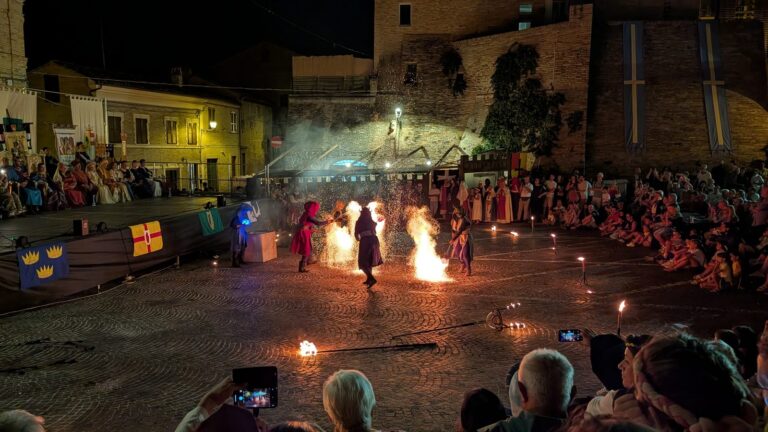
Once the kitchen line thins out, usually between ten and eleven, the evening shifts from eating to lingering. A local band, an accordion player, or a portable sound system typically takes over the same ground the tables sat on, and dancing — often a specific regional style rather than anything generic — starts among people who clearly already know the steps. Nobody minds if you watch instead. The crowd thins gradually, and by midnight what’s left is mostly the volunteers, stacking chairs for a repeat performance the following night.
The Mistakes That Give You Away
A handful of habits mark a visitor as new to the format faster than any accent could, and nearly all of them come from expecting a restaurant.
Looking for a waiter is the most common — scanning the crowd for someone to flag down, when in fact no one is coming, because the order already happened at the cassa. Close behind it is the tip: reaching for extra coins for volunteers who aren’t earning wages and have no tab to add gratuity to. Asking the kitchen for a substitution — no onions, sauce on the side — rarely lands well either; a sagra’s menu is one dish cooked in bulk, not a kitchen taking special requests, and the answer is usually a polite but genuine non è possibile (it’s not possible).
Sitting at the one table set differently from the rest, expecting an English-language menu, and photographing volunteers at the grill without asking round out the list. None of it is catastrophic, but each is a small tell that briefly marks a visitor as someone who wandered in rather than someone who came to eat the way the town does. For how eating out in Italy is structured outside the sagra format, Trattoria, Osteria, Ristorante, Enoteca: The Italian Restaurant Hierarchy Decoded is worth a read before the trip.
FAQ: Sagra Etiquette Questions Americans Actually Ask
Do I order at my table, or do I have to find someone? You find the cassa. There’s no table service — order and payment both happen at the cash desk before you sit down.
What exactly is a blocchetto, and do I need to hold onto it? The small booklet of paper tickets you receive after paying, one per item ordered. Keep it until every course is claimed at the sportelli; a lost ticket usually means re-explaining your order, not a simple reprint.
Is tipping expected anywhere at a sagra? No. The people serving food and parking cars are volunteers, not tipped staff, and there’s no mechanism for adding gratuity to a bill already settled at the cassa.
Can I ask the kitchen to modify a dish? Rarely successfully. A sagra kitchen cooks one dish in bulk rather than taking individual requests, so plan on eating it as served.
I don’t speak Italian — will I still be able to order? Yes. Pointing at the posted menu and holding up fingers for quantity works better than a full sentence at a moving cash line, though a few basic food and number words speed things up for everyone behind you.
Do I need to bring my own plate, napkin, or utensils? No, those come with the meal you’ve paid for. What you’re responsible for is carrying your own plates to and from the sportelli and bussing your own table afterward.
What happens if I lose a ticket after I’ve already paid? Find a volunteer near the sportelli and explain — most sagre can work it out with whoever staffed the cassa that evening, though it may take extra minutes during a busy stretch. It’s a minor inconvenience, not a lost meal.
The Only Rule That Matters
Every detail above bends somewhere — some sagre skip the blocchetto, some combine bar and kitchen into a single line, some now run through a phone app. What doesn’t change is the underlying logic: learn how payment works before looking for a seat, because at a sagra the transaction always comes first and the meal follows from it. Watch what the table ahead of you is doing, ask come funziona? (“how does this work?”) if anything looks unclear, and treat the answer as the rule for that particular evening — this piece describes central Italy’s sagra etiquette specifically, not every region’s.
For more italian sagra tips and insider dispatches like this one, explore more on Tastes & Wonders of Italy or subscribe to our YouTube channel for video reports from around the country.
🌍 https://tasteandwondersofitaly.com/ – 📺 https://www.youtube.com/@TasteWondersofItaly