Loreto, Italy: The Basilica an Engineer Can’t Explain Away
In Loreto, the marble screen outside is cold and smooth under my palm, carved by hands that once answered to Bramante, finished two generations after he died. Then you step through the low doorway and the temperature of the surface changes entirely. The three walls of the Santa Casa are rough, reddish stone, laid in a technique no Renaissance mason working in the Marche would have used — coursed rubble bonded the way builders worked around Nazareth two thousand years ago, not the way anyone built in Italy in the thirteenth century. I have run my hand over enough historic masonry over thirty years of professional inspections to know the difference between a wall built here and a wall built somewhere else. This one was built somewhere else.
Loreto is a hill town in Italy’s Marche region, about twelve miles south of Ancona, built entirely around one structure: the Basilica della Santa Casa, the Basilica of the Holy House. Inside it, protected by a marble screen designed by Donato Bramante, stands a small stone house that Catholic tradition holds is the home in Nazareth where the Virgin Mary was born and raised, and where she received the news that she would bear a child. Historical accounts place its arrival on this exact hilltop on the night of December 9–10, 1294. Loreto ranks as Italy’s largest Marian shrine and one of the most visited Catholic pilgrimage sites in Europe; the town recorded roughly 1.2 million visitors in 2023 alone. It has also been, since 1920, the official patron shrine of aviators — a detail that matters more to American visitors than most guidebooks let on.
The Santa Casa: Angels, Ships, and What the Stones Actually Say
Local devotion doesn’t tell one translation story — it tells five. Between 1291 and 1296, tradition places the walls first at Tersatto, in modern Croatia, then briefly near Ancona, then in a wood belonging to a noblewoman named Loreta (the source of the town’s name), then on a hillside called Monte Prodo, and finally on the public road where the basilica now stands. Each move, in the popular account, happened overnight, carried by angels, with no explanation offered for why the Holy Family’s house needed three intermediate stops to reach a fourth.
The historical record is messier, and I find it more interesting for that. A rival account holds that the walls were never airlifted at all: they were shipped, by the Byzantine-descended Angeli family who ruled Epirus, as part of a dowry when the despot’s daughter married into the Angevin royal house of Naples — in 1294, the same year tradition gives for the house’s arrival. A document from that year, rediscovered relatively recently, appears to record exactly that transaction. Whether the family name Angeli slowly became, over a few generations of retelling, angeli — angels — is a question historians still argue over, and reasonably so.
What isn’t seriously disputed is the physical evidence in the stone itself. The three walls inside Bramante’s screen are built from coursed, undressed masonry that has nothing in common with thirteenth-century Marche construction and everything in common with first-century building technique around Nazareth; the material wasn’t quarried in Italy. Early Christian graffiti, consistent with markings found at devotional sites in the Holy Land, have been documented directly on the stones. Whatever moved these walls — angels, ships, or both at different points in a long retelling — they are, by every material test that’s been applied to them, a genuine fragment of an ancient structure from Galilee. I’m not in a position to adjudicate the miracle. I am in a position to say the masonry doesn’t lie, and the masonry says: this is not local stone.
Whichever version of the arrival persuades you more, the destination did the same work either way. By the fifteenth and sixteenth centuries, Loreto had joined Rome and Santiago de Compostela among the pilgrimage sites European Catholics treated as a genuine spiritual obligation, to the point that Pope Leo X ruled in 1520 that a pilgrimage vow to Loreto satisfied the same obligation as one to Jerusalem. More than fifty popes have visited in person, along with less predictable guests: René Descartes came to give thanks for a philosophical breakthrough he credited to the Virgin of Loreto.
Three Centuries, One Building: Bramante, Sansovino, and the Sangallo Dome
What surrounds the Holy House took three centuries and roughly a dozen of the era’s best-known names to complete, and it shows — nothing about the exterior reads as a single coherent design, because it never was one. Bishop Nicolò dall’Aste of Recanati started construction in 1468, driven as much by the practical need to shelter growing crowds of pilgrims as by devotion. Over the following century, Giuliano da Maiano, Baccio Pontelli, Francesco di Giorgio Martini, Giuliano da Sangallo, Donato Bramante, Andrea Sansovino, and Antonio da Sangallo the Younger all worked on it in sequence, each inheriting and adjusting the last architect’s structural decisions — a harder discipline, as anyone who has taken over a half-finished project can tell you, than starting from a blank site.
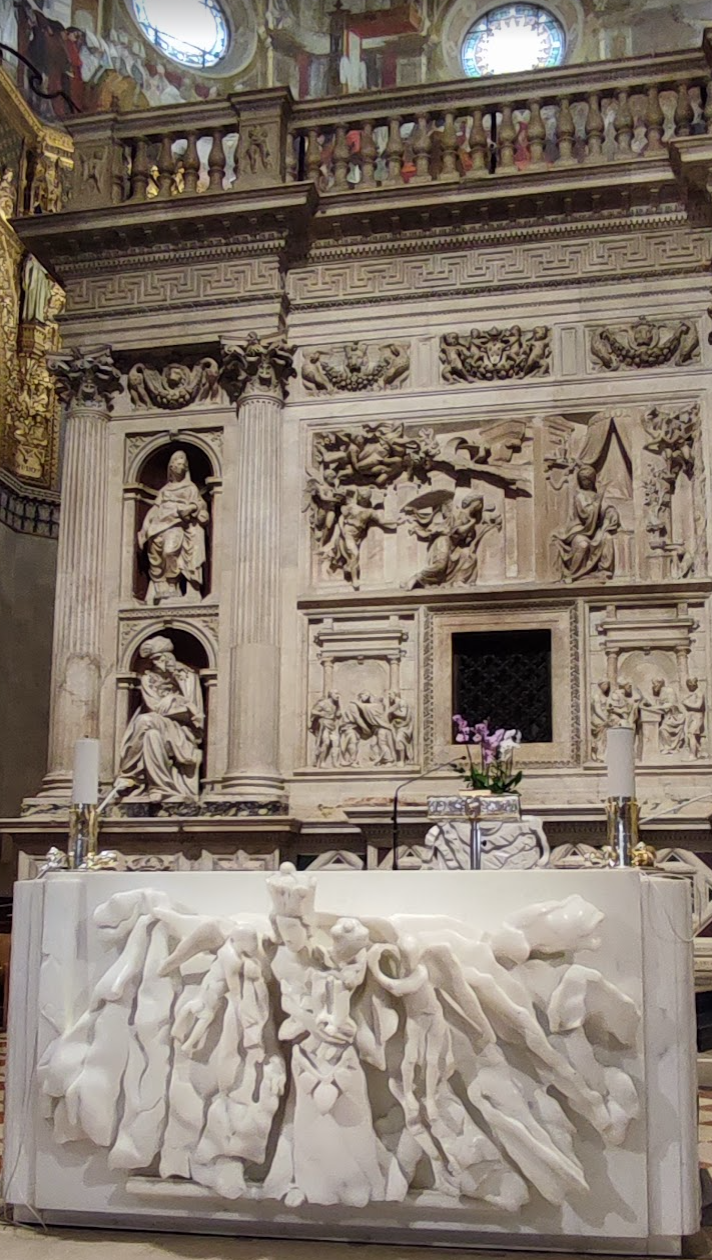
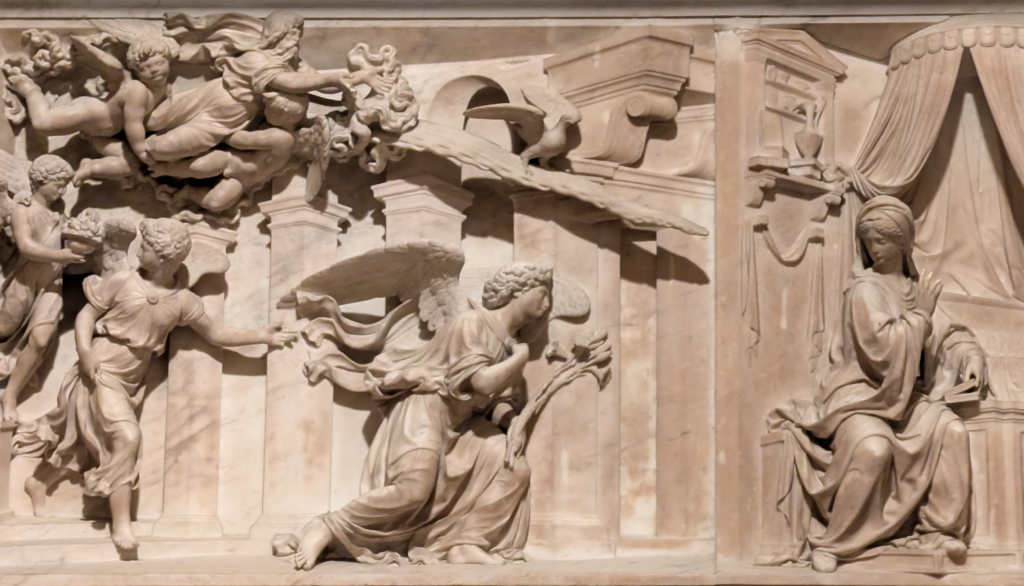
Bramante’s contribution, from 1509 onward, is the object most visitors come to see even if they don’t know his name: the tall marble screen wrapped entirely around the Holy House, carved with reliefs of the Annunciation and the life of Mary, executed under three successive popes — Leo X, Clement VII, and Paul III — largely by Andrea Sansovino and a rotating team of sculptors. It is, structurally, a building inside a building: a self-supporting marble envelope that protects the ancient stone without loading it, which is exactly the right instinct if you don’t want a fragile, foundation-less thirteenth-century wall carrying weight it was never built to bear.
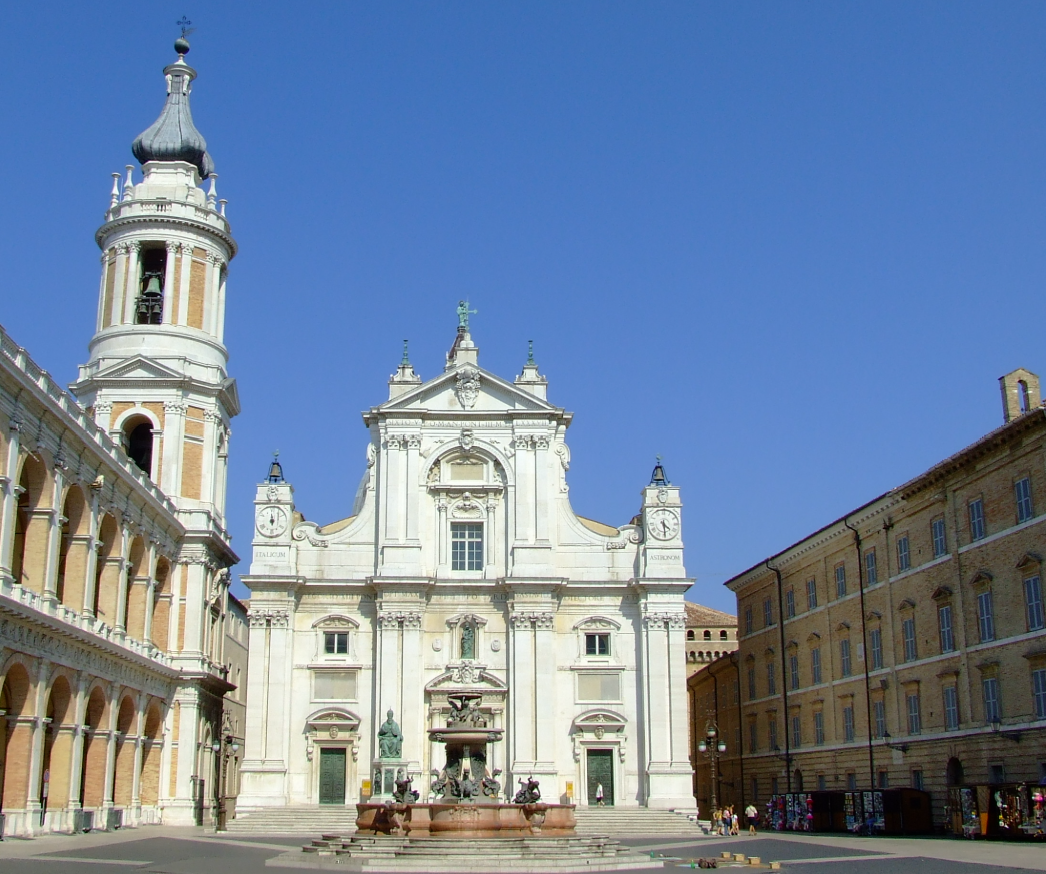
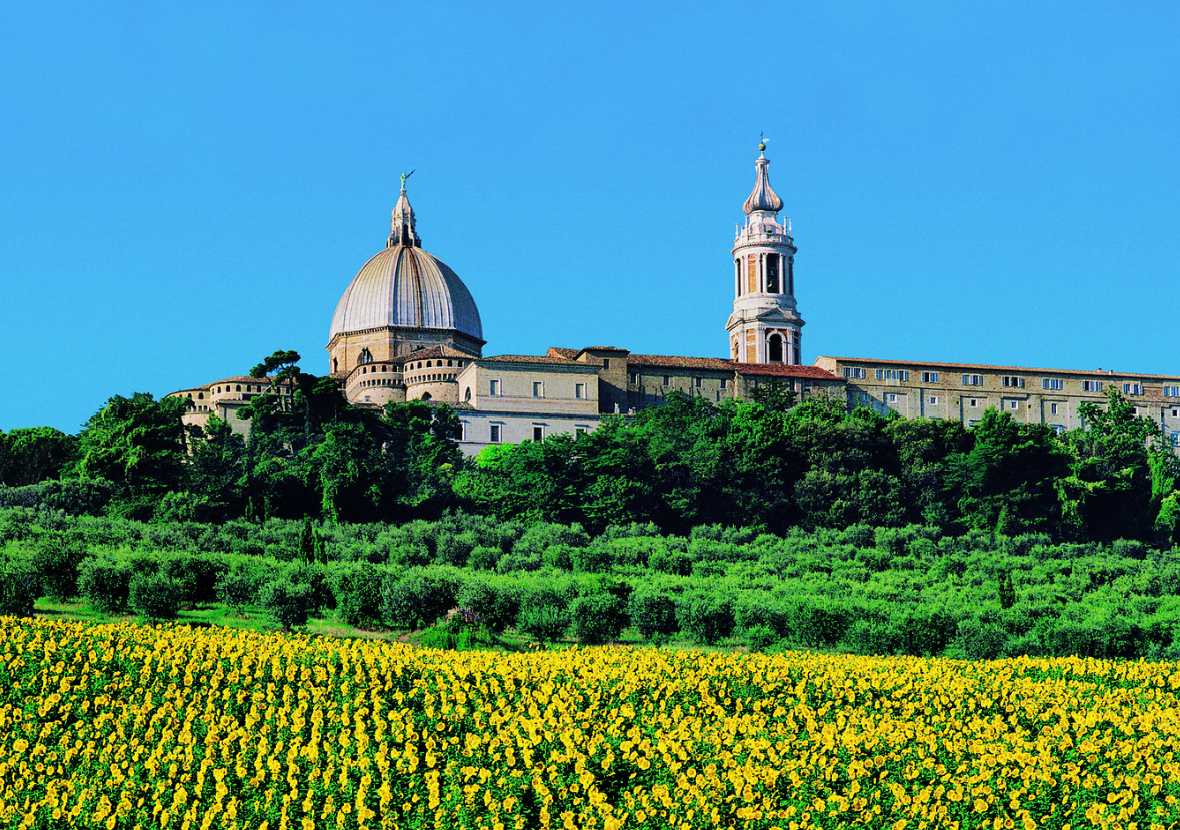
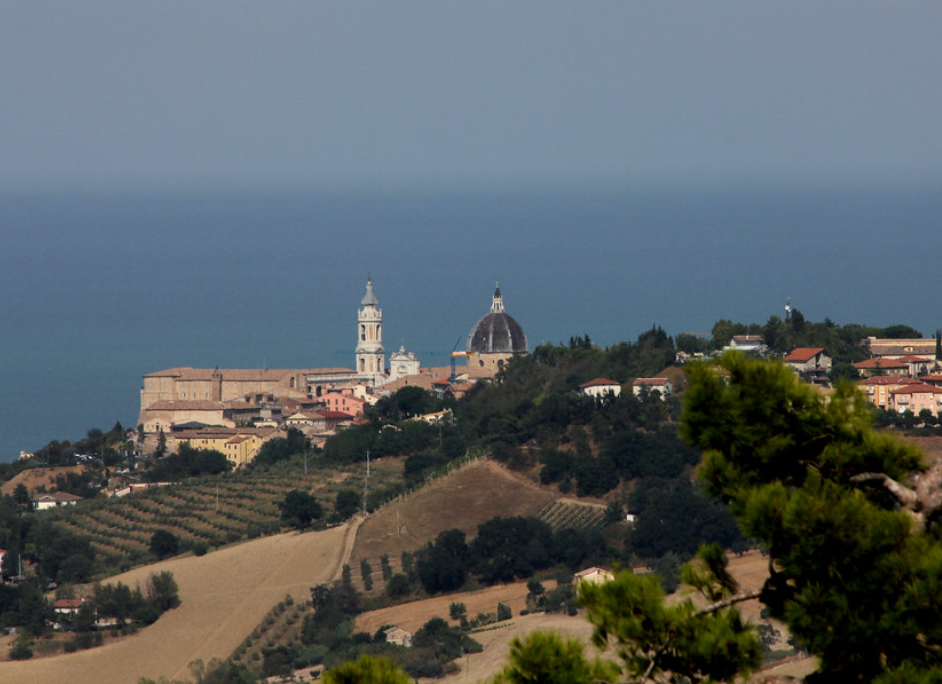
Above it all sits the dome, raised by Giuliano da Sangallo in 1499–1500 and deliberately modeled on Filippo Brunelleschi’s cupola for Florence’s cathedral — a debt visible in the way it seems to float rather than press down, thanks to ribbing and window rhythm borrowed almost directly from Florence. The façade wasn’t finished until 1587, its three bronze doors added between 1590 and 1610. Ring the interior and you find thirteen apsidal chapels in that same Florentine-inflected Gothic style — the cappelle delle nazioni, chapels of the nations, each historically sponsored by a different country’s Catholic community, turning the building into a built register of which nations considered this shrine worth their patronage. In the sacristies off the right transept, frescoes by Melozzo da Forlì and Luca Signorelli survive on facing walls, each set within fine intarsia framing. Luigi Vanvitelli, better known for the royal palace at Caserta, added the bell tower two centuries later, between 1750 and 1754.
Walk the camminamenti di ronda — the covered defensive walkway that rings the apse — and the complex reveals its second identity: this is a fortress as much as a church, built with an eye on Ottoman raiders working the Adriatic coast in the same centuries the marble was being carved below.
What an Engineer Sees Looking Up: Loreto’s Dome in a Seismic Zone
Loreto sits in one of the more seismically active regions of Italy, and it’s worth understanding why that matters for a building shaped like this one. A masonry dome carried on a drum — which is exactly what Giuliano da Sangallo built here — is structurally sound under vertical load; domes are extremely good at compression. What they tolerate far less well is horizontal shaking, because a ring of masonry wants to spread outward under lateral force, and a fresco-covered vault has none of the flexibility that would let it absorb that movement without cracking. The failure pattern I look for first in any masonry dome of this period is exactly that: hoop cracking around the base of the drum, where the ring is working hardest to hold itself together.
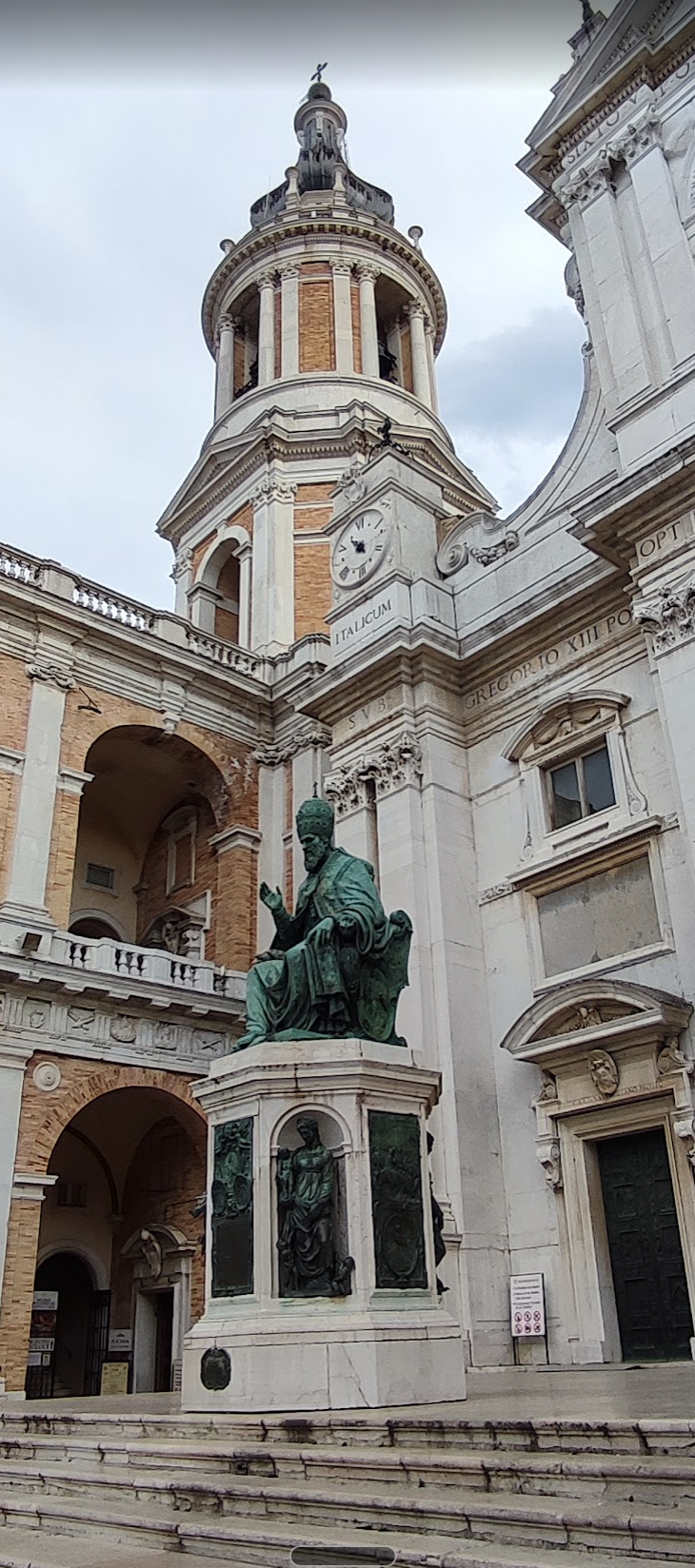
Someone clearly understood this problem early: the historical record shows the dome here was reinforced not long after it went up, with supporting piers thickened by full-centered arches specifically for safety, and further interventions added in the centuries that followed. That’s not a modern retrofit; it’s a sixteenth- or seventeenth-century builder already treating the dome as a known risk.
There’s a structural logic buried in the fortress design, too. The thick perimeter walls and the ronda walkway weren’t only defensive against raiders; they added mass and stiffness low in the building, exactly where it’s needed most to resist lateral loading, whether the force comes from a cannon or an earthquake.
The region’s two defining recent earthquakes bracket the question well. The 1997 Umbria-Marche sequence and the far larger 2016–2017 central Italy sequence — the one that leveled the Basilica of San Benedetto in Norcia and cracked Assisi’s basilicas — both struck the Apennine interior, tens of kilometers inland from Loreto’s position on the coastal strip near Ancona. Distance from the epicenter, and the different soil conditions of the coast versus the mountain valleys, did real work here: I haven’t found a published damage assessment recording serious structural harm to this basilica from either sequence, which is a very different outcome from what befell masonry churches with comparable domes thirty miles inland. That gap, between what happened at Norcia and what apparently didn’t happen at Loreto, is itself a lesson about how much site geology decides the fate of a historic building — sometimes more than its design does.
The Black Madonna Nobody Fully Agrees On
The statue inside the Santa Casa today is not the statue that stood there for most of the shrine’s history, and even that sentence needs a footnote. The original wooden image — by tradition a dark-faced Madonna, read by many visitors as literally Black — was reportedly hidden away and swapped for a copy sometime before Napoleon’s troops looted the sanctuary in 1797; the substitute is the one that then burned in a fire inside the Santa Casa in 1921, while the original, according to this account, had already been quietly moved to a convent in nearby Treia, where it’s venerated to this day. Other sources treat the statue destroyed in 1921 as the original outright. I can’t settle which version is correct, and as far as I’ve found, neither can the specialists who’ve written about it.
What isn’t contested is the explanation for the dark face itself, which is more prosaic than the legends around it: centuries of smoke from oil lamps and votive candles darkening cedar wood, the same slow staining you’ll find on far older icons across the Mediterranean. The Madonna venerated in the Santa Casa today is a replacement, carved after the fire and dressed in the same jeweled dalmatica — a ceremonial robe — as its predecessor. It inherited the same dark face, the same title, and, for the aviators who still salute her from the cockpit on their way past, the same protection.
Why the U.S. Air Force Answers to a Shrine in the Marche
Here is the detail no standard guidebook connects for an American reader: this church is why the U.S. Air Force, alongside St. Michael the Archangel, counts Our Lady of Loreto among its patrons, and why a small chapel inside this basilica is nicknamed, in Italian, la Cappella Americana.
The link runs through 1920. Aviation was barely two decades old, still largely improvised, when pilots from Italian aero clubs — veterans of the First World War — petitioned Pope Benedict XV to give their profession a patron. He agreed: on March 24, 1920, in a papal brief, he named the Virgin of Loreto Patrona Aeronautarum, patroness of all air navigators, drawing the connection directly from the legend of a house that traveled by air, and approved a formal blessing for aircraft at the same time. The Italian Air Force, founded three years later, has venerated her ever since, and celebrates a Mass in her honor every December 10.
The chapel that commemorates this, dedicated to the Assumption and known locally as the Cappella Americana, was decorated between 1953 and 1970 with funds from English-speaking American Catholics, gathered through the Universal Congregation that oversees the shrine. Its frescoes, by the painter Beppe Steffanina, trace the entire mythology of human flight — from Icarus, through Leonardo da Vinci’s studies, to what the chapel’s own description calls simply “modern astronauts.” An American-funded chapel inside a Renaissance basilica, telling the story of flight from Greek myth to the space age, is not the kind of detail that shows up on a typical two-hour coach tour of Loreto, and it should.
The military connection runs deeper than devotion. Walk down the hillside below the basilica, along the Scala Santa — the long stone staircase pilgrims still climb — and you reach the Polish Military Cemetery, built between 1944 and 1946 for soldiers of the Polish II Corps, the army General Władysław Anders assembled from roughly 160,000 Polish prisoners released from Soviet camps, then routed through Persia and Palestine before joining the British Eighth Army on the Adriatic front. Sources differ on exactly how many men are buried across the cemetery’s three terraces — figures ranging from 1,080 to roughly 1,112 appear across different accounts, and I haven’t found one number every source agrees on — but the consistent detail is what the Corps did on its way through: it fought alongside the Italian Corps of Liberation to take Ancona and Loreto that summer, and by at least one Polish veterans’ account, Polish soldiers helped extinguish a fire that was, at that moment, threatening to destroy the Santa Casa itself.
That’s a striking image to sit with: soldiers from a country under Nazi and Soviet occupation, fighting up the Adriatic coast toward a German defensive line, pausing to save a shrine dedicated to a house that supposedly flew here from the Holy Land eight centuries earlier. Every November 2, a Mass is still said in the cemetery for the men who didn’t live to see the war’s end. Most American visitors know Anzio and Monte Cassino from history class; almost none know that the same Polish corps that later broke the Gothic Line fought its way through the town they’re about to have lunch in.
Lorenzo Lotto’s Last Address
One more resident deserves mention, and he never left. Lorenzo Lotto, the Venetian painter whose reputation has only grown since art historians rediscovered him in the twentieth century, first started spending time at the sanctuary in 1552, in his early seventies, and moved to Loreto permanently in 1554, when he formally became an oblate of the Santa Casa — donating his remaining possessions, and effectively himself, to the shrine in exchange for room, board, and the right to keep painting until he died. He didn’t have long left: he was gone by 1556 or early 1557.
The paintings he made in those final years, tired and half-blind by his own account but still working, hang today in the Museo Pontificio Santa Casa, in the west wing of the Apostolic Palace beside the basilica — among them a Presentation at the Temple that scholars now read as close to a spiritual last testament, painted without any of the showmanship of his earlier commissioned work. Lotto’s late Marche period, of which Loreto was the final chapter, is one of the reasons this region holds one of the largest concentrations of his surviving work anywhere — a detail worth knowing if you’d rather see an unfamiliar master’s final paintings in the town where he made them than fight the crowds in front of a more famous name in Venice.
Getting to Loreto and Planning Your Visit
Getting to Loreto is straightforward. Drivers on the A14 leave at the Loreto–Porto Recanati exit and reach the historic center within minutes. By train, Loreto has its own stop on the Ancona–Pescara line, though the station sits about two miles from the basilica; a local shuttle bus covers the climb up to Piazza della Madonna for anyone who’d rather not walk it. Flying in, the nearest airport is Ancona-Falconara, officially the Aeroporto Raffaello Sanzio, roughly a thirty-minute taxi or bus ride away.
Basilica hours run early morning to early evening most of the year, but they shift for feast days, and guided visits pause during Mass — check the sanctuary’s schedule before building a tight itinerary around it. Entry to the basilica is free; the camminamenti di ronda and the Museo Pontificio Santa Casa each carry separate admission. Dress modestly, as at any working Catholic sanctuary: shoulders and knees covered is the standard that gets you through the door.
Two windows are worth avoiding unless you specifically want the crowds: December 10, the Festa della Venuta marking the house’s arrival, and September 8, the town’s own patronal feast for Mary’s birth. Outside those dates, budget two to three unhurried hours for the basilica, the Santa Casa itself, and the treasury museum; add another hour if the camminamenti are open and you want the walk.
Loreto pairs naturally with a longer day in this part of the Marche. Recanati, birthplace of the poet Giacomo Leopardi, is fifteen minutes away and deserves its own visit. Osimo and the limestone cliffs of the Conero Riviera extend the day toward the coast, and Macerata is close enough to fold in if opera season is running at the Sferisterio. None of it requires more than a rental car and a morning start from Ancona.
FAQ — Planning Your Loreto Visit
What’s the difference between Loreto and Lourdes?
Loreto and Lourdes are both major Marian pilgrimage sites, but they mark different kinds of miracle. Lourdes, in southern France, commemorates the Marian apparitions to Bernadette Soubirous in 1858 and is associated with healing waters from a grotto. Loreto, in Italy’s Marche region, venerates a physical relic — the Holy House itself, believed to be Mary’s childhood home in Nazareth — rather than an apparition or a spring. Lourdes draws roughly six million visitors a year; Loreto’s numbers are smaller but still place it among Europe’s largest Marian shrines.
Can you go inside the Holy House?
Yes. Visitors can walk directly into the Santa Casa, the three-walled structure enclosed within Bramante’s marble screen, and it remains open every day the basilica is open. The house has no roof of its own — it was built against a cave in Nazareth and is now covered by the basilica’s dome — and the worn stone threshold shows grooves left by centuries of pilgrims kneeling at the entrance. Access is free, though visits pause briefly during scheduled Masses inside the Santa Casa.
How much time do you need at Loreto?
Most visitors need two to three hours to see the basilica, the Santa Casa, and the treasury museum without rushing. Add another hour if the camminamenti di ronda, the fortress walkway around the apse, are open and you want to walk them. Travelers combining Loreto with Recanati, Osimo, or the Conero Riviera in the same day should plan to arrive by mid-morning.
How do you get to Loreto from Rome?
The most direct route from Rome is by car, roughly three hours via the A14 Bologna–Taranto highway, exiting at Loreto–Porto Recanati. By train, most connections run through Ancona, with a short local ride or shuttle bus from Loreto’s own station up to the historic center; door-to-door, budget around four hours depending on the connection.
Do you need to book tickets in advance?
No advance booking is required to enter the basilica or the Santa Casa, and admission to both is free. Guided tours of the interior require renting an audio headset on-site for a small fee, and access to the camminamenti di ronda and the Museo Pontificio Santa Casa carries separate paid admission. Large tour groups and buses do need to register parking and check-in slots in advance, which is worth knowing if you’re traveling independently and want to avoid their crowds.
What is the dress code at the Loreto basilica?
Loreto enforces the same modest dress standard as most working Catholic sanctuaries in Italy: shoulders and knees covered for both men and women, with hats removed inside the church. Beachwear, especially if you’re combining Loreto with a day on the nearby Adriatic coast, will not get you past the entrance. A light scarf or wrap is worth keeping in your bag if you’re arriving straight from the beach.
What else is worth seeing near Loreto?
Recanati, the birthplace of poet Giacomo Leopardi, sits about fifteen minutes away and rewards a slower visit of its own. Osimo and the limestone cliffs of the Conero Riviera extend a day trip toward the coast, while Macerata, roughly forty minutes inland, is worth folding in if the Sferisterio’s opera season is running. None of these require more than a rental car and a morning start.
The Final Word
Loreto rewards exactly the kind of attention most day-trippers don’t have time to give it: the tension between a legend about angels and a wall built from Nazarene stone, between a fortress and a shrine, between a dome modeled on Florence and a chapel funded by Americans to honor astronauts. None of it needs to be resolved to be worth the visit. If this stretch of the Marche — Loreto, Recanati, the Sibillini foothills — has you thinking further ahead than a single afternoon, including toward a property of your own, I offer a 60-minute orientation call built for exactly that kind of planning; you can book one through TidyCal.