Why Italian Coastal Towns Empty Right After Ferragosto
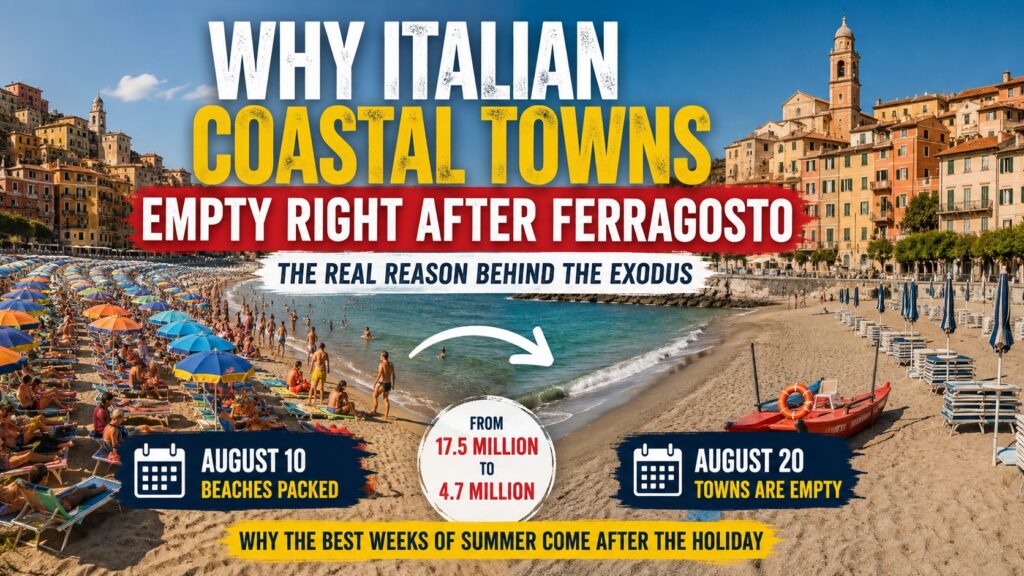
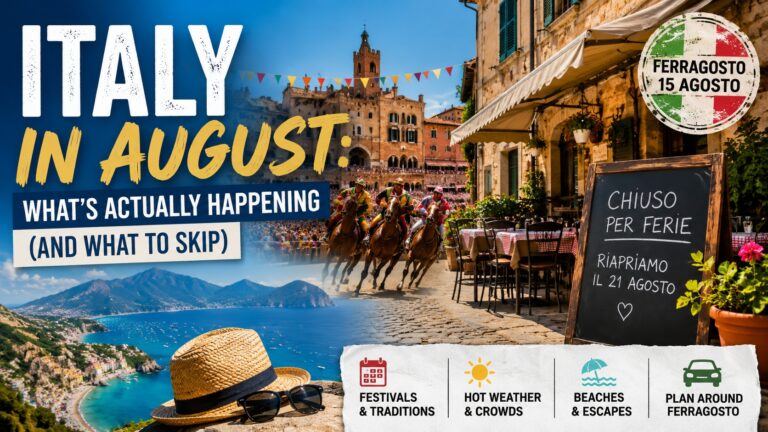
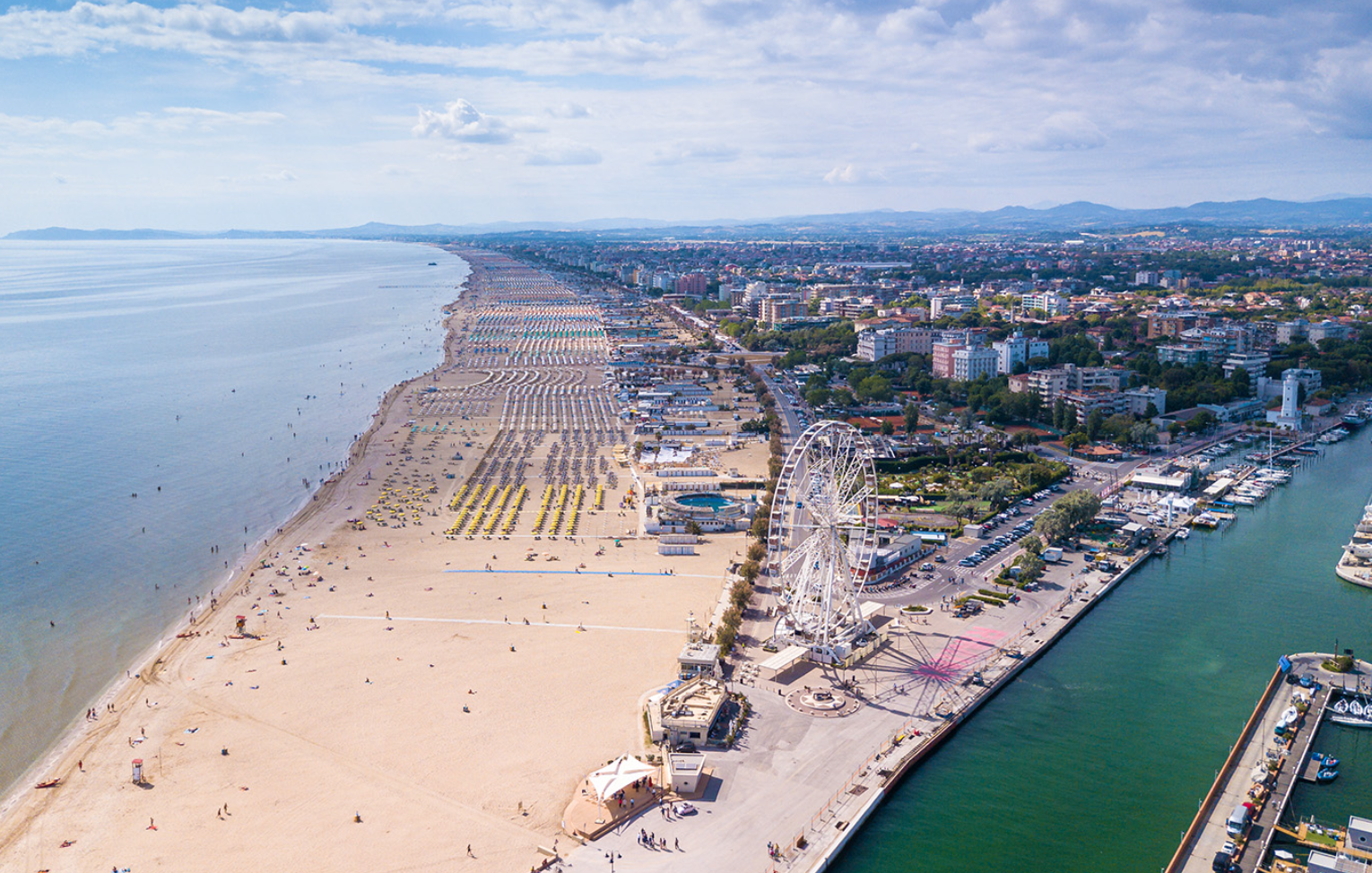
Every year, Italian coastal towns empty out almost overnight after Ferragosto, the August 15 holiday that closes the main act of the Italian summer. I have watched the changeover from an Adriatic boardwalk more times than I can count: on August 10, the beach runs five rows of umbrellas deep, and there is no path to the water that doesn’t cross someone’s towel; by August 20, the same stretch holds a few dozen people, and the beach attendants are already stacking unrented loungers. A Tecnè survey conducted for Federalberghi, Italy’s national hotel association, puts the number of Italian coastal vacationers in August 2026 at roughly 17.5 million, against only 4.7 million in September — a drop of nearly three-quarters in a single turn of the calendar. This piece explains why the collapse happens, and why the two weeks that follow it are often the better ones to be here.
Direct answer: Italian coastal towns empty after Ferragosto because the holiday marks the hard closing date of the country’s collective August shutdown — the month when factories, artisan workshops, and much of the service economy pause for negotiated union holidays, when seasonal beach and hospitality contracts wind down, and when a school calendar that restarts across most of Italy between September 7 and September 17 forces families to convert the last stretch of vacation into a compressed return-home operation. The result is a demographic cliff: a beach town’s temporary population can fall to a third or a quarter of its Ferragosto peak within 48 hours, even though the weather, the sea, and the calendar days left in summer barely change.
What Actually Happens Between August 15 and September 1
The Ferragosto weekend itself is not, in traffic terms, the worst of the summer — that title belongs to the first two Saturdays of August, when Autostrade per l’Italia and Anas issue their earliest bollino nero (black-dot, meaning critical traffic) warnings of the season for the outbound rush to the coast. Ferragosto’s own Saturday tends to register a milder red-dot morning. The real congestion of the “after” arrives in three distinct waves: the weekends of August 16–17, August 22–23, and August 29–30, each flagged red by the same monitoring network for the return trip toward the cities, with tailbacks that regularly spill into the following Monday. Anyone who has driven the A14 north from the Marche coast toward Bologna on one of those Sunday evenings has lived this migration from the inside.
What the traffic bulletins measure in cars, the beach measures in bodies. A stretch of coast that supported a full staff of lifeguards, three shifts of waiters, and a rotating cast of ice cream vendors on August 14 does not gradually thin over the following weeks — it drops in a single weekend, because everyone who is leaving is leaving on the same two or three days, for the same reason, at the same time. This is a different phenomenon from the one covered in Ferragosto Explained, which is about the holiday itself; this is about the machinery that switches off the moment the holiday ends.
Why the Exodus Is a Deadline, Not a Slow Fade
Italy’s collective August shutdown has a closing date
Much of Italy’s manufacturing and artisan economy still operates on a model inherited from decades of union-negotiated collective holidays: entire factories, workshops, and supply chains close for a fixed block in August rather than staggering time off across the year. Ferragosto sits near the middle of that block, and for many businesses it is also near the end of it — the owner or the skeleton staff still on duty needs to be back at a workbench, a counter, or a construction site within days, not weeks. A vacation that has a fixed return-to-work date does not get extended because the weather is still good.
Seasonal contracts expire on a clock, not a forecast
The waitstaff, lifeguards, and beach attendants who make an Adriatic town function in August are, in large part, working fixed-term seasonal contracts that were negotiated months earlier around the historical peak — meaning mid-July through Ferragosto. Once that window closes, many of those same workers are heading back to university, to a second job, or simply to the end of their contracted hours. A restaurant that ran three services a day in the first two weeks of August can find itself, quite suddenly, without the staff to run more than one.
The school calendar sets the real deadline
For families with children, the true constraint is not Ferragosto itself but the date the classroom reopens. Regional school calendars for the 2026–2027 year restart on a staggered schedule: Bolzano leads on September 7, followed by Trento, Valle d’Aosta, and Veneto on September 10; the bulk of the country — Marche included — resumes between September 14 and September 16, with Puglia closing out the calendar on September 17. Once that date is fixed, a family works backward from it: a week to resettle at home, uniforms and school supplies to buy, the last days of August already earmarked for logistics rather than the beach. Ferragosto, in effect, becomes the last date on which a full-length vacation can still be squeezed in before that countdown starts.
The beach itself runs on a business model built for the peak
Italy’s stabilimenti balneari — the licensed private beach concessions that supply umbrellas, sunbeds, and services along most of the sandy coast — operate under concessions that typically run well into September on paper. In practice, the staffing and service level offered in the last two weeks of the season is a business decision, not a regulatory one: after Ferragosto, the revenue per operating day drops fast enough that many operators scale back hours, close secondary services, and consolidate staff, even on days when the beach itself remains legally open and the water is, if anything, warmer than it was in July.
The infrastructure was never sized for the other Italy that shows up in August
Here is the detail a hospitality guide will not give you, because it isn’t a hospitality problem — it’s a civil engineering one. Coastal towns on the Adriatic are, for most of the year, small municipalities: a few thousand registered residents, a water network, a sewage treatment plant, and a parking allotment all sized on that number. In August, the same footprint can be asked to serve a population three to five times larger. In my professional work assessing municipal infrastructure across Le Marche, I have seen this mismatch play out on the same networks year after year: aqueducts running at the edge of their rated capacity, treatment plants processing loads their design documents never anticipated, and parking systems that only make sense as a controlled-chaos improvisation for six weeks a year. None of this is a scandal — it is simply expensive to build permanent capacity for a demand spike that lasts less than two months — but it is also a quiet, structural reason why so much of what makes a beach town run smoothly in early August (extra shuttle buses, extended parking enforcement, additional cleaning crews) is the first thing withdrawn once the numbers drop. The town isn’t just emptier after Ferragosto; the temporary systems built to serve the crowd disappear with the crowd.
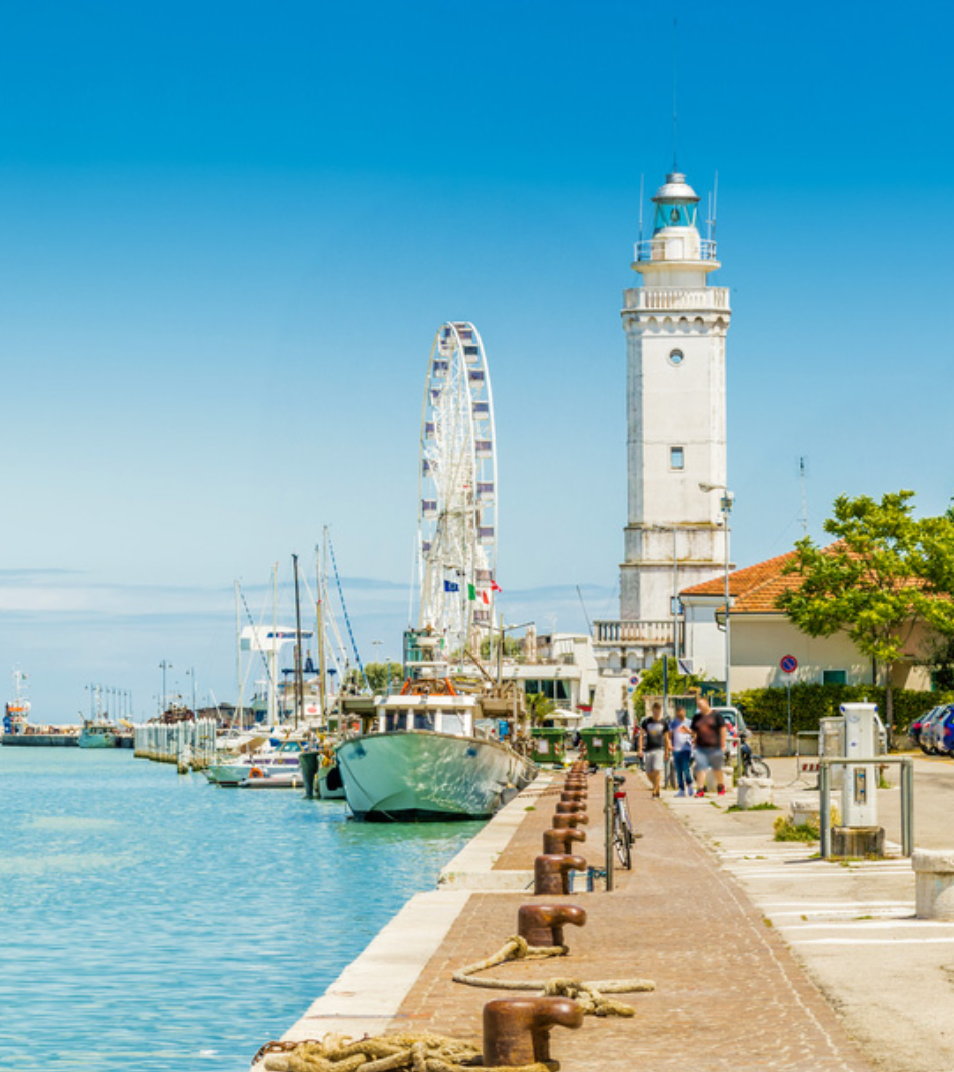
The Reversal: Why Late August and September Are the Insider’s Window
Here is what the exodus obscures: nothing about the coast itself gets worse after August 15. If anything, the opposite is true. Shallow, semi-enclosed seas like the Adriatic hold onto summer heat well after the calendar turns toward autumn, a lag effect any oceanographer will recognize — the water is slower to warm in spring, and just as slow to cool once September arrives. Copernicus Climate Change Service data analyzed for the Italian seas found September 2025 to be the third-warmest September on record for national sea-surface temperatures, with anomalies over the central and southern Adriatic running above 1°C compared to the 1991–2020 average. Along much of the Adriatic coast, water temperatures in the low-to-mid twenties Celsius persist comfortably through September, which is to say the swimming season does not end when the crowd does.
What does change is everything around the water. The beach that needed five rows of umbrellas in the second week of August needs a fraction of that by the last week; restaurants that were fully booked and running rushed, harried service in mid-August suddenly have room to slow down, which in a country where dining is supposed to be unhurried is not a small thing. Rates for rooms and rentals typically ease once the peak-week premium expires, since demand has thinned even as the season technically continues. And the town itself changes character — the version of a beach town, that returns to the people who actually live there once the temporary population clears out, is closer to the place its own residents would describe if you asked them what they like about it.
The trick is choosing a town that has a life beyond the beach season to return to. A resort development built purely to serve summer tourism can feel genuinely half-shuttered once the crowds leave, because there was never much of a local economy underneath the seasonal one. Towns with a working fishing fleet, a functioning port, or a year-round population large enough to support its own commerce — Senigallia, San Benedetto del Tronto, Civitanova Marche among them on the Marche coast — do not have that problem. Their restaurants, markets, and cafés were open in February and will be open in November; August tourism is an addition to their economy, not the entirety of it. Choosing one of these over a single-purpose resort town is the single most reliable way to avoid the post-Ferragosto letdown.
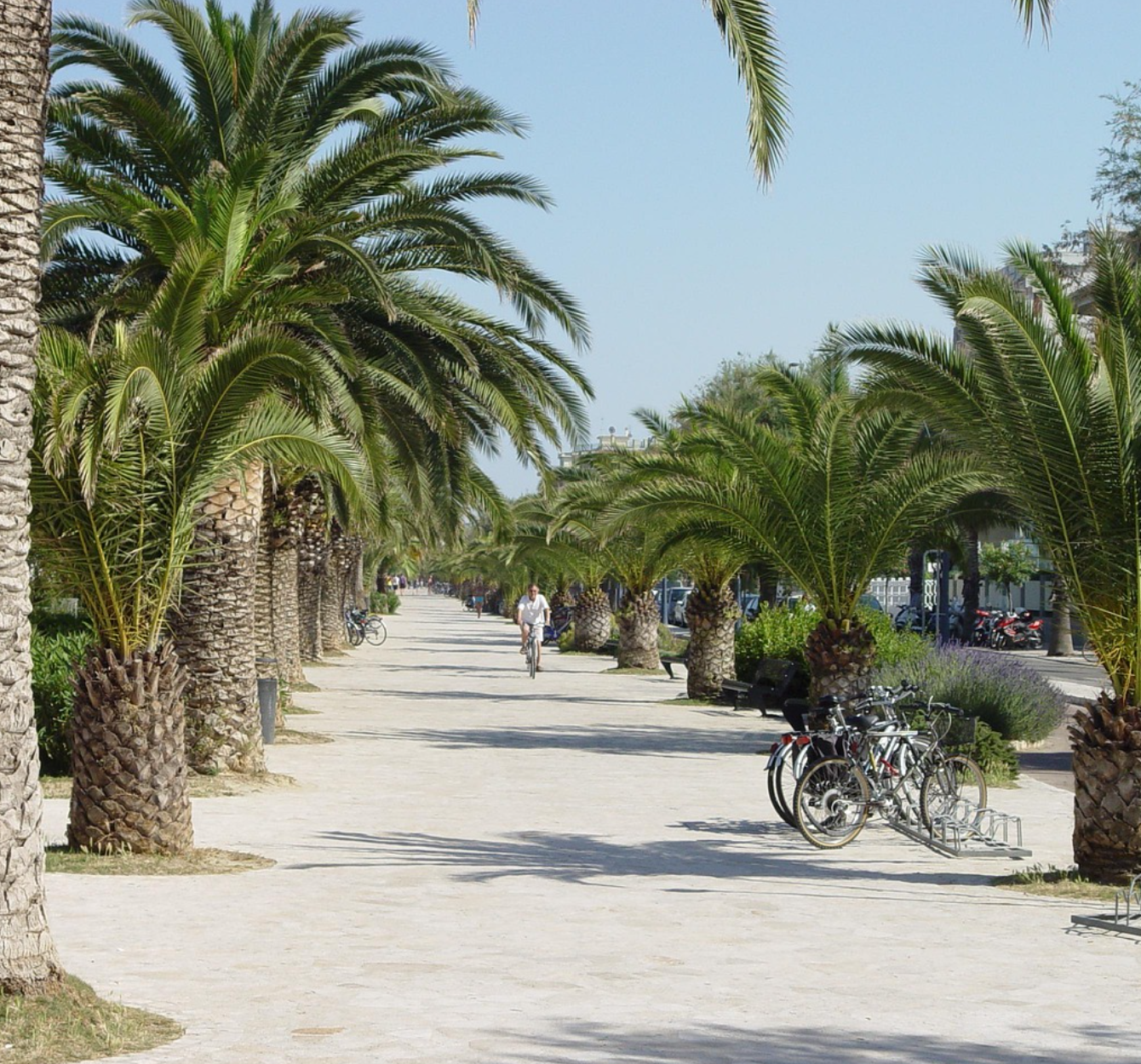
The Honest Practical Guide: What Closes, What Stays Open, How to Choose
What typically scales back or closes
Expect reduced hours or full closure, especially by the first week of September, from: secondary or overflow beach concessions that exist purely to absorb peak-week overflow; seasonal pop-up bars and kiosks staffed by short-term summer hires; extra shuttle and parking services laid on specifically for the August surge; and restaurants that depend heavily on a single large seasonal staff rotation rather than a stable year-round team.
What reliably stays open
The primary beach concessions in any town with a real year-round population almost always remain operational through September, often with better service once the rush eases. Historic town centers, markets, and the restaurants that serve residents rather than day-trippers keep their normal rhythm. Museums, churches, and cultural sites — which were never particularly seasonal to begin with — are unaffected and considerably less crowded.
How to choose a town that won’t shut down around you
Look for a working port or fishing fleet, a year-round population in the thousands rather than the hundreds, and a historic center that exists independently of the seafront — signs that the town’s economy does not collapse the moment the summer visitors leave. A quick way to check: search for the town’s name alongside “mercato” (market) or “porto peschereccio” (fishing port); a town with an active weekly market or working harbor almost always has the year-round infrastructure to stay lively after Ferragosto.
FAQ — Visiting the Italian Coast After Ferragosto
What does “after Ferragosto” mean for travel to Italy?
It refers to the period from roughly August 16 through late September, when the bulk of Italian domestic tourists have returned home from their coastal vacations, leaving beach towns with a fraction of their mid-August population while the weather and sea conditions remain largely unchanged.
Is it still warm enough to swim in Italy after Ferragosto?
Yes. Adriatic sea temperatures typically remain in the low-to-mid twenties Celsius through September, and Copernicus climate data show recent Septembers running warmer than the historical average, making it one of the more comfortable months for swimming rather than a marginal one.
Do hotels and restaurants close after Ferragosto?
Some do, particularly seasonal pop-ups and secondary beach concessions that exist only to absorb the August overflow. Establishments serving a year-round local population — in towns with real off-season economies — generally stay open through September with reduced but reliable hours.
When exactly does the crowd disappear?
Most of the change happens within the three weekends following Ferragosto — August 16–17, 22–23, and 29–30 — when Italy’s return traffic (il controesodo) peaks according to Autostrade per l’Italia and Anas monitoring. By the first week of September, most towns have reached their off-peak rhythm.
Are prices lower after Ferragosto?
Generally, yes, since accommodation and rental rates tend to ease once the mid-August demand premium expires, though exact pricing varies by property and should be checked directly for current rates.
Which coastal towns stay lively even after the crowds leave?
Towns with a genuine year-round economy — a working fishing port, a historic center independent of the beachfront, and a resident population in the thousands — tend to hold their character best. On the Marche coast, Senigallia, San Benedetto del Tronto, and Civitanova Marche are reliable examples.
Why does the infrastructure feel strained in early August but fine by September?
Coastal municipalities size their permanent water, sewage, and parking systems for their registered year-round population, not for the three-to-fivefold surge of August visitors. Once the seasonal crowd leaves, those systems return to operating within their intended capacity, which is part of why the “after” period often feels calmer in ways that go beyond just fewer people on the sand.
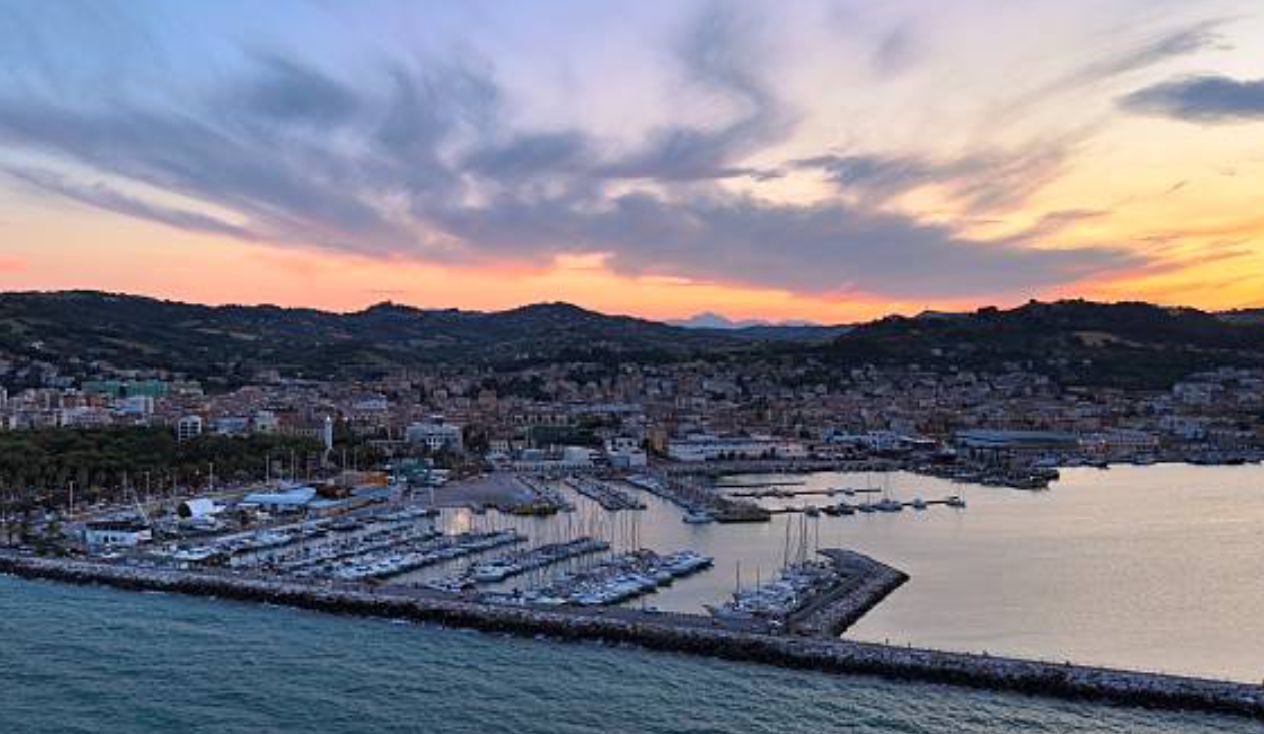
The Final Word
The two weeks after Ferragosto are not the tail end of the Italian coast’s good season — they are a different, and in several ways better, version of it. The water is as warm as it was in July, the towns that have a real economy underneath their beach season carry on without missing a beat, and the crowd that made early August feel like a “quinta fila di ombrelloni” has gone home to get ready for school. If your dates are flexible, this is the window worth taking.
If you’re planning a longer stay on the Marche coast this season, our guides to Ittiturismo, Brodetto, and the Conero Riviera versus the Amalfi Coast comparison are natural next reads — and if you’d like more insider dispatches like this one, explore the rest of Tastes & Wonders of Italy or subscribe to the newsletter.
Written by Mirco Vitellozzi, a structural engineer from Le Marche who writes about Italy from the inside. More essays at Tastes & Wonders of Italy, and short films on YouTube.