Italian Aperitivo Decoded: The Rules No Tourist Knows
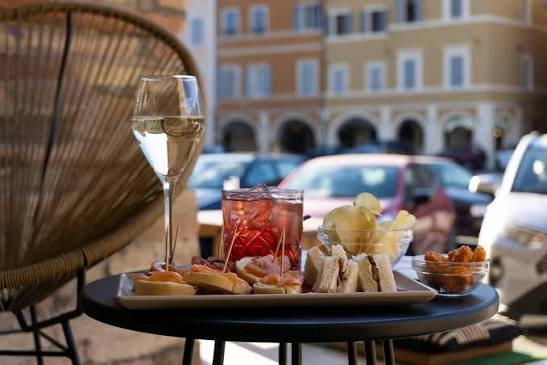
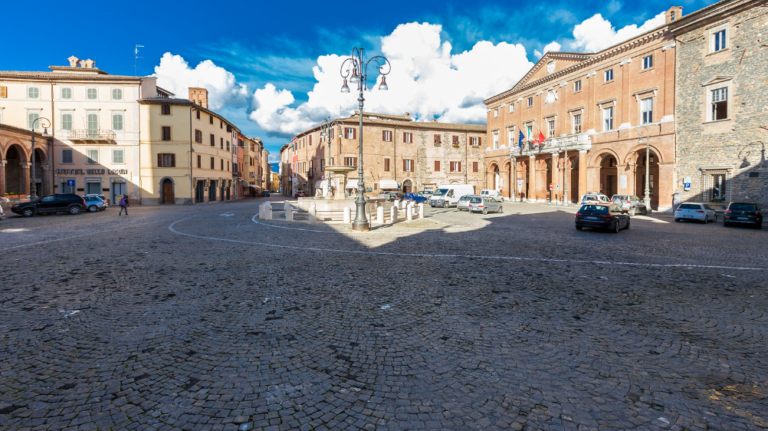
At seven in the evening, in a piazza in the Marchigiano hinterland, the tables fill in a specific order. First the regulars, who take the same seats they took yesterday. Then the younger crowd, drifting in after work, ordering the same drink they ordered last Tuesday. A glass arrives with ice, a slice of orange, a small bowl of olives and taralli that nobody asked for and nobody pays extra for. Nobody is eating dinner. Nobody is in a hurry. This is l’aperitivo, and if you have only encountered it as “Italian happy hour” in an American food blog, you are missing almost everything that makes it work.
The word aperitivo comes from the Latin aperitivus, “that which opens” — a drink taken before a meal specifically to open the stomach and stimulate appetite, not to replace the meal that follows. It happens in a defined window, roughly 6 to 8 p.m., always before dinner, never instead of it. It is built around one or two drinks, a small plate of something salty to accompany them, and conversation that is allowed to move slowly. Understanding that single distinction — a ritual that opens the evening, not a meal that closes it — is the one piece of information that separates a visitor who blends in from one who doesn’t.
What Aperitivo Actually Is (and Isn’t)
The modern aperitivo is not ancient in the way Italians sometimes like to claim, though its lineage genuinely does stretch back further than most drinking customs. The Greeks and Romans drank bitter, herb-infused wines before banquets specifically to stimulate digestion — a genuinely medicinal habit long before it became a social one. But the aperitivo as Italy practices it today, with its specific rhythm and its specific drinks, was born in a particular shop, in a particular city, in a particular year: Turin, 1786, when a young liquor-maker named Antonio Benedetto Carpano began selling a white wine infused with more than thirty herbs and spices from a small store under the porticoes of Piazza Castello. He called it vermut — vermouth — and it became, almost immediately, fashionable. The Savoy royal court adopted it; King Vittorio Amedeo III is said to have sent his footmen to fetch it personally. By the late nineteenth century, the ritual had spread through the café culture of Turin, Genoa, Florence, Venice, Rome, Naples and Milan, each city developing its own version of the same basic idea: a drink, a small snack, a specific pre-dinner hour, taken in company.
What the ritual is not — and this is where confusion sets in for American visitors — is a meal. The function of aperitivo is to prepare the appetite, not satisfy it. The traditional accompaniment is a handful of olives, some potato chips, a few slices of focaccia or a small plate of cured meat: enough to give the alcohol something to work against, never enough to constitute dinner. An Italian ordering an aperitivo at seven is planning to eat dinner at nine or later. The two events are sequential, not interchangeable.
The Rule That Trips Up Every American: Aperitivo vs. Apericena
Here is the distinction that causes more confusion for American visitors than any other single fact about Italian drinking culture, and it has a very specific, very traceable origin.
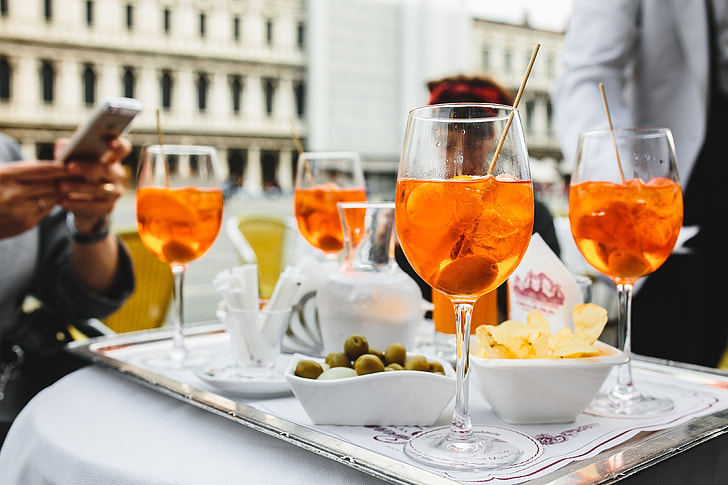
In the mid-1990s, a Milanese bar owner named Vinicio Valdo, running a venue called Cap San Martin, noticed something: the more free food he put out alongside the drinks, the more his customers drank, and the longer they stayed. He began setting up buffets during the aperitivo hour — pasta salads, rice dishes, cold cuts, whatever kept people ordering another round. He called it, without much ceremony, l’aperitivo alla milanese. It caught on. Within a decade it had a new, uglier name: apericena — a portmanteau of aperitivo and cena (dinner) — and it had spread from Milan through the rest of northern Italy and then the whole country, evolving into exactly what the name suggests: an all-you-can-eat buffet, included in the price of one drink, that functions as a full dinner substitute rather than an appetite opener. Valdo himself, in interviews given decades later, expressed something close to regret about what his invention had become, describing the modern version as having lost the point of the original ritual entirely.
This matters for you because it means two different things are now both called “aperitivo” in Italy, and they carry very different social weight. The classic aperitivo — a cocktail, a bowl of olives, an hour of conversation before a proper dinner elsewhere — is still what most adult Italians, in most regions, mean by the word. The apericena — the buffet, the all-you-can-eat plate stacking, the treatment of the aperitivo hour as dinner itself — is a younger, more commercial, and more regionally concentrated phenomenon, still strongest in Milan and the north, viewed by many Italians (correctly or not) as a degraded version of something that used to be about the drink and the conversation, not the volume of free food. Many Italians, particularly outside the under-35 crowd in northern cities, still treat the buffet-heavy apericena with a raised eyebrow.
The tourist mistake, and it is a genuinely visible one, is walking into a classic aperitivo bar — one offering a modest bowl of olives and chips with your drink — and treating it like the buffet you had in Milan, piling a plate as if the bar owed you a meal. It doesn’t. Read the room: if there’s a groaning buffet table, you’re at an apericena and the rules are different. If there’s a small bowl next to your glass, you’re at an aperitivo, and that bowl is not dinner.
What to Order — and What Locals Actually Drink
The classic aperitivo repertoire has a specific historical logic once you know where each drink comes from, and knowing it will change what you order.
Vermouth, straight or on ice, is where the whole tradition starts — Carpano’s original 1786 recipe, still made today by Martini, Cinzano and others, in dry, red and white styles, each traditionally garnished differently (a green olive with dry, half an orange slice with red, half a lemon slice with white).
The Negroni and the Americano both descend from the vermouth-and-bitter family: the Americano is Campari, sweet vermouth and soda; the Negroni adds gin to the same base, reportedly invented in Florence in the 1920s when Count Camillo Negroni asked a bartender to strengthen his usual Americano.
The Spritz has a more specific and more contested history than most visitors realize. The original spritz veneziano was created in Venice around 1920, built on the bitter liqueur Select — not Aperol. Aperol itself was invented separately, in Padua, in 1919, by the Barbieri brothers, and it took until the 1970s for the now-standard combination of Aperol, Prosecco and soda to become the fixed modern formula. The official IBA ratio, if you want to make one correctly, is three parts Prosecco, two parts Aperol, one part soda water, poured over ice in that order.
Here is the detail that separates a visitor who’s paid attention from one who hasn’t: in Venice, locals drink Select. Tourists drink Aperol. This isn’t snobbery so much as regional loyalty to the original recipe — Select is more bitter, more herbal, less sweet, and it’s the flavor Venice actually built the cocktail around a century ago. Ordering a Select spritz in Venice, or a Campari spritz anywhere, signals that you know something most visitors don’t bother to learn.
For those who prefer to skip alcohol entirely, Crodino — the bright orange non-alcoholic bitter that’s been advertised on Italian television since the 1960s — is the standard order, not a consolation prize; plenty of Italians order it by choice, not necessity, particularly earlier in the week.
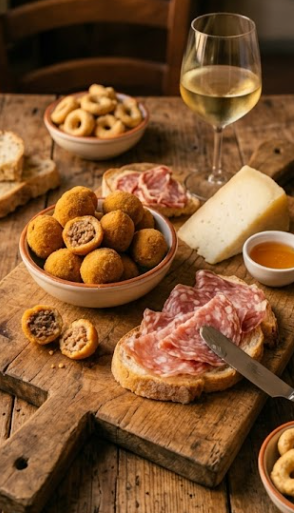
In central Italy and Le Marche specifically, the aperitivo hour tends toward wine — a glass of Verdicchio or Rosso Piceno rather than a mixed cocktail — paired with regional stuzzichini rather than the generic bar snacks you’d get further north: olive all’ascolana (the fried, meat-stuffed olives that are the Marche’s signature dish), slices of ciauscolo (the region’s spreadable salume), and local pecorino, when the bar takes its aperitivo seriously.
The Rules No Tourist Knows
This is the part that no menu explains and no waiter will correct you on directly, because Italians generally assume you already know it. You don’t have to guess.
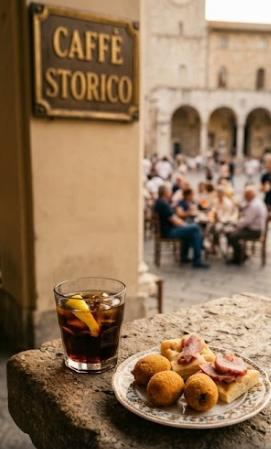
It is not dinner. This is the rule everything else follows from. If you are hungry for a full meal, the aperitivo hour is not where you solve that problem — unless you’ve specifically found an apericena venue and understand what you’re walking into.
One or two drinks is normal; more looks like something else. The aperitivo hour is not a happy-hour drinking session in the American sense. Italians nurse a single spritz or vermouth across an hour of conversation. Ordering round after round reads as either very thirsty or very lost.
Timing matters, and it’s narrower than you’d think. Aperitivo runs roughly from six to eight, occasionally stretching to nine in the south or in summer. Ordering a Negroni at 4 p.m. or at 11 p.m. simply removes you from the social context the drink exists inside; you’ll get served, but you’ll be drinking alone, out of rhythm with everyone else in the room.
The price includes what’s in the bowl, and you don’t negotiate it. The olives, chips or focaccia that arrive with your drink are priced into the drink itself. This is not a a la carte situation and no one expects you to order additional food unless you want to.
The pace is slow, and rushing it defeats the purpose. An aperitivo is a conversation with a drink attached, not a drink with a time limit. If you order and finish quickly and ask for the check, you’ve essentially treated a social ritual like a transaction, which reads, to anyone paying attention, as slightly odd.
Standing or seated both work, but they signal different things. A crowded outdoor bar with people standing, glass in hand, is typically a younger, more casual scene. A seated table at a café is the more traditional register, particularly outside major cities. Neither is wrong; know which one you’ve walked into.
Tipping does not function the way it does in the United States. Aperitivo bars, like most Italian bars and restaurants, do not expect the 15-to-20-percent tip standard in America. Rounding up, or leaving a euro or two for table service, is generous and sufficient; leaving nothing is also entirely normal.
How Aperitivo Changes by City
The ritual is genuinely regional, and knowing the local variant before you arrive saves you from ordering the wrong thing in the wrong room.
Turin is where it began, and vermouth is still treated there with something close to reverence — the historic cafés along the porticoes serve it with Piedmontese bagna càuda or fonduta in scaled-down aperitivo portions, alongside grissini and cheese.
Milan is the modern epicenter, the birthplace of the buffet-style apericena and still the city where the aperitivo hour runs longest and loudest, particularly around the Navigli canals, where the crowd standing outside bars with drinks in hand can stretch for entire blocks by eight o’clock.
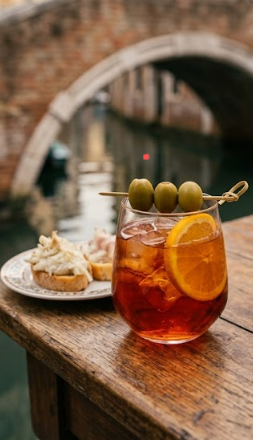
Venice keeps closer to the original spritz formula — Select rather than Aperol — and pairs the drink with cicchetti, the small savory snacks served at bacari (traditional Venetian wine bars) that function almost as Venice’s answer to Spanish tapas; ordering un’ombra (literally “a shadow” — a small glass of house wine) alongside cicchetti is the specifically Venetian register of the ritual.
Rome tends toward a more restrained version — Negroni and Americano over elaborate spritz variations, olive all’ascolana and supplì (fried rice balls) as the standard accompaniment, and a generally lower-key social energy than Milan’s.
Le Marche and central Italy run closer to Turin’s register than Milan’s: wine over cocktails, regional stuzzichini over generic bar snacks, and a pace that assumes you have somewhere unhurried to be afterward, which — in a region built around small hill towns rather than nightlife districts — is usually true.
Common Mistakes Americans Make
Gathering the errors into one place, because this is the section that gives the title its purpose. American visitors, with real consistency, tend to: treat the free snacks as a meal and eat far more of them than the drink’s price accounts for; order a full round of cocktails as if it were a happy-hour drinking session rather than a one-or-two-drink ritual; show up at 4 p.m. or after 10 p.m. and wonder why the bar feels empty or the wrong crowd is there; ask for the check within fifteen minutes of sitting down, signaling that they’ve misunderstood the pace entirely; leave a large American-style tip that the server didn’t expect and doesn’t quite know what to do with; and — most commonly of all — order an Aperol Spritz in Venice without knowing that the city’s own bars, left to their own preferences, reach for Select.
None of these mistakes are embarrassing in the sense of causing a scene. Italians are, generally, unbothered by tourists ordering the “wrong” drink or misreading the pace. But knowing the difference is the line between spending an hour as a spectator of Italian life and spending an hour actually inside it.
Planning Your Aperitivo
When to go. Six to eight p.m. is the safe, universal window; stretch to nine in summer or in southern Italy, where the evening starts later across the board.
What to expect to pay. A classic aperitivo — one cocktail or glass of wine with the accompanying snacks — typically runs eight to twelve euros in most of Italy, more in tourist-dense areas of Venice, Florence or Rome’s historic center. An apericena with full buffet access usually runs ten to fifteen euros, occasionally structured as a fixed entry price covering unlimited food.
How to order. Walk in, sit or stand at the bar, and order a single drink — that’s the entire protocol. If you want food beyond what arrives automatically, ask what’s available; don’t assume a buffet exists unless you can see one.
What to pair it with. In Le Marche specifically, an aperitivo built around Verdicchio or Rosso Piceno, paired with olive all’ascolana and a plate of ciauscolo, is as authentic a version of this ritual as exists anywhere in the country — a detail worth knowing if your itinerary through the region includes the food culture covered in our guide to the Marche and the Mediterranean diet.
FAQ — Italian Aperitivo for the American Visitor
What is aperitivo, exactly? Aperitivo is a pre-dinner Italian ritual involving one or two drinks — typically a cocktail, wine or vermouth — accompanied by a small snack, taken roughly between 6 and 8 p.m., specifically to stimulate the appetite before dinner. The word comes from the Latin aperitivus, “that which opens.” It is a social ritual, not a meal, and understanding that distinction is the single most useful thing an American visitor can know before ordering one.
What is the difference between aperitivo and apericena? Aperitivo is the classic version: a drink with a modest accompaniment of olives, chips or focaccia, meant to precede a separate dinner later in the evening. Apericena — invented in Milan in the mid-1990s by bar owner Vinicio Valdo — is a buffet-style version where the food, often unlimited, effectively replaces dinner. Many Italians consider the apericena a commercialized departure from the original ritual; both exist today, but they carry different social expectations, and mixing them up (treating a classic aperitivo’s small snack bowl as an all-you-can-eat buffet) is the most visible tourist mistake.
What should I order at an Italian aperitivo? Classic choices include vermouth (straight or on ice), the Negroni, the Americano, and the Spritz — traditionally made with Aperol, though the original Venetian version used the more bitter liqueur Select, which many Venetians still prefer. Non-alcoholic drinkers commonly order Crodino, a bright orange bitter that Italians order by preference, not as a compromise. In central Italy and Le Marche, a glass of local wine — Verdicchio or Rosso Piceno — is at least as common as a mixed cocktail.
Why do Venetians drink Select instead of Aperol Spritz? The original spritz veneziano, created in Venice around 1920, was built on Select, a bitter liqueur with more herbal, less sweet notes than Aperol, which was invented separately in Padua in 1919. The now-globally-famous Aperol Spritz formula only became standard in the 1970s and was popularized internationally starting in the 2000s. Many Venetians still consider Select the authentic local choice, and ordering it signals familiarity with the drink’s actual history rather than its marketing.
Is it rude to eat a lot of the free snacks at an aperitivo? It depends entirely on what kind of venue you’re in. At a classic aperitivo, the small bowl of olives, chips or focaccia served with your drink is meant to accompany one or two drinks, not to constitute a meal — treating it as an all-you-can-eat opportunity is a visible tourist mistake. At an apericena, where a buffet is explicitly part of the price, filling a plate is exactly the point. The key is recognizing which format you’ve walked into before you start eating.
How much should I tip during aperitivo in Italy? Italian bars and restaurants, including aperitivo venues, do not operate on the American 15-to-20-percent tipping standard. Rounding up the bill or leaving a euro or two for table service is generous and appropriate; leaving nothing at all is also entirely normal and won’t be read as rude.
What time should I go for aperitivo, and how long should I stay? The standard window is roughly 6 to 8 p.m., stretching to 9 in summer or in southern Italy. A typical aperitivo lasts somewhere between forty-five minutes and an hour and a half — long enough for one or two drinks and unhurried conversation, but understood as a prelude to dinner rather than dinner itself. Arriving much earlier or later removes you from the social rhythm the ritual is built around.
The Final Word
Aperitivo survives, in its classic form, because it does one thing extremely well: it draws a clean line between the working day and the evening, without demanding that you commit to a full meal to cross it. An American visitor who understands the rule — one drink, a small snack, an hour of unhurried company, dinner still ahead — gets access to something that the buffet-heavy, dinner-replacing version of the ritual has, for many Italians, already lost. Order the Select in Venice. Order the local wine in the Marche. Leave room for dinner. That’s the whole decoder, really: not a set of etiquette rules to memorize, but one piece of information — this opens the evening, it doesn’t close it — that changes how everything else falls into place.
Planning an Italy itinerary built around the food and rituals of daily life rather than the checklist sights? I offer 30-minute consultations to help build exactly that kind of trip — book through TidyCal.