Trattoria, Osteria, Ristorante, Enoteca: The Italian Restaurant Hierarchy Decoded
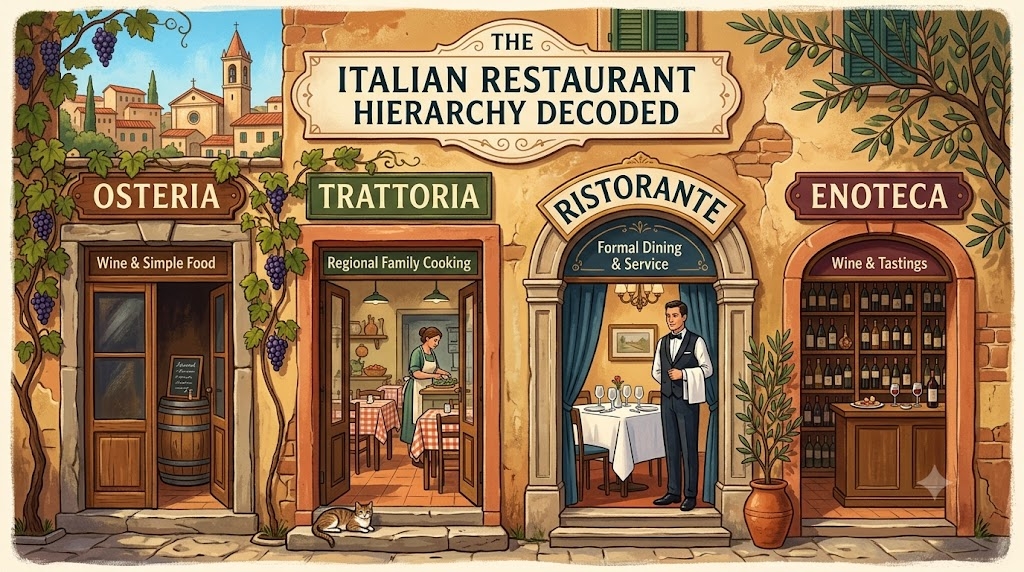
The types of Italian restaurants you will meet here — osteria, trattoria, ristorante, enoteca, and a half-dozen regional variants most guidebooks skip — once corresponded to a clear hierarchy of formality, ownership, and specialty. An osteria poured wine. A trattoria fed the neighborhood. A ristorante served with white tablecloths and a proper wine list. An enoteca sold bottles to take home. I have eaten dinner at a paper-covered table where house wine arrived in an unlabeled bottle before I had ordered anything, and I have eaten dinner where a waiter asked whether I preferred my water at twelve or eighteen degrees — both in Le Marche, both places serving food to paying customers, only one of them willing to call itself a ristorante.
That old hierarchy has largely collapsed. I have eaten remarkable food in places calling themselves osterie and forgettable, reheated plates in places calling themselves ristoranti. The name on the door is a clue, not a contract. What follows is the history behind each term and, more usefully, how to read a place regardless of what it calls itself.
Osteria: From Wine Stop to Neighborhood Table
The word osteria descends from oste, an innkeeper, rooted in the Latin hospes — host. In medieval Italy, an osteria was not primarily a place to eat. It was a place to drink wine drawn from a cask and, if you were a traveling merchant or a farmer between fields, to sit at a shared table with food you had brought yourself. The osteria supplied the wine and the roof; you supplied the meal. Bologna’s Osteria del Sole, pouring wine at the same address since 1465, still runs closer to that original arrangement than almost anywhere else in the country.
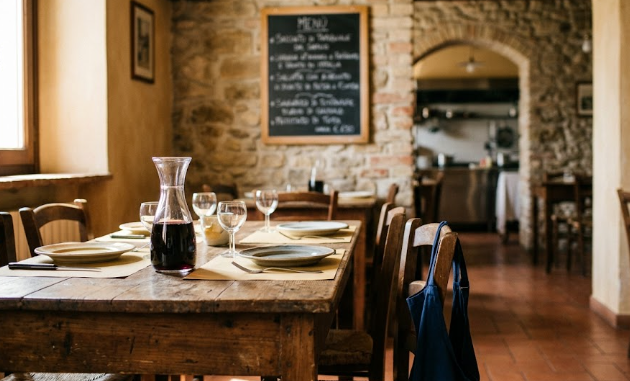
Somewhere along the way, osterie started cooking. A cask of wine beside a fire in a stone room in January tends to attract people who would rather eat something warm than unwrap a cold panino, and innkeepers who could cook began doing exactly that. What emerged is the osteria as most travelers meet it today: a small, often family-run room with one or two dishes chalked on a board, a menu that may not exist in printed form at all, and a kitchen that cooks whatever the market delivered that morning.
The complication is that the name has since been claimed by establishments with nothing to do with any of this. Osteria Francescana in Modena carries three Michelin stars and a tasting menu running into the hundreds of euros — a homage to Emilian tradition, not a description of what’s actually inside. I mention this not to make you distrust the word, but because a Marchigiano who has eaten in genuine osterie near San Ginesio, where the only printed thing in the room is the newspaper on the counter, knows exactly how wide the gap can be between a label and the room it’s attached to.
Trattoria: The Kitchen That Cooks Like Family
If the osteria’s origin is about wine, the trattoria’s is about cooking. The word borrows from the French traiteur — a caterer, someone who prepares food to be served rather than simply hosting a room. A trattoria, at its best, is a family-run kitchen serving the traditional dishes of its own region, often the same recipes across generations, adjusted only by whichever family member is currently at the stove.
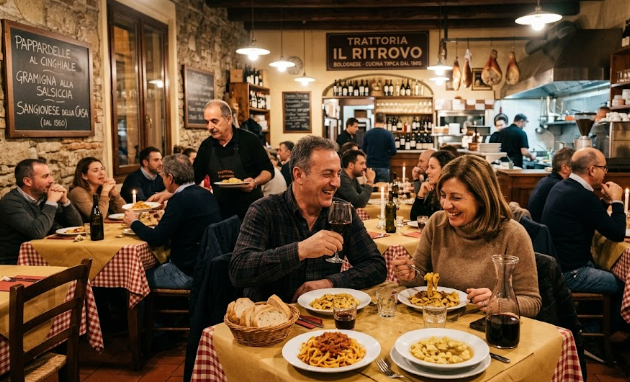
This is the category I would point an American traveler toward first for one meal that explains a region’s food without pretense. A trattoria menu tends to be short, seasonal, and regionally specific; you will not find a trattoria in Le Marche serving carbonara alongside vincisgrassi as though the two belonged to the same tradition. The room is usually plain — paper placemats rather than linen, a proprietor who remembers regulars by name and by order. Reservations matter more than the plain décor suggests: a well-run trattoria with twelve tables and forty years of local loyalty fills up on a Friday night regardless of how unassuming it looks from the street.
What has genuinely changed is the ceiling on price. A generation ago, “trattoria” reliably meant inexpensive. Today trattorie in Rome, Florence, or Bologna commonly charge ristorante prices while keeping the name for the warmth and authenticity it signals — a marketing choice as much as a structural one. The name still tells you the food will be regional and the kitchen will likely be family-run. It no longer reliably tells you the bill will be modest.
Ristorante: Where Formality Was the Point From the Start
The ristorante, unlike the other three terms, was never originally Italian. It descends from the French restaurant, itself from restaurer — to restore — and the concept crossed into Italy from Paris, where the earliest establishments bearing the name served restorative broths to a paying public rather than only to hotel guests. Because of its proximity to France, Piedmont is generally credited as home to some of Italy’s earliest true ristoranti, arriving in the second half of the eighteenth century: formal dining rooms with an à la carte menu, trained waitstaff, and a kitchen brigade in place of a single family cook.
That formality is still the defining trait today. A ristorante seats you rather than letting you find your own table. It employs dedicated waitstaff, often including a sommelier, and its wine list extends beyond the house carafe into labeled bottles worth discussing. The menu is broader than a trattoria’s — antipasto, primo, secondo, dessert, each with several choices — and the meal moves through those courses rather than arriving as a single shared plate. A ristorante meal is far more likely to end with an actual dessert course than the fruit or biscotto a trattoria might offer as an afterthought.
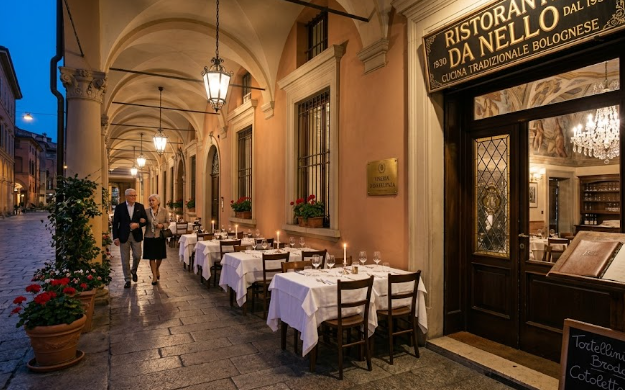
Price and formality tend to track together, but not perfectly. I have eaten at ristoranti in small towns across Le Marche where the prices were entirely reasonable and the formality was simply a matter of table manners — cloth napkins and a proper wine list did not translate into an inflated bill. The word signals structure and service. It does not automatically signal extravagance.
Enoteca: The Wine Shop That Learned to Feed You
Enoteca comes from Greek roots meaning, essentially, a wine repository — a library built for bottles rather than books. Historically, an enoteca sold wine, full stop. You walked in, tasted a glass if the owner was generous, and walked out with something to bring home. Food was not the point; the wine was.
That has shifted more than any of the other three categories. Modern enoteche routinely serve small plates alongside the bottles — cured meats and cheese, bruschetta, sometimes a short list of first courses — because customers wanted something to eat while they tasted. The wine remains the reason to walk in: an enoteca’s staff tend to know their region’s producers by name and vintage in a way a trattoria’s waitstaff usually does not, and the bottle list is typically organized by appellation rather than by price. In Le Marche, where Verdicchio is the wine an enoteca exists to showcase, asking the person behind the counter which producer they would pour for themselves is a more useful question than reading the label.
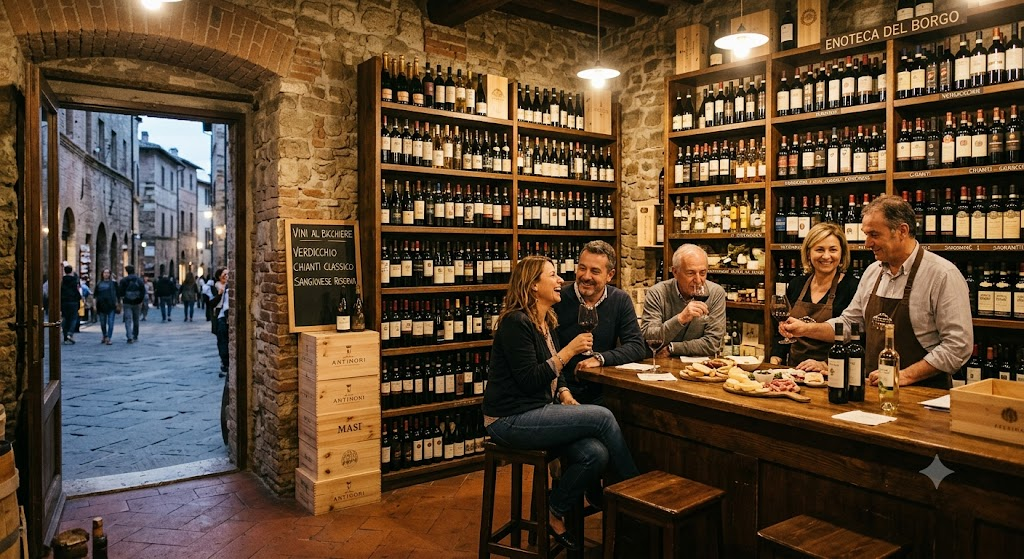
The reverse migration has happened too: full-service restaurants sometimes call themselves enoteca purely to signal an ambitious wine list, regardless of whether wine was ever their founding purpose. As with osteria and trattoria, the label promises an emphasis. It no longer guarantees an origin story.
Beyond the Big Four
The four terms above cover most of what an American traveler will see repeated across guidebooks, but central and northern Italy work with a far richer vocabulary, and knowing a few more words signals a level of attention the standard glossary does not offer.
A tavola calda — literally, hot table — is a counter-service spot serving pre-made hot dishes by weight or portion, closer to a cafeteria than a restaurant; you point, you are served, and you often eat standing. A rosticceria overlaps heavily with it, historically centered on roasted meats and porchetta to take away. A friggitoria specializes in fried food — olive all’ascolana among them, in Le Marche’s Piceno area — meant to be eaten quickly, often on foot.
In Venice, the bacaro is the local answer to all of this: a small wine bar serving cicchetti, bite-sized snacks eaten standing at the counter with a small glass of wine, the ombra, poured without much ceremony. Cantina Do Mori, tracing its origins to the 1460s, still runs on essentially that format centuries later. South of Rome, in the Castelli Romani hill towns of Frascati, Ariccia, and Albano, the fraschetta serves a comparable role around a different product: it began as a cellar selling new wine, marked by a leafy branch — a frasca — hung over the door, and evolved into a place for cured meats, cheese, and the region’s famous spit-roasted porchetta, eaten at long communal tables with wine poured sfuso, straight from the carafe.
An agriturismo is a working farm that also serves meals, built around what the farm itself produces — a category with no real American equivalent, since the food service exists because of the farm rather than the other way around. A pizzeria serves pizza and little else worth ordering; a paninoteca is a sandwich counter; a gelateria and a pasticceria-bar round out the categories most relevant to a traveler assembling meals through the day rather than sitting for three formal ones.
How to Read a Place Regardless of Its Name
None of the labels above are reliable on their own anymore, which means the real skill — the one no sign will teach you — is reading the room instead of the word above the door. I do this the same way I would assess a building I had not designed myself: not by what the owner claims it is, but by what the physical evidence in front of me actually says.
Start with the menu. A short, handwritten, or chalkboard menu that changes daily is a stronger signal of a serious kitchen than a laminated, multi-page menu translated into four languages — the latter is built for volume and turnover, not for whatever the market delivered that morning. A menu with no English at all, in a town where English-speaking visitors are rare, tells you the kitchen is cooking for its neighbors rather than for you specifically, which is usually the meal worth having. Seasonality is the second signal: if the same dishes appear on the menu in August and in January, the kitchen isn’t actually cooking with what’s available.
The coperto — a small per-person cover charge, typically one to three euros, occasionally higher in touristy areas — isn’t itself meaningful; it’s standard and legal across most of Italy, though banned by regional law in and around Rome. What’s worth checking is whether it appears on a posted price list before you sit down. A place that hides its coperto, or inflates it well past the ordinary range, is telling you something about how it treats visitors generally. The crowd tells you more than the décor ever will: a room seated mostly with Italians at an ordinary weekday lunch hour is doing something right, independent of whatever word is painted on the sign. And the bill, when it arrives, should make sense against what you ordered.
Types of Italian Restaurants at a Glance
| Osteria | Trattoria | Ristorante | Enoteca | |
|---|---|---|---|---|
| Origin | Medieval wine tavern; guests brought their own food | French traiteur, “caterer”; family-run regional kitchen | French restaurant; formal dining imported via Piedmont | Greek-rooted “wine library”; originally a bottle shop |
| What you’ll eat | Simple, daily-changing regional dishes | Traditional regional cooking, family recipes | Full multi-course menu, broader repertoire | Cured meats, cheese, small plates alongside wine |
| Formality | Low; communal, informal | Low to moderate; plain but proud | Moderate to high; seated service, waitstaff | Low to moderate; counter or casual tables |
| Typical price | Modest | Modest to moderate (rising in cities) | Moderate to high | Moderate, driven by wine choices |
| Choose it when | You want the least filtered version of local eating | You want a regional dish cooked the way a family makes it | You want a structured, multi-course meal with service | You want to understand a region through its wine |
Names are used loosely by many establishments today; treat this table as a guide to the traditional meaning, not a guarantee of what any specific restaurant will deliver.
FAQ — Italian Restaurant Types Explained
What’s the difference between a trattoria, osteria, ristorante, and enoteca? Traditionally, an osteria centered on wine with simple food, a trattoria served family-style regional cooking, a ristorante offered full formal service, and an enoteca sold wine with small bites on the side. Today the boundaries have blurred, and the name is only a rough guide to what you will actually find.
What does osteria mean? Osteria comes from oste, the Italian word for innkeeper, rooted in the Latin hospes, or host. It originally described a tavern that supplied wine and a room while guests brought their own food to eat there.
Is a trattoria cheaper than a ristorante? Usually, though not always. Trattorie traditionally kept prices modest by serving simple, family-style regional food, but in major cities some now charge close to ristorante prices while keeping the name for the warmth and authenticity it signals.
Can I just walk into a trattoria without a reservation? You can try, but a well-regarded trattoria with local regulars can fill up on weekend evenings despite its plain appearance. Calling ahead, especially for dinner in a small town, is safer than assuming a casual name means casual availability.
Is an enoteca a restaurant? Not originally. An enoteca began as a wine shop with no food service at all. Most modern enoteche now serve cured meats, cheese, and simple small plates alongside the wine, but the focus remains the bottle list rather than a full menu.
What is the coperto, and do I need to tip in Italy? The coperto is a small per-person cover charge, typically one to three euros, covering the table setting rather than the food; it should be listed on the posted menu before you sit down and is banned by regional law in and around Rome. Tipping is not expected in Italy, though rounding up or leaving a few euros for excellent service is a welcome, entirely optional gesture.
How can I tell what kind of place I’m walking into if the name doesn’t match reality? Read the menu before the sign: a short, handwritten, or daily-changing menu with no multilingual translation usually signals a kitchen cooking for its neighborhood rather than for tourists. A dining room filled mostly with Italians at an ordinary weekday hour is one of the most reliable signals of all, regardless of what word is painted above the door.
The Takeaway
Learning what these words used to mean will not stop a modern osteria from surprising you, in either direction. What it will do is give you a vocabulary for noticing the surprise — for registering that a place calling itself a trattoria is charging ristorante prices, or that an enoteca has quietly become the best kitchen on the street. That noticing is most of what separates a traveler who eats well in Italy from one who eats wherever looks reassuringly familiar.
If you’re planning a trip through Le Marche or central Italy and want an itinerary built around where locals actually eat rather than where the signage looks trustworthy, you can book a consultation with me — details on the About page.