Award-Winning Italian Olive Oils You Can Actually Buy in the US
By Mirco Vitellozzi
Every autumn, the New York International Olive Oil Competition hands out gold medals to dozens of Italian producers, and every autumn, American shoppers read the list, feel reassured, and then stand in front of a grocery shelf with no idea which of those award winning italian olive oil bottles actually exists in the United States. Those are two separate facts — who won, and who ships — and almost nobody checks both. I did, mill by mill, verifying each producer’s checkout with a New York delivery address and scanning the catalogs of thirteen American retailers, and what came back surprised me: out of sixty-eight producers I checked across Marche, Umbria, Tuscany, and Abruzzo, most of this year’s medals belong to oils you cannot order from where you’re sitting.
This article contains affiliate links. If you buy through one, I earn a small commission at no extra cost to you. I only recommend oils I’d pour in my own kitchen.
I grew up in those same hills, and I know how often an American reader assumes that any press release mentioning a famous Italian region means the bottle is one search away. It usually isn’t. The gap between a competition result and a working shopping cart is where most of these guides quietly stop looking, and where this one starts.
What a Gold Medal Actually Certifies
A gold medal certifies a sample, not a producer’s whole output or reputation. Competitions like the NYIOOC and EVOOLEUM are entered voluntarily, and entry carries a fee, which means only producers who choose to pay and submit a bottle can win anything. A mill with no medals on its label may make oil just as good; it simply didn’t enter, or entered a different harvest year that scored differently. The judging itself is real and worth trusting on its own terms: panels of trained tasters work blind, scoring for defects like rancidity or fustiness alongside positive traits like bitterness and pungency, backed by laboratory chemistry that checks acidity and peroxide values against the legal threshold for “extra virgin” in the first place. Read “award winning” as a credible signal about one specific lot, tested under real scrutiny — not as a ranking of every olive oil in Italy, and not as proof that a producer without a medal on the shelf is somehow inferior.

How I Checked What Actually Ships
I didn’t take a producer’s word for it, and I didn’t assume that an English-language website meant American availability. For every mill in this piece, I ran its online checkout with a delivery address in New York (NY 10001) and recorded whether it quoted a shipping rate or refused the order outright. I cross-referenced that against the live catalogs of thirteen American specialty retailers, checked in early November 2026, and sorted every producer into one of five buckets: ships to the US directly from its own site, sells through a dedicated American storefront, is carried by a US importer or retailer, is carried by an Italian retailer that handles US customs and duties on your behalf, or shows no evidence of US availability at all. That last bucket is the biggest by far, and it’s the one this article exists to warn you about before you fall in love with a name you read in a press release.
Stock changes by the week, so treat availability here as a starting point, not a guarantee — and always click through to the retailer’s own page before you order.
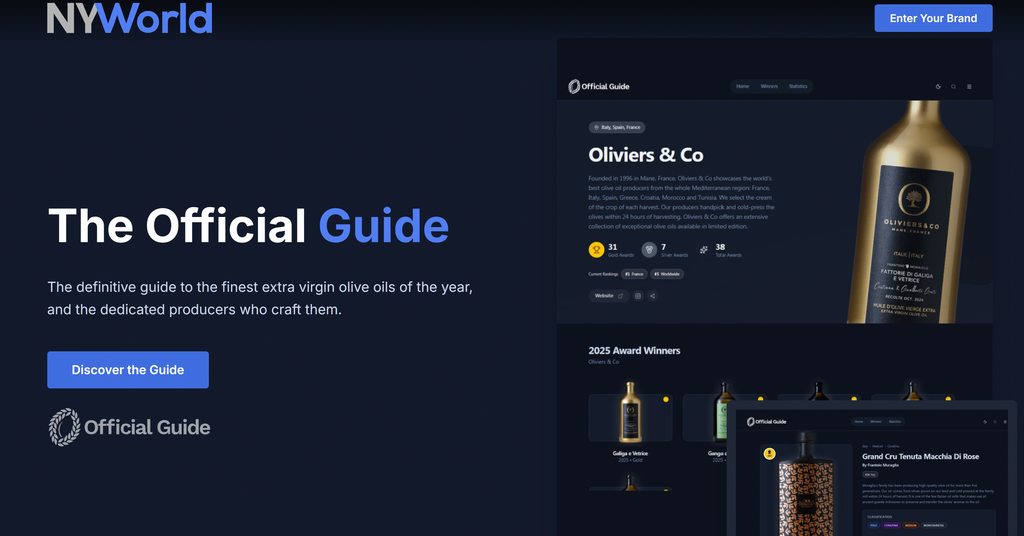
The Award-Winning Italian Olive Oil You Can Actually Buy, by Price
Three honest caveats before the list. First, these prices were accurate in early November 2026 and olive oil pricing moves with each harvest and with the fifteen percent US tariff that’s applied to European goods since 2025, so expect some drift. Second, “in stock today” can become “sold out tomorrow” — I ran into this twice while researching this piece, and I’ll tell you where. Third, I’m linking to the retailer’s collection page for each producer rather than the single bottle, because the specific vintage or format in stock changes faster than this article can, and a link to one depleted SKU is worse than no link at all.
One more thing worth knowing before you click anything: a handful of these producers only reach American buyers because an importer or retailer absorbed the cost of customs clearance and duty-paid shipping, which is the “C-star” category in my own research notes. That arrangement is why a bottle that sells for the equivalent of eighteen dollars at the Italian mill can land at forty-five or more once it clears a US port, and it’s also why the producers who’ve gone to the trouble tend to be the larger, better-capitalized estates rather than the small family operations that make up most of Marche’s olive groves.
Under $45: the entry point
Il Casolare, the organic unfiltered extra virgin from Farchioni, the large family producer based near Lake Trasimeno in Umbria, is the easiest of this group to find on a US specialty grocer’s shelf and the cheapest at roughly $25 for a 750 ml bottle. It’s a blend built for everyday cooking rather than a monovarietal showpiece, which is exactly what makes it a reasonable starting bottle. One honest flag: when I checked The Gourmet Corner’s listing, it was marked sold out with no restock date given — a fair illustration of how intermittent this category’s US stock really is, so check before you plan a gift around it.
The most unusual bottle in this entire piece is Marche, and it didn’t come from a frantoio at all. Greenwood, the olive oil label founded by musician Jonny Greenwood on land in Le Marche, sells a 350 ml Ascolana Tenera monovarietal for about $43 through Olio2go, the Virginia-based importer that carries the deepest Italian catalog I found anywhere in this research, alongside a larger three-bottle gift set under the “Shufra” name. It hasn’t entered the NYIOOC or EVOOLEUM as far as I could verify, so I’m not presenting it as a medal winner — I’m presenting it because it is, at the time of writing, the only Marche extra virgin olive oil I could find for sale anywhere in the United States. Hold that thought; it’s the subject of the next section.
$45 to $60: where this year’s medals actually live
Marina Palusci, a small family estate in Abruzzo, won two gold medals at the 2026 NYIOOC, including one for L’Uomo di Ferro, a monovarietal made from the Dritta cultivar native to the Abruzzese coast. It’s sold through Olive Oil Lovers at roughly $47 for a 500 ml bottle and was in stock when I checked, with a smaller sample size and a three-bottle set also listed on the same page if you want to compare harvests before committing to a full bottle. Dritta is not a name American shoppers will recognize, and that’s precisely the point: it tastes nothing like the generic “Italian blend” most of us grew up with, with a sharper, greener bitterness that announces itself on the back of the throat rather than the front.
Badia a Coltibuono, the Chianti estate better known for wine, won gold at the 2026 NYIOOC for Albereto, an IGP Toscano oil from its own organic groves, and it’s carried by Olio2go at around $58 for 500 ml. When I checked, it was marked sold out — the second concrete case of the intermittent availability I warned you about above, and a reason to set a stock alert rather than wait and hope.
Above $60: for the reader who wants the real thing
Two Tuscan golds from the 2026 NYIOOC sell directly from the producer rather than through a retailer middleman, and both run above the $60 mark once you account for shipping from Italy: Frantoio Pruneti‘s Pruneti Frantoio, a monovarietal from the Frantoio cultivar grown around San Polo in Chianti, and Olio Piro‘s Piro, pressed from centuries-old trees on Monte Amiata. Pruneti also turns up on Olive Oil Lovers’ own catalog, so you have a choice between buying direct from Tuscany or through a US-based cart; Piro, as far as I could confirm, ships only direct, and has an active US affiliate program listed through a marketing network, which at least tells you the producer has bothered to build an American sales channel rather than treating US buyers as an afterthought. Neither producer publishes a fixed US retail price on their English pages at the time of writing, so check the current figure at checkout rather than trusting any number printed here. Both are worth the extra cost if what you want is a true single-estate oil rather than a blend assembled from several growers’ fruit, which is the trade-off this entire price tier is really about.
One flag against overspending, since a selection article that never says no isn’t a selection: Olio2go also sells a $171 gift hatbox bundling three small Greenwood bottles together under the name “Shufra di Shufra.” Unless you specifically want the packaging as a gift object, skip it — none of the three oils inside has won an independent medal, and you’d pay roughly four times the per-bottle price of the standalone Ascolana Tenera for the box.
The Winners You Can’t Buy, and Why That Matters
Frantoio Chiodi, based near Perugia in Umbria, won gold at the 2026 NYIOOC for Il Prezioso Raggia, a monovarietal pressed from the Raggia cultivar — a variety you’ll also meet later in this article, because it’s one of the handful native to the Marche hills, grown in Umbria too but historically tied to the same stretch of the central Apennines. I found no American retailer or direct-ship option for Chiodi at all, no US-facing e-commerce page, and no listing in any of the thirteen catalogs I scanned. This is not a dig at the producer; the gold medal is real and the oil is almost certainly excellent. It simply illustrates the core argument of this piece: the trophy and the shopping cart are unconnected, and a producer can win in New York without ever selling in New York, or anywhere else in the country.
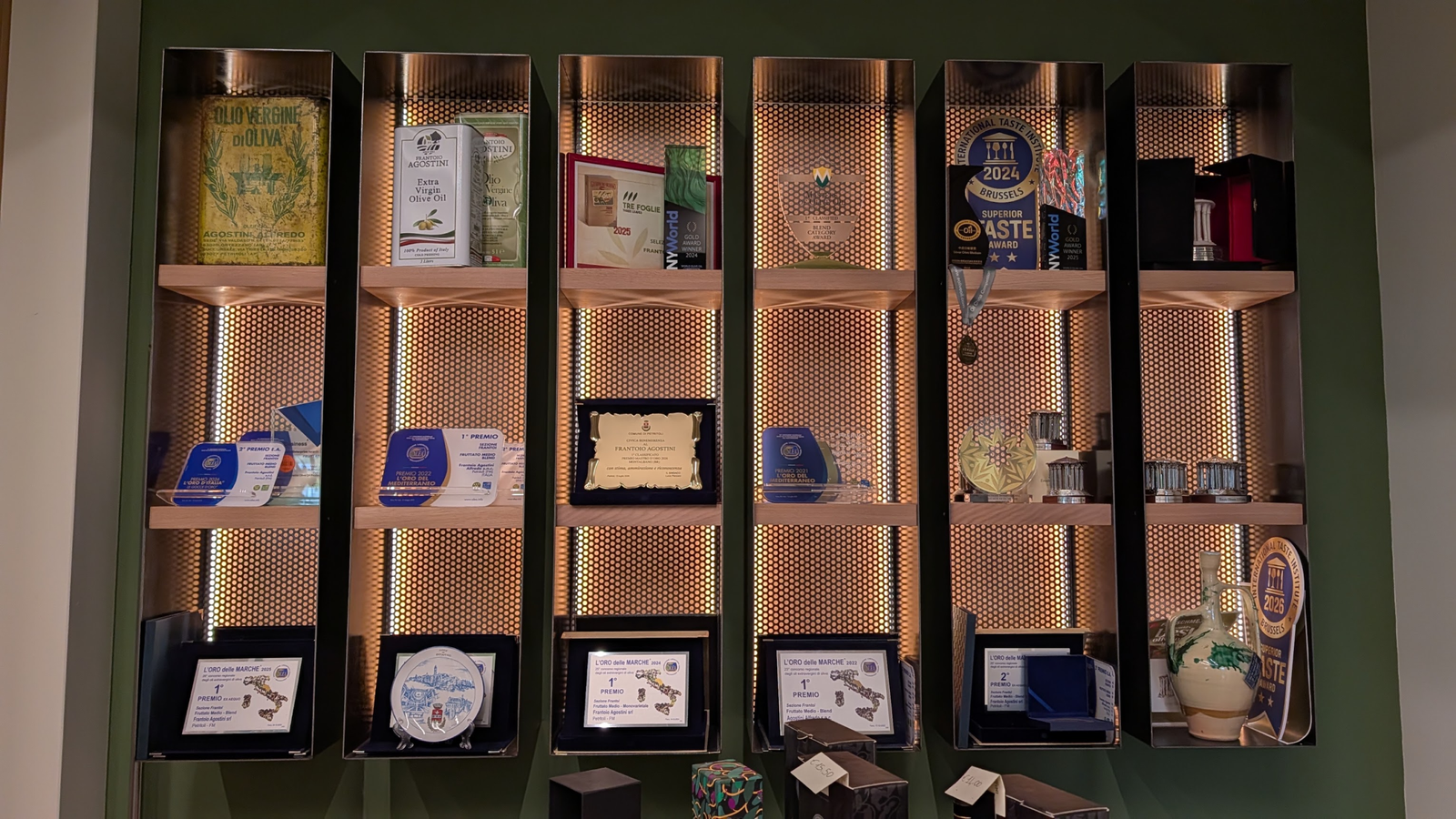
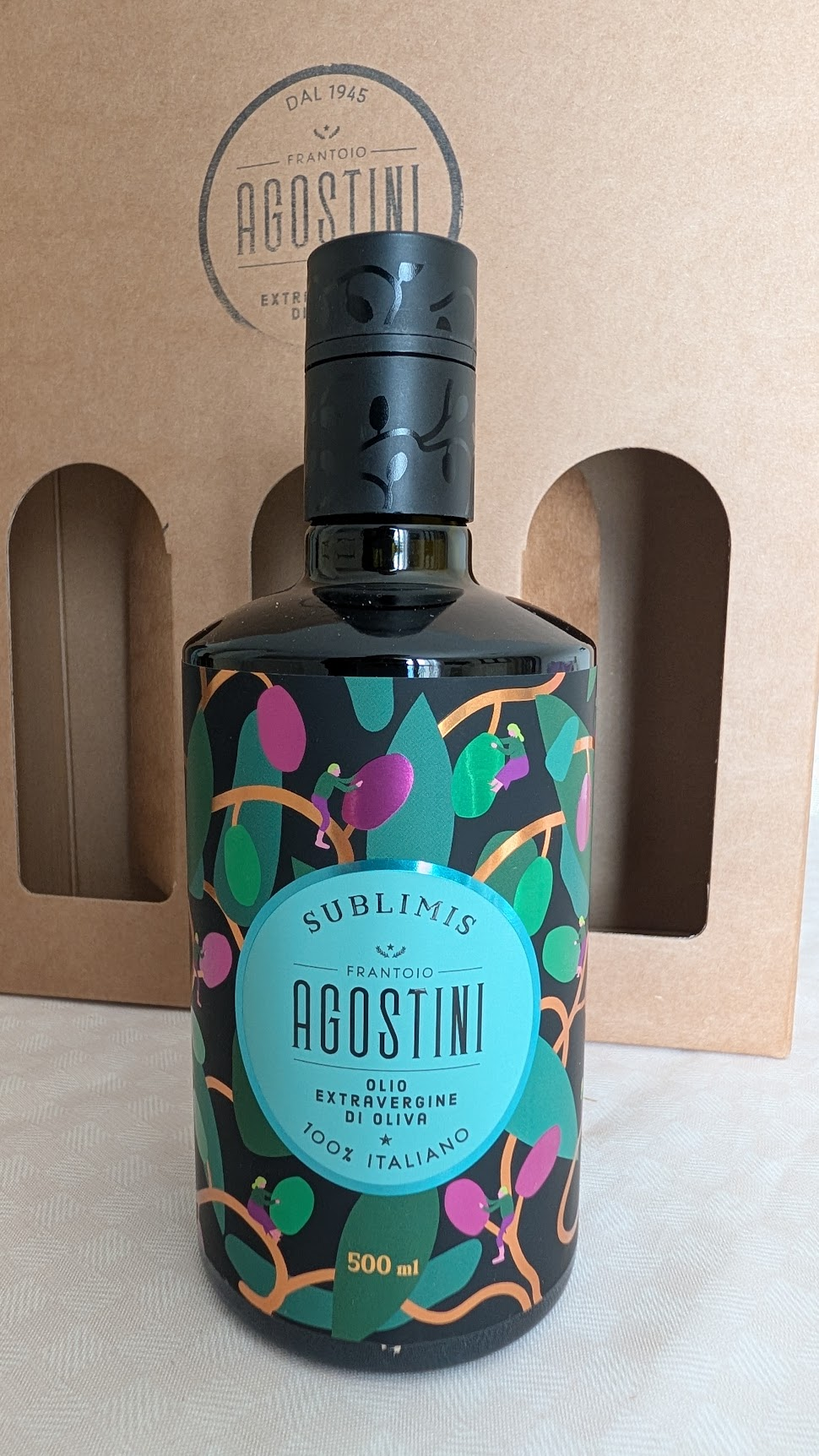
The largest gap I found sits closer to home for me. Frantoio Agostini, a mill in Petritoli, in the province of Fermo — the same stretch of the Marche hills I grew up walking — didn’t just win a category gold this year. Its 100% Italiano Bio oil from the Ascolana Tenera cultivar won the Mastro d’Oro 2026, the award given to the single best extra virgin olive oil judged in Italy. I checked for any American retailer or direct shipping option and found none. A full disclosure belongs here, since this blog doesn’t hide behind vague “insider” claims: I have my own olives pressed at this mill, so I know its groves and its press room directly, not from a brochure. I’m naming the award because it’s real, verifiable, and the single clearest illustration of the next section’s argument — not as a sales pitch, since there’s currently nothing to sell you.
The Marche Gap
Here is the number that should bother anyone who takes “Made in Italy” seriously: across thirteen American importers and retailers I scanned, I found exactly one extra virgin olive oil from Le Marche for sale in the United States, and it’s a musician’s side project, not a medal winner. Of the seventeen Marche producers in my full survey, only seven sell directly to an American buyer at all, and the best of this year’s regional harvest — the oil that just took the top prize in the entire country — isn’t one of them.
Tuscany tells the opposite story. Seventeen of the nineteen Tuscan producers I checked sell into the US in some form, six of them shipping directly from their own estate. Umbria and Abruzzo sit in between, with roughly two-thirds of their producers reachable from an American address. Marche is the outlier, and the reasons are structural rather than a matter of quality. The region’s oil production is split across hundreds of small groves rather than consolidated into a handful of export-ready brands; the cultivars that define it — Coroncina, Mignola, Raggia, Piantone di Mogliano, Orbetana, Ascolana Tenera — are nearly unknown outside Italy and therefore hard to market to a buyer who has never heard the names; and building a US-compliant shipping and labeling pipeline costs real money that a two-hundred-tree family operation rarely has to spare.
The sharpest single fact I found is this: Cartoceto, the only DOP-protected olive oil designation in Marche, has no bottle for sale anywhere in the United States, under any of the thirteen retailers I scanned. A Protected Designation of Origin label is a legal guarantee tied to a specific territory, cultivar mix, and production method, enforced the same way Parmigiano Reggiano or Chianti wine is enforced — it’s the strongest authenticity claim Italian food law offers, and the American buyer researching “real Italian olive oil” has no way to act on it for this particular one. None of that is a knock on the oil itself. If anything, a region that keeps winning national competitions while remaining almost invisible on American shelves is proof that quality and market access are two different battles, and Marche has only won the first one.
If You Want a Monocultivar
Everything above is blended or single-origin oil sold under a brand name. If you want to go a step further and taste one specific olive rather than a house style, ask any retailer carrying Italian oil whether they stock a true monocultivar — a frantoio (the mill where olives are pressed, usually within hours of picking) using only one variety, with that variety named on the label rather than buried in fine print. Dritta, Frantoio, and Raggia all appear in this article as single-variety oils, and each tastes distinctly different from a generic “Italian blend”: Dritta leans sharp and grassy, Frantoio reads rounder with a almond-like finish, and Raggia sits somewhere between the two, with a peppery bite that fades faster than either.
A monocultivar is also the clearest way to taste a region rather than just a brand, because the variety itself carries the terrain’s fingerprint in a way a blend is designed to smooth over. If you want to go deeper into the cultivars unique to Marche specifically — including the ones that haven’t made it into a single American bottle yet — I’ve written a separate guide to them.
Common Questions About Award-Winning Italian Olive Oil
What does “award-winning” actually mean on an olive oil label? It means a specific batch from a specific harvest won a medal at a named competition, judged by a trained tasting panel against a defined set of chemical and sensory standards. It does not mean every bottle a producer makes carries the same quality, and it does not mean the producer out-ranks every mill that didn’t enter.
Is a medal-winning oil actually worth the extra price? Usually yes, if you’re buying it to taste rather than to cook everything in. Medal oils tend to come from a single, carefully pressed harvest rather than a blended, mass-market batch, and the price difference mostly reflects that smaller scale, not marketing.
How can I tell if the bottle I’m buying is actually fresh? Check the harvest date, not the “best by” date — a true Italian producer prints the harvest year clearly, and extra virgin olive oil is at its best within twelve to eighteen months of pressing. If a bottle shows no harvest year at all, that’s a reason to look elsewhere.
How long does a bottle last once it’s open? Plan on finishing it within six to eight weeks at room temperature, away from light and heat. Olive oil doesn’t spoil the way milk does, but it oxidizes gradually, and the bright, peppery quality that makes a medal-winning oil worth the price fades well before the oil turns rancid.
Should I buy direct from the Italian producer or from a US retailer? Buying direct usually means a fresher harvest and a more specific story, but longer shipping and higher cost; buying from a US retailer like Olive Oil Lovers or Olio2go usually means faster delivery and an easier return policy, at the cost of a markup. Both are legitimate choices — I’ve noted which route each oil in this piece actually takes.
Why do Italian olive oils cost more than Spanish or Greek ones? Partly scale — Spain and Greece produce at a volume Italy’s small, hillside groves can’t match — and partly the fifteen percent tariff now applied to European goods entering the US, which lands on top of an already higher production cost. The gap isn’t a marketing invention; it shows up at checkout.
Is there a Marche oil worth watching for, even if it isn’t sold in the US yet? Frantoio Agostini’s Ascolana Tenera, which just won Italy’s top national award, is the one I’d watch first — not because I can send you a link today, but because a mill that wins the Mastro d’Oro while remaining invisible to American buyers is exactly the kind of gap that tends to close once an importer takes notice.
This Page Gets Checked Every Year
Competition results and American stock both turn over on an annual cycle, so this guide gets rebuilt every May, after the NYIOOC and EVOOLEUM announce their new winners for the year.
A Last Word
The gap between what wins in New York and what ships to New York is wider than most buying guides let on, and nowhere is it wider than in Marche, where the region I come from keeps winning competitions it can barely sell into. If any of the oils above move you to try something you’ve never tasted, that’s the whole point of this list — and if you want the deeper story of the olives behind them, the cultivar guide is the next stop.