Ferragosto Explained: What Italy’s August 15 Holiday Actually Means
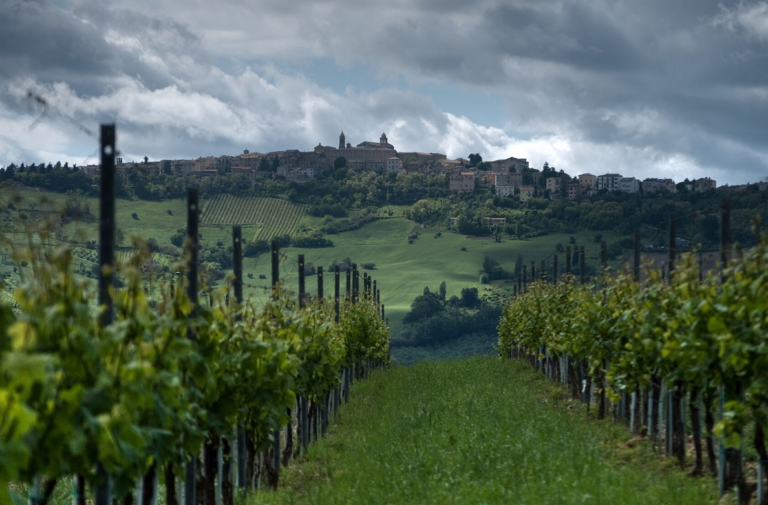
Ferragosto in Macerata falls at two in the afternoon on a Friday in mid-August, and the Corso della Repubblica is dead. The shutter over the pharmacy is down, the newsstand has a handwritten chiuso per ferie (“closed for the holidays”) sign taped to the glass, and the only sound for several minutes is a single motorino idling somewhere off Piazza della Libertà. Forty minutes east, on the Adriatic sand at Civitanova Marche, several hundred thousand people are doing precisely the opposite: grilling sausages under rented umbrellas, running relay races through the shallows, queuing three deep for gelato. Both scenes are Ferragosto. Neither one is the whole story.
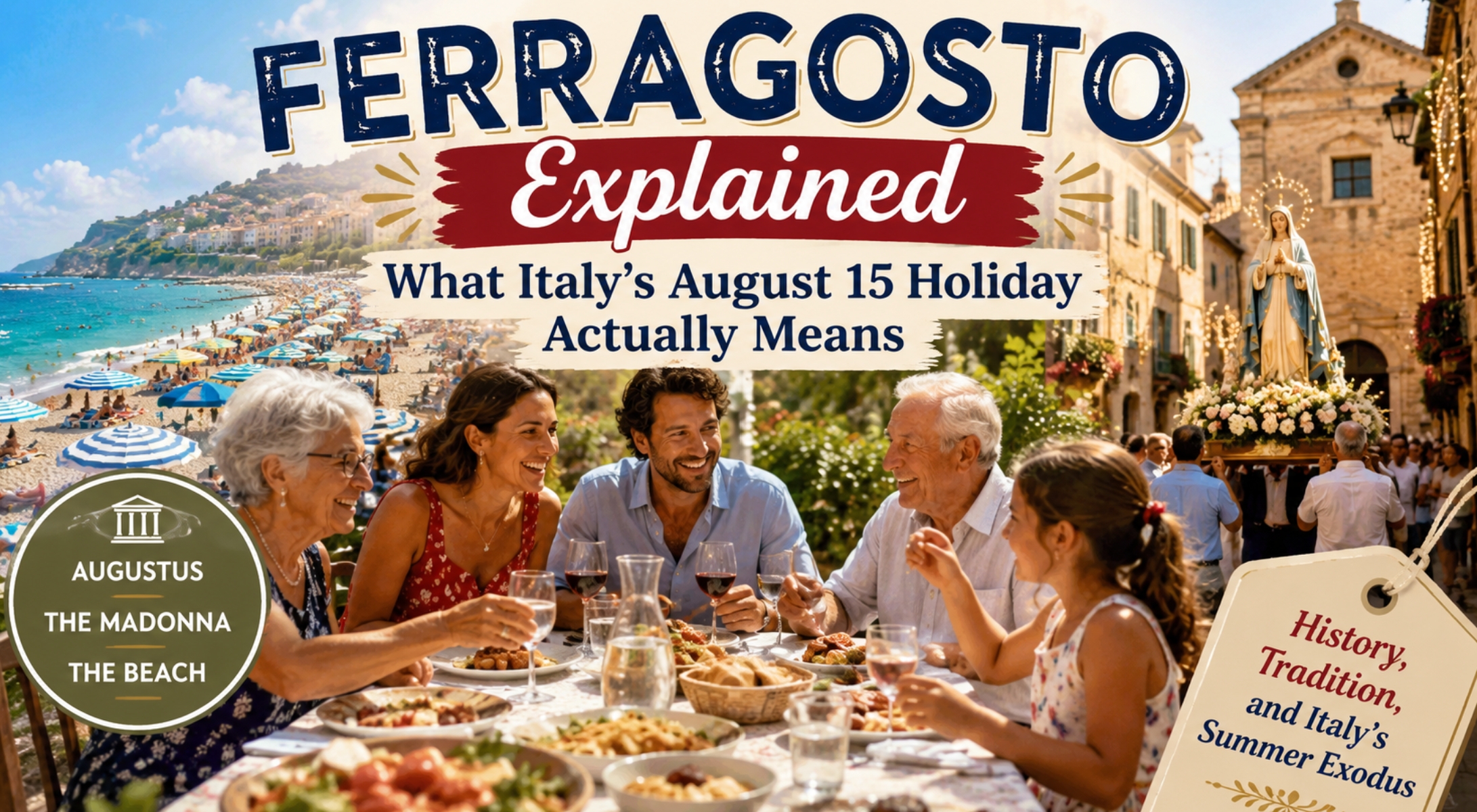
Ferragosto is Italy’s national holiday on August 15, and it is really three holidays folded into one date. The name comes from the Latin Feriae Augusti (“the rest of Augustus”), a period of celebration the emperor Augustus is credited with establishing in 18 BC to mark the close of the agricultural year. The Catholic Church later shifted the observance to August 15 to align it with the Assumption of Mary, the feast marking her bodily ascension into heaven — which is why the day is also called l’Assunta. Then, in the twentieth century, the Fascist regime turned the date into Italy’s first taste of mass tourism, subsidizing train fares so that factory workers could reach the coast, many for the first time in their lives. Today, Ferragosto is a public holiday, a family lunch, and a nationwide migration to the sea and the mountains, all happening on the same afternoon.
What Ferragosto Actually Is
Each of the three layers left something behind. Understanding all three explains why an Italian will casually mention “Augustus,” “the Madonna,” and “the beach” in the same breath when you ask what the holiday means, without seeing any contradiction in it.
Augustus and the Feriae Augusti of 18 BC
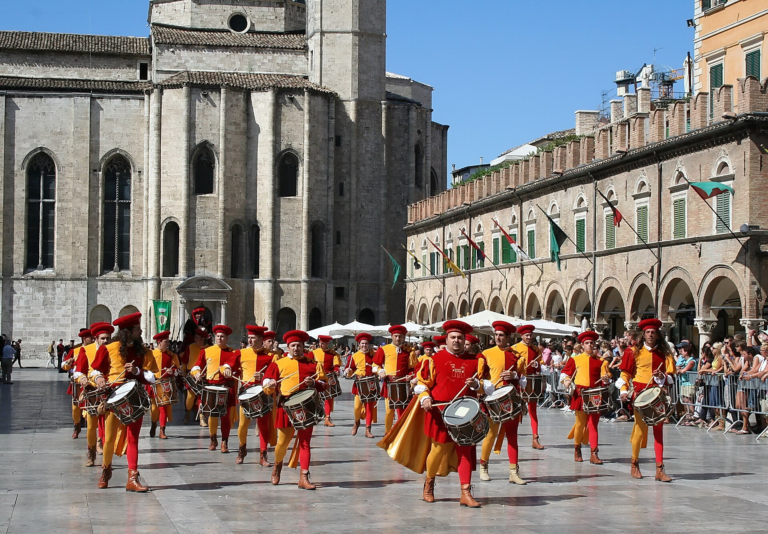
The oldest layer is Roman, and agricultural in origin. August already carried a cluster of end-of-harvest festivals — the Vinalia rustica, honoring Jupiter and the ripening grape; the Consualia, dedicated to Conso, the god of the earth and stored grain. Augustus is said to have consolidated these into a single extended period of rest for workers and draft animals, the Feriae Augusti, in 18 BC. Oxen, donkeys, and mules were relieved of their duties and decorated with flowers for the occasion, and horse races were staged across the empire. One version of that tradition never actually stopped: the Palio dell’Assunta, run through Siena’s shell-shaped piazza every August 16, descends directly from those Augustan-era races, and it’s a scene I’ve covered in more detail in our guide to the Palio di Siena. It is worth remembering, too, that the month itself takes its name from this same emperor: the Roman Senate renamed sextilis to augustus in 8 BC, so the holiday and the month it falls in share a namesake.
L’Assunta: the Christian overlay
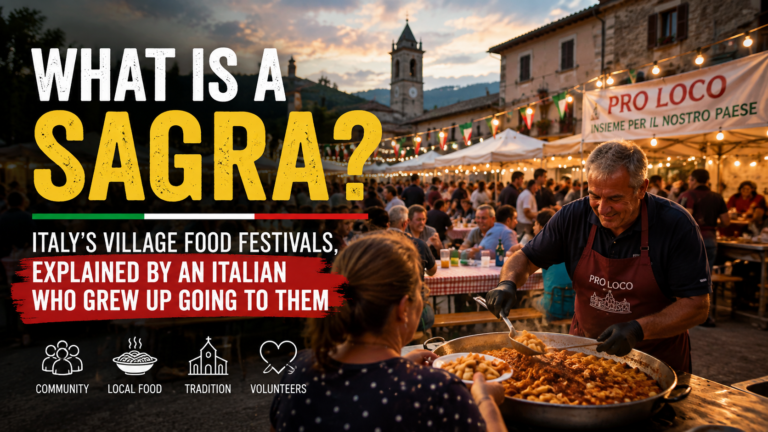
The second layer arrived centuries later and moved the date. The Feast of the Assumption, commemorating Mary’s bodily ascension into heaven, had been observed by the Eastern Church from the sixth century onward and was gradually adopted across the Catholic world; the dogma itself was formally proclaimed by Pope Pius XII only in 1950, though the feast day long predates that declaration. Over time, the Church folded the older Roman celebration into this new religious date, moving the point of rest from August 1 to August 15. The result is the hybrid that gives the holiday its double identity: a civic day off named for a pagan emperor, observed on the feast day of a Catholic dogma. In towns across the Marche and the rest of central Italy, this is still the layer that shows up in the streets after dark, in the form of processions carrying a statue of the Madonna through the historic center, and in the countless sagre (village food festivals) that pair a saint’s day with a folding table of grilled meat and local wine.
Treni popolari: how a 1930s train ticket built the modern August exodus
The third layer is the most recent, and the one most guidebooks skip entirely. The mass migration to beach and mountain that now defines the holiday did not exist as a national habit before the 1930s. It was created, deliberately, by the Fascist regime through the Opera Nazionale Dopolavoro (OND), the state’s national leisure organization, founded in 1925 to manage workers’ free time. Starting in August 1931, the state railway ran the Treni Speciali Celeri per Servizi Festivi Popolari — known simply as treni popolari, or “people’s trains” — offering discounts of up to 80 percent on third-class fares for holiday travel. According to research by railway historian Andrea Giuntini, cited by the Italian outlet Il Post, close to half a million people used these discounted fares in the very first season alone, between early August and late September of 1931. Many were riding a train, and seeing the sea or the mountains, for the first time. The service ran until 1939, when the war ended it, but the habit it created — leaving the city en masse in mid-August, at a discount, for the coast — outlived the regime by nearly a century. When your Italian host mentions the esodo (the exodus) with a slight roll of the eyes, this is the history behind the shrug: the ritual is genuinely beloved, but its origin as organized leisure is something most Italians know and rarely dwell on.
How Italians Actually Spend the Day
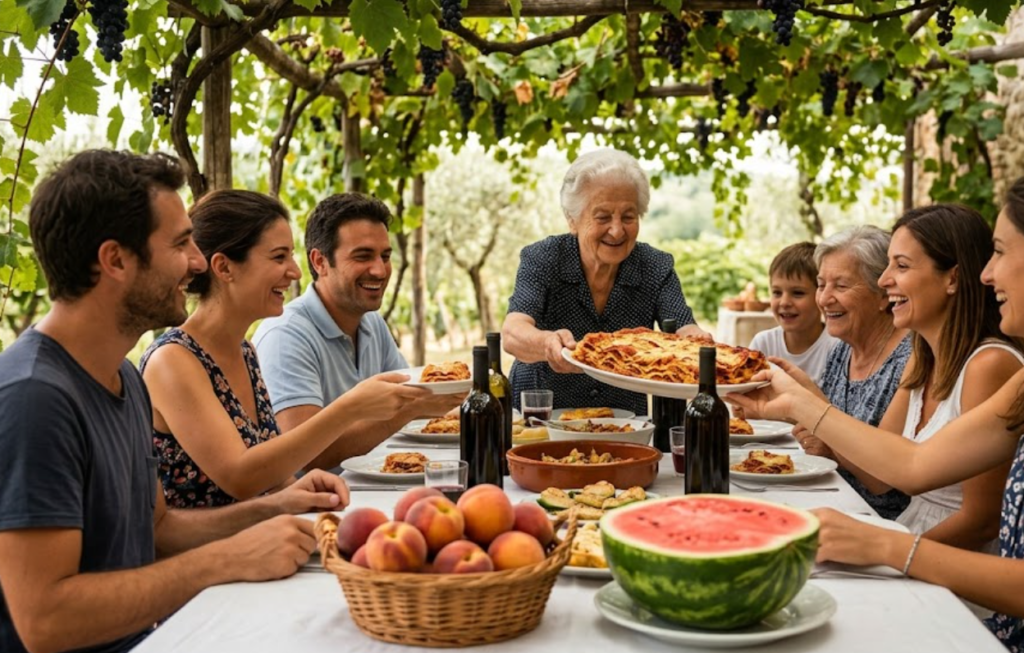
Strip away the history and Ferragosto, in practice, is built around one long table. The pranzo di Ferragosto (Ferragosto lunch) gathers three generations of a family, typically at a house in the countryside rather than a restaurant, and can run from one in the afternoon until the light changes. It is the same instinct for the shared, unhurried table that shapes Le Marche’s relationship with the Mediterranean Diet — pasta first, grilled meat or fish second, a watermelon course to close it, wine throughout — just stretched over a longer, more indulgent afternoon than an ordinary Sunday.
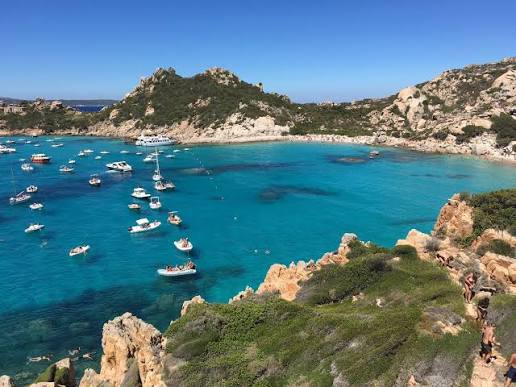
After lunch, or instead of it for families who leave the table earlier, the destination is the coast or the hills. On the Adriatic, beach clubs fill to capacity by mid-morning, and the evening of the 14th and the 15th brings fireworks over the water in towns up and down the coast, along with a tradition among younger beachgoers called gavettoni — ambush water fights conducted with buckets and water guns, aimed at anyone who looks unsuspecting enough to be worth soaking. Inland, hill towns mark the Assunta with religious processions and sagre built around whatever the local specialty happens to be, from grilled porchetta to fresh pasta rolled that morning. None of this is staged for visitors. It is simply what August 15 looks like in a country that has agreed, almost unanimously, to stop for one day.
The Ferragosto Survival Guide
This is the part that actually catches visitors off guard, and it deserves more precision than most travel guides give it.
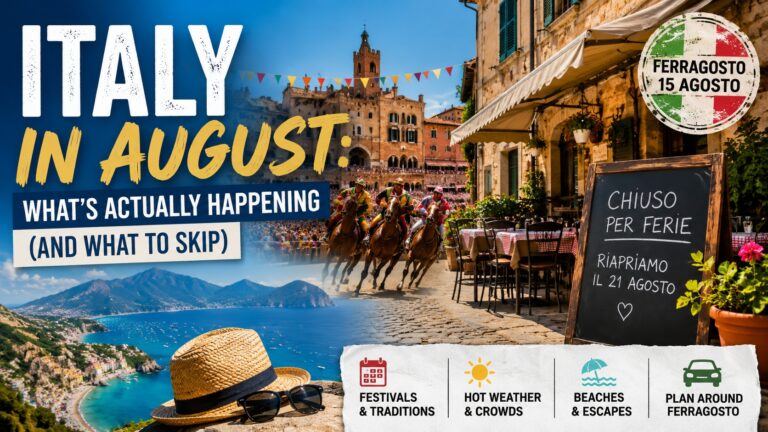
What closes: independent shops, artisan workshops, banks, and post offices close outright, and many neighborhood trattorias hang a chiuso per ferie sign for one to three weeks around the date, not just the day itself. Regular grocery stores and mini-markets are typically shut all day. Some privately run museums and galleries close or reduce their hours; the Vatican Museums, notably, close on both August 14 and 15.
What stays open: supermarkets in larger towns generally open for a few hours in the morning — often 9am to 1pm — before shutting for the rest of the day. Pharmacies operate on a rotating farmacia di turno system, so at least one is always reachable in any given area; searching “farmacia di turno” plus the name of the town will surface the one on duty. State-run museums and archaeological sites, including the Colosseum and Pompeii, remain open on Ferragosto itself. Restaurants and bars in tourist zones and along the coast stay open and busy — for many, it’s their single highest-volume day of the year.
Transport: trains run, but on a reduced holiday schedule, and stations are more crowded than usual precisely because everyone is traveling at once. If a trip depends on an intercity connection, it is worth checking the timetable a day or two ahead rather than assuming a normal frequency, and worth avoiding scheduling anything time-sensitive for August 15 itself.
The flip side: the emptying-out that inconveniences errands also creates the year’s quietest version of Italy’s art cities. With residents gone to the coast, the historic centers of Rome, Florence, or a smaller city like Macerata belong almost entirely to visitors and the tourist-facing businesses that stay open for them. Queues at major sites shrink, streets go quiet at midday, and a traveler more interested in a church interior than a beach towel finds this, counterintuitively, one of the better days of the year to be there.
What to Do, and What to Avoid
If you are already on the coast on August 15, stay there. It is the single best day of the year to see Italian beach culture at full volume, and it rewards showing up early for a table at a stabilimento balneare (beach club) rather than treating it as a day to move between towns. If you are in a city, plan around the closures rather than against them: buy what you need for the next day before the afternoon of the 14th, lean on the state museums that stay open, and treat the day itself as a pause in the itinerary rather than a full sightseeing day. Do not book an intercity train for August 15 if you can help it, and do not expect a neighborhood trattoria to be open on a whim — reserve ahead in tourist areas, or plan to eat where the locals do, at the beach.
If you are mapping out a longer stay in central Italy around this period and want to know which towns empty out completely and which stay lively, that is the kind of question I answer in one-to-one planning sessions. You can find out how to reach me on the About page.
FAQ — Ferragosto for the American Visitor
What does Ferragosto mean? Ferragosto is Italy’s national holiday on August 15, and the word comes from the Latin Feriae Augusti (“the rest of Augustus”), a period of celebration linked to the emperor Augustus. Over the centuries it absorbed the Catholic feast of the Assumption of Mary, also celebrated on August 15.
Is everything closed in Italy on Ferragosto? No, but the closures are real. Independent shops, banks, and many neighborhood restaurants close, often for one to three weeks around the date. Supermarkets, pharmacies (via a rotating on-duty system), state museums, and tourist-area restaurants generally stay open, often with reduced hours.
What do Italians do on Ferragosto? Most spend the day around a long family lunch, then head to the beach or the mountains for the afternoon. Coastal towns add fireworks and beach games in the evening, while inland hill towns mark the day with religious processions and food festivals tied to the Assumption.
Is August 15 a good time to visit Italy? It depends on what you want. For beach culture and festival atmosphere, it is one of the best days of the year. For running errands, eating at a neighborhood restaurant, or visiting a small private museum, it is one of the most restrictive.
Why is it called Ferragosto? The name is a contraction of the Latin Feriae Augusti. The holiday later moved from its original date of August 1 to August 15, when the Catholic Church aligned it with the Feast of the Assumption of Mary.
Do I need to budget extra for travel around Ferragosto? Generally yes. Ferragosto week is peak season for coastal and mountain destinations in Italy, and accommodation, beach club access, and popular restaurants tend to be priced and booked at their highest levels of the year, particularly on the Adriatic coast.
What’s the one thing about Ferragosto that visitors usually get wrong? Assuming it behaves like an ordinary Sunday. Ferragosto closures often extend for days on either side of August 15, and the Fascist-era origin of the modern August exodus — the discounted “people’s trains” of the 1930s — is a detail almost no English-language guide mentions, even though it explains why the ritual feels so uniformly national rather than regional.
The Takeaway
Ferragosto rewards understanding before it rewards planning. Once you know that the closed pharmacy, the packed beach, and the procession behind the Madonna are three different centuries talking at once, the day stops being an inconvenience and starts being one of the clearest windows into how Italy actually organizes its year. If you want more stories like this one, told from the inside rather than observed from a hotel balcony, there is more to read on Tastes & Wonders of Italy, including our take on what happens to Italian coastal towns once Ferragosto ends and why September might be the smarter month to visit.
Written by Mirco Vitellozzi, a structural engineer from Le Marche who writes about Italy from the inside. More essays at Tastes & Wonders of Italy, and short films on YouTube.