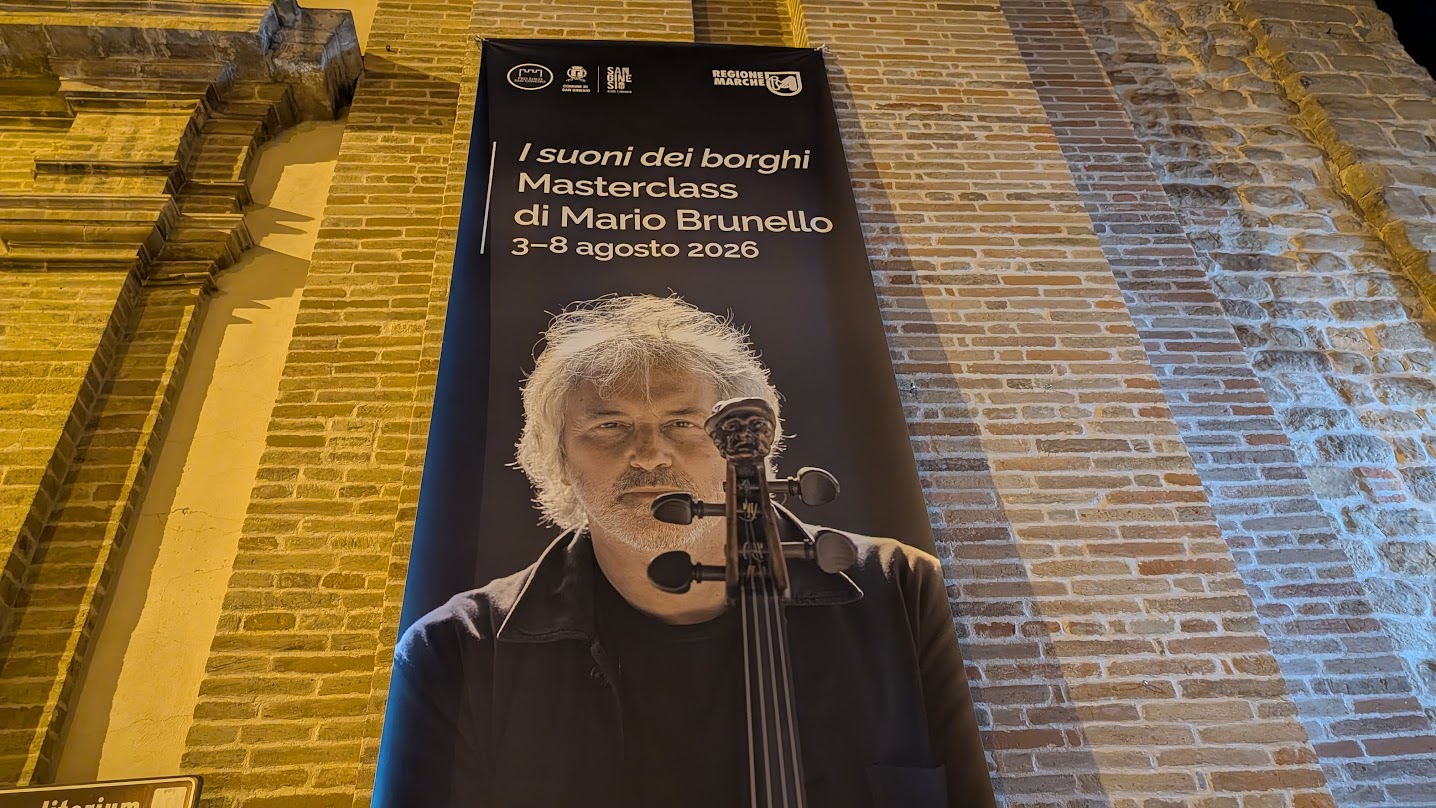
I Suoni dei Borghi 2026: Mario Brunello in San Ginesio
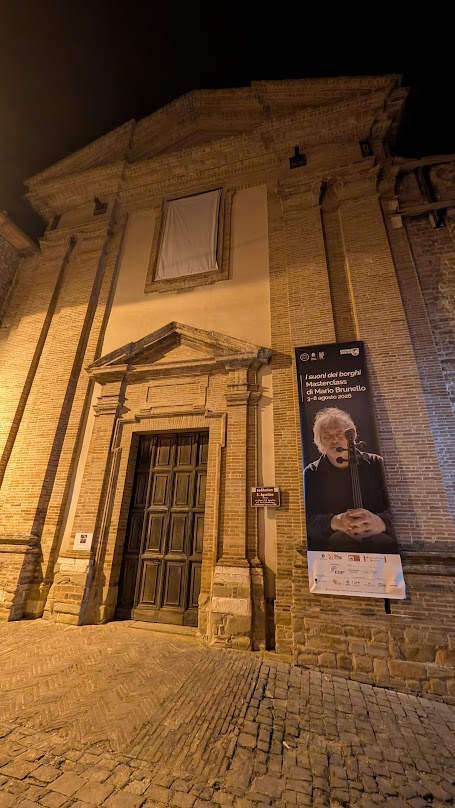
At nine in the evening in early August, the cloister of Sant’Agostino in San Ginesio holds the day’s heat in its brick walls while the air coming off the Sibillini Mountains turns cool enough for a jacket. This is where I Suoni dei Borghi 2026 places its concerts: an eighth edition running from August 3 to August 8, built around cellist Mario Brunello and the international masterclass he has taught in this walled hill town in Le Marche since 2019. Two of the three public concerts cost nothing to attend. If you are anywhere in central Italy during that week, this is the most serious music you will hear for free, in a village of roughly three thousand people at 700 meters above sea level.
What is happening in San Ginesio, August 3–8, 2026
I Suoni dei Borghi (literally “the sounds of the villages”) is a week-long international cello masterclass led by Mario Brunello, held in San Ginesio in the province of Macerata and promoted by the local Pro Loco — the volunteer civic association that runs cultural life in most Italian small towns — together with the Comune of San Ginesio and with support from the Marche Region. The project was conceived by Brunello and is designed and directed by Annalisa Pavoni. Three concerts open the week to the general public, all at 9 p.m. inside the Sant’Agostino complex.
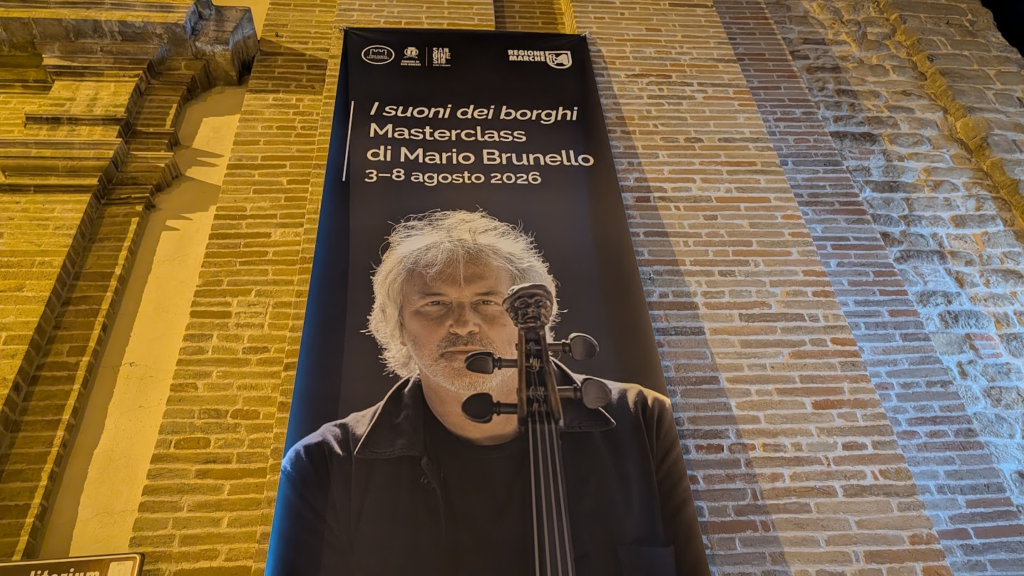
The 2026 program runs as follows:
- Monday, August 3, 9 p.m., Cloister of Sant’Agostino — opening concert: Mario Brunello, cello, with pianist Maria Semeraro, in an all-Brahms program. According to the program published by Marcheinfinite, it includes the Sonata op. 78 in Paul Klengel’s transcription for cello and piano, the Sonata no. 2 op. 99, and the Vier ernste Gesänge op. 121. An aperitivo precedes the concert at 7:30 p.m. This concert was reported sold out on July 31, 2026.
- Friday, August 7, 9 p.m., Cloister of Sant’Agostino — the Cello Orchestra of the chamber music class: nineteen cellists between the ages of 8 and 69, with a strong Dutch and German contingent, prepared by cellist Sanne de Graaf. Free admission.
- Saturday, August 8, 9 p.m., Auditorium of Sant’Agostino — closing concert by the young cellists of the Advanced Masterclass, who will have spent the week studying with Brunello. Free admission.
A fourth musical moment, a small concert in the mountains on Thursday, August 6, belongs to the participants’ program rather than the public calendar. It comes at the end of a night walk to a viewpoint in the Sibillini, timed so that the playing happens as the sun rises over the range, with the Adriatic visible in the distance. Whether outsiders can join varies year to year, and it is worth an email to ask rather than an assumption.
Why the venue matters more than the program suggests
Here is the part that no concert listing will tell you, and the reason this particular festival reads differently to an Italian engineer than it does to a music critic.
San Ginesio sits inside the Monti Sibillini National Park, on the ridge that gave it the nickname il balcone dei Sibillini, the balcony of the Sibillini. It is also inside the seismic crater of the August 24, 2016 earthquake sequence. The Collegiata di Santa Maria Assunta — the town’s principal church, an eleventh-century foundation whose flamboyant Gothic terracotta facade was built by Enrico Alemanno in 1421 and has no real equivalent in the region — has been closed to the community since 2016. Its reconstruction was funded at 7.38 million euros by decree of the Sisma 2016 reconstruction commissioner, covering masonry consolidation, vaults, floors, roofing, and the restoration of the artworks inside. On July 25, 2026, it opened for two hours, as an exceptional guided visit inside the working site, still wrapped in scaffolding.
Sant’Agostino, where the concerts happen, went the other way. The complex was structurally secured and returned to public use in 2020, and the town chose to reopen it with an exhibition rather than a ceremony. Its Auditorium has since hosted everything from press conferences on school reconstruction to this masterclass.
I spend a large part of my professional life assessing masonry buildings in exactly this condition, and the pattern I find most often in towns like this one is a long, unglamorous sequence: emergency shoring, then a decade of technical files, then a scaffold that becomes part of the skyline. What the people of San Ginesio have done in the meantime is refuse to wait. The cloister with the remarkable acoustics is not a substitute venue chosen for charm. It is the building that came back first, and they filled it with cellos.
The backstory: a masterclass that turned into a village institution
Brunello’s project did not begin as a festival. It began as a teaching idea rooted in a specific place, and the place was chosen because of the earthquake, not in spite of it.
Method, Form, Nature
The week’s teaching is organized around three words. Method — how to practice — is paired with a visit to a piece of local craftsmanship; in 2026 that means a honey producer near Amandola, in the Sibillini foothills. Form — how to play — is paired with a visit to the region’s artistic heritage; this year, the Boccati polyptych at Belforte del Chienti, one of the great fifteenth-century paintings of Le Marche and almost unknown outside the region. Nature — as a source of inspiration — is a full-day excursion in the mountains.
An American reader should register how unusual this is. The excursions are not enrichment activities bolted onto a music course. They are the curriculum. Brunello’s argument, made through the schedule rather than in a manifesto, is that you cannot separate how a musician plays from where the musician has been that morning.
The “9–99” class
The second thing that makes this project strange, in the good sense, is that it is not restricted to professionals. Alongside the Advanced Masterclass — three places, admission by video audition, three individual lessons of ninety minutes each — runs a parallel course called “9–99 Years,” open to students, professionals, and amateurs of any age and level. Both groups eat together, travel together, and play together. The Friday concert is the proof: nineteen cellists spanning six decades of age on one stage.
Auditors are welcome too, at the organizers’ discretion and by prior arrangement. If you are a serious amateur cellist reading this in the United States and planning an Italian trip for 2027, this is the detail to write down.
What the recognition means
In 2025 the project was designated a Progetto Speciale by the Italian Ministry of Culture, a status reserved for initiatives judged to have national cultural value. Separately, in the framework of the Italiadecide report, the Comune of San Ginesio was recognized at the Chamber of Deputies in Rome for the project’s civic model. San Ginesio itself carries the Bandiera Arancione (Orange Flag) quality mark from the Touring Club Italiano, membership in I Borghi più belli d’Italia, and the UNWTO Best Tourism Village award it received in 2021.
The most concrete measure of the teaching, though, is a name. Ettore Pagano attended the Advanced Masterclass in San Ginesio repeatedly between 2020 and 2024. On May 30, 2026, in Brussels, he became the first Italian ever to win the Queen Elisabeth Competition, in the edition dedicated to the cello, and left with the Goffriller “Casals” cello on four-year loan from the Pau Casals Foundation. The young players on the Sant’Agostino stage on August 8 are drawn from the same pool.
Planning your visit
Getting to San Ginesio
There is no way around it: this is a car trip. San Ginesio is roughly 90 kilometers from Ancona Falconara airport, the region’s main air gateway, and about 80 kilometers from the port of Ancona if you are arriving by ferry from Croatia or Greece. From the A14 coastal motorway, take the Civitanova Marche exit, follow the SS77 to the Macerata Ovest–Sforzacosta exit, then the SP78 toward San Ginesio. Free parking is available in the marked lot below the walls, with an adjacent camper area.
Without a car, the nearest railway station is Tolentino, from which SASP buses run to San Ginesio, stopping at Porta Picena. Check timetables directly with the operator, because August service in inland Marche thins out considerably. From Macerata, where I live, the drive takes a little over half an hour on roads that climb steadily once you leave the Chienti valley.
Tickets, reservations, and the waiting list
The August 3 opening concert required a reservation and carried a single-price ticket reported at 10 euros, or 20 euros including the 7:30 p.m. aperitivo — figures published by Marcheinfinite on July 24, 2026. As of July 31, that concert was sold out. The organizers are keeping a waiting list; requests go to masterclassbrunello@gmail.com, which is also the general information address for the project.
The concerts on August 7 and August 8 are free and, as far as the published information indicates, do not require booking. That does not mean you should arrive at 8:55 p.m. The cloister is not large, and word about this week has traveled: local seating fills early. Nine o’clock in San Ginesio in August is a proper temperature, but bring a layer — at 700 meters the drop after sunset is sharp.
What else to do in the same trip
San Ginesio rewards an afternoon on its own terms. The town’s medieval walls are among the better-preserved in Le Marche, and the panorama from the ramparts covers a startling arc: the Sibillini and Monte Vettore to the west, the Gran Sasso on a clear day to the south, the Conero promontory and the Adriatic to the east. The Collegiata remains behind scaffolding, but its facade is visible from Piazza Alberico Gentili, named for the sixteenth-century jurist born here who ended his career as Regius Professor of Civil Law at Oxford — a detail worth knowing before you stand in the square.
For a longer itinerary, the road south toward Sarnano and Amandola runs through the heart of the Sibillini foothills, and the road north reaches Tolentino and Macerata within forty minutes. If your Italian trip falls in the same window, the Macerata Opera Festival at the open-air Sferisterio runs through August as well, which makes a two-night base in Macerata province an efficient piece of planning.
Where to stay
San Ginesio has a small stock of B&Bs, agriturismi, and case vacanza inside and just below the walls, and the Comune’s tourism office maintains a current list. Availability during the first week of August is genuinely tight, since masterclass participants and their accompanying family members occupy a share of it. Sarnano, twelve kilometers south, has more rooms and a thermal spa; Macerata, thirty kilometers north, has the widest choice and puts you inside the opera festival’s orbit.
FAQ — I Suoni dei Borghi 2026, answered
What is I Suoni dei Borghi?
It is an international cello masterclass and concert week founded by Italian cellist Mario Brunello, held every summer in San Ginesio, a walled hill town in the Sibillini Mountains of Le Marche. The 2026 edition, its eighth, runs August 3–8 and includes three concerts open to the public.
When are the 2026 concerts?
Monday, August 3 (Mario Brunello and Maria Semeraro, all-Brahms), Friday, August 7 (Cello Orchestra of the chamber music class), and Saturday, August 8 (young cellists of the Advanced Masterclass). All three begin at 9 p.m. in the Sant’Agostino complex.
Do I need a ticket?
The August 3 opening concert required booking and was reported sold out on July 31, 2026; a waiting list is being kept at masterclassbrunello@gmail.com. The August 7 and August 8 concerts are free and open to the public.
How much does it cost to attend?
Nothing for the two closing concerts. The opening concert was priced at 10 euros, or 20 euros with the pre-concert aperitivo, according to the program published in late July 2026.
How long should I stay in San Ginesio?
For a single concert, an afternoon and an evening are enough. To see the town properly and reach the Sibillini trailheads or Amandola and Sarnano, plan two nights and bring a car.
Can I study with Brunello myself, even as an amateur?
Yes. Alongside the selective Advanced Masterclass, the project runs a “9–99 Years” course open to amateurs of any age, and auditors may attend by arrangement. Applications for the 2026 edition closed on June 30, 2026, so this is a plan for a future summer; write to masterclassbrunello@gmail.com for terms.
Why is the town’s main church closed?
The Collegiata di Santa Maria Assunta has been shut since the 2016 central Italy earthquake sequence and is undergoing a 7.38-million-euro seismic retrofit and restoration funded through the Sisma 2016 reconstruction program. Occasional guided visits inside the construction site are organized; the last one took place on July 25, 2026.
The takeaway
There is a version of cultural tourism in Italy that consists of buying an expensive seat in a famous venue and leaving the next morning. This is the opposite of that. A village that lost its church to an earthquake put its recovered building to work, invited one of the most respected cellists in Europe, opened the class to a nine-year-old and a sixty-nine-year-old at the same time, and then gave two of the three concerts away for free. That the resulting week has produced a Queen Elisabeth laureate is almost beside the point, though it does answer the question of whether the standard is real.
If you are in central Italy this week, drive up. If you are planning next summer, put the first week of August on your Le Marche map now.
Planning a trip through Le Marche and want to build it around what is actually happening rather than what the guidebooks recommend? You can find more from an Italian insider’s perspective across Tastes & Wonders of Italy.