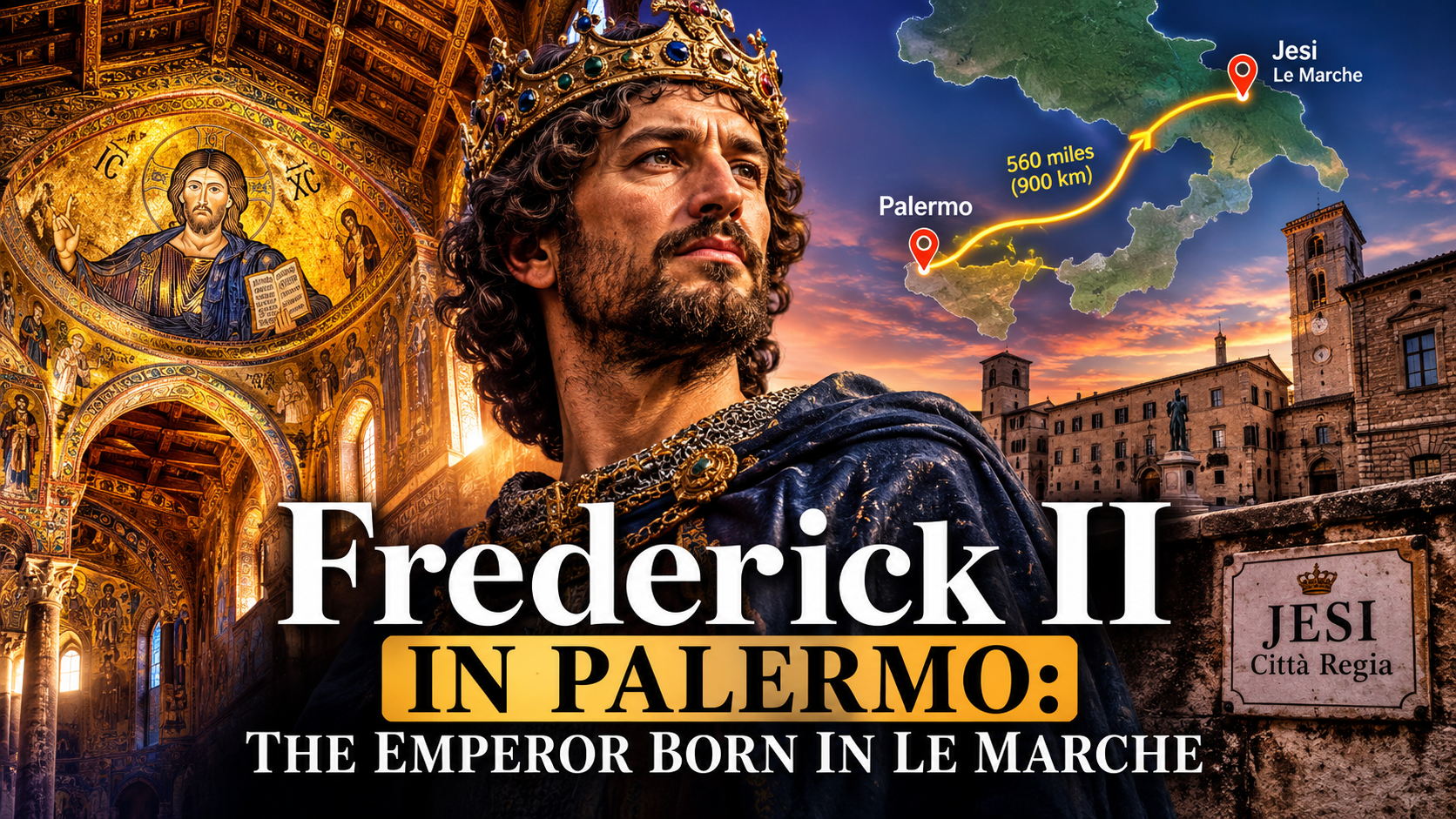
Frederick II in Palermo: The Emperor Born in Le Marche
The light inside the Cappella Palatina does not fall. It collects. It gathers in the gold tesserae of the apse, slides along the honeycombed underside of a wooden ceiling built by craftsmen trained in Fatimid Cairo, and settles on a floor of porphyry and cut marble that has been walked on since 1140. I photographed that ceiling on a February morning, tilting the camera up until my neck hurt, and what struck me was not the beauty. It was the engineering. To understand Frederick II in Palermo you have to start here, in the chapel where he grew up — and then travel 560 miles north to a market square in Le Marche, where an empress gave birth in a tent in front of witnesses on December 26, 1194.
A note on links: some of the booking links in this article are affiliate links, and if you book through them I earn a small commission at no additional cost to you. One thing worth saying up front, because it costs me money to say it: neither the Palatine Chapel ticket nor the monumental-area ticket at Palermo Cathedral can be bought on their own through any affiliate platform. Both come from the official channels, and I say so below.
The short answer: why a Marche town connects to a Sicilian cathedral
Frederick II of Hohenstaufen — stupor mundi, “the wonder of the world” to his contemporaries — was born in Jesi, a walled town in Italy’s Marche region, and is buried in a red porphyry sarcophagus in Palermo Cathedral, alongside his father, his mother, and his Norman grandfather Roger II. He spent his childhood in Palermo, ruled a Mediterranean empire from Sicily and then from mainland Apulia, died near Foggia on December 13, 1250, and was carried back to the Sicilian capital for burial. Two towns at opposite ends of Italy hold the beginning and the end of the same life, and almost no American itinerary connects them.
December 26, 1194: an empress gives birth in a public square
Constance de Hauteville was about 40 years old, pregnant for the first time, and traveling south to join her husband. Henry VI of Hohenstaufen, son of Frederick Barbarossa, had been crowned King of Sicily in Palermo the day before, on Christmas Day. Constance was the daughter of Roger II, the Norman king who had welded Sicily and southern Italy into a single kingdom; the marriage had handed the Hohenstaufen dynasty the richest crown in the Mediterranean.
She got as far as Jesi. Labor came on December 26, and the imperial party stopped in the town — a place then loyal to the empire, roughly 20 miles inland from Ancona on the Esino river.
Why Constance chose a tent in the middle of town
What happened next is the reason Jesi has a piazza named after an emperor who barely knew it. According to the medieval chroniclers, Constance had a pavilion erected in the town’s main square and gave birth in it publicly, in the presence of the married women of Jesi.
The choice was political, not sentimental. A woman of 40 producing an heir after eight years of childless marriage invited exactly the rumor her enemies wanted: that the baby was a substitution, a peasant child passed off as a prince. A birth witnessed by dozens of women was legal testimony. Some chroniclers add that she nursed the child publicly the following day. The Florentine chronicler Giovanni Villani, writing more than a century later and firmly on the papal side, is one of the sources for the scene — which is worth knowing, because he had no interest in flattering the Hohenstaufen.
The site was the square in front of the old cathedral of San Floriano. Today it is Piazza Federico II, and Palazzo Ghislieri, which faces it, houses the museum dedicated to him.
The letter that made Jesi “our Bethlehem”
Here is the part that surprises Italians too. Frederick almost certainly never came back. He was moved on within days, entrusted for a time to the Duchess of Spoleto, and by 1198 he was a four-year-old king being crowned in Palermo. Local tradition claims a second passage through Jesi in 1220, on his way to Rome for the imperial coronation; historians are generally skeptical.
And yet in August 1239, at war with Pope Gregory IX and campaigning to pull the March of Ancona away from the Church, Frederick wrote to the people of Jesi. The letter — probably drafted by his chancellor Pier delle Vigne, and preserved today in the Vatican Apostolic Library — calls the town the insigne principio of his life and names it, without embarrassment, “our Bethlehem.” He then quotes the Gospel of Matthew almost verbatim, casting himself in the role of the prince who comes out of the small city to rule his people.
It is propaganda of the highest order, written by a man the Pope had just compared to the beast of the Apocalypse. It also worked: Jesi went over to the imperial side. The town still calls itself città regia, “royal city,” a status supposedly granted by Frederick — although no document conferring it has ever been found, and local historians say so openly. I prefer the honest version. The title rests on civic pride and a very good letter, which in Italy is often enough.
Palermo was not a capital he created — it was one he inherited
This is where most retellings, including the one I was given when this article was suggested to me, go wrong. Frederick II did not move his capital to Palermo. Palermo was already the capital, and had been since his grandfather Roger II was crowned there in 1130. Frederick inherited the city, the palace, the chapel, the fleet, the Greek and Arabic-speaking bureaucracy, and the crown — all of it through his mother.
If anything, the movement went the other way.
The city that raised him
Frederick spent his childhood and youth in Palermo, a city where Latin, Greek, and Arabic were all administrative languages and where the royal tiraz — the palace workshop — produced silk and jewels for a court that looked more Byzantine and Fatimid than northern European. He learned to read the Mediterranean from inside it. The Sicilian School of poets that gathered around his court produced the first sustained body of lyric poetry in an Italian vernacular, a debt Dante acknowledged. The falconry treatise he wrote, De arte venandi cum avibus, still reads as observational science rather than medieval bestiary.
What actually happened to the seat of power
In March 1221 Frederick visited Apulia for the first time, and it changed his geography permanently. Apulia sat closer to the mainland, to the Adriatic crossings, to the German and papal problems that consumed him. In 1223, according to the Italian culture ministry’s own account of his reign, the capital of the Kingdom of Sicily was transferred from Palermo to Foggia. Over the following three decades he covered the region with castles, hunting lodges, and administrative palaces — Castel del Monte among them.
So the emperor born by accident in Le Marche, raised in Palermo, governed from Apulia, died in Apulia, and returned to Palermo only in a coffin. The city he is most associated with is the one he left.
Reading the Cappella Palatina with an engineer’s eye
Roger II founded the Palatine Chapel in 1131 or 1132, immediately after his coronation, and it was consecrated on April 28, 1140. It sits inside the Palazzo dei Normanni, on the highest ground of the old city. It is the single most concentrated object in Sicily, and I would argue in Italy.
The ceiling that should not exist
Look up. The nave is covered by a wooden muqarnas ceiling — a three-dimensional cellular structure of carved niches and star-shaped polygons, the honeycomb form that Islamic architecture uses to move between a flat wall and a vault. It was built and painted by craftsmen trained in Fatimid Egypt, and it carries Kufic inscriptions of good omen and figurative scenes: dancers, musicians, hunters, gamblers, lions, riders.
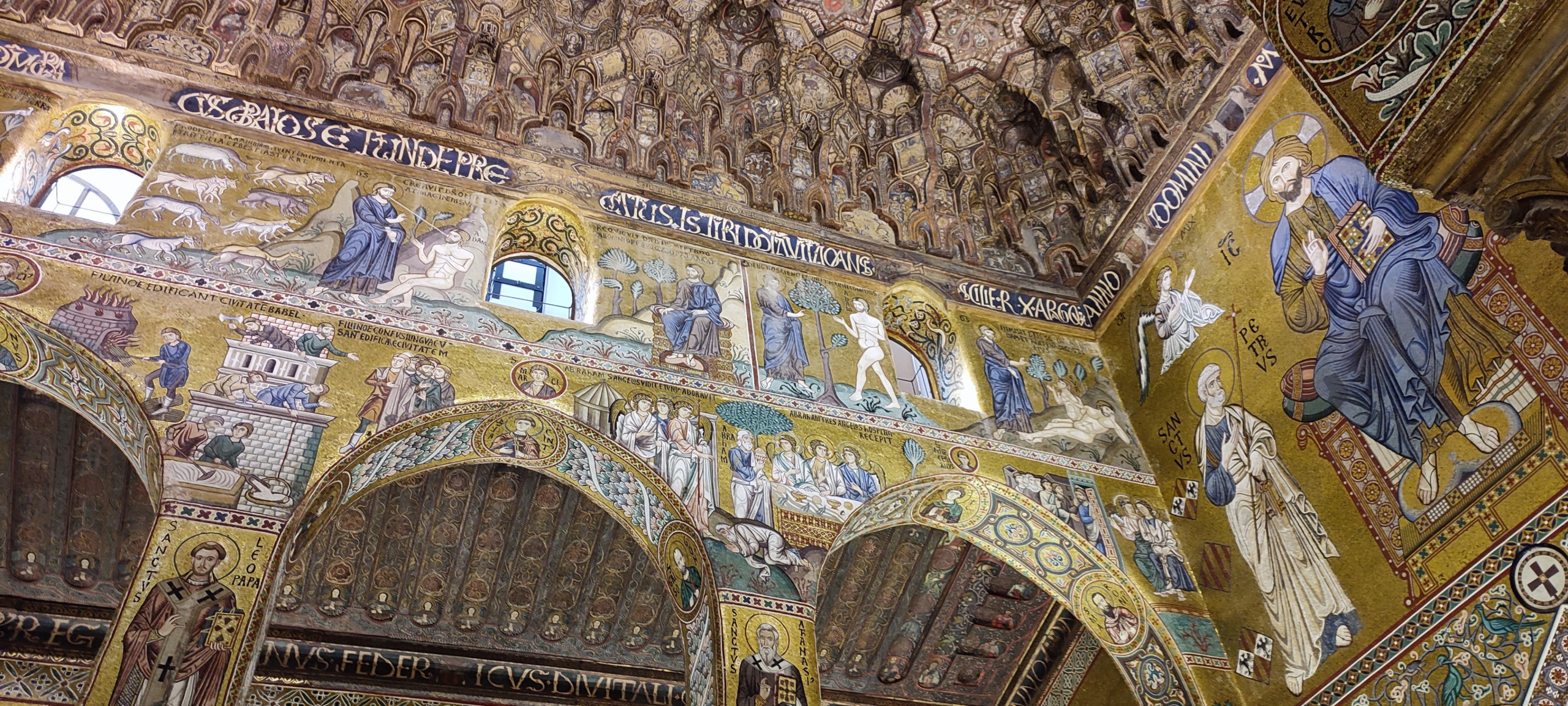
Two things about it are worth carrying into the room with you. The first is that this is, by scholarly consensus, the only monumental Fatimid-period painted cycle in the entire Mediterranean basin to survive intact. Not the best preserved. The only one.
The second is structural, and it is the reason I kept photographing it. A carved wooden ceiling is light, and it is assembled from thousands of small pieces with tolerance built into every joint. Masonry vaults of that span crack, settle, and get rebuilt; timber assemblies of that kind flex and stay. In thirty years of assessing historic buildings in a seismic country I have opened a great many ceilings, and the ones that outlive the walls around them are almost always the light ones. That the most fragile-looking thing in the chapel is also the oldest surviving element is not a paradox. It is physics.
The mosaics and the argument they are making
The walls are Byzantine: gold-ground mosaics executed to a standard that rivals Constantinople, with the Christ Pantocrator in the dome. The columns are ancient, reused from classical buildings. The floor is opus sectile, cut marble and porphyry.
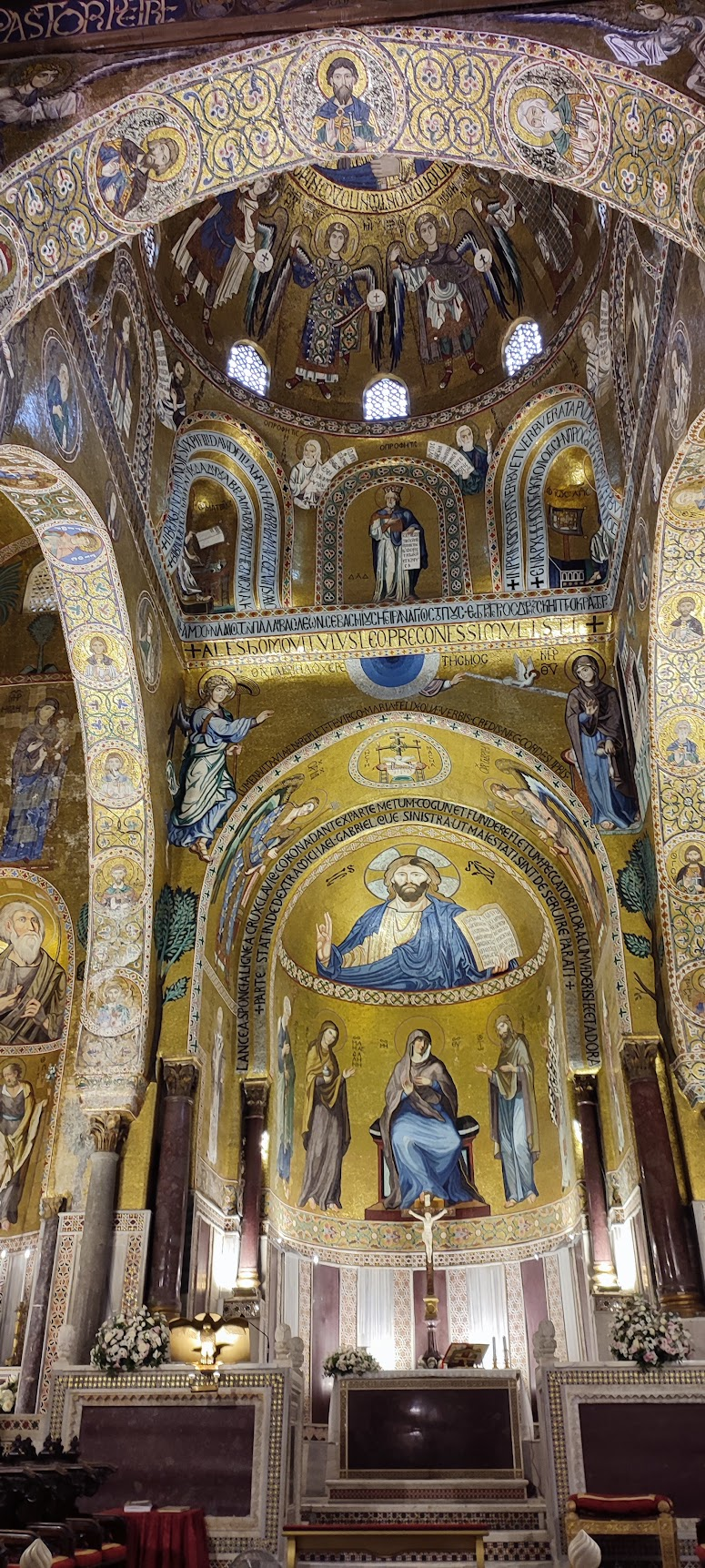
Put those three languages in one room and you get the point Roger II was making. He ruled Greek Christians, Latin Christians, Arabic-speaking Muslims, and Jews, and he needed all of them to look at his chapel and see something of themselves. The Palatine Chapel is not decoration. It is a constitutional argument in stone, wood, and glass — and the boy who grew up hearing Mass under that ceiling absorbed it. The chapel became part of the UNESCO World Heritage site “Arab-Norman Palermo and the Cathedral Churches of Cefalù and Monreale” in 2015.
The red porphyry sarcophagus: a burial that was also an appropriation
Walk fifteen minutes downhill to the cathedral and you reach the other end of the story. In a chapel off the right-hand aisle stand four royal tombs. Frederick’s is a sarcophagus of red porphyry with a semicircular base, carried on four lions, under a canopy on six columns. Behind it lies Roger II. Nearby are Henry VI and Constance de Hauteville.
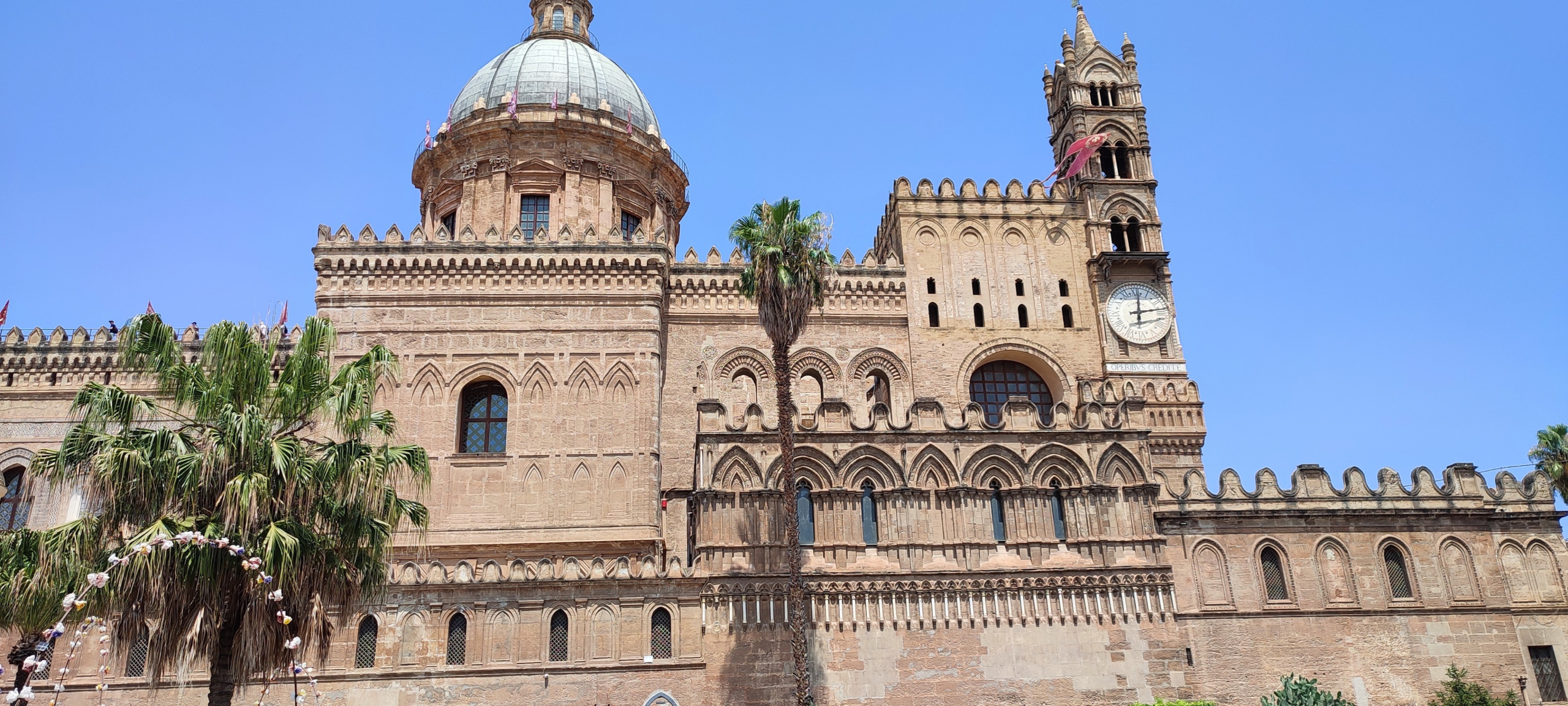
Porphyry is not a decorative choice. The deep purple-red stone came from a single quarry in Egypt, worked out in antiquity, so every medieval porphyry object is recycled Roman imperial material. Using it was a claim: I am the successor of the emperors.
And the sarcophagus was not made for Frederick. Roger II had commissioned two porphyry sarcophagi before 1145 for the cathedral of Cefalù, which he had founded — one for himself, one to stand empty. After his death in 1154 his wishes were ignored. Frederick had both sarcophagi moved to Palermo and reassigned them: one for himself, one for his father. His grandfather’s empty tomb of humility became the emperor’s bed. Cefalù is still waiting.
What is inside the tomb
The sarcophagus was opened in 1781 by the scholar Francesco Daniele, by candlelight, and the body was found remarkably preserved: layered tunics, a crown of gilded silver leaf and pearls, an emerald ring, the imperial globe at the neck, a sword along the left side. Daniele published the findings in 1784, and the tomb remained open for two decades, until 1801.
A non-invasive survey between 1994 and 1998, using X-rays and DNA sampling, confirmed what Daniele had already recorded: Frederick is not alone in there. Two other bodies share the sarcophagus, one identified as Peter of Aragon, the other an unidentified woman. Nobody has explained her.
Excommunicated at the time of his death, buried in the church of the city he had governed from a distance, sharing a stolen tomb with a stranger — the ending fits the man better than a solemn monument would have.
How to see both ends of the story
In Palermo
The Palatine Chapel is visited through the Complesso Monumentale di Palazzo Reale, and the standard adult ticket was €19 when I checked in August 2026, covering the chapel and the Royal Apartments. Buy online; the ticketing is handled by the Fondazione Federico II, which is a pleasing loop. Note that the plain entry ticket is sold only through that official channel. Every Palatine Chapel product on the third-party booking platforms bundles a guide, an app, or a multi-site pass, which is a fine thing to buy on purpose and an expensive thing to buy by accident.
Two warnings that matter more than the price. First, the Palazzo dei Normanni is the seat of the Sicilian Regional Assembly, so the complex can close partially or entirely, without notice, when the chamber is sitting. Second, the closure days for the Royal Apartments have changed more than once in recent years, and published sources currently disagree about which days those are. Check the official calendar in the week you travel, not the month before. On Sunday mornings the chapel closes for Mass.
For the tombs, entry to the cathedral nave is free; the royal tombs, treasury, crypt, and roof terraces sit inside the ticketed monumental area, with separate and combined tickets running roughly €8 to €13 as of August 2026. The treasury holds the gold crown recovered from the tomb of Constance of Aragon, Frederick’s first wife. The roof walk gives you the best rooftop view in Palermo, and it is worth the narrow stairs.
Give the chapel a full hour. Go at opening, when the light is still low and the tour groups are at Monreale.
Monreale itself deserves a separate half day rather than a slot inside a city tour. The mosaic cycle there works on a completely different scale from the chapel’s, and the town sits about five miles uphill from the center — exactly the kind of trip a shuttle solves and a rental car complicates. The round-trip van transfer with a self-guided visit costs about $47 and leaves you alone inside the cathedral, which is the version I would choose.
In Jesi
Jesi is a compact walled town of about 40,000 people, roughly 50 minutes from my desk in Macerata and 20 miles from Ancona. The train station is a ten-minute walk from the historic center; Ancona-Falconara airport is 9 miles away.
Piazza Federico II is the birth site — an unusually severe, elongated square rather than a picture composition. Palazzo Ghislieri on the square holds the Museo Federico II Stupor Mundi, sixteen themed rooms, heavy on multimedia reconstruction. Admission was €7 full and €5 reduced in August 2026, with a €19 family ticket and a €15 combined pass covering nine municipal museums. Opening hours are seasonal and thin in winter, so book or call.
Be honest with yourself about what it is: an interpretation center, not a treasury. There is no relic of Frederick in Jesi, because Jesi never had him. What Jesi has is the ground, the walls he would have seen going up shortly afterward, and the letter.
Two blocks away, Palazzo Pianetti holds the civic art gallery and a rococo gallery that is genuinely remarkable, plus paintings by Lorenzo Lotto. And the surrounding hills are the Castelli di Jesi, the heartland of Verdicchio — which means the practical shape of a Jesi day is: museum, gallery, lunch, a winery in the afternoon.
Getting from one end to the other
Volotea has run a direct Ancona–Palermo route with two weekly frequencies, Monday and Friday, in a seasonal pattern; the flight is about 1 hour 20 minutes. It is the sort of route that appears and disappears, so verify it for your dates. Otherwise, connect through Rome or Milan.
The itinerary that works, if the two-city idea appeals to you: three or four days in Palermo, fly or connect north, then two days in Le Marche using Ancona or Jesi as a base. Not the reverse. Palermo is overwhelming and should come first; Le Marche is quiet and should come after, when you can hear it.
What I would skip
Do not try to do Palermo and Jesi as a single “Frederick II tour” if you have less than a week. The connection is intellectual, not logistical, and forcing it produces two rushed half-visits.
Skip the guided tour of the Palatine Chapel unless the guide is a specialist. The standard commentary is a list of superlatives, and the chapel does not need help being impressive; it needs quiet. Read fifteen minutes in advance and go in alone.
And in Jesi, skip the reconstructed-medieval-atmosphere restaurants near the piazza. Eat where the Verdicchio producers eat, in the countryside.
Booking Notes: What I Would Actually Reserve in Palermo
The two tickets that matter are not sold through booking platforms. The €19 combined ticket for the Royal Palace and the Palatine Chapel comes from the Fondazione Federico II; the monumental-area ticket at the cathedral, the one that covers the royal tombs, the treasury, the crypt, and the roof walk, comes from the cathedral’s own ticket office. Buy both directly, a few days ahead, and check the palace calendar the same week you travel. Everything the platforms sell for the Palatine Chapel is a guided product wrapped around that same €19, which is worth paying for deliberately and irritating to discover after the fact.
Monreale is the trip worth booking, and worth booking without a guide. The round-trip van transfer with a self-guided visit runs about $47 and rated 4.7 across more than 260 reviews when I checked in August 2026. It handles the one genuinely awkward piece of Palermo logistics and then leaves you to look at the mosaics at your own pace, which is what a cathedral of that size actually requires.
If you want a guide, make it private and licensed. I would skip the standard chapel commentary, but a half day with a licensed guide who follows your questions is a different product entirely. The private art and architecture half-day covers the cathedral, Teatro Massimo, and the layered streets between them, at roughly $405 for a group of up to four, rated 4.7 across 138 reviews as of August 2026. Split four ways that is about a hundred dollars each for something that adapts to what you actually want to know — and if Frederick is your reason for coming, say so when you book, because the guide will build the day around the tombs.
What I would skip: the Monreale-plus-Cefalù-plus-a-beach day trips. They look efficient and they are not. Palermo to Cefalù is about 45 miles along the coast; Cefalù back inland to Monreale is another 50; Monreale down to Palermo is short but slow. That is close to three hours in a van to see two churches for an hour each. Cefalù has a genuine claim on this story — it is where Roger II wanted his porphyry sarcophagus to end up, and where it never arrived — but it deserves its own overnight, not a bus window.
FAQ — Frederick II, Palermo and Jesi
Who was Frederick II and why is he called stupor mundi?
Frederick II (1194–1250) was King of Sicily, Holy Roman Emperor, and King of Jerusalem. Contemporaries called him stupor mundi, “the wonder of the world,” for his multilingual court, his scientific curiosity, his treatise on falconry, and his repeated collisions with the papacy, which excommunicated him twice.
Where exactly is Frederick II buried?
In Palermo Cathedral, in the chapel of the royal tombs off the right aisle. His red porphyry sarcophagus stands beside those of his father Henry VI, his mother Constance de Hauteville, and his grandfather Roger II.
Do I need a separate ticket to see the royal tombs?
Yes. Entering the cathedral nave is free, but the royal tombs sit within the ticketed monumental area, together with the treasury, crypt, and roof walk. Tickets ranged from about €8 to €13 in August 2026 depending on the combination chosen, and they are sold through the cathedral’s own ticket office rather than through booking platforms.
When is the best time to visit the Palatine Chapel?
Right at opening, Monday through Saturday, in shoulder season — late September through November, or March through early May. Avoid Sunday mornings, when the chapel closes for Mass, and check for parliamentary closures, since the palace houses the Sicilian Regional Assembly.
How much time do the two sites need?
Allow one hour for the Palatine Chapel and the Royal Apartments, and one hour for the cathedral’s monumental area including the roof. In Jesi, ninety minutes covers the Stupor Mundi museum, and a half day covers the town properly.
Is Jesi worth a detour if I am already in Italy?
If you are visiting Le Marche, yes — it combines naturally with the Verdicchio wine country and with Ancona. If you are on a Rome–Florence–Venice route, no. Jesi rewards travelers who are already exploring central Italy, not as a standalone pilgrimage.
What do Italians know about this that visitors usually miss?
Every Italian schoolchild learns that Frederick II was born in Jesi. Almost none of them connect that fact to the tomb in Palermo, or realize that the man moved his working capital away from Sicily to Foggia in 1223. The two cities are taught in separate chapters. Standing in both, in the same trip, is a perspective most Italians have never had.
The takeaway
Frederick II is the closest thing Italian history has to a hinge. He connects Norman Sicily to the Holy Roman Empire, Arabic science to Latin scholasticism, a market square in Le Marche to a cathedral in Palermo — and he did it while being called the Antichrist by one pope and the wonder of the world by everyone else.
If you are planning a trip that includes Sicily, spend an hour under the ceiling of the Palatine Chapel thinking about the child who heard Mass there. And if your route brings you through central Italy, stand in Piazza Federico II in Jesi and consider that an empire’s most restless mind began in a tent, in public, on a December morning, because his mother needed witnesses.
Planning a trip through Le Marche or central Italy and want the version an Italian engineer would give you? You can book a consultation with me through the site, or explore more of the region in the guides below.