The Palio di Siena Explained: History, Contrade & Meaning
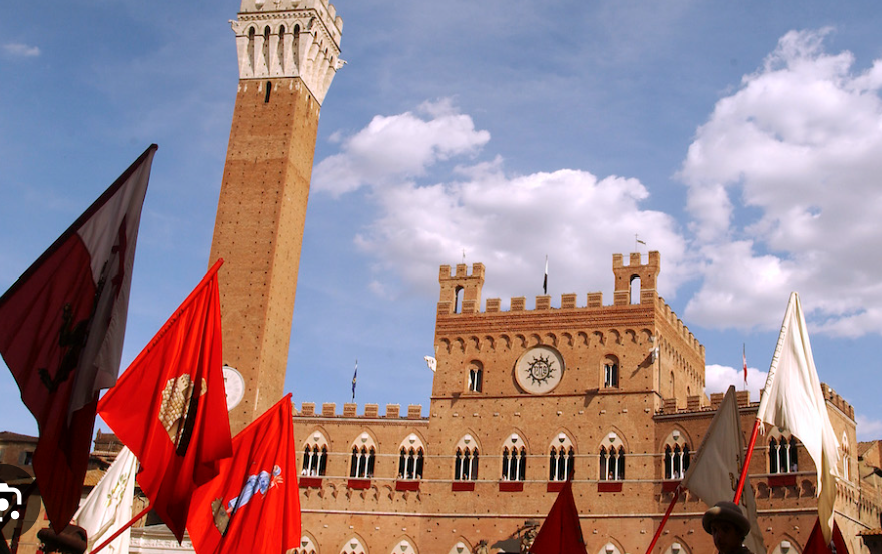
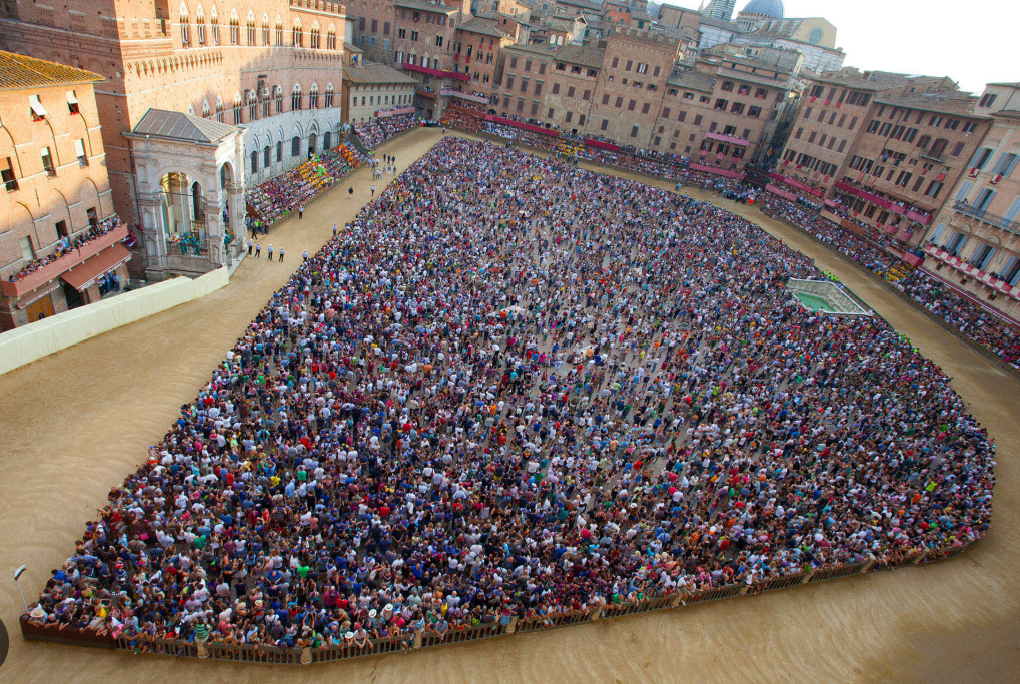
The dust in Piazza del Campo has a specific smell. It is a mixture of crushed tufo—the yellow-ochre volcanic dirt laid over the medieval paving stones—sweat, and centuries of unresolved tension. When the mortaretto (a loud firecracker) detonates to signal the entrance of the horses, a square holding forty thousand people goes completely, unnervingly silent. You can hear the hooves of ten horses striking the earth before you see them. This is not a historical reenactment. It is not a folkloric show put on for tourists. It is a brutal, ninety-second distillation of a city’s soul.
I am Mirco Vitellozzi. I am a engineer living and working in Le Marche, central Italy, but like anyone deeply invested in the structural integrity of Italian culture, I have spent years observing the mechanics of Siena. As an Italian, I do not look at the Palio as a sporting event. I look at it as a complex societal architecture, a load-bearing pillar of civic identity that has survived empires, world wars, and modernity. Visitors often arrive in Siena expecting a picturesque medieval horse race. They leave either deeply moved or utterly disturbed, precisely because they lacked the cultural scaffolding to process what they just witnessed.
Here is the Palio di Siena explained from the inside: the history, the bloodlines, the invisible agreements, and the year-round ecosystem that makes ninety seconds in the Campo matter so much.
What is the Palio di Siena, Really?
If you need the Palio di Siena explained in a single concept, understand this: it is a medieval territorial war sublimated into a bareback horse race. Held twice a year—on July 2 and August 16—the Palio is a competition between the contrade (historical city wards) of Siena. Out of the seventeen existing contrade, ten are selected to race in each event. The race takes place in the shell-shaped Piazza del Campo, requires three laps around a treacherous dirt track, lasts roughly ninety seconds, and is won by the first horse to cross the finish line, even if it has lost its rider. But the race is merely the explosive conclusion. The Palio is a continuous, year-round civic institution that dictates the social, political, and emotional lives of the Sienese people.
The Deep Architecture of Sienese History
To understand why the city shuts down for a horse race, you have to look at the blueprints of Sienese history. Siena in the Middle Ages was a fierce, independent republic, locked in a perpetual state of war with Florence. The city was divided into military companies tasked with defending the gates and walls. When Siena finally fell to the Florentines and the Medici in the sixteenth century, the military function of these neighborhoods evaporated, but the territorial tribalism remained.
The civic energy needed an outlet. Originally, the Sienese engaged in violent public games: pugilato (mass boxing matches), pallonata, and bull hunts. As these were gradually outlawed by the ruling aristocracy for being too deadly, the focus shifted to racing. There were races with buffaloes, races with donkeys, and long, linear horse races outside the city walls.
The shift to the modern format happened in the seventeenth century. Archival consensus, including records from the Comune di Siena, marks 1633 as the first documented horse race “alla tonda”—meaning a circular race held within the confines of Piazza del Campo. By 1656, the race on July 2 was institutionalized as the Palio di Provenzano, dedicated to the Madonna of Provenzano. The August 16 race, the Palio dell’Assunta, dedicated to the Assumption of Mary, was added later to complete the summer cycle. The dates are structural; they do not move for weekends or holidays.
The borders of this tribal system were permanently codified in 1729. Violante Beatrice of Bavaria, the Governor of Siena, issued a proclamation called the Bando, which officially defined the boundaries of the seventeen surviving contrade. That decree is still the law today. If you are born one meter across a street, you belong to a different contrada. The continuity of this institution is staggering. The Palio has been suspended only for absolute catastrophes: World War I, World War II, and the recent COVID-19 pandemic. Occasionally, the city will call an extraordinary Palio to mark a major historical event. The last extraordinary Palio was run on October 20, 2018, to commemorate the centenary of the end of the First World War.
The Contrade: A Living World
You cannot understand the race without understanding the contrada. The seventeen contrade are the Aquila (Eagle), Bruco (Caterpillar), Chiocciola (Snail), Civetta (Owl), Drago (Dragon), Giraffa (Giraffe), Istrice (Crested Porcupine), Leocorno (Unicorn), Lupa (She-Wolf), Nicchio (Seashell), Oca (Goose), Onda (Wave), Pantera (Panther), Selva (Forest), Tartuca (Tortoise), Torre (Tower), and Valdimontone (Valley of the Ram).
A contrada is not a sports team or a fan club. It is a sovereign micro-state. Each has its own constitution, its own elected prior, its own museum holding centuries of won banners, its own church, and its own patron saint. Crucially, each has a società, a social club that operates 365 days a year. The società is the living room of the ward. It is where teenagers do their homework, where the elderly play cards, and where the neighborhood eats together. You do not support a contrada; you are born into it. Membership is territorially inherited and officially sealed by a secular baptism. Every year, during the contrada’s patron saint festival, the prior baptizes the newborns at the neighborhood fountain, binding them to the ward for life. Members pay voluntary annual taxes (protettorato) to fund the contrada’s activities, primarily the massive expense of the Palio.
This intense localization breeds intense friction. The contrade are defined as much by who they hate as by who they are. Several contrade have historical enemies (avversarie or nemiche). The rivalries are generational and visceral. The Oca and the Torre detest each other. The Chiocciola and the Tartuca have a mutual animosity that goes back centuries. The Aquila and the Pantera are sworn enemies. There is even a unilateral rivalry: the Onda considers the Torre an enemy, but the Torre does not officially recognize the Onda as its primary rival. In the context of the Palio, ensuring your enemy loses is considered almost as glorious as winning yourself.
Decoding the Four Days
The Palio is not a single day. It is a four-day ritual strictly governed by regulations. For the July Palio, the days are June 29 to July 2. For August, they are August 13 to August 16. Because the Campo can safely accommodate only ten horses, seven contrade run by right (those that did not run the corresponding Palio the previous year), and three are drawn by lot.
The mechanics begin on the morning of the first day with La Tratta (the drawing). The city brings in a pool of physically vetted horses. They are tested on the dirt track in short heats. The captains of the ten participating contrade then gather to select the ten horses they deem most suitable. Then comes the lottery. In front of the Palazzo Pubblico, a number is drawn for a horse, and a number is drawn for a contrada. The horse is assigned randomly. There is no substitution. If a contrada draws a champion, there is weeping and celebration in the square. If they draw a slow or inexperienced horse, there is despair.
Once the horse is assigned, the contrada hires a jockey (fantino). The horse is entrusted to the barbaresco, a highly respected groom from the contrada who will watch, feed, and sleep next to the animal for the next four days.
Over the next three days, there are six trial runs (prove), concluding with the provaccia on the morning of the race. These trials are not about speed. They are about acclimating the horse to the brutal corners of the track and, more importantly, they are a smokescreen for the partiti.
The partiti are the secret deals struck between the contrada captains and the jockeys in the middle of the night. Millions of euros in informal, undocumented promises change hands. A captain might pay a jockey in another contrada to block an enemy horse at the starting line. A captain with a bad horse might sell his jockey’s services to an allied contrada to help them win. It is Machiavellian game theory played out in real-time.
On the eve of the race, each participating contrada holds the cena della prova generale, a massive outdoor dinner for thousands of its members. The energy is a mix of a religious vigil and a war council.
The next afternoon, the race day begins in the contrada’s church. The horse is brought directly to the altar. The priest blesses the animal. The absolute silence in the church is broken by the priest’s final, ancient command: “Vai e torna vincitore” (Go and return a winner). From that moment on, if the horse defecates in the church, it is considered an omen of extreme good luck.
The Mechanics of the Race
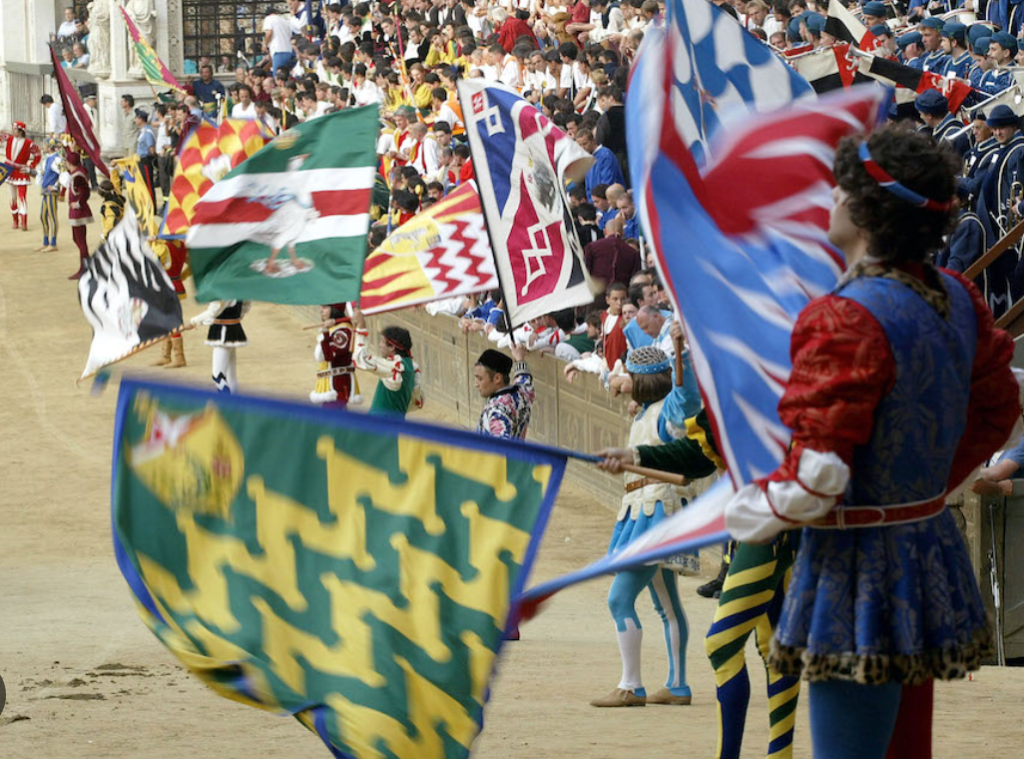
Before the race, Piazza del Campo must be consecrated. This is the role of the Corteo Storico, a magnificent two-hour historical procession. Representatives from all seventeen contrade, as well as ancient city guilds and magistrates, march in absolute precision wearing deeply researched Renaissance costumes. Flag throwers (alfieri) perform complex maneuvers to the relentless, slow beat of the drums. The procession ends with the arrival of the Carroccio, an ox-drawn cart bearing the prize banner itself.
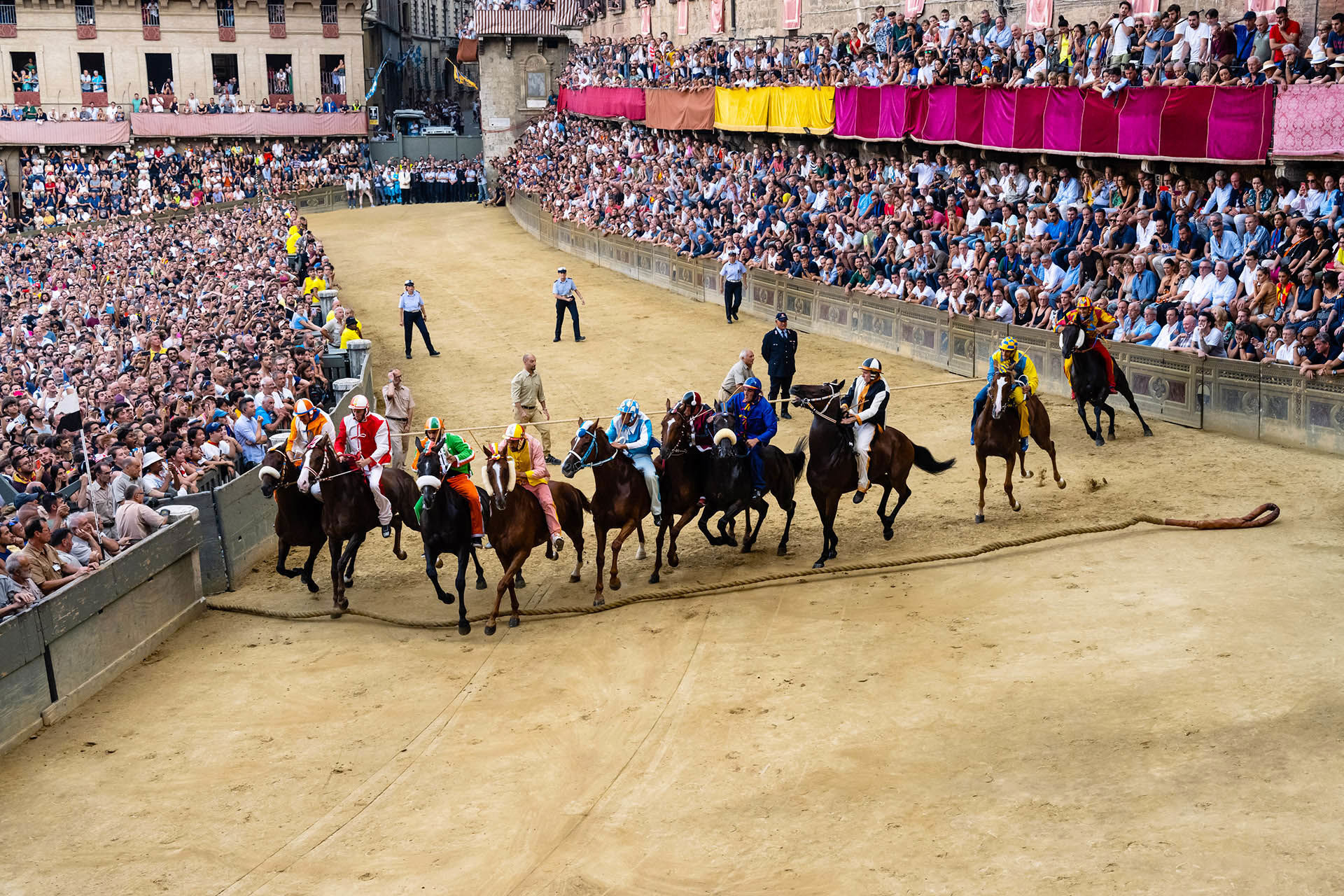
Then, the track is cleared. The mortaretto fires. The ten horses emerge from the courtyard of the Palazzo Pubblico. They are ridden a pelo (bareback). The jockeys carry a nerbo, a whip made from dried, stretched oxhide. The nerbo is used to urge their own horse, but just as often, it is used to strike rival jockeys or rival horses.
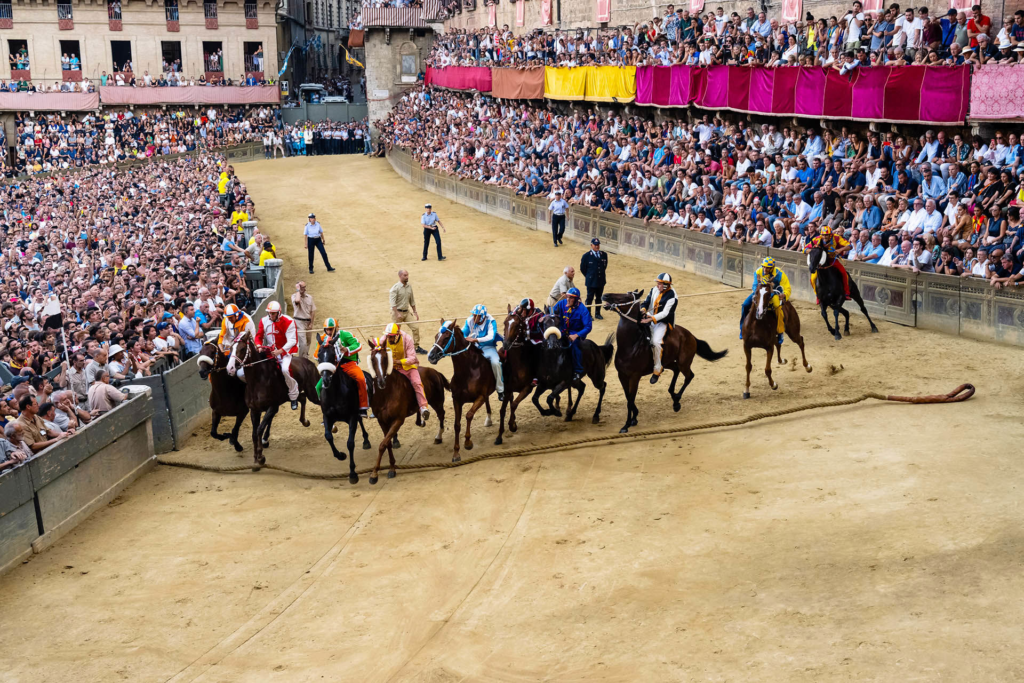
The starting procedure is called the mossa. The starting area is delineated by two thick ropes called the canape. The starter (mossiere) calls the contrade into the space between the ropes in an order determined by a secret lottery drawn just moments before. Nine horses enter the ropes. The tenth horse is the rincorsa (the run-up). The race does not start until the rincorsa decides to enter the ropes from behind at a gallop.
The tension at the mossa is agonizing. It can take five minutes, or it can take an hour. The jockey of the rincorsa holds the ultimate power. He is constantly looking at the alignment of the nine horses, waiting for his contrada’s allies to be in a good position and his enemies to be trapped or facing the wrong way. Meanwhile, the jockeys inside the ropes are screaming at each other, making last-minute deals, and trying to keep their highly strung horses calm. When the rincorsa finally breaks the line, the front rope drops, and the explosion of kinetic energy is terrifying.
The race is three laps. The track is roughly 339 meters long, making the total distance just over a kilometer. The track is not flat. It drops sharply into the most dangerous point of the race: the San Martino curve, a tight, ninety-degree downhill bend where centrifugal force throws horses and riders toward the padded barriers. The track then climbs back up to the Casato curve.
A jockey’s job is largely to guide the horse through these two corners. If a jockey falls—which happens frequently—the horse continues to run. A riderless horse is called a cavallo scosso. In Siena, the horse represents the contrada, not the man. A cavallo scosso can cross the finish line first and win the Palio. When the race ends, the winning contrada floods the track in a state of absolute delirium.
The Drappellone: The Rag of Victory
The prize for this immense expenditure of money, anxiety, and risk is a piece of painted silk. It is called the drappellone (large banner), or affectionately, the cencio (the rag). Every year, the city commissions a different artist to paint it. The July banner must depict the Madonna of Provenzano; the August banner must depict the Assumption of Mary. Beyond that, the artist has creative freedom, though they must include the heraldry of the participating contrade.
The drappellone is not just a trophy; it is a historical document. Past banners have reflected the macro-history of Italy, bearing the symbols of the Savoy monarchy, fascist insignias during the 1930s, and later the emblems of the Republic. Winning the cencio means taking it immediately to the church (Provenzano in July, the Duomo in August) to sing a Te Deum of thanks, and then locking it in the contrada museum forever.
The Fantini: Mercenaries in the Campo
The jockeys are a strange anomaly in the Sienese ecosystem. While the contrada members are strictly locals, the fantini are outsiders. Historically from rural Tuscany or the Maremma, today many are of Sardinian descent, carrying a long tradition of bareback horsemanship.
In Siena, the jockey is a mercenary. He is paid handsomely to win, but he is also paid by other contrade to ensure someone else loses. A jockey’s reputation is built on trust with the captains, physical bravery, and tactical ruthlessness. If a jockey betrays his contrada—by taking a bribe from an enemy and deliberately riding poorly—he requires an immediate police escort to escape the city, because the furious members of the contrada will try to beat him senseless.
The Honest Part: Animal Welfare
As an engineer, I deal with facts, and the facts regarding the Palio require honest evaluation without preaching. To the outside world, the Palio is often viewed strictly through the lens of animal rights. Horses run at high speeds around tight, unbanked corners on a medieval square. Horses have fallen, sustained catastrophic fractures, and been euthanized.
The Sienese are fiercely defensive of their horses, pointing out that the animal is venerated like a deity within the contrada. But love does not change physics. In response to intense public and political pressure, the Comune di Siena instituted a comprehensive Protocollo Equino (Equine Protocol). While safety measures evolved throughout the 1990s, the protocol was heavily formalized in 1999 and is updated regularly.
Today, purebred English thoroughbreds are banned; only specific half-blood horses (anglo-arabo) are permitted, chosen for their sturdier legs and adaptability to tight turns. The dirt track composition is a highly engineered mix of tufo, clay, and sand designed to maximize grip and elasticity. The city mandates strict veterinary screenings, year-round blood testing, and specialized training tracks. The corners of San Martino and Casato are heavily padded with specialized impact-absorbing barriers.
Have the protocols reduced fatalities? Yes, statistically. Have they eliminated the risk? No. The Palio is inherently dangerous. The debate is ongoing, reflecting the friction between modern ethical standards and ancient civic religion. The Sienese argue that the horse is living out its nature and that the city protects them far better than the commercial racing industry. You must look at the facts and decide for yourself, but you must do so acknowledging that the Sienese revere these animals deeply.
What it Means
Why does this matter? In an increasingly globalized, homogenized world, Siena offers a radical alternative: hyper-localism. The Palio is a city talking to itself. It does not care about television rights. It does not care if tourists understand it. It is an annual reaffirmation of identity. When a Sienese person watches the Palio, they are not watching a race; they are watching their ancestors, their neighborhood, their enemies, and their own bloodlines compressed into a single, violent blur of color in the center of their city. It is the ultimate expression of belonging.
How to Experience It (And the Etiquette of Being a Guest)
If you plan to attend, you must transition from a tourist to a respectful observer. Do not wear the colors of a contrada unless you have a deep, personal connection to it. Do not interfere with the marching comparsa (groups) in the streets. Do not complain about the crowds, the heat, or the lack of bathrooms in the center of the Campo. You are a guest in someone else’s house during their most intimate family gathering.
I will not waste your time here with the mechanics of buying tickets or finding a hotel. I have already mapped out the exact logistics of the four seat types, how to access the palchi, and how to navigate the city on race day. For that structural data, refer directly to my practical guide: Palio di Siena: What It Is and How to Watch It.
If you are fascinated by this level of localized Italian identity, you will find similar, though less explosive, veins of history across the Apennines in my home region. To understand the cultural geography, read my analysis of Tuscany vs Le Marche. In fact, the deep civic pride of Siena echoes in the historical reenactments of Le Marche, such as the Ritorno degli Esuli in San Ginesio (forthcoming). Central Italy is a tapestry of these rivalries and rituals. To explore them properly, sign up for the Tastes & Wonders of Italy newsletter and download my free ebook on navigating authentic Italy.
*
Frequently Asked Questions
Why is the Palio di Siena run bareback? Riding bareback (a pelo) is a historical tradition dating back to the origins of the race. It increases the difficulty, levels the playing field between the horses, and tests the absolute skill and balance of the fantino (jockey) through the sharp turns of the Campo.
Can a horse win the Palio without a jockey? Yes. In the rules of the Palio, the horse represents the contrada. If a jockey falls off, the horse becomes a cavallo scosso (riderless horse). If the cavallo scosso crosses the finish line first with its head ornament (spennacchiera) intact, that contrada wins the Palio.
How are the horses chosen for the Palio? The horses are not bred or owned by the contrade. They are presented by private owners, vetted by city veterinarians, and tested on the track. The captains of the ten racing contrade choose the ten best horses, which are then assigned to the contrade entirely by a blind lottery called La Tratta.
What is the prize for winning the Palio? The winning contrada receives the drappellone (or cencio), a large, hand-painted silk banner commissioned by the city from a different artist each year. There is no official financial prize; the reward is pure glory and the right to mock rival contrade for months.
Is the Palio di Siena cruel to horses? This is a subject of intense debate. The race is objectively dangerous, and horses have been fatally injured on the tight corners. However, Siena has implemented a strict Protocollo Equino since 1999, banning thoroughbreds in favor of sturdier half-bloods, padding the track barriers, and instituting rigorous veterinary checks to minimize risk.
What happens if a contrada’s enemy wins? It is a psychological disaster. The winning contrada will relentlessly taunt their nemica (rival) with songs, parades, and pacifiers (symbolizing that the losers are crying babies). Preventing an enemy from winning is considered a highly successful Palio outcome, second only to winning yourself.
How much do the jockeys get paid? Jockey payments are strictly unofficial and undocumented, negotiated secretly through partiti. Top jockeys can earn hundreds of thousands of euros for a single race, combining their base fee from their contrada and bribes or incentives from allied contrade to hinder rivals.
Does the Palio run if it rains? No. The tufo dirt track becomes dangerously slippery when wet. If it rains, the green flag is hung from the Palazzo Pubblico, and the race or trial is postponed until the track is dry and safe, even if it means delaying the Palio by a day or more.
*