Inside I Giorni di Azzolino, Grottazzolina’s Medieval Festival
Inside I Giorni di Azzolino
By ten at night on the first Saturday of August, the column forming in the upper streets of Grottazzolina smells of lamp oil, hot wool, and dust. I Giorni di Azzolino is the historical reenactment this hill town in Le Marche has staged for twenty-eight editions, and its central night ends with a thirteenth-century army walking into a piazza to rename a village. Roughly 3,100 people live here. Several hundred of them are in costume. This is not a show staged for tour buses — there are no tour buses — and understanding what you are watching requires knowing a small, contested piece of papal politics from 1225. That is what this piece is for.
What I Giorni di Azzolino actually is
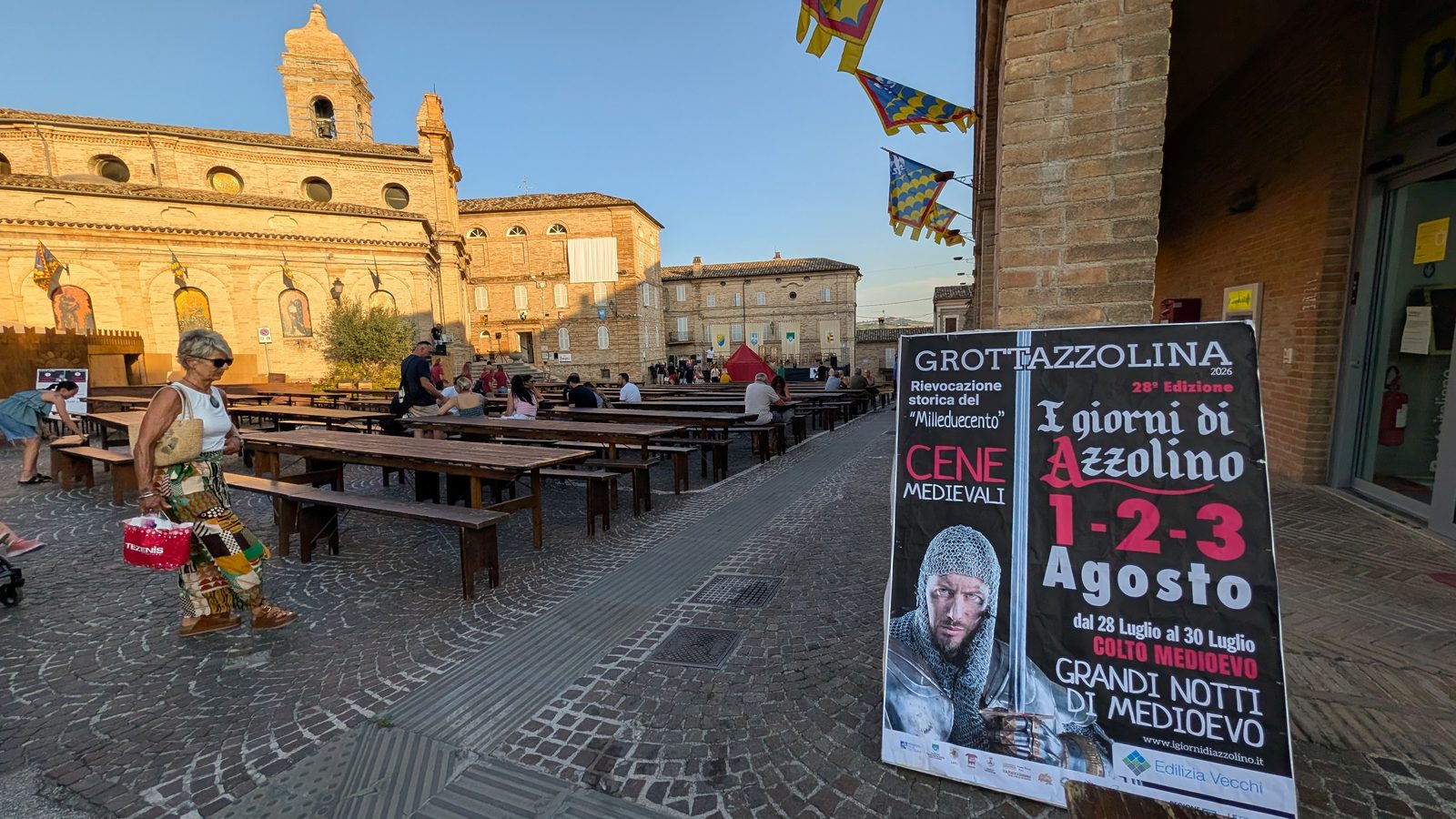
I Giorni di Azzolino is a seven-night medieval reenactment held every summer in Grottazzolina, in the province of Fermo, in Italy’s Marche region. It commemorates the capture of the fortress of Crypta Canonicorum by Azzo VII d’Este, Marquis of Este and lord of Ferrara, after which the settlement took his name and eventually became Grottazzolina. The 2026 edition, the twenty-eighth, ran from July 28 through August 3. Entry to the streets, the encampments, and the shows is free; you pay only for what you eat and drink. The three set-piece nights fall at the end: the Procession of the Triumph and the Baptism, the Joust of the Monk, and the Palio of the town’s contrade (the historic neighborhood districts that compete against one another). In 2026 that closing palio is dedicated to Pope Leo XIV and appears on the official program under his family name, as the Palio di Prevost.
The shape of the week
The opening nights are the quiet ones, and they are the reason I take this festival more seriously than most. Under the label Colto Medioevo — “learned Middle Ages” — the organizers program archaeologists and historians giving public talks on Picene material culture and on the meaning of equestrian tournaments in the thirteenth century, plus a concert of medieval music in the church of San Giovanni Battista. A reenactment that pays for lecturers before it pays for fire-breathers is telling you something about its own standards.
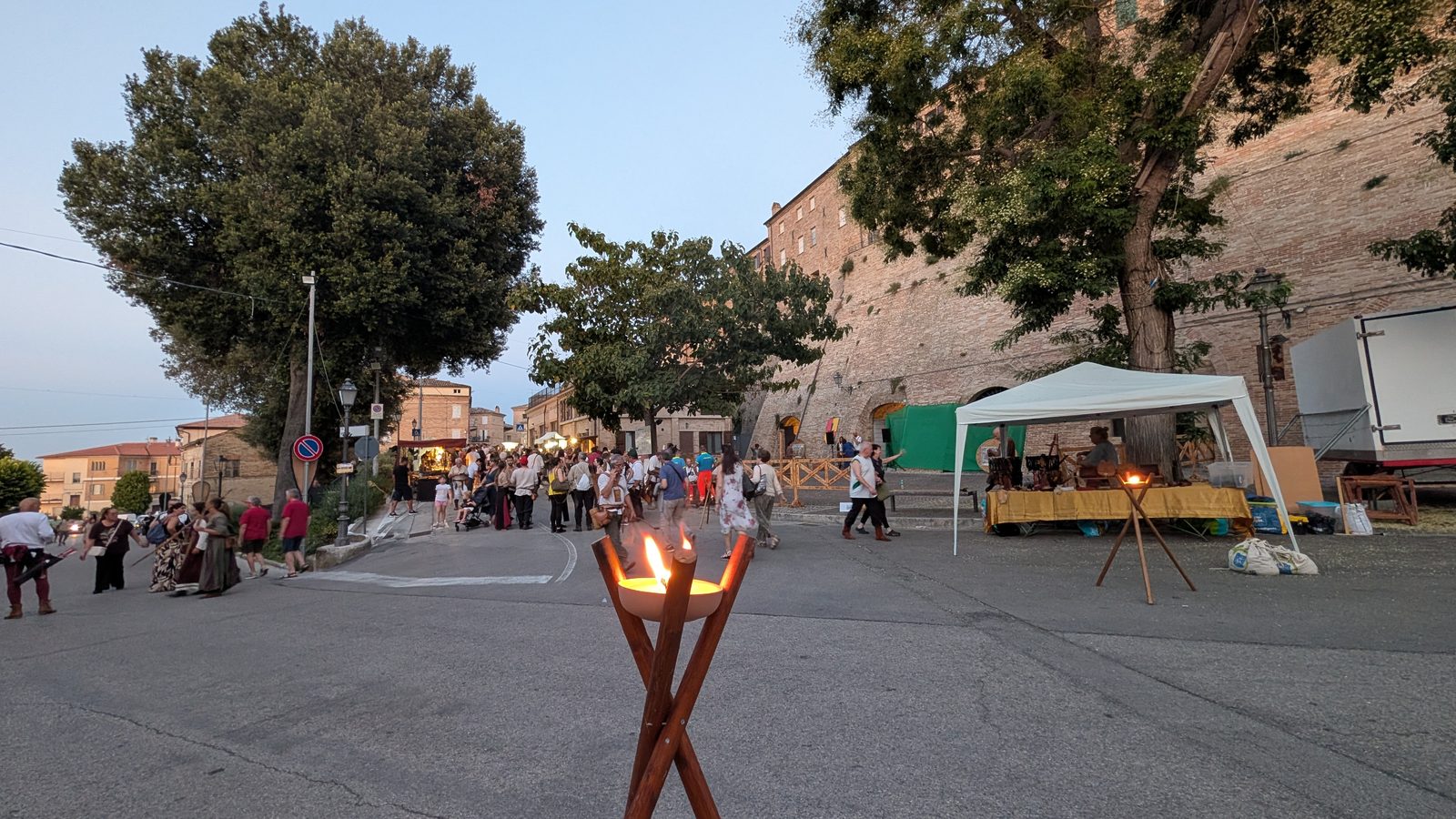
The weekend is when the town fills. The market of mestieri smarriti — lost trades — opens around seven in the evening, the taverns open at seven-thirty, and the programmed spectacle runs until roughly half past eleven. Everything happens after dark, which in the Marche in early August is both a mercy and a design choice.
The 1225 that the town replays
The story Grottazzolina tells is this. The Este family had been granted the March of Ancona — the medieval province that gave the modern Marche its name — by the papacy. Azzo VII, acting on that investiture, moved down from Este in the Veneto and took the March against the will of Rinaldo, Bishop of Fermo, storming three fortified villages belonging to the canons of Fermo cathedral. The strongest of the three was the crag now called Grottazzolina. The old name, Crypta Canonicorum, “the canons’ grotto,” became Gruptae Aczolini, “Azzolino’s grotto.” The festival’s climax is that renaming, staged as a baptism.
What the documents actually say
Here is where I have to be more careful than the promotional material, and where thirty years of reading building records has left me constitutionally unable to accept a single tidy date.
Three different dates circulate for the Este enfeoffment of Grottazzolina. The Province of Fermo gives 1213 and credits Pope Innocent III. The Comune of Grottazzolina’s own heritage page gives 1217, also crediting Innocent III — which cannot be right, since Innocent III died in July 1216. The reenactment association gives 1225, and some of its pages credit Pope Honorius II, who died in 1130, almost a century early; other versions of the same text correctly say Honorius III.
The Treccani Dizionario Biografico degli Italiani resolves most of this. The Este expedition to conquer the March of Ancona was granted by Innocent III and prepared at Padua in late 1213. It was led not by Azzo VII but by his elder half-brother Aldobrandino, who died — poisoned, according to the chronicles — at Ancona in 1215. Azzo VII, born around 1205, inherited the claim as a boy; Honorius III reconfirmed the investiture of the March to him in 1217. By 1225 the province had rebelled, and Honorius III wrote to Azzo blaming his own vicar for provoking the revolt through extortionate taxation.
So the three dates are not competing errors. They are three moments in one long, unsuccessful Este project: the grant, the reconfirmation, and the attempt to hold what was slipping away. The town reenacts the last of the three, which is the one where a garrison actually changed hands. If you want the honest version to tell your travel companions: the year is defensible, the pope is Honorius III, and anyone who tells you the documents are unambiguous has not read them.
The wrong Azzolino — a warning for readers of Dante
If you know the Divine Comedy, the name Azzolino will ring a bell, and it will ring the wrong one.
In Inferno XII, the centaur Nessus points out the tyrants boiling in a river of blood: “E quella fronte c’ha ‘l pel così nero, / è Azzolino” — “and that brow with hair so black, that is Azzolino.” Dante’s Azzolino is Ezzelino III da Romano, the Ghibelline lord of the Trevigiana March, the Este family’s hereditary enemy and Frederick II’s son-in-law. He is not the man Grottazzolina celebrates. Dante and his contemporaries simply used Azzolino as the vernacular form of Ezzelino, and the collision with Azzo d’Este’s nickname is one of those medieval naming accidents no one has bothered to clean up in eight hundred years.
The comedy runs deeper. A few lines later in the same canto, immersed in the same boiling river, Dante places Obizzo d’Este — Azzo VII’s own grandson and successor. The festival’s hero has his heir damned three verses after his enemy. Nobody in Grottazzolina mentions this, and I have never had the heart to raise it in the piazza.
The Joust of the Monk, and why a rider smashes an emperor’s face
The Sunday-night event is the one that has no equivalent anywhere else I know of in Italy. Most Italian jousts are ring-jousts: a lance, a small suspended ring, precision. The Giostra del Monaco is fought with a mazza ferrata, an iron-studded mace, and the target is three plaster shields of graduated size bearing at their center the effigy of Emperor Frederick II. The rider is announced and accredited by a herald, then charges and strikes, and the plaster comes apart.
The symbolism is not subtle, and it is not meant to be. This is a Guelph joust — a papal-party joust — and what is being ceremonially destroyed is the face of the Hohenstaufen emperor who spent thirty years trying to break the papacy’s hold on central Italy. The winner among the competing towns is proclaimed Paladino Estense, defender of the faith.
One correction the organizers’ own materials invite. The joust is named for Ezzelino “the Monk,” but the nickname belonged to Ezzelino II da Romano, who withdrew into religious life around 1221 and died in 1235. The Este rival captured at Cassano d’Adda in 1259 was his son, Ezzelino III, known to his contemporaries as the Terrible or the Tyrant. Treccani is explicit on both. The joust is magnificent either way, and the confusion between fathers and sons of the same name is exactly the kind of slippage that keeps medievalists employed.
The towns that send riders are not random. They belong to a consortium, and that consortium is the least visible and most interesting thing about this festival.
The White Eagle network
In 2004, three amateur historical associations from three different Italian regions signed an agreement. Este Medievale, from Este in the Veneto, the original seat of the marquisate. The Contrada San Giacomo of Ferrara, from the city the Este would rule for three centuries. And the Ente Rievocazioni Storiche I Giorni di Azzolino, from a hill town of three thousand people in the province of Fermo. The consortium they founded is called Terre e Castelli Estensi — Este Lands and Castles — and its members are known collectively as the Cities of the White Eagle, after the bird on the Este coat of arms.
Since then it has grown. Várpalota, in Hungary, joined first. Camposampiero, near Padua, was formally admitted in November 2019. Lissaro di Mestrino, also in the Paduan countryside, followed. Six towns across three Italian regions and two countries, bound by nothing except a shared claim on the same thirteenth-century family, and by the willingness of six municipal administrations to put budget lines behind it.
The practical result is a circuit. The Este reenactment season runs through the spring in the Veneto — a court festival in Este itself, a program on women in the Middle Ages at Camposampiero, medieval days and a donkey palio at Lissaro di Mestrino — and lands in the Marche at the end of July. The archery championship and the Joust of the Monk are contested across the whole network, which is why the standings matter to people in Ferrara and why a Hungarian delegation turns up in the Fermano in August.
I want to be clear about what this is, because it has no equivalent in American civic life that I know of. This is not a sister-city plaque in a municipal lobby. It is twenty-two years of continuous, unpaid, reciprocal travel between communities that met through archival research, coordinated by volunteers, part-funded by town councils, and organized around a joust. Cultural diplomacy conducted entirely below the level at which any ministry would notice.
Why there is a Hungarian town in this
The Várpalota connection rests on a woman most visitors have never heard of, and her story does not flatter the man this festival celebrates.
Beatrice d’Este was born in 1215, the only child of Aldobrandino I — Azzo VII’s elder half-brother, the one who died at Ancona in the year she was born. Orphaned at birth, she was raised by her uncle Azzo. In early 1234 the aging Andrew II of Hungary, twice widowed, visited the Este court and wanted to marry her. Azzo VII consented on one condition: that both bride and groom renounce her dowry and every claim to her father’s inheritance. They married at Székesfehérvár on May 14, 1234, and Andrew died sixteen months later.
What followed is worse. Widowed and pregnant, Beatrice was accused of adultery by her stepson, King Béla IV, and placed under arrest; she escaped Hungary and bore her son in the Empire. When she asked to return to her uncle’s court in Italy, Azzo VII refused her. She spent the rest of a short life pressing her son’s claims and died before she was thirty-five. That son, Stephen the Posthumous, fathered Andrew III, the last king of the Árpád dynasty.
So the Hungarian flag in the piazza commemorates a marriage that Azzo VII permitted on condition of disinheriting his niece, and a woman he then declined to shelter. The reenactment does not tell that half. I am not suggesting it should — a festival is not a seminar — but it is the sort of thing worth knowing while you watch the banners go by.
What the northern delegations bring
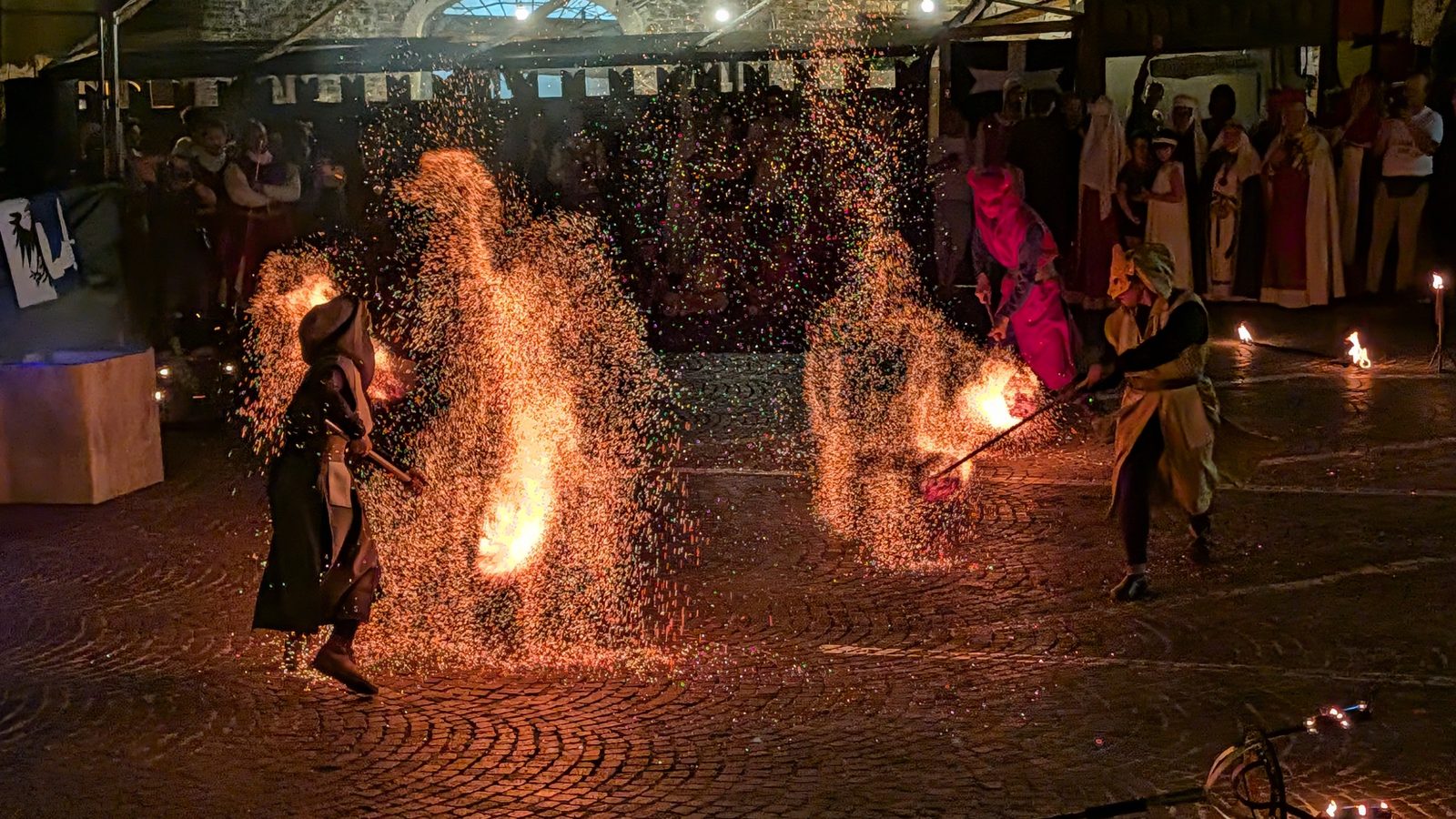
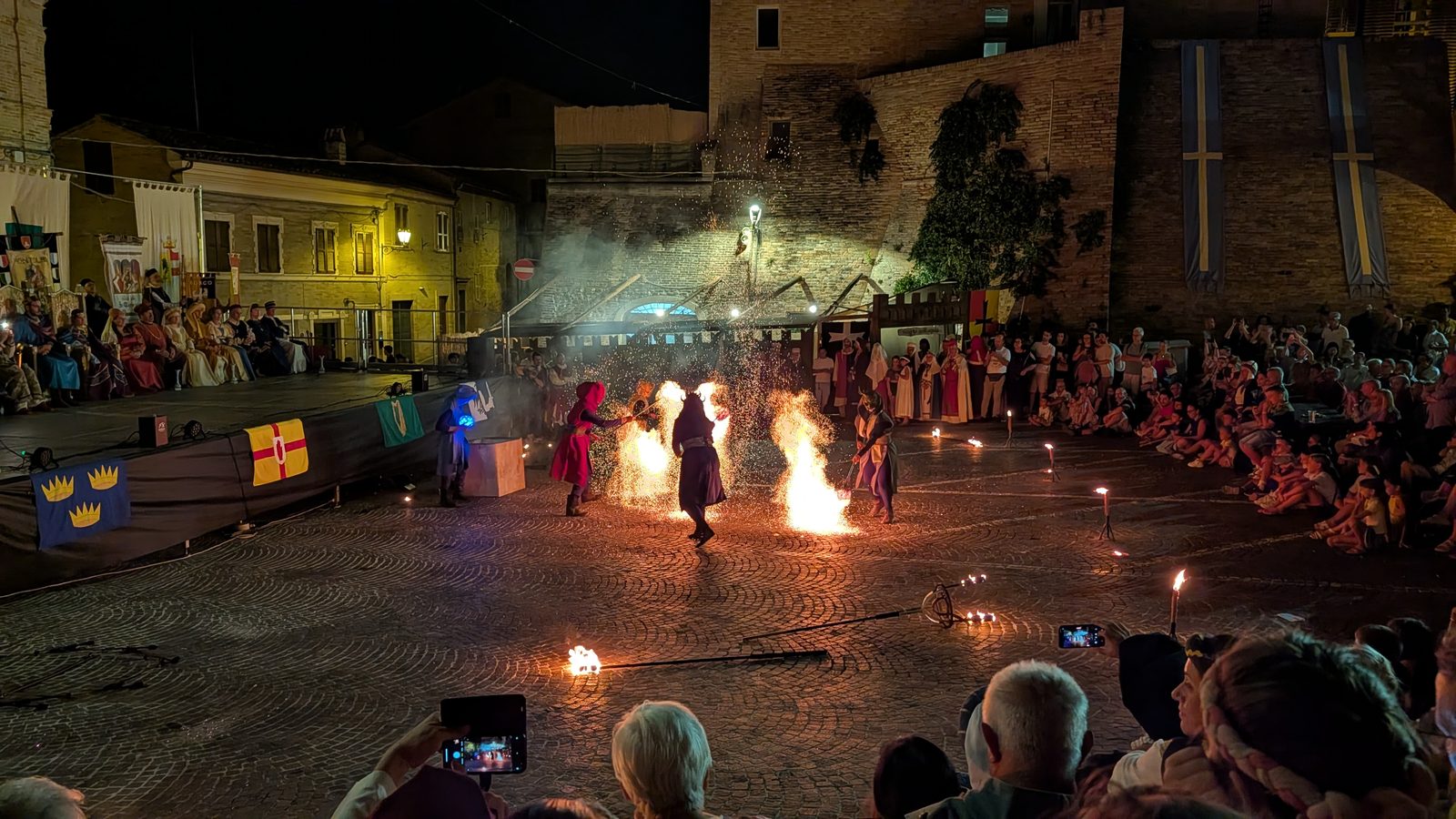
The visiting groups are not decorative. Ferrara’s Borgo San Giacomo sends flag-throwers who have won the Italian federal championship, and their display after the procession — the sbandieratori, throwing and catching heavy banners in the dark of a piazza — is the loudest ten minutes of the week. Este Medievale sends the Danzar Cortese dancers, working from reconstructed thirteenth- and fourteenth-century choreography.
Este also sends its focolieri. The word has no clean English equivalent: fire-workers, the section of a reenactment company that performs with burning staffs, swords, chains and bolas to live or recorded medieval music. The 2026 procession night closed at half past eleven with their piece La Sfera del Destino, the Sphere of Destiny — a narrative fire show rather than a display of tricks, built around a single burning sphere and a story told in movement.
It was the finest thing I saw that night, and I say that having spent the previous three hours inside the procession that preceded it. Fire performance is the one element of a medieval festival that is frankly modern in technique and entirely convincing in effect: nothing else returns a piazza to a pre-electric century as completely as being lit by a moving flame. If you can only stay for one hour on procession night, stay for the last one.
Eating your way through the taverns
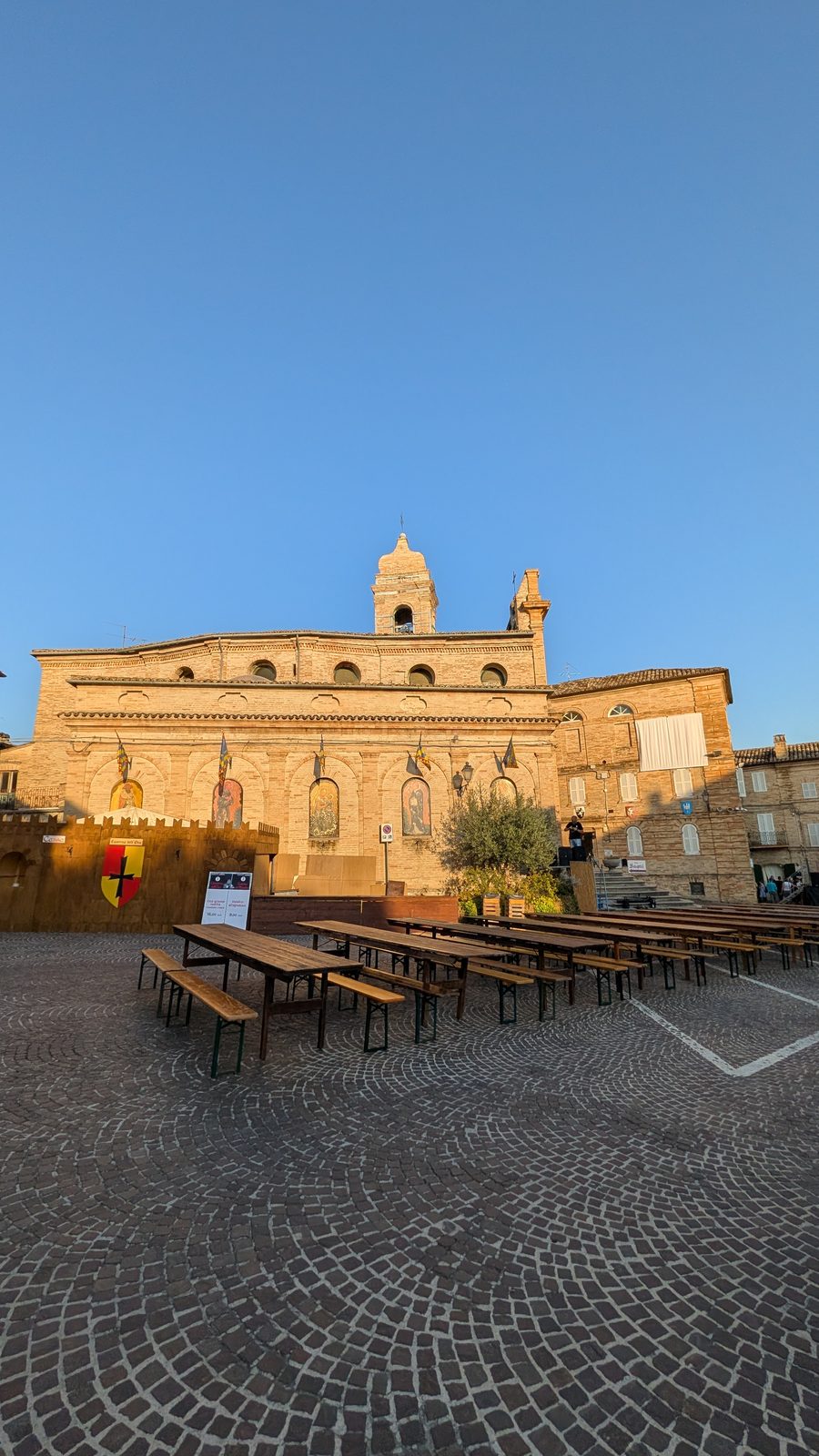
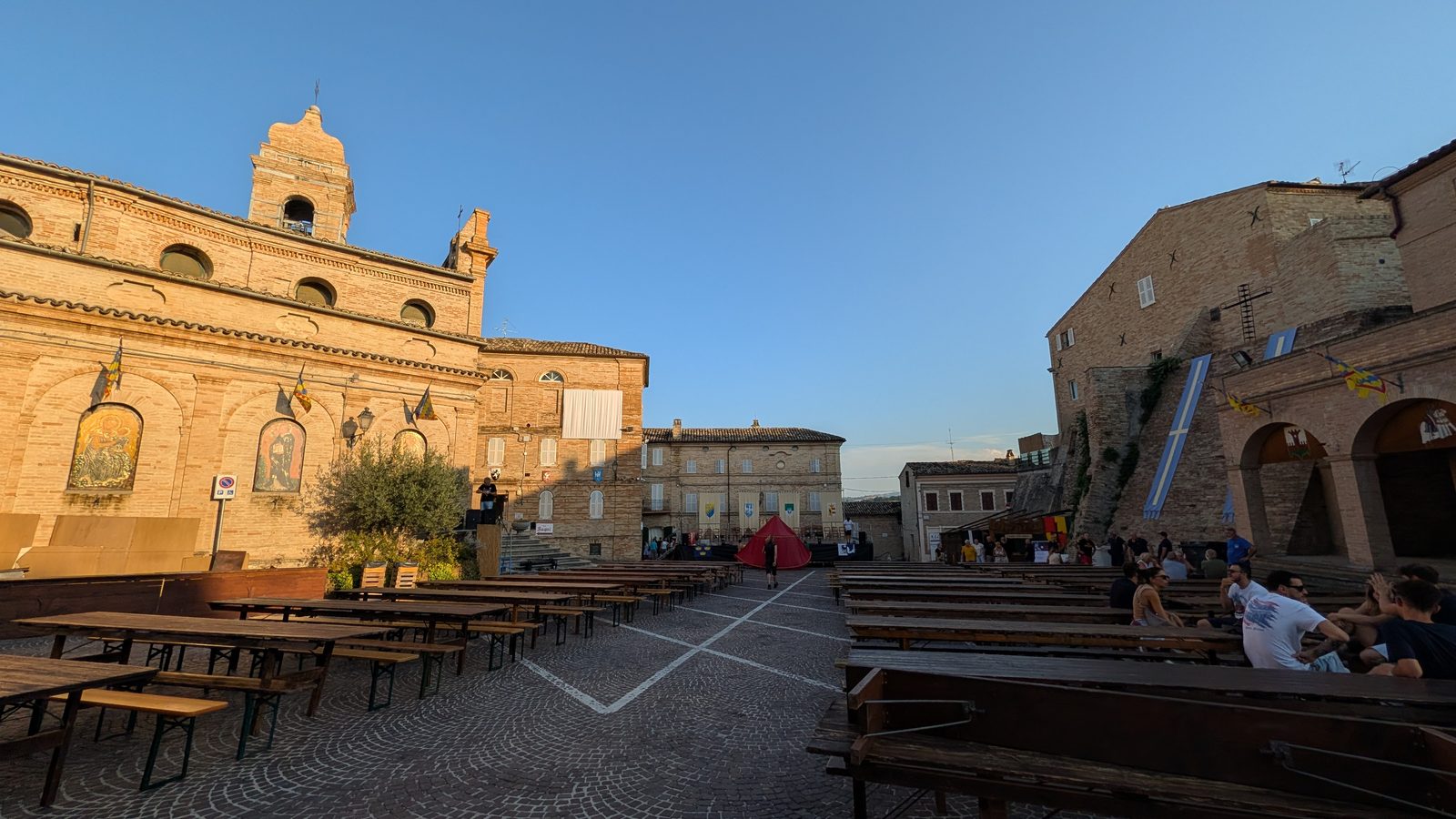
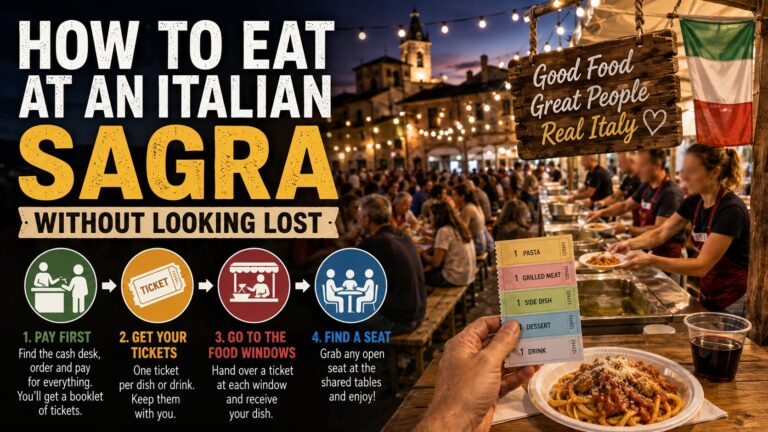
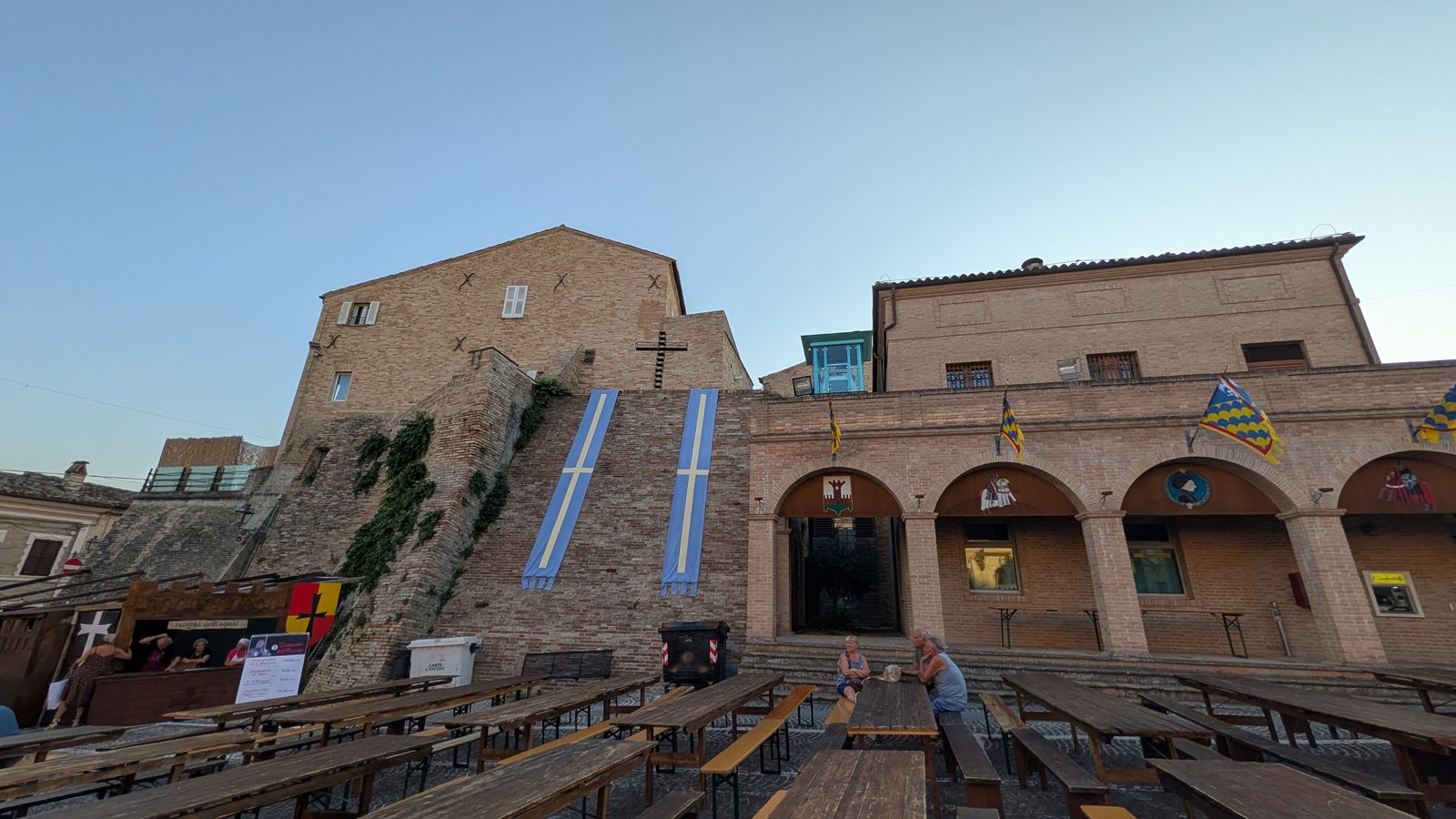
Dinner here is itinerante — roving. Seven taverns are set up across the historic center, each with its own name and its own two or three dishes, and you move between them with a paper map, ordering as you go. The 2026 list gives you the flavor of the thing: spelt tagliatelle stone-ground and hand-cut, truffle-dressed pasta, tripe in the Marche style, roast goose, suckling pig in sweet-and-sour sauce, and a dessert tavern pouring vin cotto, the cooked-must wine that farming families in this province have made at home for generations.
Two notes from someone who eats here. First, this is not fantasy-medieval food invented for tourists; spelt, tripe, goose, and vin cotto are the actual load-bearing ingredients of the Fermano countryside, and the recipes are closer to a farmhouse Sunday than to a theme restaurant. Second, the portions are calibrated for people walking between seven stops over three hours. Order less than instinct tells you at the first tavern.
What the procession looks like from inside it
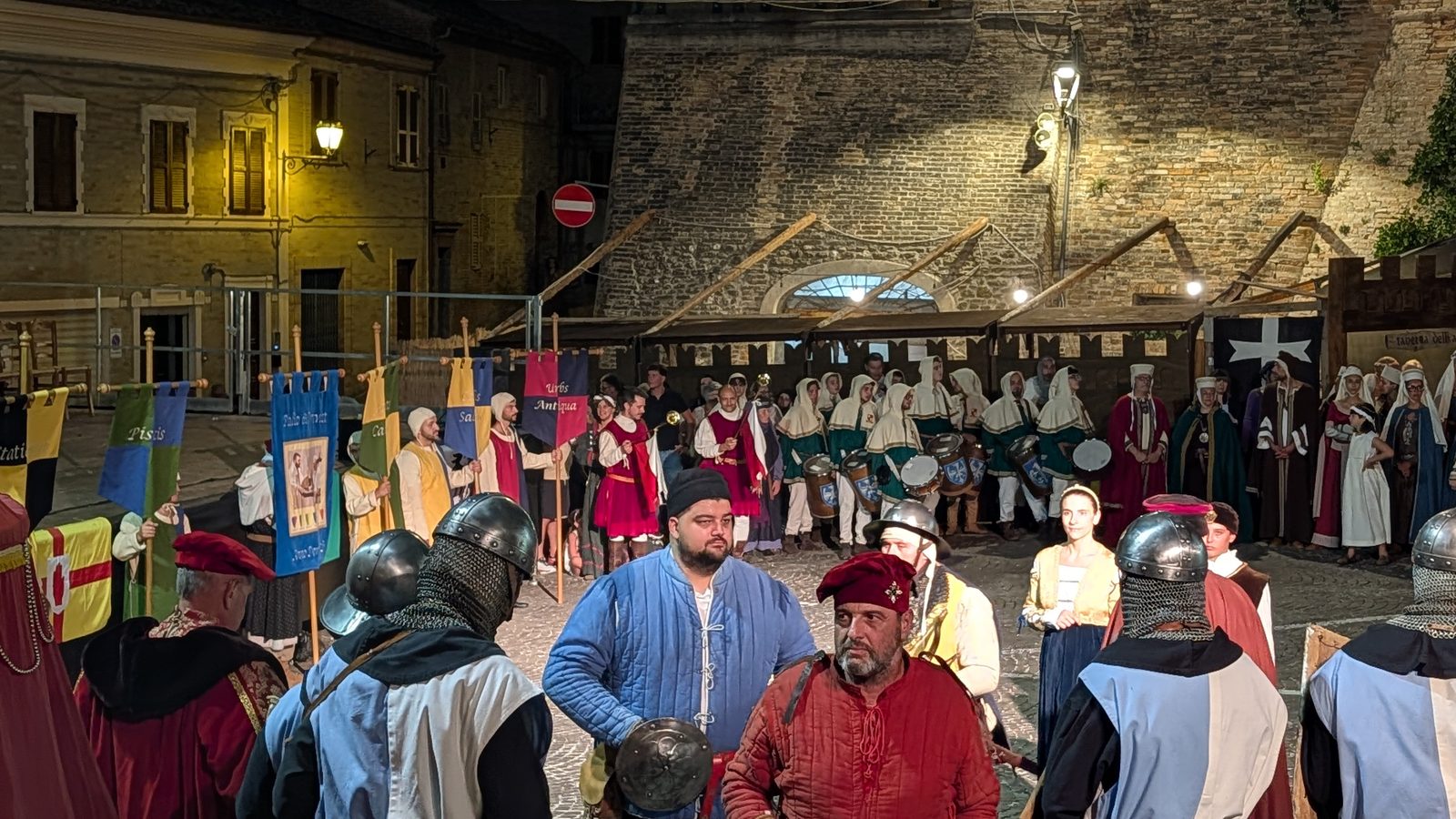
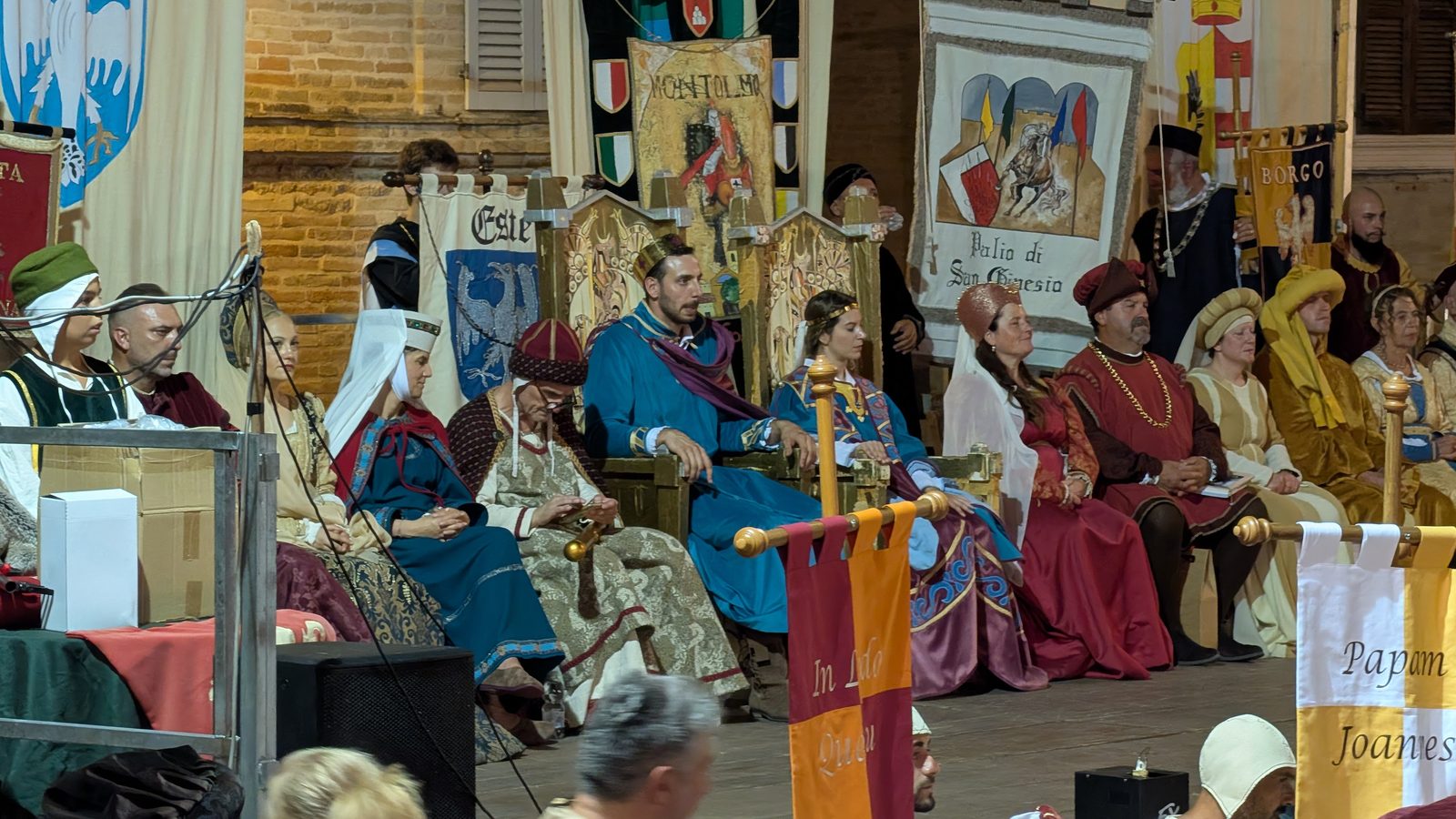
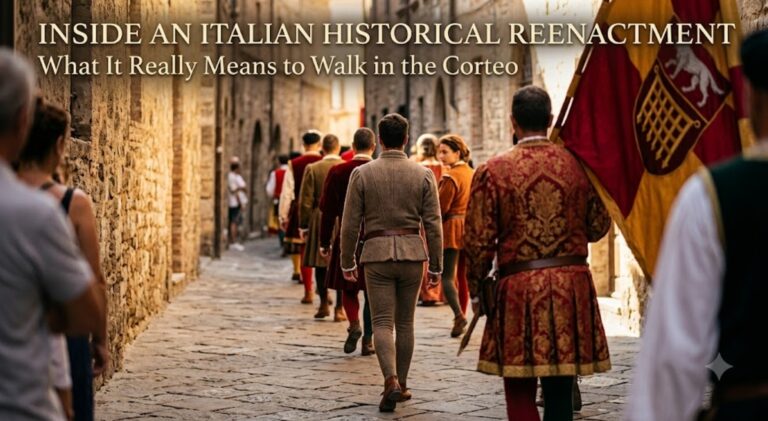
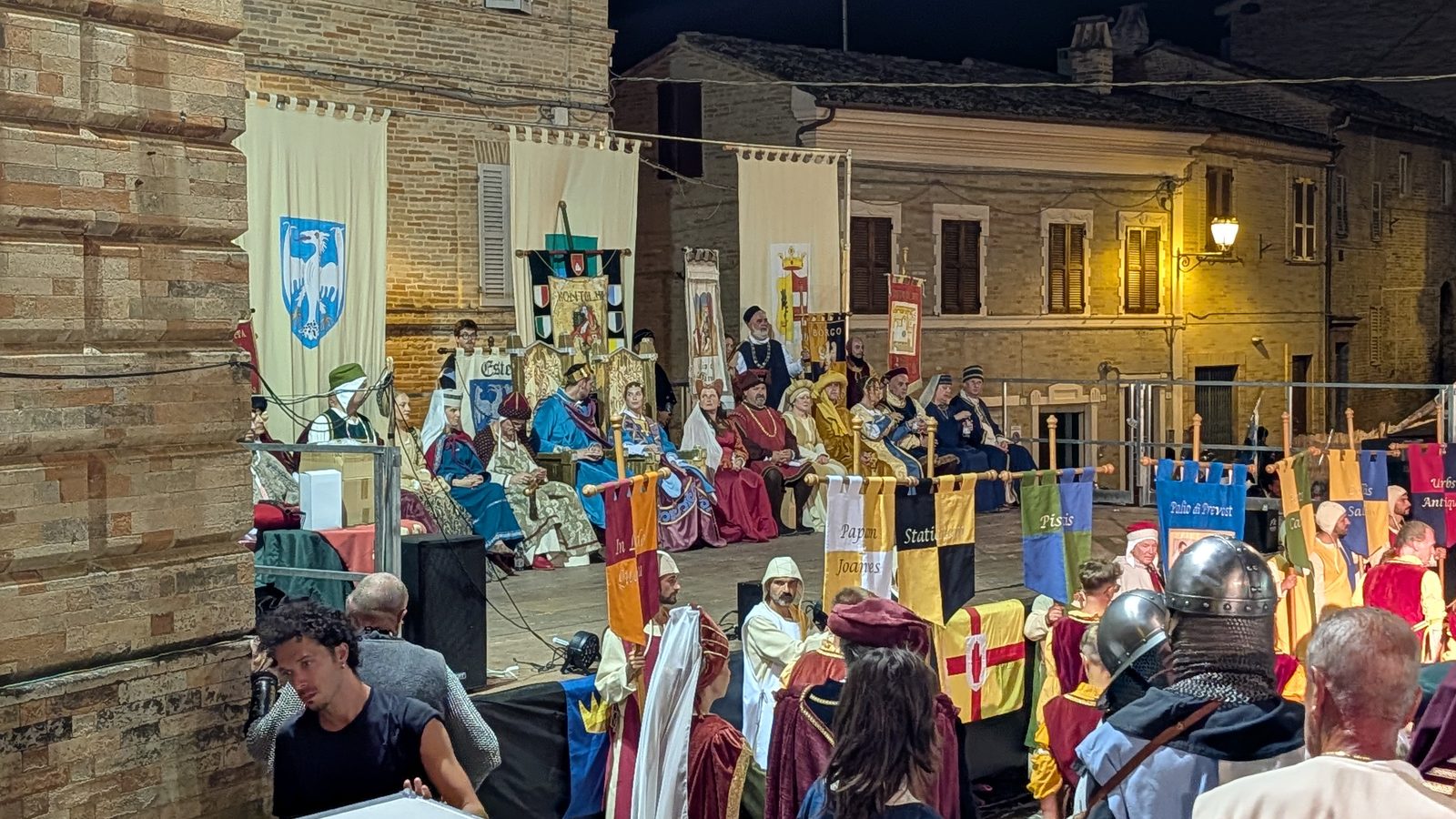
I walked in the Corteo del Trionfo on the night of Saturday, August 1, 2026, wearing the costume of the knight of Porta Picena, one of the four gate-districts of San Ginesio, with the delegation of the Associazione Tradizioni Sanginesine. The photographs in this article were taken from inside the column rather than from behind the barrier.
The first thing you learn is that you see almost nothing of the event you are producing. A procession is a linear object moving through a narrow, curved historic center; from within it your field of view is the back of the person ahead of you, the wall on your right, and a strip of faces above the rope on your left. The spectacle exists entirely for the people standing still. You are inside the machine, not in the audience for it.
The second thing is the discipline. Between the town’s own historical group and the guest delegations — Fermo’s Cavalcata dell’Assunta, the Torneo Cavalleresco at Servigliano, the Associazione Tradizioni Sanginesine from San Ginesio, which is the group I walked with, Ferrara’s Contrada San Giacomo, Este Medievale, and others from the Veneto — several hundred people in wool and leather have to arrive in the right sequence, at the right pace, at the right piazza, in the dark. Nobody is paid. Rehearsal is a matter of habit accumulated over years and over families.
The third thing is what you are actually wearing. San Ginesio is not my town and it is not Grottazzolina’s either. It sits fifty kilometers inland, in the province of Macerata, under the Sibillini range, and its own Palio — a ring joust run every August 13 and 15 by the four surviving gate-districts of an original eight — has nothing to do with Azzo VII d’Este. Yet the knight of Porta Picena marches in an Este triumph in the Fermano because that is how the reenactment world in this region works: towns lend each other their identities for a night, and the loan is reciprocal. Wearing another community’s colors in a third community’s ceremony is a strange and specific sensation. You represent people who are not present, in front of people who are not yours, in a story that belongs to neither.
The last thing is the reason I keep coming back to reenactment as a subject. I have spent thirty years assessing masonry buildings in seismic Italy, a good many of them in this province, and I know how provisional the physical fabric of these towns is. The Province of Fermo’s own description of Grottazzolina notes that the castle’s original nucleus, burned in the fifteenth century and rebuilt, survives as fragments after a collapse in 1964. Stone here is not permanent. What has actually transmitted across eight centuries is not the fortress; it is the annual agreement among a few hundred people to put on wool in August and walk. That is a more durable structure than anything I could certify.
Planning your visit
Getting there
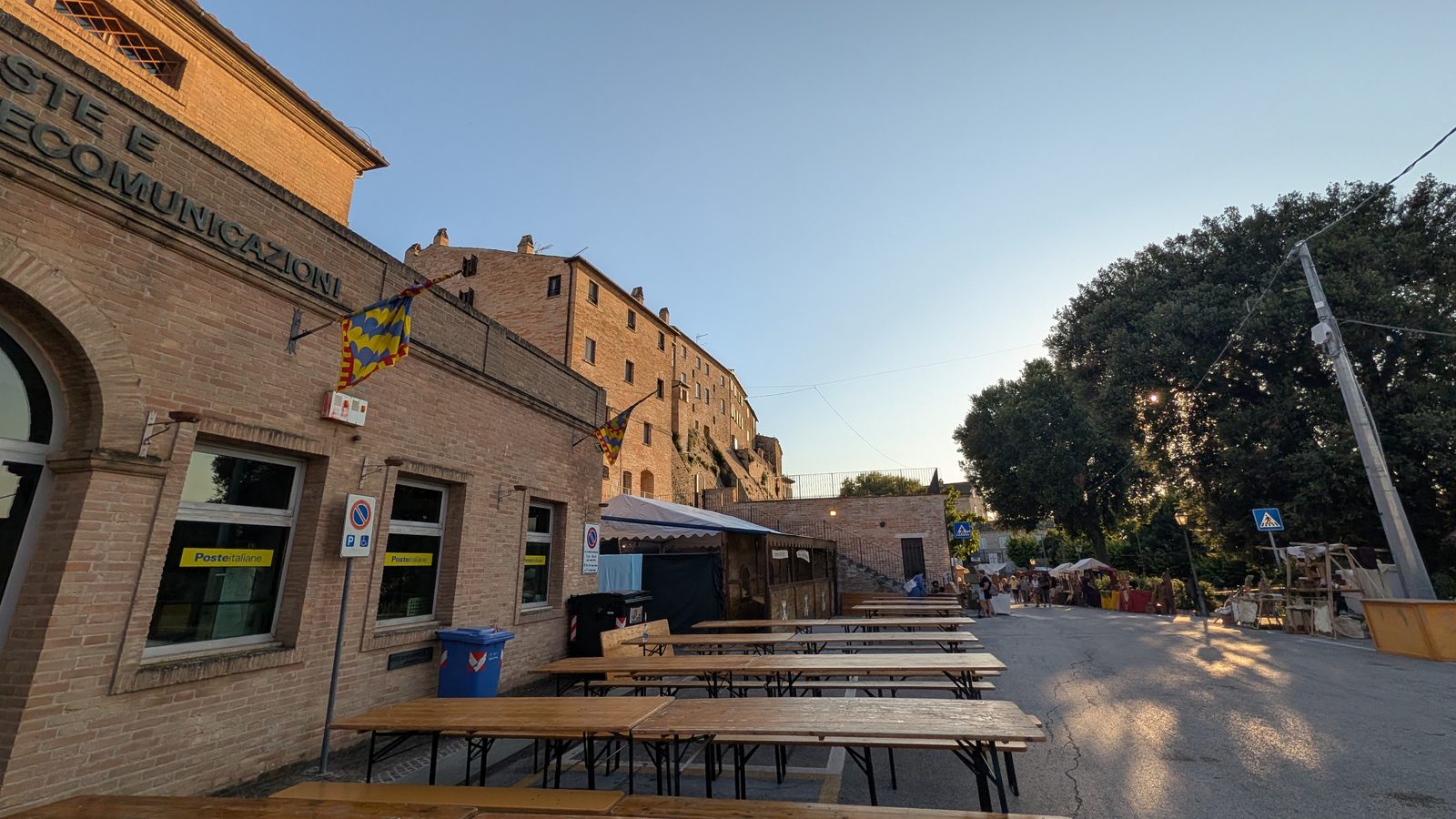
Grottazzolina sits at 227 meters on the ridge between the Tenna and Ete valleys. By the Comune’s own figures it is 13 km from Fermo, 23 km from Porto San Giorgio on the coast, 35 km from Civitanova Marche, 48 km from Macerata, 73 km from Ancona, and 81 km from Ascoli Piceno.
You need a car. The nearest useful rail stop is Porto San Giorgio–Fermo on the Adriatic line, and the nearest airports are Ancona–Falconara and, for most American itineraries, Rome Fiumicino at roughly three and a half hours by road. During the festival the Comune sets up dedicated parking outside the center with a free shuttle bus to the historic core, which is closed to traffic. Use it. The streets of a hill town built for donkeys do not improve when four thousand people arrive.
Where to stay
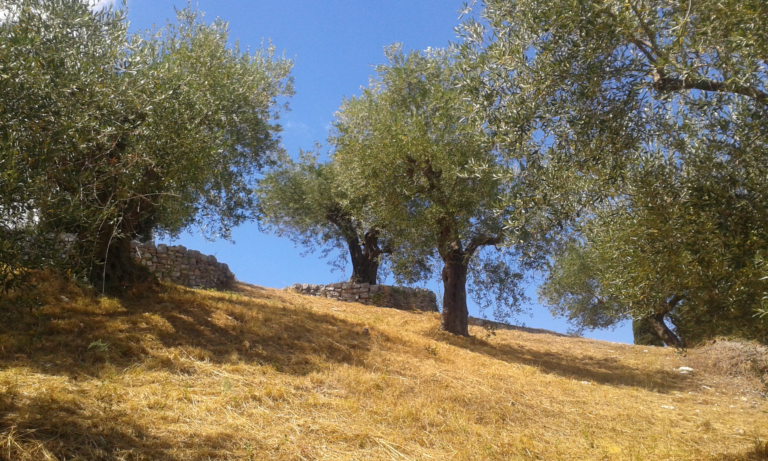
There is essentially no hotel capacity in Grottazzolina itself. Base yourself in Fermo, which has real accommodation, a magnificent piazza, and a Roman cistern worth an afternoon; or on the coast at Porto San Giorgio; or in one of the agriturismi scattered through the Tenna valley, which is where I would send friends. Book by spring for early August — this is peak Italian domestic holiday season, and the coastal Marche fills with Italians, not foreigners.
Costs and practicalities
Entry to the streets, the market, the encampments, and the evening shows is free. Your spending is at the taverns, dish by dish, in cash or card depending on the tavern; bring cash to be safe. Nothing here is ticketed the way Siena’s Palio or Verona’s opera season is ticketed, and there is no reserved seating for the joust or the procession — position is a matter of arriving early and standing.
Almost everything begins after 9 p.m. and runs past midnight. Children are everywhere, and the program includes puppet theater and games explicitly for them. Dress for warm evenings that cool sharply after eleven, and wear shoes that tolerate cobbles.
What to pair with it
The same organization runs the Marche Irish Festival in the same streets in the days immediately before — in 2026, July 25 to 27 — which is a genuinely odd and enjoyable collision of Celtic music and a Marche hill town. Beyond that, the Fermano in early August gives you Fermo itself, the Sibillini mountains an hour inland, and the Adriatic beaches twenty minutes east. If you are building a week around historical reenactment specifically, the delegations marching at Grottazzolina are your itinerary. Fermo’s Cavalcata dell’Assunta and Servigliano’s Torneo Cavalleresco are the two obvious companions, and San Ginesio’s Palio — a ring joust on August 13 and 15, contested by the town’s four surviving gate-districts — is the third. San Ginesio is also the one place in the Marche with a formal, centuries-old bond with Siena, renewed every three years in a ceremony called the Return of the Exiles; if the Palio di Siena is on your list, that connection is worth knowing about before you go.
Frequently asked questions
What is I Giorni di Azzolino? It is a seven-night thirteenth-century historical reenactment held each summer in Grottazzolina, in Italy’s Marche region, commemorating the 1225 capture of the town by Azzo VII d’Este and its renaming in his honor. The 2026 edition was the twenty-eighth.
When is the best time to go? The festival runs from the last days of July into the first days of August. The three strongest nights are the final three: the Procession of the Triumph and the Baptism, the Joust of the Monk, and the Palio of the contrade. Confirm exact dates on the official site each spring, since they shift with the calendar.
Do I need tickets? No. Access to the historic center, the medieval market, the military encampments, and all evening shows is free. There is no ticketing office and no reserved seating.
How much should I budget? Only for food and drink at the seven taverns, ordered dish by dish, plus parking and accommodation elsewhere in the province. It is one of the least expensive cultural events of its scale in Italy, largely because it is run by volunteers for its own community.
How much time do I need? One night gets you a real experience if you choose the right one. Two nights — the procession night and the joust night — gets you the whole architecture of the thing. Stay late whichever night you pick: the fire show that closes the procession night starts around half past eleven. The program does not open until evening, so a festival day leaves the entire daytime free for Fermo, the coast, or the Sibillini.
Is it worth it if I’ve already seen the Palio di Siena? They answer different questions. Siena is a civic rite performed in front of the world, with the world’s attendant logistics. Grottazzolina is a village doing something for itself, at close range, with no barrier between you and the horses beyond a rope. If you found Siena overwhelming rather than moving, this is the corrective.
What is the one thing visitors get wrong here? Assuming the participants are performers. Almost everyone in costume is a resident with a job, walking unpaid in August heat because their family has done it for years. Treat the procession as you would a religious one — photograph it, but do not step into it, and do not ask people in costume to pose mid-column.
The takeaway
Twenty-eight editions is long enough to stop being a revival and start being a tradition in its own right. What Grottazzolina has built is not a spectacle for visitors — visitors are welcome, but incidental — it is a piece of civic infrastructure, maintained annually by people who get nothing for it except the fact of its continuing. The history underneath it is messier than the posters admit, the joust is named after the wrong Ezzelino, and Dante damned the founder’s grandson. None of that diminishes it. It is the most honest kind of Italian festival: one that would happen exactly the same way if no foreigner ever came.
If you want more of Le Marche from someone who lives and works here rather than visits, the rest of Tastes & Wonders of Italy is built on the same principle.