Italy in August: What’s Actually Happening (and What to Skip)
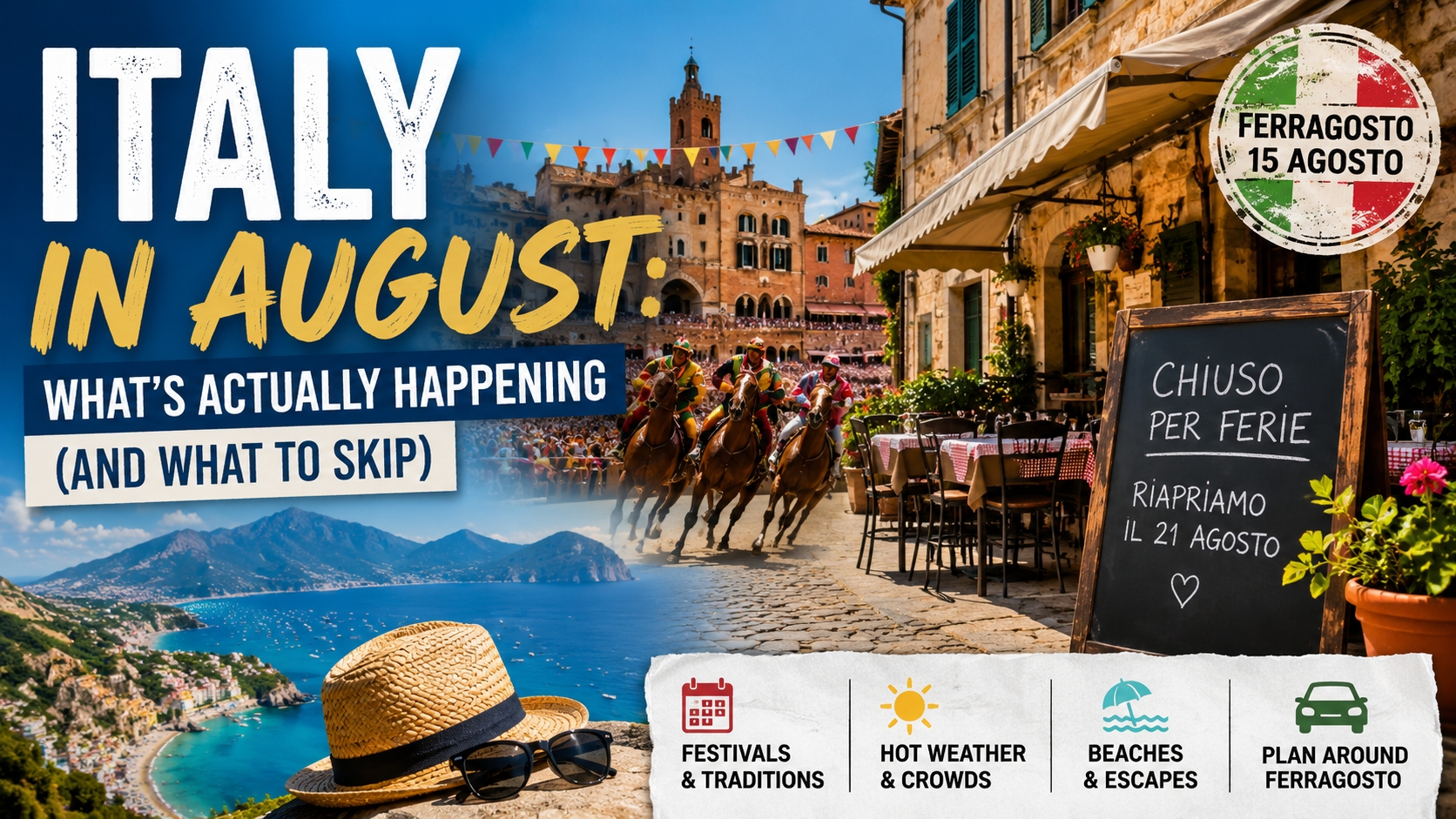
By mid-August, my hill town does something that no guidebook photograph ever captures: it goes quiet in the middle of the day. Shutters come down over shop windows with a handwritten sign taped behind the glass — chiuso per ferie, closed for vacation, sometimes with a return date, sometimes not. The streets empty out between two and five in the afternoon, a stillness locals call the controra, when even the cicadas seem to slow down. Then, around eight, the same streets fill again for the evening passeggiata, and somewhere close by a brass band is tuning up for a festival that has run, without interruption, since before anyone’s grandparents were born.
Here is the extractable answer, before anything else: August in Italy is high season, hot, and crowded in the places everyone already knows — but it is also the single richest month on the Italian festival calendar, home to the country’s oldest horse race, its grandest open-air opera, and rituals that will not exist in July or September. The trap is Ferragosto week, roughly August 13 to 17, when half the country closes its shops and drives to the sea at the same time. Plan around that week rather than through it, and August rewards you more than any other month of the year.
Is August a Good Time to Visit Italy?
The honest answer has a yes and a no in it, and both are true at once.
Yes, if what you want is the Italy of festivals: the Palio di Siena thundering around Piazza del Campo, opera under the stars at the Arena di Verona, torchlit processions in towns most American travelers have never heard of. August is when Italy performs its own history for itself, not for tourists — the events exist because a town has run them for centuries, and visitors are simply allowed to watch. No, if what you want is quiet museums, empty piazzas, and a functioning neighborhood trattoria on every corner of a big interior city. Rome, Florence, and Milan in August are hot, dense with fellow travelers, and thinner on the small businesses that make a city feel lived-in, because the people who live there have left.
Temperatures in central and southern Italy regularly climb into the low-to-mid 90s Fahrenheit through August, with cities holding heat well into the evening. Coastal breezes and hilltop elevation both help; a flat interior piazza at 3 p.m. does not. The crowding follows a similar geography: beach towns and lake resorts fill to capacity, especially on weekends, while some inland art cities are, paradoxically, easier to move through in the exact week their local population is smallest.
There is also a pricing reality worth stating plainly. August sits inside peak season for flights, hotels, and rental cars across the entire country, and the two weeks surrounding Ferragosto typically carry the highest rates of the summer, sometimes double a June or September figure for the same room. Combine that with a festival calendar that fills accommodation in event towns months in advance, and the financial case for booking early is stronger in August than in almost any other month.
The real variable, then, is not the month itself — it is which nine days inside the month you choose, and Ferragosto is the one that decides everything else.
The Ferragosto Problem
Ferragosto is Italy’s mid-August public holiday, observed on August 15, and it is the single fact that shapes travel to Italy in August more than heat, more than crowds, more than any festival calendar. The name comes from Feriae Augusti, a rest period the emperor Augustus declared in 18 BCE after the harvest; centuries later the Catholic Church folded it into the Feast of the Assumption of Mary, and the two calendars — imperial and religious — have shared the date ever since.
What matters for a visitor is not the history but the mechanics. Closures build gradually from around August 1, tighten through the week of the 15th, and loosen again after August 20. On the day itself, independent restaurants, family-run shops, artisan workshops, pharmacies, and local services shut almost completely in most towns; only tourist-facing businesses in the major cities and coastal resorts stay open, because their entire season depends on it. Until 2010, closures during this period reportedly affected as much as 90 percent of Italian businesses; the practice has since compressed into a more manageable one-to-two-week window, but the pattern — most of urban Italy taking the same two weeks off at the same time — has not gone away. Some estimates put the number of Italians who relocate to the coast or the mountains during this stretch at around 20 million, with northern cities such as Milan and Turin losing a significant share of their resident population by mid-month.
If your plan is museums and monuments in Rome, Florence, or Venice, Ferragosto is largely fine — the sights stay open, and the crowds thinning out are locals, not tourists. If your plan is eating in neighborhood restaurants, browsing artisan shops, or experiencing the daily rhythm of an Italian city, expect a hollowed-out version of it during the peak week, with a fuller version returning by the 21st.
What Ferragosto looks like on the ground has less to do with sightseeing than with the table. Families gather for a long outdoor lunch that runs well into the afternoon, built around whatever is regional and in season rather than any single fixed dish — grilled meats and vegetables on the coast, stuffed pasta or roast fowl inland. Fireworks over the water are a fixture in beach towns that evening, and in cities still holding some population, a night-long street dance called the Gran Ballo di Ferragosto takes over piazzas in Rome and a handful of other centers. None of this is staged for visitors; it happens whether tourists are there to see it or not, which is a large part of why it is worth arranging a trip around rather than simply enduring.
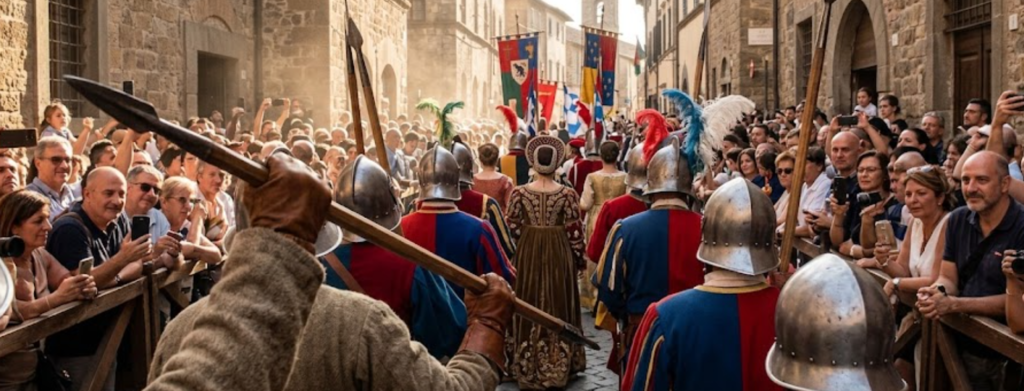
Le Marche runs its own version of this collision every August 14 and 15, and it happens to be my hometown region. In Fermo, the Cavalcata dell’Assunta — a religious and civic re-enactment whose earliest written record dates to 1182 — sends ten contrade (city districts) through the streets in medieval dress, culminating in a bareback horse race on the 15th. For 2026, the city’s 45th modern edition is experimenting with moving the torchlit historical procession to the evening of the 14th, keeping the 15th itself free for the solemn Mass and the race. It draws a fraction of the crowd that descends on Siena the following night for the Palio dell’Assunta, and that smaller scale is exactly the point.
What’s Actually Happening: The Events Worth the Trip
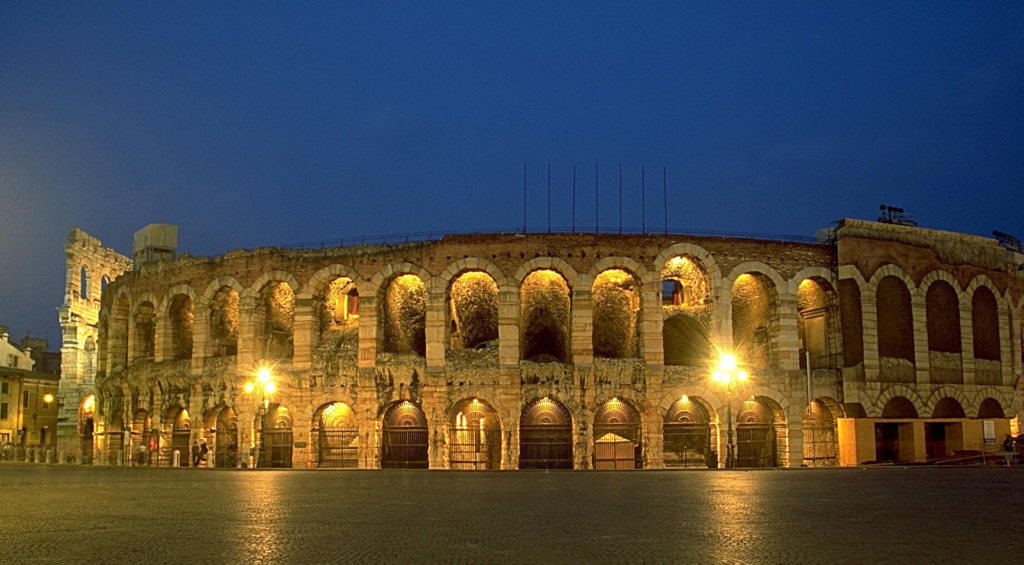
Open-air opera. The Arena di Verona runs its 103rd opera season this year from June 12 through September 12, with August evenings dedicated to Aida and Turandot inside a two-thousand-year-old Roman amphitheater that still seats over ten thousand people without a microphone in sight. Two hundred miles south, Macerata’s Sferisterio — a 19th-century arena originally built for a now-forgotten ball game — hosts its own festival through August 9, with Nabucco, Il Barbiere di Siviglia, and a closing performance of Carmina Burana. And in Rome, the Baths of Caracalla open after dark for opera and ballet staged among illuminated ancient ruins, a setting no indoor theater can match.
Palii and historical re-enactments. August 16 belongs to Siena and the Palio dell’Assunta, the more crowded and more expensive of the city’s two annual horse races, run in honor of the Feast of the Assumption. Ninety seconds of racing follow hours of ceremony — the blessing of the horses inside each contrada‘s own church, the two-hour historical procession into Piazza del Campo, the charged silence before the start. A day earlier, in my own region, the Cavalcata dell’Assunta plays out the same devotional logic on a smaller stage in Fermo. Both belong to a broader Italian tradition of the palio — a word that in Le Marche alone takes several distinct forms, medieval jousts and ring-races among them, most clustered in July and the first half of August.
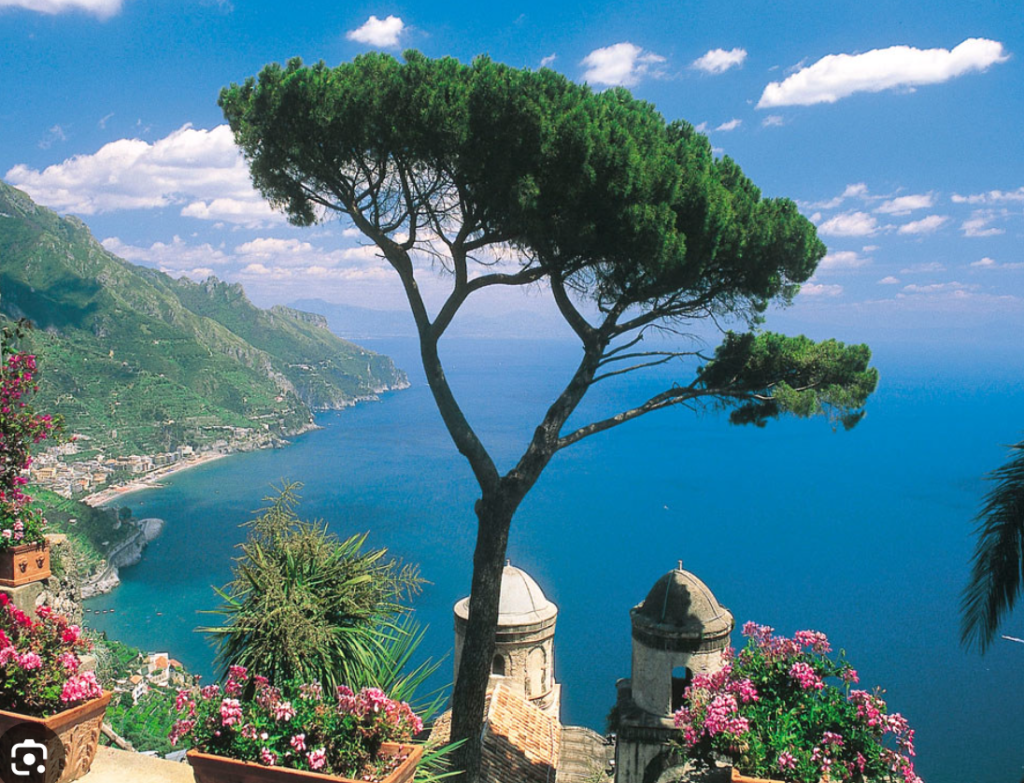
Music and festival. If you were in Umbria for Umbria Jazz in early July — covered in the twin piece to this one — August carries the baton south to Puglia, where the Notte della Taranta closes out the season on August 22 in Melpignano, a folk-music marathon built around the hypnotic, tambourine-driven pizzica dance and drawing crowds in the hundreds of thousands for its final concert. On the Amalfi Coast, the Ravello Festival keeps running through September 5, with concerts at sunset and, on August 11, its signature dawn concert on the terrace of Villa Rufolo — the garden that convinced Wagner he had found the setting for the second act of Parsifal.
Art. The Venice Biennale’s 61st International Art Exhibition runs all the way through August and into November, so there is no wrong week to see it, only a wrong hour — arrive at the Giardini or Arsenale before ten to avoid the worst of the midday crowds.
One honest gap: the Venice Film Festival, which opens at the very end of August, is one of the highest-volume searches connected to this month and does not yet have its own dedicated guide here — that piece is coming.
Taken together, these events are not scattered coincidences on a calendar; they cluster in the two windows either side of Ferragosto, which is itself a useful planning fact. Book a mid-August trip around one anchor event — the Palio, a Ravello concert, a Sferisterio opera night — and the rest of the itinerary can be built from towns within a two-hour drive, most of which are considerably calmer than the headline destination itself.
Where Italians Actually Go in August
The exodus that empties the cities has a destination, and it is almost never another city. The Adriatic coast from Rimini down through the Marche and into Puglia fills with families who return to the same stabilimento balneare (beach club) every year, often the same umbrella row their parents used, sometimes for three generations running. The Tyrrhenian side does the same from Liguria down through the Cilento coast south of Naples. Inland, the Dolomites and the Apennines fill with a quieter, cooler crowd escaping the heat rather than chasing the sea, and Sardinia’s interior villages see a wave of returning emigrants — Sardinians who moved north for work decades ago, back for two weeks with their own children in tow.
What this means for the cities of art — Florence, Siena, even parts of Rome — is that the life leaves before the tourists arrive to fill the space. Restaurants that survive on regulars close because their regulars are at the beach. Local markets thin out; the neighborhood butcher and the corner tabaccheria post the same handwritten sign my own street sees. What remains is the built city: extraordinary, but performing for an audience rather than living for itself. This is not a flaw unique to August; it is simply the month in which the gap between the two versions of a city is widest, and the traveler’s job is to know which version they are walking into.
What to Skip in August
The most honest advice I can give is about what not to do, because most English-language guides to this month are written to sell you a season rather than to prepare you for it.
Skip a first visit to a large interior city — Florence, Rome, inland Milan — during Ferragosto week specifically. You will pay peak-season prices for a city with its local texture switched off, and the heat in a landlocked historic center is worse than almost anywhere else in the country. Skip the most saturated coastal towns on August weekends unless you have a reservation locked down weeks in advance; the roads out of every major city on a Friday afternoon in August carry the heaviest traffic warnings of the year, and beach towns from the Amalfi Coast to the Cinque Terre run at genuine capacity, with day-trip access sometimes capped entirely. Skip counting on public transport running at its normal frequency during the peak week — regional trains and local buses often shift to a reduced holiday schedule, which catches visitors used to the rest of the year’s timetable off guard. And skip the expectation that a famous tourist center — Siena on Palio day, Venice at the Biennale, any hill town with its own festival — will hand you the “authentic local life” that travel writing likes to promise. On the days these places are busiest, they are performing a version of themselves for a paying audience, which is a different and still worthwhile experience, but not the quiet, ordinary Italy some travelers are chasing. That version exists a few days before or after, or in the region next door that nobody put on a list.
How to Do August Right
Book early — for the Palio, for Ravello, for any coastal accommodation on an August weekend — because the calendar above is not a secret and Italians plan around it just as carefully as you should. Use the fixed-date events as the anchor points of your itinerary rather than an afterthought: build the trip around August 16 in Siena or August 22 in Melpignano, and fill the days around it with the region next door rather than another pass through the same three famous cities.
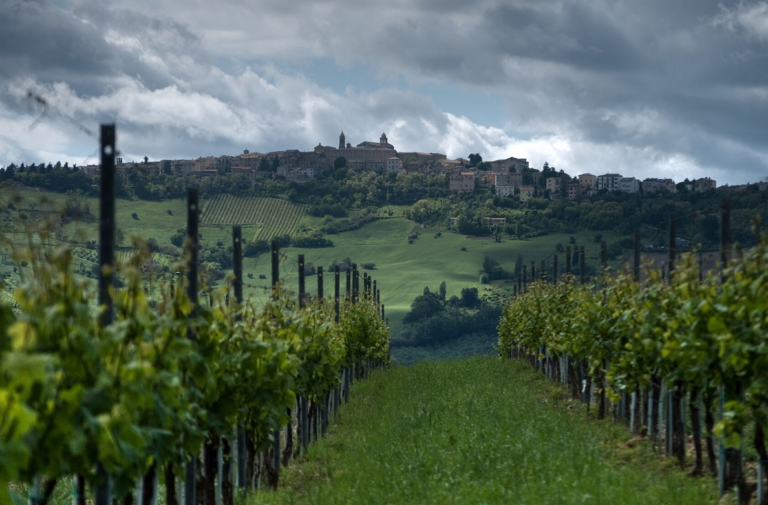
That region, for me, is central Italy away from the obvious names — Le Marche, Umbria, and Abruzzo, which absorb almost none of the crowd pressure that Tuscany and the Amalfi Coast carry in August and deliver hill towns, food, and their own festival calendars at a fraction of the noise. It is the same argument I made for July, and August only strengthens it: when the coast is packed and the famous interior cities are half-closed, the region with no single famous name to chase is often the one still working exactly as it should.
A practical shape for a two-week August trip: open with two or three days in one of the major events — Siena for the Palio, Verona or Macerata for opera — booked and paid for months ahead. Move inland to Le Marche or Umbria for the Ferragosto week itself, where the heat is more bearable in the hills, the closures are gentler in towns that depend on August visitors rather than resent them, and a second, smaller festival is usually only a short drive away. Close the trip on the coast once the worst of the mid-month crush has passed, when accommodation prices ease and the beach towns settle back into something closer to their actual rhythm. Accommodation for all three legs is worth locking in as early as flights, particularly anywhere near an event date — agriturismi and boutique hotels in event towns routinely sell out before the festival programs themselves are even finalized.
If you are building a central Italy itinerary around this month and want a local’s read on where the events, the heat, and the crowds actually intersect, I take on a limited number of consulting calls for exactly this kind of trip planning — you can find the link at the end of this piece.
FAQ: Italy in August, Answered
Is August a good month to visit Italy? It depends on what you want. August is excellent for festivals, opera, and historical re-enactments, and difficult for quiet city exploration or budget travel, since prices and crowds peak alongside the heat.
What closes in Italy for Ferragosto? Most independent restaurants, shops, artisan workshops, and local services close for one to two weeks centered on August 15, while hotels, tourist-area restaurants, and major museums generally stay open.
What are the biggest events in Italy in August? The Palio di Siena on August 16, the Arena di Verona and Macerata opera festivals, the Notte della Taranta on August 22, and the ongoing Ravello Festival and Venice Biennale are the highlights of the month.
Does it get too hot to travel comfortably in August? Interior cities regularly reach the low-to-mid 90s Fahrenheit with heat lingering into the evening; coastal towns and hill regions are noticeably more comfortable than flat, landlocked city centers.
Where do Italians go on vacation in August? The large majority head to the coast — the Adriatic from Rimini south, or the Tyrrhenian from Liguria to the Cilento — with a smaller share retreating to the Alps and Apennines.
What should I avoid doing in Italy in August? Avoid a first visit to a major interior city during Ferragosto week itself, avoid booking coastal weekends without reservations made well in advance, and avoid expecting ordinary daily life in towns mid-festival.
When should I book a trip to Italy in August? For fixed events like the Palio or Ravello Festival, book accommodation and any grandstand or balcony seating six to twelve months ahead; for general travel, lock in lodging by early spring for August dates.
The Takeaway
August in Italy is not one season but two running side by side: a country half-closed and overheated in its most famous interior cities, and, at the very same time, the fullest festival calendar of the year in the towns willing to run their oldest traditions in the middle of it. Plan around Ferragosto week rather than through it, anchor the trip to one or two fixed-date events, and let the region next door — not the one everyone already has on their list — carry the rest of the itinerary.
Written by Mirco Vitellozzi, a structural engineer from Le Marche who writes about Italy from the inside. More essays at Tastes & Wonders of Italy, and short films on YouTube.