Le Marche, Italy’s Longevity Region: What the Data Says
Le Marche is Italy’s longevity region by the number that demographers track. The highest median age at death of any Italian region: 86.1 years in 2023, according to ISTAT. I have spent thirty years surveying farmhouses in these hills, climbing into attics built by hands long gone. The number still stopped me the first time I checked it against Campania’s 81.9. Stone villages sit quiet on ridge after ridge, and the people tending their gardens are, on average, living longer than the rest of the country. This guide reads those numbers the way an engineer reads a site report, carefully, with every caveat attached. Le Marche is not a Blue Zone, and the real story is sharper than the marketing version.
Le Marche earns the title of Italy’s longevity region through ISTAT’s median age at death, not through Blue Zone certification. In 2023, half of all deaths in the region happened after age 86.1, the highest threshold in the country. The national median stood at 84.4, and Campania’s trailed at 81.9. Because that statistic measures how late death typically arrives, not how many years people spend in good health, the two questions have different answers here.
What the Numbers Say About Italy’s Longevity Region
Every April, ISTAT publishes a fresh read on how long Italians live, and where. The 2026 edition is titled “La salute: una conquista da difendere” (“Health: A Conquest Worth Defending”). It tracks median age at death, the point where half the deaths in a population have already happened and half are still to come. This is a cleaner measure than the age we usually quote, because a handful of very young or very old deaths cannot skew it.
In 2023, the regional ranking looked like this:
- Le Marche: 86.1 years
- Umbria: 85.9 years
- Molise and Tuscany: 85.7 years
- National median: 84.4 years
- Campania, the lowest: 81.9 years
That four-year gap between Campania and Le Marche is not noise. It shows up again when you split the national median by sex: 81.6 for men, 86.3 for women, in 2023. Women outlive men almost everywhere in Italy, and Le Marche follows that pattern too.
Life expectancy at birth tells a related but separate story. Italy’s overall figure reached 83.4 years in 2024, and the country has gained ground steadily since 1990. Men added about eight years, and women added about six and a half, so the national averages now stand at 81.5 and 85.6. By 2025, Trentino-Alto Adige led every region, with men at 82.8 and women at 86.8. Le Marche did not top that particular list. Instead, it led the Center of Italy, at 82.2 for men and 86.2 for women in 2024. So the region is not first on every chart. It is first on the one that measures how long a typical death is postponed, and that distinction matters.
Two Indicators, Two Different Questions
Most press coverage of this topic blurs two numbers that measure different things. Median age at death tells you when, on average, people in a region actually die. Life expectancy at birth, instead, is a projection: it estimates how long a baby born today would live if current death rates held steady for their whole life. The two usually move together, but they are not interchangeable. A region can lead on one without leading on the other.
Here is the sentence worth quoting in full: median age at death measures what already happened. Life expectancy, meanwhile, predicts what has not happened yet, and mixing the two turns history into a promise the data cannot keep.
I read tables like this one the way I read a site survey before I sign off on a foundation. A number is only useful once you know exactly what it measured. A longevity region claim built on median age at death says something true and specific: Marchigiani who died in 2023 had, on average, outlived anyone else’s grandparents in Italy. However, it says nothing directly about how healthy the region’s living residents are right now. That is a separate figure entirely, and this guide gets to it further down.
That gap between what a statistic proves and what it merely suggests is where most travel-website claims about longevity fall apart. Le Marche does not need the inflated version. The real number already beats the rest of the country.
Where Marche Longevity Concentrates: Ascoli, Comunanza, and the Nuoro Comparison
National totals set the scale first for any claim about Italy’s longevity region. On January 1, 2025, Italy counted 23,548 residents aged one hundred or older, according to ISTAT. That is more than two thousand more than the year before. Almost 83 percent were women. Within that group, 724 people had reached at least 105, the threshold demographers call semi-supercentenarian, and 19 had passed 110.
Le Marche’s share of that total is surprisingly large for its size. The region counted 682 centenarians, up 56 from the previous year, and 30 residents past 105, up from 20. Ancona and Ascoli Piceno each recorded nine.
The number worth sitting with, though, is a rate, not a raw count. Ranked by centenarians past 105 per 100,000 residents, the table puts Valle d’Aosta first at 2.4, Liguria next at 2.3, and Le Marche at 2.0. Provinces tell a sharper story. Nuoro, in Sardinia’s Barbagia, the heartland of one of the world’s best-documented Blue Zones, sits at 4.6 per 100,000. Ascoli Piceno follows close behind at 4.5, ahead of Imperia at 3.8. That is the strongest single data point in this piece: a province in Le Marche runs almost neck and neck with the province researchers use to define extreme longevity.
The trend is not new, either. Back in 2019, Le Marche counted 430 centenarians, about 3 percent of the national total, split between 368 women and 62 men. So, over the course of a decade, the region has grown that figure by roughly 30 percent.
Ascoli Piceno’s province holds Comunanza, a village of about three thousand people set above the Aso River valley at the foot of the Sibillini Mountains. Italy’s official tourism portal calls it the “village of longevity” because of how many centenarians have lived there. One of Italy’s documented supercentenarians, Santa Gennari, was born in the Marche on February 23, 1899. She died on June 18, 2011, at 112 years and 115 days old.
None of this is coincidence dressed up as science. Ancona is home to INRCA, Italy’s only IRCCS institute dedicated specifically to elderly health and active aging research, recognized since 1968. In 2012, the Ministry of Health, the Marche region, and INRCA founded Italia Longeva, the national research network on aging that still operates from Ancona today. In fact, the institutions that study longevity in Italy are based, quite literally, in this region. The regional government has formalized that reputation, too. A 2023 regional law recognized Le Marche as a “land of wellbeing and quality of life.” That law now funds an annual international forum on the subject, held each spring in Ascoli Piceno.
Why Here? Countryside, Food, Daily Walking, and Family
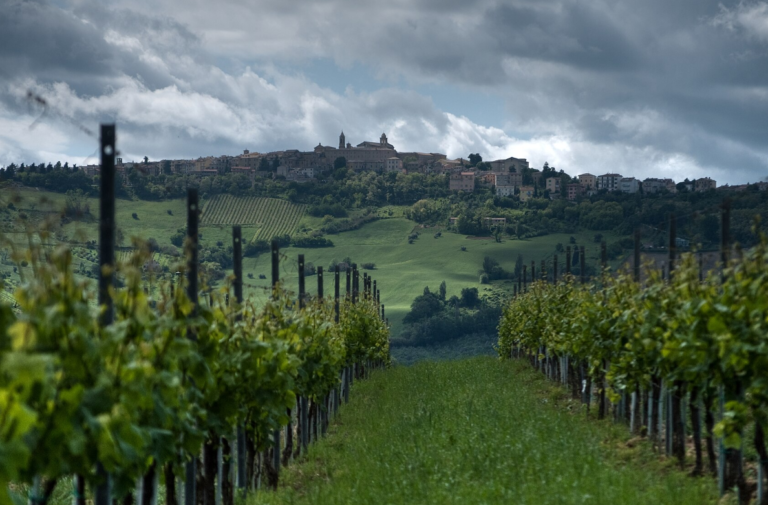
Researchers who study these Marche numbers point to a familiar list, and it is worth naming plainly, not dressing it up. The region stays heavily rural: hill towns instead of dense cities, small farms instead of industrial agriculture, and a food culture built on what the land produces nearby.
I covered the roots of that food culture in a companion piece: Le Marche: The Italian Region Where the Mediterranean Diet Was Born. That piece explains what the Mediterranean diet actually means on a local table. This one is not about the diet itself. Instead, it is about what the diet, the walking, and the family structure add up to over a lifetime.
Daily movement, for example, matters more than gym membership here. Hill towns sit on slopes, so errands mean stairs and inclines rather than flat sidewalks. As a result, residents get more daily movement simply by living their ordinary routine. Family networks stay dense, too: multiple generations often live within walking distance, which keeps older residents connected and, in practical terms, looked after.
A companion piece in this series looks closely at one Marche village where researchers actually measured these mechanisms. It traces how a Mediterranean diet built on local olive oil, legumes, and home cooking connects to the region’s numbers on the ground. That piece, on Montegiorgio, is coming soon on this blog, and it goes further into the food side than this article does. The oil at the center of that diet follows an economy of its own, traced in Italian olive oil culture.
Finally, none of this amounts to a secret formula. It is closer to a set of everyday habits, sustained for decades, in a landscape that makes those habits easy to keep. That is, admittedly, a less dramatic explanation than a Blue Zone. Still, it also happens to be the one the data supports.
The Honest Counterweight: Longer Life Is Not Automatically Healthier Life
Here is where the promotional version of this story usually stops, and where the honest version keeps going. ISTAT’s BES 2025 wellbeing indicators, drawn from 2024 data, put Le Marche’s life expectancy at 84.2 years, third nationally behind the province of Trento at 84.7 and Bolzano at 84.6. So far, that still sounds like a longevity story.
Then the same dataset measures healthy life expectancy: the years a person can expect to live without a serious chronic limitation. Le Marche drops to 57.4 years there, below the national average of 58.1. In fact, it is the only region in Central or Northern Italy that falls under that national line. Bolzano, by comparison, reaches 69.7 healthy years. More years does not automatically mean more good years, and that gap, 57.4 against 58.1, is the honest counterweight at the center of this article.
The same BES report flags specific risk factors behind that gap. Some 26.8 percent of Marche residents report a sedentary lifestyle, and 42.3 percent carry excess weight. Avoidable mortality sits at 15.3 per 10,000 residents. Still, one figure does run in the region’s favor: road deaths among people aged 15 to 34 sit at 0.4, among the lowest rates in the country.
Readers who search around will find another number floating online: 16.6 percent sedentary, against a national 28.1 percent. At first glance, that looks like a flat contradiction. However, it is not the same survey. That lower figure comes from a different data collection than ISTAT’s BES indicators, so the two are not directly comparable. This article uses the BES figure of 26.8 percent, because it comes from the same ISTAT release as every other statistic here. Mixing survey sources produces exactly the kind of misleading comparison this piece is trying to avoid.
Geography adds one more caution. Comunanza’s village of longevity reputation rests on a small population, and small numbers swing hard. Campodimele, in Lazio, spent decades as Italy’s most famous longevity village, studied internationally and written up in the foreign press. Its most recent registry count, though, shows zero residents over one hundred, and only two between 95 and 99. A village-sized sample can carry a headline for a generation and then quietly stop matching it. Comunanza’s numbers are real today. Even so, they are exactly the kind of figure that needs rechecking, not retiring, every few years.
What a Visitor Actually Sees in Italy’s Longevity Region
None of this shows up as a spa package or a wellness retreat with a marketing budget. What a visitor to Ascoli Piceno’s countryside finds is closer to normal life at a slower register. Markets run on what is in season. Cafés keep the same regulars every morning. Hill towns turn errands into daily walking, not a fitness routine.
Comunanza itself, then, is a small working town, not a destination built around its reputation. There is no museum of longevity, no guided tour pitched at the claim. What there is instead is the Sibillini Mountains rising behind it, the Aso River valley below, and a rhythm of life that has never needed advertising.
For a traveler curious about Italy’s longevity region, the practical entry points are the same hill towns covered elsewhere on this blog. Cingoli offers a long balcony view over the Marche countryside, and the wider Sibillini foothills hold Comunanza itself. Neither promises a longer life to anyone passing through for a week. What they do offer is a fairly accurate look at the conditions researchers point to: walkable terrain, small farms, and towns built around family rather than cars.
FAQ: Understanding Italy’s Longevity Region
What is Italy’s longevity region? Le Marche holds Italy’s highest median age at death, 86.1 years in 2023, according to ISTAT. That makes it the country’s longevity region by that specific measure, though it is not an officially certified Blue Zone.
Is Le Marche a Blue Zone like Sardinia? No. The two get confused often, though. Blue Zones are a small, defined set of areas studied for extreme clusters of verified centenarians. Sardinia’s Barbagia area, including Nuoro province, is the recognized Italian example. Ascoli Piceno’s province runs close to Nuoro on one specific metric, centenarians past 105 per 100,000 residents, but the region as a whole has not undergone the same certification.
What is the difference between median age at death and life expectancy? Median age at death measures when people who have already died actually died, splitting the population in half. Life expectancy at birth, instead, is a projection based on today’s death rates. The two numbers usually move together, but they answer different questions.
Which town in Le Marche has the most centenarians relative to its size? Ascoli Piceno province leads on the rate that matters most: centenarians past 105 per 100,000 residents, at 4.5, just behind Sardinia’s Nuoro at 4.6. Within the province, the village of Comunanza carries the strongest reputation, recognized by italia.it as the village of longevity.
Does living in Le Marche mean a healthier life, not just a longer one? Not automatically. ISTAT’s 2024 data puts the region’s healthy life expectancy at 57.4 years, below the national average of 58.1. As a result, Le Marche is the only Central or Northern Italian region under that line.
Is Comunanza worth visiting specifically for its longevity reputation? It is, first, a small and real working town, not a tourist site built around the claim. Visitors come for the Sibillini Mountains setting and the Aso River valley more than for any dedicated longevity attraction.
When is the best time to explore this part of Le Marche? Spring and early autumn suit the hill towns around Ascoli Piceno best, with mild temperatures for walking the terrain locals credit with keeping residents active. Late March also brings the InLife wellbeing forum to Ascoli Piceno itself, a detail worth checking against the current year’s dates before planning around it.
The Final Word
Le Marche earns its claim to the title of Italy’s longevity region honestly, on a specific and well-documented number: the highest median age at death in the country. It does not earn the looser claims that sometimes get attached to that fact. The Blue Zone label, the guarantee of extra healthy years, the idea that the whole region has cracked some secret: none of that holds up.
What it has instead is a rural landscape that makes normal healthy habits easy to sustain for decades. It also has real institutions built around aging research, and one province, Ascoli Piceno, that stands genuinely close to Sardinia’s most studied longevity hotspot.
For readers weighing a longer stay here, perhaps even a house in one of these hill towns, the same terrain and community structure is worth seeing in person first. If you are exploring a move to this part of central Italy, an independent property survey is worth serious consideration. It stays separate from any agent’s commission, and these numbers are exactly the kind of thing it is built to check. You can book an orientation call through the link below.